
Computer
How to Master Google and Facebook Ads

Table of Contents
- Understanding the Two Platforms: Key Differences and When to Use Each
- Mastering Google Ads: Structure, Keywords, and Campaign Types
- Campaign and Account Structure
- Keyword Strategy: Match Types and Intent
- Writing High-Converting Google Ad Copy
- Google Campaign Types Worth Knowing
- Mastering Facebook and Meta Ads: Audiences, Creative, and Funnel Strategy
- The Meta Ads Ecosystem
- Audience Targeting: The Three Tiers
- Creative Strategy: The Make-or-Break Factor
- Conversion Tracking: The Foundation of Informed Optimisation
- Budgeting, Bidding, and Scaling Profitably
- Advanced Optimisation Techniques
- Google Ads Advanced Tactics
- Meta Ads Advanced Tactics
- Landing Page Optimisation: Where Ads Win or Lose
- Conclusion
- Frequently Asked Questions (FAQ)
- External References & Further Reading
In today's hyper-competitive digital landscape, knowing how to run paid advertising campaigns is no longer a nice-to-have skill — it is one of the most valuable capabilities a business owner, marketer, or entrepreneur can possess. Google Ads and Facebook Ads (now part of Meta Ads) together represent the duopoly of digital advertising, collectively accounting for over 50% of global digital ad spend. Every day, billions of people search on Google and scroll through Facebook and Instagram, creating an unprecedented opportunity to place your product or service directly in front of the right person at the right moment.
Yet despite their reach and power, both platforms are widely misused. Businesses pour money into poorly structured campaigns, write uninspiring ad copy, target the wrong audiences, and abandon campaigns before the algorithm has enough data to optimise. The result is wasted budget, disappointing returns, and the mistaken conclusion that paid advertising does not work.
The truth is that paid advertising works extraordinarily well — when done correctly. Google and Facebook Ads are not slot machines where you insert money and hope for returns. They are sophisticated, data-driven systems that reward those who understand their mechanics, respect their learning phases, test systematically, and iterate relentlessly. This guide provides a comprehensive, practical roadmap for mastering both platforms — covering campaign structure, targeting, creative strategy, budgeting, conversion tracking, and advanced optimisation techniques that separate amateur campaigns from profitable ones.
Understanding the Two Platforms: Key Differences and When to Use Each
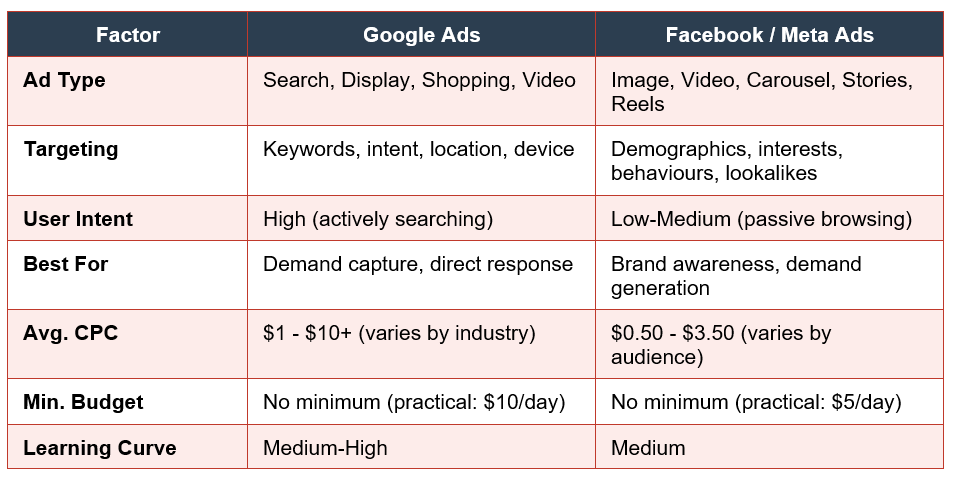
Before diving into tactics, it is essential to understand the fundamental philosophical difference between Google Ads and Facebook Ads. This distinction shapes every campaign decision, from targeting to creative format to measurement.Google Ads is a demand capture platform. When someone types a query into Google, they are actively looking for something — a product, a service, an answer, a solution. Your ad intercepts that intent at the moment of highest purchase readiness. This makes Google Ads extraordinarily effective for direct response: driving immediate conversions, generating leads from high-intent prospects, and capturing buyers who are already in the market.
Facebook and Instagram Ads, by contrast, are demand generation platforms. Users are not searching for products — they are scrolling through content shared by friends, family, and creators. Your ad must interrupt that scroll and create desire where none previously existed. This makes Facebook Ads particularly powerful for building brand awareness, reaching audiences who do not yet know they need your product, running retargeting campaigns, and driving lower-funnel conversions through repeated exposure.
The most effective advertisers use both platforms in a complementary, full-funnel strategy: Facebook to build awareness and warm up cold audiences, and Google to capture the purchase intent that follows. Understanding this interplay is the foundation of paid advertising mastery.
The comparison table below summarises the key differences to help you make informed platform decisions:
Mastering Google Ads: Structure, Keywords, and Campaign Types
Campaign and Account Structure
A well-structured Google Ads account is the bedrock of performance. Poor structure is one of the most common — and most costly — mistakes advertisers make. The hierarchy runs as follows: Account Campaigns Ad Groups Ads Keywords. Google AI noe helps you with keyword researchEach campaign should represent a single theme, product category, or business objective. Each ad group within that campaign should contain tightly related keywords and ads that speak directly to those keywords. A common rule of thumb is the Single Keyword Ad Group (SKAG) approach for high-value terms, or tightly themed groups of three to five closely related keywords. This granularity allows you to write hyper-relevant ad copy for each keyword cluster, which raises your Quality Score, lowers your cost per click, and improves your Ad Rank.
Quality Score — Google's 1-10 rating of the expected relevance and performance of your ad — is one of the most important metrics to understand and optimise. It is based on three components: expected click-through rate, ad relevance, and landing page experience. A high Quality Score reduces your cost per click by as much as 50% compared to a low score, meaning better structure literally costs you less money for the same results.
Keyword Strategy: Match Types and Intent
Keyword selection is the art and science at the heart of Google Ads. Choosing the right keywords, in the right match types, for the right stage of the buyer journey is what separates profitable campaigns from money pits.Google offers three primary keyword match types. Broad match shows your ads for searches related to your keyword — highly unpredictable and expensive without careful negative keyword management. Phrase match shows ads for searches that include the meaning of your keyword phrase in the correct order — more controlled but still flexible. Exact match shows ads only for searches that match your keyword precisely or with close variants — the most controlled and often the most efficient for high-intent terms.
Negative keywords — terms for which you explicitly do not want your ads to show — are equally important. A business selling premium leather handbags, for example, would add 'cheap', 'free', 'DIY', and 'vegan' as negative keywords to prevent irrelevant clicks. Failing to build a comprehensive negative keyword list is one of the fastest ways to drain an advertising budget.
Use Google Keyword Planner, Semrush, or Ahrefs to research search volumes, competition levels, and cost-per-click estimates. Prioritise keywords with clear commercial intent (containing terms like 'buy', 'best', 'near me', 'price', or 'service') for campaigns focused on direct conversion.
Writing High-Converting Google Ad Copy
Responsive Search Ads (RSAs) are now Google's primary ad format. You provide up to 15 headlines and 4 descriptions, and Google's machine learning tests combinations to identify the highest-performing versions. While this automation is powerful, the quality of your inputs determines the quality of the outputs.Effective Google ad copy follows a clear formula: lead with the primary keyword in at least one headline to signal relevance; include a clear, specific value proposition (what makes you different or better); incorporate social proof where possible (number of customers served, years in business, ratings); and end with a compelling call to action that tells the user exactly what to do next. Headlines that include numbers, questions, and urgency consistently outperform vague, generic alternatives.
Google Campaign Types Worth Knowing
- Search campaigns: Text ads shown when users search for specific keywords. Highest purchase intent of any format.
- Performance Max campaigns: Google's AI-driven campaign type that runs across all Google channels (Search, Display, YouTube, Gmail, Maps) simultaneously. Powerful for conversion optimisation but requires strong asset input and sufficient conversion data.
- Shopping campaigns: Product listing ads showing product image, price, and retailer name directly in search results. Essential for e-commerce businesses.
- Display campaigns: Banner and image ads across the Google Display Network of over 2 million websites. Best for remarketing and brand awareness.
- YouTube campaigns: Video ads before, during, or alongside YouTube content. Excellent for storytelling, product demonstrations, and brand building.
Mastering Facebook and Meta Ads: Audiences, Creative, and Funnel Strategy
The Meta Ads Ecosystem
Meta Ads Manager gives advertisers access to one of the world's most powerful audience targeting systems, spanning Facebook, Instagram, Messenger, and the Audience Network. With approximately 3.2 billion daily active users across Meta's platforms, the audience scale is unparalleled. But reach alone means nothing without the right targeting, creative, and funnel strategy.The Meta Ads account structure mirrors Google's hierarchy: Account Campaigns Ad Sets Ads. Campaigns define your objective — awareness, traffic, engagement, leads, or sales. Ad sets define your audience, placement, budget, and schedule. Ads contain your creative — the image, video, copy, and call to action that users actually see.
Choosing the correct campaign objective is critically important because it tells Meta's algorithm what kind of user to optimise for. Selecting 'Traffic' when you actually want 'Purchases' is a common and costly mistake — you will receive clicks from users who have no intention of buying, while Meta's algorithm never learns to find your ideal customer.
Audience Targeting: The Three Tiers
Facebook's targeting capabilities operate across three broad audience tiers, each serving a different stage of the marketing funnel:- Cold audiences (Top of Funnel): Users who have never heard of your brand. Targeted by demographic data (age, gender, location), interests (pages they follow, content they engage with), and behaviours (purchase history, device usage, travel patterns). Broad targeting combined with strong creative is often more effective than narrow interest stacking, particularly after iOS 14 privacy changes reduced the precision of interest data.
- Warm audiences (Middle of Funnel): Users who have previously engaged with your brand — visited your website, watched your videos, engaged with your Instagram profile, or interacted with a previous ad. These audiences are significantly more likely to convert and typically deliver lower cost-per-acquisition than cold audiences. Custom Audiences built from website pixel data, video views, or engagement are the primary tools here.
- Hot audiences (Bottom of Funnel): Users who have taken high-intent actions — added to cart, initiated checkout, viewed specific product pages, or purchased previously. Retargeting these audiences with targeted offers, urgency messaging, or abandoned cart reminders consistently delivers the highest return on ad spend of any audience type.
Lookalike audiences — Meta's ability to find users who share characteristics with your existing customers — bridge the gap between warm and cold targeting. A 1% lookalike of your purchaser list is often the highest-performing cold audience available and should be a staple of any scaling strategy.
Creative Strategy: The Make-or-Break Factor
On Meta platforms, creative is the targeting. In a world where broad targeting has become more effective than granular interest stacking, your ad creative itself does the work of finding the right audience — because the algorithm serves your ad to those who respond to it best. This makes creative quality the single most important variable in Facebook Ads performance.Winning creative formats consistently include: native-looking video content that feels organic rather than overtly commercial; user-generated content (UGC) filmed on smartphones by real customers sharing authentic experiences; static images with bold, clear value propositions and strong visual contrast; and carousel ads that tell a sequential story or showcase multiple product variations.
Ad copy on Facebook follows a distinct structure: hook, story, offer, call to action. The hook — the first line of copy or the first three seconds of video — determines whether the user pauses their scroll or keeps moving. It must immediately address a pain point, create curiosity, or make a bold promise. The story provides context and builds desire. The offer makes the value proposition explicit. The call to action removes friction and directs the next step.
Testing creative systematically is non-negotiable. The winning ad today will fatigue and underperform within weeks. Maintaining a constant creative testing pipeline — introducing two to four new concepts per month — is what separates advertisers who scale profitably from those who plateau and decline.
Conversion Tracking: The Foundation of Informed Optimisation
No matter how brilliant your targeting or creative, paid advertising mastery is impossible without accurate conversion tracking. Both platforms require proper tracking setup before any meaningful optimisation can occur.For Google Ads, conversion tracking is implemented via the Google Ads tag installed on your website, or through Google Analytics 4 (GA4) with an imported conversion goal. Track every meaningful action: purchase completions, lead form submissions, phone calls, and key page visits. Enable auto-tagging to allow Google to pass click data into GA4 for deeper analysis.
For Meta Ads, the Meta Pixel must be installed on every page of your website, with standard events (ViewContent, AddToCart, InitiateCheckout, Purchase) properly configured on the relevant pages. Following Apple's iOS 14 privacy changes, Meta's Conversions API (CAPI) — a server-side tracking solution — has become essential for businesses that want to maintain signal accuracy and give Meta's algorithm sufficient purchase data to optimise effectively.
Both platforms use a learning phase period — typically 7-14 days or 50 conversion events — during which their algorithms gather data to identify the best users to target. Making significant changes to campaigns during this phase resets the learning phase and can severely harm performance. Understanding and respecting the learning phase is one of the most important yet underappreciated principles of paid advertising management.
Budgeting, Bidding, and Scaling Profitably
Budget management is where many otherwise competent advertisers stumble. Both underspending (preventing the algorithm from gathering sufficient data) and overspending (scaling before a campaign is proven) are common and costly mistakes.The recommended approach for new campaigns is to start with a test budget sufficient to gather meaningful data within 7-14 days. For Google Ads, this typically means setting a daily budget at least 10-15 times your target cost per acquisition (CPA). For Facebook Ads, a minimum of $20-50 per day per ad set is usually required to generate enough impression and click volume for the algorithm to learn.
Once a campaign or ad set has proven its profitability — typically after reaching 50+ conversions and demonstrating a stable CPA or return on ad spend (ROAS) — scaling can begin. The golden rule of scaling on Meta is to increase budgets by no more than 20-30% every 3-5 days to avoid triggering a new learning phase. On Google, scaling can be more aggressive once campaigns have exited the learning phase and are running on a Maximise Conversions or Target CPA bid strategy.
Key performance metrics to monitor on both platforms include: Click-Through Rate (CTR), Cost Per Click (CPC), Conversion Rate, Cost Per Acquisition (CPA), Return on Ad Spend (ROAS), and Quality Score (Google-specific). Regular monitoring, combined with a systematic testing approach, enables continuous incremental improvement that compounds into significant performance gains over time.
Advanced Optimisation Techniques
Google Ads Advanced Tactics
- Ad scheduling: Analyse conversion data by day of week and hour of day. Use bid adjustments to increase bids during peak conversion windows and reduce spend during low-performing periods.
- Device bid adjustments: If mobile converts significantly worse than desktop for your business, apply negative bid adjustments on mobile rather than blanket spend across all devices.
- Audience layering: Apply audience segments (in-market, remarketing, customer match) as observation or targeting layers on Search campaigns to adjust bids based on audience signals without restricting reach.
- Search term report analysis: Review the search terms report weekly to identify irrelevant queries triggering your ads (add as negatives) and valuable terms not yet in your keyword list (add as new keywords).
Meta Ads Advanced Tactics
- Advantage+ Shopping campaigns: Meta's automated shopping campaign format uses AI to optimise audience, placement, and budget simultaneously. For e-commerce businesses with sufficient purchase data, these campaigns frequently outperform manually structured alternatives.
- Broad targeting with strong creative: Post-iOS 14, many advertisers have found that removing interest targeting entirely and using only location, age, and gender targeting — while providing high-quality creative — allows Meta's algorithm to self-optimise toward the best-converting users more effectively.
- Dynamic creative testing: Upload multiple images, videos, headlines, and copy variants at the ad level and let Meta automatically test combinations, surfacing the highest-performing mix for each audience segment.
- Cross-platform retargeting sequences: Build retargeting sequences that move users through the funnel systematically — show a brand awareness video to cold audiences, retarget viewers with a product-focused ad, then retarget non-purchasers with an offer or testimonial ad.
Landing Page Optimisation: Where Ads Win or Lose
Even the most brilliantly structured campaign with perfect targeting and compelling creative will fail if it sends traffic to a poor landing page. The landing page is where the conversion happens — or does not — and its quality is often the single biggest lever available to improve campaign profitability.The principle of message match is paramount: the headline and offer on your landing page must directly reflect the promise made in the ad. Any disconnect between ad and landing page increases bounce rate, destroys Quality Score, and wastes click budget. A user who clicked an ad promising '50% off summer dresses' must arrive at a page featuring exactly that offer — not the homepage.
High-converting landing pages share common characteristics: a single, clear call to action with no competing links or navigation distractions; a compelling headline that restates the value proposition; social proof in the form of reviews, testimonials, or trust badges; fast loading speed (every additional second of load time reduces conversions by approximately 7%, according to Google research); and mobile-optimised design, since the majority of paid traffic arrives via mobile devices.
Tools such as Google Optimize, Optimizely, or VWO enable A/B testing of landing page elements — headline, hero image, CTA button text, form length — to systematically improve conversion rates. Improving your conversion rate from 2% to 3% effectively reduces your cost per acquisition by 33% without touching your ad budget.
Conclusion
Mastering Google and Facebook Ads is not a destination — it is an ongoing practice of structured learning, disciplined testing, and data-driven refinement. The platforms evolve constantly, introducing new campaign types, targeting options, creative formats, and algorithm updates that require advertisers to remain curious and adaptable. What works brilliantly today may need reinvention in six months, and the willingness to test, learn, and iterate is the most important trait any paid advertiser can develop.The framework presented in this guide — understanding platform intent, building sound account structure, mastering audience targeting, creating compelling and testable creative, tracking conversions accurately, managing budgets intelligently, and optimising landing pages relentlessly — provides a complete foundation for profitable paid advertising on both platforms.
Start with one platform before expanding to both. Build proven processes before scaling spend. Let data — not assumptions — guide every optimisation decision. And remember that the gap between a mediocre paid advertising campaign and a great one rarely comes down to budget: it comes down to knowledge, discipline, and the willingness to keep improving. The investment you make in developing these skills will compound into significant competitive advantage and measurable business growth.
Frequently Asked Questions (FAQ)
Should I start with Google Ads or Facebook Ads?
It depends on your business model and objectives. If you sell a product or service that people actively search for (solicitor, plumber, accountant, specific product category), start with Google Search Ads to capture existing demand. If you are launching a new product, building a brand, or selling something people do not yet know to search for, start with Facebook Ads to generate demand. For most growing businesses, both platforms eventually play complementary roles in a full-funnel strategy.What is a realistic starting budget for paid advertising?
For meaningful test results, plan on a minimum of $500 to $1,000 per month on either platform. This is enough to gather sufficient click and conversion data to make informed optimisation decisions. On Facebook, $10-20 per day per ad set is the practical minimum. On Google, your required budget depends heavily on the cost-per-click in your industry, which can range from $0.50 in low-competition niches to $50+ in highly competitive categories like legal or financial services.How long does it take to see results from paid ads?
Google Search Ads can generate results almost immediately upon launch, since they target users with active purchase intent. Facebook Ads typically require a learning phase of 7-14 days before the algorithm optimises effectively, and meaningful performance data usually requires 2-4 weeks of spend. Sustainable, scalable results generally develop over 60-90 days of consistent testing and optimisation. Patience during the learning phase is essential — premature optimisation or campaign changes reset the algorithm's learning and extend the time to results.How has iOS 14 affected Facebook advertising, and what should I do about it?
Apple's iOS 14 privacy changes in 2021 significantly reduced Meta's ability to track user actions on external websites via the browser pixel, affecting attribution accuracy and audience targeting precision. The primary mitigations are: implementing Meta's Conversions API (CAPI) for server-side tracking, verifying and prioritising your domain in Business Manager, configuring your eight prioritised conversion events in Events Manager, and allowing campaigns sufficient time to optimise, as reduced signal means the algorithm needs more impressions to learn. First-party data — email lists, CRM data — has become significantly more valuable post-iOS 14.What free resources are available to learn Google and Facebook Ads?
Both platforms offer extensive official learning resources. Google Skillshop provides free certification courses covering all Google Ads campaign types. Meta Blueprint offers free and paid courses on all aspects of Meta advertising. Beyond official resources, WordStream's blog, Jon Loomer's Facebook Ads blog, and the r/PPC and r/FacebookAds subreddits are excellent communities for practical, current knowledge. Tools like the Facebook Ads Library allow you to study competitors' ad creative strategies, providing real-world inspiration and market intelligence at no cost.
External References
The following authoritative sources were used in researching this guide and are recommended for further study:1. Google Skillshop — Free Google Ads Certification Courses
https://skillshop.withgoogle.com/
2. Meta Blueprint — Official Facebook and Instagram Ads Training
https://www.facebook.com/business/learn
3. Google Ads Help Centre — Campaign Types and Best Practices
https://support.google.com/google-ads/
4. Meta Business Help Centre — Ads Manager Guide
https://www.facebook.com/business/help/
5. WordStream — Google Ads Benchmarks by Industry
https://www.wordstream.com/google-adwords
6. Jon Loomer Digital — Advanced Facebook Ads Strategy
https://www.jonloomer.com/
7. Semrush — Keyword Research and Competitor Ad Analysis
https://www.semrush.com/
8. Meta Ads Library — Research Competitor Ads
https://www.facebook.com/ads/library/
9. Google Research — The Impact of Page Speed on Conversions
https://think.storage.googleapis.com/docs/mobile-page-speed-new-industry-benchmarks.pdf
10. Optimizely — A/B Testing and Landing Page Optimisation
https://www.optimizely.com/
When someone writes an piece of writing he/she keeps the thought of a user in his/her brain that how a user can know it. Therefore that's why this piece of writing is great. Thanks!