

Retirement
How to Play the Retirement Tax Game: Complete Guide

32.8% of retirees have zero tax plan. 58.9% of lower-income retirees have never heard of RMDs. 26.6% wish they had chosen Roth. The jump from the 12% to the 22% tax bracket is the single biggest leap in the entire 2026 federal bracket structure — and most pre-retirees will hit it the moment Social Security and RMDs stack up. The game has rules. Here they are.

The Retirement Tax Surprise Index, published in April 2026, surveyed Americans approaching and in retirement and found that 32.8 percent of retirees have zero tax plan for retirement. 26.6 percent said their top financial regret was not contributing to a Roth account instead of a traditional one. 27.4 percent were sceptical it is even legally possible to cut their retirement tax bill. Meanwhile, the mechanics that produce these surprises — required minimum distributions, Social Security taxation, Medicare IRMAA surcharges, and the cascade of bracket effects when income sources stack up — are knowable, plannable, and in many cases largely avoidable with the right sequence of decisions.
The ‘guessing game’ in the title is not entirely metaphorical. Retirement tax planning requires estimating future tax rates (which nobody knows), future Social Security solvency (which is uncertain), future healthcare costs (which are variable), and future RMD amounts (which depend on account growth). But the uncertainty does not eliminate the value of strategy. The rules of the game are fixed, and playing by them consistently — even imperfectly — produces far better outcomes than ignoring them. This guide explains the rules.
32.8% of retirees: zero tax plan (Retirement Tax Surprise Index, April 2026). 58.9% of retirees earning under $25K have never heard of RMDs. 26.6%: top regret is not using Roth. 27.4%: don't believe it's possible to cut their retirement tax bill. Nearly 40% of Gen X entering retirement without meaningful tax preparation.
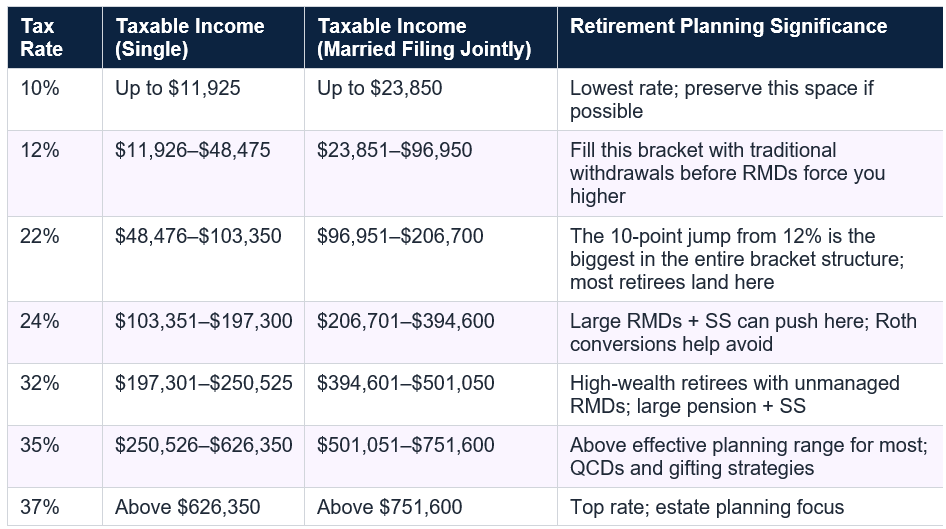
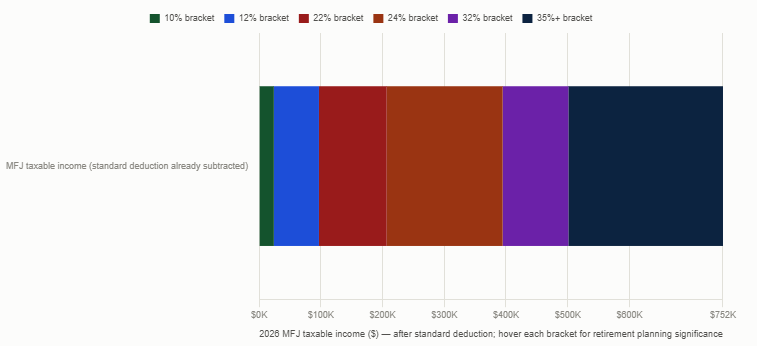
The 2026 standard deduction is $16,100 for single filers and $32,200 for married filing jointly (MFJ). The additional standard deduction for age 65 or older is $1,650 per person. A married couple both aged 65+ therefore has a total standard deduction of $35,500 ($32,200 + $1,650 + $1,650). On top of this, the OBBBA added a new $6,000 senior bonus deduction for tax years 2025–2028 (see Section 11), potentially bringing total deductions to $41,500 for some couples before a single dollar of income is taxed.
2026 MFJ standard deduction: $32,200 (up from $30,000 in 2025). Both spouses 65+: additional $3,300 = total $35,500 standard deduction before OBBBA senior bonus. OBBBA senior bonus: $6,000 per individual (2025–2028). 401(k)/403(b) limit 2026: $24,500. Roth IRA: $7,000 ($8,000 age 50+). SECURE 2.0 super catch-up (ages 60–63): $34,750 for 401(k).
Social Security benefits are subject to federal income tax based on ‘provisional income’ (also called combined income): the sum of adjusted gross income plus tax-exempt interest plus half of Social Security benefits. The 2026 thresholds are unchanged from prior years:
The Social Security torpedo hits hardest between approximately $32,000 and $44,000 of provisional income for married couples — a range that is surprisingly easy to enter once traditional IRA distributions or RMDs begin. A retiree who believes they are in the 12% bracket may be effectively taxed at 22%+ in this zone. Roth distributions (which do not count as provisional income) and Qualified Charitable Distributions (which satisfy RMDs without adding to AGI) are the two most effective tools for navigating the torpedo zone.
Missing an RMD triggers a 25% excise tax on the shortfall (reduced from 50% by SECURE 2.0). Under SECURE 2.0, this reduces to 10% if corrected within two years using IRS Form 5329. But the more significant concern for most retirees is not the penalty — it is the cumulative tax impact of large, unavoidable RMDs stacking on top of Social Security and other income.
RMD at 73 on a $1M traditional IRA: ~$37,736 (divisor 26.5 from IRS Uniform Lifetime Table). Without Roth conversion pre-RMD, RMDs may force $100,000–$150,000/year into the 24%–32% federal bracket. Net tax savings from proactive Roth conversion before RMD age: $150,000–$300,000 over a 20-year retirement in many scenarios (SeniorSimple, July 2026). Missing an RMD: 25% excise tax on shortfall; 10% if corrected within 2 years (SECURE 2.0).
Retirees who defer all traditional account withdrawals until RMDs begin at 73 or 75 often discover that their required distributions are far larger than they anticipated — because the account continued to grow untouched. A $700,000 traditional IRA at age 62 growing at 6% for 11 years reaches approximately $1.33 million by age 73 — requiring an initial RMD of approximately $50,000. Combined with Social Security of $40,000, the couple's provisional income alone hits $65,000, triggering 85% SS taxation. The RMD window — the years between retirement and RMD start age — is precisely when Roth conversions are most valuable.
A Roth conversion moves pre-tax IRA or 401(k) money into a Roth account, triggering ordinary income tax on the converted amount in the year of conversion. The converted funds then grow tax-free, and qualified withdrawals in retirement are completely tax-free, with no RMDs, no Social Security taxation impact, and no IRMAA contribution from Roth withdrawals.
The Income Laboratory’s April 2026 Roth Conversion Strategy guide models the optimal approach for a typical retired couple: aged 63 and 62, $1.4M in traditional IRAs, $200K in taxable accounts, $300K in Roth, Social Security at 67 ($48,000/year combined), no pension. Their conversion window is ten years (ages 63–72) before RMDs begin at 73. Without conversions, RMDs start at approximately $54,000/year combined with $48,000 in Social Security — over $102,000 of taxable income firmly in the 22% bracket. Optimal strategy:
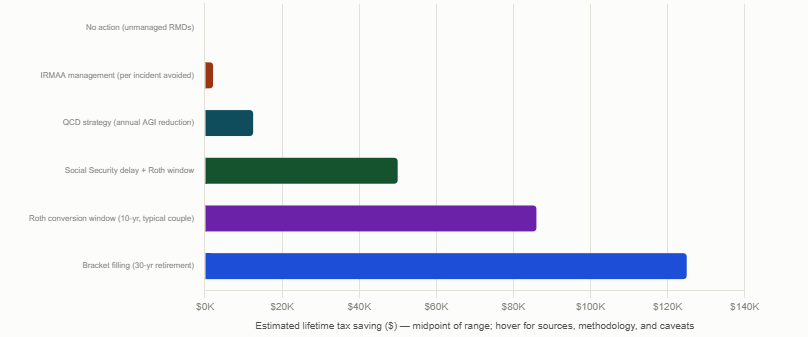
convert $85,000–$100,000 per year during the window, filling through the top of the 22% bracket. Result: 10-year tax savings of approximately $52,000, with a lifetime benefit (including tax-free growth on converted amounts) exceeding $120,000.
The mechanics: in 2026, married filing jointly, the 12% bracket runs up to $96,950 of taxable income. After the $32,200 standard deduction, this means taxable income of $96,950 equates to gross income of approximately $129,150. If a retired couple has Social Security of $30,000 per year (which may be partially non-taxable) and no other income, they have significant room to take traditional IRA withdrawals or Roth conversions at the 12% rate before any income reaches the 22% bracket. TakeHomeTax.com (June 2026) summarises the strategy: ‘Fill the 12% federal bracket from traditional accounts every year, even before you need the cash. Move that money to taxable for spending or Roth for future tax-free growth.
This bracket filling uses your lowest brackets while you have them, before RMDs force larger traditional withdrawals into higher brackets.’
Strategic sequencing — bracket filling plus deliberate withdrawal ordering — typically saves $50,000 to $200,000 over a 30-year retirement compared to the conventional sequence of drawing taxable accounts first, then traditional, then Roth (TakeHomeTax.com).
The QCD is one of the most powerful available tools for retirees who are charitably inclined, for two distinct reasons:
2026 QCD limit: $111,000 per individual (SECURE 2.0 indexed; UBS 2026). $1 of QCD instead of traditional IRA withdrawal can be worth $2,000+ in Medicare premium savings by keeping MAGI below IRMAA thresholds (Retiree Advisor Match, August 2026). One-time QCD to split-interest charitable entity: $55,000 per individual.
A more sophisticated sequence, described by TakeHomeTax.com (June 2026) and SeniorSimple (July 2026), is the bracket-filling approach: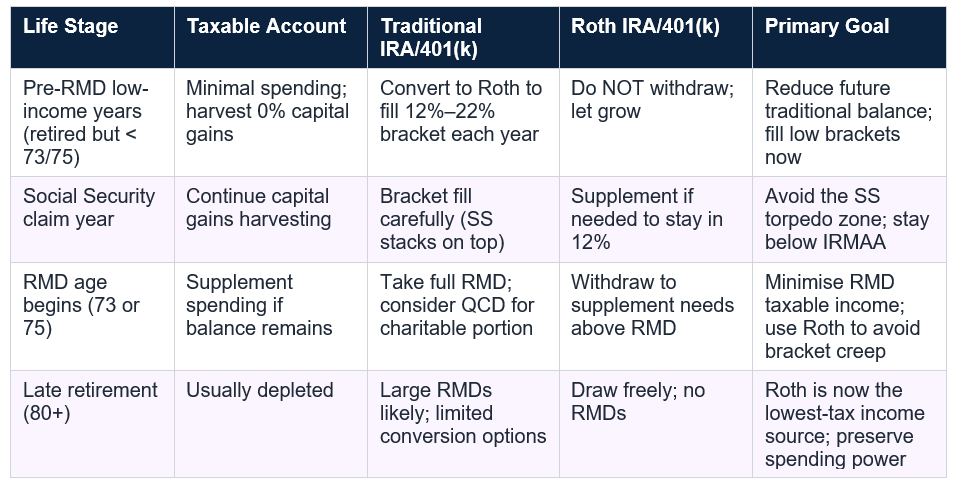
A Roth conversion done in the wrong year can erase the entire $12,000 senior bonus deduction for a married couple — and bump your Medicare Part B premium to a higher IRMAA tier two years later. A $1 over both the senior bonus phaseout threshold and the IRMAA threshold can cost $3,000–$5,000 in combined deduction loss and higher Medicare premiums. This is the 2026 retiree tax trap most likely to produce an unexpected tax bill.
The ‘one dollar problem’ is that IRMAA tiers are cliff-style — not gradual. Crossing the threshold by a single dollar adds the entire surcharge amount. SeniorSimple (July 2026) quantifies the risk: a $1 over the IRMAA threshold can cost $1,200 to $3,000 in higher Medicare premiums per year. The Retiree Advisor Match calculator (August 2026) makes a more precise point: ‘$1 in Roth vs. traditional IRA can be worth $2,000+ in Medicare premium savings.’
The IRMAA calculation uses income from two years prior, which means a large Roth conversion in 2026 may not affect 2026 Medicare premiums — but will affect 2028 premiums. This two-year lag requires forward planning: a retiree who converts aggressively at age 63 may face higher Medicare premiums at age 65 as a result, unless the conversion was kept below the IRMAA threshold.
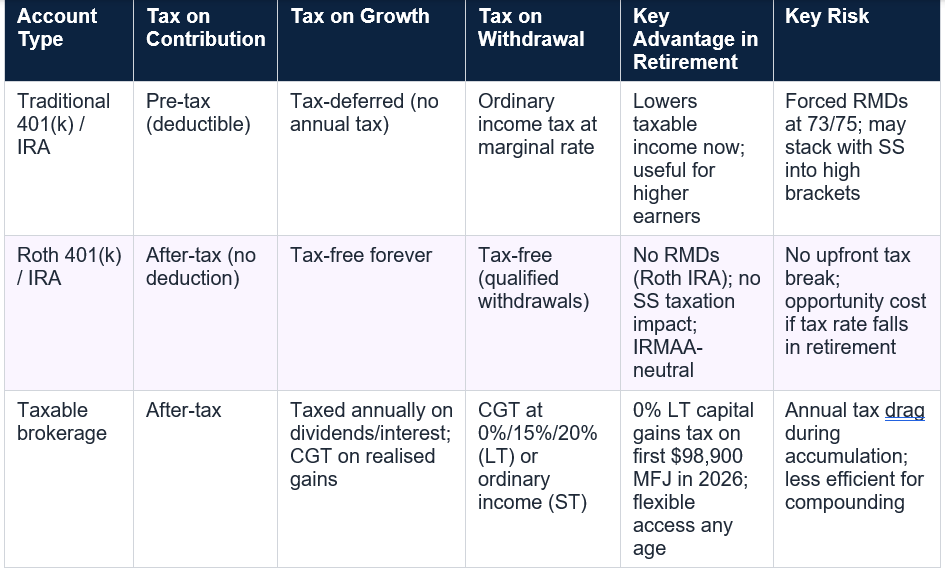

The ideal mix varies by individual, but the general principle from Income Laboratory’s 2026 conversion guide is: ‘Nearly every retiree with a meaningful pre-tax balance will face a marginal rate above 12% once RMDs, Social Security, and pension income stack up.’ Tax diversification — built deliberately during the working years and actively managed during the Roth conversion window — is the most reliable structural defence against this.
But the principles are learnable, and the failure to learn them is expensive. The 32.8% of retirees with no tax plan are not simply unprepared. Many of them are actively losing money they did not know they could keep. 26.6% have already named their biggest financial regret: not using Roth. The $150,000 to $300,000 in lifetime tax savings available from proactive RMD management and Roth conversion strategy is not hypothetical — it is the modelled outcome of applying rules that already exist.
The game has rules. The rules are knowable. Playing by them, even imperfectly, consistently produces better outcomes than ignoring them. The best time to start was the day you retired. The second-best time is the next tax year that still has open bracket space.
The Retirement Tax Surprise Index (April 2026) identifies the largest single regret as not using Roth accounts during accumulation — cited by 26.6% of retirees as their top financial regret. The structural consequence is that most American retirement wealth sits in traditional accounts where every dollar of growth is a deferred tax liability. When RMDs begin forcing withdrawals at 73 or 75, those withdrawals stack with Social Security to push income into the 22%–24% or even 32% federal bracket — far above the 12% rate at which many of the same dollars could have been taxed during the Roth conversion window. A close second: failing to use the Roth conversion window between retirement and RMD age, during which taxable income is often at its career low and 12%–22% conversions are available.
At what income does Social Security become taxable in 2026?
Social Security benefits begin to become taxable at $25,000 of provisional income for single filers and $32,000 for married filing jointly. At these thresholds, up to 50% of benefits are included in taxable income. Above $34,000 (single) and $44,000 (MFJ), up to 85% of benefits are taxable. Provisional income is calculated as adjusted gross income plus tax-exempt interest plus half of Social Security benefits. Traditional IRA withdrawals and RMDs count fully toward provisional income; Roth distributions do not. The 'Social Security torpedo' occurs in the $32,000–$44,000 MFJ provisional income zone, where each extra dollar of ordinary income effectively generates $1.85 of taxable income, pushing the effective marginal rate above 40% for retirees nominally in the 22% bracket (Retiree Advisor Match calculator, August 2026).
What is a Roth conversion and why does it matter?
A Roth conversion is the transfer of pre-tax traditional IRA or 401(k) funds into a Roth account, triggering ordinary income tax on the converted amount in the year of transfer. The converted funds then grow tax-free, and qualified withdrawals are completely tax-free. The conversion matters because it allows retirees to pay tax voluntarily at a known, controllable rate — typically the lower rates available during the Roth conversion window (between retirement and RMD age) — rather than involuntarily at higher rates forced by RMDs and Social Security stacking later. For a typical retired couple with $1.4M in traditional IRAs, converting $85,000–$100,000 per year during a 10-year conversion window can save approximately $52,000 in taxes over the window and more than $120,000 in lifetime tax (Income Laboratory, April 2026). There is no income limit on Roth conversions — anyone can convert regardless of income.
What is IRMAA and how do I avoid it?
IRMAA (Income-Related Monthly Adjustment Amount) is a surcharge on Medicare Part B and Part D premiums that applies when your MAGI (from two years prior) exceeds specified thresholds. In 2026, the base threshold is $103,000 for individuals. Crossing the threshold triggers a significant additional monthly premium. Because the tiers are cliffs (not gradual), a $1 excess can cost $1,200–$3,000 per year in additional Medicare premiums. To avoid IRMAA: keep MAGI below the threshold by limiting traditional IRA distributions and Roth conversions to amounts that stay under the tier; use Roth distributions instead of traditional IRA withdrawals (Roth withdrawals don't count toward MAGI); use Qualified Charitable Distributions to satisfy RMDs without adding to AGI. Always check the IRMAA tiers before committing to a Roth conversion, because the two-year look-back means conversions in 2026 affect 2028 Medicare premiums.
What are the 2026 RMD rules under SECURE 2.0?
Under the SECURE 2.0 Act, the required minimum distribution start age is 73 for those born between 1951 and 1959, and 75 for those born in 1960 or later. For those turning 73 in 2026, the first RMD is due by April 1, 2027 (the first-year extension), with the second RMD due by December 31, 2027. Taking two RMDs in one year (because of the first-year extension) can significantly increase taxable income, often making it preferable to take the first RMD by December 31 of the year you turn 73 rather than waiting for the April 1 deadline. The RMD is calculated by dividing the prior year-end account balance by the IRS Uniform Lifetime Table factor for your age; at 73, that factor is 26.5. Missing an RMD triggers a 25% excise tax on the shortfall (reduced to 10% if corrected within two years using IRS Form 5329).
What is the OBBBA senior bonus deduction for 2026?
The One Big Beautiful Bill Act (OBBBA), signed July 4, 2025, created a new $6,000 'senior bonus deduction' for each qualifying individual aged 65 or older, available for tax years 2025 through 2028 only. A married couple both aged 65 can claim $12,000 in total senior bonus deductions. This is in addition to the regular standard deduction ($32,200 MFJ in 2026) and the additional $1,650 per 65+ spouse — a total potential deduction of $47,500 for a qualifying couple. However, the deduction phases out by $1 for every $2 of MAGI above $75,000 (single) or $150,000 (MFJ). This phaseout creates a hidden effective marginal rate increase in the $150,000–$350,000 MAGI range, where extra income eliminates deduction at 50 cents per dollar. A Roth conversion that pushes MAGI into the phaseout zone in the wrong year can eliminate thousands of dollars of deduction and trigger IRMAA simultaneously.
MFJ Tax Brackets For Retirees
Life Time Tax Savings: Each Retirement Strategy
Table of Contents
- The Tax Game Most Retirees Don’t Know They’re Playing
- The 2026 Retirement Tax Landscape: Key Numbers You Need to Know
- The First Trap: Not Understanding Which Accounts Are Taxable
- The Social Security Torpedo: The Hidden Effective Rate Above 40%
- Required Minimum Distributions: The Forced Withdrawal Reckoning
- The Roth Conversion Window: The Most Powerful Move in the Playbook
- Strategy #1: Bracket Filling — Use Your Low-Rate Years on Purpose
- Strategy #2: Social Security Delay — Tax Efficiency and Longevity
- Strategy #3: Qualified Charitable Distributions (QCDs)
- Strategy #4: The Tax-Efficient Withdrawal Sequence
- The 2026 OBBBA Senior Bonus Deduction — And Its Trap
- Medicare IRMAA: The ‘One Dollar’ Problem
- The Retirement Tax Account Diversification Framework
- Conclusion: The Game Has Rules. Learning Them Is the Strategy.
- Frequently Asked Questions
The Tax Game Most Retirees Don’t Know They’re Playing
Most Americans spend their working lives focused on accumulating retirement savings. The tax consequences of withdrawing those savings — in what order, from which accounts, at what rate, in which years — receive far less attention. The result, for a large proportion of retirees, is a tax surprise that was entirely avoidable.The Retirement Tax Surprise Index, published in April 2026, surveyed Americans approaching and in retirement and found that 32.8 percent of retirees have zero tax plan for retirement. 26.6 percent said their top financial regret was not contributing to a Roth account instead of a traditional one. 27.4 percent were sceptical it is even legally possible to cut their retirement tax bill. Meanwhile, the mechanics that produce these surprises — required minimum distributions, Social Security taxation, Medicare IRMAA surcharges, and the cascade of bracket effects when income sources stack up — are knowable, plannable, and in many cases largely avoidable with the right sequence of decisions.
The ‘guessing game’ in the title is not entirely metaphorical. Retirement tax planning requires estimating future tax rates (which nobody knows), future Social Security solvency (which is uncertain), future healthcare costs (which are variable), and future RMD amounts (which depend on account growth). But the uncertainty does not eliminate the value of strategy. The rules of the game are fixed, and playing by them consistently — even imperfectly — produces far better outcomes than ignoring them. This guide explains the rules.
32.8% of retirees: zero tax plan (Retirement Tax Surprise Index, April 2026). 58.9% of retirees earning under $25K have never heard of RMDs. 26.6%: top regret is not using Roth. 27.4%: don't believe it's possible to cut their retirement tax bill. Nearly 40% of Gen X entering retirement without meaningful tax preparation.
The 2026 Retirement Tax Landscape: Key Numbers You Need to Know
The TCJA (Tax Cuts and Jobs Act) tax rates were made permanent in 2026 by the One Big Beautiful Bill Act (OBBBA) signed July 4, 2025. This resolves the long-running uncertainty about whether rates would revert to pre-TCJA levels. The 2026 federal income tax brackets for married filing jointly:The 2026 standard deduction is $16,100 for single filers and $32,200 for married filing jointly (MFJ). The additional standard deduction for age 65 or older is $1,650 per person. A married couple both aged 65+ therefore has a total standard deduction of $35,500 ($32,200 + $1,650 + $1,650). On top of this, the OBBBA added a new $6,000 senior bonus deduction for tax years 2025–2028 (see Section 11), potentially bringing total deductions to $41,500 for some couples before a single dollar of income is taxed.
2026 MFJ standard deduction: $32,200 (up from $30,000 in 2025). Both spouses 65+: additional $3,300 = total $35,500 standard deduction before OBBBA senior bonus. OBBBA senior bonus: $6,000 per individual (2025–2028). 401(k)/403(b) limit 2026: $24,500. Roth IRA: $7,000 ($8,000 age 50+). SECURE 2.0 super catch-up (ages 60–63): $34,750 for 401(k).
The First Trap: Not Understanding Which Accounts Are Taxable
The most foundational concept in retirement tax planning is the tax treatment of the three major account types — and the fact that most pre-retirees do not have a clear picture of how much of their accumulated retirement wealth will be taxed when they access it:- Traditional 401(k) and IRA: contributions were pre-tax. Every dollar withdrawn in retirement is taxable as ordinary income, including all investment growth. This is where the majority of American retirement wealth is held. Every dollar of traditional balance is a deferred tax liability at whatever your marginal rate is when you withdraw it.
- Roth 401(k) and Roth IRA: contributions were made after tax. Qualified withdrawals — account held five or more years and owner aged 59½ or older — are completely tax-free, including all investment growth. Roth IRAs have no required minimum distributions during the owner’s lifetime. Note: Roth 401(k) accounts are now also exempt from RMDs under recent changes, but rolling to a Roth IRA at or before age 73 is still recommended to avoid any plan-specific complications.
- Taxable brokerage accounts: contributions were after-tax. Income and dividends are taxed annually. Capital gains on sale are taxed at the long-term rate (0%, 15%, or 20% depending on income) if held over one year. In 2026, the 0% long-term capital gains rate applies to taxable income up to $49,450 (single) or $98,900 (MFJ) — a significant tax planning opportunity for retirees with low ordinary income.
The Social Security Torpedo: The Hidden Effective Rate Above 40%
One of the most surprising tax mechanisms in retirement is the taxation of Social Security benefits — and specifically the ‘torpedo zone’ in which the effective marginal rate temporarily spikes well above the nominal bracket rate.Social Security benefits are subject to federal income tax based on ‘provisional income’ (also called combined income): the sum of adjusted gross income plus tax-exempt interest plus half of Social Security benefits. The 2026 thresholds are unchanged from prior years:
- Below $25,000 (single) / $32,000 (MFJ): no Social Security is taxable.
- $25,000–$34,000 (single) / $32,000–$44,000 (MFJ): up to 50% of benefits are taxable.
- Above $34,000 (single) / $44,000 (MFJ): up to 85% of benefits are taxable.
The Social Security torpedo hits hardest between approximately $32,000 and $44,000 of provisional income for married couples — a range that is surprisingly easy to enter once traditional IRA distributions or RMDs begin. A retiree who believes they are in the 12% bracket may be effectively taxed at 22%+ in this zone. Roth distributions (which do not count as provisional income) and Qualified Charitable Distributions (which satisfy RMDs without adding to AGI) are the two most effective tools for navigating the torpedo zone.
5. Required Minimum Distributions: The Forced Withdrawal Reckoning
Required Minimum Distributions (RMDs) are the IRS mechanism that requires retirees to begin withdrawing from traditional retirement accounts and pay income tax on those withdrawals, regardless of whether they need the money for living expenses. The SECURE 2.0 Act changed the start age:- Born 1951–1959: RMDs begin at age 73.
- Born 1960 or later: RMDs begin at age 75 (UBS 2026 Retirement Guide; Stonewood Financial, July 2026).
Missing an RMD triggers a 25% excise tax on the shortfall (reduced from 50% by SECURE 2.0). Under SECURE 2.0, this reduces to 10% if corrected within two years using IRS Form 5329. But the more significant concern for most retirees is not the penalty — it is the cumulative tax impact of large, unavoidable RMDs stacking on top of Social Security and other income.
RMD at 73 on a $1M traditional IRA: ~$37,736 (divisor 26.5 from IRS Uniform Lifetime Table). Without Roth conversion pre-RMD, RMDs may force $100,000–$150,000/year into the 24%–32% federal bracket. Net tax savings from proactive Roth conversion before RMD age: $150,000–$300,000 over a 20-year retirement in many scenarios (SeniorSimple, July 2026). Missing an RMD: 25% excise tax on shortfall; 10% if corrected within 2 years (SECURE 2.0).
Retirees who defer all traditional account withdrawals until RMDs begin at 73 or 75 often discover that their required distributions are far larger than they anticipated — because the account continued to grow untouched. A $700,000 traditional IRA at age 62 growing at 6% for 11 years reaches approximately $1.33 million by age 73 — requiring an initial RMD of approximately $50,000. Combined with Social Security of $40,000, the couple's provisional income alone hits $65,000, triggering 85% SS taxation. The RMD window — the years between retirement and RMD start age — is precisely when Roth conversions are most valuable.
6. The Roth Conversion Window: The Most Powerful Move in the Playbook
The Roth conversion window is the period between retirement and the age at which RMDs begin — a gap that SECURE 2.0 has extended to ten or more years for many retirees who retire at 62 or 63 and delay RMDs until age 73 or 75. During this window, taxable income is often at its lowest point in decades: no salary, not yet taking Social Security, no RMDs. This is precisely the period when converting traditional IRA or 401(k) assets to Roth is most tax-efficient.A Roth conversion moves pre-tax IRA or 401(k) money into a Roth account, triggering ordinary income tax on the converted amount in the year of conversion. The converted funds then grow tax-free, and qualified withdrawals in retirement are completely tax-free, with no RMDs, no Social Security taxation impact, and no IRMAA contribution from Roth withdrawals.
The Income Laboratory’s April 2026 Roth Conversion Strategy guide models the optimal approach for a typical retired couple: aged 63 and 62, $1.4M in traditional IRAs, $200K in taxable accounts, $300K in Roth, Social Security at 67 ($48,000/year combined), no pension. Their conversion window is ten years (ages 63–72) before RMDs begin at 73. Without conversions, RMDs start at approximately $54,000/year combined with $48,000 in Social Security — over $102,000 of taxable income firmly in the 22% bracket. Optimal strategy:
convert $85,000–$100,000 per year during the window, filling through the top of the 22% bracket. Result: 10-year tax savings of approximately $52,000, with a lifetime benefit (including tax-free growth on converted amounts) exceeding $120,000.
Strategy #1: Bracket Filling — Use Your Low-Rate Years on Purpose
Bracket filling is the practice of deliberately withdrawing from traditional accounts (or converting to Roth) up to the top of a specific tax bracket — even when you do not need the cash for living expenses — in order to consume bracket space that would otherwise be lost when RMDs and Social Security force you into higher brackets later.The mechanics: in 2026, married filing jointly, the 12% bracket runs up to $96,950 of taxable income. After the $32,200 standard deduction, this means taxable income of $96,950 equates to gross income of approximately $129,150. If a retired couple has Social Security of $30,000 per year (which may be partially non-taxable) and no other income, they have significant room to take traditional IRA withdrawals or Roth conversions at the 12% rate before any income reaches the 22% bracket. TakeHomeTax.com (June 2026) summarises the strategy: ‘Fill the 12% federal bracket from traditional accounts every year, even before you need the cash. Move that money to taxable for spending or Roth for future tax-free growth.
This bracket filling uses your lowest brackets while you have them, before RMDs force larger traditional withdrawals into higher brackets.’
Strategic sequencing — bracket filling plus deliberate withdrawal ordering — typically saves $50,000 to $200,000 over a 30-year retirement compared to the conventional sequence of drawing taxable accounts first, then traditional, then Roth (TakeHomeTax.com).
Strategy #2: Social Security Delay — Tax Efficiency and Longevity
Delaying Social Security from age 62 (early claiming) to age 70 (maximum delay) increases the monthly benefit by approximately 77% and also affects the retirement tax picture in several ways:- Larger SS benefit means more income is subject to the 85% taxable threshold — which is a potential tax cost in the long run for higher-income retirees.
- However, for retirees who delay SS and use the years between retirement and age 70 to do Roth conversions at low tax rates, the delay creates the conversion window without SS income stacking on top, enabling more aggressive conversion at lower brackets.
- The maximum possible Social Security benefit at full retirement age (67 for most) climbs to approximately $4,152 per month in 2026 (Clarita Financial Partners, May 2026). At age 70, delayed credits add an additional 24% to this figure for those who wait.
Strategy #3: Qualified Charitable Distributions (QCDs)
A Qualified Charitable Distribution (QCD) is a direct transfer from a traditional IRA to a qualifying charity, available to IRA owners aged 70½ or older. The 2026 QCD limit is $111,000 per individual, indexed for inflation under SECURE 2.0 (UBS 2026 Retirement Guide; up from $108,000 in 2025).The QCD is one of the most powerful available tools for retirees who are charitably inclined, for two distinct reasons:
- It satisfies the RMD obligation without adding to adjusted gross income. A $37,000 QCD that covers the entire year’s RMD produces no taxable income from the RMD — compared with taking the $37,000 distribution and donating it separately (which adds $37,000 to AGI even if the charitable deduction offsets it, because the standard deduction is almost always taken rather than itemising).
- By keeping AGI lower, a QCD prevents the RMD from triggering Social Security taxation (provisional income stays lower), IRMAA surcharges, and the OBBBA senior bonus deduction phaseout.
2026 QCD limit: $111,000 per individual (SECURE 2.0 indexed; UBS 2026). $1 of QCD instead of traditional IRA withdrawal can be worth $2,000+ in Medicare premium savings by keeping MAGI below IRMAA thresholds (Retiree Advisor Match, August 2026). One-time QCD to split-interest charitable entity: $55,000 per individual.
Strategy #4: The Tax-Efficient Withdrawal Sequence
The sequence in which retirement accounts are drawn down — which accounts you take money from first, second, and last — has a material impact on lifetime tax costs. The conventional advice is to draw taxable accounts first, then traditional, then Roth. This preserves the Roth for longest — maximising tax-free compounding — and draws traditional accounts only when needed. But it can create a significant problem for retirees with large traditional balances: the account grows during the Roth preservation period and generates very large RMDs that push income into high brackets and trigger Medicare IRMAA surcharges.A more sophisticated sequence, described by TakeHomeTax.com (June 2026) and SeniorSimple (July 2026), is the bracket-filling approach:
- In years when taxable income is low (before Social Security and before RMDs): fill the 12% bracket with traditional IRA distributions or Roth conversions, even if not needed for spending. The money goes to taxable accounts for future use or into Roth for future tax-free growth.
- Once RMDs begin: take the RMD first (it is mandatory), then use Roth distributions for additional spending needs to keep total taxable income from rising into higher brackets. Use QCDs to satisfy portions of the RMD if you are charitably inclined.
- Use the 0% long-term capital gains bracket aggressively: in 2026, taxable income below $98,900 (MFJ) is subject to 0% federal tax on long-term capital gains and qualified dividends. In years of low ordinary income, harvesting gains in taxable accounts at 0% is a significant tax-free wealth transfer that is often missed.
The 2026 OBBBA Senior Bonus Deduction — And Its Trap
One of the most consequential new retirement tax provisions in 2026 is the ‘senior bonus deduction’ created by the One Big Beautiful Bill Act (OBBBA). For tax years 2025 through 2028 only:- A $6,000 additional deduction is available for each qualifying senior aged 65 or older.
- A married couple both aged 65+ can claim $12,000 in total senior bonus deductions.
- Added to the $32,200 MFJ standard deduction plus the $3,300 age-65+ additional standard deduction, a qualifying couple can potentially have $47,500 in total deductions before any income is taxed at all.
A Roth conversion done in the wrong year can erase the entire $12,000 senior bonus deduction for a married couple — and bump your Medicare Part B premium to a higher IRMAA tier two years later. A $1 over both the senior bonus phaseout threshold and the IRMAA threshold can cost $3,000–$5,000 in combined deduction loss and higher Medicare premiums. This is the 2026 retiree tax trap most likely to produce an unexpected tax bill.
Medicare IRMAA: The ‘One Dollar’ Problem
Medicare Income-Related Monthly Adjustment Amounts (IRMAA) are surcharges applied to Medicare Part B and Part D premiums based on income from two years prior. In 2026, the base Medicare Part B premium is $185.00 per month. IRMAA surcharges kick in at $103,000 of MAGI for individuals (approximately $206,000 for MFJ). Each IRMAA tier adds significantly to monthly premiums.The ‘one dollar problem’ is that IRMAA tiers are cliff-style — not gradual. Crossing the threshold by a single dollar adds the entire surcharge amount. SeniorSimple (July 2026) quantifies the risk: a $1 over the IRMAA threshold can cost $1,200 to $3,000 in higher Medicare premiums per year. The Retiree Advisor Match calculator (August 2026) makes a more precise point: ‘$1 in Roth vs. traditional IRA can be worth $2,000+ in Medicare premium savings.’
The IRMAA calculation uses income from two years prior, which means a large Roth conversion in 2026 may not affect 2026 Medicare premiums — but will affect 2028 premiums. This two-year lag requires forward planning: a retiree who converts aggressively at age 63 may face higher Medicare premiums at age 65 as a result, unless the conversion was kept below the IRMAA threshold.
The Retirement Tax Account Diversification Framework
The most robust defence against retirement tax surprises is holding meaningful assets in all three tax-treatment buckets: taxable, tax-deferred (traditional), and tax-free (Roth). This ‘tax diversification’ gives the retiree flexibility to draw from whichever account produces the lowest marginal tax rate in any given year, rather than being locked into a single account type with a fixed tax treatment.The ideal mix varies by individual, but the general principle from Income Laboratory’s 2026 conversion guide is: ‘Nearly every retiree with a meaningful pre-tax balance will face a marginal rate above 12% once RMDs, Social Security, and pension income stack up.’ Tax diversification — built deliberately during the working years and actively managed during the Roth conversion window — is the most reliable structural defence against this.
Conclusion
Retirement tax planning is genuinely complex. It involves six to eight interacting variables — bracket levels, RMD start ages, Social Security provisional income, IRMAA thresholds, the OBBBA senior deduction phaseout, the long-term capital gains rate structure, state income taxes, and the two-year Medicare lag — all operating simultaneously and changing as income and assets shift year by year. No single article replaces a personal analysis with a qualified tax professional.But the principles are learnable, and the failure to learn them is expensive. The 32.8% of retirees with no tax plan are not simply unprepared. Many of them are actively losing money they did not know they could keep. 26.6% have already named their biggest financial regret: not using Roth. The $150,000 to $300,000 in lifetime tax savings available from proactive RMD management and Roth conversion strategy is not hypothetical — it is the modelled outcome of applying rules that already exist.
The game has rules. The rules are knowable. Playing by them, even imperfectly, consistently produces better outcomes than ignoring them. The best time to start was the day you retired. The second-best time is the next tax year that still has open bracket space.
Frequently Asked Questions
What is the biggest retirement tax mistake Americans make?The Retirement Tax Surprise Index (April 2026) identifies the largest single regret as not using Roth accounts during accumulation — cited by 26.6% of retirees as their top financial regret. The structural consequence is that most American retirement wealth sits in traditional accounts where every dollar of growth is a deferred tax liability. When RMDs begin forcing withdrawals at 73 or 75, those withdrawals stack with Social Security to push income into the 22%–24% or even 32% federal bracket — far above the 12% rate at which many of the same dollars could have been taxed during the Roth conversion window. A close second: failing to use the Roth conversion window between retirement and RMD age, during which taxable income is often at its career low and 12%–22% conversions are available.
At what income does Social Security become taxable in 2026?
Social Security benefits begin to become taxable at $25,000 of provisional income for single filers and $32,000 for married filing jointly. At these thresholds, up to 50% of benefits are included in taxable income. Above $34,000 (single) and $44,000 (MFJ), up to 85% of benefits are taxable. Provisional income is calculated as adjusted gross income plus tax-exempt interest plus half of Social Security benefits. Traditional IRA withdrawals and RMDs count fully toward provisional income; Roth distributions do not. The 'Social Security torpedo' occurs in the $32,000–$44,000 MFJ provisional income zone, where each extra dollar of ordinary income effectively generates $1.85 of taxable income, pushing the effective marginal rate above 40% for retirees nominally in the 22% bracket (Retiree Advisor Match calculator, August 2026).
What is a Roth conversion and why does it matter?
A Roth conversion is the transfer of pre-tax traditional IRA or 401(k) funds into a Roth account, triggering ordinary income tax on the converted amount in the year of transfer. The converted funds then grow tax-free, and qualified withdrawals are completely tax-free. The conversion matters because it allows retirees to pay tax voluntarily at a known, controllable rate — typically the lower rates available during the Roth conversion window (between retirement and RMD age) — rather than involuntarily at higher rates forced by RMDs and Social Security stacking later. For a typical retired couple with $1.4M in traditional IRAs, converting $85,000–$100,000 per year during a 10-year conversion window can save approximately $52,000 in taxes over the window and more than $120,000 in lifetime tax (Income Laboratory, April 2026). There is no income limit on Roth conversions — anyone can convert regardless of income.
What is IRMAA and how do I avoid it?
IRMAA (Income-Related Monthly Adjustment Amount) is a surcharge on Medicare Part B and Part D premiums that applies when your MAGI (from two years prior) exceeds specified thresholds. In 2026, the base threshold is $103,000 for individuals. Crossing the threshold triggers a significant additional monthly premium. Because the tiers are cliffs (not gradual), a $1 excess can cost $1,200–$3,000 per year in additional Medicare premiums. To avoid IRMAA: keep MAGI below the threshold by limiting traditional IRA distributions and Roth conversions to amounts that stay under the tier; use Roth distributions instead of traditional IRA withdrawals (Roth withdrawals don't count toward MAGI); use Qualified Charitable Distributions to satisfy RMDs without adding to AGI. Always check the IRMAA tiers before committing to a Roth conversion, because the two-year look-back means conversions in 2026 affect 2028 Medicare premiums.
What are the 2026 RMD rules under SECURE 2.0?
Under the SECURE 2.0 Act, the required minimum distribution start age is 73 for those born between 1951 and 1959, and 75 for those born in 1960 or later. For those turning 73 in 2026, the first RMD is due by April 1, 2027 (the first-year extension), with the second RMD due by December 31, 2027. Taking two RMDs in one year (because of the first-year extension) can significantly increase taxable income, often making it preferable to take the first RMD by December 31 of the year you turn 73 rather than waiting for the April 1 deadline. The RMD is calculated by dividing the prior year-end account balance by the IRS Uniform Lifetime Table factor for your age; at 73, that factor is 26.5. Missing an RMD triggers a 25% excise tax on the shortfall (reduced to 10% if corrected within two years using IRS Form 5329).
What is the OBBBA senior bonus deduction for 2026?
The One Big Beautiful Bill Act (OBBBA), signed July 4, 2025, created a new $6,000 'senior bonus deduction' for each qualifying individual aged 65 or older, available for tax years 2025 through 2028 only. A married couple both aged 65 can claim $12,000 in total senior bonus deductions. This is in addition to the regular standard deduction ($32,200 MFJ in 2026) and the additional $1,650 per 65+ spouse — a total potential deduction of $47,500 for a qualifying couple. However, the deduction phases out by $1 for every $2 of MAGI above $75,000 (single) or $150,000 (MFJ). This phaseout creates a hidden effective marginal rate increase in the $150,000–$350,000 MAGI range, where extra income eliminates deduction at 50 cents per dollar. A Roth conversion that pushes MAGI into the phaseout zone in the wrong year can eliminate thousands of dollars of deduction and trigger IRMAA simultaneously.
0 Comments
Be the first to share your thoughts on this article.