

Professional & Career Development
Late Career Job Loss: 3 Ways to Protect Your Retirement

Nobody plans for it. You’re in your late 50s or early 60s, a few years from retirement, your savings are finally at a level that feels real, and then the layoff happens. Or the restructuring. Or the ‘position elimination’ that reads like a neutral business decision but falls disproportionately on the people who have been there the longest. A study that tracked American workers for over 20 years found that 56% of people over 50 lose their long-term job before they choose to retire. The financial impact is severe: missed pension contributions, forced early Social Security claims, healthcare gaps, and portfolio withdrawals at the worst possible moment. This article is not about grieving the loss or disputing the unfairness — both of which are entirely valid. It is about the three specific moves you need to make to protect as much of your retirement as possible when it happens.
Losing a job in your 30s is painful but recoverable. The math of time is on your side: decades of saving, investing, and career-rebuilding ahead. Losing a job in your mid-50s or early 60s is categorically different. The damage compounds across three dimensions at once, and each one makes the others worse.
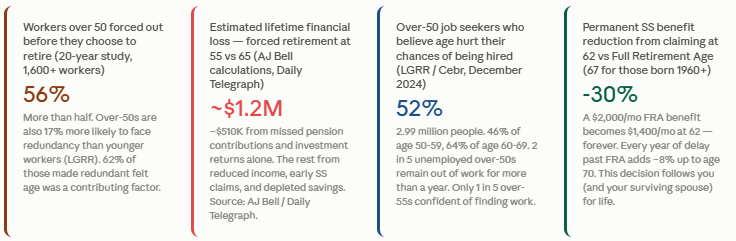
First, the savings window closes. The years between 55 and 65 are typically the highest-earning years of a career, and therefore the years of maximum retirement contribution potential. If a $90,000 salary supports $15,000 per year in 401(k) contributions, each year of job loss at this stage is not just $15,000 missing from the account — it is $15,000 that was never invested, never compounded, and never grew. AJ Bell, the UK stockbroker, calculated that someone earning the equivalent of $63,000 forced to retire at 55 instead of 65 would be roughly $1.2 million worse off over their lifetime — approximately $510,000 of that from missed pension contributions and investment returns alone.
Second, re-employment at this stage is genuinely harder. Not just slightly harder — structurally harder, as a documented pattern. Legal & General Retail Retirement’s 2024 research found that over 50s are 17% more likely to face redundancy than younger workers, but then face a wall: 52% of over-50 job seekers believe their age made employers less likely to hire them. Two in five who are unemployed over 50 remain out of work for more than a year. Third, the benefits cliff arrives: health insurance, which has been partially subsidised by the employer, disappears the moment the job ends. Not financial, legal, or tax advice.
The scale of late career job loss (2024-2026): 56% of workers over 50 lose their long-term job before they choose to retire (20-year study, 1,600+ workers, cited Empower Over 50). Over-50s are 17% more likely to face redundancy than younger workers (LGRR 'Missing Midlife Workers' report). 52% of over-50 job seekers (2.99 million people) believe their age made employers less likely to hire them (LGRR / Cebr December 2024). 62% of over-50s made redundant felt their age was a contributing factor (LGRR). During 2022-2025 tech layoffs, over-40s were 1.5x more likely to be cut than younger colleagues (EEOC data). 39% of affected older workers changed their retirement plans. Estimated $36,000 retirement savings shortfall (LGRR). $1.2M total lifetime financial impact for a $63K earner forced to retire at 55 vs 65 (AJ Bell calculations). Sources: LGRR December 2024; Empower Over 50; EEOC; AJ Bell/Daily Telegraph. Not financial advice.
The mechanisms vary. Sometimes it is a genuine restructuring. Sometimes it is a targeted layoff that disproportionately affects senior, higher-salaried workers. The EEOC found that during the mass layoff wave of 2022 through 2025, workers over 40 across the tech industry were approximately 1.5 times more likely to be cut than their younger colleagues. The patterns that push older workers out include being labelled ‘overqualified,’ ‘too close to retirement age,’ or ‘too expensive’ — all documented in Legal & General’s 2024 research. The EEOC enforces the Age Discrimination in Employment Act, but the barriers remain.
The point of this section is not legal strategy — it is emotional and practical preparation. If the majority of workers over 50 face this before they are ready, the rational response is to make sure your financial structure is as resilient as possible before the event. And if the event has already happened, the rational response is the three ways that follow. Not financial advice.
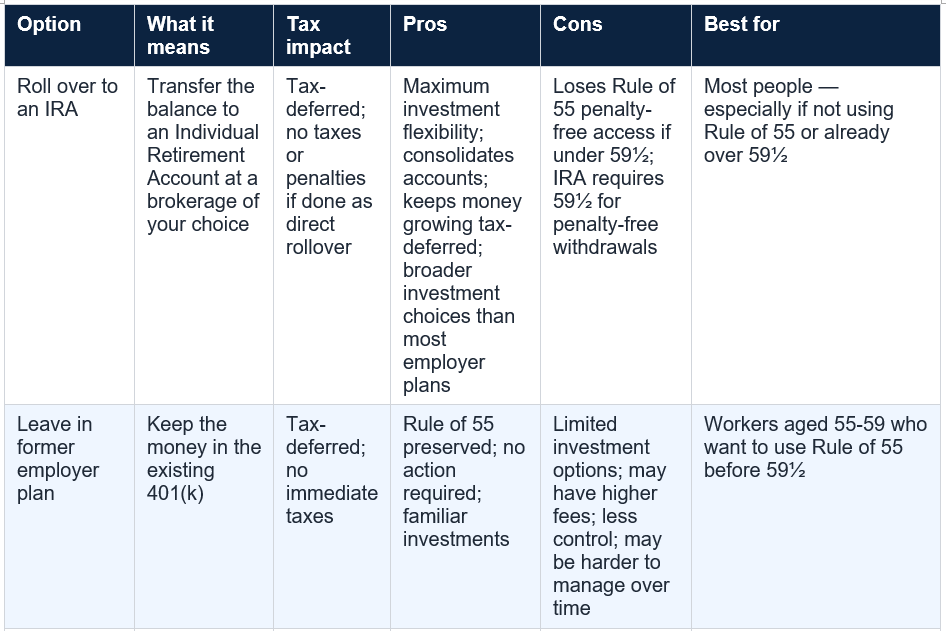
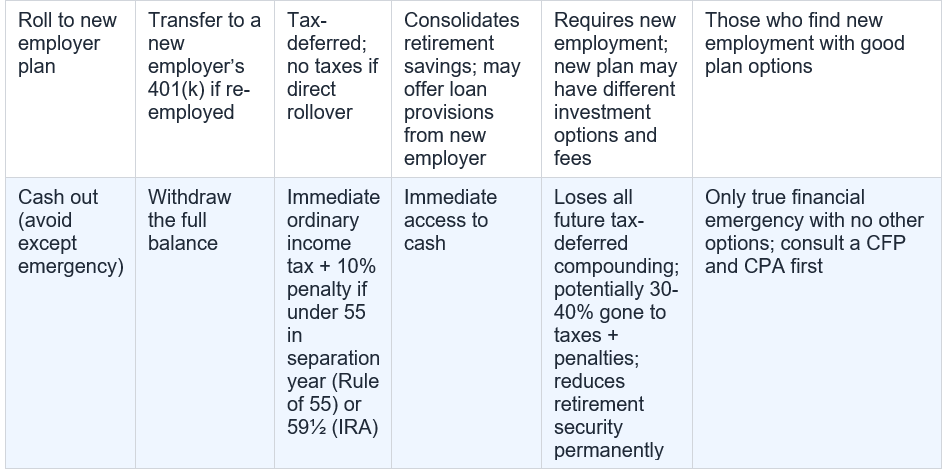
The good news is that in most cases, your 401(k) goes nowhere. The money is yours. If you have left a job, voluntarily or not, the account does not disappear. You have several options, and time to evaluate them. The critical principle from every financial planning source is consistent: keep the money invested. Withdrawing and spending it is almost always the worst possible outcome. The money’s value comes from its continued tax-deferred compounding, and every dollar taken out prematurely is a dollar that is taxed now, possibly penalised now, and then unavailable to compound for the next ten to twenty years. Creative Planning’s analysis puts it directly: ‘Keeping this money invested could increase the chances that the money will earn positive returns and could be a potential source of income when you retire.’ Not financial advice.
Protect the portfolio by: (1) NOT cashing out — taxes + possible 10% penalty can consume 30-40% of the balance. (2) Understanding the Rule of 55 if you are 55+ in the year of separation — this may allow penalty-free 401(k) distributions from THIS employer's plan without the 10% penalty. (3) Rolling to an IRA for greater investment flexibility if you don't expect to use the Rule of 55. (4) Resisting the urge to time the market — stay invested in your target allocation. (5) Making conservative withdrawals only after exhausting unemployment, severance, and other income sources. Source: Creative Planning; LPL/EWM; Merrill Edge. Not financial advice.
The rule works like this: if you separate from your employer (voluntarily or involuntarily) in the calendar year you turn 55 or later, you can begin taking distributions from the 401(k) plan of that specific employer without paying the 10% early withdrawal penalty. You still owe ordinary income tax on the distributions — there is no tax-free lunch here — but the 10% penalty is waived. For public safety employees (police, firefighters, EMS), the qualifying age is even lower, at 50.
Creative Planning’s analysis of post-layoff options notes the Rule of 55 explicitly: ‘As long as you turn 55 (or are already older) during the calendar year you leave or lose your job, you can begin taking distributions from your 401(k) without an early withdrawal penalty. And the Rule of 55 doesn’t just work for 401(k) plans — it can also apply to other qualified retirement plans (such as a 403b).’ The critical caveat: it only applies to the retirement plan of the employer you are leaving at the time of separation. If you have older 401(k)s from previous employers, those are NOT covered by the Rule of 55 — they retain the 59½ age threshold for penalty-free withdrawals. This is a common and expensive mistake. Not tax advice. Consult a CPA.
Rule of 55 critical limitation: it applies ONLY to the 401(k) of the employer you are separating from, not to retirement accounts from previous employers. If you roll your current employer's 401(k) into an IRA before taking distributions, you may LOSE the Rule of 55 protection — because IRA rules require age 59½ for penalty-free distributions (with some exceptions like SEPP/72(t)). If you plan to use the Rule of 55, do NOT roll the current employer's 401(k) to an IRA until after you have taken any distributions you need. Source: Creative Planning; AARP. Not tax advice. Consult a CPA.
The income bridge has three components: what the former employer owes you (severance and benefits continuation), what the government provides (unemployment compensation), and what you can earn in the interim (part-time or contract work). Most people in the shock of job loss focus only on the first and forget the compounding value of keeping all three components as large as possible for as long as possible. Not financial advice.
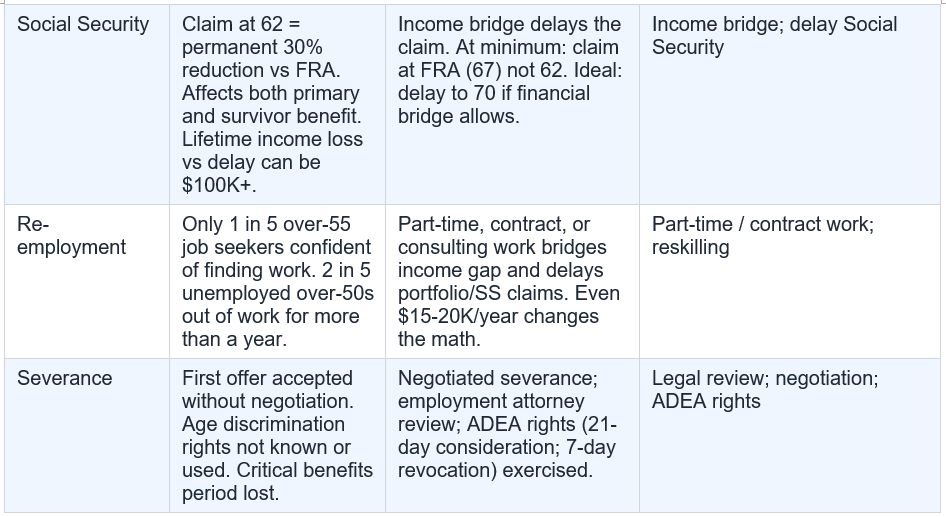
Protect the income bridge by: (1) Negotiating severance — do not accept the first number. Employment attorneys often find room for improvement, especially if the layoff appears age-related. (2) Filing for unemployment compensation immediately — every week of delay is a week of benefits lost. (3) Exploring part-time or contract work — even $15,000-$20,000/year from part-time work dramatically changes the portfolio math. (4) Keeping COBRA or Marketplace coverage to avoid healthcare costs spiralling. (5) Delaying any portfolio withdrawal or Social Security claim for as long as the income bridge can sustain. Not financial advice.
Your options are: COBRA continuation coverage (you keep your existing plan for up to 18 months, paying 100% of the premium plus up to 2% in administrative fees); joining a spouse’s employer plan if they are employed (often the most cost-effective option); or enrolling in a Marketplace plan through healthcare.gov under the Special Enrollment Period triggered by the job loss (60-day window). AARP’s guidance on forced early retirement also flags a critical Medicare timing issue: if you are near 65, failing to enrol in Medicare on time while on COBRA can trigger permanent late-enrolment penalties. COBRA can bridge the gap to Medicare if the job loss occurs within approximately 18 months of turning 65. Not financial advice. Consult a qualified benefits adviser.
Healthcare decision framework after job loss: (1) Age 50-63: COBRA (up to 18 months) OR ACA Marketplace plan. Compare costs — ACA plans with subsidies may be significantly cheaper than COBRA depending on income. Apply to healthcare.gov within 60 days of job loss. (2) Age 63½: COBRA bridges to Medicare at 65 — careful timing of enrolment. (3) Age 65: Enrol in Medicare (Parts A and B). Failing to enrol when eligible — even while on COBRA — triggers permanent Part B late-enrolment penalty of 10% per year of delay. (4) Spouse's plan available: compare cost vs COBRA vs Marketplace — likely the cheapest option. Source: Creative Planning; AARP; Claiborne Progress/Edward Jones. Not financial advice.
The ADEA is specifically relevant here. Under the Age Discrimination in Employment Act, workers over 40 must be given 21 days to consider a severance offer and 7 days to revoke after signing. The offer must include information about other employees who were and were not offered severance (in group layoffs) so that the affected employee can assess whether age discrimination played a role. Many workers do not know these rights. The EEOC filed seven lawsuits under the Age Discrimination Act in fiscal year 2024. The legal landscape exists; using it requires knowing what is owed.
Even a modest improvement in severance — two extra months of salary, continuation of health benefits for an additional period, or outplacement assistance — translates directly into the length of the income bridge, which translates directly into how long the portfolio can continue compounding and how long Social Security can be deferred. Every dollar of negotiated severance is worth more than a dollar of retirement savings withdrawn early. Not legal advice. Consult an employment attorney.
The mechanics are well established: you can claim Social Security as early as age 62, but benefits are permanently reduced by up to 30% compared to claiming at Full Retirement Age (FRA), currently 67 for anyone born in 1960 or later. For every year past FRA you delay up to age 70, benefits increase by approximately 8%. A monthly benefit of $2,000 at FRA becomes approximately $1,400 at 62 (a 30% permanent reduction) or approximately $2,480 at 70 (a 24% increase). If you live to 85, the lifetime income difference between claiming at 62 and 70 is substantial.
The expert consensus after a job loss is to protect Social Security from a panic claim. AARP’s analysis of forced early retirement quotes Heather Schreiber, founder of HLS Retirement Consulting: ‘My last place I would want to draw from would be Social Security.’ Her reasoning is the survivor benefit: for married couples where one partner earned significantly more, claiming early reduces not just their own income but the survivor benefit their spouse would receive for the rest of their life. ‘This is affecting not one life but two.’ Not financial advice.
Protect Social Security by: (1) Not claiming before FRA unless the income bridge cannot sustain the gap — the permanent 30% reduction compounds for life. (2) Using the income bridge (severance + unemployment + part-time work) and conservative portfolio withdrawals to delay the claim as long as feasible. (3) If married: delay the higher earner's claim as long as possible — this maximises both the primary benefit and the survivor benefit. (4) Using a Social Security break-even calculator to understand your specific numbers — break-even for delaying 62→67 is typically age 78-80. (5) If resources are genuinely exhausted: claiming early is better than depleting the entire retirement portfolio or going without healthcare. Source: AARP; Heather Schreiber / HLS Retirement Consulting; Merrill Edge; Motley Fool. Not financial advice.
The decision framework is not binary — it depends on your specific numbers. If you are 62, have a $200,000 portfolio, no severance, no part-time income, and spouse has no employment, the portfolio cannot survive 8 years of withdrawals while you wait for maximum age-70 benefits. That is not a realistic recommendation. If you are 60, have $500,000 in retirement savings, three months of severance, and the capacity for part-time work, delaying Social Security for several years is financially achievable and the lifetime value is significant.
The breakeven calculation is the clearest decision tool. Compare cumulative lifetime benefits from different claiming ages — at the crossover point, delayed claiming has paid off more in total. If your family health history and current health suggest a long life, delay. If health is uncertain, the calculus shifts. Not financial advice. A fee-only financial adviser with Social Security expertise can run your specific numbers.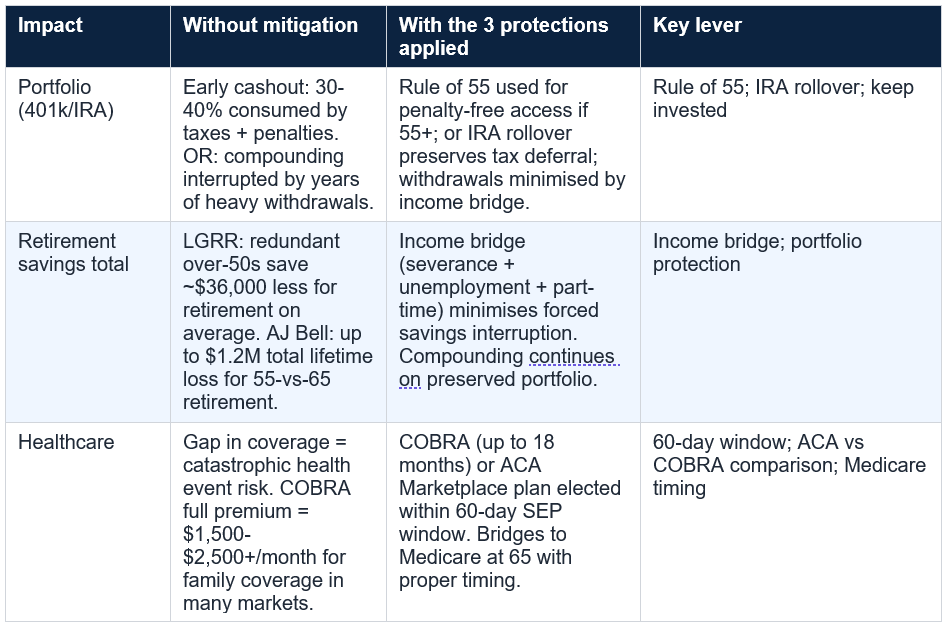
The numbers tell a hard truth: 56% of workers over 50 are forced out before they choose to retire. Over-50s are 17% more likely to face redundancy than their younger colleagues. Two in five who are unemployed over 50 remain out of work for more than a year. These are structural realities about the labour market, not personal failures. And they are exactly the realities that make a clear, specific financial response plan more important than emotional processing in the first 30 days.
This is not the plan you had. It is a real plan, built from what you actually have now, for the retirement you can still protect. Not financial, legal, or tax advice. Consult a fee-only financial adviser (CFP), employment attorney, and CPA for guidance specific to your situation. For free legal assistance on age discrimination, contact the EEOC (eeoc.gov) or an employment attorney who works on contingency in employment matters.
The Rule of 55 is a provision in the US tax code that allows you to take distributions from your 401(k) plan without paying the 10% early withdrawal penalty, provided you left your employer (voluntarily or by layoff) in the calendar year you turned 55 or older (age 50 for public safety workers). You still owe ordinary income tax on distributions — the rule only waives the 10% penalty, not the tax itself. This is a critical lifeline for workers in their late 50s who need income from their retirement account but are below the standard 59½ threshold. Critical caveat: the Rule of 55 applies only to the 401(k) of the specific employer you are separating from at the time of the layoff. It does NOT apply to older 401(k)s from previous employers, and it does NOT apply to IRAs. If you roll your current employer's 401(k) into an IRA before taking distributions, you may lose the Rule of 55 protection — IRA requires 59½ for penalty-free withdrawals (except under SEPP/72(t)). Source: Creative Planning; AARP. Not tax advice. Consult a CPA.
Should I claim Social Security early if I lose my job after 60?
Not automatically, and not as a first response. The advice from multiple financial planning sources — including AARP's expert Heather Schreiber — is to treat early Social Security claiming as a last resort, not a first response to job loss. Claiming at 62 instead of your Full Retirement Age (67 for those born 1960+) permanently reduces your benefit by up to 30%. If you live to 85, that reduction compounds over 23 years of reduced income. For married couples, it also reduces the survivor benefit your spouse receives. The recommended approach: exhaust unemployment compensation, severance, and part-time income first. Use conservative withdrawals from your portfolio (Rule of 55 or post-59½) before claiming Social Security. Delay Social Security as long as the financial bridge allows — even delaying from 62 to 65 or 67 substantially increases lifetime income. However: if delaying Social Security would require fully depleting your retirement portfolio, claiming earlier may be the right decision for your specific situation. Not financial advice. Consult a fee-only CFP who can run your specific numbers.
What are my options for health insurance after losing my job over 55?
You have three main options. (1) COBRA: you keep your existing employer-sponsored plan for up to 18 months, paying 100% of the premium plus up to 2% administrative fee. This is often $1,500-$2,500+ per month for family coverage in many US markets. You have 60 days from job loss to elect COBRA. (2) ACA Marketplace plan: job loss qualifies as a life event triggering a Special Enrollment Period (SEP) — a 60-day window to enrol in a plan via healthcare.gov. Premium subsidies are available based on your income, and with reduced income after job loss, your subsidy may be significant, making Marketplace plans substantially cheaper than COBRA. (3) Spouse's employer plan: if your spouse has employer-sponsored coverage, joining their plan may be the most cost-effective option and is typically cheaper than COBRA. For those approaching 65: COBRA can bridge the gap to Medicare, but you must enrol in Medicare on time at 65. Failing to enrol when eligible (even while on COBRA) can trigger permanent Part B late-enrolment penalties of 10% per year of delay. Sources: AARP; Creative Planning; Claiborne Progress / Edward Jones. Not financial advice.
What rights do I have if I was laid off specifically because of my age?
The Age Discrimination in Employment Act (ADEA) prohibits discrimination against workers aged 40 and over in hiring, firing, layoffs, compensation, and other employment conditions. If you believe your layoff was age-motivated, you have legal recourse. Key protections: (1) Severance agreements: under the Older Workers Benefit Protection Act (OWBPA), workers over 40 must be given 21 days to consider a severance offer and 7 days to revoke after signing. The agreement must disclose which other employees were offered (or not offered) severance in group layoffs. (2) EEOC: you can file a charge with the Equal Employment Opportunity Commission (eeoc.gov). The EEOC filed seven age discrimination lawsuits in fiscal year 2024. (3) Employment attorneys: many take age discrimination cases on contingency (no upfront fee) because the ADEA allows recovery of attorney's fees. Do not sign a severance agreement releasing claims until you have had a qualified employment attorney review it. Do not assume because you signed a severance you have no rights — the agreement must meet OWBPA requirements to be valid. Sources: EEOC; LGRR December 2024; Empower Over 50. Not legal advice. Consult an employment attorney.
What should I do with my 401(k) if I'm laid off at 57?
At 57, you are in the Rule of 55 window (you separated at or after age 55), which means you can take distributions from your current employer's 401(k) without the 10% early withdrawal penalty — though you still owe ordinary income tax. Your options: (1) Leave the money in your former employer's plan if you need penalty-free access before 59½ via the Rule of 55. (2) Roll to an IRA if you don't expect to need the money before 59½ — this gives you maximum investment flexibility and broader fund choices. Do NOT roll to an IRA if you need access before 59½ and would rely on the Rule of 55, because rolling to an IRA removes that protection. (3) Do not cash out — the immediate tax bill plus potential 10% penalty (if you rolled to an IRA and are under 59½) can cost 30-40% of the balance. Prioritise: use unemployment compensation and severance before touching the 401(k). Take only what you genuinely need. Keep the rest invested. Sources: Creative Planning; AARP; Merrill Edge. Not tax or financial advice. Consult a fee-only CFP and CPA.
Table of Contents
- Why Late Career Job Loss Hits Harder Than Any Other
- The Reality: More Than Half of Workers Over 50 Are Forced Out
- The First 30 Days: What to Do Immediately
- Way #1: Protect the Portfolio — What to Do With Your 401(k)
- The Rule of 55: A Lifeline Most People Miss
- The Four 401(k) Options After Job Loss (and the One to Avoid)
- Way #2: Protect the Income Bridge — Healthcare, Severance, and Unemployment
- The Healthcare Gap: The Most Dangerous Cost of Early Job Loss
- Severance: Negotiate Before You Sign
- Way #3: Protect Your Social Security — The Decision That Lasts a Lifetime
- The Social Security Claim Early vs Wait Dilemma
- The Overall Retirement Damage Assessment: What the Numbers Say
- Conclusion: This Was Not the Plan. Here Is the New Plan.
- Frequently Asked Questions
- External References and Further Reading
Why Late Career Job Loss Hits Harder Than Any Other
Losing a job in your 30s is painful but recoverable. The math of time is on your side: decades of saving, investing, and career-rebuilding ahead. Losing a job in your mid-50s or early 60s is categorically different. The damage compounds across three dimensions at once, and each one makes the others worse.First, the savings window closes. The years between 55 and 65 are typically the highest-earning years of a career, and therefore the years of maximum retirement contribution potential. If a $90,000 salary supports $15,000 per year in 401(k) contributions, each year of job loss at this stage is not just $15,000 missing from the account — it is $15,000 that was never invested, never compounded, and never grew. AJ Bell, the UK stockbroker, calculated that someone earning the equivalent of $63,000 forced to retire at 55 instead of 65 would be roughly $1.2 million worse off over their lifetime — approximately $510,000 of that from missed pension contributions and investment returns alone.
Second, re-employment at this stage is genuinely harder. Not just slightly harder — structurally harder, as a documented pattern. Legal & General Retail Retirement’s 2024 research found that over 50s are 17% more likely to face redundancy than younger workers, but then face a wall: 52% of over-50 job seekers believe their age made employers less likely to hire them. Two in five who are unemployed over 50 remain out of work for more than a year. Third, the benefits cliff arrives: health insurance, which has been partially subsidised by the employer, disappears the moment the job ends. Not financial, legal, or tax advice.
The scale of late career job loss (2024-2026): 56% of workers over 50 lose their long-term job before they choose to retire (20-year study, 1,600+ workers, cited Empower Over 50). Over-50s are 17% more likely to face redundancy than younger workers (LGRR 'Missing Midlife Workers' report). 52% of over-50 job seekers (2.99 million people) believe their age made employers less likely to hire them (LGRR / Cebr December 2024). 62% of over-50s made redundant felt their age was a contributing factor (LGRR). During 2022-2025 tech layoffs, over-40s were 1.5x more likely to be cut than younger colleagues (EEOC data). 39% of affected older workers changed their retirement plans. Estimated $36,000 retirement savings shortfall (LGRR). $1.2M total lifetime financial impact for a $63K earner forced to retire at 55 vs 65 (AJ Bell calculations). Sources: LGRR December 2024; Empower Over 50; EEOC; AJ Bell/Daily Telegraph. Not financial advice.
The Reality: More Than Half of Workers Over 50 Are Forced Out
The headline statistic from Empower Over 50’s research summary — 56% of workers over 50 are forced out of their long-term employment before they choose to retire — should be the most widely known number in personal finance. It is not. Most people approaching their late career years assume that because they have built expertise, delivered results, and become organisationally embedded, their position is secure. The data says otherwise.The mechanisms vary. Sometimes it is a genuine restructuring. Sometimes it is a targeted layoff that disproportionately affects senior, higher-salaried workers. The EEOC found that during the mass layoff wave of 2022 through 2025, workers over 40 across the tech industry were approximately 1.5 times more likely to be cut than their younger colleagues. The patterns that push older workers out include being labelled ‘overqualified,’ ‘too close to retirement age,’ or ‘too expensive’ — all documented in Legal & General’s 2024 research. The EEOC enforces the Age Discrimination in Employment Act, but the barriers remain.
The point of this section is not legal strategy — it is emotional and practical preparation. If the majority of workers over 50 face this before they are ready, the rational response is to make sure your financial structure is as resilient as possible before the event. And if the event has already happened, the rational response is the three ways that follow. Not financial advice.
The First 30 Days: What to Do Immediately
The 30 days immediately following a job loss are the ones with the most time-sensitive decisions — and the most expensive mistakes if you miss the windows. Before you do anything with your retirement accounts, before you claim Social Security, before you accept the first severance number offered, there are four practical actions to take urgently.- File for unemployment compensation immediately. Do not wait while you figure out the rest. Benefits take time to start, they are time-limited, and they help preserve your retirement assets by providing an income source while you organise your response. In most states, unemployment compensation is available regardless of age for those who were laid off (not fired for cause).
- Do not touch the 401(k) yet. The worst financial move you can make in the first week is to cash out the retirement account to cover expenses. Taxes and the 10% early withdrawal penalty (if under 55 in the year of separation) can consume 30-40% of the balance immediately. The portfolio is the last resort, not the first.
- Extend your health insurance coverage within 60 days. You have a 60-day window to elect COBRA continuation coverage or enrol in a Marketplace plan via a Special Enrollment Period triggered by the job loss. Miss that window and you may face a gap in coverage.
- Read any severance agreement before signing. Under the Age Discrimination in Employment Act (ADEA), workers over 40 have 21 days to consider a severance offer and 7 days to revoke after signing. Do not sign in the meeting. Have an employment attorney review it first.
Way #1: Protect the Portfolio — What to Do With Your 401(k)
Your 401(k) or 403(b) is probably the largest financial asset you own outside of your home. It took decades to build. In the aftermath of a job loss, it is also under pressure from two directions simultaneously: you may need income from it sooner than planned, and the panic of the moment can push you toward decisions that permanently damage its value. The first way to protect your retirement is to protect the portfolio from both of those threats.The good news is that in most cases, your 401(k) goes nowhere. The money is yours. If you have left a job, voluntarily or not, the account does not disappear. You have several options, and time to evaluate them. The critical principle from every financial planning source is consistent: keep the money invested. Withdrawing and spending it is almost always the worst possible outcome. The money’s value comes from its continued tax-deferred compounding, and every dollar taken out prematurely is a dollar that is taxed now, possibly penalised now, and then unavailable to compound for the next ten to twenty years. Creative Planning’s analysis puts it directly: ‘Keeping this money invested could increase the chances that the money will earn positive returns and could be a potential source of income when you retire.’ Not financial advice.
Protect the portfolio by: (1) NOT cashing out — taxes + possible 10% penalty can consume 30-40% of the balance. (2) Understanding the Rule of 55 if you are 55+ in the year of separation — this may allow penalty-free 401(k) distributions from THIS employer's plan without the 10% penalty. (3) Rolling to an IRA for greater investment flexibility if you don't expect to use the Rule of 55. (4) Resisting the urge to time the market — stay invested in your target allocation. (5) Making conservative withdrawals only after exhausting unemployment, severance, and other income sources. Source: Creative Planning; LPL/EWM; Merrill Edge. Not financial advice.
The Rule of 55: A Lifeline Most People Miss
Most people know that taking money from a 401(k) before age 59½ triggers a 10% early withdrawal penalty. Fewer people know about the Rule of 55 — a provision in the tax code that makes a late career layoff less catastrophic for workers who are 55 or older in the year they lose their job.The rule works like this: if you separate from your employer (voluntarily or involuntarily) in the calendar year you turn 55 or later, you can begin taking distributions from the 401(k) plan of that specific employer without paying the 10% early withdrawal penalty. You still owe ordinary income tax on the distributions — there is no tax-free lunch here — but the 10% penalty is waived. For public safety employees (police, firefighters, EMS), the qualifying age is even lower, at 50.
Creative Planning’s analysis of post-layoff options notes the Rule of 55 explicitly: ‘As long as you turn 55 (or are already older) during the calendar year you leave or lose your job, you can begin taking distributions from your 401(k) without an early withdrawal penalty. And the Rule of 55 doesn’t just work for 401(k) plans — it can also apply to other qualified retirement plans (such as a 403b).’ The critical caveat: it only applies to the retirement plan of the employer you are leaving at the time of separation. If you have older 401(k)s from previous employers, those are NOT covered by the Rule of 55 — they retain the 59½ age threshold for penalty-free withdrawals. This is a common and expensive mistake. Not tax advice. Consult a CPA.
Rule of 55 critical limitation: it applies ONLY to the 401(k) of the employer you are separating from, not to retirement accounts from previous employers. If you roll your current employer's 401(k) into an IRA before taking distributions, you may LOSE the Rule of 55 protection — because IRA rules require age 59½ for penalty-free distributions (with some exceptions like SEPP/72(t)). If you plan to use the Rule of 55, do NOT roll the current employer's 401(k) to an IRA until after you have taken any distributions you need. Source: Creative Planning; AARP. Not tax advice. Consult a CPA.
The Four 401(k) Options After Job Loss (and the One to Avoid)
After a job loss, your employer’s retirement plan gives you four choices. Understanding the difference is worth thousands of dollars. Here they are, in order from most advisable to least:
Way #2: Protect the Income Bridge — Healthcare, Severance, and Unemployment
The second way to protect your retirement after a late career job loss is to build the strongest possible income bridge before you ever need to touch the portfolio or make any Social Security decision. Every month you can fund your living expenses from unemployment compensation, severance, or earned income is a month that your retirement account continues compounding untouched and a month you can defer a Social Security claim that would otherwise be permanently reduced.The income bridge has three components: what the former employer owes you (severance and benefits continuation), what the government provides (unemployment compensation), and what you can earn in the interim (part-time or contract work). Most people in the shock of job loss focus only on the first and forget the compounding value of keeping all three components as large as possible for as long as possible. Not financial advice.
Protect the income bridge by: (1) Negotiating severance — do not accept the first number. Employment attorneys often find room for improvement, especially if the layoff appears age-related. (2) Filing for unemployment compensation immediately — every week of delay is a week of benefits lost. (3) Exploring part-time or contract work — even $15,000-$20,000/year from part-time work dramatically changes the portfolio math. (4) Keeping COBRA or Marketplace coverage to avoid healthcare costs spiralling. (5) Delaying any portfolio withdrawal or Social Security claim for as long as the income bridge can sustain. Not financial advice.
The Healthcare Gap: The Most Dangerous Cost of Early Job Loss
When employer-sponsored health insurance ends with a job, two things happen simultaneously: you lose coverage that was heavily subsidised, and you become fully responsible for your own premium. For many workers in their 50s and 60s, this is the most financially dangerous moment of the entire job loss — not because healthcare is pleasant to think about, but because a single major health event without adequate coverage can wipe out retirement savings in a way that takes years to recover from.Your options are: COBRA continuation coverage (you keep your existing plan for up to 18 months, paying 100% of the premium plus up to 2% in administrative fees); joining a spouse’s employer plan if they are employed (often the most cost-effective option); or enrolling in a Marketplace plan through healthcare.gov under the Special Enrollment Period triggered by the job loss (60-day window). AARP’s guidance on forced early retirement also flags a critical Medicare timing issue: if you are near 65, failing to enrol in Medicare on time while on COBRA can trigger permanent late-enrolment penalties. COBRA can bridge the gap to Medicare if the job loss occurs within approximately 18 months of turning 65. Not financial advice. Consult a qualified benefits adviser.
Healthcare decision framework after job loss: (1) Age 50-63: COBRA (up to 18 months) OR ACA Marketplace plan. Compare costs — ACA plans with subsidies may be significantly cheaper than COBRA depending on income. Apply to healthcare.gov within 60 days of job loss. (2) Age 63½: COBRA bridges to Medicare at 65 — careful timing of enrolment. (3) Age 65: Enrol in Medicare (Parts A and B). Failing to enrol when eligible — even while on COBRA — triggers permanent Part B late-enrolment penalty of 10% per year of delay. (4) Spouse's plan available: compare cost vs COBRA vs Marketplace — likely the cheapest option. Source: Creative Planning; AARP; Claiborne Progress/Edward Jones. Not financial advice.
Severance: Negotiate Before You Sign
If a severance package is offered, the first thing to know is that it is almost always negotiable. Employers offer an initial number because they expect acceptance; many workers, in the shock of job loss, accept without discussion. An employment attorney familiar with age discrimination law can assess whether the severance offer is reasonable, whether there are unpaid benefits or accrued vacation to include, and whether the terms of the separation — the confidentiality clauses, the non-compete provisions, and crucially the release of legal claims — are standard or unusually broad.The ADEA is specifically relevant here. Under the Age Discrimination in Employment Act, workers over 40 must be given 21 days to consider a severance offer and 7 days to revoke after signing. The offer must include information about other employees who were and were not offered severance (in group layoffs) so that the affected employee can assess whether age discrimination played a role. Many workers do not know these rights. The EEOC filed seven lawsuits under the Age Discrimination Act in fiscal year 2024. The legal landscape exists; using it requires knowing what is owed.
Even a modest improvement in severance — two extra months of salary, continuation of health benefits for an additional period, or outplacement assistance — translates directly into the length of the income bridge, which translates directly into how long the portfolio can continue compounding and how long Social Security can be deferred. Every dollar of negotiated severance is worth more than a dollar of retirement savings withdrawn early. Not legal advice. Consult an employment attorney.
Way #3: Protect Your Social Security — The Decision That Lasts a Lifetime
Social Security is the third and most permanent of the three protections. The decision of when to claim — and especially whether to claim early out of financial desperation rather than by informed choice — is one that follows a retiree for the rest of their life and, for married couples, affects the surviving spouse’s income after the primary earner’s death.The mechanics are well established: you can claim Social Security as early as age 62, but benefits are permanently reduced by up to 30% compared to claiming at Full Retirement Age (FRA), currently 67 for anyone born in 1960 or later. For every year past FRA you delay up to age 70, benefits increase by approximately 8%. A monthly benefit of $2,000 at FRA becomes approximately $1,400 at 62 (a 30% permanent reduction) or approximately $2,480 at 70 (a 24% increase). If you live to 85, the lifetime income difference between claiming at 62 and 70 is substantial.
The expert consensus after a job loss is to protect Social Security from a panic claim. AARP’s analysis of forced early retirement quotes Heather Schreiber, founder of HLS Retirement Consulting: ‘My last place I would want to draw from would be Social Security.’ Her reasoning is the survivor benefit: for married couples where one partner earned significantly more, claiming early reduces not just their own income but the survivor benefit their spouse would receive for the rest of their life. ‘This is affecting not one life but two.’ Not financial advice.
Protect Social Security by: (1) Not claiming before FRA unless the income bridge cannot sustain the gap — the permanent 30% reduction compounds for life. (2) Using the income bridge (severance + unemployment + part-time work) and conservative portfolio withdrawals to delay the claim as long as feasible. (3) If married: delay the higher earner's claim as long as possible — this maximises both the primary benefit and the survivor benefit. (4) Using a Social Security break-even calculator to understand your specific numbers — break-even for delaying 62→67 is typically age 78-80. (5) If resources are genuinely exhausted: claiming early is better than depleting the entire retirement portfolio or going without healthcare. Source: AARP; Heather Schreiber / HLS Retirement Consulting; Merrill Edge; Motley Fool. Not financial advice.
The Social Security Claim Early vs Wait Dilemma
The tension in the Social Security decision after a job loss is real and specific: you have lost income, you have expenses that continue, and you know you can start receiving a check right now if you are 62 or older. The Motley Fool’s analysis of early retirement scenarios acknowledges this honestly: ‘Claiming early can also mean withdrawing less from your retirement account, helping your savings last even longer.’ And: ‘If delaying benefits would result in draining your retirement fund, claiming early may be your best bet.’The decision framework is not binary — it depends on your specific numbers. If you are 62, have a $200,000 portfolio, no severance, no part-time income, and spouse has no employment, the portfolio cannot survive 8 years of withdrawals while you wait for maximum age-70 benefits. That is not a realistic recommendation. If you are 60, have $500,000 in retirement savings, three months of severance, and the capacity for part-time work, delaying Social Security for several years is financially achievable and the lifetime value is significant.
The breakeven calculation is the clearest decision tool. Compare cumulative lifetime benefits from different claiming ages — at the crossover point, delayed claiming has paid off more in total. If your family health history and current health suggest a long life, delay. If health is uncertain, the calculus shifts. Not financial advice. A fee-only financial adviser with Social Security expertise can run your specific numbers.
The Overall Retirement Damage Assessment: What the Numbers Say
Conclusion
A late career job loss is not a financial death sentence, even when it feels like one. But it demands a specific, structured response — not panic, and not passivity. The three protections in this article are not abstract principles; they are a sequence: protect the portfolio first, because the mistakes there are the most irreversible. Build the income bridge second, because every month the bridge holds is a month the portfolio keeps compounding and Social Security stays intact. Protect Social Security third, because the decision to claim early — made in the financial stress of the first weeks after a layoff — is one of the few retirement decisions that literally follows you for the rest of your life.The numbers tell a hard truth: 56% of workers over 50 are forced out before they choose to retire. Over-50s are 17% more likely to face redundancy than their younger colleagues. Two in five who are unemployed over 50 remain out of work for more than a year. These are structural realities about the labour market, not personal failures. And they are exactly the realities that make a clear, specific financial response plan more important than emotional processing in the first 30 days.
This is not the plan you had. It is a real plan, built from what you actually have now, for the retirement you can still protect. Not financial, legal, or tax advice. Consult a fee-only financial adviser (CFP), employment attorney, and CPA for guidance specific to your situation. For free legal assistance on age discrimination, contact the EEOC (eeoc.gov) or an employment attorney who works on contingency in employment matters.
Frequently Asked Questions
What is the Rule of 55 and how does it help after a late career layoff?The Rule of 55 is a provision in the US tax code that allows you to take distributions from your 401(k) plan without paying the 10% early withdrawal penalty, provided you left your employer (voluntarily or by layoff) in the calendar year you turned 55 or older (age 50 for public safety workers). You still owe ordinary income tax on distributions — the rule only waives the 10% penalty, not the tax itself. This is a critical lifeline for workers in their late 50s who need income from their retirement account but are below the standard 59½ threshold. Critical caveat: the Rule of 55 applies only to the 401(k) of the specific employer you are separating from at the time of the layoff. It does NOT apply to older 401(k)s from previous employers, and it does NOT apply to IRAs. If you roll your current employer's 401(k) into an IRA before taking distributions, you may lose the Rule of 55 protection — IRA requires 59½ for penalty-free withdrawals (except under SEPP/72(t)). Source: Creative Planning; AARP. Not tax advice. Consult a CPA.
Should I claim Social Security early if I lose my job after 60?
Not automatically, and not as a first response. The advice from multiple financial planning sources — including AARP's expert Heather Schreiber — is to treat early Social Security claiming as a last resort, not a first response to job loss. Claiming at 62 instead of your Full Retirement Age (67 for those born 1960+) permanently reduces your benefit by up to 30%. If you live to 85, that reduction compounds over 23 years of reduced income. For married couples, it also reduces the survivor benefit your spouse receives. The recommended approach: exhaust unemployment compensation, severance, and part-time income first. Use conservative withdrawals from your portfolio (Rule of 55 or post-59½) before claiming Social Security. Delay Social Security as long as the financial bridge allows — even delaying from 62 to 65 or 67 substantially increases lifetime income. However: if delaying Social Security would require fully depleting your retirement portfolio, claiming earlier may be the right decision for your specific situation. Not financial advice. Consult a fee-only CFP who can run your specific numbers.
What are my options for health insurance after losing my job over 55?
You have three main options. (1) COBRA: you keep your existing employer-sponsored plan for up to 18 months, paying 100% of the premium plus up to 2% administrative fee. This is often $1,500-$2,500+ per month for family coverage in many US markets. You have 60 days from job loss to elect COBRA. (2) ACA Marketplace plan: job loss qualifies as a life event triggering a Special Enrollment Period (SEP) — a 60-day window to enrol in a plan via healthcare.gov. Premium subsidies are available based on your income, and with reduced income after job loss, your subsidy may be significant, making Marketplace plans substantially cheaper than COBRA. (3) Spouse's employer plan: if your spouse has employer-sponsored coverage, joining their plan may be the most cost-effective option and is typically cheaper than COBRA. For those approaching 65: COBRA can bridge the gap to Medicare, but you must enrol in Medicare on time at 65. Failing to enrol when eligible (even while on COBRA) can trigger permanent Part B late-enrolment penalties of 10% per year of delay. Sources: AARP; Creative Planning; Claiborne Progress / Edward Jones. Not financial advice.
What rights do I have if I was laid off specifically because of my age?
The Age Discrimination in Employment Act (ADEA) prohibits discrimination against workers aged 40 and over in hiring, firing, layoffs, compensation, and other employment conditions. If you believe your layoff was age-motivated, you have legal recourse. Key protections: (1) Severance agreements: under the Older Workers Benefit Protection Act (OWBPA), workers over 40 must be given 21 days to consider a severance offer and 7 days to revoke after signing. The agreement must disclose which other employees were offered (or not offered) severance in group layoffs. (2) EEOC: you can file a charge with the Equal Employment Opportunity Commission (eeoc.gov). The EEOC filed seven age discrimination lawsuits in fiscal year 2024. (3) Employment attorneys: many take age discrimination cases on contingency (no upfront fee) because the ADEA allows recovery of attorney's fees. Do not sign a severance agreement releasing claims until you have had a qualified employment attorney review it. Do not assume because you signed a severance you have no rights — the agreement must meet OWBPA requirements to be valid. Sources: EEOC; LGRR December 2024; Empower Over 50. Not legal advice. Consult an employment attorney.
What should I do with my 401(k) if I'm laid off at 57?
At 57, you are in the Rule of 55 window (you separated at or after age 55), which means you can take distributions from your current employer's 401(k) without the 10% early withdrawal penalty — though you still owe ordinary income tax. Your options: (1) Leave the money in your former employer's plan if you need penalty-free access before 59½ via the Rule of 55. (2) Roll to an IRA if you don't expect to need the money before 59½ — this gives you maximum investment flexibility and broader fund choices. Do NOT roll to an IRA if you need access before 59½ and would rely on the Rule of 55, because rolling to an IRA removes that protection. (3) Do not cash out — the immediate tax bill plus potential 10% penalty (if you rolled to an IRA and are under 59½) can cost 30-40% of the balance. Prioritise: use unemployment compensation and severance before touching the 401(k). Take only what you genuinely need. Keep the rest invested. Sources: Creative Planning; AARP; Merrill Edge. Not tax or financial advice. Consult a fee-only CFP and CPA.
0 Comments
Be the first to share your thoughts on this article.