
Business
LinkedIn B2B Lead Generation: The 2026 Complete Guide

LinkedIn is responsible for 80% of all B2B leads generated via social media. It is 277% more effective than Facebook and X for B2B lead generation. Its Lead Gen Forms convert at 13% — triple the industry average for landing pages. And yet most B2B teams are using it passively, posting without strategy and connecting without intent. This is the complete, data-backed guide to turning LinkedIn into a systematic lead generation engine in 2026.
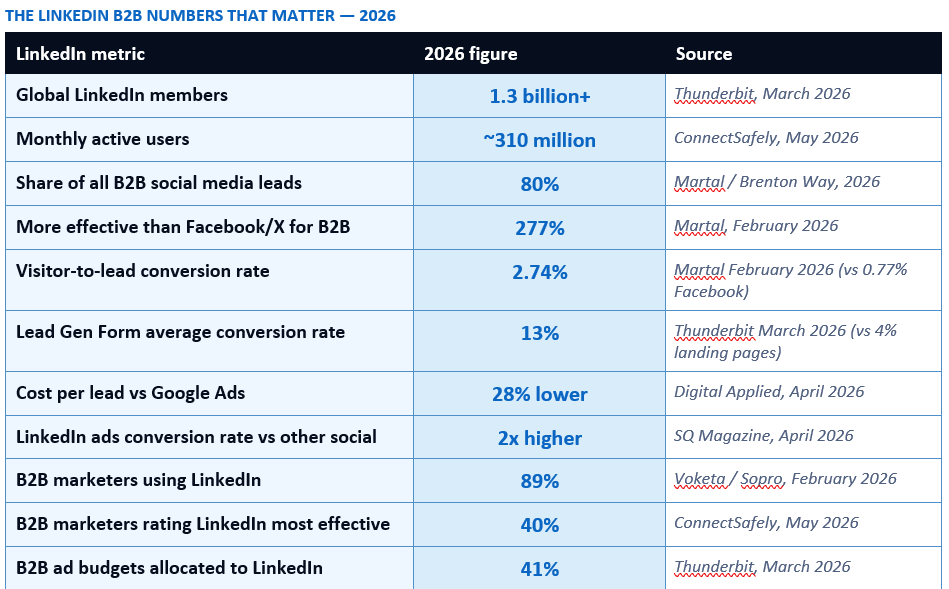
The reason for this structural dominance is not mystery: LinkedIn is where business decision-makers are. According to LinkedIn's own data, four out of five LinkedIn members drive business decisions at their organisations. The platform hosts senior executives, procurement managers, IT decision-makers, CFOs, and founders — the exact people whose buy-in B2B sales require. When you post on LinkedIn, you are posting in the professional context where these people are operating with their business hats on. That context, combined with LinkedIn's unmatched professional targeting capabilities (job title, company size, seniority, industry, skills, and 200+ additional attributes), makes it the highest-signal B2B marketing environment available.
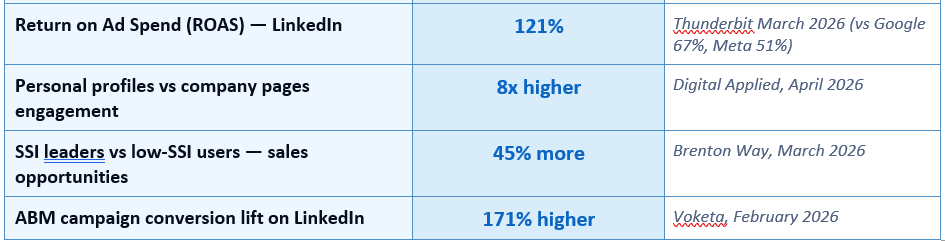
The scale is correspondingly significant: 1.3 billion members globally (Thunderbit), 310 million monthly active users, 41% of all B2B ad budgets now allocated to the platform, and a 121% return on ad spend — outperforming both Google Search (67%) and Meta (51%) in the same B2B benchmark dataset (Thunderbit, March 2026). For any B2B company with an average contract value above $5,000, LinkedIn is not optional — it is the primary digital channel.
LinkedIn generates 75–85% of all B2B leads from social media. 93% of B2B marketers use LinkedIn, and 40% rate it as the most effective channel for quality leads. LinkedIn's cost per lead is 28% lower than Google Ads while delivering 2x higher conversion rates.
— CONNECTSAFELY / LINKEDIN B2B STATISTICS — MAY 2026
The highest-leverage actions for a B2B company page are: writing an About section with the keywords your ICP would use when searching for solutions like yours; using the Products section to describe your offering with customer-benefit language rather than feature lists; posting consistently (companies posting weekly see 2x higher engagement rates); and activating your employees to share and comment on company posts, which amplifies organic reach dramatically. Critically, employee advocacy has a compound effect — Sopro's February 2026 analysis confirms that 53% of B2B marketers use LinkedIn to identify prospects, and seeing your team actively engaging with the company's content signals a healthy, active organisation.
An ICP for LinkedIn should specify: job title and level of seniority (e.g., 'VP of Sales, director level and above at SaaS companies'); industry and sub-industry; company size range (headcount and/or revenue); geography; and any LinkedIn-specific signals that indicate readiness to engage — recently changed jobs (a 30-day activity signal), company growth (a proxy for budget availability), or recent content engagement on topics relevant to your solution.
The practical benefit of ICP definition is not just targeting efficiency. It fundamentally changes how you write content, how you frame connection requests, and how you open conversations. Outreach that specifically references the prospect's seniority, industry, and likely challenges converts at dramatically higher rates than generic messages. LinkedIn allows filtering by all the ICP attributes above in both its free search tools and, more powerfully, in Sales Navigator — which we cover in Step 6.
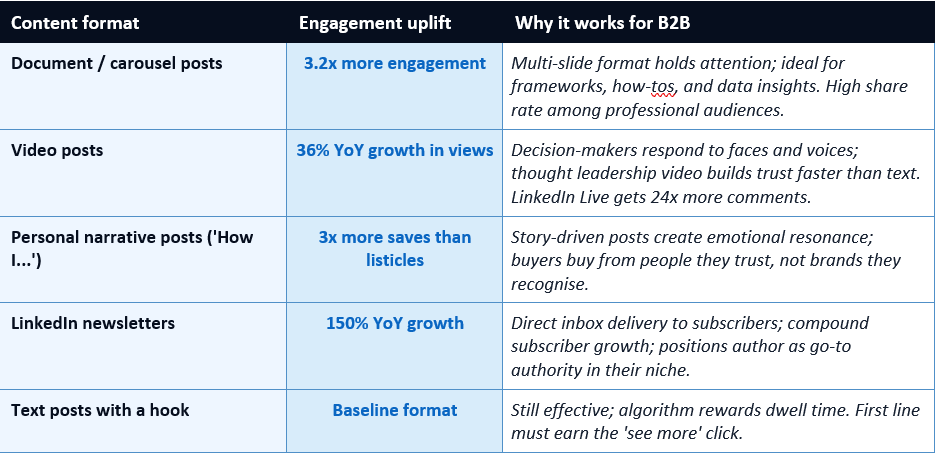
Sources: Digital Applied (April 2026), Thunderbit (March 2026), Voketa (February 2026), ConnectSafely (May 2026).
The single most important content principle for B2B LinkedIn is thought leadership. Thunderbit's March 2026 analysis found that 73% of decision-makers trust thought leadership on LinkedIn more than traditional marketing materials, and 95% of hidden decision-makers say strong thought leadership makes them more receptive to outreach. This is not a soft finding — it means that the content you publish directly determines how your outreach is received. A prospect who has been reading your insights for three months answers your connection request differently from a prospect who has never heard of you.
The key Sales Navigator capabilities that directly improve lead generation quality and efficiency are: advanced lead and account filters that allow ICP-specific searches across 200+ attributes; lead alerts that flag when a prospect changes jobs, gets promoted, publishes content, or is mentioned in the news — all signals of potential buying intent; Account Intelligence that shows company growth, headcount changes, and recent activities at target accounts; and TeamLink, which reveals which of your colleagues have existing connections to target prospects, enabling warm introductions through the team rather than cold outreach.
The connection between Sales Navigator use and commercial outcomes is documented: companies with strong Social Selling Index scores generate 45% more sales opportunities than those with low scores (Brenton Way, March 2026). Sales Navigator is the tool through which SSI is most directly built — by researching prospects, engaging with their content, and building warm relationships rather than sending cold messages.
The practical use case for LGFs is gated content distribution: offer a research report, a practical guide, an event registration, or a checklist in exchange for contact information. Because the prospect's information is already in LinkedIn's system, the completion process takes a single tap — dramatically reducing the drop-off that occurs when you ask prospects to manually complete an off-platform form. The quality of leads is consistently rated as high because LinkedIn users are identified professionals, not anonymous web visitors.
LGFs are best paired with Sponsored Content (promoted posts) rather than text ads for B2B. The combination of a high-value content offer, LinkedIn's precision targeting (to your exact ICP by job title, seniority, company size, and industry), and the frictionless LGF format produces the best cost-per-qualified-lead of any LinkedIn ad format. SQ Magazine's April 2026 analysis confirms: 'Lead Gen Forms and Thought Leader Ads outperform traditional formats on cost per qualified lead.'
LinkedIn Ads carry a higher cost per click than Facebook or Google Ads. The average CPL on LinkedIn is $75 to $100 versus $25 to $50 on Facebook (Voketa, February 2026). But LinkedIn leads convert to revenue at two to three times the rate of other social leads — meaning the higher upfront cost is justified by lower cost-per-closed-deal, not lower cost-per-click. For high-value B2B contracts (average deal sizes above $10,000), LinkedIn's targeting precision and professional context produce better pipeline-to-revenue economics than cheaper, lower-quality alternatives.
Improving your SSI is not a gamification exercise — it is a proxy measure for the activities that actually generate leads. The four SSI dimensions map to the four most high-impact LinkedIn lead generation behaviours: a complete, value-oriented profile (professional brand); targeted ICP searches and prospect identification (finding the right people); meaningful content engagement and original posting (engaging with insights); and personalised connection requests and message sequences (building relationships). Doing all four well consistently produces the best lead generation outcomes; the SSI score reflects how systematically you are doing them.
LinkedIn supports ABM through two primary mechanisms. The first is LinkedIn's Company Targeting in the Ads platform, which allows you to upload a list of target account names and serve ads exclusively to employees of those specific companies. The second is the combination of Sales Navigator's account lists and CRM integration, which allows your sales team to focus all outreach, content engagement, and relationship-building on a precisely defined set of target accounts.
The ABM approach changes how you think about LinkedIn content. Rather than creating broad thought leadership aimed at your ICP persona across all companies, you create content specifically relevant to the challenges, news, and context of your target accounts. SQ Magazine's April 2026 analysis notes '30–50% conversion lift' for ABM and retargeting approaches on LinkedIn. The precision of targeting means smaller audience sizes but dramatically higher relevance and conversion rates per impression.
The ten-step framework in this guide — profile optimisation, company page activation, ICP definition, content strategy, structured outreach, Sales Navigator, Lead Gen Forms, LinkedIn Ads, SSI building, and ABM — is not a set of tactics to try one at a time. It is a system in which each component amplifies the others. Your content builds the trust that makes your outreach welcome. Your profile converts the interest your content generates. Your ads scale the reach your organic activity establishes. Measure the right metrics, avoid the common mistakes, and iterate consistently. LinkedIn B2B lead generation is not a campaign — it is a compounding asset that builds real value over time.
Thunderbit — LinkedIn B2B Marketing Statistics and Trends for 2026 (March 2026) https://thunderbit.com/blog/linkedin-b2b-marketing-statistics-trends
Digital Applied — LinkedIn Statistics 2026: 140+ B2B Marketing Data Points (April 2026) https://www.digitalapplied.com/blog/linkedin-statistics-2026-b2b-marketing-data
SQ Magazine — LinkedIn Advertising Statistics 2026: Big Wins (April 2026) https://sqmagazine.co.uk/linkedin-advertising-statistics/
ConnectSafely — 100+ LinkedIn Statistics 2026: Revenue, Users, Engagement Rate (May 2026) https://connectsafely.ai/articles/linkedin-statistics-2026
Brenton Way — 60+ LinkedIn Marketing Statistics for 2026 (March 2026) https://brentonway.com/blog/linkedin-marketing-stats
Voketa — 75+ LinkedIn Statistics Every Marketer Needs in 2026 (February 2026) https://www.voketa.com/blog/linkedin-statistics-2026
Sopro — 62 LinkedIn Lead Generation Statistics for 2025 (February 2026) https://sopro.io/resources/blog/linkedin-lead-generation-statistics/
Ryesing — LinkedIn Lead Generation for B2B: 2026 Strategy Guide (March 2026) https://www.ryesing.com/post/a-guide-to-linkedin-lead-generation-for-b2b-growth
Prospeo — 12 B2B Lead Generation Tactics That Work in 2026 https://prospeo.io/s/lead-generation-tactics-b2b
TABLE OF CONTENTS
- Why LinkedIn Is the B2B Lead Generation Platform in 2026
- Step 1: Optimise Your Profile as a Lead Magnet
- Step 2: Optimise Your Company Page
- Step 3: Define Your Ideal Customer Profile on LinkedIn
- Step 4: Build a Content Strategy That Attracts Decision-Makers
- Step 5: Structured Outreach — Connection Requests and Messaging
- Step 6: LinkedIn Sales Navigator — The Power Tool for B2B
- Step 7: LinkedIn Lead Gen Forms — The Highest-Converting Ad Format
- Step 8: LinkedIn Ads for B2B — When and How to Use Them
- Step 9: Building Your Social Selling Index Score
- Step 10: Account-Based Marketing on LinkedIn
- Measuring What Matters: LinkedIn B2B Metrics and KPIs
- Common LinkedIn Lead Generation Mistakes to Avoid
- Conclusion
- Frequently Asked Questions
- References
Why LinkedIn Is the B2B Lead Generation Platform in 2026
LinkedIn is not simply the largest professional network in the world. It is the platform that has structurally won the B2B lead generation market in a way that shows no sign of reversing. The data from 2026 makes this case conclusively: LinkedIn is responsible for 80% of all B2B leads generated via social media, is 277% more effective than Facebook and X for B2B lead generation, generates a visitor-to-lead conversion rate of 2.74% versus Facebook's 0.77%, and delivers a 28% lower cost per qualified lead than Google Ads. Its Lead Gen Forms convert at 13% on average — triple the industry standard for landing pages (Thunderbit, March 2026).The reason for this structural dominance is not mystery: LinkedIn is where business decision-makers are. According to LinkedIn's own data, four out of five LinkedIn members drive business decisions at their organisations. The platform hosts senior executives, procurement managers, IT decision-makers, CFOs, and founders — the exact people whose buy-in B2B sales require. When you post on LinkedIn, you are posting in the professional context where these people are operating with their business hats on. That context, combined with LinkedIn's unmatched professional targeting capabilities (job title, company size, seniority, industry, skills, and 200+ additional attributes), makes it the highest-signal B2B marketing environment available.
The scale is correspondingly significant: 1.3 billion members globally (Thunderbit), 310 million monthly active users, 41% of all B2B ad budgets now allocated to the platform, and a 121% return on ad spend — outperforming both Google Search (67%) and Meta (51%) in the same B2B benchmark dataset (Thunderbit, March 2026). For any B2B company with an average contract value above $5,000, LinkedIn is not optional — it is the primary digital channel.
LinkedIn generates 75–85% of all B2B leads from social media. 93% of B2B marketers use LinkedIn, and 40% rate it as the most effective channel for quality leads. LinkedIn's cost per lead is 28% lower than Google Ads while delivering 2x higher conversion rates.
— CONNECTSAFELY / LINKEDIN B2B STATISTICS — MAY 2026
Step 1: Optimise Your Profile as a Lead Magnet
Your LinkedIn profile is not a CV — it is your primary B2B conversion tool. Every element should answer one question from a prospective buyer's perspective: 'What is in this for me?' Ryesing's March 2026 guide makes this explicit: 'Your LinkedIn profile isn't just a digital CV; it's your primary conversion tool. Every element, from your headline to your Featured section, should be optimised to answer a prospect's core question: What's in it for me?'The headline: value proposition, not job title
Most LinkedIn headlines read 'Senior Account Executive at [Company Name].' This is a missed opportunity. Your headline appears in every search result, every comment, every connection request, and every message you send. Replace your job title with a value-oriented statement that your ideal customer would find immediately relevant. Instead of 'B2B Sales Manager,' try 'Helping SaaS companies cut customer acquisition costs by 30% | B2B Growth.' The difference in profile click-through rate is significant and documented.The About section: lead magnet
Write your About section from the buyer's perspective, not the seller's. The first two lines are the most critical — they appear without the 'see more' click and determine whether prospects keep reading. Lead with the problem you solve, for whom you solve it, and the result you deliver. Include a clear call to action at the end — 'DM me to discuss' or 'Book a 20-minute call via the link below' — and make it easy to follow.The Featured section: conversion engine
The Featured section, displayed prominently below your About section, is the highest-visibility real estate on your profile for directing prospect action. Use it for: a link to your best-performing content piece, a case study PDF, a booking link, or a product demo. This is where passive profile visitors can be converted into active leads without any outreach required.Step 2: Optimise Your Company Page
While personal profiles generate eight times more engagement than company pages (Digital Applied, April 2026), the company page is still the brand credibility anchor that prospects check before responding to individual outreach. Ryesing's 2026 guide notes that 'far too many businesses treat this as an afterthought, leaving it as a bare-bones digital storefront. This is a massive missed opportunity.' Company pages with complete information get 30% more weekly views (Voketa, February 2026).The highest-leverage actions for a B2B company page are: writing an About section with the keywords your ICP would use when searching for solutions like yours; using the Products section to describe your offering with customer-benefit language rather than feature lists; posting consistently (companies posting weekly see 2x higher engagement rates); and activating your employees to share and comment on company posts, which amplifies organic reach dramatically. Critically, employee advocacy has a compound effect — Sopro's February 2026 analysis confirms that 53% of B2B marketers use LinkedIn to identify prospects, and seeing your team actively engaging with the company's content signals a healthy, active organisation.
Step 3: Define Your Ideal Customer Profile on LinkedIn
LinkedIn's targeting capabilities are only valuable if you know precisely who you are targeting. Before any outreach, advertising, or content effort, define your Ideal Customer Profile (ICP) in LinkedIn-specific terms. Ryesing's 2026 guide states that 'having a crystal-clear buyer persona is non-negotiable here. If you haven't nailed this down, you're flying blind.'An ICP for LinkedIn should specify: job title and level of seniority (e.g., 'VP of Sales, director level and above at SaaS companies'); industry and sub-industry; company size range (headcount and/or revenue); geography; and any LinkedIn-specific signals that indicate readiness to engage — recently changed jobs (a 30-day activity signal), company growth (a proxy for budget availability), or recent content engagement on topics relevant to your solution.
The practical benefit of ICP definition is not just targeting efficiency. It fundamentally changes how you write content, how you frame connection requests, and how you open conversations. Outreach that specifically references the prospect's seniority, industry, and likely challenges converts at dramatically higher rates than generic messages. LinkedIn allows filtering by all the ICP attributes above in both its free search tools and, more powerfully, in Sales Navigator — which we cover in Step 6.
Step 4: Build a Content Strategy That Attracts Decision-Makers
Content is the highest-leverage organic lead generation mechanism on LinkedIn because it brings qualified prospects to you, rather than requiring you to find and contact each one individually. The 2026 content performance data changes how smart B2B teams allocate their content investment.Sources: Digital Applied (April 2026), Thunderbit (March 2026), Voketa (February 2026), ConnectSafely (May 2026).
The single most important content principle for B2B LinkedIn is thought leadership. Thunderbit's March 2026 analysis found that 73% of decision-makers trust thought leadership on LinkedIn more than traditional marketing materials, and 95% of hidden decision-makers say strong thought leadership makes them more receptive to outreach. This is not a soft finding — it means that the content you publish directly determines how your outreach is received. A prospect who has been reading your insights for three months answers your connection request differently from a prospect who has never heard of you.
Step 5: Structured Outreach — Connection Requests and Messaging
LinkedIn outreach is the bridge between your content (which builds passive awareness) and your pipeline (which requires direct conversation). The difference between effective and ineffective LinkedIn outreach is not persistence — it is relevance and personalisation.Connection requests: short, specific, and value-focused
Ryesing's 2026 guide explicitly warns against the 'spray and pray' approach: 'Forget the old tactic of blasting out connection requests. That's a fast track to getting ignored.' A connection request note should be fewer than 200 characters, reference something specific about the prospect (a recent post they wrote, a shared mutual connection, their company's recent news), and give a clear reason why connecting would be valuable to them. A three-sentence note with a specific reference point outperforms a generic 'I'd love to connect' by orders of magnitude.The message sequence: give before you ask
After connecting, the most effective B2B outreach sequences follow a give-before-you-ask model. The first message provides genuine value — a relevant insight, a useful resource, a thoughtful question about their situation — without any sales intent. The second message follows up on what you shared or asks a diagnostic question. Only the third or fourth touchpoint introduces any kind of commercial suggestion, and even then as a soft offer rather than a pitch. Most founders and salespeople invert this sequence, leading with their pitch and wondering why nobody responds.High-converting LinkedIn outreach sequence — a B2B template framework
- Connection request note (keep under 200 chars): 'Hi [Name] — I've been following your posts on [topic]. Building a network of [ICP description]. Would love to connect.' Reference something real; keep it human.
- Message 1 — value first (day 2–3 after connecting): 'Hi [Name] — I wrote a short piece on [relevant topic your ICP struggles with] — sharing in case it's useful. Happy to discuss if it sparks any thoughts.' No ask. Genuine value only.
- Message 2 — engage on their world (day 7–10): 'Saw that [Company] recently [relevant news/growth/challenge]. Are you finding that [common pain point in their situation]? Curious how you're approaching it.' Diagnostic question about them, not a pitch about you.
- Message 3 — soft offer (day 14–21): 'Based on our conversation / what I've seen at [ICP peer companies], [your solution] typically helps with exactly this. Happy to share how if useful — or not, if it's not relevant to where you are right now.' Permission-based and low-pressure.
- Follow-up (optional, day 30): A brief check-in referencing something new — a relevant article, a LinkedIn post of theirs, industry news. Keeps the conversation open without being pushy.
Step 6: LinkedIn Sales Navigator — The Power Tool for B2B
LinkedIn Sales Navigator is the premium prospecting tool that gives B2B teams access to advanced search filters, real-time buying signals, and CRM integration that dramatically outperforms LinkedIn's free search capabilities. For any B2B team doing serious pipeline work on LinkedIn, it is a standard investment.The key Sales Navigator capabilities that directly improve lead generation quality and efficiency are: advanced lead and account filters that allow ICP-specific searches across 200+ attributes; lead alerts that flag when a prospect changes jobs, gets promoted, publishes content, or is mentioned in the news — all signals of potential buying intent; Account Intelligence that shows company growth, headcount changes, and recent activities at target accounts; and TeamLink, which reveals which of your colleagues have existing connections to target prospects, enabling warm introductions through the team rather than cold outreach.
The connection between Sales Navigator use and commercial outcomes is documented: companies with strong Social Selling Index scores generate 45% more sales opportunities than those with low scores (Brenton Way, March 2026). Sales Navigator is the tool through which SSI is most directly built — by researching prospects, engaging with their content, and building warm relationships rather than sending cold messages.
Step 7: LinkedIn Lead Gen Forms — The Highest-Converting Ad Format
LinkedIn Lead Gen Forms (LGFs) are native forms embedded directly in LinkedIn ads that pre-populate with the prospect's LinkedIn profile data — name, email, job title, company, and other fields — eliminating the form-filling friction that kills conversion on external landing pages. The performance data is compelling: LGFs convert at 13% on average versus 4% for landing pages, and can reduce cost per lead by approximately 25% compared to driving traffic off-platform (SQ Magazine, April 2026; Thunderbit, March 2026).The practical use case for LGFs is gated content distribution: offer a research report, a practical guide, an event registration, or a checklist in exchange for contact information. Because the prospect's information is already in LinkedIn's system, the completion process takes a single tap — dramatically reducing the drop-off that occurs when you ask prospects to manually complete an off-platform form. The quality of leads is consistently rated as high because LinkedIn users are identified professionals, not anonymous web visitors.
LGFs are best paired with Sponsored Content (promoted posts) rather than text ads for B2B. The combination of a high-value content offer, LinkedIn's precision targeting (to your exact ICP by job title, seniority, company size, and industry), and the frictionless LGF format produces the best cost-per-qualified-lead of any LinkedIn ad format. SQ Magazine's April 2026 analysis confirms: 'Lead Gen Forms and Thought Leader Ads outperform traditional formats on cost per qualified lead.'
Step 8: LinkedIn Ads for B2B — When and How to Use Them
LinkedIn Ads carry a higher cost per click than Facebook or Google Ads. The average CPL on LinkedIn is $75 to $100 versus $25 to $50 on Facebook (Voketa, February 2026). But LinkedIn leads convert to revenue at two to three times the rate of other social leads — meaning the higher upfront cost is justified by lower cost-per-closed-deal, not lower cost-per-click. For high-value B2B contracts (average deal sizes above $10,000), LinkedIn's targeting precision and professional context produce better pipeline-to-revenue economics than cheaper, lower-quality alternatives.
The core B2B ad formats and when to use them
Sponsored Content (promoted posts) is the most versatile format — it reaches your ICP's feed with content that appears organic. Best used for thought leadership amplification and LGF-backed content offers. Conversation Ads deliver personalised messages directly to prospects' inboxes, with 50% open rates and 12% click-through rates — significantly outperforming standard Message Ads (38% open rate, 3–3.6% CTR) according to Salesso's analysis. Thought Leader Ads, which promote posts from individual employees' profiles rather than company pages, leverage the 8x personal-profile engagement advantage and are rated by Martal as one of the formats 'outperforming traditional formats on cost per qualified lead' in 2026.Step 9: Building Your Social Selling Index Score
The Social Selling Index (SSI) is LinkedIn's proprietary measure of how effectively you use the platform for sales activities. It scores four dimensions: establishing your professional brand, finding the right people, engaging with insights, and building relationships. Companies with strong SSI scores generate 45% more sales opportunities than those with low scores (Brenton Way, March 2026).Improving your SSI is not a gamification exercise — it is a proxy measure for the activities that actually generate leads. The four SSI dimensions map to the four most high-impact LinkedIn lead generation behaviours: a complete, value-oriented profile (professional brand); targeted ICP searches and prospect identification (finding the right people); meaningful content engagement and original posting (engaging with insights); and personalised connection requests and message sequences (building relationships). Doing all four well consistently produces the best lead generation outcomes; the SSI score reflects how systematically you are doing them.
Step 10: Account-Based Marketing on LinkedIn
Account-Based Marketing (ABM) — targeting a defined list of specific companies rather than broad persona-defined audiences — generates some of the strongest outcomes in LinkedIn B2B. Voketa's February 2026 data shows ABM campaigns on LinkedIn achieve 171% higher conversion rates than standard campaigns.LinkedIn supports ABM through two primary mechanisms. The first is LinkedIn's Company Targeting in the Ads platform, which allows you to upload a list of target account names and serve ads exclusively to employees of those specific companies. The second is the combination of Sales Navigator's account lists and CRM integration, which allows your sales team to focus all outreach, content engagement, and relationship-building on a precisely defined set of target accounts.
The ABM approach changes how you think about LinkedIn content. Rather than creating broad thought leadership aimed at your ICP persona across all companies, you create content specifically relevant to the challenges, news, and context of your target accounts. SQ Magazine's April 2026 analysis notes '30–50% conversion lift' for ABM and retargeting approaches on LinkedIn. The precision of targeting means smaller audience sizes but dramatically higher relevance and conversion rates per impression.
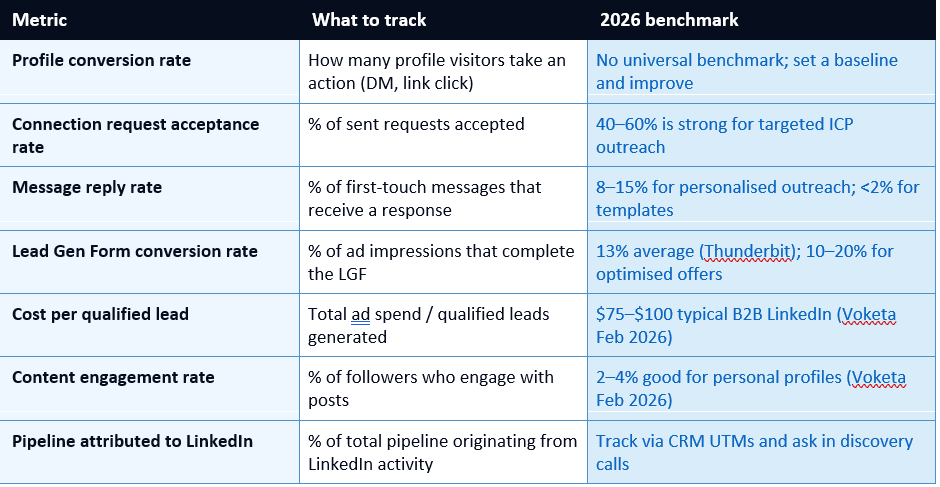
Measuring What Matters: LinkedIn B2B Metrics and KPIs
Tracking the right metrics is what separates LinkedIn activity from LinkedIn results. Most teams track vanity metrics — likes, impressions, follower growth — while ignoring the performance indicators that reveal whether their LinkedIn activity is generating pipeline and revenue.Common LinkedIn Lead Generation Mistakes to Avoid
The seven most common LinkedIn B2B lead generation mistakes — and how to fix them
- Posting from the company page and ignoring personal profiles: Personal profiles generate 8x more engagement than company pages (Digital Applied, April 2026). Build a culture of individual thought leadership among your team — salespeople, executives, and founders — and use the company page as a credibility anchor, not the primary content vehicle.
- Leading with a sales pitch in the first message: The single most common and most damaging LinkedIn outreach mistake. A pitch in the first message signals that you care more about selling than understanding the prospect's situation. Always lead with value or genuine curiosity. Reserve your offer for message three or four, once you have established that the conversation is mutually relevant.
- Gating all your best content: Prospeo's 2026 B2B lead generation analysis notes: 'Stop gating your best content. Gate demos and tools, not PDFs. Ungated content reaches the 95%.' Ungated thought leadership builds the trust and authority that makes gated offers worth completing. Gating everything produces high MQL counts and low conversion rates.
- Ignoring the LinkedIn algorithm's format preferences: In 2026, document posts outperform plain text by 3.2x, video views are growing at 36% YoY, and LinkedIn Live generates 24x more comments than static posts. Allocating 100% of content to text posts misses the highest-engagement formats entirely.
- Treating LinkedIn as a set-and-forget channel: LinkedIn requires consistent daily or weekly activity — posting, commenting on prospects' content, sending personalised connection requests, and following up on conversations. The algorithm rewards consistent activity with disproportionately higher organic reach. Bursts of activity followed by silence produce no compounding effect.
- Not tracking pipeline attribution: Most LinkedIn B2B marketers track impressions and engagement but not pipeline. Without knowing how many deals originate from LinkedIn activity, you cannot make evidence-based decisions about where to invest your LinkedIn time and budget. Add a LinkedIn source field to your CRM and ask every discovery call lead how they found you.
- Using automation tools that send generic bulk messages: LinkedIn's abuse detection has significantly improved. Automated bulk connection campaigns with generic messages are increasingly resulting in account restrictions, and they generate response rates below 1% — far below what personalised outreach achieves. Volume without relevance is not a lead generation strategy; it is a reputation-destruction strategy.
CONCLUSION
LinkedIn is not a social network with some B2B marketing features bolted on. It is the dominant B2B lead generation platform, responsible for 80% of all B2B social media leads, 277% more effective than any competing social channel, and delivering a 13% Lead Gen Form conversion rate that no off-platform alternative consistently matches. The data from 2026 is unambiguous about the platform's primacy in B2B marketing. The question is not whether to use LinkedIn for lead generation — it is whether you are using it systematically or casually.The ten-step framework in this guide — profile optimisation, company page activation, ICP definition, content strategy, structured outreach, Sales Navigator, Lead Gen Forms, LinkedIn Ads, SSI building, and ABM — is not a set of tactics to try one at a time. It is a system in which each component amplifies the others. Your content builds the trust that makes your outreach welcome. Your profile converts the interest your content generates. Your ads scale the reach your organic activity establishes. Measure the right metrics, avoid the common mistakes, and iterate consistently. LinkedIn B2B lead generation is not a campaign — it is a compounding asset that builds real value over time.
Frequently Asked Questions
How effective is LinkedIn for B2B lead generation compared to other platforms?
LinkedIn is the dominant B2B lead generation platform by a significant margin. According to Martal's February 2026 analysis, LinkedIn is responsible for 80% of all B2B leads generated via social media and is 277% more effective than Facebook and X for B2B lead generation. Its visitor-to-lead conversion rate is 2.74%, compared with 0.77% for Facebook. LinkedIn's Lead Gen Forms convert at 13% on average — triple the industry benchmark for landing pages. LinkedIn also delivers a 121% return on ad spend in B2B campaigns, outperforming both Google Search (67%) and Meta (51%) in the same dataset (Thunderbit, March 2026). For B2B companies with average contract values above $5,000, no other digital channel consistently outperforms LinkedIn on a cost-per-qualified-lead basis.What is the LinkedIn Social Selling Index (SSI) and why does it matter?
The Social Selling Index (SSI) is LinkedIn's measure of how effectively you use the platform for professional relationship-building and sales activities. It scores four dimensions: establishing your professional brand (complete, compelling profile and consistent content), finding the right people (using search and Sales Navigator to identify ICP-matched prospects), engaging with insights (commenting, sharing, and creating relevant content), and building relationships (personalised connection requests and meaningful conversations). Companies with strong SSI scores generate 45% more sales opportunities than those with low scores, according to Brenton Way's March 2026 data. Improving SSI is not about gaming a metric — it is about doing the activities that actually generate leads more consistently and systematically.What is the best content format for B2B lead generation on LinkedIn in 2026?
Document/carousel posts outperform plain text by 3.2x in engagement (Digital Applied, April 2026), making them the highest-performing organic content format for B2B. Video posts are growing at 36% year-on-year in views, and LinkedIn Live generates 24x more comments than static posts. Personal narrative 'How I...' posts generate 3x more saves than listicle formats. LinkedIn Newsletters are growing at 150% year-on-year and deliver direct inbox access to subscribers — a high-value distribution mechanism for thought leadership. For paid formats, Lead Gen Forms and Thought Leader Ads outperform traditional display and text ad formats on cost per qualified lead. The most important strategic principle is personal over corporate — personal profile posts generate 8x more engagement than equivalent content from company pages.How do LinkedIn Lead Gen Forms work and are they worth using?
LinkedIn Lead Gen Forms are native forms embedded directly in LinkedIn sponsored content that pre-populate with the prospect's LinkedIn profile data — removing the friction of manual form completion. When a prospect clicks your ad, a form appears with their name, email, job title, and other fields already filled in from their LinkedIn profile. They confirm in one tap. The result is a 13% average conversion rate (Thunderbit, March 2026) versus the industry standard 4% for external landing pages, and a 25% reduction in cost per lead compared with driving traffic off-platform (SQ Magazine, April 2026). They are particularly effective for distributing gated content (research reports, guides, event registrations) to precisely defined ICP audiences. The trade-off is that LGF leads can include some lower-intent prospects who complete the form out of interest in the content rather than buying intent — building a follow-up qualification step into your workflow is important.What is the best LinkedIn outreach message for B2B cold outreach?
The most effective LinkedIn B2B outreach follows a give-before-you-ask sequence that prioritises relevance and personalisation over volume. For a connection request note, keep it under 200 characters, reference something specific about the prospect (a post they wrote, recent company news, a shared context), and give a genuine reason to connect. After connecting, send a first message that provides value — a relevant insight, a useful resource — with no sales intent. The second message engages with their situation diagnostically ('Are you finding that [common pain point]?'). Only the third or fourth touchpoint introduces any commercial offer, framed as a low-pressure option. Message reply rates of 8–15% are achievable for genuinely personalised outreach. Generic templated messages that lead with a pitch typically achieve below 2% reply rates and increasingly trigger LinkedIn's abuse detection, risking account restriction.How much should I budget for LinkedIn Ads for B2B in 2026?
The average cost per lead on LinkedIn B2B ads is $75 to $100, compared with $25 to $50 on Facebook (Voketa, February 2026). LinkedIn CPCs are higher, but LinkedIn leads convert to revenue at 2 to 3 times the rate of other social leads, making the cost-per-closed-deal more competitive than the headline CPL suggests. A reasonable starting test budget for LinkedIn B2B advertising is $2,000 to $5,000 per month — enough to generate meaningful data on audience response, format performance, and lead quality without committing to a large investment before you have validated your ICP targeting and offer. LinkedIn recommends a minimum daily budget of $10 per campaign for meaningful reach. Industries like SaaS, financial services, and consulting frequently see 3% to 5% conversion rates on lead gen campaigns, making a $2,000 monthly budget capable of generating 20 to 40 qualified leads in the right sectors.References
Martal — LinkedIn Statistics 2026: Global Trends and Social Selling Data (February 2026) https://martal.ca/linkedin-statistics-lb/Thunderbit — LinkedIn B2B Marketing Statistics and Trends for 2026 (March 2026) https://thunderbit.com/blog/linkedin-b2b-marketing-statistics-trends
Digital Applied — LinkedIn Statistics 2026: 140+ B2B Marketing Data Points (April 2026) https://www.digitalapplied.com/blog/linkedin-statistics-2026-b2b-marketing-data
SQ Magazine — LinkedIn Advertising Statistics 2026: Big Wins (April 2026) https://sqmagazine.co.uk/linkedin-advertising-statistics/
ConnectSafely — 100+ LinkedIn Statistics 2026: Revenue, Users, Engagement Rate (May 2026) https://connectsafely.ai/articles/linkedin-statistics-2026
Brenton Way — 60+ LinkedIn Marketing Statistics for 2026 (March 2026) https://brentonway.com/blog/linkedin-marketing-stats
Voketa — 75+ LinkedIn Statistics Every Marketer Needs in 2026 (February 2026) https://www.voketa.com/blog/linkedin-statistics-2026
Sopro — 62 LinkedIn Lead Generation Statistics for 2025 (February 2026) https://sopro.io/resources/blog/linkedin-lead-generation-statistics/
Ryesing — LinkedIn Lead Generation for B2B: 2026 Strategy Guide (March 2026) https://www.ryesing.com/post/a-guide-to-linkedin-lead-generation-for-b2b-growth
Prospeo — 12 B2B Lead Generation Tactics That Work in 2026 https://prospeo.io/s/lead-generation-tactics-b2b
0 Comments
Be the first to share your thoughts on this article.