

Knowledge
Medicare Replacing ID Numbers for 1.3 Million Enrollees

Table of Contents
- What Actually Happened: The Data Breach Behind the Change
- The Key Facts at a Glance
- What Changed — and What Did Not
- What Changed
- What Did NOT Change
- What Affected Beneficiaries Should Do
- The Scam Threat: How Fraudsters Are Exploiting This Change
- What This Tells Us About Medicare Data Security
- Conclusion
- Frequently Asked Questions (FAQ)
- External References
If you are a Medicare beneficiary who received an unexpected new Medicare card in the mail earlier this year, you are not alone — and you are not in trouble. Approximately 1.3 million Medicare enrollees across the United States received brand-new Medicare cards in March 2026, with updated Medicare Beneficiary Identifier (MBI) numbers that became active on April 14, 2026. The change was initiated by the Centers for Medicare & Medicaid Services (CMS) and was directly linked to data breach incidents involving Medicare claims processing vendors that had compromised the personal identifiers of approximately 1.9% of the total Medicare beneficiary population.
For the vast majority of the 1.3 million affected beneficiaries, this change is administrative in nature: your coverage, your premiums, your benefits, and your healthcare providers all remain exactly the same. The only thing that changed is the specific 11-character alphanumeric identifier printed on your Medicare card, which doctors, pharmacies, hospitals, and insurance companies use to process claims and verify your eligibility. But because the change involves a new card, a new number, and the word 'data breach,' it has understandably generated significant confusion, concern, and — importantly — a wave of scam attempts targeting affected beneficiaries.
This guide covers everything you need to know: what actually happened, exactly what changed and what did not, what you should do if you received a new card, what to do if you believe you should have received one but did not, the specific scam tactics being used to exploit this situation, and how to protect your Medicare benefits and personal information going forward.
What Actually Happened: The Data Breach Behind the Change
The Centers for Medicare & Medicaid Services (CMS) notified Medicare plans in early March 2026 that it had processed 1.3 million Medicare Beneficiary Identifier reassignments, with a planned effective date of April 14, 2026. While CMS did not issue a detailed public explanation of the specific incident or incidents that triggered the mass reissuance, analysis by Medicare insurance industry sources — including Ritter Insurance Marketing's broker communication published on March 11, 2026 — indicated that the reassignments were almost certainly a response to one or more data breaches from claims processing vendors who handle Medicare billing on behalf of healthcare providers.This type of incident — a third-party vendor breach rather than a direct breach of CMS systems — has become a recurring vulnerability in American healthcare data security. Claims processing vendors sit at the intersection of enormous volumes of patient data and the billing infrastructure that connects providers, payers, and government healthcare programs, making them attractive targets for cybercriminals and creating a systemic exposure point whose risk is partially outside the direct control of any single insurer or government agency.
The decision to reissue MBIs rather than simply investigate and contain the breach reflects CMS's recognition that once a Medicare identifier has been compromised, it can be used indefinitely for fraudulent billing claims unless it is changed. Fraudulent Medicare billing — in which bad actors submit claims for services never rendered using stolen patient identifiers — represents billions of dollars in losses to the Medicare program annually, and the administrative cost of reissuing 1.3 million identifiers is a justified investment in fraud prevention relative to the claims exposure created by compromised numbers remaining active.
Total Medicare beneficiaries in the US: ~67.5 million people — with approximately 1.3 million receiving new MBIs in this reissuance, roughly 1.9% of the total Medicare population was affected — a targeted response to specific identified compromise rather than a wholesale system change (CDC / CMS Enrollment Data, 2026)
The Key Facts at a Glance
The table below provides a concise reference for the most important facts about the 2026 MBI reissuance: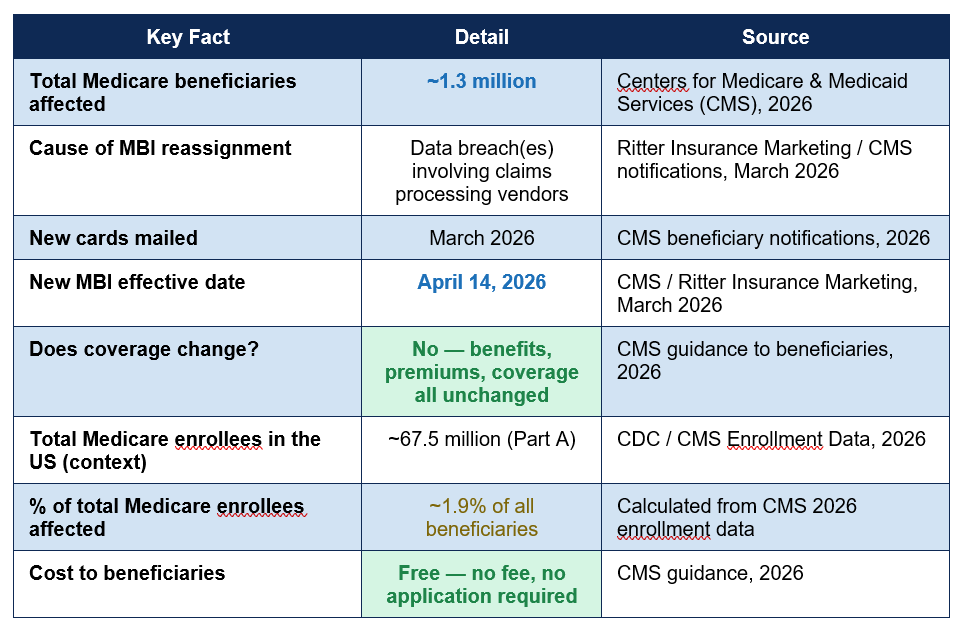
What is a Medicare Beneficiary Identifier (MBI)? The MBI is the unique, 11-character alphanumeric identifier printed on every Medicare card, introduced in 2018 to replace the previous system that used Social Security Numbers as Medicare identifiers. Removing Social Security Numbers from Medicare cards was itself a major fraud-prevention step — using SSNs as patient identifiers created obvious identity theft risk every time a Medicare card was presented at a healthcare appointment. The 2026 MBI reassignment continues this evolution, replacing specific compromised identifiers with new ones rather than waiting for fraud to materialize.
What Changed — and What Did Not
The single most important message for affected beneficiaries is that this change is narrowly administrative. Understanding exactly what is and is not different is essential for avoiding both unnecessary worry and practical disruptions to your healthcare.What Changed
- The 11-character MBI printed on your Medicare card — and used by doctors, pharmacies, hospitals, and insurers to process your claims.
- The number stored in CMS's billing systems that healthcare providers use to verify your eligibility and submit claims.
- The card itself, which was mailed as a replacement and reflects the new MBI on its face.
What Did NOT Change
- Your Medicare coverage — Part A, Part B, or Medicare Advantage plan.
- Your premiums, deductibles, copayments, or out-of-pocket maximums.
- Your covered benefits, including prescriptions covered under Part D.
- Your Medicare Advantage plan, supplemental coverage, or any other insurance you hold.
- Your relationship with your doctors, specialists, pharmacies, or hospitals.
- Your Social Security benefit payments or any other government benefits.
The practical implication of the MBI change becoming active on April 14, 2026 is straightforward but important: from that date, any healthcare claim or pharmacy transaction submitted using the old MBI would be rejected by Medicare's billing system with an error code (specifically AAA72, used by claims processors to indicate an inactive or no-longer-valid MBI). This is why updating your providers with your new number as promptly as possible was so important for those who received a new card.
What Affected Beneficiaries Should Do
For the 1.3 million beneficiaries who received a new card, the action steps are specific and time-sensitive, even though the change itself was processed automatically by CMS:- Begin using the new card immediately from April 14, 2026: If you received your new card and the effective date has passed, switch to the new card for all Medicare-related interactions. Present the new card at medical appointments, provide the new number to your pharmacy, and use it wherever your Medicare number is required.
- Notify all healthcare providers proactively: Contact your primary care physician, specialists, pharmacy, and any other providers you see regularly and give them your new MBI. Do not wait until your next appointment — a proactive phone call or message prevents billing rejections that can delay medication dispensing or claims processing. Providers who try to verify your eligibility using the old number on or after April 14 will receive an error and may need your new number urgently.
- Securely destroy the old card: Shred the old Medicare card immediately — do not simply throw it in the trash. The old MBI, while deactivated in Medicare's billing system, could still be used by identity thieves to attempt to access other records or accounts where the same number may have been stored.
- Review your Medicare Summary Notices and Explanation of Benefits statements: For the weeks and months following the card change, pay specific attention to your Medicare statements to confirm that claims are being processed correctly and that there are no unfamiliar charges. Any billing activity you do not recognise should be reported to Medicare immediately.
- If you did not receive a new card: If you believe you should have received a new card but did not — or are unsure whether you are among the 1.3 million — call 1-800-MEDICARE (1-800-633-4227) directly to verify your status. Do not rely on any other source that contacts you proactively claiming to know whether you are affected.
The Scam Threat: How Fraudsters Are Exploiting This Change
Any time Medicare makes a change that affects large numbers of beneficiaries, scammers move quickly to exploit the confusion, and the 2026 MBI reissuance has been no exception. The New York StateWide Senior Action Council specifically warned in April 2026 that beneficiaries should be on high alert for a range of fraud attempts directly tied to the card change.The table below sets out the clearest distinction between a scam attempt and the legitimate process:
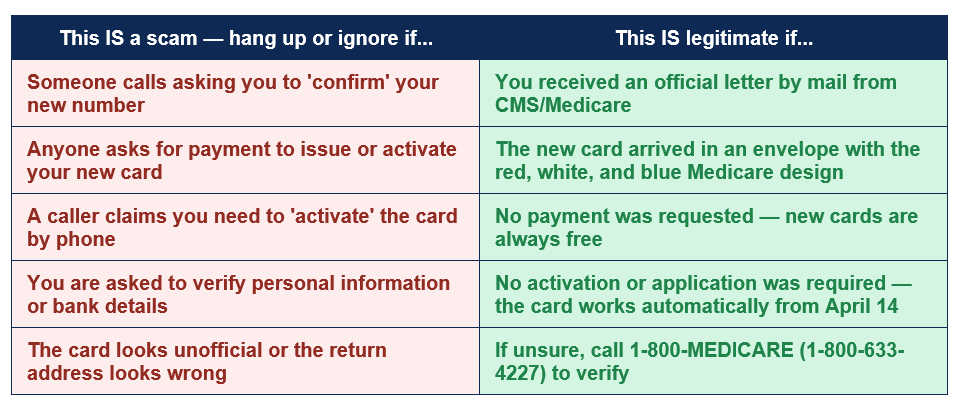
CRITICAL SCAM WARNING: Medicare will NEVER call you, email you, or text you asking for your new Medicare number, your old Medicare number, your Social Security Number, your bank account details, or any payment to process your new card. The new card was mailed automatically and is completely free. If you receive any contact claiming to be from Medicare asking for any of this information, hang up immediately and call 1-800-MEDICARE (1-800-633-4227) to report it.
The specific scam patterns observed in connection with this reissuance include callers claiming to be CMS or Medicare representatives who need to 'verify' or 'activate' the new number, phishing emails asking beneficiaries to click a link to confirm their identity, and in-person solicitors at senior centres or community events offering to help update Medicare records in exchange for personal information. None of these are legitimate; Medicare does not require beneficiary action to activate the new card, and the only trustworthy number to call with questions is 1-800-MEDICARE.
What This Tells Us About Medicare Data Security
The 2026 MBI reissuance is a significant event, but it is not an isolated one. It fits within a broader pattern of recurring data security challenges in American healthcare that have affected tens of millions of people over the past several years, and it raises legitimate questions about the structural vulnerabilities in the claims processing ecosystem that serves federal healthcare programmes.The specific vulnerability exploited in this incident — a breach at a third-party claims processing vendor rather than at CMS systems directly — illustrates a recurring challenge in healthcare data security: the most sensitive patient data and billing identifiers flow not only through government systems but through the extensive network of private companies that handle billing, eligibility verification, and claims adjudication on behalf of the healthcare system. When these vendors are breached, the exposure can be enormous, as illustrated by the Change Healthcare breach of 2024, which affected a reported 100 million Americans and disrupted Medicare and Medicaid claims processing across the country for weeks.
CMS's response — proactively reissuing 1.3 million MBIs rather than waiting for fraud to materialise — represents a more aggressive fraud-prevention posture than has sometimes been taken in response to data incidents, and reflects the programme's awareness that compromised Medicare identifiers can be used to generate fraudulent billing claims for months or years if left active. For the 67 million people on Medicare who were not part of this specific reissuance, the episode is still a reminder that healthcare identity data is a high-value target, and that protecting your Medicare statements, card, and number is a genuine ongoing priority rather than a one-time task.
Conclusion
The replacement of Medicare Beneficiary Identifiers for 1.3 million enrollees in 2026 was a significant, coordinated response to a real data security threat — one that, while concerning in its cause, was handled in a way that protected affected beneficiaries without changing a single aspect of their coverage, benefits, or premiums. New cards were mailed in March 2026, the new MBIs became active on April 14, and for the approximately 1.9% of Medicare beneficiaries who were part of the reissuance, the practical requirement was straightforward: start using the new card, tell your providers, destroy the old one.What makes this episode consequential beyond the immediate administrative change is what it reveals about the vulnerability of healthcare data in a system that routes enormous volumes of sensitive patient information through private claims processing vendors alongside government infrastructure. The 2024 Change Healthcare breach set a grim benchmark; the 2026 MBI reissuance is a data point in an ongoing challenge rather than a resolved incident. For Medicare beneficiaries, the most effective responses remain the same regardless of which specific incident prompts them: protect your Medicare card and number, review your Medicare statements for unfamiliar activity, and hang up on any unsolicited contact asking for personal information or payment.
For those who received a new card and have already updated their providers: good. For those who are only now learning about the change: call 1-800-MEDICARE to confirm your status and get current guidance directly from the source. And for everyone on Medicare, whether or not you were among the 1.3 million: your benefits remain exactly what they were. This was an identifier change, not a coverage change — and knowing that distinction clearly is the first and most important step in navigating it.
Frequently Asked Questions (FAQ)
Why did Medicare send me a new card with a new number?
CMS issued new Medicare Beneficiary Identifier (MBI) numbers to approximately 1.3 million beneficiaries whose existing MBIs were compromised in a data breach affecting Medicare claims processing vendors. The reissuance is a fraud-prevention measure designed to prevent your Medicare number from being used to submit fraudulent billing claims. Your coverage, benefits, and premiums are completely unchanged.Do I have to do anything to make the new card work?
No activation is required. New MBIs became active automatically on April 14, 2026. What you do need to do is start using the new card immediately from that date, inform your doctors, pharmacies, and other providers of your new number, and securely shred and dispose of your old card. If you present the old card at a healthcare appointment after April 14, the provider will receive an error code when trying to verify your eligibility and will need your new number.Will my Medicare coverage, premiums, or benefits change?
No. The only thing that changed is the 11-character identifier number on your Medicare card. Your Part A and Part B coverage, your Medicare Advantage or supplemental plan, your Part D prescriptions, your deductibles, copayments, and premiums are all exactly as they were before. This is purely an administrative security change to your identifier, not a modification of your coverage.I received a call saying I need to confirm my new Medicare number — is this legitimate?
No. This is a scam. Medicare will never call you, email you, or text you asking you to confirm, verify, or activate a new Medicare card or number. If you receive any contact of this kind, hang up immediately. Do not provide your Medicare number, Social Security Number, or any personal or financial information. Report the contact by calling 1-800-MEDICARE (1-800-633-4227) or the Senior Medicare Patrol (SMP) at 877-808-2468.How do I know if I was among the 1.3 million who received a new card?
If you were affected, you should have received a new Medicare card in the mail during March 2026, accompanied by a letter from CMS explaining the change. If you did not receive a new card and are unsure whether you were affected, call Medicare directly at 1-800-MEDICARE (1-800-633-4227) to verify your current MBI status. Do not call any other number that contacts you proactively claiming to know your status — use only the official Medicare helpline.
External References
The following authoritative sources were used in researching this article and are recommended for further reading:1. Ritter Insurance Marketing — 1.3 Million Medicare Beneficiary Identifiers to Be Reissued in March 2026
https://ritterim.com/blog/1-3-million-medicare-beneficiary-identifiers-to-be-reissued-in-march-2026/
2. Pennsylvania Health Law Project — New Medicare Cards Issued to 1.3 Million People
https://www.phlp.org/en/news/new-medicare-cards-issued-to-1-3-million-people
3. Yahoo Finance / NY StateWide Senior Action Council — Important Change Coming for Some Medicare Beneficiaries (April 15, 2026)
https://finance.yahoo.com/news/important-change-coming-medicare-beneficiaries-133000876.html
4. SavingAdvice.com — The 1.3 Million List: Why Medicare Is Replacing ID Numbers (April 20, 2026)
https://www.savingadvice.com/articles/2026/04/20/10731926_the-1-3-million-list-why-medicare-is-replacing-id-numbers-for-1-3-million-enrollees.html
5. Verification of Benefits — Medicare Is Issuing New Patient ID Numbers Due to a Data Breach
https://verificationofbenefits.com/medicare-is-issuing-new-patient-id-numbers-due-to-a-data-breach/
6. Stephanie Allard Consulting — New Medicare ID Numbers Effective April 14, 2026: Are You Ready?
https://www.stephanieallardconsulting.com/articles/new-medicare-id-numbers-effective-april-14-2026-are-you-ready
7. Medicare.gov — Official Medicare Homepage
https://www.medicare.gov/
8. Senior Medicare Patrol (SMP) — Report Medicare Fraud: 1-877-808-2468
https://www.smpresource.org/
0 Comments
Be the first to share your thoughts on this article.