

Professional & Career Development
Nursing: America’s Most Reliable Path to Prosperity

Table of Contents
- The Career That Inflation Cannot Touch
- The Numbers That Make the Case: Nursing’s Salary Ladder
- The Labor Market No Other Career Can Match
- AI-Resistant, Recession-Proof: Why Nursing Is Different
- The Three Wealth-Building Paths in Nursing
- Travel Nursing: The Six-Figure Fast Track
- Advanced Practice: Where Nursing Becomes a True Profession of Prosperity
- The Regional Opportunity Map
- What It Costs to Get There — and Why the ROI Is Exceptional
- The Honest Downsides: What Every Aspiring Nurse Should Know
- Conclusion: The Prosperity Path That Works in Any Economy
- Frequently Asked Questions
- External References
The Career That Inflation Cannot Touch
Across the American economy in 2026, nearly every category of worker is watching something erode. College-educated office workers face displacement from AI automation. Manufacturing workers contend with reshoring uncertainty and technological substitution. White-collar professionals in finance, legal research, and marketing are watching AI tools reduce headcount in their sectors. Even software engineers — the most celebrated well-paid career of the past generation — are experiencing a hiring slowdown as AI-assisted coding tools reduce the labour intensity of software development.Against this backdrop, nursing stands apart. The nursing profession is growing faster than the overall economy, paying salaries that rival or exceed many professions requiring four-year or even graduate degrees, offering a ladder from entry-level wages to six-figure earnings without requiring decades of waiting, and providing one structural advantage that virtually no other career in America can claim: the demand for skilled nurses is driven by human biology and population ageing, not by business cycle or technological substitution.
This article makes the case that nursing has become the single most reliable path to sustained financial prosperity available to American workers in 2026. Not the most glamorous, and not without real costs and challenges. But the most reliable, the most durable, and the most accessible to the widest range of people regardless of their starting point.
Healthcare in January 2026: Healthcare contributed 82,000 jobs to the US economy in January 2026 — representing nearly 63%, or two-thirds, of the 130,000 total jobs added nationwide that month. — Bureau of Labor Statistics, reported by Nurse.Org, February 2026
The Numbers That Make the Case: Nursing’s Salary Ladder
The financial case for nursing is best understood as a ladder with multiple rungs, each representing a combination of education investment and return that is highly visible, well-documented, and achievable without luck or unusual circumstances.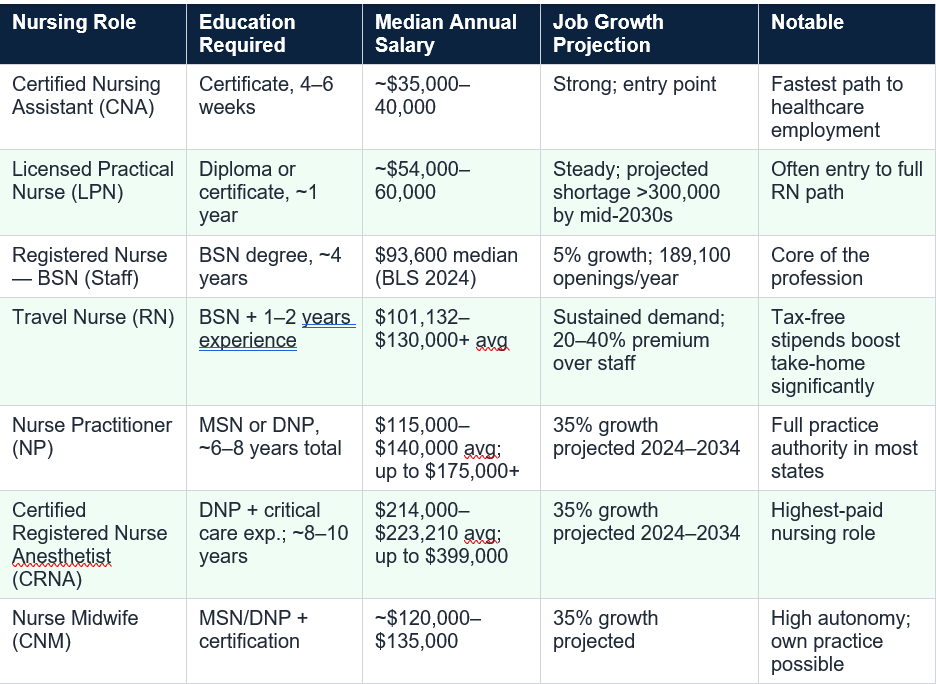
The spread is remarkable. A CNA entering the healthcare workforce this year with six weeks of training is earning $35,000 to $40,000. A CRNA at the top of the same profession is earning $214,000 on average, with the highest earners reaching nearly $400,000. Every step between those two points is defined by specific, achievable education milestones and a salary return that consistently pays off the education investment quickly.
NurseSalaryIntel’s 2026 salary data analysis found that the BSN degree pays for itself in under two years of practice, and the nurse practitioner degree pays for itself in under 14 months. These are exceptional return-on-investment figures by any measure of educational economics. The NP degree ROI in 14 months is faster than virtually any other graduate credential outside of specialist medicine.
The Labor Market No Other Career Can Match
The Bureau of Labor Statistics projects employment of registered nurses to grow 5 percent from 2024 to 2034, faster than average for all occupations, translating to approximately 189,100 openings per year. For advanced practice registered nurses — nurse practitioners, nurse anesthetists, and nurse midwives — the projection is a staggering 35 percent growth over the same decade, among the fastest growth rates in the entire occupational landscape.But the BLS projections, as significant as they are, understate the depth of the structural demand. According to the 2025 NSI National Health Care Retention and RN Staffing Report, hospitals hired roughly 385,000 RNs in 2024 alone to backfill positions from a turnover rate of approximately 16 percent. This means the profession generates demand not just from new population needs but from its own turnover cycle — creating a steady, structural floor of hiring that does not disappear even in recessions.
Compare this to other high-earning fields. In January 2026, financial activities shed 22,000 jobs while federal government employment declined by 34,000. Technology sector layoffs have been a recurring headline since 2022. Law firm hiring has contracted with AI-assisted document review reducing paralegal and junior associate headcount. Healthcare was the only major sector adding jobs consistently and at scale.
AI-Resistant, Recession-Proof: Why Nursing Is Different
Every generation of workers faces the question of which jobs technology will eventually replace. The current generation is confronting the AI automation question with greater urgency than any before it, because large language models and robotics are encroaching into cognitive work that was previously assumed to be safe from automation.Nursing is not immune to AI’s influence — AI diagnostic tools, clinical decision support systems, and documentation automation are all changing how nurses work. But there is a strong consensus among both economists and technology analysts that nursing itself — the bedside presence, physical assessment, patient education, emotional support, and clinical judgment that define the core of nursing practice — cannot be automated in any form currently foreseeable. A 2025 McKinsey survey found that nurses are cautiously optimistic about AI, with about two-thirds hoping to see more AI tools incorporated into their work, framing AI as an assistant to nursing rather than a replacement for it.
The recession-proof quality of nursing comes from the same source as its AI resistance: it serves a need that does not diminish in downturns. People get sick, have babies, and need surgery regardless of economic conditions. The 2008–2009 recession — the worst American economic contraction since the Great Depression — saw healthcare employment continue to grow while every other major sector contracted. The pattern repeated in 2020 and in the 2025 labour market slowdown that saw BLS revise overall job growth sharply downward while healthcare added 82,000 jobs in a single month.
The AI insurance argument: Nursing is among the small number of professional careers where AI is expected to be additive rather than substitutive. When your career’s core value is the application of human judgment, empathy, and physical presence to a vulnerable person in their most challenging moment, it is structurally resistant to replacement by large language models.
The Three Wealth-Building Paths in Nursing
Path 1: The Education Ladder
The most traditional wealth-building path in nursing is the credential ladder: CNA to LPN to RN to BSN to specialty certification to APRN. Each step is a defined, achievable investment with a quantifiable return. The key financial advantage of this path over the four-year degree-then-career model is that nurses earn meaningful incomes at every step — an LPN earns $54,000 to $60,000 while working toward an RN degree through an LPN-to-RN bridge programme. A staff RN earning $93,600 is working toward a nurse practitioner degree at nights and weekends. The income does not stop while the credentials accumulate.Path 2: Travel Nursing
Travel nursing represents the income maximisation path for RNs who want to build wealth quickly without advancing their degree. Average travel nurse salary in 2026 is approximately $101,132 per year, but the structure of travel nurse compensation — with tax-free housing and meal stipends that are not counted as taxable income — means that take-home pay is typically significantly higher than the gross figure suggests. ICU travel nurses can earn $2,600 to $4,500 per week. CRNA travel assignments can reach $7,000 per week. A disciplined travel nurse who maintains a tax home, works consistently, and saves aggressively can build substantial wealth in five to seven years.Path 3: Advanced Practice — The Professional Income Path
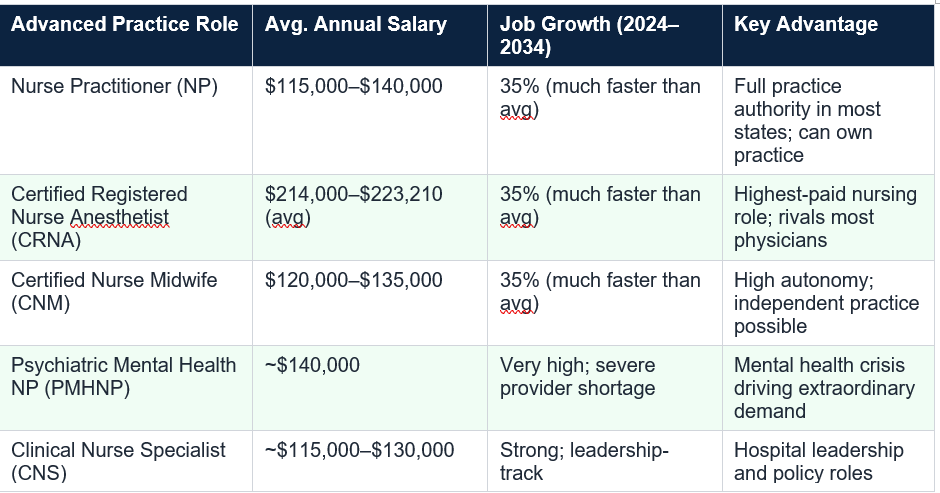
The advanced practice path — becoming a nurse practitioner, CRNA, certified nurse midwife, or clinical nurse specialist — is where nursing fully competes with traditional high-earning professional careers. NPs earn $115,000 to $140,000 on average nationally in 2026, with psychiatric mental health NPs leading specialties at approximately $140,000 annually, reflecting the national mental health crisis and severe shortage of psychiatric providers. CRNAs at $214,000 to $223,000 on average are earning more than most primary care physicians. Many open their own practices, particularly in states that grant full independent practice authority.Travel Nursing: The Six-Figure Fast Track
For an RN with one to two years of hospital experience who is willing to accept 13-week contracts in different locations, travel nursing provides the fastest legal path to a six-figure income available to someone with a two-to-four-year degree in any field. The average travel nurse salary of $101,132 per year is a national average across all experience levels and specialties. ICU and critical care nurses, OR nurses, and those willing to work crisis assignments earn considerably more.The tax structure of travel nursing is a significant financial advantage that is not widely understood outside the profession. Because travel nurses are away from their permanent tax home, they qualify for tax-free housing and meal stipends that do not appear as taxable income. These stipends are governed by General Services Administration rates and can add $1,200 to $2,400 per month in non-taxable compensation. A travel nurse earning $90,000 in taxable wages and $18,000 in tax-free stipends has an effective compensation package worth significantly more than $108,000 from a tax-efficiency standpoint.
Travel nursing does come with real trade-offs. Contracts typically run 13 weeks. Benefits are generally less comprehensive than permanent staff positions. Building long-term relationships with a single healthcare system is not possible. Housing arrangements in new cities require consistent effort. These are genuine costs, and travel nursing is not a sustainable long-term lifestyle for everyone. But as a five-to-eight-year wealth acceleration strategy for an RN who wants to build savings, pay off student loans, and establish a financial foundation, it has few equivalents in the US economy.
Advanced Practice: Where Nursing Becomes a True Profession of Prosperity
The transformation of nursing from a respectable professional career to a path to genuine financial prosperity is most visible at the advanced practice level. Nurse practitioners in 2026 earn between $115,000 and $140,000 on average nationally, with top earners in California and New York exceeding $175,000. Psychiatric mental health nurse practitioners, reflecting the national mental health crisis, are among the highest-compensated NP specialties at approximately $140,000.CRNAs stand in a category of their own. At $214,000 to $223,000 average annual salary — with travel CRNA assignments reaching $259,707 on average and the highest earners approaching $400,000 — CRNAs earn more than most primary care physicians and many specialists. The path requires a DNP-level graduate degree plus at least two years of critical care nursing experience, making it an eight-to-ten-year commitment from the start of nursing training. But it is a defined path with known milestones, known costs, and a known destination.
The Regional Opportunity Map
Nursing salaries and career opportunities are not evenly distributed across the United States, and understanding the regional landscape matters for maximising the financial return of a nursing career.
- California: Consistently the highest-paying state for RNs and NPs. California’s mandatory nurse-to-patient staffing ratios, enacted law, make nurses structurally more valuable per unit of labour and drive salaries higher than any other state. NPs in California average $158,500+. RN salaries are among the nation’s highest.
- Texas: Leading the country with a projected 24.1% increase in nursing positions. Texas combines low state income taxes with strong healthcare system growth, making it a strong financial choice despite lower nominal salaries than California.
- Florida: 21.4% projected growth, driven by one of the largest elderly populations in the country and a growing retirement population from across the Northeast. High demand for geriatric and home healthcare nurses specifically.
- New York, Washington, Alaska, Massachusetts: Among the highest-paying states by average nurse salary. New York City hospitals offer top-of-market compensation. Washington state offers strong union-negotiated contracts.
- Rural and underserved areas: Frequently offer loan forgiveness programmes, relocation bonuses, and premium pay to attract nurses. National Health Service Corps loan repayment of up to $55,000 is available for nurses in qualifying shortage areas.
What It Costs to Get There — and Why the ROI Is Exceptional
No discussion of nursing as a prosperity path is complete without honest accounting of the cost to enter the profession. Nursing is not cheap to enter, and the advanced practice paths carry genuine financial investment. But the return on that investment is among the most favourable available in American higher education.- ADN (Associate Degree in Nursing, 2 years): $10,000 to $40,000, depending on institution. Produces an entry-level RN, eligible for the NCLEX licensing exam.
- BSN (Bachelor of Science in Nursing, 4 years): $40,000 to $120,000. The standard credential for hospital employment. Increasingly required for magnet hospitals and Level 1 trauma centres.
- MSN/DNP for Nurse Practitioner or CRNA: $30,000 to $80,000+ for the graduate degree. CRNA programmes tend to be more expensive. NP programmes increasingly offered online with lower costs.
Many nurses also receive tuition assistance from employers. The 2025 Healthcare Market Report noted that hospitals and academic institutions are offering incentives including tuition reimbursement, student loan repayment, and sign-on bonuses to recruit and retain nurses. IRS rules allow employers to provide up to $5,250 per year in tuition assistance tax-free. A nurse pursuing a CRNA degree with employer tuition assistance and a hospital loan repayment programme may reach the credential with very little net debt.
The Honest Downsides: What Every Aspiring Nurse Should Know
The case for nursing as an American prosperity path is strong. But it comes with real costs and honest challenges that any person considering this path deserves to understand clearly.- Physical and emotional demands: Nursing is physically demanding work. Long shifts — typically 12 hours — involve constant movement, patient lifts, and sustained concentration. Burnout is a documented and serious challenge. The ANA reports nurse burnout is on the rise, and ‘stress and burnout’ is consistently cited as the core reason nurses leave the workforce.
- The new graduate hiring bottleneck: Despite the broad nursing shortage, new BSN graduates sometimes struggle to land their first hospital job in competitive urban markets. Hospitals are tightening budgets and preferring experienced nurses. Rural areas and specialty clinics have openings; urban academic medical centres can be competitive for new graduates.
- Night, weekend, and holiday shifts: The 24/7 nature of healthcare means nursing schedules are not nine-to-five. Night shift differentials and overtime premiums do boost income, but the lifestyle costs are real and should be factored into any honest assessment of nursing as a career.
- The faculty shortage creates a programme access bottleneck: Each year, tens of thousands of qualified applicants are turned away from nursing programmes due to insufficient faculty and clinical placement sites. Getting into a nursing programme is competitive, particularly for community college ADN programmes in high-demand areas.
Conclusion
The conditions that make nursing the most reliable path to American prosperity in 2026 are not temporary. They are structural. The United States has an ageing population that will require more healthcare for the next 20 to 30 years. The nursing workforce’s own demographic composition — with a median nurse age of 52 and a wave of retirements expected through the early 2030s — means the demand from population ageing will be compounded by supply-side contraction. The AI technology cycle is making nurses more productive but not fewer in number. And the salary ladder from CNA to CRNA, with its clearly defined steps and quantifiable returns at each level, provides a financial roadmap that most professions cannot match.This is not to say nursing is the right path for every person. The physical demands are real. The emotional weight of caring for patients in the worst moments of their lives is significant and requires genuine vocation. The schedule constraints are a genuine quality-of-life consideration. And the entry barriers — competitive programme admissions, licensing exams, and the cost of advanced degrees — require real effort and investment.
But for any American family asking the question of which career path in 2026 combines the best balance of job security, income growth potential, AI resistance, recession resilience, and accessibility across socioeconomic backgrounds, the answer is nursing. The data makes the case clearly, and the case gets stronger every year the structural conditions that drive it remain in place.
Frequently Asked Questions
Is nursing a good career for financial stability in 2026?
Yes, by virtually every measurable indicator. The BLS projects 189,100 RN job openings per year through 2034. Healthcare added 82,000 jobs in January 2026 alone. The median RN salary is $93,600 nationally, significantly above the national median for all occupations. Advanced practice nurses — NPs and CRNAs — earn $115,000 to $220,000+ on average. Nursing is one of the few professions that has grown consistently through every recession of the past 30 years.What is the highest-paying nursing career?
The Certified Registered Nurse Anesthetist (CRNA) is consistently the highest-paid nursing role, averaging $214,000 to $223,210 per year nationally according to BLS and NurseSalaryIntel 2026 data. Travel CRNAs can earn $259,707 on average, with the highest earners approaching $400,000. The path requires a DNP-level degree and at least two years of critical care nursing experience, making it an eight-to-ten-year commitment from the start of training.How much does a travel nurse make in 2026?
The average travel nurse salary in 2026 is approximately $101,132 per year, or $2,165 per week, according to MedPro Healthcare Staffing’s 2026 analysis. ICU travel nurses earn $2,600 to $4,500 per week. Travel CRNAs average $259,707 annually. These figures do not fully reflect take-home income because travel nurses also receive tax-free housing and meal stipends that can add $1,200 to $2,400 per month in non-taxable compensation.How fast is nursing growing compared to other careers?
RN employment is projected to grow 5% from 2024 to 2034, faster than average for all occupations. Advanced practice nurses (NPs, CRNAs, CNMs) are projected to grow 35% over the same period, among the fastest growth rates of any occupation category. For context, technology careers are growing more slowly than these projections in some specialties due to AI productivity tools reducing hiring volume.Is nursing a good career for someone who doesn’t want to go to college for four years?
Yes. The Associate Degree in Nursing (ADN) is a two-year community college programme that produces a licensed RN eligible for the NCLEX exam. ADN nurses earn the same base wages as BSN nurses in many markets. The ADN to BSN transition is available through online bridge programmes while working full-time as a nurse. The total educational investment is dramatically lower than a four-year degree, and income begins within two years.How does nursing compare to a traditional four-year college degree financially?
Favourably, in most comparisons. The average four-year degree graduate earns $45,000 to $55,000 initially and carries approximately $35,530 in student debt. A BSN nurse earns a median of $93,600 nationally and can access an education ladder that reaches $220,000+. NurseSalaryIntel calculated that the BSN pays for itself in under two years of practice. The NP degree pays for itself in under 14 months. Few other educational paths produce comparable ROI speed.Is nursing AI-proof?
No career is perfectly AI-proof, but nursing is among the most structurally resistant to AI substitution of any professional career. The core of nursing practice — bedside presence, physical assessment, patient education, emotional support, and clinical judgment in high-stakes situations — requires human presence and human judgment in ways that AI cannot currently replicate. A 2025 McKinsey survey found nurses are cautiously optimistic about AI, with about two-thirds hoping to see more AI tools incorporated as assistants, not replacements.What are the highest-paying states for nurses?
California consistently leads, with NPs averaging $158,500+ and RN salaries among the nation’s highest, driven by mandatory nurse-to-patient staffing ratios. New York, Washington, Alaska, and Massachusetts also offer top-of-market nurse salaries. Texas leads in job growth with a projected 24.1% increase in nursing positions. Rural and underserved areas frequently offer loan forgiveness of up to $55,000 through the National Health Service Corps to attract nurses.External References and Further Reading
BLS Occupational Outlook Handbook — Registered Nurses, Nurse.Org — 15 Highest Paying Nursing Jobs in 2026, Nurse.Org — Healthcare Jobs Surged in January 2026 (February 2026), NurseSalaryIntel — Nurse Salary Data 2026: Key Stats, Benchmarks & Sourced Numbers, MedPro Healthcare Staffing — Travel Nurse Salary in 2026 (January 2026), MedSalaryData — Nurse Practitioner Salary 2026: Average Pay by State, Specialty & Experience, HIPAA Certify Blog — Nursing Career Outlook 2026 (January 2026), Herzing University — Nursing Trends to Watch in 2026 (January 2026), Purdue Global — 10 Nursing Trends for 2026, Apprenticeship.gov — Registered Apprenticeship in Healthcare, Bureau of Labor Statistics — Occupational Employment Statistics: Registered Nurses
0 Comments
Be the first to share your thoughts on this article.