

Professional & Career Development
£100k: Should I Give Up Work to Raise My Child? (UK)

You have crossed the threshold that was supposed to mean financial security. You earn £100,000 a year. And then the baby arrives and someone runs the numbers, and the numbers do not look the way you expected. Full-time nursery costs approximately £9,994 per year at the national average, before extras. At that salary, you have crossed the exact threshold at which the UK government withdraws all funded childcare — the 30-hour funded places, Tax-Free Childcare, and for those near the Child Benefit taper, that goes too. Earning £1 over £100,000 triggers an effective marginal tax rate of approximately 62%. The CBI’s September 2026 response to the CenTax report states it plainly: women whose partners earn over £100,000 are 50% more likely to leave the workforce after losing childcare support than women whose partners earn below that threshold. This article does not tell you what to decide. It tells you what the numbers actually are, what the government tools actually do, what the career break actually costs, and how other people in exactly this situation have thought through the same question.
This article does not offer a verdict. Whether you should give up work, reduce your hours, stay full-time, or find a third option is a decision that involves money, identity, career momentum, your relationship, your child, and factors that no spreadsheet can fully capture. What this article offers is clarity on the financial framework — exactly what the UK system does to a £100,000 earner who has young children, exactly what the numbers look like before and after the various planning tools that exist, and exactly what the career-break data says about the long-term cost of stepping away. Not financial advice.
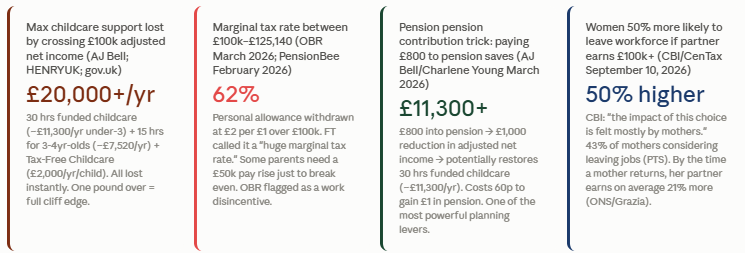
The cliff edge by the numbers: losing £1 over £100,000 adjusted net income triggers loss of: 30 hours funded childcare per week (worth ~£11,300/year under-3; ~£7,520/year age 3-4) + Tax-Free Childcare (£2,000/year per child) + Child Benefit high income charge from £60k. Total potential annual loss: upwards of £20,000 per year (AJ Bell; Quilter August 2026). Sources: AJ Bell March 2026; PensionBee February 2026; HENRYUK November 2025; gov.uk. Not financial advice.
But most people on £100,000 are already making pension contributions. A 5% employee pension contribution takes £5,000 out of gross pay — reducing both the income tax bill and, more importantly, the adjusted net income, which is the figure the government uses to determine childcare eligibility. Before considering the cliff-edge implications, the net spendable income from £100,000 is considerably lower than the headline number suggests. PensionBee’s February 2026 guide to the £100k trap notes the layered complexity: income tax, National Insurance, pension contributions, and now the childcare implications all interact to make £100,000 a salary that can feel surprisingly tight when children arrive. Not financial advice.
First: the 30 funded hours per week of childcare for children aged nine months to three years old (expanded from September 2025 to cover this age range). Based on average UK hourly childcare rates (Coram childcare survey 2024, uprated 2% by AJ Bell), the annual value of these hours is approximately £11,300 for a child under three in full-time care. Second: 15 funded hours per week reduces to zero for three- to four-year-olds once the threshold is crossed. The HENRYUK analysis estimates this at approximately £7,520 per year for full-time childcare. Third: Tax-Free Childcare is removed. This government scheme, where for every £8 you pay into an account the government adds £2, is worth up to £2,000 per child per year. Combined, the annual value of support that vanishes at £100,001 can exceed £20,000 for a family with a child under three in full-time care. Not financial advice.
The cliff edge in plain numbers: at £99,999 adjusted net income: free childcare hours (~£11,300/year) + Tax-Free Childcare (~£2,000/year) = ~£13,300 per child in government support. At £100,001 adjusted net income: £0 from both schemes. The difference between earning £99,999 and £100,001 is £2 in extra gross income and potentially £13,000+ less in childcare support. AJ Bell's Charlene Young: 'The perfect way to illustrate the cliff-edge nature of UK childcare funding schemes is to imagine a parent with earnings of £99,000.' Source: AJ Bell March 2026; PensionBee February 2026; HENRYUK. Not financial or tax advice. Verify at gov.uk.
In central London and other high-cost areas, the equivalent full-time nursery figure is higher still. The startups.co.uk analysis noted that in Southend-on-Sea, parents put 31% of their monthly take-home pay towards childcare. For a £100,000 earner whose childcare costs reach that proportion, the question of whether working is financially net-positive is genuinely open. The UK now ranks as the third most expensive country for childcare by the OECD (startups.co.uk), and the cost of a full-time nursery place for a child under two has risen from £236 per week in 2018 to significantly higher figures in 2025 and 2026 (Grazia Daily). Not financial advice.
The practical consequence is that a pay rise from £100,000 to £110,000 results in approximately £6,200 in extra income tax — and if that pay rise also crosses the childcare cliff edge for the first time, the loss of funded childcare worth £11,000-£13,000 per year may mean the £10,000 gross pay rise actually leaves the household worse off in net terms than before the rise. The Financial Times described this as a ‘huge marginal tax rate,’ and thanksben.com summarised: ‘so steep that some parents need a £50K salary increase just to break even.’ Not financial or tax advice. Consult a qualified financial adviser.
Against that temporary outgoing, the financial arguments for staying employed are durable: continued employer pension contributions (which stop completely if you leave work), continued accumulation of National Insurance credits towards the State Pension, preserved salary progression (salaries do not stand still for people who remain employed, but they often do not recover fully for those who take career breaks), and the compounding of pension savings. Fidelity UK’s Ask Fidelity guidance makes the breakeven calculation direct: in pure salary terms, to make it worthwhile to work five days a week and pay for the additional childcare beyond the funded 30 hours (from September 2025), you need to earn an extra £7,200 per year after tax. Not financial advice.
The question is whether ‘stepping back’ means leaving work entirely (the largest financial and career risk), reducing hours to part-time (preserving the career while reducing income), or making salary sacrifice contributions to bring adjusted net income below £100,000 without actually reducing work hours. Each has a different risk and benefit profile. The nuclear option — leaving work entirely for three to five years — carries the career penalty documented in the next section. The salary sacrifice option, which this article covers separately, may produce a better outcome with lower risk. Not financial advice.
Jackie Leiper, managing director of pensions at Scottish Widows, is explicit on this: ‘Caring responsibilities and high childcare costs are keeping women out of the workforce, lowering their contributions and denting their pension pots.’ The gender dimension is stark. By the time a mother returns to full-time work, her male partner will on average be earning 21% more than her, according to ONS data cited by Grazia Daily. The pension gap that opens during a career break is a structural disadvantage that accumulates quietly and is difficult to close. Not financial advice.
Pension gap from a career break: a three-year break on a £100k salary (5% employer contribution) = approximately £15,000+ in missed employer pension contributions alone, before investment growth. National Insurance gaps may also accumulate, affecting State Pension entitlement. You can make voluntary NI contributions (Class 3, 2026-27: £17.45/week) to fill gaps. Check your State Pension forecast at gov.uk. Sources: Scottish Widows; Grazia Daily; gov.uk. Not financial or pension advice. Consult a regulated pension adviser.
AJ Bell’s Charlene Young gave the most concrete example in the March 2026 analysis: ‘If you are a high earning parent then paying in just £800 to a pension would lower your adjusted net income by £1,000 (£800 plus automatic basic rate tax relief), potentially getting you back over £27,000 in childcare support and topping up your pension pot by £1,000, too.’ She also noted: ‘If you’re able to pay more into a pension, you’ll come further away from the edge and have the benefit of boosting your pension pot at a cost of 60p to you for every extra £1 invested.’
For a parent whose adjusted net income is £102,000 — just £2,000 over the cliff edge — a pension contribution of £1,600 gross (costing approximately £960 after basic rate tax relief) would reduce adjusted net income back to £100,000, potentially restoring access to £11,300+ in funded childcare support. The return on that £960 out-of-pocket expenditure is potentially enormous. The pension also grows and eventually comes back to the contributor. This is one of the few areas of personal finance where the maths is genuinely compelling regardless of other circumstances. Not financial advice. Consult a qualified IFA or tax adviser for your specific position.
The pension calculation: if your adjusted net income is between £100,000 and £113,000, a pension contribution may restore access to funded childcare and Tax-Free Childcare worth significantly more than the contribution cost. AJ Bell: 'paying in just £800 to a pension would lower your adjusted net income by £1,000, potentially getting you back over £27,000 in childcare support.' Calculate your adjusted net income at HMRC's tax check, then model the pension contribution needed to go below £100,000. Source: AJ Bell/Charlene Young, March 2026 and October 2024; PensionBee February 2026. Not financial or tax advice. Consult a regulated adviser.
The HENRYUK community — a Reddit forum of high-earning parents navigating exactly these decisions — has produced detailed analyses of when salary sacrifice to below £100,000 makes financial sense. Their November 2025 guide calculated that a child under three in full-time childcare receives £11,300 per year of government support if both parents earn under £100,000. A child aged 3+ in full-time childcare receives approximately £7,520 per year. The guide also notes a ‘coasting’ strategy: once you have topped up a Tax-Free Childcare account, the government’s 25% top-up can be spent until up to two years after the funding period ends, providing a further buffer.
The key principle: adjusted net income is calculated on an individual basis in the UK (not household), and includes gross salary minus pension contributions and salary sacrifice amounts. If your employer offers salary sacrifice, using it to bring your adjusted net income below £100,000 is one of the most tax-efficient moves available to a parent at this salary level. Not financial or tax advice.
At £100,000 gross, taking SPL means your income drops to £187.18 per week for the duration of leave taken at the statutory rate. However, some employers — including Spotify (six months fully paid for all genders, cited thanksben.com) — enhance SPL to full pay. Checking your employer’s enhanced SPL policy is worth doing before assuming that one parent must take all the leave or that the lower earner must take it all. Shared Parental Leave can be a way to split the childcare coverage across both parents without either parent making a permanent career exit. Not employment advice.
The career penalty accumulates non-linearly. A six-to-twelve month career break, managed well (maintained professional networks, some consultancy or freelance work), is recoverable for most careers. A three-to-five-year break at senior level is qualitatively different. The professional networks thin. The technical skills drift. The institutional knowledge evaporates. The promotions that happened while you were absent have shaped the hierarchy you return to. CBI’s September 2026 statement, citing the CenTax report, noted that women whose partners earn over £100,000 are 50% more likely to leave the workforce after losing childcare support than women in lower-earning households — and the language they used was telling: a ‘perverse choice.’ Not career advice.
The financial analysis says: use pension contributions to stay below the £100,000 threshold if you can. Consider salary sacrifice. Explore shared parental leave. Model the full financial picture before making any decision about a career exit. But the financial analysis also cannot tell you whether full-time work with full-time nursery is the right choice for your child, your relationship, and your own wellbeing. Those are the questions the maths cannot touch, and this article does not pretend otherwise. Not financial or personal advice.
Until the system changes, parents at £100,000 face a genuine and complex calculation. The pension contribution tool — specifically, the ability to reduce adjusted net income below £100,000 through increased pension or salary sacrifice contributions — is the most powerful single lever available. It can restore access to childcare support worth significantly more than the contribution cost, while also building retirement wealth. Using it is almost universally financially sensible before any decision about leaving work is made. The decision about whether to leave work involves factors this article cannot weigh: your specific career trajectory, your partner’s circumstances, your child’s specific needs, and your own sense of what a good life looks like. Not financial or personal advice. Consult a qualified independent financial adviser (IFA), a pension specialist, and, if needed, a tax adviser, before making decisions of this magnitude.
Crossing £100,000 of adjusted net income in the UK triggers the loss of all three childcare government support schemes simultaneously. You lose: (1) 30 funded childcare hours per week for children aged 9 months to 3 years old (worth approximately £11,300 per year at national average hourly childcare rates, according to AJ Bell/Coram data 2025); (2) 15 funded hours per week for 3-4 year olds reduces proportionately (worth approximately £7,520/year for full-time care per HENRYUK analysis 2025); (3) Tax-Free Childcare — where the government tops up every £8 you pay with £2, up to £2,000 per child per year (gov.uk; Fidelity UK). The combined annual value of lost support can exceed £20,000 per year for a family with a child under three in full-time care. Child Benefit is also tapered via the High Income Child Benefit Charge from £60,000 and is effectively eliminated from £80,000 onwards. This is a cliff-edge threshold — you lose it as soon as you earn £1 over £100,000 of adjusted net income (PensionBee February 2026; AJ Bell March 2026; CBI September 2026). Not financial or tax advice. Verify current thresholds at gov.uk.
Can pension contributions help me keep my childcare benefits at £100k?
Yes — this is one of the most financially efficient tools available to parents near the £100,000 threshold. UK childcare eligibility is based on adjusted net income, which is gross income minus pension contributions and salary sacrifice amounts. Making pension contributions can reduce your adjusted net income below £100,000, restoring access to funded childcare hours and Tax-Free Childcare worth potentially thousands more than the contribution cost. AJ Bell's Charlene Young gave this example in March 2026: 'Paying in just £800 to a pension would lower your adjusted net income by £1,000 (£800 plus automatic basic rate tax relief), potentially getting you back over £27,000 in childcare support and topping up your pension pot by £1,000.' She also noted: 'If you're able to pay more into a pension, you'll come further away from the edge and have the benefit of boosting your pension pot at a cost of 60p to you for every extra £1 invested.' Salary sacrifice is also effective and additionally saves National Insurance in some cases. Not financial or tax advice. Consult a qualified IFA or tax adviser for your specific adjusted net income calculation. Verify at gov.uk/check-national-insurance-record.
What is the 62% marginal tax rate at £100,000?
Between £100,000 and £125,140 of adjusted net income, the effective marginal rate of income tax is approximately 62%. This happens because the UK personal allowance (£12,570 in 2026/27) is withdrawn at £2 for every £1 of earnings above £100,000. The result is that every £2 earned above £100,000 causes £1 of previously allowable income to become taxable at the basic rate (20%), on top of the 40% tax already due on the higher-rate earnings. The OBR flagged this in its March 2026 Economic and Fiscal Outlook as a concern for 'incentives to work, save, and invest.' The practical consequence: a £10,000 pay rise from £100,000 to £110,000 results in approximately £6,200 in additional income tax — and if that pay rise also crosses the childcare cliff edge for the first time, the total cost including lost childcare support could mean the household is worse off after the rise. Source: OBR March 2026; PensionBee February 2026; AJ Bell March 2026. Not financial or tax advice.
What is the long-term career cost of a career break for a woman in the UK?
The data on career breaks and their long-term impact is striking. Grazia Daily, citing research on the gender pay gap and career trajectories, found that by the time a mother returns to full-time work after a career break, her male partner will on average be earning 21% more than her. PTS research found that 43% of mothers are considering leaving their jobs due to childcare costs, and one in five is working in a less senior role than her ability specifically to ease childcare bills. The CBI's September 2026 statement, citing the CenTax report, found that women whose partners earn over £100,000 are 50% more likely to leave the workforce after losing childcare support than women in lower-earning households. Jackie Leiper, managing director of pensions at Scottish Widows, describes the effect directly: 'Caring responsibilities and high childcare costs are keeping women out of the workforce, lowering their contributions and denting their pension pots.' The pension gap is particularly significant: every year outside the workforce means lost employer pension contributions and potential National Insurance gaps that affect State Pension entitlement. Sources: Grazia Daily; CBI September 2026; Scottish Widows. Not career or financial advice.
What is the UK funded childcare provision in 2026?
As of September 2025, eligible working parents in England can access up to 30 funded childcare hours per week for children aged nine months old to school age (Fidelity UK; gov.uk). This replaced the previous 15-hour free entitlement for 3-4 year olds and extended provision significantly downwards in age. The 30-hour entitlement applies in term time (38 weeks), making the annual total 1,140 funded hours. Eligibility requires both parents (or a single parent) to work at least 16 hours per week at minimum wage and to have an adjusted net income of no more than £100,000 each. Losing this threshold means losing the entire 30-hour entitlement instantly — there is no taper. Outside England, Scotland, Wales and Northern Ireland have different entitlements. Tax-Free Childcare (available UK-wide) allows parents to receive a 25% government top-up (up to £2,000/year per child) on childcare spending, also subject to the £100,000 adjusted net income limit. For current figures, check gov.uk/free-childcare-education-for-2-to-4-year-olds and gov.uk/tax-free-childcare. Sources: Fidelity UK; gov.uk; AJ Bell March 2026. Not financial or legal advice. Always verify current entitlements at gov.uk.
Table of Contents
- The Question Nobody Told You Would Be This Hard
- What £100k Actually Takes Home in 2026
- The Childcare Cliff Edge: What You Lose the Moment You Cross £100,000
- The Real Cost of Full-Time Childcare in 2026
- The 62% Marginal Tax Rate Nobody Talks About Enough
- The Case for Staying in Work: What the Numbers Say
- The Case for Stepping Back: What the Numbers Also Say
- The Pension Trap Inside the Career Break Decision
- The Pension Contribution Trick That Changes Everything
- Salary Sacrifice, Adjusted Net Income, and the Art of the Threshold
- Shared Parental Leave: The Under-Used Option
- The Long-Term Career Cost of a Break: What the Data Shows
- What to Weigh Beyond the Maths
- Conclusion: The Numbers Are Clear. The Decision Is Yours.
- Frequently Asked Questions
The Question Nobody Told You Would Be This Hard
£100,000 a year sounds like the answer to most financial questions. And in many respects it is — it is a salary that puts you in the top 5% of earners in the United Kingdom. But the moment you add a young child to the equation, something strange happens to the maths. The childcare costs arrive. The tax system takes a specific, sharp, and deeply counterintuitive turn. And the question that was supposed to have been answered — ‘am I earning enough?’ — suddenly does not have a clean answer anymore.This article does not offer a verdict. Whether you should give up work, reduce your hours, stay full-time, or find a third option is a decision that involves money, identity, career momentum, your relationship, your child, and factors that no spreadsheet can fully capture. What this article offers is clarity on the financial framework — exactly what the UK system does to a £100,000 earner who has young children, exactly what the numbers look like before and after the various planning tools that exist, and exactly what the career-break data says about the long-term cost of stepping away. Not financial advice.
The cliff edge by the numbers: losing £1 over £100,000 adjusted net income triggers loss of: 30 hours funded childcare per week (worth ~£11,300/year under-3; ~£7,520/year age 3-4) + Tax-Free Childcare (£2,000/year per child) + Child Benefit high income charge from £60k. Total potential annual loss: upwards of £20,000 per year (AJ Bell; Quilter August 2026). Sources: AJ Bell March 2026; PensionBee February 2026; HENRYUK November 2025; gov.uk. Not financial advice.
What £100k Actually Takes Home in 2026
Before the childcare question, it is worth being clear about what £100,000 gross actually means in net income. At £100,000, you pay 40% income tax on earnings above the basic rate band, and your personal allowance of £12,570 begins to be withdrawn at a rate of £2 for every £1 above £100,000 — although at exactly £100,000 the allowance is still intact. You also pay National Insurance, with Class 1 contributions at 2% above the upper earnings limit. After standard income tax, National Insurance, and assuming no pension contributions, the annual take-home on a £100,000 salary is approximately £65,000–67,000, varying by exact NI category and other deductions.But most people on £100,000 are already making pension contributions. A 5% employee pension contribution takes £5,000 out of gross pay — reducing both the income tax bill and, more importantly, the adjusted net income, which is the figure the government uses to determine childcare eligibility. Before considering the cliff-edge implications, the net spendable income from £100,000 is considerably lower than the headline number suggests. PensionBee’s February 2026 guide to the £100k trap notes the layered complexity: income tax, National Insurance, pension contributions, and now the childcare implications all interact to make £100,000 a salary that can feel surprisingly tight when children arrive. Not financial advice.
The Childcare Cliff Edge: What You Lose the Moment You Cross £100,000
The UK childcare funding system has a cliff edge at £100,000 of adjusted net income that the OBR, the CBI, the AJ Bell pensions team, and even TikTok have described as one of the most counterproductive features of the UK tax and benefits system. The mechanism is simple and brutal: if either parent’s adjusted net income exceeds £100,000 by a single pound, the entire household loses three separate childcare benefits simultaneously.First: the 30 funded hours per week of childcare for children aged nine months to three years old (expanded from September 2025 to cover this age range). Based on average UK hourly childcare rates (Coram childcare survey 2024, uprated 2% by AJ Bell), the annual value of these hours is approximately £11,300 for a child under three in full-time care. Second: 15 funded hours per week reduces to zero for three- to four-year-olds once the threshold is crossed. The HENRYUK analysis estimates this at approximately £7,520 per year for full-time childcare. Third: Tax-Free Childcare is removed. This government scheme, where for every £8 you pay into an account the government adds £2, is worth up to £2,000 per child per year. Combined, the annual value of support that vanishes at £100,001 can exceed £20,000 for a family with a child under three in full-time care. Not financial advice.
The cliff edge in plain numbers: at £99,999 adjusted net income: free childcare hours (~£11,300/year) + Tax-Free Childcare (~£2,000/year) = ~£13,300 per child in government support. At £100,001 adjusted net income: £0 from both schemes. The difference between earning £99,999 and £100,001 is £2 in extra gross income and potentially £13,000+ less in childcare support. AJ Bell's Charlene Young: 'The perfect way to illustrate the cliff-edge nature of UK childcare funding schemes is to imagine a parent with earnings of £99,000.' Source: AJ Bell March 2026; PensionBee February 2026; HENRYUK. Not financial or tax advice. Verify at gov.uk.
The Real Cost of Full-Time Childcare in 2026
The average cost of full-time childcare (50 hours per week) in the UK is approximately £263 per week — or £9,994 per year over 38 term-time weeks (PensionBee, February 2026; national average). For part-time care (25 hours per week), the figure is approximately £138 per week, or £5,244 for 38 weeks. These are averages; regional variation is substantial. In Guildford, Surrey, The Drum reported in February 2025 that nursery costs run to £103 per day per child — a figure that means a household needs to earn at least £70,000 before tax just to break even on full-time nursery after tax and childcare costs.In central London and other high-cost areas, the equivalent full-time nursery figure is higher still. The startups.co.uk analysis noted that in Southend-on-Sea, parents put 31% of their monthly take-home pay towards childcare. For a £100,000 earner whose childcare costs reach that proportion, the question of whether working is financially net-positive is genuinely open. The UK now ranks as the third most expensive country for childcare by the OECD (startups.co.uk), and the cost of a full-time nursery place for a child under two has risen from £236 per week in 2018 to significantly higher figures in 2025 and 2026 (Grazia Daily). Not financial advice.
The 62% Marginal Tax Rate Nobody Talks About Enough
Between £100,000 and £125,140 of adjusted net income, the effective marginal tax rate is approximately 62%. This is the combined effect of the 40% income tax rate and the withdrawal of the personal allowance. Every additional £1 of earnings above £100,000 results in 40p of income tax on that pound plus 20p of income tax on the extra income brought into the basic rate band by personal allowance withdrawal. The OBR flagged this in its March 2026 Economic and Fiscal Outlook, warning specifically about marginal tax rates and their impact on ‘incentives to work, save, and invest.’The practical consequence is that a pay rise from £100,000 to £110,000 results in approximately £6,200 in extra income tax — and if that pay rise also crosses the childcare cliff edge for the first time, the loss of funded childcare worth £11,000-£13,000 per year may mean the £10,000 gross pay rise actually leaves the household worse off in net terms than before the rise. The Financial Times described this as a ‘huge marginal tax rate,’ and thanksben.com summarised: ‘so steep that some parents need a £50K salary increase just to break even.’ Not financial or tax advice. Consult a qualified financial adviser.
The Case for Staying in Work: What the Numbers Say
The financial case for staying in full-time work at £100,000 becomes stronger once you look beyond the immediate nursery years and consider the long-term picture. The childcare cliff edge is a phase: it is most acute when children are under school age. Once children are in full-time school (from age 4-5), childcare costs drop substantially and the financial calculus changes significantly. Paying £9,994 per year for full-time nursery over two or three years is a real, large cost — but it is a time-limited cost.Against that temporary outgoing, the financial arguments for staying employed are durable: continued employer pension contributions (which stop completely if you leave work), continued accumulation of National Insurance credits towards the State Pension, preserved salary progression (salaries do not stand still for people who remain employed, but they often do not recover fully for those who take career breaks), and the compounding of pension savings. Fidelity UK’s Ask Fidelity guidance makes the breakeven calculation direct: in pure salary terms, to make it worthwhile to work five days a week and pay for the additional childcare beyond the funded 30 hours (from September 2025), you need to earn an extra £7,200 per year after tax. Not financial advice.
The Case for Stepping Back: What the Numbers Also Say
The case for stepping back is also real and documented. The startups.co.uk analysis of the £100k salary with childcare costs described a situation where, in high-cost areas, childcare represented 31% of take-home earnings. A parent in that position who could live on a single salary would recover all of that 31% net of childcare. They would also regain access to the funded childcare hours and Tax-Free Childcare if the remaining earner’s adjusted net income were below £100,000.The question is whether ‘stepping back’ means leaving work entirely (the largest financial and career risk), reducing hours to part-time (preserving the career while reducing income), or making salary sacrifice contributions to bring adjusted net income below £100,000 without actually reducing work hours. Each has a different risk and benefit profile. The nuclear option — leaving work entirely for three to five years — carries the career penalty documented in the next section. The salary sacrifice option, which this article covers separately, may produce a better outcome with lower risk. Not financial advice.
The Pension Trap Inside the Career Break Decision
One of the least-discussed costs of a career break at the £100,000 level is the pension impact. When you are employed and earning £100,000, employer pension contributions are likely to be significant — many employers match 5%, 10%, or more of salary. On £100,000, a 5% employer contribution is £5,000 per year going into your pension that you did not contribute yourself. Stop working and that disappears entirely. Stop working for three years and you have lost approximately £15,000 in employer pension contributions alone, plus the compounding growth those contributions would have generated.Jackie Leiper, managing director of pensions at Scottish Widows, is explicit on this: ‘Caring responsibilities and high childcare costs are keeping women out of the workforce, lowering their contributions and denting their pension pots.’ The gender dimension is stark. By the time a mother returns to full-time work, her male partner will on average be earning 21% more than her, according to ONS data cited by Grazia Daily. The pension gap that opens during a career break is a structural disadvantage that accumulates quietly and is difficult to close. Not financial advice.
Pension gap from a career break: a three-year break on a £100k salary (5% employer contribution) = approximately £15,000+ in missed employer pension contributions alone, before investment growth. National Insurance gaps may also accumulate, affecting State Pension entitlement. You can make voluntary NI contributions (Class 3, 2026-27: £17.45/week) to fill gaps. Check your State Pension forecast at gov.uk. Sources: Scottish Widows; Grazia Daily; gov.uk. Not financial or pension advice. Consult a regulated pension adviser.
The Pension Contribution Trick That Changes Everything
The single most important financial planning tool available to a £100,000 earner with young children is pension contributions as an adjusted net income reducer. The mechanism is straightforward: pension contributions — whether made directly or through salary sacrifice — reduce your ‘adjusted net income,’ which is the figure the government uses to calculate eligibility for childcare benefits and Child Benefit. They do not just reduce your tax bill; they can restore your eligibility for childcare support worth significantly more than the contribution itself.AJ Bell’s Charlene Young gave the most concrete example in the March 2026 analysis: ‘If you are a high earning parent then paying in just £800 to a pension would lower your adjusted net income by £1,000 (£800 plus automatic basic rate tax relief), potentially getting you back over £27,000 in childcare support and topping up your pension pot by £1,000, too.’ She also noted: ‘If you’re able to pay more into a pension, you’ll come further away from the edge and have the benefit of boosting your pension pot at a cost of 60p to you for every extra £1 invested.’
For a parent whose adjusted net income is £102,000 — just £2,000 over the cliff edge — a pension contribution of £1,600 gross (costing approximately £960 after basic rate tax relief) would reduce adjusted net income back to £100,000, potentially restoring access to £11,300+ in funded childcare support. The return on that £960 out-of-pocket expenditure is potentially enormous. The pension also grows and eventually comes back to the contributor. This is one of the few areas of personal finance where the maths is genuinely compelling regardless of other circumstances. Not financial advice. Consult a qualified IFA or tax adviser for your specific position.
The pension calculation: if your adjusted net income is between £100,000 and £113,000, a pension contribution may restore access to funded childcare and Tax-Free Childcare worth significantly more than the contribution cost. AJ Bell: 'paying in just £800 to a pension would lower your adjusted net income by £1,000, potentially getting you back over £27,000 in childcare support.' Calculate your adjusted net income at HMRC's tax check, then model the pension contribution needed to go below £100,000. Source: AJ Bell/Charlene Young, March 2026 and October 2024; PensionBee February 2026. Not financial or tax advice. Consult a regulated adviser.
Salary Sacrifice, Adjusted Net Income, and the Art of the Threshold
Salary sacrifice is an arrangement where you give up part of your gross salary in exchange for an equivalent employer contribution to your pension. Unlike direct pension contributions, salary sacrifice reduces your gross pensionable pay, which reduces both income tax and National Insurance contributions. It is particularly effective before April 2029, after which NIC treatment changes (Baldwins Cofield; HENRYUK r/HENRYUK). It also reduces adjusted net income, making it a powerful tool for managing the £100,000 childcare threshold.The HENRYUK community — a Reddit forum of high-earning parents navigating exactly these decisions — has produced detailed analyses of when salary sacrifice to below £100,000 makes financial sense. Their November 2025 guide calculated that a child under three in full-time childcare receives £11,300 per year of government support if both parents earn under £100,000. A child aged 3+ in full-time childcare receives approximately £7,520 per year. The guide also notes a ‘coasting’ strategy: once you have topped up a Tax-Free Childcare account, the government’s 25% top-up can be spent until up to two years after the funding period ends, providing a further buffer.
The key principle: adjusted net income is calculated on an individual basis in the UK (not household), and includes gross salary minus pension contributions and salary sacrifice amounts. If your employer offers salary sacrifice, using it to bring your adjusted net income below £100,000 is one of the most tax-efficient moves available to a parent at this salary level. Not financial or tax advice.
Shared Parental Leave: The Under-Used Option
One option many couples at this income level overlook is Shared Parental Leave (SPL). Under UK rules, eligible parents can share up to 50 weeks of leave between them, of which 37 weeks are paid at the statutory rate. For 2025-26, the weekly statutory rate is £187.18 per week (Chase.co.uk). This allows the higher earner to return to work earlier while the other parent takes the remaining leave — or allows leave to be taken in a more complex pattern of blocks that suits both parents’ employment needs.At £100,000 gross, taking SPL means your income drops to £187.18 per week for the duration of leave taken at the statutory rate. However, some employers — including Spotify (six months fully paid for all genders, cited thanksben.com) — enhance SPL to full pay. Checking your employer’s enhanced SPL policy is worth doing before assuming that one parent must take all the leave or that the lower earner must take it all. Shared Parental Leave can be a way to split the childcare coverage across both parents without either parent making a permanent career exit. Not employment advice.
The Long-Term Career Cost of a Break: What the Data Shows
The most honest part of this analysis is the career cost data. Grazia Daily’s review of research on mothers leaving the workforce found that by the time a mother returns to full-time work, her male partner will on average be earning 21% more than her. PTS research found that 43% of mothers are considering leaving their jobs due to childcare costs, and that one in five is already working in a less senior role than her ability, specifically to manage childcare bills. Once you accept a demotion or reduced seniority to manage childcare, returning to the previous level is neither quick nor guaranteed.The career penalty accumulates non-linearly. A six-to-twelve month career break, managed well (maintained professional networks, some consultancy or freelance work), is recoverable for most careers. A three-to-five-year break at senior level is qualitatively different. The professional networks thin. The technical skills drift. The institutional knowledge evaporates. The promotions that happened while you were absent have shaped the hierarchy you return to. CBI’s September 2026 statement, citing the CenTax report, noted that women whose partners earn over £100,000 are 50% more likely to leave the workforce after losing childcare support than women in lower-earning households — and the language they used was telling: a ‘perverse choice.’ Not career advice.
What to Weigh Beyond the Maths
Fidelity UK’s Ask Fidelity feature, in its response to a parent at this exact life stage, raises the question that the spreadsheets cannot answer: ‘Would going part-time and placing less emphasis on your career feel like sacrificing an important part of your identity?’ This is not a peripheral consideration. Identity, contribution, professional engagement, peer relationships, mental stimulation — these are real goods that employment provides and that a career exit removes. They are not universally valued equally, and the answer to this question varies by person, by career, and by family circumstances.The financial analysis says: use pension contributions to stay below the £100,000 threshold if you can. Consider salary sacrifice. Explore shared parental leave. Model the full financial picture before making any decision about a career exit. But the financial analysis also cannot tell you whether full-time work with full-time nursery is the right choice for your child, your relationship, and your own wellbeing. Those are the questions the maths cannot touch, and this article does not pretend otherwise. Not financial or personal advice.
Conclusion
The UK’s childcare cliff edge at £100,000 is, by consensus of the OBR, the CBI, AJ Bell, Quilter, PensionBee, and a growing list of financial commentators, one of the most counterproductive thresholds in the tax system. It creates a perverse incentive to earn less, actively discourages career progression for parents with young children, and falls disproportionately on women. The Centre for British Progress calculated in March 2026 that abolishing the cliff edge would actually generate £130 million for the Treasury by 2029/30. That should tell you something about how badly designed it is.Until the system changes, parents at £100,000 face a genuine and complex calculation. The pension contribution tool — specifically, the ability to reduce adjusted net income below £100,000 through increased pension or salary sacrifice contributions — is the most powerful single lever available. It can restore access to childcare support worth significantly more than the contribution cost, while also building retirement wealth. Using it is almost universally financially sensible before any decision about leaving work is made. The decision about whether to leave work involves factors this article cannot weigh: your specific career trajectory, your partner’s circumstances, your child’s specific needs, and your own sense of what a good life looks like. Not financial or personal advice. Consult a qualified independent financial adviser (IFA), a pension specialist, and, if needed, a tax adviser, before making decisions of this magnitude.
Frequently Asked Questions
What do I lose if I earn over £100,000 with young children in the UK?Crossing £100,000 of adjusted net income in the UK triggers the loss of all three childcare government support schemes simultaneously. You lose: (1) 30 funded childcare hours per week for children aged 9 months to 3 years old (worth approximately £11,300 per year at national average hourly childcare rates, according to AJ Bell/Coram data 2025); (2) 15 funded hours per week for 3-4 year olds reduces proportionately (worth approximately £7,520/year for full-time care per HENRYUK analysis 2025); (3) Tax-Free Childcare — where the government tops up every £8 you pay with £2, up to £2,000 per child per year (gov.uk; Fidelity UK). The combined annual value of lost support can exceed £20,000 per year for a family with a child under three in full-time care. Child Benefit is also tapered via the High Income Child Benefit Charge from £60,000 and is effectively eliminated from £80,000 onwards. This is a cliff-edge threshold — you lose it as soon as you earn £1 over £100,000 of adjusted net income (PensionBee February 2026; AJ Bell March 2026; CBI September 2026). Not financial or tax advice. Verify current thresholds at gov.uk.
Can pension contributions help me keep my childcare benefits at £100k?
Yes — this is one of the most financially efficient tools available to parents near the £100,000 threshold. UK childcare eligibility is based on adjusted net income, which is gross income minus pension contributions and salary sacrifice amounts. Making pension contributions can reduce your adjusted net income below £100,000, restoring access to funded childcare hours and Tax-Free Childcare worth potentially thousands more than the contribution cost. AJ Bell's Charlene Young gave this example in March 2026: 'Paying in just £800 to a pension would lower your adjusted net income by £1,000 (£800 plus automatic basic rate tax relief), potentially getting you back over £27,000 in childcare support and topping up your pension pot by £1,000.' She also noted: 'If you're able to pay more into a pension, you'll come further away from the edge and have the benefit of boosting your pension pot at a cost of 60p to you for every extra £1 invested.' Salary sacrifice is also effective and additionally saves National Insurance in some cases. Not financial or tax advice. Consult a qualified IFA or tax adviser for your specific adjusted net income calculation. Verify at gov.uk/check-national-insurance-record.
What is the 62% marginal tax rate at £100,000?
Between £100,000 and £125,140 of adjusted net income, the effective marginal rate of income tax is approximately 62%. This happens because the UK personal allowance (£12,570 in 2026/27) is withdrawn at £2 for every £1 of earnings above £100,000. The result is that every £2 earned above £100,000 causes £1 of previously allowable income to become taxable at the basic rate (20%), on top of the 40% tax already due on the higher-rate earnings. The OBR flagged this in its March 2026 Economic and Fiscal Outlook as a concern for 'incentives to work, save, and invest.' The practical consequence: a £10,000 pay rise from £100,000 to £110,000 results in approximately £6,200 in additional income tax — and if that pay rise also crosses the childcare cliff edge for the first time, the total cost including lost childcare support could mean the household is worse off after the rise. Source: OBR March 2026; PensionBee February 2026; AJ Bell March 2026. Not financial or tax advice.
What is the long-term career cost of a career break for a woman in the UK?
The data on career breaks and their long-term impact is striking. Grazia Daily, citing research on the gender pay gap and career trajectories, found that by the time a mother returns to full-time work after a career break, her male partner will on average be earning 21% more than her. PTS research found that 43% of mothers are considering leaving their jobs due to childcare costs, and one in five is working in a less senior role than her ability specifically to ease childcare bills. The CBI's September 2026 statement, citing the CenTax report, found that women whose partners earn over £100,000 are 50% more likely to leave the workforce after losing childcare support than women in lower-earning households. Jackie Leiper, managing director of pensions at Scottish Widows, describes the effect directly: 'Caring responsibilities and high childcare costs are keeping women out of the workforce, lowering their contributions and denting their pension pots.' The pension gap is particularly significant: every year outside the workforce means lost employer pension contributions and potential National Insurance gaps that affect State Pension entitlement. Sources: Grazia Daily; CBI September 2026; Scottish Widows. Not career or financial advice.
What is the UK funded childcare provision in 2026?
As of September 2025, eligible working parents in England can access up to 30 funded childcare hours per week for children aged nine months old to school age (Fidelity UK; gov.uk). This replaced the previous 15-hour free entitlement for 3-4 year olds and extended provision significantly downwards in age. The 30-hour entitlement applies in term time (38 weeks), making the annual total 1,140 funded hours. Eligibility requires both parents (or a single parent) to work at least 16 hours per week at minimum wage and to have an adjusted net income of no more than £100,000 each. Losing this threshold means losing the entire 30-hour entitlement instantly — there is no taper. Outside England, Scotland, Wales and Northern Ireland have different entitlements. Tax-Free Childcare (available UK-wide) allows parents to receive a 25% government top-up (up to £2,000/year per child) on childcare spending, also subject to the £100,000 adjusted net income limit. For current figures, check gov.uk/free-childcare-education-for-2-to-4-year-olds and gov.uk/tax-free-childcare. Sources: Fidelity UK; gov.uk; AJ Bell March 2026. Not financial or legal advice. Always verify current entitlements at gov.uk.
0 Comments
Be the first to share your thoughts on this article.