

Real Estate
Renters' Rights Act: What Tenants and Landlords Must Know
Table of Contents
- The Most Significant Housing Reform in a Generation
- What the Renters' Rights Act 2025 Is and When It Applies
- The Key Dates Every Tenant and Landlord Must Know
- Change 1: Section 21 No-Fault Evictions Abolished
- Change 2: Fixed-Term Tenancies Replaced by Rolling Contracts
- Change 3: Rent Increases Restricted to Once a Year
- Change 4: The Right to Request a Pet
- Change 5: No Discrimination Against Benefit Claimants or Families
- Change 6: No Rental Bidding Wars
- What Landlords Must Do Immediately: The Information Sheet
- Changes Coming in Later Phases
- Conclusion: A New Framework for Private Renting
- Frequently Asked Questions
- External References
The Most Significant Housing Reform in a Generation
The private rented sector in England houses approximately 11 million people. For decades, many of those tenants lived with a structural insecurity that most homeowners never experience: the Section 21 notice, which allowed a landlord to ask a tenant to leave at any time and without providing any reason. A family who had lived in a property for years, paid rent on time, and maintained the home responsibly could receive a Section 21 and be required to find somewhere else to live within two months.The Renters' Rights Act 2025, which received Royal Assent on 27 October 2025 and begins implementation on 1 May 2026, ends this. It is described by the NRLA as the most significant overhaul of private rented sector legislation in more than 30 years. The Act abolishes no-fault evictions, replaces fixed-term assured shorthold tenancies with rolling periodic contracts, restricts rent increases to once per year, gives tenants a legal right to request pets, and bans rental bidding wars and discrimination against benefit claimants.
This article explains every major change, the specific dates that matter, the obligations it places on landlords, and the rights it gives tenants — all drawn from GOV.UK, the NRLA, mydeposits, and OTS Solicitors guidance published in April 2026.
Disclaimer: This article is for general informational purposes only and does not constitute legal advice. The Renters' Rights Act 2025 applies to England. Rules differ in Scotland, Wales, and Northern Ireland. Legislation and guidance are updated frequently. Always consult a qualified solicitor or contact MHCLG for advice specific to your situation.
What the Renters' Rights Act 2025 Is and When It Applies
The Renters' Rights Act 2025 is a UK Act of Parliament that reforms the private rented sector in England. It applies to assured and assured shorthold tenancies where: the property is the tenant's main home; the tenant is an individual (not a company or organisation); and the landlord is not living at the same address as the tenant.It does not apply to: lodger agreements; company lets; tenancies where the property is not the tenant's main home; tenancies with a resident landlord living in the same building; social housing regulated tenancies; or licences. Rules also differ in Scotland (where equivalent reforms have already been implemented), Wales (with its own Renting Homes Act), and Northern Ireland.
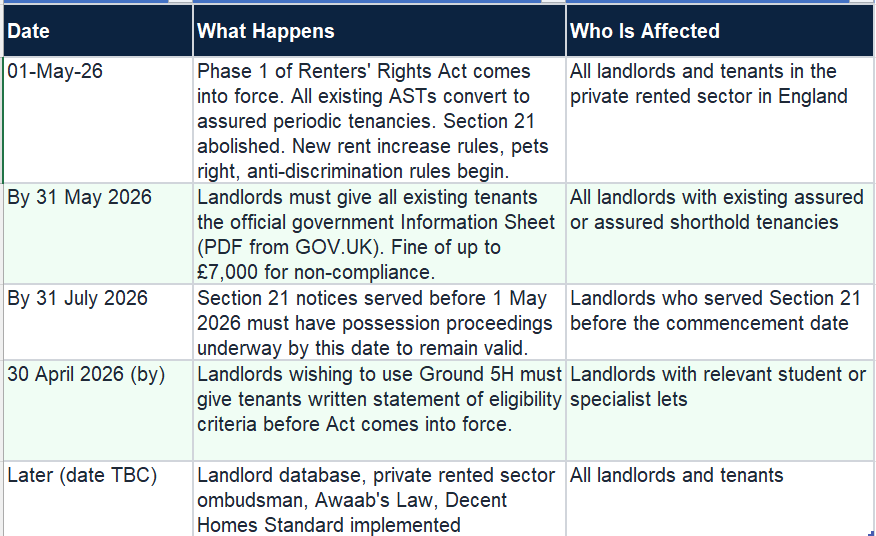
The Act is being implemented in phases. Phase 1 begins on 1 May 2026 and covers the major structural reforms: the end of Section 21, the conversion of all tenancies to assured periodic tenancies, rent increase restrictions, pets, and anti-discrimination rules. Further phases will implement a new landlord database, a private rented sector ombudsman, Awaab's Law (damp and mould standards), and the Decent Homes Standard.
The Key Dates Every Tenant and Landlord Must Know
Change 1: Section 21 No-Fault Evictions Abolished
Section 21 of the Housing Act 1988 allowed landlords to give tenants two months' notice to leave without providing any reason. From 1 May 2026, this route to possession no longer exists. Landlords will only be able to seek possession by serving a Section 8 notice citing one or more specific legal grounds.For tenants, this is the most significant single change: genuine security of tenure. The threat of arbitrary eviction disappears. A tenant who pays rent, maintains the property, and does not breach the tenancy cannot be asked to leave simply because the landlord has decided they want the property back.
For landlords, the change means the possession process becomes more formal and in some cases longer. However, the Act also updates and extends the Section 8 grounds to make it easier to regain possession in legitimate circumstances. New grounds include:
- Ground 1A (selling the property): a landlord who genuinely needs to sell the property can regain possession with proper notice. There is a 12-month restriction on re-letting after using this ground (with an exception for shared-ownership landlords who notify tenants by 31 May 2026).
- Ground 1B (moving back into the property): a landlord who needs to move into the property themselves, or move in a close family member, can use this ground.
- Extended rent arrears ground: tenants must be in three months of rent arrears for this ground to apply (previously a lower threshold), and landlords must give four weeks' notice (twice the previous period).
- Anti-social behaviour grounds: the Act makes it easier to evict tenants who commit anti-social behaviour.
Change 2: Fixed-Term Tenancies Replaced by Rolling Contracts
From 1 May 2026, fixed-term assured shorthold tenancies (ASTs) are abolished and replaced with assured periodic tenancies (APTs). All existing ASTs automatically convert to APTs on that date. New tenancies entered into from 1 May 2026 must be assured periodic tenancies from the outset.An assured periodic tenancy has no fixed end date. It continues until either the tenant gives proper notice to leave or the landlord serves a valid Section 8 notice under a specific ground for possession. Tenants are not locked in for a minimum fixed term, though in practice they cannot leave without giving proper notice.
For tenants, the change provides flexibility and removes the anxiety of approaching a fixed-term end date, when many no-fault evictions previously occurred. Tenants can stay as long as they wish, provided they meet the terms of the tenancy, without facing arbitrary non-renewal.
For landlords, the change requires adaptation. The ability to let a property for a defined term and then recover it simply by not renewing is gone. Possession now requires a specific legal ground. Many landlords have used the period since Royal Assent in October 2025 to review their practices and update their tenancy agreements.
Change 3: Rent Increases Restricted to Once a Year
Under the Renters' Rights Act, rent on an assured periodic tenancy can only be increased once per year, and only through the Section 13 notice procedure. Landlords must give tenants at least two months' notice of any proposed rent increase before it takes effect.Tenants who consider a proposed rent increase to be above local market rent for comparable properties have the right to challenge it. Challenges are made to the First-tier Tribunal (Property Chamber), which has the power to reduce a proposed increase if it determines it is above market rent. Tenants must follow the specified procedure and pay an application fee to challenge.
Landlords may not increase rent more frequently than annually, even if the tenancy agreement states otherwise. Any clause in a tenancy agreement purporting to allow more frequent increases will be unenforceable after 1 May 2026.
Change 4: The Right to Request a Pet
From 1 May 2026, tenants have a contractual right to request permission to keep a pet. The landlord must consider the request within a set timeframe and provide valid written reasons if they choose to refuse.The Act does not provide an automatic right to have a pet — landlords can still refuse. But they must do so on reasonable grounds and must communicate their decision within a specified period. Blanket no-pet policies in tenancy agreements will not be enforceable as a basis for refusal.
To protect against potential damage caused by pets, landlords are permitted to require tenants to obtain pet insurance as a condition of the permission. This is a specific provision in the Act designed to make landlords more willing to consent, by providing a financial remedy if pets cause damage to the property.
Change 5: No Discrimination Against Benefit Claimants or Families
The Renters' Rights Act introduces new anti-discrimination rules that make it illegal for landlords to refuse tenants based solely on: the fact that they have children; or the fact that they receive benefits (including housing benefit or Universal Credit).The so-called 'No DSS' policies — adverts and practices that excluded benefit claimants from the rental market — are banned. Similarly, landlords cannot advertise properties as unsuitable for families with children. Rent Repayment Orders are extended in scope and the maximum amount a tenant can claim is increased from 12 months of rent to 24 months, with the limitation period for applications also extended from 12 to 24 months.
Change 6: No Rental Bidding Wars
Landlords and letting agents must include a rental price on all property adverts and are banned from accepting or encouraging offers above the advertised rent. This provision is specifically designed to address the bidding-war dynamics that have driven up rents in high-demand markets, where prospective tenants were offering above the listed asking price to secure properties.Landlords may not demand rent in advance beyond the first month of the tenancy (payable after the tenancy agreement has been signed), nor can they demand more than one month's rent at any time during the tenancy. This removes the practice of asking for several months' rent upfront that was used by some landlords as an alternative to referencing checks for tenants in receipt of benefits.
10. What Landlords Must Do Immediately: The Information Sheet
The most immediate compliance obligation for existing landlords is the government Information Sheet. Published on 20 March 2026 by the Ministry of Housing, Communities and Local Government (MHCLG), the Information Sheet is an official PDF document that must be provided to every tenant named on an existing assured or assured shorthold tenancy agreement by 31 May 2026.- The Information Sheet must be the exact PDF downloaded from GOV.UK. Sending a link to the PDF does not comply.
- It can be provided digitally as an email attachment or as a printed copy.
- If a letting agent manages the property, the agent must also provide it, even if the landlord has done so.
- Failure to provide the Information Sheet is a breach of legal duties. Fines of up to £7,000 per breach apply. If the breach continues for more than 28 days after a penalty is issued, civil penalties of up to £40,000 may apply.
- Lodgers and company lets are excluded from this requirement.
Changes Coming in Later Phases
Phase 1 on 1 May 2026 is the most substantial implementation date, but further elements of the Renters' Rights Act will be implemented in subsequent phases with dates to be confirmed:- Private rented sector landlord database: a new mandatory database requiring all private landlords in England to register. Non-registration will be an offence. The database will be publicly searchable.
- Private rented sector ombudsman: a new mandatory ombudsman scheme that all private landlords must join, providing tenants with an independent dispute resolution mechanism.
- Awaab's Law (extended to the PRS): currently applying to social housing, Awaab's Law will require private landlords to address damp and mould within specified timescales.
- Decent Homes Standard: the baseline housing standard currently applicable to social housing will be extended to the private rented sector.
Conclusion
The Renters' Rights Act 2025 is genuinely transformative for the private rented sector in England. It removes the structural insecurity that has characterised private renting for a generation by abolishing no-fault evictions, replacing fixed-term contracts with rolling tenancies, and giving tenants clear rights around rent increases, pets, and freedom from discrimination.For landlords, the changes require adaptation to a more formalised possession regime, new compliance obligations starting with the Information Sheet deadline of 31 May 2026, and a longer-term shift toward thinking about tenancies as ongoing relationships rather than fixed-term contracts. The Act does not make letting impossible — the Section 8 grounds for possession remain available and have been extended and clarified — but it does make the process more formal.
Both tenants and landlords who engage with the new framework from 1 May 2026 will be in a stronger position than those who do not. For tenants, that means understanding new rights and how to exercise them. For landlords, that means ensuring compliance is in place before the implementation dates, and that tenancy practices are updated to reflect the new regime. The transition window is now open. The deadline is 1 May 2026.
Frequently Asked Questions
What is the Renters' Rights Act 2025?
The Renters' Rights Act 2025 is a UK Act of Parliament that received Royal Assent on 27 October 2025 and fundamentally reforms the private rented sector in England. Its Phase 1 provisions come into force on 1 May 2026. The Act abolishes Section 21 no-fault evictions, replaces fixed-term assured shorthold tenancies with rolling assured periodic tenancies, restricts rent increases to once per year, gives tenants a right to request pets, bans rental bidding wars, and introduces anti-discrimination rules. It is described as the biggest overhaul of private rented sector legislation in more than 30 years.What happens to my fixed-term tenancy on 1 May 2026?
All existing assured and assured shorthold tenancies automatically convert to assured periodic tenancies on 1 May 2026. If you are currently in a fixed term, your tenancy becomes periodic (rolling monthly) from that date. Your landlord cannot serve a Section 21 notice after 1 May 2026. They can still seek possession using Section 8 grounds, which include circumstances such as rent arrears, anti-social behaviour, and wanting to sell or move into the property.Can my landlord still evict me after 1 May 2026?
Yes, but only using specific legal grounds. The Section 21 no-fault eviction route is abolished on 1 May 2026. Landlords must now serve a Section 8 notice citing one or more of the specific grounds for possession set out in the Renters' Rights Act. These include grounds for rent arrears (three months' rent owed), anti-social behaviour, the landlord wanting to sell, and the landlord or a close family member wanting to move in. The extended four-week notice period applies to rent arrears grounds.What is the government Information Sheet and do I need to give it?
The Information Sheet is an official PDF document published by the government on 20 March 2026. Landlords with existing assured or assured shorthold tenancies must give it to every named tenant by 31 May 2026. It can be sent digitally as an email attachment or provided as a printed copy. Emailing or texting a link to the PDF does not comply. Failure to provide it can result in fines of up to £7,000. The sheet must be the exact PDF downloaded from GOV.UK.Can I get a pet under the new Renters' Rights Act?
From 1 May 2026, you have the right to request permission to keep a pet in a rented property. Your landlord must consider the request within a set timeframe and provide valid written reasons if they refuse. Blanket no-pet clauses in tenancy agreements will not be enforceable as a basis for refusal. Landlords may require you to obtain pet insurance as a condition of consent. The Act does not give an absolute right to have a pet — refusal on reasonable grounds remains possible.What are the new rent increase rules?
Landlords can only increase rent on an assured periodic tenancy once per year, using the Section 13 notice procedure. Tenants must be given at least two months' notice of any proposed increase. If you believe a proposed rent increase is above local market rent for comparable properties, you can challenge it at the First-tier Tribunal (Property Chamber), which has the power to reduce the increase. The application involves a procedure and a fee.What happens if my landlord already served a Section 21 notice before 1 May 2026?
Section 21 notices served before 1 May 2026 remain valid, but possession proceedings must be underway by 31 July 2026 for the notice to retain validity. If your landlord served a Section 21 before 1 May but has not commenced possession proceedings by 31 July 2026, the notice becomes invalid and the tenancy continues as an assured periodic tenancy under the new rules.External References and Further Reading
GOV.UK — Renting Is Changing: Official Government Landlord Guidance (Published April 2026), GOV.UK — The Renters' Rights Act Information Sheet 2026 (Official PDF, updated 22 April 2026), Legislation.gov.uk — Renters' Rights Act 2025 (Full Statutory Text), NRLA — Renter's Rights Act: Complete Landlord Guide (Updated April 2026), NRLA — Renters' Rights Act: Tenancies Agreed Before 1 May 2026, mydeposits — The Renters' Rights Act Information Sheet: Landlord Compliance Guide (April 2026), Boyes Turner Solicitors — Renters' Rights Act 2025 Explained: UK Landlord Changes from May 2026, OTS Solicitors — Renters' Rights Act 2025: Key Changes, Deadlines and FAQs, Adam Bernard (Solicitors) — New Tenant Rights and Rental Rules in England 2026, Shelter — Renters' Rights Bill: What It Means for Renters

0 Comments Comments