

Finance
Social Security Guide for Gen Z & Millennials

The Social Security trust fund for retirement benefits is projected to run dry in 2032. At that point, only 78% of scheduled benefits could be paid from incoming payroll taxes. Millennials and Gen Z are the workers funding today’s retirees. Here is exactly how the system works, what 2026 rules apply to you, and what the trust fund crisis actually means for your retirement planning.

The system has worked this way since 1935, when President Franklin D. Roosevelt signed the Social Security Act into law. What has changed — dramatically — is the ratio of workers to retirees. In 1960, approximately 5.1 workers supported each Social Security beneficiary. Today, that ratio is approximately 2.7 to 1, and it is declining. Baby Boomers are retiring in large numbers, living longer, and collecting benefits that, for a typical median-wage retiree, will total approximately $730,000 over a lifetime — against less than $200,000 in combined worker and employer contributions (Fortune, August 2026).
For Gen Z and Millennials, Social Security is the largest deduction from every paycheck, a program they are legally obligated to fund, and — for many — a program they are not certain will exist in the same form when they retire. This guide explains the system as it actually works in 2026, what the 2026 Trustees Report says about its future, and what younger workers should do about both.
The trust funds accumulated large surpluses during the decades when Baby Boomers were in the workforce. Beginning in the late 2010s, as Boomers began retiring in large numbers, the ratio of payroll tax revenue to benefit obligations shifted. The funds have been drawing down reserves to cover the difference between what comes in and what goes out. The 2026 Trustees Report projects that the Old-Age and Survivors Insurance (OASI) trust fund will exhaust its reserves in the fourth quarter of 2032 — the point at which the surplus buffer is gone and only incoming payroll taxes remain to pay benefits.
Fortune’s August 2026 analysis describes the generational arithmetic starkly: ‘Baby boomers hold the wealth, millennials carry the costs, Gen Z inherits the receipts.’ The pay-as-you-go structure was designed for a different demographic reality — one with more workers per retiree and shorter average retirements. Those conditions no longer hold.
Social Security is not a broken program — it is a program that was designed for one demographic reality and now operates in a very different one. It still collects trillions in payroll taxes annually. It still has legal authority to pay benefits from that incoming revenue indefinitely, even after trust fund depletion. The question is not whether Social Security continues to exist but whether Congress will act to ensure it pays 100% — rather than 78% — of scheduled benefits.
The critical numbers from the 2026 report: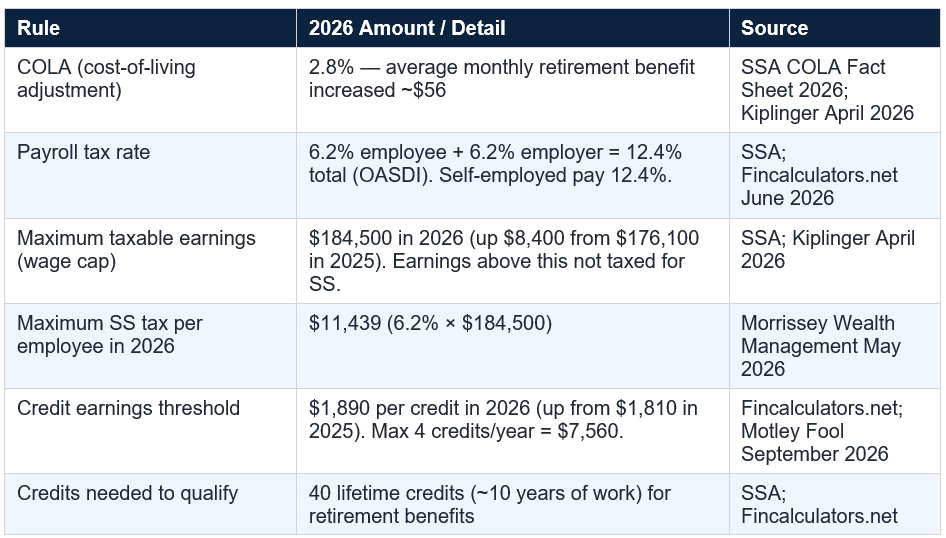
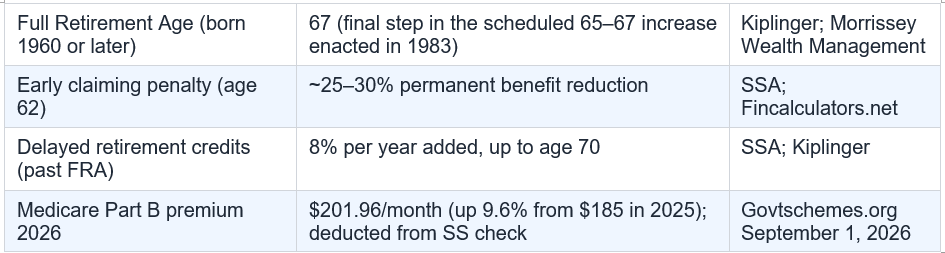
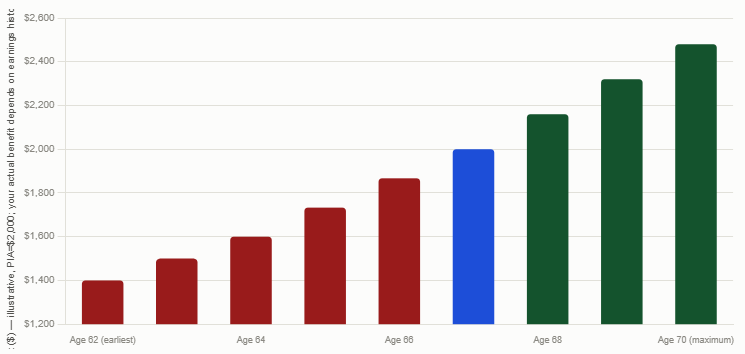
Claiming before FRA permanently reduces your monthly benefit. Claiming at 62 — the earliest possible age — reduces benefits by approximately 25 to 30 percent, calculated as 5/9 of 1 percent per month for the first 36 months before FRA, then 5/12 of 1 percent per month beyond that. The reduction is permanent for as long as you receive benefits.
Claiming after FRA permanently increases your monthly benefit. Each month of delay past FRA adds 2/3 of 1 percent, compounding to 8 percent per year. At age 70, the maximum possible benefit is reached. Delay credits stop accumulating at 70; there is no financial advantage to waiting beyond that age. For a Millennial or Gen Z worker, this means the claiming window will run from age 62 through 70 — an 8-year range producing benefit levels that differ by approximately 76 percent between the two extremes.
For Gen Z workers, the full retirement age is 67 — but it could be higher by the time they retire. Raising the FRA is consistently proposed as one of the most straightforward ways to improve Social Security's long-term finances. There is no current legislation changing the FRA beyond 67, but it is a plausible outcome of future reform packages. Planning assumption: assume the current 67 FRA, but do not be surprised if it changes.
What counts as covered earnings:
The maximum possible Social Security benefit in 2026 goes to a worker who earned at or above the taxable maximum ($184,500) for 35 years and delays claiming to age 70. That maximum monthly benefit is approximately $5,108 before Medicare deductions (SSA 2026 benefit tables).
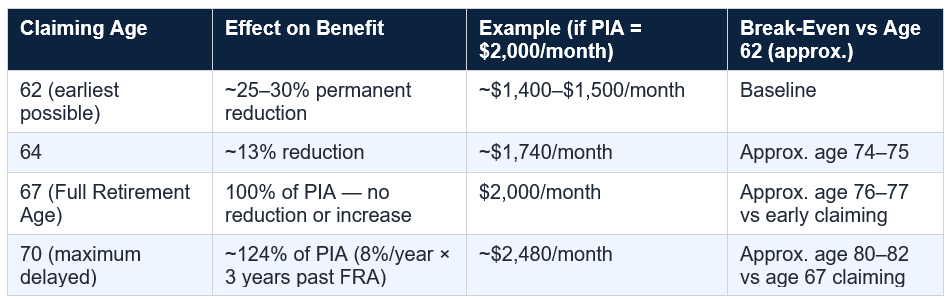
The break-even analysis: claiming at 70 instead of 67 means you forgo 36 months of payments at $2,000 per month ($72,000 total) in exchange for $480 more per month from age 70 onwards. Break-even occurs at approximately age 80 to 82 — meaning those with longer expected lifespans benefit more from delayed claiming. Conversely, those in poor health or with reason to expect shorter lifespans may be better served by claiming earlier.
For Gen Z and Millennials, who will not claim for decades, the claiming strategy decision is premature. The practical action now is to ensure credits are accumulating, earnings records are accurate, and the personal savings being built in 401(k) and IRA accounts reduce the dependency on Social Security’s eventual benefit level.
However, Govtschemes.org’s September 2026 analysis of Social Security changes makes a critical point that most COLA headlines omit: the Medicare Part B premium in 2026 rose to $201.96 per month, up from $185.00 in 2025, an increase of approximately 9.6 percent. Since Medicare Part B premiums are deducted directly from Social Security checks before they are deposited, a meaningful portion of the 2026 COLA was absorbed by the premium increase before retirees received it in their bank accounts.
For working Gen Z and Millennial Americans, the COLA is relevant in two ways: it determines how much current retirees receive (and therefore how much the trust fund pays out), and it is the mechanism by which their own eventual benefits will be adjusted for inflation during retirement. A COLA below actual inflation — as critics of the current CPI-W calculation method argue is frequently the case for seniors — means benefits quietly lose purchasing power over time.
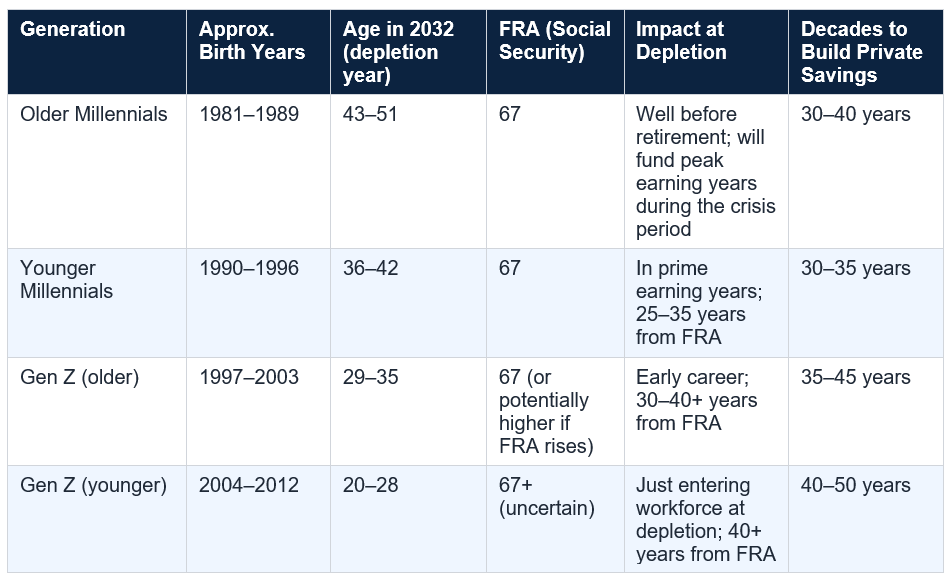
The arithmetic is both alarming and somewhat reassuring. Gen Z workers in 2026 are 40 to 50 years from their full retirement ages. Even if the trust fund is depleted in 2032, they have four to five decades of working years ahead during which Congress could and very likely will act. The political reality is that Social Security affects 72.5 million current beneficiaries — an enormously powerful constituency. No Congress has allowed full payment to drop since the program’s creation in 1935. But the nature, timing, and distribution of the fix matters enormously for younger workers.
Fortune’s August 2026 analysis captures the generational tension: ‘Baby boomers hold the wealth, millennials carry the costs, Gen Z inherits the receipts.’ The more benefit reductions rather than tax increases are used to fix the shortfall, the more the burden falls on current and future retirees. The more payroll tax increases are used, the more the burden falls on current workers — primarily Millennials and Gen Z.
The Real Risk: Financial advisers now tell younger workers to assume Social Security will provide approximately 30% of retirement income rather than the 40% it currently provides to retirees (Rolling Out, March 2026). This is a conservative planning assumption — it does not assume Social Security disappears, but it does assume some reduction from today's scheduled levels. Plan for 30%. Anything above 30% is a bonus.
What has changed is the certainty of the amount. A generation ago, financial planners encouraged pre-retirees to count on Social Security covering 40 percent or more of retirement income. Today, the prudent planning assumption is approximately 30 percent — and the priority for younger workers is to build the private savings that make up the difference. The 401(k), the Roth IRA, and the employer match are not optional supplements to Social Security. They are, increasingly, the foundation, with Social Security as the supplement.
The most practical actions for Gen Z and Millennial workers: create or review your my Social Security account at ssa.gov annually; ensure your payroll taxes are correctly recorded; contribute at least enough to your 401(k) to capture the full employer match; consider Roth contributions while in a lower tax bracket; and plan your retirement savings target around a Social Security benefit of approximately 30 percent of your target income. The system is under pressure. It is not, by any reasonable expectation, going away.
Almost certainly yes, but potentially paying less than 100% of scheduled benefits unless Congress acts. The 2026 Social Security Trustees Report projects the OASI trust fund will be depleted in the fourth quarter of 2032. After that point, incoming payroll taxes would still cover approximately 78% of scheduled benefits — an automatic cut of about 22% if no legislative action is taken. However, Social Security has never missed a payment in its 91-year history, and the political constituency of 72.5 million current beneficiaries plus tens of millions of near-retirees makes a complete elimination of the program essentially inconceivable. The question is not whether it exists but what percentage of scheduled benefits it pays and whether reforms (tax increases, benefit adjustments, or both) close the gap before depletion.
What is the full retirement age for Millennials and Gen Z?
Anyone born in 1960 or later — which includes all Millennials born after 1980 and the entirety of Gen Z — has a Full Retirement Age (FRA) of 67. This is the final step in a gradual increase from 65 to 67 that was enacted in 1983 and completed with the 1959 cohort (FRA 66 and 10 months) in 2026. For the 1960+ cohort, the FRA is definitively 67. However, many reform proposals include raising the FRA further (to 68 or 69) as part of a package to restore trust fund solvency. There is no current legislation changing the FRA beyond 67, but younger workers should not assume the FRA will remain fixed at 67 for the next 40 to 50 years.
How many Social Security credits do I need and how do I earn them?
You need 40 lifetime credits to qualify for Social Security retirement benefits — approximately 10 years of work with covered earnings. In 2026, one credit requires $1,890 in covered earnings, and you can earn a maximum of four credits per year (requiring $7,560 in earnings). Credits are earned from wages reported by your employer, self-employment income reported on Schedule SE, and gig economy income reported on Schedule C or SE. Investment income, rental income, and capital gains do not generate Social Security credits. Check your current credit total at ssa.gov/myaccount. If you are under 40 and working full-time, you are almost certainly accumulating credits at the maximum rate.
How does the COLA work and will it protect my benefits from inflation?
The COLA (cost-of-living adjustment) increases Social Security benefits each January to offset inflation. For 2026, the COLA is 2.8%, calculated from the change in the Consumer Price Index for Urban Wage Earners and Clerical Workers (CPI-W) in Q3 2025 vs Q3 2024. The average monthly retirement benefit increased by approximately $56. However, the COLA has been criticized for not fully reflecting the inflation experienced by seniors — particularly medical and housing costs. Additionally, in 2026, the Medicare Part B premium rose 9.6% to $201.96/month, which is deducted directly from Social Security checks, partially absorbing the COLA before it reached beneficiaries' accounts. For current workers, the COLA is also the mechanism by which eventual benefits are adjusted for inflation during retirement.
What is the difference between the OASI and DI trust funds?
Social Security actually has two separate trust funds. The Old-Age and Survivors Insurance (OASI) trust fund pays retirement and survivor benefits. The Disability Insurance (DI) trust fund pays disability benefits. The 2026 Trustees Report projects the OASI fund depletes in Q4 2032, while the DI fund remains solvent throughout the 75-year projection window. Combining the two funds — which would require Congressional action — would delay the OASI depletion date by approximately two years to around 2034, at which point the combined fund would cover approximately 83% of scheduled benefits. Congress has previously reallocated assets between the two funds as a short-term measure; whether and when it does so again will depend on political will.
How much will I get from Social Security when I retire?
Your Social Security benefit depends on your earnings history, the age at which you claim, and (critically) what Congress does about the trust fund before you retire. The SSA calculates your Primary Insurance Amount (PIA) based on your Average Indexed Monthly Earnings across your 35 highest-earning years. Claiming at 67 (FRA) pays 100% of your PIA; claiming at 62 pays approximately 70–75% of PIA; claiming at 70 pays approximately 124% of PIA. The maximum benefit for a maximum-wage earner who delays to age 70 is approximately $5,108/month in 2026. Check your personalized estimate at ssa.gov/myaccount — it shows projected benefits at 62, 67, and 70 based on your actual earnings record. Financial advisers currently recommend planning as if Social Security will provide approximately 30% of your target retirement income rather than the 40% it provides to current retirees.
Table of Contents
- The System Gen Z and Millennials Are Paying Into
- How Social Security Works: The Pay-As-You-Go Reality
- The 2032 Trust Fund Cliff: What the Latest Trustees Report Says
- The Key 2026 Rules Every Worker Needs to Know
- Full Retirement Age: When Can You Claim?
- How to Qualify: Credits, Earnings, and What Counts
- How Your Benefit Is Calculated
- Early vs. Delayed Claiming: The 8% Per Year Rule
- Spousal, Divorced, and Survivor Benefits
- The 2026 COLA and Medicare Premium Reality
- What the Trust Fund Crisis Means for Gen Z and Millennials Specifically
- What Advisers Are Telling Younger Workers Right Now
- The Parallel System: 401(k), IRA, and Roth
- Reform Options: How Congress Could Fix This
- Conclusion: The System Is Under Pressure — But Not Gone
- Frequently Asked Questions
Claiming Age Imapct (FRA = 67 For 1960 + Birth)
The System Gen Z and Millennials Are Paying Into
Every working American with a paycheck has the same two lines deducted from it: federal income tax and FICA. The FICA line — 6.2 percent of wages up to $184,500 in 2026, matched by your employer — goes to fund Social Security and Medicare for today’s retirees. For Gen Z workers entering the workforce and Millennials in their peak earning years, this is not an abstract contribution to a future account. It is a transfer payment to the generation currently receiving benefits.The system has worked this way since 1935, when President Franklin D. Roosevelt signed the Social Security Act into law. What has changed — dramatically — is the ratio of workers to retirees. In 1960, approximately 5.1 workers supported each Social Security beneficiary. Today, that ratio is approximately 2.7 to 1, and it is declining. Baby Boomers are retiring in large numbers, living longer, and collecting benefits that, for a typical median-wage retiree, will total approximately $730,000 over a lifetime — against less than $200,000 in combined worker and employer contributions (Fortune, August 2026).
For Gen Z and Millennials, Social Security is the largest deduction from every paycheck, a program they are legally obligated to fund, and — for many — a program they are not certain will exist in the same form when they retire. This guide explains the system as it actually works in 2026, what the 2026 Trustees Report says about its future, and what younger workers should do about both.
How Social Security Works: The Pay-As-You-Go Reality
Social Security is not a savings account. The payroll taxes deducted from your paycheck today do not go into a fund bearing your name and growing until you retire. They go, almost immediately, to pay the benefits of current retirees. Any surplus — when more is collected than paid out — has historically flowed into the Social Security trust funds, which are invested in special-issue US Treasury bonds.The trust funds accumulated large surpluses during the decades when Baby Boomers were in the workforce. Beginning in the late 2010s, as Boomers began retiring in large numbers, the ratio of payroll tax revenue to benefit obligations shifted. The funds have been drawing down reserves to cover the difference between what comes in and what goes out. The 2026 Trustees Report projects that the Old-Age and Survivors Insurance (OASI) trust fund will exhaust its reserves in the fourth quarter of 2032 — the point at which the surplus buffer is gone and only incoming payroll taxes remain to pay benefits.
Fortune’s August 2026 analysis describes the generational arithmetic starkly: ‘Baby boomers hold the wealth, millennials carry the costs, Gen Z inherits the receipts.’ The pay-as-you-go structure was designed for a different demographic reality — one with more workers per retiree and shorter average retirements. Those conditions no longer hold.
Social Security is not a broken program — it is a program that was designed for one demographic reality and now operates in a very different one. It still collects trillions in payroll taxes annually. It still has legal authority to pay benefits from that incoming revenue indefinitely, even after trust fund depletion. The question is not whether Social Security continues to exist but whether Congress will act to ensure it pays 100% — rather than 78% — of scheduled benefits.
The 2032 Trust Fund Cliff: What the Latest Trustees Report Says
The 2026 Social Security Trustees Report, published in June 2026, moved the projected OASI trust fund depletion date forward by one year — from 2033 to the fourth quarter of 2032. The Bipartisan Policy Center’s June 2026 explainer identifies the primary reason: the 2025 ‘One Big Beautiful Bill Act’ included provisions that lowered tax liability for Social Security beneficiaries, reducing revenue into the trust fund and accelerating the depletion timeline.The critical numbers from the 2026 report:
- OASI trust fund alone: projected depletion in Q4 2032. At that point, incoming payroll tax revenue would cover approximately 78% of scheduled retirement benefits, representing an automatic across-the-board cut of approximately 22%.
- Combined OASI and Disability Insurance (DI) trust funds: depleted approximately 2034, covering approximately 83% of scheduled benefits. Combining the two funds would require an act of Congress.
- The longer Congress waits: the harder the fix becomes. The Bipartisan Policy Center notes that a balanced package of benefit adjustments and tax increases implemented now would make the program fiscally sustainable — but each year of delay requires a larger adjustment.
The Key 2026 Rules Every Worker Needs to Know
Full Retirement Age: When Can You Claim?
The Full Retirement Age (FRA) is the age at which you receive 100 percent of your calculated Social Security benefit. For everyone born in 1960 or later — which includes all Millennials born from 1981 onward and the entirety of Gen Z — the FRA is 67. This is the final step in a gradual increase from 65 to 67 that was enacted by Congress in 1983 and completed in 2026 for the last cohort of those born in 1959 (whose FRA is 66 and 10 months).Claiming before FRA permanently reduces your monthly benefit. Claiming at 62 — the earliest possible age — reduces benefits by approximately 25 to 30 percent, calculated as 5/9 of 1 percent per month for the first 36 months before FRA, then 5/12 of 1 percent per month beyond that. The reduction is permanent for as long as you receive benefits.
Claiming after FRA permanently increases your monthly benefit. Each month of delay past FRA adds 2/3 of 1 percent, compounding to 8 percent per year. At age 70, the maximum possible benefit is reached. Delay credits stop accumulating at 70; there is no financial advantage to waiting beyond that age. For a Millennial or Gen Z worker, this means the claiming window will run from age 62 through 70 — an 8-year range producing benefit levels that differ by approximately 76 percent between the two extremes.
For Gen Z workers, the full retirement age is 67 — but it could be higher by the time they retire. Raising the FRA is consistently proposed as one of the most straightforward ways to improve Social Security's long-term finances. There is no current legislation changing the FRA beyond 67, but it is a plausible outcome of future reform packages. Planning assumption: assume the current 67 FRA, but do not be surprised if it changes.
How to Qualify: Credits, Earnings, and What Counts
Social Security retirement benefits require 40 lifetime work credits — approximately 10 years of work with earnings reported to the SSA. In 2026, one credit is earned for every $1,890 of covered earnings, with a maximum of 4 credits per year. Earning the full 4 credits in 2026 requires at least $7,560 in covered earnings during the year.What counts as covered earnings:
- Wages from a W-2 employer: automatically reported to the SSA and credited against your Social Security record.
- Self-employment income: reported on Schedule SE; you pay the full 12.4% self-employment tax on net earnings above $400 per year.
- Part-time income: counted as long as it is from covered employment. A part-time job paying $500/month generates $6,000 per year in covered earnings — sufficient for 3 credits in 2026.
- Gig economy income: treated as self-employment income. Uber, DoorDash, freelance work, and similar platform income counts if reported on Schedule C or Schedule SE, but many gig workers fail to report or underpay, missing credits they have actually earned.
- Investment income (dividends, capital gains, rental income) — not subject to Social Security tax and does not generate credits.
- State and local government employee income in some states — some public sector workers participate in separate pension systems and do not accrue Social Security credits. Check your specific employer plan.
How Your Benefit Is Calculated
Your Social Security retirement benefit is calculated from your Primary Insurance Amount (PIA), which is based on your Average Indexed Monthly Earnings (AIME) across your 35 highest-earning years (indexed for wage growth). The formula is intentionally progressive — it replaces a higher percentage of income for lower earners than for higher earners:- 90% of the first $1,226 of AIME (2026 bend point)
- 32% of AIME between $1,226 and $7,391 (2026 bend point)
- 15% of AIME above $7,391
The maximum possible Social Security benefit in 2026 goes to a worker who earned at or above the taxable maximum ($184,500) for 35 years and delays claiming to age 70. That maximum monthly benefit is approximately $5,108 before Medicare deductions (SSA 2026 benefit tables).
Early vs. Delayed Claiming: The 8% Per Year Rule
The decision of when to claim Social Security is one of the most consequential in retirement planning, with the gap between early and late claiming producing a lifetime benefit difference that can exceed $100,000 or more for many workers. The mechanics:The break-even analysis: claiming at 70 instead of 67 means you forgo 36 months of payments at $2,000 per month ($72,000 total) in exchange for $480 more per month from age 70 onwards. Break-even occurs at approximately age 80 to 82 — meaning those with longer expected lifespans benefit more from delayed claiming. Conversely, those in poor health or with reason to expect shorter lifespans may be better served by claiming earlier.
For Gen Z and Millennials, who will not claim for decades, the claiming strategy decision is premature. The practical action now is to ensure credits are accumulating, earnings records are accurate, and the personal savings being built in 401(k) and IRA accounts reduce the dependency on Social Security’s eventual benefit level.
Spousal, Divorced, and Survivor Benefits
Social Security provides benefits beyond individual retirement payments that are particularly relevant to many Millennial and Gen Z households:- Spousal benefits: a married individual can claim up to 50% of their spouse's Primary Insurance Amount, even if they have never worked or have very limited Social Security earnings of their own. The 50% spousal benefit is only available at the claimant's own FRA (age 67 for those born in 1960 or later). Claiming at 62 reduces the spousal benefit to approximately 32.5%.
- Divorced spousal benefits: if a marriage lasted at least 10 years, a divorced individual can claim benefits based on their ex-spouse's earnings record, provided both spouses are 62 or older, the claimant is currently unmarried, and the claim does not affect the ex-spouse's benefit or their current spouse's benefit. Critically, the ex-spouse does not need to have filed for benefits for a divorced spouse to claim.
- Survivor benefits: a surviving spouse can claim benefits based on the deceased spouse's record. The amount depends on the age at which the deceased spouse claimed and the age at which the surviving spouse claims. A surviving spouse can claim reduced benefits as early as age 60 (or 50 if disabled).
- Deemed filing (born after January 1, 1954): anyone born after this date who files for Social Security is treated as claiming both their own benefit and any spousal benefit simultaneously. The old strategy of ‘file and suspend’ or claiming only a spousal benefit while allowing personal benefits to grow no longer applies to this group.
The 2026 COLA and Medicare Premium Reality
The 2026 cost-of-living adjustment (COLA) of 2.8 percent was slightly higher than 2025’s 2.5 percent increase and slightly above the 10-year average COLA of approximately 3.1 percent. For the average Social Security retirement beneficiary, the 2.8% COLA translates to approximately $56 per month in additional income.However, Govtschemes.org’s September 2026 analysis of Social Security changes makes a critical point that most COLA headlines omit: the Medicare Part B premium in 2026 rose to $201.96 per month, up from $185.00 in 2025, an increase of approximately 9.6 percent. Since Medicare Part B premiums are deducted directly from Social Security checks before they are deposited, a meaningful portion of the 2026 COLA was absorbed by the premium increase before retirees received it in their bank accounts.
For working Gen Z and Millennial Americans, the COLA is relevant in two ways: it determines how much current retirees receive (and therefore how much the trust fund pays out), and it is the mechanism by which their own eventual benefits will be adjusted for inflation during retirement. A COLA below actual inflation — as critics of the current CPI-W calculation method argue is frequently the case for seniors — means benefits quietly lose purchasing power over time.
What the Trust Fund Crisis Means for Gen Z and Millennials Specifically
The 2032 OASI trust fund depletion date, and its likely impact, falls at different points in the retirement timeline for different generations:The arithmetic is both alarming and somewhat reassuring. Gen Z workers in 2026 are 40 to 50 years from their full retirement ages. Even if the trust fund is depleted in 2032, they have four to five decades of working years ahead during which Congress could and very likely will act. The political reality is that Social Security affects 72.5 million current beneficiaries — an enormously powerful constituency. No Congress has allowed full payment to drop since the program’s creation in 1935. But the nature, timing, and distribution of the fix matters enormously for younger workers.
Fortune’s August 2026 analysis captures the generational tension: ‘Baby boomers hold the wealth, millennials carry the costs, Gen Z inherits the receipts.’ The more benefit reductions rather than tax increases are used to fix the shortfall, the more the burden falls on current and future retirees. The more payroll tax increases are used, the more the burden falls on current workers — primarily Millennials and Gen Z.
The Real Risk: Financial advisers now tell younger workers to assume Social Security will provide approximately 30% of retirement income rather than the 40% it currently provides to retirees (Rolling Out, March 2026). This is a conservative planning assumption — it does not assume Social Security disappears, but it does assume some reduction from today's scheduled levels. Plan for 30%. Anything above 30% is a bonus.
What Advisers Are Telling Younger Workers Right Now
The professional financial planning community has developed a consistent message for Gen Z and Millennial clients in the context of the trust fund projections:- Do not count on Social Security as the foundation of your retirement plan: treat it as a supplement, not a guarantee. Build retirement security primarily from 401(k), IRA, and Roth IRA accounts.
- Maximize your 401(k) employer match without exception: if your employer matches contributions, contribute at least enough to receive the full match. This is an instant 50 to 100 percent return on the matched amount that no Social Security benefit can replicate.
- Use a Roth IRA or Roth 401(k) for tax diversification: contributions are made from after-tax income, and qualified withdrawals in retirement are completely tax-free. If Social Security is eventually taxable income in retirement (it currently is for higher earners), having tax-free Roth withdrawals available provides valuable flexibility.
- Do not ignore Social Security: check your earnings record annually at ssa.gov, ensure all income has been correctly recorded, and understand your projected benefit. Social Security is likely to provide something meaningful. The question is how much — and that depends both on Congress and on your own earnings history.
- Consider the 30% planning assumption: model your retirement savings target assuming Social Security provides 30% of your target retirement income, not 40% or more. If it ultimately provides more, you retire earlier or live more comfortably. If it provides less, your private savings compensate.
The Parallel System: 401(k), IRA, and Roth
The long-term shift in US retirement planning has been from Social Security supplemented by personal savings to personal savings supplemented by Social Security. The three primary private retirement savings vehicles in 2026:- 401(k) and 403(b) employer plans: 2026 contribution limit $23,500 (under age 50); $31,000 (age 50–59 and 64+); $34,750 (age 60–63 under SECURE 2.0 ‘super catch-up’ provisions). Employer matching is the highest-priority savings incentive in the US retirement system.
- Traditional IRA: 2026 contribution limit $7,000 (under 50); $8,000 (50+). Contributions may be tax-deductible depending on income and access to an employer plan.
- Roth IRA: same contribution limits as Traditional IRA. Income limits apply (phase-out begins at $150,000 single, $236,000 married filing jointly in 2026). Contributions are after-tax; qualified withdrawals are completely tax-free. For Gen Z and younger Millennials in lower tax brackets today, Roth contributions are typically the most tax-efficient structure.
Reform Options: How Congress Could Fix This
The Social Security financing gap is not technically difficult to close. It is politically difficult. The range of options currently debated:- Raise the payroll tax rate: increasing the 6.2% employee and employer rate by 1 to 2 percentage points each would significantly extend trust fund solvency. This is a burden borne primarily by current workers, including Millennials and Gen Z.
- Raise or eliminate the wage cap: currently, earnings above $184,500 are not subject to Social Security tax. Eliminating the cap (subjecting all earnings to the 6.2% tax) would substantially increase revenue, with the burden falling on high earners.
- Raise the Full Retirement Age beyond 67: extending the FRA to 68 or 69 would reduce the total benefits paid over retirees' lifetimes. This is effectively a benefit cut, falling on future retirees including Millennials and Gen Z.
- Reduce benefits for high earners: a targeted reduction in benefits for higher-income retirees would extend trust fund solvency while protecting lower-income beneficiaries. The Committee for a Responsible Federal Budget has proposed a ceiling on benefits for wealthier retirees.
- Modify the COLA formula: switching from the CPI-W (which currently drives COLA calculations) to the Chained CPI (which typically produces slightly lower COLA increases) would reduce future benefit growth.
Conclusion
Social Security in 2026 is a program under genuine financial pressure, with a trust fund depletion projected in 2032 that would trigger automatic benefit cuts of approximately 22 percent unless Congress acts. For Gen Z and Millennial workers who are decades from retirement, this is a serious planning consideration, not an existential crisis. The program will still collect trillions in payroll taxes annually, still serve tens of millions of beneficiaries, and still provide meaningful retirement income to those who have earned it through decades of work.What has changed is the certainty of the amount. A generation ago, financial planners encouraged pre-retirees to count on Social Security covering 40 percent or more of retirement income. Today, the prudent planning assumption is approximately 30 percent — and the priority for younger workers is to build the private savings that make up the difference. The 401(k), the Roth IRA, and the employer match are not optional supplements to Social Security. They are, increasingly, the foundation, with Social Security as the supplement.
The most practical actions for Gen Z and Millennial workers: create or review your my Social Security account at ssa.gov annually; ensure your payroll taxes are correctly recorded; contribute at least enough to your 401(k) to capture the full employer match; consider Roth contributions while in a lower tax bracket; and plan your retirement savings target around a Social Security benefit of approximately 30 percent of your target income. The system is under pressure. It is not, by any reasonable expectation, going away.
Frequently Asked Questions
Will Social Security still exist when Gen Z retires?Almost certainly yes, but potentially paying less than 100% of scheduled benefits unless Congress acts. The 2026 Social Security Trustees Report projects the OASI trust fund will be depleted in the fourth quarter of 2032. After that point, incoming payroll taxes would still cover approximately 78% of scheduled benefits — an automatic cut of about 22% if no legislative action is taken. However, Social Security has never missed a payment in its 91-year history, and the political constituency of 72.5 million current beneficiaries plus tens of millions of near-retirees makes a complete elimination of the program essentially inconceivable. The question is not whether it exists but what percentage of scheduled benefits it pays and whether reforms (tax increases, benefit adjustments, or both) close the gap before depletion.
What is the full retirement age for Millennials and Gen Z?
Anyone born in 1960 or later — which includes all Millennials born after 1980 and the entirety of Gen Z — has a Full Retirement Age (FRA) of 67. This is the final step in a gradual increase from 65 to 67 that was enacted in 1983 and completed with the 1959 cohort (FRA 66 and 10 months) in 2026. For the 1960+ cohort, the FRA is definitively 67. However, many reform proposals include raising the FRA further (to 68 or 69) as part of a package to restore trust fund solvency. There is no current legislation changing the FRA beyond 67, but younger workers should not assume the FRA will remain fixed at 67 for the next 40 to 50 years.
How many Social Security credits do I need and how do I earn them?
You need 40 lifetime credits to qualify for Social Security retirement benefits — approximately 10 years of work with covered earnings. In 2026, one credit requires $1,890 in covered earnings, and you can earn a maximum of four credits per year (requiring $7,560 in earnings). Credits are earned from wages reported by your employer, self-employment income reported on Schedule SE, and gig economy income reported on Schedule C or SE. Investment income, rental income, and capital gains do not generate Social Security credits. Check your current credit total at ssa.gov/myaccount. If you are under 40 and working full-time, you are almost certainly accumulating credits at the maximum rate.
How does the COLA work and will it protect my benefits from inflation?
The COLA (cost-of-living adjustment) increases Social Security benefits each January to offset inflation. For 2026, the COLA is 2.8%, calculated from the change in the Consumer Price Index for Urban Wage Earners and Clerical Workers (CPI-W) in Q3 2025 vs Q3 2024. The average monthly retirement benefit increased by approximately $56. However, the COLA has been criticized for not fully reflecting the inflation experienced by seniors — particularly medical and housing costs. Additionally, in 2026, the Medicare Part B premium rose 9.6% to $201.96/month, which is deducted directly from Social Security checks, partially absorbing the COLA before it reached beneficiaries' accounts. For current workers, the COLA is also the mechanism by which eventual benefits are adjusted for inflation during retirement.
What is the difference between the OASI and DI trust funds?
Social Security actually has two separate trust funds. The Old-Age and Survivors Insurance (OASI) trust fund pays retirement and survivor benefits. The Disability Insurance (DI) trust fund pays disability benefits. The 2026 Trustees Report projects the OASI fund depletes in Q4 2032, while the DI fund remains solvent throughout the 75-year projection window. Combining the two funds — which would require Congressional action — would delay the OASI depletion date by approximately two years to around 2034, at which point the combined fund would cover approximately 83% of scheduled benefits. Congress has previously reallocated assets between the two funds as a short-term measure; whether and when it does so again will depend on political will.
How much will I get from Social Security when I retire?
Your Social Security benefit depends on your earnings history, the age at which you claim, and (critically) what Congress does about the trust fund before you retire. The SSA calculates your Primary Insurance Amount (PIA) based on your Average Indexed Monthly Earnings across your 35 highest-earning years. Claiming at 67 (FRA) pays 100% of your PIA; claiming at 62 pays approximately 70–75% of PIA; claiming at 70 pays approximately 124% of PIA. The maximum benefit for a maximum-wage earner who delays to age 70 is approximately $5,108/month in 2026. Check your personalized estimate at ssa.gov/myaccount — it shows projected benefits at 62, 67, and 70 based on your actual earnings record. Financial advisers currently recommend planning as if Social Security will provide approximately 30% of your target retirement income rather than the 40% it provides to current retirees.
0 Comments
Be the first to share your thoughts on this article.