

Investing
The $3 Trillion Cash Problem: Why Investors Sit Out

Key Statistics: Retail money-market funds: more than $3 trillion (Investment Company Institute, cited by WSJ, August 12, 2026). Total money-market fund assets (retail + institutional): nearly $8 trillion as of July 9, 2026 (ICI/US Bank). WSJ $3 trillion problem article published August 12, 2026. Three-month T-bill yields: peaked above 5.5% in 2023; now in 3.5–4.0% range. Federal Reserve held rates in 2026 after cutting in 2024–2025; possibility of rate increase re-entered discussions. UBS Global Wealth Management: 32% of high-net-worth portfolios in cash globally (2026); US outlier at 23%. Municipal bonds can offer approximately 4%+ with no federal taxes. Vanguard Total Bond: ~1% over 10 years (LyrArc). T. Rowe Price: systematic investor in 60/40 portfolio over 5 or 30 years outperformed identical strategy held in cash over same periods (data to Dec 31, 2025). S&P 500 2025: +16%; up significantly despite 2026 volatility concerns.
The Investment Company Institute reports that total money-market fund assets reached nearly $8 trillion as of July 9, 2026. Of that vast sum, more than $3 trillion is held by retail investors in retail money-market accounts — ordinary households who moved heavily into cash-equivalent instruments when interest rates rose sharply in 2022 and 2023, and who have not moved back.
The WSJ story illustrated the phenomenon with one investor: a retired airline pilot, Don Ross, who has been keeping 85 percent of his savings in cash-equivalent instruments. Every financial planner he has spoken with has suggested he invest the cash. He is not sold. His position is not unusual. And according to wealth management firms across the United States, his is the most common and most costly conversation they are having in 2026.
Disclaimer: This article is for general informational and educational purposes only. It is not financial or investment advice. Investing involves risk, including the possible loss of capital. Past performance is not a reliable indicator of future results. Always consult a qualified financial adviser before changing your investment strategy.
For individual investors who had watched their portfolios fall significantly in 2022 — the S&P 500 declined 18 percent and bonds fell simultaneously, making it the worst year for a 60/40 portfolio since 1937 — money-market funds and T-bills suddenly offered something that had not been available for over a decade: a genuinely competitive, safe return. Five percent with no market risk was an offer that tens of millions of investors accepted.
US Bank’s July 2026 analysis documents the transition: for years, money market accounts, certificates of deposit, and US Treasury bills offered yields that attracted little attention. That changed as interest rates rose. The rush into cash-equivalent instruments was rational at the time. The question in 2026 is whether staying there remains rational now that conditions have changed.
US Bank Asset Management, July 2026: Investors who leave long-term, investable assets in cash for too long can allow short-term convenience to displace long-term progress. Cash can support near-term spending and provide a buffer during periods of market volatility. Stocks and bonds can serve longer-term goals by offering the potential for higher growth and income in exchange for greater uncertainty and price movement.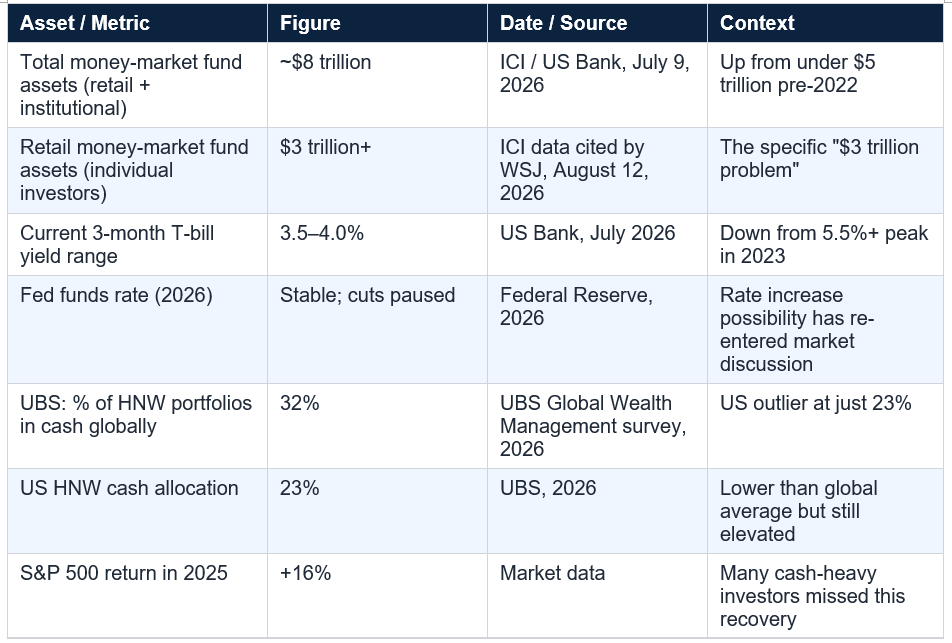
The scale of this cash accumulation is historically unusual. During normal periods, retail money-market funds hold a fraction of this total. The $3 trillion retail figure represents years of accumulated inflows from investors who made a rational short-term decision and have not revisited it as the rate environment has changed. Albert Pham’s August 2026 analysis of the WSJ story describes the situation precisely: a massive pool of investor cash is creating an unusual challenge for the wealth-management industry — individual investors are increasingly comfortable doing nothing with their money.
The WSJ article notes that advisers have been offering clients alternatives: private credit, municipal bonds, bond ladders, and diversified equity exposure. The challenge is that each alternative comes with trade-offs that some investors are unwilling to accept. The LyrArc summary of the WSJ piece highlights that when one adviser suggested private credit, Don Ross declined — citing poor performance reports of private credit in 2026. When the adviser noted that municipal bonds could offer approximately 4 percent tax-free, the investor remained unconvinced.
The wealth management industry’s structural problem is this: if investors are comfortable earning 3.5 percent in money-market funds without the volatility of market-linked investments, the theoretical case for accepting more risk has to overcome not just the investor’s comfort with the current arrangement but also the specific context of 2026, in which volatility has been elevated and recent memory of positive market returns is partly offset by Q1 2026’s declines.
Consider 2025: the S&P 500 returned approximately 16 percent. An investor with $500,000 in an index fund tracking the S&P 500 would have earned approximately $80,000. The same $500,000 in a money-market fund at 4 percent earned approximately $20,000. The opportunity cost of the cash position in 2025 alone: approximately $60,000 on a $500,000 balance.
Over longer periods, the compounding of this annual opportunity cost becomes the defining feature of retirement wealth outcomes. T. Rowe Price’s March 2026 analysis demonstrated this with systematic investment modelling: an investor who contributed $12,000 per year (or $1,000 per month) to a 60/40 portfolio over five or thirty years generated a materially larger final portfolio than an investor who used the identical contribution pattern but held the money in cash over the same periods.
The five-year and thirty-year versions of this comparison both show the same result: time in the market, even through periods of significant volatility, outperforms equivalent time in cash-equivalent instruments — not in every single year, but consistently over the medium and long term.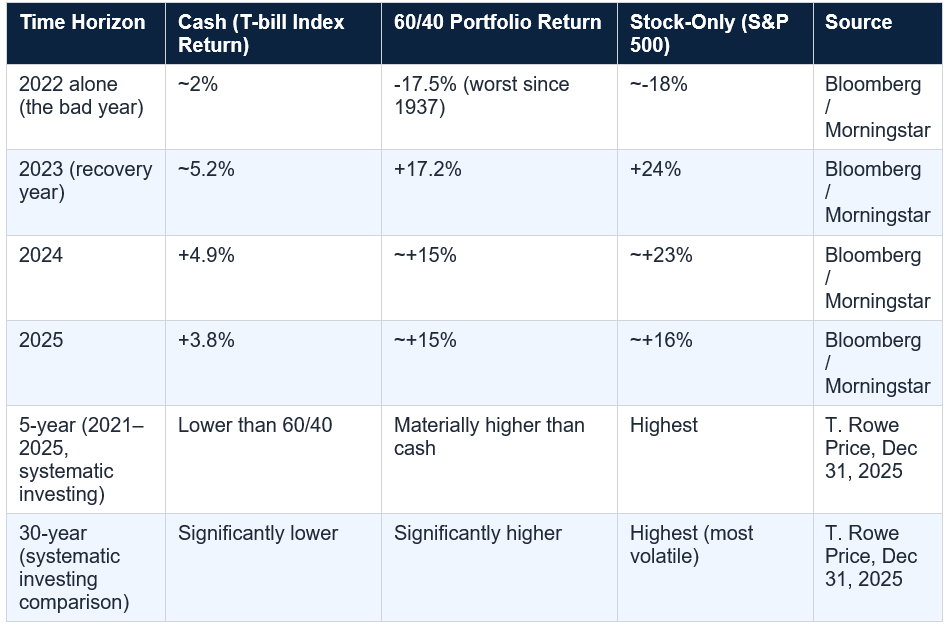
The data tells a clear story over any period extending beyond two years: cash underperforms diversified portfolios, and the underperformance compounds. The 2022 loss that made cash attractive was real and painful, but investors who remained in cash through 2023, 2024, and 2025 missed three years of strong market recovery. The opportunity cost of the cash position in those three years alone typically exceeded the loss avoided in 2022.
Paula Polito, UBS Global Wealth Management (2026): Cash is a safe asset for a liquidity strategy but a risky one for longevity. We see high levels of cash globally. This is a situation that needs to change for investors to meet their long-term financial goals.
Waiting for the right moment to invest is one of the most reliably documented investor mistakes. The right moment is defined only in retrospect, and the investors who wait for it consistently miss the largest gains, which tend to cluster in unpredictable bursts following the worst market periods. The cash that moved to safety in 2022 missed the 24 percent S&P 500 return in 2023, the 23 percent return in 2024, and the 16 percent return in 2025.
US Bank’s Tom Hainlin framed the core principle: investors earn returns from taking on uncertainty or risk. The three trillion dollar retail money-market pool represents investors who have, temporarily or permanently, decided they are not willing to take on uncertainty. For those whose time horizon is genuinely short — retirees drawing income, near-term savers — this is appropriate. For the larger group whose time horizon is long but whose investment position is short, the wealth management industry has a — very large — problem.
The Wall Street Journal reported on August 12, 2026 that retail investors are holding more than $3 trillion in retail money-market funds — cash-equivalent instruments earning 3.5 to 4.0% yields. The problem, according to the wealth management industry, is that a significant portion of this cash belongs to long-term investors who moved into money-market funds when rates rose sharply in 2022 and 2023 and have not moved back, despite the opportunity cost of sitting out the 2023, 2024, and 2025 market recoveries.
How much is held in money-market funds in 2026?
Total money-market fund assets (retail and institutional) reached nearly $8 trillion as of July 9, 2026, according to the Investment Company Institute, as cited by US Bank. Of that total, more than $3 trillion is held in retail money-market funds by individual investors, per data cited by The Wall Street Journal on August 12, 2026.
What is the opportunity cost of holding too much cash?
T. Rowe Price’s March 2026 analysis shows that a systematic investor in a 60/40 portfolio over five or thirty years generated materially more wealth than an identical investor who held equivalent contributions in cash over the same periods. In practice: the S&P 500 returned approximately 24% in 2023, 23% in 2024, and 16% in 2025. An investor holding $500,000 in cash at 4% missed approximately $60,000 of potential gains in 2025 alone, on top of similar opportunity costs in the two prior recovery years.
Is 3.5% in a money-market fund actually safe?
Not as safe as it appears in real terms. US CPI inflation was 3.3% in March 2026, meaning the real return on a 3.5% money-market fund is approximately 0.2% before taxes. After federal income tax (money-market interest is taxable as ordinary income), a 32% bracket investor earns approximately 2.4% gross, which is below the inflation rate. The apparent safety of cash comes with a hidden cost: inflation erosion of purchasing power, and no protection against the risk of outliving savings.
Should I move my cash to investments in 2026?
Whether you should redeploy cash depends on your time horizon, risk tolerance, and financial goals. If cash serves as your emergency fund or covers near-term spending (within 1–2 years), it belongs where it is. If it represents long-term savings for goals 5, 10, or 20 years away, the evidence from multiple decades of market history consistently shows that diversified investment portfolios outperform cash over these timeframes. A qualified financial adviser can model the specific impact for your portfolio. This article is not financial advice.
What alternatives to cash are wealth managers recommending in 2026?
Wealth managers are recommending investment-grade corporate bonds (currently yielding 5–6% for investment-grade credit), municipal bonds (approximately 4%+ with federal tax exemption), bond ladders (structured portfolios of bonds maturing at regular intervals), dividend-focused equity funds, and diversified 60/40 balanced portfolios. Each carries different risk-return profiles. For investors not ready to fully re-enter equity markets, short-duration bond funds serve as a bridge between money-market yields and longer-duration investments.
How much cash should I actually hold?
Standard financial planning guidance recommends: 3 to 6 months of essential expenses in an emergency fund; all known spending needs within the next 1 to 2 years in cash or short-term instruments; 2 to 5 year goals in short-term bonds or bond ladders; and long-term savings in a diversified portfolio aligned with your risk tolerance and time horizon. Everything beyond these purposes that genuinely belongs to long-term wealth accumulation is likely costing you real return by sitting in cash-equivalent instruments.
Table of Contents
- Three Trillion Reasons to Pay Attention
- How We Got Here: The Rate-Rise Cash Rush
- The Scale of the Problem: $8 Trillion and Counting
- Why Individual Investors Are Not Moving
- What Wealth Managers Are Actually Worried About
- The Real Opportunity Cost of Holding Cash
- What the Numbers Say: Cash vs. Markets Over Time
- The Yield Illusion: 3.5% Is Not Free Money
- Who Is Most at Risk of the Cash Trap?
- What the Alternatives Actually Offer in 2026
- The Right Amount of Cash: How Much Is Enough?
- What Advisers Are Telling Their Clients to Do
- Conclusion: Waiting Is a Decision Too
- Frequently Asked Questions
Three Trillion Reasons to Pay Attention
On August 12, 2026, The Wall Street Journal published a story that framed an unusual investment industry challenge: wealth management has a $3 trillion problem. The problem is not a market crash, a liquidity crisis, or a regulatory failure. The problem is individual investors who are choosing to do nothing — keeping trillions of dollars in retail money-market funds, earning yields in the 3.5 to 4.0 percent range, while the markets they are sitting out continue to move.The Investment Company Institute reports that total money-market fund assets reached nearly $8 trillion as of July 9, 2026. Of that vast sum, more than $3 trillion is held by retail investors in retail money-market accounts — ordinary households who moved heavily into cash-equivalent instruments when interest rates rose sharply in 2022 and 2023, and who have not moved back.
The WSJ story illustrated the phenomenon with one investor: a retired airline pilot, Don Ross, who has been keeping 85 percent of his savings in cash-equivalent instruments. Every financial planner he has spoken with has suggested he invest the cash. He is not sold. His position is not unusual. And according to wealth management firms across the United States, his is the most common and most costly conversation they are having in 2026.
Disclaimer: This article is for general informational and educational purposes only. It is not financial or investment advice. Investing involves risk, including the possible loss of capital. Past performance is not a reliable indicator of future results. Always consult a qualified financial adviser before changing your investment strategy.
How We Got Here: The Rate-Rise Cash Rush
To understand why $3 trillion sits in retail money-market funds in August 2026, you need to understand what happened between 2022 and 2023. The Federal Reserve, responding to inflation that peaked at 9.1 percent in June 2022, raised the federal funds rate from near zero to 5.25 to 5.50 percent — the fastest rate-hiking cycle in 40 years. Three-month Treasury bill yields, which had been below 0.1 percent in early 2022, rose above 5.5 percent by mid-2023.For individual investors who had watched their portfolios fall significantly in 2022 — the S&P 500 declined 18 percent and bonds fell simultaneously, making it the worst year for a 60/40 portfolio since 1937 — money-market funds and T-bills suddenly offered something that had not been available for over a decade: a genuinely competitive, safe return. Five percent with no market risk was an offer that tens of millions of investors accepted.
US Bank’s July 2026 analysis documents the transition: for years, money market accounts, certificates of deposit, and US Treasury bills offered yields that attracted little attention. That changed as interest rates rose. The rush into cash-equivalent instruments was rational at the time. The question in 2026 is whether staying there remains rational now that conditions have changed.
US Bank Asset Management, July 2026: Investors who leave long-term, investable assets in cash for too long can allow short-term convenience to displace long-term progress. Cash can support near-term spending and provide a buffer during periods of market volatility. Stocks and bonds can serve longer-term goals by offering the potential for higher growth and income in exchange for greater uncertainty and price movement.
The Scale of the Problem: $8 Trillion and Counting
The scale of this cash accumulation is historically unusual. During normal periods, retail money-market funds hold a fraction of this total. The $3 trillion retail figure represents years of accumulated inflows from investors who made a rational short-term decision and have not revisited it as the rate environment has changed. Albert Pham’s August 2026 analysis of the WSJ story describes the situation precisely: a massive pool of investor cash is creating an unusual challenge for the wealth-management industry — individual investors are increasingly comfortable doing nothing with their money.
Why Individual Investors Are Not Moving
The wealth management industry’s frustration with the cash-holding behaviour is understandable from a portfolio theory perspective. But the reasons investors are staying in cash are also understandable — and not simply irrational:Recent Market Memory
The 2022 market decline was sharp and painful. The simultaneous fall in both stocks and bonds removed the normal buffer that diversified portfolios provide. Investors who experienced this remember it. The subsequent recovery in 2023, 2024, and 2025 has partially restored confidence, but the memory of a bad year in which ‘safe’ bonds also fell lingers as a reason to distrust traditional portfolio construction.The Rate Environment Created a Genuine Alternative
At 5.5 percent, a T-bill yield was competitive with many equity dividend yields and significantly above savings account rates. At 3.5 to 4.0 percent — where yields sit in 2026 — it is less compelling but still meaningfully above the near-zero rates of 2020 and 2021. For a retiree drawing income, 3.5 percent with capital security has genuine appeal.Market Volatility in 2026
The US-Iran conflict that began on 28 February 2026 sent equity markets sharply lower in the first quarter. The S&P 500 was down approximately 4 percent year-to-date as of early April, making 3.5 percent in a money market fund look even more attractive to an investor focused on short-term returns. Geopolitical uncertainty has reinforced the instinct to stay in safety.Decision Fatigue and Inertia
UBS Global Wealth Management’s 2026 survey found 32 percent of high-net-worth portfolios globally were in cash, with the firm’s client strategy officer Paula Polito noting: we see high levels of cash globally. Cash is a safe asset for a liquidity strategy but a risky one for longevity. Part of the problem is simply inertia: the decision to move into cash was made in 2022 or 2023 and has not been actively revisited. Doing nothing is the path of least resistance.What Wealth Managers Are Actually Worried About
The wealth management industry’s concern about the $3 trillion in retail money-market funds is not altruistic. Advisers who manage fee-based relationships earn more when assets are invested than when they sit in money-market funds outside their management. But the concern also reflects a genuine professional observation about the long-term consequences of extended cash holding.The WSJ article notes that advisers have been offering clients alternatives: private credit, municipal bonds, bond ladders, and diversified equity exposure. The challenge is that each alternative comes with trade-offs that some investors are unwilling to accept. The LyrArc summary of the WSJ piece highlights that when one adviser suggested private credit, Don Ross declined — citing poor performance reports of private credit in 2026. When the adviser noted that municipal bonds could offer approximately 4 percent tax-free, the investor remained unconvinced.
The wealth management industry’s structural problem is this: if investors are comfortable earning 3.5 percent in money-market funds without the volatility of market-linked investments, the theoretical case for accepting more risk has to overcome not just the investor’s comfort with the current arrangement but also the specific context of 2026, in which volatility has been elevated and recent memory of positive market returns is partly offset by Q1 2026’s declines.
The Real Opportunity Cost of Holding Cash
The phrase opportunity cost describes what you give up when you choose one option over another. When an investor holds $500,000 in a money-market fund earning 3.5 percent, the opportunity cost is the return that money would have generated in a different investment. In strong market years, this cost can be enormous.Consider 2025: the S&P 500 returned approximately 16 percent. An investor with $500,000 in an index fund tracking the S&P 500 would have earned approximately $80,000. The same $500,000 in a money-market fund at 4 percent earned approximately $20,000. The opportunity cost of the cash position in 2025 alone: approximately $60,000 on a $500,000 balance.
Over longer periods, the compounding of this annual opportunity cost becomes the defining feature of retirement wealth outcomes. T. Rowe Price’s March 2026 analysis demonstrated this with systematic investment modelling: an investor who contributed $12,000 per year (or $1,000 per month) to a 60/40 portfolio over five or thirty years generated a materially larger final portfolio than an investor who used the identical contribution pattern but held the money in cash over the same periods.
The five-year and thirty-year versions of this comparison both show the same result: time in the market, even through periods of significant volatility, outperforms equivalent time in cash-equivalent instruments — not in every single year, but consistently over the medium and long term.
What the Numbers Say: Cash vs. Markets Over Time
The data tells a clear story over any period extending beyond two years: cash underperforms diversified portfolios, and the underperformance compounds. The 2022 loss that made cash attractive was real and painful, but investors who remained in cash through 2023, 2024, and 2025 missed three years of strong market recovery. The opportunity cost of the cash position in those three years alone typically exceeded the loss avoided in 2022.
The Yield Illusion: 3.5% Is Not Free Money
The 3.5 to 4.0 percent yield available on money-market funds in 2026 feels meaningful compared to the near-zero rates of 2020 and 2021. But there are two ways in which this yield is less attractive than it appears:Inflation Erodes Real Returns
CPI inflation in the US was 3.3 percent in March 2026 (and potentially higher in subsequent months given the Iran war’s energy price impact). A money-market fund earning 3.5 percent in a 3.3 percent inflation environment is providing a real return of approximately 0.2 percent. After federal income tax (money-market fund interest is fully taxable as ordinary income at your marginal rate), the real after-tax return for a 32 percent bracket investor is negative. The yield feels like a safe return. The after-tax, after-inflation reality is capital preservation at best.Rate Risk Is Real
Money-market fund yields are not fixed. They move directly with short-term interest rates. If the Federal Reserve cuts rates — as it did in 2024 and 2025 — the yield on a money-market fund falls correspondingly. An investor holding cash in anticipation of a better time to invest may find that the yield that made cash attractive has already declined significantly by the time they decide to act. The 5.5 percent that was available in 2023 became 3.5 to 4.0 percent in 2026. If the Fed resumes cutting, it could fall further.Paula Polito, UBS Global Wealth Management (2026): Cash is a safe asset for a liquidity strategy but a risky one for longevity. We see high levels of cash globally. This is a situation that needs to change for investors to meet their long-term financial goals.
Who Is Most at Risk of the Cash Trap?
Not all cash-heavy investors face the same risk profile. The opportunity cost of holding too much cash varies significantly by time horizon and financial situation:Retirees Drawing Income
For retirees who are actively drawing down their portfolio for living expenses, holding 12 to 24 months of spending needs in cash or short-term instruments is standard planning practice. This is not the problem the WSJ article describes. The problem is retirees who hold 5, 10, or 20 years of spending in cash-equivalent instruments, effectively removing their investment portfolio from the growth that their longer life expectancy requires.Pre-Retirees in Their 50s and Early 60s
This group faces the most acute version of the cash trap. They have enough wealth that the absolute dollar risk of market loss feels significant, but their investment horizon is typically 20 to 30 years — long enough that the compounding opportunity cost of excess cash is enormous. Moving from a portfolio that might reasonably expect 7 percent annual returns to one earning 3.5 percent in money-market funds, compounded over 25 years, produces dramatically different retirement outcomes.Long-Term Investors Who Made a Short-Term Decision
The most common version of the $3 trillion problem: investors who moved to cash in 2022 or early 2023 as a tactical response to market conditions and have not revisited the decision. They made a short-term decision — get out until things feel safer — and defaulted into a permanent position. Their time horizon is long-term. Their portfolio is positioned short-term.What the Alternatives Actually Offer in 2026
Albert Pham’s August 2026 analysis of the WSJ story identifies the alternatives that wealth managers are suggesting to cash-heavy clients. Each comes with its own risk-return profile:- Investment-grade corporate bonds: currently offering yields in the 5 to 6 percent range for investment-grade credit, providing higher income than money-market funds with moderate interest-rate risk. Appropriate for investors who can tolerate some price volatility.
- Municipal bonds: as cited by LyrArc’s summary of the WSJ, municipal bonds can offer approximately 4 percent or above — with the advantage that interest is exempt from federal income tax and typically from state income tax in the state of issuance. For high-bracket investors, the tax-equivalent yield is meaningfully above money-market rates.
- Bond ladders: a structured portfolio of bonds maturing at regular intervals (one year, two years, three years, etc.) that provides predictable income and principal return, reduces interest-rate risk by diversifying across maturities, and maintains liquidity as bonds mature.
- Dividend-focused equity funds: for investors seeking income without pure bond exposure, dividend-focused equity strategies provide yield plus potential capital appreciation, though with higher volatility than bonds.
- 60/40 balanced portfolios: the standard diversified approach remains the best-evidenced strategy for most long-term investors. The 2022 experience tested it severely, but the subsequent three years of recovery (totalling approximately 50 percent cumulative returns in a 60/40 portfolio from 2023 through 2025) have reasserted its historical pattern.
The Right Amount of Cash: How Much Is Enough?
The goal is not to have zero cash. The goal is to have the right amount of cash for your specific situation and to ensure that everything above that amount is working toward your financial objectives. US Bank’s guidance provides the clearest framework:- Emergency fund: 3 to 6 months of essential living expenses in a readily accessible account. This is the baseline that should always be maintained regardless of market conditions or investment opportunities.
- Near-term spending: any cash needed for known expenses within the next one to two years (home purchase, education, healthcare, major purchase) should be in cash or very short-term instruments to eliminate the risk of needing to sell investments at a loss.
- Intermediate goals (2 to 5 years): money needed in the 2 to 5 year timeframe is appropriately held in short-term bond funds or bond ladders — not equity, but not pure cash either.
- Long-term wealth: everything beyond the emergency fund, near-term spending, and intermediate goals that is genuinely long-term savings belongs in a portfolio aligned with your risk tolerance and time horizon.
What Advisers Are Telling Their Clients to Do
The wealth management industry’s response to the $3 trillion problem involves several consistent strategies:- Running the numbers: showing clients the specific dollar impact of excess cash holding over 5, 10, and 20 years, customised to their portfolio size and expected return differential. Abstract percentages feel abstract; $200,000 in foregone retirement wealth at a specific age does not.
- Gradual redeployment: rather than asking cash-heavy investors to move all at once — which triggers loss aversion and market timing anxiety — advisers are suggesting systematic redeployment over six to twelve months. Dollar-cost averaging the cash back into the market spreads entry-point risk.
- Short-duration bond entry points: for investors not yet ready for equity exposure, short-duration bond funds provide a step up from money-market yields with modest additional risk. This serves as a bridge between pure cash and longer-duration investment.
- Tax efficiency framing: for investors in higher brackets, the tax advantage of municipal bonds makes the effective yield comparison more favourable than the headline numbers suggest. Advisers are using specific after-tax calculations to make the case.
- Acknowledging the uncertainty while reframing the risk: advisers are increasingly explicit that the risk of staying in cash — the risk of outliving your money, the risk of inflation erosion, the risk of missing the recovery — is as real as the risk of market volatility. Cash does not eliminate risk. It changes which risks you face.
Conclusion
The $3 trillion sitting in retail money-market funds is not an accident. It is the result of a series of rational individual decisions, made in a specific market context between 2022 and 2023, that have been allowed to persist into a different market context in 2026. The decision to move to cash was understandable. The decision to stay there, at 3.5 percent yields that barely keep pace with inflation before taxes, is costing investors real long-term wealth.Waiting for the right moment to invest is one of the most reliably documented investor mistakes. The right moment is defined only in retrospect, and the investors who wait for it consistently miss the largest gains, which tend to cluster in unpredictable bursts following the worst market periods. The cash that moved to safety in 2022 missed the 24 percent S&P 500 return in 2023, the 23 percent return in 2024, and the 16 percent return in 2025.
US Bank’s Tom Hainlin framed the core principle: investors earn returns from taking on uncertainty or risk. The three trillion dollar retail money-market pool represents investors who have, temporarily or permanently, decided they are not willing to take on uncertainty. For those whose time horizon is genuinely short — retirees drawing income, near-term savers — this is appropriate. For the larger group whose time horizon is long but whose investment position is short, the wealth management industry has a — very large — problem.
Frequently Asked Questions
What is the $3 trillion cash problem in wealth management?The Wall Street Journal reported on August 12, 2026 that retail investors are holding more than $3 trillion in retail money-market funds — cash-equivalent instruments earning 3.5 to 4.0% yields. The problem, according to the wealth management industry, is that a significant portion of this cash belongs to long-term investors who moved into money-market funds when rates rose sharply in 2022 and 2023 and have not moved back, despite the opportunity cost of sitting out the 2023, 2024, and 2025 market recoveries.
How much is held in money-market funds in 2026?
Total money-market fund assets (retail and institutional) reached nearly $8 trillion as of July 9, 2026, according to the Investment Company Institute, as cited by US Bank. Of that total, more than $3 trillion is held in retail money-market funds by individual investors, per data cited by The Wall Street Journal on August 12, 2026.
What is the opportunity cost of holding too much cash?
T. Rowe Price’s March 2026 analysis shows that a systematic investor in a 60/40 portfolio over five or thirty years generated materially more wealth than an identical investor who held equivalent contributions in cash over the same periods. In practice: the S&P 500 returned approximately 24% in 2023, 23% in 2024, and 16% in 2025. An investor holding $500,000 in cash at 4% missed approximately $60,000 of potential gains in 2025 alone, on top of similar opportunity costs in the two prior recovery years.
Is 3.5% in a money-market fund actually safe?
Not as safe as it appears in real terms. US CPI inflation was 3.3% in March 2026, meaning the real return on a 3.5% money-market fund is approximately 0.2% before taxes. After federal income tax (money-market interest is taxable as ordinary income), a 32% bracket investor earns approximately 2.4% gross, which is below the inflation rate. The apparent safety of cash comes with a hidden cost: inflation erosion of purchasing power, and no protection against the risk of outliving savings.
Should I move my cash to investments in 2026?
Whether you should redeploy cash depends on your time horizon, risk tolerance, and financial goals. If cash serves as your emergency fund or covers near-term spending (within 1–2 years), it belongs where it is. If it represents long-term savings for goals 5, 10, or 20 years away, the evidence from multiple decades of market history consistently shows that diversified investment portfolios outperform cash over these timeframes. A qualified financial adviser can model the specific impact for your portfolio. This article is not financial advice.
What alternatives to cash are wealth managers recommending in 2026?
Wealth managers are recommending investment-grade corporate bonds (currently yielding 5–6% for investment-grade credit), municipal bonds (approximately 4%+ with federal tax exemption), bond ladders (structured portfolios of bonds maturing at regular intervals), dividend-focused equity funds, and diversified 60/40 balanced portfolios. Each carries different risk-return profiles. For investors not ready to fully re-enter equity markets, short-duration bond funds serve as a bridge between money-market yields and longer-duration investments.
How much cash should I actually hold?
Standard financial planning guidance recommends: 3 to 6 months of essential expenses in an emergency fund; all known spending needs within the next 1 to 2 years in cash or short-term instruments; 2 to 5 year goals in short-term bonds or bond ladders; and long-term savings in a diversified portfolio aligned with your risk tolerance and time horizon. Everything beyond these purposes that genuinely belongs to long-term wealth accumulation is likely costing you real return by sitting in cash-equivalent instruments.
0 Comments
Be the first to share your thoughts on this article.