
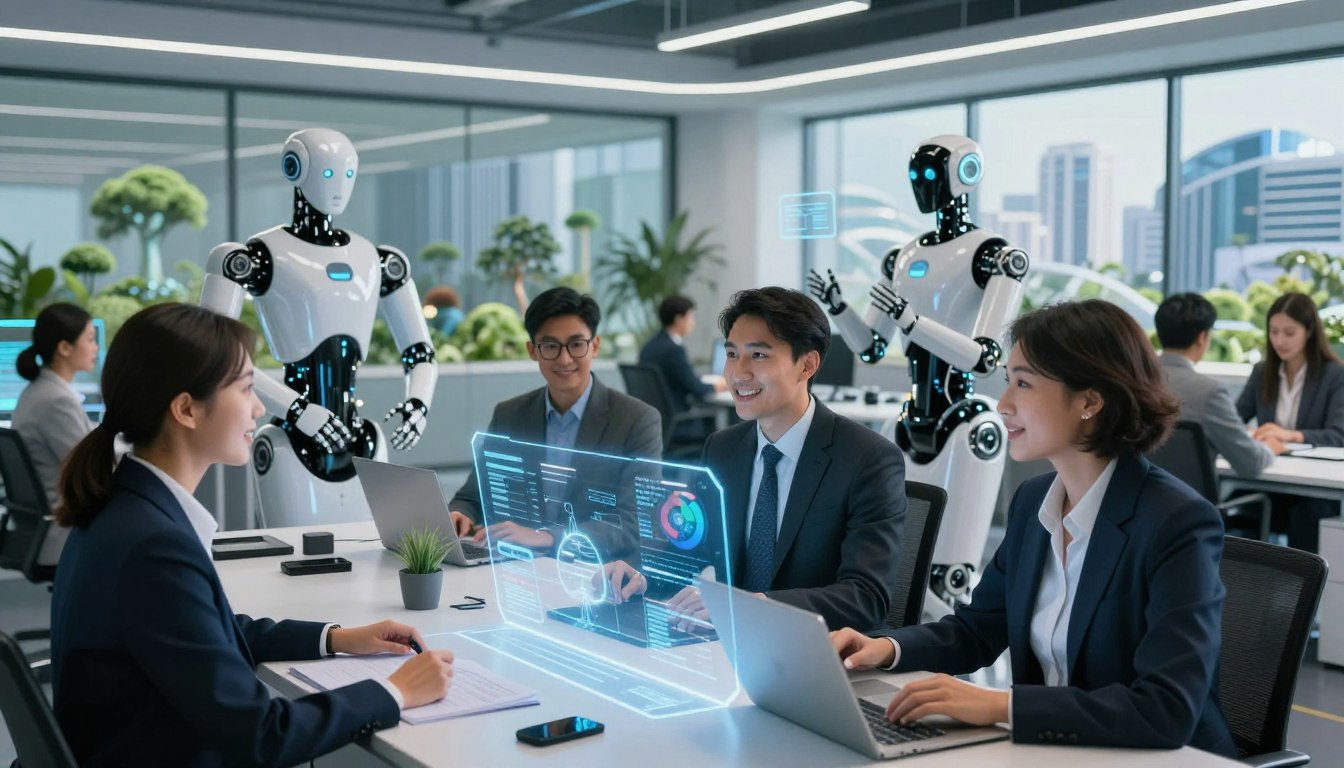
The Future of Human and AI Collaboration Explained
Artificial intelligence is no longer just a simple tool. It has evolved into a powerful partner. This new form of collaboration is reshaping how work gets done across many industries. You are witnessing a fundamental shift. Machine intelligence and human creativity are joining forces. This partnership unlocks potential that neither could achieve alone. This synergy creates a smarter way of working. It drives innovation and efficiency to new heights. The World Economic Forum predicts that while automation may change many jobs, it will also create millions of new roles by 2030.
PwC research suggests the economic impact is massive. Global GDP could see a significant boost, highlighting the immense commercial opportunity. For you, this means adapting skills is essential for thriving today and beyond.
Key Takeaways
- Artificial intelligence is now a collaborative partner, not just a tool.
- This partnership is transforming major industries like healthcare and finance.
- While some jobs will change, many new roles will be created.
- The economic impact of this shift is projected to be in the trillions of dollars.
- Success depends on combining unique human strengths with machine capabilities.
- Adapting your skill set is crucial for navigating this new landscape.
Understanding the Evolution of Human-AI Collaboration
Modern work environments are being reshaped by synergistic relationships between people and artificial systems. This partnership leverages complementary strengths that create outcomes superior to what either could achieve alone.
Origins of Collaborative Intelligence
Early automation systems handled simple, narrowly defined functions over many years. They sorted emails or recommended products with basic rules. Today's advanced intelligence represents a dramatic evolution from those beginnings.
True human-ai collaboration emerged from recognizing how human and machine capabilities complement each other. Early AI focused on replacing repetitive
tasks. Modern approaches emphasize augmentation—enhancing your capabilities rather than replacing them.
Key Industry Transformations
Key industries are experiencing fundamental changes to their processes. Healthcare uses AI-assisted diagnostics that provide data-driven insights. This improves accuracy while letting professionals focus on patient care.
Finance blends computational power with human judgment for smarter decisions. These systems represent a paradigm shift in how you approach complex problem-solving. Machines become intelligent partners rather than simple tools.
The ability to learn from feedback and adapt to new contexts accelerates this evolution. Collaborative workflows now transform entire sectors through continuous learning and improvement.
Exploring The Future of Human and AI Collaboration Trends
Data-driven forecasts reveal significant shifts in professional landscapes driven by collaborative technologies. These insights help you prepare for coming changes in how work gets done.
Data-Driven Insights for Future Impact
Research shows nearly 40% of current skills will transform by 2030. McKinsey's 2023 report indicates automation could boost global productivity growth to 3.4%Organizations using these systems see better outcomes in decision-making. AI handles heavy data tasks while you focus on creative work.
Emerging Technologies and Applications
Autonomous agents that perceive and act represent key innovations. Vibe coding generates functional code from natural language instructions.
Wearable AI and augmented reality systems integrate assistance into daily workflows. These tools enhance your capabilities across various professional contexts.
Real-World Case Studies
Healthcare demonstrates practical impact through AI-assisted diagnostics. Doctors maintain patient focus while receiving data-driven insights.
Customer service uses chatbots for routine inquiries. Human agents address complex issues requiring empathy and nuanced judgment.
Laboratory automation executes experiments based on scientist guidance. This accelerates discovery while leveraging human creativity.
Blending Human Creativity and AI Precision
Effective collaboration between people and technology hinges on recognizing distinct advantages. Each brings unique strengths to the partnership that create superior outcomes when properly aligned.
Leveraging Human Intuition and Emotional Intelligence
Your human capabilities include emotional intelligence and creative thinking. These strengths allow you to understand nuanced situations that machines cannot grasp.
Intuition and empathy remain distinctly human advantages. They enable you to make ethical judgments and adapt to novel scenarios. This complements artificial intelligence's computational power perfectly.
Maximizing Data Analysis and Automation
Delegate data-heavy tasks to automated systems for optimal efficiency. Repetitive work with clear parameters benefits from machine accuracy and speed.
This approach frees your cognitive resources for higher-value activities. You can focus on strategic decisions requiring human insight while automation handles precision tasks.
The partnership achieves complex goals through this balanced division of labor. Both contributors operate in areas where they naturally excel.
Navigating Ethical and Privacy Challenges in AI Integration
As you adopt collaborative technologies, addressing privacy and accountability becomes a critical priority. These challenges require careful consideration of how artificial intelligence impacts your operations and stakeholders.
Establishing Transparent and Accountable AI Practices
Data privacy represents one of your most significant concerns. Recent reports show that 13% of organizations experienced breaches of AI systems. Alarmingly, 97% of compromised organizations lacked proper access controls.
Algorithmic bias presents another major challenge. Your understanding of how algorithms work is crucial. They reflect the data they're trained on, which can perpetuate existing biases.
This raises serious questions about fairness in critical decisions affecting hiring, lending, and healthcare. Over-reliance on automated systems threatens to erode essential human skills.
You must ensure humans remain active participants in decision-making processes. Establishing clear frameworks for accountability is essential. The EU AI Act provides governance that mandates fairness and transparency.
Your approach should prioritize human oversight. This ensures that values, context, and ethical considerations guide integration. Balancing rapid adoption with proper governance prevents operational disruption.
Addressing responsibility gaps in collaborative systems requires clear frameworks. Maintaining human responsibility for consequential decisions protects both your organization and the people it serves.
Enhancing Decision-Making and Innovation with AI
Smarter business outcomes emerge from the strategic fusion of data-driven insights and human expertise. This partnership elevates your organization's capabilities beyond traditional methods.
AI as a Catalyst for Smarter Business Outcomes
Intelligent systems process vast datasets to provide real-time insights. This accelerates your decision-making while improving accuracy across operations.
In healthcare, these tools analyze medical information to assist diagnoses. Doctors maintain final judgment, personalizing care based on patient context. Financial professionals use predictive algorithms for market trends. Your oversight ensures responsible application of these insights.
Research from Carnegie Mellon shows how AI can strengthen human. This approach creates measurable value through combined strengths.
Collaborative Tools for Progressive Workflows
Modern platforms streamline processes and automate routine tasks. They boost productivity by freeing your team for strategic work.
Project management tools track progress and predict obstacles. This creates more efficient workflows with better outcomes. McKinsey's 2023 report indicates automation could boost global productivity growth significantly.
| Decision Factor | AI Contribution | Human Contribution |
| Data Processing | Rapid analysis of large datasets | Contextual understanding and ethical judgment |
| Innovation Generation | Pattern recognition and prediction | Creative thinking and intuition |
| Workflow Efficiency | Automation of repetitive tasks | Strategic oversight and relationship management |
Your judgment remains essential for ethical decisions and innovation. This balanced approach delivers superior results that neither could achieve alone.
Empowering Your Workforce with Future-Ready AI Skills
Organizations must now invest in developing human capabilities that complement intelligent systems. Your people need specific skills to work effectively alongside advanced tools. This requires thoughtful training and continuous learning programs.
Cultivating Trust and Continuous Learning
Building trust between your team and AI agents is essential. Your people need transparency in how these systems operate. They must understand the contextbehind AI recommendations.
Data literacy becomes a core competency for your workforce. This knowledge helps your team interpret AI-generated content. They can then apply human judgment to automated insights.
The World Economic Forum projects significant skill transformation by 2030. Nearly 40% of current capabilities will need updating. Continuous learning ensures your people remain valuable contributors.
| Human-Centric Skills | Technical AI Skills | Collaborative Benefits |
| Critical thinking and creativity | Data literacy and AI fluency | Enhanced decision-making |
| Emotional intelligence | System interaction knowledge | Improved innovation |
| Ethical judgment | Tool limitation understanding | Balanced oversight |
Your training should focus on skills machines cannot replicate. Combine these with technical knowledge about AI systems. This approach maximizes the value your team brings to partnerships.
Develop a culture where continuous learning is prioritized. Your people will adapt as roles evolve over coming years. This mindset ensures successful integration of intelligent tools into daily work.
Conclusion
At its core, this synergistic relationship unlocks capabilities that transcend traditional boundaries. It represents more than efficiency gains—it's about discovering new potential through combined strengths.
An augmentation-first approach enhances your creative thinking and problem-solving capabilities. This method builds trust gradually between people and intelligent systems.
Your path forward requires balancing technological potential with essential human qualities. Maintain oversight of consequential decisions while leveraging AI's analytical power.
Continuous learning ensures your team's knowledge evolves alongside these systems. This partnership will deepen across industries, driving innovation and productivity through smarter collaboration.

0 Comments Comments