

Financial Literacy
The Subscription You Forgot You Were Paying

42% of Americans are paying for at least one subscription they have completely forgotten about. The average wasted spend: $204 per year. Americans collectively waste $15.5 billion on forgotten subscriptions annually. Here is exactly where the money goes — and how to get it back.

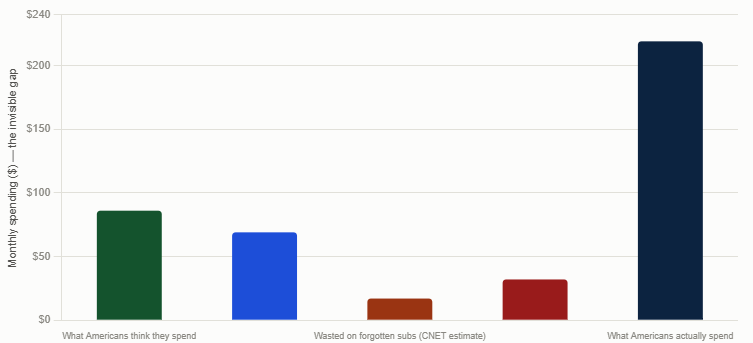
Forty-two percent of Americans admit they are currently paying for at least one subscription they have completely forgotten about, according to C+R Research, cited across multiple 2026 analyses including Resubs and JustCancel. The average annual cost of those forgotten charges: $204 per year, according to a 2025 CNET survey cited by Resubs in January 2026. Americans collectively waste over $15.5 billion annually on forgotten subscriptions, according to SubStop’s March 2026 data.
This is not a story about irresponsibility. It is a story about system design. The subscription model was built for frictionless payment — small recurring charges, on autopilot, spread across multiple payment methods, billed on different dates, renewed automatically by default. Frictionless payment also means frictionless forgetting. The invisible tax is not accidental; it is structural.
The Numbers: 42% of Americans pay for at least one subscription they’ve completely forgotten about (C+R Research). Average forgotten subscription waste: $204/year, $17/month (CNET 2025 survey, Resubs). Americans collectively waste $15.5 billion annually on forgotten subscriptions (SubStop March 2026). 89% underestimate their total subscription spending (West Monroe).
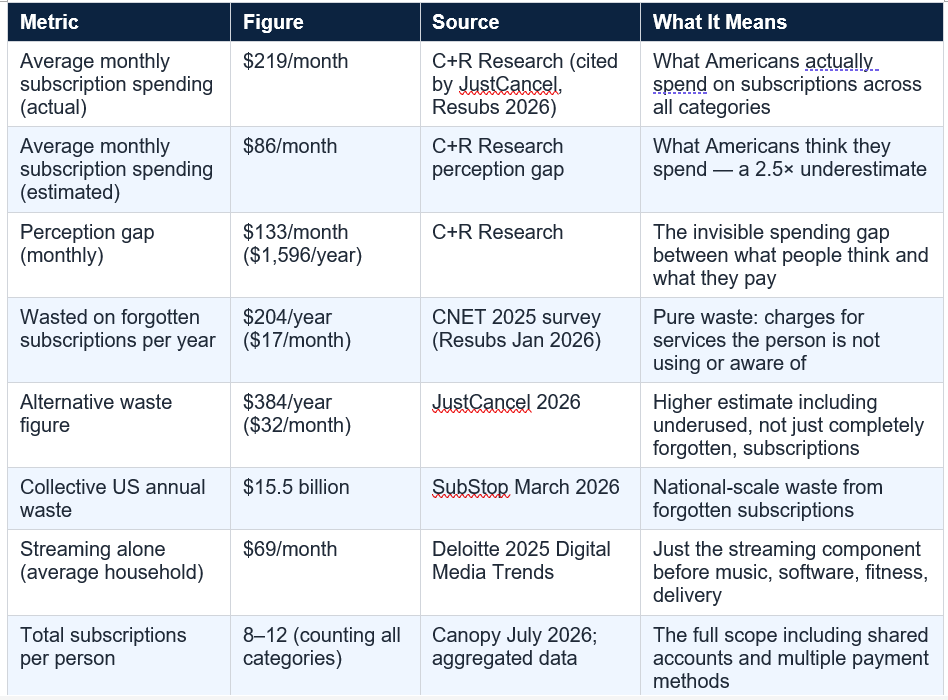
The West Monroe data adds the most revealing dimension: two-thirds of consumers were off by more than $200 per month in their subscription spending estimates. This is not a small rounding error. It is a systematic, large-scale blindspot that the subscription economy has engineered into the payment experience.
Self Financial’s data puts the average cost of forgotten free trial conversions at $34.31 per person in total. For 37.8 percent of those affected, the unexpected expense meant cutting back on other spending. The structure is not accidental: a ‘free’ trial that requires a payment method is, architecturally, a paid subscription with a delayed start.
The pattern by which this becomes a forgotten charge: the initial sign-up creates an entry in one payment method’s autopay list. No reminder is sent before the trial ends. The first charge arrives on a bill alongside 15 other items. It is not noticed. By month three, it has been billed three times and is firmly embedded in the payment landscape as a ‘normal’ charge.
Common services with annual billing that frequently generate forgotten charges: Amazon Prime, Apple iCloud+ (when billed annually), Adobe Creative Cloud annual plans, antivirus and security software, premium news subscriptions, domain registrations, password manager annual plans, and specialised software tools used for a single project. Each of these is a legitimate service that may provide value. Each is also an annual charge that can be paid for years without use if it is not actively reviewed.
The SubDupes June 2026 guide identifies annual billing amnesia as one of the three primary mechanics driving forgotten subscription spending, noting that the frictionless payment system — designed to make payment easy for the consumer — also makes forgetting effortless for the same reason.
The average household now pays for four streaming services at a combined cost of $69 per month (Deloitte 2025 Digital Media Trends, cited by Canopy July 2026). The dynamic that produces this is subscription stacking: new services are added for specific reasons (a new show, a sporting event, a free trial offer), while existing services are retained through inertia. The stack grows because additions have a specific trigger but removals require a deliberate, friction-bearing decision.
Netflix for the main household viewing, Disney+ for the children, Prime Video bundled with Amazon Prime, Peacock for the sports package set up for the playoffs, Paramount+ from the free trial that was never cancelled, Max for the one series that just started. Combined cost: $70 to $100 per month for six services. Active use: probably two to three of them at any given time.
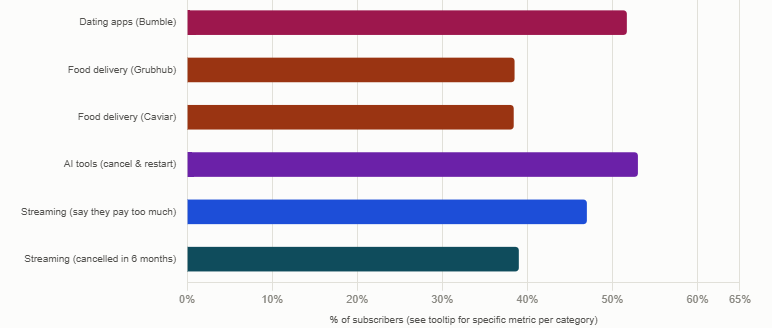
The Readless May 2026 subscription fatigue statistics analysis, citing Deloitte 2025, found that 47 percent of streamers say they already pay too much for the services they have, and 39 percent cancelled at least one streaming service in the previous six months. The recognition of overpayment is widespread; the action to address it is less consistent.
Subscription stacking is not limited to streaming. The same pattern applies to fitness apps (new app added when enthusiasm spikes; old app retained on autopay), productivity tools (new tool trialled for a project; old tool never cancelled), and cloud storage (tier upgraded when storage was needed; never downgraded when files were deleted).
The just-in-case subscription is psychologically distinct from the forgotten subscription. The person paying for it knows they have it. They just cannot bring themselves to cancel it. The gym app that they used six months ago and might use again. The language learning app that cost $79.99 for the year and might be picked up again after the busy period. The project management tool they used for one client and might use for the next one.
The practical test for just-in-case subscriptions: if you did not have this subscription today and you were considering subscribing to it, would you? If the answer is no — if you would not pay to start this service today — then the only reason to keep it is inertia. Inertia is not a financial strategy. Cancel it. If you genuinely need it in three months, you can re-subscribe, and many services offer win-back promotions to returning subscribers that are actually cheaper than the standard rate.
.
The 15-minute audit described in this guide is the intervention. It requires no new habit, no app, no ongoing commitment. It requires one 15-minute session per quarter, starting today. The average first-time audit finds $50 to $100 per month in charges that can be eliminated without meaningful change in daily life. That is $600 to $1,200 per year recovered from spending that was happening below the level of conscious awareness.
The subscription you forgot is not a mystery. It is on your statement. It has been there for months. The only step it requires is looking.
The most widely cited figure comes from a 2025 CNET survey, referenced by Resubs in January 2026 and the Chattanooga Times Free Press in February 2026: the average person wastes $204 per year — roughly $17 per month — on completely forgotten subscriptions. JustCancel's 2026 analysis, which includes underused (not just completely forgotten) subscriptions, puts the figure at $384 per year ($32 per month). At a collective level, SubStop's March 2026 data estimates Americans waste over $15.5 billion annually on forgotten subscriptions. The broader context: Americans spend an average of $219 per month on all subscriptions (C+R Research) but estimate only $86, a 2.5× perception gap. 89% of consumers underestimate their subscription spending (West Monroe).
Why do so many people forget about their subscriptions?
Three structural features of the subscription model drive forgotten spending, as identified by Resubs and SubDupes in their 2026 analyses: (1) Autopay by default — 72% of consumers have all subscriptions on autopilot, removing the monthly payment decision that would keep the charge visible. (2) Payment fragmentation — subscriptions are charged to different payment methods (credit cards, PayPal, Apple ID, Google Play), so no single statement shows the complete picture. (3) Annual billing — charges that appear once per year create a 364-day visibility gap during which the subscription becomes cognitively invisible. 74% of consumers say it is easy to forget recurring charges (C+R Research). The combination of these three features is not accidental; it is a structural feature of the subscription business model that serves operators by reducing cancellation rates.
What subscription categories are most commonly forgotten?
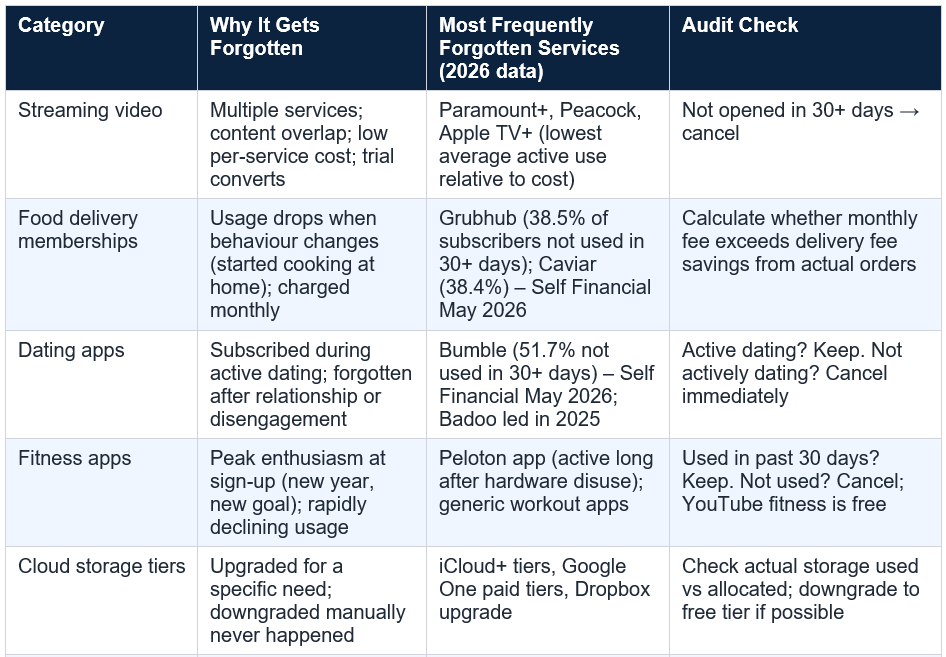
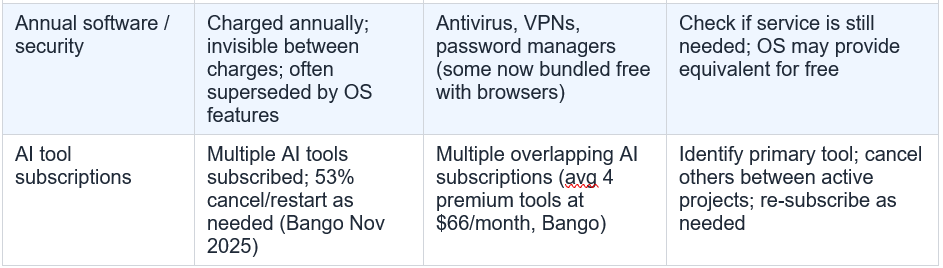
Based on Self Financial's May 2026 survey and aggregated data from JustCancel, SubStop, and Canopy: dating apps (Bumble had 51.7% of subscribers not using it in 30+ days), food delivery memberships (Grubhub at 38.5%, Caviar at 38.4%), fitness apps (gym and workout apps abandoned after initial enthusiasm fades), streaming video services (particularly smaller services subscribed for a single season of a show), cloud storage tiers (upgraded for a specific need and never downgraded), annual software and security subscriptions (charged once per year and invisible between billing cycles), and AI tool subscriptions (average American AI subscriber pays for 4 premium AI tools at $66/month, with 53% cancelling and restarting as needed per Bango November 2025).
What is the fastest way to find forgotten subscriptions?
The 15-minute audit protocol: (1) Export 90 days of statements from all bank accounts and credit cards; highlight every recurring charge. (2) Check Apple ID subscriptions at Settings → [Your Name] → Subscriptions (iPhone) or appleid.apple.com. Check Google Play subscriptions at play.google.com/store/account/subscriptions. (3) Search your primary email for 'annual renewal,' 'subscription receipt,' and 'free trial' filtered to the past 14 months. (4) For each subscription found, apply the three-question test: When did I last use this? Is it available free elsewhere? Would I subscribe today if starting fresh? Cancel any that fail. Canopy's July 2026 guide estimates the average person finds 2–3 completely forgotten subscriptions on their first audit.
Is it hard to cancel subscriptions?
It should not be. The FTC's Click-to-Cancel rule, effective May 2025, requires that cancellation of any online subscription be as easy as the original sign-up — if you can sign up with one click online, you must be able to cancel with one click online. However, JustCancel's analysis of 1,189 subscription services found that 143 of them still make cancellation unnecessarily difficult despite this requirement, using multi-step processes, hidden cancellation links, mandatory phone calls, or persuasion flows designed to deter cancellation. If a service makes cancellation unreasonably difficult, you can report it to the FTC at ReportFraud.ftc.gov. You can also contact your bank or credit card company to block future charges from a specific merchant.
How often should I audit my subscriptions?
Quarterly — once every three months — is the standard recommendation from multiple consumer finance guides including Canopy (July 2026) and Resubs (January 2026). The first audit typically produces the largest savings, as it captures accumulated forgotten charges from potentially months or years. Subsequent audits find less because the habit of removal prevents accumulation. Setting a calendar reminder for the first week of each quarter takes approximately 30 seconds and makes the habit automatic rather than dependent on remembering to do it. An annual audit is better than no audit; a quarterly audit is better than annual because it catches free trial conversions and new subscriptions before they spend months accumulating as forgotten charges.
Table of Contents
- The Invisible Tax
- The Numbers: How Much Forgotten Subscriptions Actually Cost
- Why We Forget: The Architecture of Invisible Spending
- Trap 1: The Free Trial That Became a Paid Subscription
- Trap 2: The Annual Renewal You Stopped Remembering
- Trap 3: Subscription Stacking — Adding Without Ever Removing
- Trap 4: The ‘Just In Case’ Subscription
- The Most Commonly Forgotten Subscription Categories
- The 15-Minute Subscription Audit Protocol
- After the Audit: The Cancel, Keep, or Negotiate Decision
- Conclusion: The Subscription You Forgot Is the Easiest Money You’ll Ever Save
- Frequently Asked Questions
The Perception Gap
Most Forgotten Categories
The Invisible Tax
There is a charge on your bank statement or credit card bill right now that you have not thought about in months. It could be the meditation app you used during a difficult January three years ago. The streaming service you signed up for to watch one show that ended in 2024. The cloud storage tier you upgraded to before you deleted those files. The gym app that outlasted your gym membership by 18 months.Forty-two percent of Americans admit they are currently paying for at least one subscription they have completely forgotten about, according to C+R Research, cited across multiple 2026 analyses including Resubs and JustCancel. The average annual cost of those forgotten charges: $204 per year, according to a 2025 CNET survey cited by Resubs in January 2026. Americans collectively waste over $15.5 billion annually on forgotten subscriptions, according to SubStop’s March 2026 data.
This is not a story about irresponsibility. It is a story about system design. The subscription model was built for frictionless payment — small recurring charges, on autopilot, spread across multiple payment methods, billed on different dates, renewed automatically by default. Frictionless payment also means frictionless forgetting. The invisible tax is not accidental; it is structural.
The Numbers: 42% of Americans pay for at least one subscription they’ve completely forgotten about (C+R Research). Average forgotten subscription waste: $204/year, $17/month (CNET 2025 survey, Resubs). Americans collectively waste $15.5 billion annually on forgotten subscriptions (SubStop March 2026). 89% underestimate their total subscription spending (West Monroe).
The Numbers: How Much Forgotten Subscriptions Actually Cost
The subscription spending data presents a picture of systematic underestimation at every level:The West Monroe data adds the most revealing dimension: two-thirds of consumers were off by more than $200 per month in their subscription spending estimates. This is not a small rounding error. It is a systematic, large-scale blindspot that the subscription economy has engineered into the payment experience.
Why We Forget: The Architecture of Invisible Spending
Before examining the specific traps, it is worth naming the structural features that make subscription forgetting so universal. According to Resubs’ March 2026 subscription spending statistics and SubDupes’ June 2026 analysis, three features of the subscription payment model are primarily responsible:- Autopay by default: 72 percent of consumers have all subscriptions set to auto-pay (C+R Research, cited by Resubs March 2026). Auto-pay removes the active decision to pay each month, which is its selling point. It also removes the monthly cognitive encounter with the charge that would otherwise keep it visible.
- Payment fragmentation: subscriptions are charged to different cards and accounts — a streaming service to the household Visa, a fitness app to the personal Amex, a software tool to the PayPal account, a news subscription to the Apple ID. No single statement shows the full picture. 74 percent of consumers say it is easy to forget recurring charges (C+R Research, cited by Resubs).
- Annual billing: some subscriptions charge annually rather than monthly. An annual charge for $119.99 appears once per year, is processed as a single event, and then becomes cognitively invisible for 364 days. When the next charge arrives, many subscribers have forgotten they ever signed up.
Trap 1: The Free Trial That Became a Paid Subscription
Trap: The Free Trial Conversion — You signed up with the intention to cancel. You didn’t.
Seventy percent of participants in Self Financial’s May 2026 survey have forgotten to cancel a free trial at some point, locking them into a paid subscription. Forty-eight percent of Americans have been charged after forgetting to cancel a free trial (C+R Research, cited by JustCancel). The mechanism is simple and consistent: a service offers a 7-day, 14-day, or 30-day free trial that requires a credit card at sign-up. The card is the key — the charge happens by default, and cancellation requires an active step that must happen before a specific deadline.Self Financial’s data puts the average cost of forgotten free trial conversions at $34.31 per person in total. For 37.8 percent of those affected, the unexpected expense meant cutting back on other spending. The structure is not accidental: a ‘free’ trial that requires a payment method is, architecturally, a paid subscription with a delayed start.
The pattern by which this becomes a forgotten charge: the initial sign-up creates an entry in one payment method’s autopay list. No reminder is sent before the trial ends. The first charge arrives on a bill alongside 15 other items. It is not noticed. By month three, it has been billed three times and is firmly embedded in the payment landscape as a ‘normal’ charge.
Trap 2: The Annual Renewal You Stopped Remembering
Trap: Annual Billing Amnesia — The charge appears once a year. Out of sight, completely out of mind.
Annual billing is the most efficient vehicle for forgotten subscription spending because it creates a 364-day visibility gap. A service billed at $119.99 in October 2025 generates one charge, one email receipt, and one statement line — and then disappears from conscious awareness until October 2026. At that point, the subscriber may not even recognise the charge or remember signing up.Common services with annual billing that frequently generate forgotten charges: Amazon Prime, Apple iCloud+ (when billed annually), Adobe Creative Cloud annual plans, antivirus and security software, premium news subscriptions, domain registrations, password manager annual plans, and specialised software tools used for a single project. Each of these is a legitimate service that may provide value. Each is also an annual charge that can be paid for years without use if it is not actively reviewed.
The SubDupes June 2026 guide identifies annual billing amnesia as one of the three primary mechanics driving forgotten subscription spending, noting that the frictionless payment system — designed to make payment easy for the consumer — also makes forgetting effortless for the same reason.
Trap 3: Subscription Stacking — Adding Without Ever Removing
Trap: Subscription Stacking — New services get added; old ones never get removed. The stack grows indefinitely.The average household now pays for four streaming services at a combined cost of $69 per month (Deloitte 2025 Digital Media Trends, cited by Canopy July 2026). The dynamic that produces this is subscription stacking: new services are added for specific reasons (a new show, a sporting event, a free trial offer), while existing services are retained through inertia. The stack grows because additions have a specific trigger but removals require a deliberate, friction-bearing decision.
Netflix for the main household viewing, Disney+ for the children, Prime Video bundled with Amazon Prime, Peacock for the sports package set up for the playoffs, Paramount+ from the free trial that was never cancelled, Max for the one series that just started. Combined cost: $70 to $100 per month for six services. Active use: probably two to three of them at any given time.
The Readless May 2026 subscription fatigue statistics analysis, citing Deloitte 2025, found that 47 percent of streamers say they already pay too much for the services they have, and 39 percent cancelled at least one streaming service in the previous six months. The recognition of overpayment is widespread; the action to address it is less consistent.
Subscription stacking is not limited to streaming. The same pattern applies to fitness apps (new app added when enthusiasm spikes; old app retained on autopay), productivity tools (new tool trialled for a project; old tool never cancelled), and cloud storage (tier upgraded when storage was needed; never downgraded when files were deleted).
Trap 4: The ‘Just In Case’ Subscription
Trap: The Status Quo Bias — You don’t use it. But what if you need it later?
Seventy-two percent of consumers say they have kept a subscription ‘just in case’ they might use it later (Bankrate, cited by JustCancel). This is the status quo bias applied to subscription spending: the default is to keep what is already in place, because cancellation requires an active decision and feels like losing access to something, even if that something has not been accessed in months.The just-in-case subscription is psychologically distinct from the forgotten subscription. The person paying for it knows they have it. They just cannot bring themselves to cancel it. The gym app that they used six months ago and might use again. The language learning app that cost $79.99 for the year and might be picked up again after the busy period. The project management tool they used for one client and might use for the next one.
The practical test for just-in-case subscriptions: if you did not have this subscription today and you were considering subscribing to it, would you? If the answer is no — if you would not pay to start this service today — then the only reason to keep it is inertia. Inertia is not a financial strategy. Cancel it. If you genuinely need it in three months, you can re-subscribe, and many services offer win-back promotions to returning subscribers that are actually cheaper than the standard rate.
The Most Commonly Forgotten Subscription Categories
Self Financial’s May 2026 survey and the aggregated data from JustCancel, SubStop, SubDupes, and Canopy identify the subscription categories most likely to harbour forgotten charges:
The 15-Minute Subscription Audit Protocol
The subscription audit is the most reliably high-return 15 minutes available in personal finance. The average person finds at least two to three completely forgotten subscriptions on the first audit. The protocol, drawn from Canopy’s July 2026 forgotten subscription guide and Resubs’ audit framework:Step 1 (5 minutes): Statement Review
Export or screenshot 90 days of statements from every bank account, credit card, and PayPal or Venmo account. Highlight every recurring charge: any charge that appears at the same or similar amount on a monthly or annual basis. Do not rely on memory; rely on the statements.Step 2 (3 minutes): Platform Checks
Check Apple ID subscriptions at Settings → [Your Name] → Subscriptions (or appleid.apple.com on the web). Check Google Play subscriptions at play.google.com/store/account/subscriptions. These surfaces reveal mobile app subscriptions that never appear on credit card statements in a recognisable form because they are consolidated under the Apple or Google billing descriptor.Step 3 (3 minutes): Email Search
In your primary email account, search for: ‘annual renewal,’ ‘your subscription has renewed,’ ‘subscription receipt,’ and ‘free trial.’ Filter results to the past 14 months. Every result is either an active subscription or a service you once signed up for. Compare the list to what you identified in Steps 1 and 2.Step 4 (4 minutes): The Three-Question Test
For each subscription identified, answer three questions: (1) When did I last use this? (2) Is this available free elsewhere or through a bundle I already pay for? (3) Would I subscribe to this today if I were starting from scratch? Cancel any subscription that fails any one of these questions. Schedule a quarterly calendar reminder for the next audit..
After the Audit: The Cancel, Keep, or Negotiate Decision
After the audit, each identified subscription falls into one of three categories:- Cancel immediately: any subscription that fails the three-question test, any forgotten subscription, any service you would not re-subscribe to today if you were starting from scratch. Cancel during the audit, not ‘soon.’ Deferring the cancellation decision is what allowed the subscription to accumulate for months in the first place.
- Keep actively: services you use at least twice per week, services tied to active professional obligations, cloud storage containing data you actively use, and any service where the cost is clearly justified by your actual use. Put these in a simple list or named note so the next audit takes less time.
- Negotiate or downgrade: services that are genuinely useful but priced at a level above what the use justifies. Many subscription services offer retention discounts (pause the cancellation flow and select ‘offer’ rather than confirming cancellation). Many offer ad-supported lower tiers, annual billing discounts, or student and senior rates. Some will offer a multi-month free period to retain a customer who initiates cancellation.
Conclusion
Forty-two percent of Americans are paying for something they cannot name. The average cost is $204 per year in completely forgotten charges — JustCancel’s broader estimate of wasted subscription spend is $384. The aggregate US cost is $15.5 billion annually. These are not small numbers, and they are not produced by financial carelessness. They are produced by a payment infrastructure specifically engineered to make recurring charges invisible: autopay by default, payment fragmentation across multiple accounts, annual billing that disappears for 364 days at a time, and cancellation flows that 143 of 1,189 analysed services deliberately make difficult.The 15-minute audit described in this guide is the intervention. It requires no new habit, no app, no ongoing commitment. It requires one 15-minute session per quarter, starting today. The average first-time audit finds $50 to $100 per month in charges that can be eliminated without meaningful change in daily life. That is $600 to $1,200 per year recovered from spending that was happening below the level of conscious awareness.
The subscription you forgot is not a mystery. It is on your statement. It has been there for months. The only step it requires is looking.
Frequently Asked Questions
How much do Americans waste on forgotten subscriptions each year?The most widely cited figure comes from a 2025 CNET survey, referenced by Resubs in January 2026 and the Chattanooga Times Free Press in February 2026: the average person wastes $204 per year — roughly $17 per month — on completely forgotten subscriptions. JustCancel's 2026 analysis, which includes underused (not just completely forgotten) subscriptions, puts the figure at $384 per year ($32 per month). At a collective level, SubStop's March 2026 data estimates Americans waste over $15.5 billion annually on forgotten subscriptions. The broader context: Americans spend an average of $219 per month on all subscriptions (C+R Research) but estimate only $86, a 2.5× perception gap. 89% of consumers underestimate their subscription spending (West Monroe).
Why do so many people forget about their subscriptions?
Three structural features of the subscription model drive forgotten spending, as identified by Resubs and SubDupes in their 2026 analyses: (1) Autopay by default — 72% of consumers have all subscriptions on autopilot, removing the monthly payment decision that would keep the charge visible. (2) Payment fragmentation — subscriptions are charged to different payment methods (credit cards, PayPal, Apple ID, Google Play), so no single statement shows the complete picture. (3) Annual billing — charges that appear once per year create a 364-day visibility gap during which the subscription becomes cognitively invisible. 74% of consumers say it is easy to forget recurring charges (C+R Research). The combination of these three features is not accidental; it is a structural feature of the subscription business model that serves operators by reducing cancellation rates.
What subscription categories are most commonly forgotten?
Based on Self Financial's May 2026 survey and aggregated data from JustCancel, SubStop, and Canopy: dating apps (Bumble had 51.7% of subscribers not using it in 30+ days), food delivery memberships (Grubhub at 38.5%, Caviar at 38.4%), fitness apps (gym and workout apps abandoned after initial enthusiasm fades), streaming video services (particularly smaller services subscribed for a single season of a show), cloud storage tiers (upgraded for a specific need and never downgraded), annual software and security subscriptions (charged once per year and invisible between billing cycles), and AI tool subscriptions (average American AI subscriber pays for 4 premium AI tools at $66/month, with 53% cancelling and restarting as needed per Bango November 2025).
What is the fastest way to find forgotten subscriptions?
The 15-minute audit protocol: (1) Export 90 days of statements from all bank accounts and credit cards; highlight every recurring charge. (2) Check Apple ID subscriptions at Settings → [Your Name] → Subscriptions (iPhone) or appleid.apple.com. Check Google Play subscriptions at play.google.com/store/account/subscriptions. (3) Search your primary email for 'annual renewal,' 'subscription receipt,' and 'free trial' filtered to the past 14 months. (4) For each subscription found, apply the three-question test: When did I last use this? Is it available free elsewhere? Would I subscribe today if starting fresh? Cancel any that fail. Canopy's July 2026 guide estimates the average person finds 2–3 completely forgotten subscriptions on their first audit.
Is it hard to cancel subscriptions?
It should not be. The FTC's Click-to-Cancel rule, effective May 2025, requires that cancellation of any online subscription be as easy as the original sign-up — if you can sign up with one click online, you must be able to cancel with one click online. However, JustCancel's analysis of 1,189 subscription services found that 143 of them still make cancellation unnecessarily difficult despite this requirement, using multi-step processes, hidden cancellation links, mandatory phone calls, or persuasion flows designed to deter cancellation. If a service makes cancellation unreasonably difficult, you can report it to the FTC at ReportFraud.ftc.gov. You can also contact your bank or credit card company to block future charges from a specific merchant.
How often should I audit my subscriptions?
Quarterly — once every three months — is the standard recommendation from multiple consumer finance guides including Canopy (July 2026) and Resubs (January 2026). The first audit typically produces the largest savings, as it captures accumulated forgotten charges from potentially months or years. Subsequent audits find less because the habit of removal prevents accumulation. Setting a calendar reminder for the first week of each quarter takes approximately 30 seconds and makes the habit automatic rather than dependent on remembering to do it. An annual audit is better than no audit; a quarterly audit is better than annual because it catches free trial conversions and new subscriptions before they spend months accumulating as forgotten charges.
0 Comments
Be the first to share your thoughts on this article.