
Investing
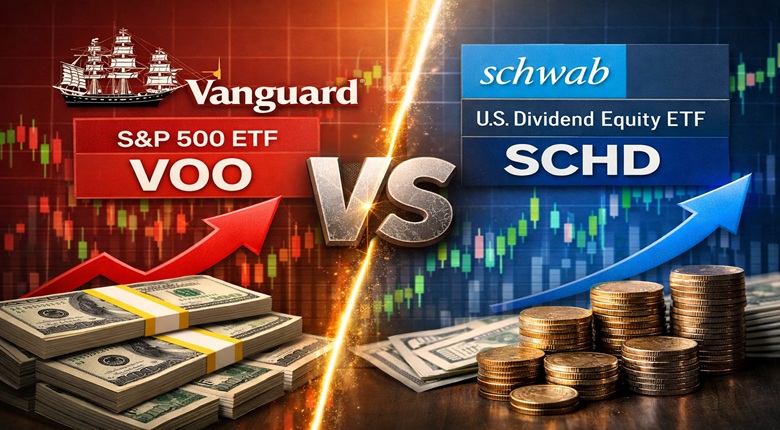
VOO vs SCHD: Best ETF for $100K Investors Compared

Investing $100,000 in either VOO or SCHD could change your financial future in fundamentally different ways. This guide breaks down every variable — returns, dividends, risk, tax, and time horizon — so you can make the decision that’s right for you.
Both are exceptional funds. Both are backed by reputable institutions with decades of track records. Both have ultra-low expense ratios and are among the most widely held ETFs in America. And yet, they are designed to do fundamentally different things with your money.
VOO (the Vanguard S&P 500 ETF) is built for maximum long-term growth. It tracks the 500 largest U.S. companies — from Apple and Microsoft to Amazon and Nvidia — and delivers the full growth of the American economy.
SCHD (the Schwab U.S. Dividend Equity ETF) is engineered for growing income. It selects high-quality companies with long dividend histories, strong cash flows, and consistent dividend growth — prioritising yield and stability over pure price appreciation.
The choice between them isn’t about which is better in some absolute sense — it’s about which is better for you, your timeline, your goals, and your relationship with passive income. This guide runs $100,000 through both funds across every metric that matters, so you can make that decision with confidence.
This concentration is both a strength and a risk factor. In bull markets dominated by tech growth, VOO has been a spectacular performer. In tech downturns, the concentration increases drawdown depth. Over any rolling 15-year period, however, the S&P 500 has delivered positive returns without exception.
Top holdings have historically included companies like Broadcom, AbbVie, Chevron, Coca-Cola, Verizon, and Texas Instruments. The composition is notably different from VOO: less concentrated in tech, more balanced across healthcare, consumer staples, financials, and energy.
Figures are illustrative estimates assuming dividends reinvested. Not a guarantee of future performance.
The projections reveal a fascinating divergence. After 30 years, VOO’s higher growth rate produces a significantly larger portfolio value ($1,005,000 vs $535,000). However, SCHD’s dividend stream at Year 30 — $236,000 annually — is nearly three times larger than VOO’s $79,000, because SCHD’s dividends have grown at roughly 11% per year. For someone in retirement who needs to live off portfolio income, SCHD may be the superior engine.
“VOO wins on portfolio value. SCHD wins on income. The right choice depends entirely on whether you plan to sell shares to fund retirement, or live off dividends without touching principal.”
— The Dividend Investor, 2025
→ Higher long-term portfolio value in most scenarios
→ Broader diversification across 500 companies vs 100
→ Lower expense ratio (0.03% vs 0.06%)
→ Better positioned to benefit from high-growth sectors like AI and technology
→ Simpler: tracks the market with maximum transparency
→ Significantly higher current income ($3,700/year vs $1,400 on $100k)
→ Dividend growth of ~11%/year means rapidly rising future income
→ Lower volatility and smaller drawdowns provide emotional stability
→ Quality factor screen (cash flow, ROE) selects financially robust companies
→ Income doesn’t require selling shares — psychologically powerful in retirement
✔ Prioritise maximum portfolio value over current income
✔ Can tolerate 20–35% drawdowns without panic-selling
✔ Plan to use the 4% rule or systematic withdrawal in retirement
✔ Hold primarily in a taxable brokerage account
✔ Want maximum simplicity: own the entire S&P 500 in one fund
✔ Are in the accumulation phase and reinvesting all dividends
✔ Need growing income to cover living expenses without selling shares
✔ Prefer lower volatility and smaller drawdowns for peace of mind
✔ Hold primarily in a Roth IRA or tax-advantaged account
✔ Value dividend growth as a hedge against inflation in retirement
✔ Want exposure to quality companies with strong fundamentals beyond pure growth
✔ Are building a “never sell” dividend income portfolio
VOO delivers the full return of the American economy. Over 30 years, $100,000 in VOO could grow to over $1,000,000 at historical average rates. Its ultra-low 0.03% expense ratio, unmatched liquidity, and market-cap exposure to the most dynamic companies on earth make it the optimal vehicle for long-term wealth accumulation. If your goal is the largest possible portfolio at retirement, VOO is almost certainly the right anchor.
SCHD builds a dividend income machine. Starting at $3,700/year on $100,000 and growing that income at ~11% annually, SCHD is designed for investors who want to live off portfolio income without ever selling a share. Its lower volatility, quality factor tilt, and remarkable dividend growth track record make it the premier income fund for dividend investors.
For most investors under 40: VOO, or a VOO-heavy blend. For investors over 50 seeking retirement income: SCHD, or a SCHD-heavy blend. For everyone: consider holding both, optimised for tax placement and life stage.
Table of Contents
- The $100,000 Question
- VOO at a Glance: The S&P 500 Tracker
- SCHD at a Glance: The Dividend Compounder
- Head-to-Head: Key Metrics Compared
- $100,000 Invested: Projected Growth Scenarios
- Income vs Growth: Which Strategy Wins?
- Risk, Volatility & Drawdowns
- Tax Efficiency & Account Placement
- Who Should Choose VOO vs SCHD?
- Conclusion: The Verdict
- Frequently Asked Questions (FAQ)
- External References
The $100,000 Question
You’ve saved $100,000. You’ve decided to invest it in a low-cost ETF. Now you face one of the most common — and most consequential — decisions in personal finance: VOO or SCHD?Both are exceptional funds. Both are backed by reputable institutions with decades of track records. Both have ultra-low expense ratios and are among the most widely held ETFs in America. And yet, they are designed to do fundamentally different things with your money.
VOO (the Vanguard S&P 500 ETF) is built for maximum long-term growth. It tracks the 500 largest U.S. companies — from Apple and Microsoft to Amazon and Nvidia — and delivers the full growth of the American economy.
SCHD (the Schwab U.S. Dividend Equity ETF) is engineered for growing income. It selects high-quality companies with long dividend histories, strong cash flows, and consistent dividend growth — prioritising yield and stability over pure price appreciation.
The choice between them isn’t about which is better in some absolute sense — it’s about which is better for you, your timeline, your goals, and your relationship with passive income. This guide runs $100,000 through both funds across every metric that matters, so you can make that decision with confidence.
IMPORTANT DISCLAIMER
This article is for educational purposes only and does not constitute financial advice. Past performance does not guarantee future results. Always consult a qualified financial advisor before making investment decisions.VOO at a Glance: The S&P 500 Tracker
The Vanguard S&P 500 ETF (VOO) is, by most measures, the single most influential retail investment product in history. Launched in 2010, it is the fund that Warren Buffett has publicly recommended for most individual investors, calling low-cost S&P 500 index funds the optimal choice for the vast majority of people.What VOO Actually Holds
VOO tracks the S&P 500 Index — 500 of the largest publicly traded U.S. companies by market capitalisation. The fund is market-cap weighted, meaning the largest companies command the largest allocations. As of early 2026, the top holdings are concentrated in mega-cap technology: Apple, Microsoft, NVIDIA, Amazon, and Alphabet collectively represent roughly 25-27% of the fund.This concentration is both a strength and a risk factor. In bull markets dominated by tech growth, VOO has been a spectacular performer. In tech downturns, the concentration increases drawdown depth. Over any rolling 15-year period, however, the S&P 500 has delivered positive returns without exception.
VOO Key Characteristics
| Full Name | Vanguard S&P 500 ETF |
| Ticker | VOO |
| Issuer | Vanguard |
| Index Tracked | S&P 500 |
| Expense Ratio | 0.03% (among the lowest available) |
| Holdings | ~500 large-cap U.S. equities |
| Dividend Yield | ~1.3–1.5% (as of 2026) |
| 10-Year Ann. Return | ~12.5% (price + dividends reinvested) |
| Inception Date | September 7, 2010 |
| AUM | ~$550 billion+ |
SCHD at a Glance: The Dividend Compounder
The Schwab U.S. Dividend Equity ETF (SCHD) has become the darling of the dividend investing community — and for good reason. Launched in 2011, it has delivered a remarkable combination of income generation and capital appreciation, outperforming many actively managed dividend funds at a fraction of the cost.What SCHD Actually Holds
SCHD tracks the Dow Jones U.S. Dividend 100 Index, which screens for companies that have paid dividends for at least 10 consecutive years, then applies quality filters: return on equity, dividend-to-free-cash-flow ratio, yield, and 5-year dividend growth rate. The result is roughly 100 stocks — quality businesses with the financial strength to sustain and grow dividends.Top holdings have historically included companies like Broadcom, AbbVie, Chevron, Coca-Cola, Verizon, and Texas Instruments. The composition is notably different from VOO: less concentrated in tech, more balanced across healthcare, consumer staples, financials, and energy.
SCHD Key Characteristics
| Full Name | Schwab U.S. Dividend Equity ETF |
| Ticker | SCHD |
| Issuer | Charles Schwab |
| Index Tracked | Dow Jones U.S. Dividend 100 Index |
| Expense Ratio | 0.06% |
| Holdings | ~100 high-quality dividend stocks |
| Dividend Yield | ~3.5–4.0% (as of 2026) |
| 10-Year Ann. Return | ~11.2% (price + dividends reinvested) |
| Dividend Growth Rate | ~11% per year (5-year average) |
| Inception Date | October 20, 2011 |
Head-to-Head: Key Metrics Compared
With $100,000 on the table, the differences between these two funds translate into very real dollar outcomes. Here is how they stack up across the metrics that matter most to long-term investors.| Metric | VOO | SCHD |
| Expense Ratio | 0.03% | 0.06% |
| Dividend Yield | ~1.4% | ~3.7% |
| Div. Growth (5yr) | ~6% p.a. | ~11% p.a. |
| Holdings Count | ~500 | ~100 |
| 10-yr Ann. Return | ~12.5% | ~11.2% |
| Beta (vs S&P 500) | 1.00 | ~0.75 |
| Max Drawdown 2022 | -19.4% | -5.9% |
| Tech Concentration | ~30% | ~10% |
| Sector Balance | Tech-heavy | Well-diversified |
| Primary Goal | Total growth | Income + growth |
KEY INSIGHT
SCHD’s lower beta and smaller 2022 drawdown reflect its defensive quality tilt. In bear markets, high-quality dividend payers historically hold value better than pure growth funds. In bull markets, VOO’s broader market exposure — particularly to high-growth tech — tends to pull ahead on total return.$100,000 Invested: Projected Growth Scenarios
The following projections model $100,000 invested in each fund with dividends reinvested, using historical average annual returns as the baseline assumption: 8% annualised price growth for VOO (plus 1.4% dividend yield) and 6% price growth for SCHD (plus 3.7% dividend yield). These are illustrative only — actual returns will vary.| Year | VOO Value | VOO Dividends | SCHD Value | SCHD Dividends |
| 1 | $108,000 | $1,400 | $106,000 | $3,600 |
| 5 | $147,000 | $7,700 | $132,000 | $20,400 |
| 10 | $217,000 | $16,800 | $175,000 | $46,200 |
| 20 | $466,000 | $37,000 | $306,000 | $104,700 |
| 30 | $1,005,000 | $79,000 | $535,000 | $236,000 |
Figures are illustrative estimates assuming dividends reinvested. Not a guarantee of future performance.
The projections reveal a fascinating divergence. After 30 years, VOO’s higher growth rate produces a significantly larger portfolio value ($1,005,000 vs $535,000). However, SCHD’s dividend stream at Year 30 — $236,000 annually — is nearly three times larger than VOO’s $79,000, because SCHD’s dividends have grown at roughly 11% per year. For someone in retirement who needs to live off portfolio income, SCHD may be the superior engine.
“VOO wins on portfolio value. SCHD wins on income. The right choice depends entirely on whether you plan to sell shares to fund retirement, or live off dividends without touching principal.”
— The Dividend Investor, 2025
Income vs Growth: Which Strategy Wins?
The “growth vs income” debate in investing is often framed as a competition. In reality, both approaches can succeed — the question is which better matches your specific situation.The Case for VOO (Total Return Focus)
The total return framework argues that dividends and capital appreciation are economically equivalent — $1 of dividend is no different from selling $1 of shares. Under this view, VOO’s higher projected portfolio value is the unambiguous winner: you accumulate more wealth, then sell shares systematically in retirement using a strategy like the 4% rule.→ Higher long-term portfolio value in most scenarios
→ Broader diversification across 500 companies vs 100
→ Lower expense ratio (0.03% vs 0.06%)
→ Better positioned to benefit from high-growth sectors like AI and technology
→ Simpler: tracks the market with maximum transparency
The Case for SCHD (Dividend Growth Focus)
The dividend growth strategy rests on a different logic: the psychological and practical value of receiving growing income without selling assets. For many retirees, never touching principal while receiving a rising income stream is deeply valuable. SCHD’s ~11% annual dividend growth rate means income roughly doubles every 6–7 years.→ Significantly higher current income ($3,700/year vs $1,400 on $100k)
→ Dividend growth of ~11%/year means rapidly rising future income
→ Lower volatility and smaller drawdowns provide emotional stability
→ Quality factor screen (cash flow, ROE) selects financially robust companies
→ Income doesn’t require selling shares — psychologically powerful in retirement
Risk, Volatility & Drawdowns
Risk is not just about losing money — it’s about whether you can stay the course during periods of decline without panic-selling at the worst possible moment. Understanding how each fund behaves in downturns is critical to choosing the one you can actually hold through market cycles.VOO: Market Risk, Fully Expressed
As a full S&P 500 tracker, VOO captures every market movement without dampening. In the 2022 bear market, VOO declined approximately 19.4% from peak to trough. In the 2020 COVID crash, it fell roughly 34% before recovering strongly. Over the long run, these drawdowns have always recovered and then exceeded prior highs — but they require conviction and a long enough time horizon to weather.SCHD: Defensive Resilience
SCHD’s quality screen acts as a natural buffer. Companies with strong cash flows, sustainable dividend policies, and robust balance sheets tend to fall less in recessions because their businesses are more stable. In 2022, SCHD declined just ~5.9% while VOO fell 19.4% — a remarkable difference. This defensive characteristic makes SCHD more suitable for investors with shorter time horizons or lower risk tolerance.RISK SUMMARY
VOO: Higher volatility, larger drawdowns, higher expected long-term return. Best tolerated with a 15+ year horizon and the stomach to hold through significant declines. SCHD: Lower volatility, smaller drawdowns, slightly lower expected return. Better suited for investors approaching or in retirement, or those who find large portfolio swings psychologically difficult.Tax Efficiency & Account Placement
Tax efficiency is one of the most overlooked variables in ETF selection, yet it can meaningfully impact real net returns over decades. Both VOO and SCHD have important tax characteristics that should influence where you hold them.VOO: Highly Tax-Efficient
VOO’s low dividend yield (~1.4%) means most of its returns come from price appreciation, which is only taxed when you sell. The ETF structure Vanguard pioneered (using patent-expired share class mechanics) minimises capital gains distributions. For investors in taxable brokerage accounts, VOO is one of the most tax-efficient equity vehicles available. You control when you realise gains.SCHD: Less Efficient in Taxable Accounts
SCHD’s higher yield (~3.7%) means meaningful dividend distributions each quarter. Even as qualified dividends (taxed at the preferential 0%, 15%, or 20% rate in the U.S.), this regular income creates a tax drag in taxable accounts. For investors in higher tax brackets, this reduces the after-tax advantage of SCHD’s income. The strategic response is clear:- Hold SCHD in tax-advantaged accounts (Roth IRA, Traditional IRA, 401k) to shelter dividends from tax.
- Hold VOO in taxable brokerage accounts where its low dividend yield and deferred capital gains structure maximises after-tax compounding.
- If you hold both, consider tax-loss harvesting opportunities during market downturns in the taxable account.
Who Should Choose VOO vs SCHD?
Neither ETF is universally superior. The right choice — or combination — depends on your age, goals, income needs, tax situation, and temperament. Here are clear investor profiles for each.VOO is the better choice if you...
✔ Are under 45 with 15+ years before needing the money✔ Prioritise maximum portfolio value over current income
✔ Can tolerate 20–35% drawdowns without panic-selling
✔ Plan to use the 4% rule or systematic withdrawal in retirement
✔ Hold primarily in a taxable brokerage account
✔ Want maximum simplicity: own the entire S&P 500 in one fund
✔ Are in the accumulation phase and reinvesting all dividends
SCHD is the better choice if you...
✔ Are 50+ and approaching or entering retirement✔ Need growing income to cover living expenses without selling shares
✔ Prefer lower volatility and smaller drawdowns for peace of mind
✔ Hold primarily in a Roth IRA or tax-advantaged account
✔ Value dividend growth as a hedge against inflation in retirement
✔ Want exposure to quality companies with strong fundamentals beyond pure growth
✔ Are building a “never sell” dividend income portfolio
The Case for Both: A 50/50 or 60/40 Split
Many sophisticated investors hold both funds — using VOO for growth in the accumulation phase and SCHD for income in retirement. A common strategy is to hold 60-70% VOO / 30-40% SCHD during working years, then gradually shift toward 40-50% SCHD as retirement approaches. This blend captures VOO’s growth engine while building the SCHD dividend stream that will eventually fund living expenses.CONCLUSION
The Verdict: VOO vs SCHD
Investing $100,000 in VOO or SCHD is not a choice between a good investment and a bad one — it is a choice between two exceptional funds with different design philosophies.VOO delivers the full return of the American economy. Over 30 years, $100,000 in VOO could grow to over $1,000,000 at historical average rates. Its ultra-low 0.03% expense ratio, unmatched liquidity, and market-cap exposure to the most dynamic companies on earth make it the optimal vehicle for long-term wealth accumulation. If your goal is the largest possible portfolio at retirement, VOO is almost certainly the right anchor.
SCHD builds a dividend income machine. Starting at $3,700/year on $100,000 and growing that income at ~11% annually, SCHD is designed for investors who want to live off portfolio income without ever selling a share. Its lower volatility, quality factor tilt, and remarkable dividend growth track record make it the premier income fund for dividend investors.
For most investors under 40: VOO, or a VOO-heavy blend. For investors over 50 seeking retirement income: SCHD, or a SCHD-heavy blend. For everyone: consider holding both, optimised for tax placement and life stage.
Frequently Asked Questions (FAQ)
Is VOO or SCHD better for long-term growth?
VOO has historically delivered higher total returns over long periods (10+ years) due to its exposure to high-growth sectors like technology. However, the gap narrows significantly when SCHD’s dividend reinvestment and dividend growth are fully accounted for. For pure portfolio value growth, VOO has the edge. For growing income, SCHD is superior.Can I hold both VOO and SCHD in my portfolio?
Absolutely — and many investors do. A common approach is to hold VOO as the core growth position and SCHD as an income layer. In tax-advantaged accounts, SCHD’s dividends compound without tax drag. In taxable accounts, VOO’s low yield and deferred gains structure is more efficient. The combination can provide both growth and income.What happens to SCHD’s dividends if the market crashes?
SCHD’s dividend history has been remarkably resilient. The quality screen selects companies with sustainable dividend policies and strong free cash flow, which means they can maintain dividends even in recessions. During COVID-19 in 2020, SCHD actually maintained and grew its dividend. However, no dividend is guaranteed — severe recessions can force dividend cuts even at quality companies.Is $100,000 enough to live off dividends from SCHD?
At SCHD’s current yield of roughly 3.5–4.0%, $100,000 generates approximately $3,500–$4,000 per year — not enough to live on alone in most developed countries. However, with dividend growth of ~11% per year, that income roughly doubles every 6–7 years. A patient investor who reinvests dividends for 20–25 years before drawing income can build a substantially larger income stream.Does VOO pay dividends?
Yes. VOO pays quarterly dividends, but its yield is relatively low at approximately 1.3–1.5%. Most of VOO’s return comes from price appreciation. Investors in growth mode should reinvest these dividends. In retirement, VOO’s dividends alone are unlikely to cover expenses, so a systematic withdrawal strategy (selling shares) is typically required.Which ETF is better for a Roth IRA?
Both work well in a Roth IRA. However, SCHD is particularly compelling in a Roth because all dividends and growth are tax-free at withdrawal. Since SCHD produces substantial dividend income that would otherwise be taxed, sheltering it in a Roth maximises the benefit. VOO works well in either taxable or tax-advantaged accounts, but its tax-efficient structure makes it less urgent to shield inside a Roth.Has SCHD ever cut its dividend?
SCHD has not cut its dividend since inception in 2011. It has grown its dividend every year, with a 5-year compound annual growth rate of approximately 11–14%. This is one of the primary reasons dividend investors favour SCHD. However, it is worth noting that SCHD has a shorter track record than many other dividend funds and has not been tested through a severe multi-year recession.External References
1. Vanguard — VOO ETF Fund Page — Overview, Holdings & Performance. https://investor.vanguard.com/investment-products/etfs/profile/voo
2. Charles Schwab — SCHD ETF Fund Page — Schwab U.S. Dividend Equity ETF.
2. Charles Schwab — SCHD ETF Fund Page — Schwab U.S. Dividend Equity ETF.
0 Comments
Be the first to share your thoughts on this article.