

Investing
What Investing $5 a Day Gives You in 30 Years

Key Projections: $5/day = $150/month = $1,825/year. At 7% annual return over 30 years: ~$181,500 total. At 10% annual return over 30 years: ~$339,073 total. At 12% annual return over 30 years: ~$529,000 total. Total contributed over 30 years: $54,750. At 10% return, the market creates $284,323 on top of your $54,750 in contributions. If you invest $10/day instead: ~$678,146 at 10% over 30 years. If you invest $5/day starting at age 25: by age 55, ~$339,000. Same amount starting at 35: by 65, ~$339,000. Same investment, same outcome — because compounding needs 30 years, not a specific age. The Rule of 72: at 10%, money doubles every 7.2 years. Key statistic: 80% of Americans say they wish they had started investing earlier (IPX1031, 2025). Average first investment age in the US: 27. Gen Z average: 20. S&P 500 historical average annual return (last 100 years): ~10% (nominal). Long-run average after inflation: ~7%. Missing the 10 best market days in a decade eliminates ~80% of returns (JPMorgan).
At a 10 percent average annual return — the approximate historical average nominal return of the S&P 500 over the past century — $5 per day for 30 years grows to approximately $339,073. You contribute $54,750 of your own money across those 30 years. The market creates the other $284,323. You put in 16 cents of every dollar in that account. The other 84 cents were never your paycheck. They were created by time and compounding.
This article explains exactly how that happens, year by year, and what it means in practice. It answers the four questions that matter most when you first see this number: Is it real? How does compounding work at that scale? What does $5 per day actually look like in a daily life? And can you actually do this with the financial situation you have right now?
The Number: $5/day × 30 years at 10% = $339,073. You contributed $54,750. The market created $284,323.
The $5-per-day framing is specifically useful because it makes the daily stakes visible. Most people can evaluate whether $5 today — the cost of a single item — is worth trading for a significantly larger future sum. The monthly figure ($150) feels more abstract. The daily figure makes the trade-off concrete: what is $5 today worth to me in 30 years? The maths gives a specific and striking answer.
The Latte Factor — David Bach, The Automatic Millionaire: The Latte Factor is not about coffee. It is about the small amounts of money we waste daily without thinking about them, and what those amounts would be worth if invested instead. Small amounts, invested consistently over long periods, are not small. They are life-changing.
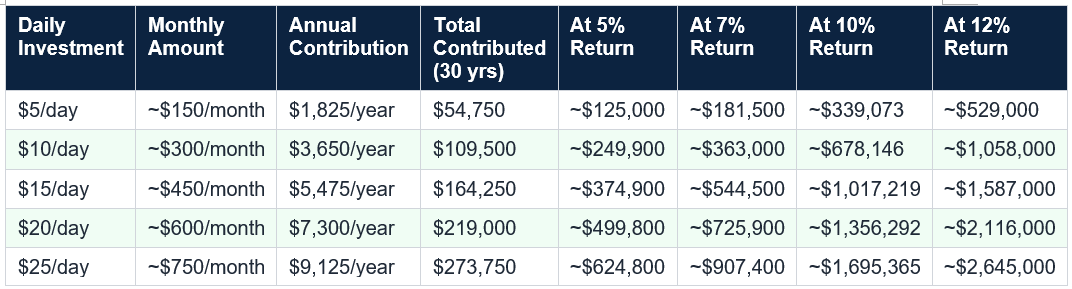
All figures in the table above are hypothetical projections based on assumed constant annual rates of return, compounded monthly, with a $150 monthly contribution ($5/day average). They do not account for taxes on gains, investment fees, or inflation. They assume consistent contribution without interruption. Past performance is not indicative of future results.
Several observations from the table are immediately striking. First, the difference between 7% and 10% on $5 per day over 30 years is $157,573 — almost three times the total amount ever contributed. The return rate matters enormously over long periods. Second, doubling the daily investment from $5 to $10 approximately doubles the outcome at every return rate — which means the relationship is linear in contributions but exponential in time. Third, at 10%, even the most modest investment of $5 per day produces a sum that would take the average American worker more than six years to earn at the median household income.
The Number: Your contributions: $54,750 (16% of the total). The market’s contribution via compounding: $284,323 (84% of the total).
This ratio — 84 percent of the final balance created by compounding, not by contributions — is what makes the 30-year time horizon transformative. It is not primarily your money that created the wealth. It is the return on your return on your return, compounded over three decades. You are not the engine of this wealth. You are the starting mechanism. The compounding engine runs itself.
To understand why the market’s contribution is so large, consider what happens to the first $5 you invest on day one of this 30-year journey. That $5, invested at 10% annually for 30 years, grows to approximately $87. Your $5 becomes $87 not because you added anything to it but because it earned returns, and those returns earned returns, and those returns earned returns, for 30 uninterrupted years. Every $5 you invest in year one does this. Every $5 you invest in year 10 does a smaller version of this. Every $5 you invest in year 29 barely compounds at all.
This is the mechanism that makes starting early so dramatically more valuable than starting with more money later.
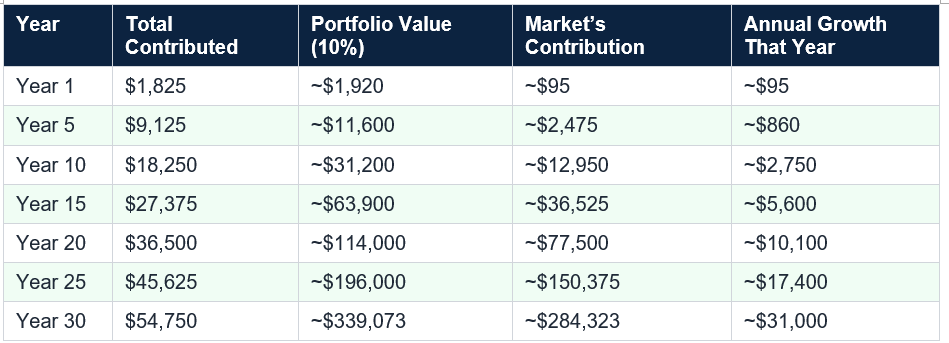
The annual growth column tells the most important story in the table. In year one, the investment generates $95. By year 30, it generates $31,000 in a single year — from the same $1,825 annual contribution. The investment has not changed. The contribution has not changed. Only time has passed, and compounding has accumulated.
The first five years of a $5-per-day investment plan are genuinely unimpressive. Five years of $5 per day at 10% produces approximately $11,600. You contributed $9,125. That is a $2,475 gain — real money, but not transformative. The investor who evaluates their $5-per-day plan at five years and concludes it is not working is making the most expensive mistake available. They are cancelling a contract in year 5 of a 30-year contract, before the exponential curve has begun to steepen.
The second decade is where doubt transitions to confidence. By year 15, $27,375 in contributions has grown to approximately $63,900. By year 20, $36,500 in contributions has grown to $114,000. For the first time, the portfolio balance feels like a genuinely meaningful sum — not because the contributions have increased, but because compounding has been running for long enough to visibly dominate.
The final decade is where the magic concentrates. In the last 10 years of a 30-year plan — years 20 through 30 — the portfolio grows from approximately $114,000 to $339,073: a gain of $225,073 in the final decade alone, despite only $18,250 in new contributions during that period. More than half of the final balance is created in the final 10 years.
The Rule of 72: Divide 72 by the annual return rate to estimate how many years it takes to double your money. At 10% return: 72 ÷ 10 = 7.2 years to double. At 7%: 10.3 years. This means a portfolio of $170,000 at year 22 (approximately where $5/day at 10% sits) doubles to $339,000 by year 30 — with relatively modest new contributions.
The Number: Starting at 25 vs. Starting at 30: Same $5/day at 10%. Age 25 start = ~$339,073 by age 55. Age 30 start = ~$196,000 by age 55. The 5-year delay costs $143,073 — for five years of just $5 per day.
The $143,073 difference is 2.6 times the total amount ever contributed in those five missed years ($9,125 in contributions over five years). Every dollar contributed in years one through five of the plan eventually generates 15 to 17 times its value by year 30. Every dollar contributed in years 26 through 30 generates only one and a half times its value by year 30.
This is the mathematical foundation of every financial adviser’s instruction to start as early as possible. It is not generic advice about discipline or good habits. It is a specific, calculable consequence of the compounding formula: the earlier a dollar enters the system, the more periods it has to compound, and the larger its final contribution to the total.
For younger readers: starting at 20 with $5 per day and running it for 45 years until age 65 at 10% produces approximately $965,000. The same contribution, started at 30 and run for 35 years, produces approximately $557,000. A 10-year head start is worth $408,000 — more than seven times the total contributions made in those 10 extra years.
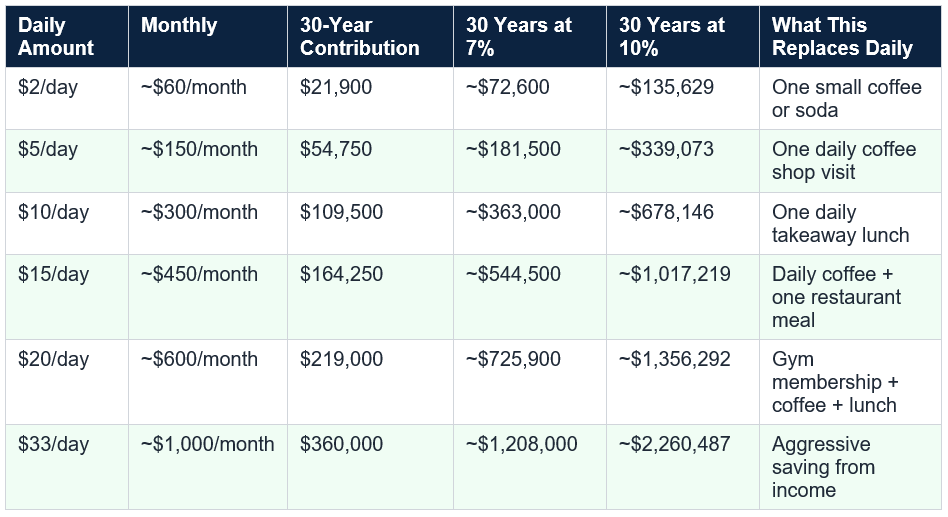
The table reveals the most important scaling insight: the jump from $5 to $10 per day approximately doubles every outcome. The jump from $10 to $20 per day approximately doubles again. The relationship is directly proportional in contributions and compounding. Every additional dollar per day adds roughly $67,800 to the 30-year outcome at 10% returns.
The solution is automation. Set up a direct debit or automatic investment plan that transfers $150 per month to your investment account without requiring a monthly decision. The investment happens whether you look at the account or not.
Using the 4% safe withdrawal rate, a widely cited guideline for sustainable retirement income, $339,000 supports annual withdrawals of approximately $13,560 per year or $1,130 per month. Added to the average Social Security benefit of approximately $1,907 per month in 2026, a retiree with $339,000 invested and Social Security income would have approximately $3,037 per month in retirement — above the US poverty line but below median household income.
$5 per day alone will not fund a lavish retirement. It is not designed to. The $5-per-day calculation is designed to demonstrate one specific truth: that a trivially small daily amount, consistently invested over a long period, creates a result that significantly exceeds what most people expect. For many people, $5 per day is the beginning of a lifetime investing habit, not the entirety of one. The person who invests $5 per day in their 20s typically scales that to $20, $30, or $50 per day in their 30s and 40s. The $5-per-day habit is the starting mechanism for a wealth-building system — and starting mechanisms, it turns out, are worth $339,000.
The plan requires no financial expertise. It requires no large initial sum. It requires no market timing, no stock picking, and no sophisticated financial product. It requires a $0-minimum brokerage account, one broadly diversified index fund, a $150-per-month automatic transfer, and the patience to not cancel the transfer when markets fall and the portfolio value declines temporarily.
Eighty percent of Americans say they wish they had started investing earlier. The average American makes their first investment at age 27. In 2026, you can make your first investment today, this afternoon, before dinner. The technology that makes $0-minimum, fee-free, globally diversified investment accounts available to anyone with a smartphone did not exist 20 years ago. It exists now. $5 per day. Thirty years. $339,073. The only question is when you start.
At a 10% average annual return (approximately the historical nominal average of the S&P 500), $5 per day ($150/month) invested for 30 years grows to approximately $339,073. You contribute $54,750 of your own money; the market creates approximately $284,323 through compounding. At a more conservative 7% return (closer to long-run real returns after inflation), the same investment grows to approximately $181,500. All projections are hypothetical and based on assumed constant annual rates of return. Past performance is not indicative of future results.
What is the difference between investing $5/day starting at 25 vs 30?
Starting at age 25 versus 30 with the same $5/day at 10% return: by age 55, the age-25 starter has approximately $339,073; the age-30 starter has approximately $196,000 by age 55. The 5-year delay costs approximately $143,073 — despite only $9,125 in extra contributions being made during those five years. This illustrates the compounding principle: the earlier contributions enter the system, the more compounding periods they benefit from, and the larger their final contribution to the total.
What is the best account to invest $5 per day in?
In the US, a Roth IRA (up to $7,000/year, tax-free growth and qualified withdrawals) is the optimal starting point for most people. Open one at Fidelity, Vanguard, or Schwab with $0 minimum. If your employer offers a 401(k) match, maximise that first. In the UK, a Stocks and Shares ISA (up to £20,000/year allowance, tax-free growth) is the equivalent. Open one at Vanguard (0.15% annual fee), Hargreaves Lansdown, or AJ Bell. After these tax-advantaged accounts, a taxable brokerage account accepts any additional amount.
What should I invest $5 per day in?
For a long-term (30-year) investment plan, a single globally diversified, low-cost equity index fund is sufficient. In the US: Vanguard Total Market Index (VTSAX/VTI, 0.03% expense ratio), Fidelity Zero Total Market Index (FZROX, 0.00%), or Schwab Total Stock Market Index (SWTSX, 0.03%). In the UK: Vanguard LifeStrategy 80% Equity, Fidelity Index World Fund, or HSBC FTSE All-World Index Fund. A target-date fund set to your expected retirement year provides an all-in-one, automatically adjusting option. The fund choice matters far less than the consistency of contributions.
What return rate should I assume for long-term investing?
The S&P 500’s historical average nominal return over the past 100 years is approximately 10% per year. After adjusting for inflation (approximately 3% average annually), the real return is approximately 7% per year. For long-term planning, using 7% provides a conservative real-terms estimate of outcomes; using 10% provides the historical nominal estimate. Both are commonly used in financial projections. Remember that actual returns vary significantly year to year and that past performance is not indicative of future results.
How do fees affect the $5-per-day plan?
Fees compound against you in the same way returns compound for you. A fund charging 1.5% per year versus 0.10% per year seems like a 1.4% difference. Over 30 years on a growing $5/day portfolio, this difference can reduce the final balance by $50,000 to $80,000. This is why low-cost index funds (expense ratios of 0.03% to 0.20%) are strongly preferred for long-term investors. Always check the total expense ratio before investing.
What happens if I stop investing during a market crash?
Stopping contributions during a market downturn is one of the most consistently documented costly investor mistakes. Market declines are temporary; recoveries are historically certain over sufficiently long periods. JPMorgan’s research shows that missing the 10 best market days in a decade eliminates approximately 80% of that decade’s total return — and those best days cluster immediately after the worst days. Automation is the most effective protection: if $150 transfers automatically on payday, it happens whether the market is up or down, whether you feel confident or fearful, and whether you checked your balance this week or not.
Table of Contents
- The Most Surprising Number in Personal Finance
- The Simple Maths: What $5 Per Day Actually Is
- The Answer: What $5 Per Day Gives You at Different Return Rates
- Where Does the Money Come From? Breaking Down the Components
- The Compounding Mechanism: How Ordinary Returns Produce Extraordinary Results
- The 30-Year Journey: What Happens Year by Year
- The Delay Penalty: What Waiting 5 Years Costs You
- What $5 Per Day Actually Looks Like in Daily Life
- Scaling Up: What Different Daily Amounts Produce
- Where to Put Your $5 Per Day
- The Three Enemies of Your $5-Per-Day Plan
- The Psychological Side: Why Most People Do Not Do This
- How to Start Automatically This Week
- Is It Enough? What $339,000 Means for Retirement
- Conclusion: The Wealth Nobody Sees You Building
- Frequently Asked Questions
The Most Surprising Number in Personal Finance
Most people, when they hear the phrase ‘investing $5 a day,’ think of it as a conversation about coffee. Skip the daily latte, put the money in the market instead. The coffee comparison is real and valid, but it undersells what is actually happening here. What $5 per day, invested consistently over 30 years at historical average stock market returns, produces is not just a larger coffee fund. It is a number that most people would not believe without seeing the maths.At a 10 percent average annual return — the approximate historical average nominal return of the S&P 500 over the past century — $5 per day for 30 years grows to approximately $339,073. You contribute $54,750 of your own money across those 30 years. The market creates the other $284,323. You put in 16 cents of every dollar in that account. The other 84 cents were never your paycheck. They were created by time and compounding.
This article explains exactly how that happens, year by year, and what it means in practice. It answers the four questions that matter most when you first see this number: Is it real? How does compounding work at that scale? What does $5 per day actually look like in a daily life? And can you actually do this with the financial situation you have right now?
The Number: $5/day × 30 years at 10% = $339,073. You contributed $54,750. The market created $284,323.
The Simple Maths: What $5 Per Day Actually Is
Before getting to what $5 per day becomes, it is worth establishing what it is. Five dollars a day is:- $35 per week
- $150.83 per month (on average, accounting for months of different lengths)
- $1,825 per year
- $54,750 over 30 years of contributions
The $5-per-day framing is specifically useful because it makes the daily stakes visible. Most people can evaluate whether $5 today — the cost of a single item — is worth trading for a significantly larger future sum. The monthly figure ($150) feels more abstract. The daily figure makes the trade-off concrete: what is $5 today worth to me in 30 years? The maths gives a specific and striking answer.
The Latte Factor — David Bach, The Automatic Millionaire: The Latte Factor is not about coffee. It is about the small amounts of money we waste daily without thinking about them, and what those amounts would be worth if invested instead. Small amounts, invested consistently over long periods, are not small. They are life-changing.
The Answer: What $5 Per Day Gives You at Different Return Rates
All figures in the table above are hypothetical projections based on assumed constant annual rates of return, compounded monthly, with a $150 monthly contribution ($5/day average). They do not account for taxes on gains, investment fees, or inflation. They assume consistent contribution without interruption. Past performance is not indicative of future results.
Several observations from the table are immediately striking. First, the difference between 7% and 10% on $5 per day over 30 years is $157,573 — almost three times the total amount ever contributed. The return rate matters enormously over long periods. Second, doubling the daily investment from $5 to $10 approximately doubles the outcome at every return rate — which means the relationship is linear in contributions but exponential in time. Third, at 10%, even the most modest investment of $5 per day produces a sum that would take the average American worker more than six years to earn at the median household income.
Where Does the Money Come From? Breaking Down the Components
The $339,073 from $5 per day at 10% over 30 years has two sources, and the ratio between them is the most instructive part of the entire calculation:The Number: Your contributions: $54,750 (16% of the total). The market’s contribution via compounding: $284,323 (84% of the total).
This ratio — 84 percent of the final balance created by compounding, not by contributions — is what makes the 30-year time horizon transformative. It is not primarily your money that created the wealth. It is the return on your return on your return, compounded over three decades. You are not the engine of this wealth. You are the starting mechanism. The compounding engine runs itself.
To understand why the market’s contribution is so large, consider what happens to the first $5 you invest on day one of this 30-year journey. That $5, invested at 10% annually for 30 years, grows to approximately $87. Your $5 becomes $87 not because you added anything to it but because it earned returns, and those returns earned returns, and those returns earned returns, for 30 uninterrupted years. Every $5 you invest in year one does this. Every $5 you invest in year 10 does a smaller version of this. Every $5 you invest in year 29 barely compounds at all.
This is the mechanism that makes starting early so dramatically more valuable than starting with more money later.
The Compounding Mechanism: How Ordinary Returns Produce Extraordinary Results
Compounding is earning returns on your returns. Not just on your original contributions, but on every dollar of growth the portfolio has ever generated. The longer the compounding period, the more powerful the effect becomes — to the point where the final years of a 30-year investment contribute more growth than the entire first decade combined.Year 1: The Beginning
In year one of the $5-per-day plan, you contribute $1,825. At 10% annual return, your portfolio earns approximately $95 in investment returns. Total at end of year one: approximately $1,920. The compounding is barely visible. The growth feels slow. Most people who abandon their investment plans do so in the first three years, when the numbers are still small enough to seem unimpressive.Year 10: Momentum Building
By the end of year 10, you have contributed $18,250. At 10% annual return, your portfolio is worth approximately $31,200. The compounding has created $12,950 on top of your $18,250 in contributions — a 71% bonus on everything you invested. Still not spectacular in absolute terms, but the curve is beginning to steepen.Year 20: The Acceleration
By the end of year 20, you have contributed $36,500. At 10% annual return, your portfolio is worth approximately $114,000. The market has now created $77,500 on top of your contributions — more than double the total you invested. The compounding is now producing more growth per year than your annual contributions. The engine is running faster than you can add fuel.Year 30: The Destination
By the end of year 30, you have contributed $54,750. At 10% annual return, your portfolio is worth approximately $339,073. In the final year alone, the portfolio generates approximately $31,000 in investment returns — more than 17 times what you contributed that year. The compounding in year 30 alone nearly covers two full years of your contributions.The annual growth column tells the most important story in the table. In year one, the investment generates $95. By year 30, it generates $31,000 in a single year — from the same $1,825 annual contribution. The investment has not changed. The contribution has not changed. Only time has passed, and compounding has accumulated.
The 30-Year Journey: What Happens Year by Year
One of the most consistent findings in investor behaviour research is that people stop investing during the periods when markets perform poorly — precisely the worst time to stop. Understanding what the journey looks like prepares investors for the parts that feel discouraging.The first five years of a $5-per-day investment plan are genuinely unimpressive. Five years of $5 per day at 10% produces approximately $11,600. You contributed $9,125. That is a $2,475 gain — real money, but not transformative. The investor who evaluates their $5-per-day plan at five years and concludes it is not working is making the most expensive mistake available. They are cancelling a contract in year 5 of a 30-year contract, before the exponential curve has begun to steepen.
The second decade is where doubt transitions to confidence. By year 15, $27,375 in contributions has grown to approximately $63,900. By year 20, $36,500 in contributions has grown to $114,000. For the first time, the portfolio balance feels like a genuinely meaningful sum — not because the contributions have increased, but because compounding has been running for long enough to visibly dominate.
The final decade is where the magic concentrates. In the last 10 years of a 30-year plan — years 20 through 30 — the portfolio grows from approximately $114,000 to $339,073: a gain of $225,073 in the final decade alone, despite only $18,250 in new contributions during that period. More than half of the final balance is created in the final 10 years.
The Rule of 72: Divide 72 by the annual return rate to estimate how many years it takes to double your money. At 10% return: 72 ÷ 10 = 7.2 years to double. At 7%: 10.3 years. This means a portfolio of $170,000 at year 22 (approximately where $5/day at 10% sits) doubles to $339,000 by year 30 — with relatively modest new contributions.
The Delay Penalty: What Waiting 5 Years Costs You
If there is a single fact about investing that most people wish they had understood earlier, it is this: the cost of waiting to invest is not linear. It is exponential. Waiting five years to start your $5-per-day plan does not cost you five years of growth. It costs you the compounding that those five years of early contributions would have generated for the remaining 25 years.The Number: Starting at 25 vs. Starting at 30: Same $5/day at 10%. Age 25 start = ~$339,073 by age 55. Age 30 start = ~$196,000 by age 55. The 5-year delay costs $143,073 — for five years of just $5 per day.
The $143,073 difference is 2.6 times the total amount ever contributed in those five missed years ($9,125 in contributions over five years). Every dollar contributed in years one through five of the plan eventually generates 15 to 17 times its value by year 30. Every dollar contributed in years 26 through 30 generates only one and a half times its value by year 30.
This is the mathematical foundation of every financial adviser’s instruction to start as early as possible. It is not generic advice about discipline or good habits. It is a specific, calculable consequence of the compounding formula: the earlier a dollar enters the system, the more periods it has to compound, and the larger its final contribution to the total.
For younger readers: starting at 20 with $5 per day and running it for 45 years until age 65 at 10% produces approximately $965,000. The same contribution, started at 30 and run for 35 years, produces approximately $557,000. A 10-year head start is worth $408,000 — more than seven times the total contributions made in those 10 extra years.
What $5 Per Day Actually Looks Like in Daily Life
The practical question that follows any discussion of $5-per-day investing is always the same: where does the $5 come from? The honest answer is that for most people, $5 per day exists in several places simultaneously, none of which requires heroic sacrifice:- One daily coffee shop visit: a standard drip coffee or latte at most coffee shops is $4 to $7. Making coffee at home instead of buying it once per day is the most cited example for good reason: it is genuinely close to $5, genuinely daily, and genuinely optional.
- One fewer lunch per week at a restaurant: the difference between a packed lunch and a restaurant or delivery lunch averages $10 to $20. Substituting one per week saves $10 to $20 — more than enough for $5 per day.
- Reducing one streaming subscription: the average American household pays for 5.4 streaming subscriptions, according to 2025 survey data. Cutting one at $15 per month provides $0.50 per day toward the $5 goal. Not sufficient alone, but meaningful when stacked.
- One fewer impulse purchase per week: the average American makes one to three impulse purchases per week totalling $20 to $40, according to Slickdeals research. Eliminating one $20 weekly impulse purchase generates $2.86 per day toward the goal.
- Cashback and reward redirection: directing cashback rewards, credit card points (redeemed for cash), or small windfalls (birthday money, tax refunds) into the investment account rather than spending them.
Scaling Up: What Different Daily Amounts Produce
The table reveals the most important scaling insight: the jump from $5 to $10 per day approximately doubles every outcome. The jump from $10 to $20 per day approximately doubles again. The relationship is directly proportional in contributions and compounding. Every additional dollar per day adds roughly $67,800 to the 30-year outcome at 10% returns.
Where to Put Your $5 Per Day
The $5-per-day plan requires an account to receive the daily or monthly transfer. The best accounts depend on your country and circumstances, but the consistent principles are: tax-advantaged first, low-cost second, diversified third.United States
- Roth IRA: the optimal starting point for most young investors. Contribute up to $7,000 per year ($7,000/12 = $583/month, well above the $150/month required for $5/day). After-tax contributions, tax-free growth, and tax-free qualified withdrawals in retirement. Available at Fidelity, Vanguard, Schwab with $0 minimum.
- 401(k) to the employer match: if your employer matches contributions, capture the full match before funding anything else. A 50% match on your contributions is an immediate 50% return that no investment can reliably replicate.
- Taxable brokerage account: if Roth IRA and 401(k) are already maximised, a taxable brokerage account (Fidelity, Schwab, Vanguard, M1 Finance) accepts any amount with no annual limit. Use tax-efficient index funds to minimise taxable distributions.
United Kingdom
- Stocks and Shares ISA: the UK equivalent of a tax-advantaged account for long-term investing. Up to £20,000 per year allowance (2026/27). All growth and dividends are tax-free. Available through Vanguard (0.15% annual fee), Hargreaves Lansdown (variable), AJ Bell, and others.
- Workplace pension: UK employers are legally required to contribute to a workplace pension. Contributing more than the auto-enrolment minimum captures employer contributions that are effectively free money.
The Investment Itself
For a $5-per-day long-term investment plan, the investment choice is less complex than most people assume. A single globally diversified equity index fund with an expense ratio below 0.20% per year is sufficient. Specifically:- US investors: Vanguard Total Market Index Fund (VTSAX or VTI), Fidelity Zero Total Market Index Fund (FZROX), or Schwab Total Stock Market Index (SWTSX).
- UK investors: Vanguard LifeStrategy 80% Equity, Fidelity Index World Fund, or HSBC FTSE All-World Index Fund.
- For simplicity: a target-date fund (set to your expected retirement year) automatically adjusts its asset allocation as you age. Available at all major brokerages.
The Three Enemies of Your $5-Per-Day Plan
Three forces work against the $5-per-day compounding plan and understanding them is essential for protecting its outcome:Enemy 1: Fees
Investment fees are the most insidious destroyer of long-term returns because they compound against you in the same way that returns compound for you. An actively managed fund charging 1.5% per year versus an index fund charging 0.1% per year seems like a small difference. Over 30 years on a growing portfolio, the fee difference on a $5-per-day plan can consume $50,000 to $80,000 in returns. Choose the lowest-cost vehicle available for your $5 per day.Enemy 2: Stopping When Markets Fall
The most consistently documented investor behaviour mistake is selling or stopping contributions during market downturns. The S&P 500 falls 10% or more approximately every 1.5 years on average. Every one of these falls is temporary. The investor who stops their $5-per-day contribution during a market decline and restarts when the market recovers misses the recovery gains — historically the largest gains in any market cycle. JPMorgan’s research shows that missing the 10 best market days in a decade eliminates approximately 80% of that decade’s total return.The solution is automation. Set up a direct debit or automatic investment plan that transfers $150 per month to your investment account without requiring a monthly decision. The investment happens whether you look at the account or not.
Enemy 3: Inflation
The projections in this article are in nominal dollars — they do not account for the reduction in purchasing power that inflation causes over 30 years. At 3% average annual inflation, $339,073 in 30 years has the purchasing power of approximately $140,000 in today’s money. This is still a significant and life-changing sum — but it is the real comparison. Using a 7% return assumption (approximately 10% nominal minus 3% inflation) provides a more conservative real-terms estimate of the outcome. At 7%, $5 per day for 30 years produces approximately $181,500 in today’s purchasing power.The Psychological Side: Why Most People Do Not Do This
If investing $5 per day for 30 years produces $339,000, and the concept is widely known, why do most people not do it? The barriers are psychological, not financial, for most people:- Present bias: the $5 feels real right now. The $339,000 feels abstract and 30 years away. Human brains are wired to prioritise present gratification over future reward. The compounding maths requires the opposite: consistent sacrifice of a small present amount for a large future reward.
- The unimpressive beginning: in year one, $5 per day becomes approximately $1,920. That is not exciting. It is not transformative. People who evaluate their investment plan at year two or three and conclude it is not making a difference are right in the short term and catastrophically wrong in the long term. The plan’s power is invisible until approximately year 15.
- The complexity illusion: many people believe that investing requires expertise, a large sum to start, or a financial adviser’s involvement. In 2026, you can open a Roth IRA at Fidelity with $0, choose a target-date fund, and set up a $150 monthly automatic investment in under 15 minutes. The barrier is not complexity. It is the decision to start.
- Financial anxiety: IPX1031’s 2025 survey found that 80% of Americans say they wish they had started investing earlier. The awareness is nearly universal. The action does not follow. The most common reason given is that people do not feel they have enough to invest — which is why the $5/day framing exists: to demonstrate that the amount required to begin is genuinely accessible.
How to Start Automatically This Week
The single most important action this article can produce is one person setting up an automatic $150 monthly investment this week. Here is exactly how:- Step 1: Open a Roth IRA (US) or Stocks and Shares ISA (UK). Choose Fidelity, Vanguard, or Schwab for the US; Vanguard or Hargreaves Lansdown for the UK. All have $0 or £0 minimums. The application takes 10 to 15 minutes.
- Step 2: Choose one fund. A target-date fund set to your retirement year (e.g., Vanguard Target Retirement 2055 for a 30-year-old) or a total market index fund (VTSAX, VTI in the US; Vanguard LifeStrategy 80% in the UK). One fund is enough. Complexity is not an advantage at this stage.
- Step 3: Set up an automatic monthly transfer. Most platforms call this an ‘automatic investment plan’ or ‘regular savings plan.’ Set it for payday. The amount: $150 per month (or £120 per month for UK readers at current rates). Set it and do not look at it more than once per quarter.
- Step 4: Remove the friction. Delete any trading apps that encourage you to check prices daily. Turn off market news notifications. The only action required by this plan after setup is to increase the contribution whenever your income increases.
- Step 5: Increase by 1% per year. Every time you receive a pay rise, increase your automatic investment by a small amount. Going from $150 to $175 per month feels small in the moment. Over 30 years, that $25 per month difference adds approximately $56,000 to the final balance at 10%.
Is It Enough? What $339,000 Means for Retirement
The realistic question that follows any retirement-adjacent discussion of the $5-per-day plan is: is $339,000 enough to retire on? The answer depends on your lifestyle, your other savings, and your expected retirement duration — but in isolation, it is an honest and useful benchmark.Using the 4% safe withdrawal rate, a widely cited guideline for sustainable retirement income, $339,000 supports annual withdrawals of approximately $13,560 per year or $1,130 per month. Added to the average Social Security benefit of approximately $1,907 per month in 2026, a retiree with $339,000 invested and Social Security income would have approximately $3,037 per month in retirement — above the US poverty line but below median household income.
$5 per day alone will not fund a lavish retirement. It is not designed to. The $5-per-day calculation is designed to demonstrate one specific truth: that a trivially small daily amount, consistently invested over a long period, creates a result that significantly exceeds what most people expect. For many people, $5 per day is the beginning of a lifetime investing habit, not the entirety of one. The person who invests $5 per day in their 20s typically scales that to $20, $30, or $50 per day in their 30s and 40s. The $5-per-day habit is the starting mechanism for a wealth-building system — and starting mechanisms, it turns out, are worth $339,000.
Conclusion
The $5-per-day investment plan produces $339,073 in 30 years at 10% nominal annual return. It requires $54,750 of your own money. The market creates $284,323. You are not the source of most of that wealth. Time is. Compounding is. The decision to start and the discipline to continue are.The plan requires no financial expertise. It requires no large initial sum. It requires no market timing, no stock picking, and no sophisticated financial product. It requires a $0-minimum brokerage account, one broadly diversified index fund, a $150-per-month automatic transfer, and the patience to not cancel the transfer when markets fall and the portfolio value declines temporarily.
Eighty percent of Americans say they wish they had started investing earlier. The average American makes their first investment at age 27. In 2026, you can make your first investment today, this afternoon, before dinner. The technology that makes $0-minimum, fee-free, globally diversified investment accounts available to anyone with a smartphone did not exist 20 years ago. It exists now. $5 per day. Thirty years. $339,073. The only question is when you start.
Frequently Asked Questions
How much does $5 a day grow to in 30 years?At a 10% average annual return (approximately the historical nominal average of the S&P 500), $5 per day ($150/month) invested for 30 years grows to approximately $339,073. You contribute $54,750 of your own money; the market creates approximately $284,323 through compounding. At a more conservative 7% return (closer to long-run real returns after inflation), the same investment grows to approximately $181,500. All projections are hypothetical and based on assumed constant annual rates of return. Past performance is not indicative of future results.
What is the difference between investing $5/day starting at 25 vs 30?
Starting at age 25 versus 30 with the same $5/day at 10% return: by age 55, the age-25 starter has approximately $339,073; the age-30 starter has approximately $196,000 by age 55. The 5-year delay costs approximately $143,073 — despite only $9,125 in extra contributions being made during those five years. This illustrates the compounding principle: the earlier contributions enter the system, the more compounding periods they benefit from, and the larger their final contribution to the total.
What is the best account to invest $5 per day in?
In the US, a Roth IRA (up to $7,000/year, tax-free growth and qualified withdrawals) is the optimal starting point for most people. Open one at Fidelity, Vanguard, or Schwab with $0 minimum. If your employer offers a 401(k) match, maximise that first. In the UK, a Stocks and Shares ISA (up to £20,000/year allowance, tax-free growth) is the equivalent. Open one at Vanguard (0.15% annual fee), Hargreaves Lansdown, or AJ Bell. After these tax-advantaged accounts, a taxable brokerage account accepts any additional amount.
What should I invest $5 per day in?
For a long-term (30-year) investment plan, a single globally diversified, low-cost equity index fund is sufficient. In the US: Vanguard Total Market Index (VTSAX/VTI, 0.03% expense ratio), Fidelity Zero Total Market Index (FZROX, 0.00%), or Schwab Total Stock Market Index (SWTSX, 0.03%). In the UK: Vanguard LifeStrategy 80% Equity, Fidelity Index World Fund, or HSBC FTSE All-World Index Fund. A target-date fund set to your expected retirement year provides an all-in-one, automatically adjusting option. The fund choice matters far less than the consistency of contributions.
What return rate should I assume for long-term investing?
The S&P 500’s historical average nominal return over the past 100 years is approximately 10% per year. After adjusting for inflation (approximately 3% average annually), the real return is approximately 7% per year. For long-term planning, using 7% provides a conservative real-terms estimate of outcomes; using 10% provides the historical nominal estimate. Both are commonly used in financial projections. Remember that actual returns vary significantly year to year and that past performance is not indicative of future results.
How do fees affect the $5-per-day plan?
Fees compound against you in the same way returns compound for you. A fund charging 1.5% per year versus 0.10% per year seems like a 1.4% difference. Over 30 years on a growing $5/day portfolio, this difference can reduce the final balance by $50,000 to $80,000. This is why low-cost index funds (expense ratios of 0.03% to 0.20%) are strongly preferred for long-term investors. Always check the total expense ratio before investing.
What happens if I stop investing during a market crash?
Stopping contributions during a market downturn is one of the most consistently documented costly investor mistakes. Market declines are temporary; recoveries are historically certain over sufficiently long periods. JPMorgan’s research shows that missing the 10 best market days in a decade eliminates approximately 80% of that decade’s total return — and those best days cluster immediately after the worst days. Automation is the most effective protection: if $150 transfers automatically on payday, it happens whether the market is up or down, whether you feel confident or fearful, and whether you checked your balance this week or not.
0 Comments
Be the first to share your thoughts on this article.