

Investing
Where Can I Buy Stocks? Complete UK & US Guide


Table of Contents
- Buying Stocks Has Never Been More Accessible
- Why Platform Choice Matters: Fees Compound Just Like Returns
- UK Stock Platforms Compared: The Complete 2026 Scorecard
- Which Account Should You Use? ISA, SIPP, LISA, JISA, or GIA
- How to Buy Stocks: Step-by-Step for First-Time Investors
- Fractional Shares: How to Buy Amazon or Apple With £10
- Buying US Stocks From the UK: What You Need to Know
- Where to Buy Stocks in the US: The Main Options
- Conclusion
- Frequently Asked Questions (FAQ)
Buying Stocks Has Never Been More Accessible
A decade ago, buying stocks in the UK meant calling a stockbroker, paying a commission of £10-£15 per trade minimum, and navigating a platform that felt designed for professional traders rather than ordinary investors. Today, you can open an account in fifteen minutes on your phone, invest as little as £1 in fractional shares of Apple or Amazon, pay zero commission, and hold everything in a tax-free Stocks and Shares ISA that shelters all your gains from capital gains and income tax. The barriers to stock market investing have collapsed — and in 2026, the question is no longer whether you can buy stocks, but where?The UK investment platform market underwent significant repricing in early 2026, according to QuantRoutine's May 2026 analysis: 'Hargreaves Lansdown cut fees and tripled its ETF cap, Freetrade made SIPPs free, Trading 212 expanded its ISA. The right pick still depends on your account type, portfolio size, and whether you want individual stocks or just ETFs.' StockBrokers.com named Trading 212 the best overall UK broker for 2026, highlighting its £0 trading fees, £0 platform fees, and £1 minimum investment. Good Money Guide, drawing on 30,000+ customer votes, places Interactive Brokers as the platform with the widest global market range.
This guide maps every route to buying stocks in 2026 — for UK and US investors — including the six major UK platforms compared side by side, the five UK account types and their tax treatment, how to open an account step by step, what fractional shares are and why they matter for new investors, the US stock investing options for UK investors (with CMC Invest data showing 43% of investors expect the US to be the best-performing market in 2026), and the accountant's priority order for using each account type to maximise tax efficiency.
Why Platform Choice Matters: Fees Compound Just Like Returns
The choice of where to buy stocks is one of the most consequential financial decisions an investor makes — not because platforms differ dramatically in which stocks you can buy (most major platforms offer UK and US shares), but because the fees they charge compound silently against your portfolio just as investment returns compound in its favour. The impact of platform fees on long-term wealth is consistently underestimated.Consider two investors: both invest £500 per month for 20 years, both achieve 7% annual returns before fees. Investor A uses a platform charging 0.45% annual platform fee plus £11.95 per trade (24 trades per year). Investor B uses a commission-free platform charging 0.15% FX fee only. Over 20 years, the total fee difference is substantial — trading commissions alone at £11.95 x 24 trades x 20 years = £5,736. Platform fees at 0.45% on a growing portfolio compound to tens of thousands of pounds. The difference in final portfolio value between high-fee and low-fee approaches on the same underlying investment returns can be £20,000-£50,000 on a medium-sized portfolio over 20 years.
This does not mean the cheapest platform is always the best choice. Hargreaves Lansdown charges more than Trading 212 or Freetrade — but it also offers far superior research tools, educational content, a broader product range, telephone support, and the confidence that comes with using the UK's largest and most established investment platform. For a new investor making their first few trades, the support infrastructure of a premium platform may be worth far more than the trading commission saving. For an experienced investor making monthly ISA contributions into index funds, the commission-free option is almost always superior.
UK stock investing — 2026 key figures: Trading 212: £0 fees, £1 minimum. Market repriced 2026. HL ETF cap tripled. Freetrade SIPPs free. 43% expect US best market in 2026. — StockBrokers.com (February 2026): 'Trading 212 stands out as the best overall broker for 2026 thanks to its low-cost structure and beginner-friendly design. No dealing fees on shares or ETFs, no platform fees, start with as little as £1.' QuantRoutine (May 2026): 'The UK platform market repriced significantly in early 2026 — HL cut fees and tripled its ETF cap, Freetrade made SIPPs free.' Good Money Guide (2 weeks ago, July 2026): 30,000+ customer votes; Interactive Brokers offers widest range of global markets. CMC Invest survey (Good Money Guide, March 2026): '43% of investors expect the US to be the best-performing market in 2026, comfortably ahead of all other regions; only 3% believe the UK will deliver the strongest returns.'
UK Stock Platforms Compared: The Complete 2026 Scorecard
The following table compares the six most widely used UK investment platforms as of July 2026, with current fees and features updated to reflect the early 2026 market repricing. All platforms listed are FCA-regulated: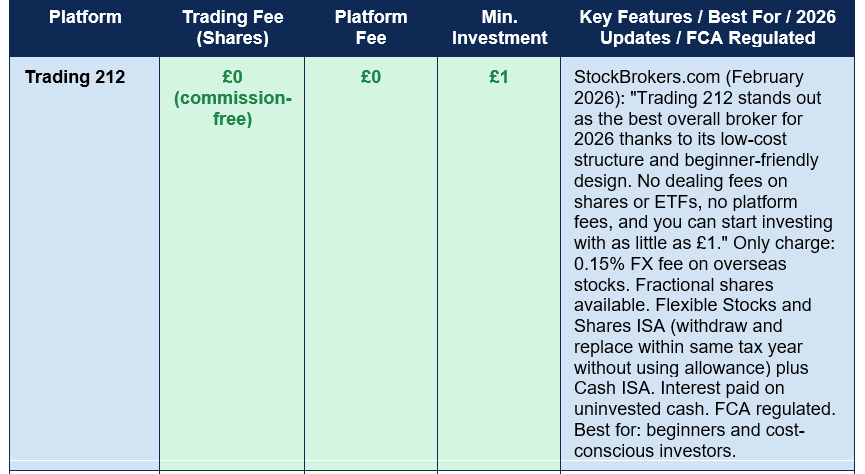
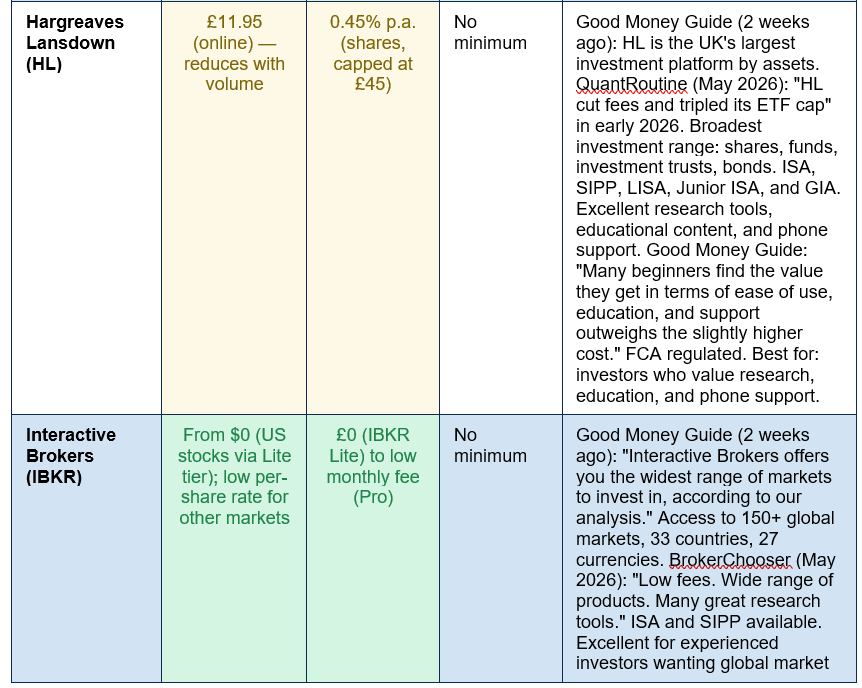
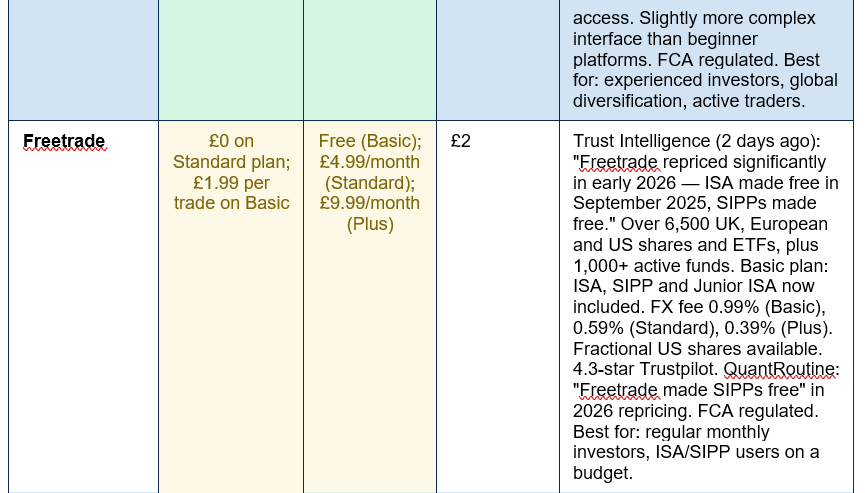
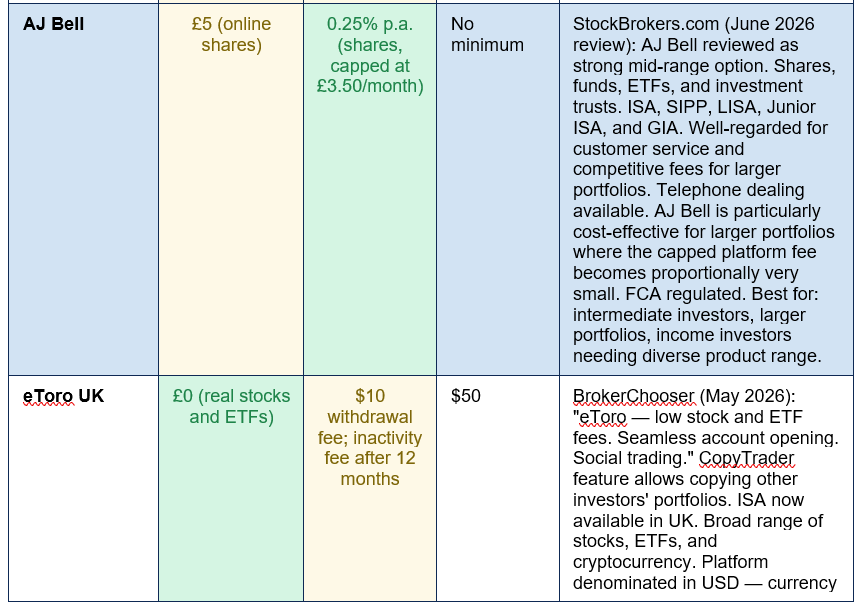

Fees and features correct to July 2026 based on published sources. Always verify current terms directly with each platform before opening an account — fees and features change frequently.
Which Account Should You Use? ISA, SIPP, LISA, JISA, or GIA
Choosing the right account type is as important as choosing the right platform — because the tax treatment of your investments determines how much of your returns you actually keep. QuantRoutine (May 2026) sets out the priority order: 'Fill your ISA first (£20,000/year). If you are a higher-rate taxpayer, also maximise a SIPP. Open a GIA only after both are maxed.' The following table maps every UK account type with its 2026 tax rules: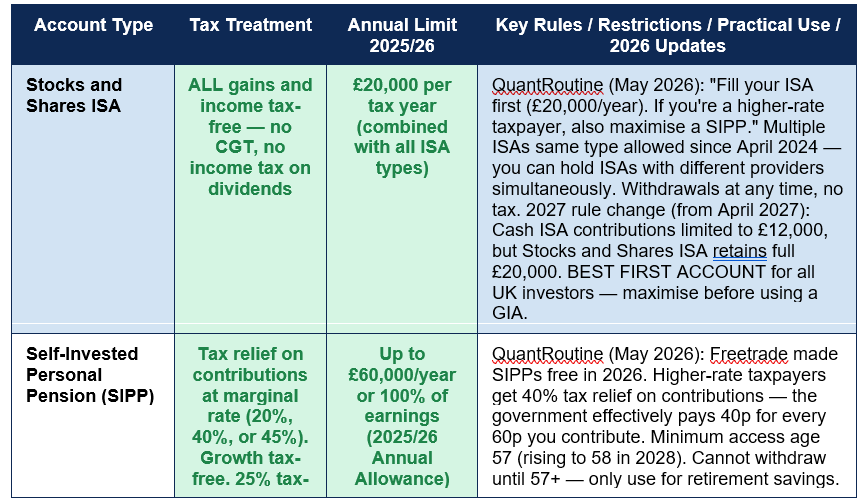
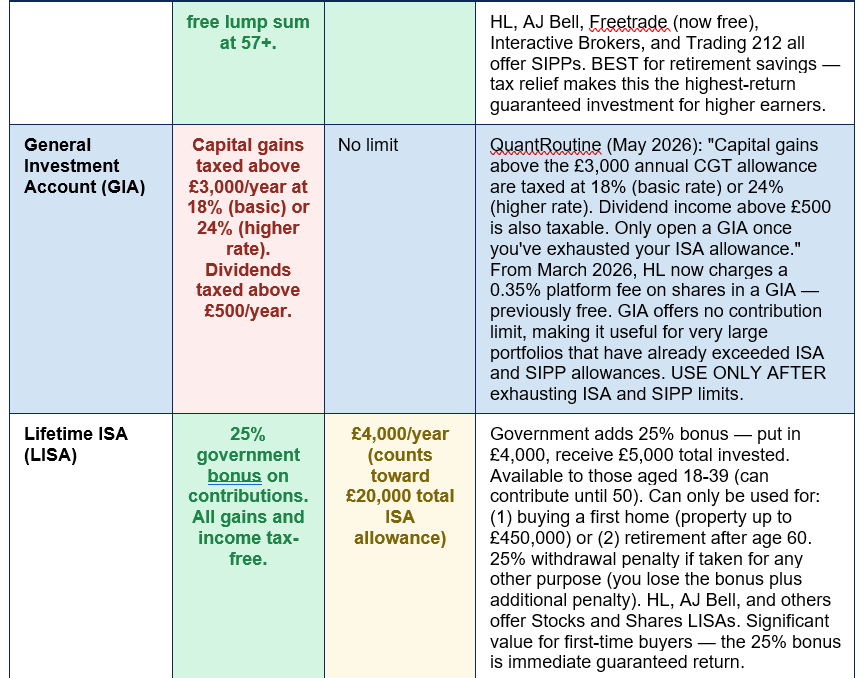
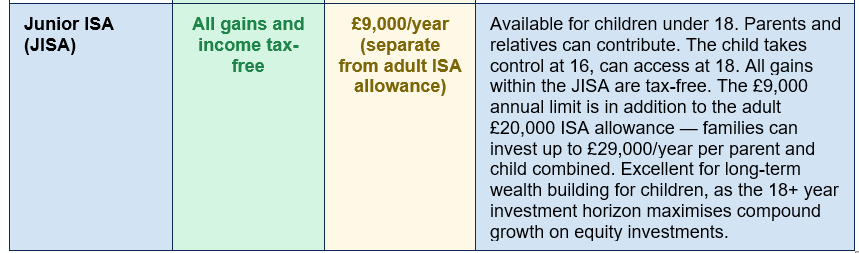
The 2027 ISA rule change every investor needs to know now: QuantRoutine (May 2026) highlights a significant upcoming change: 'From 6 April 2027, investors under 65 will be limited to contributing a maximum of £12,000 into a Cash ISA per year, while retaining the full £20,000 allowance for Stocks and Shares ISAs and other wrappers.' This rule change does NOT affect the Stocks and Shares ISA — the full £20,000 remains available for equities. But investors currently splitting their ISA allowance between Cash and Stocks and Shares should plan now: from April 2027, the maximum that can go into a Cash ISA reduces from £20,000 to £12,000. The additional £8,000 previously available for Cash ISA could instead go into a Stocks and Shares ISA, which many financial advisers would recommend anyway for long-term investment.
How to Buy Stocks: Step-by-Step for First-Time Investors
The process of buying stocks for the first time is simpler than most people expect. Here is the complete step-by-step process using a commission-free platform like Trading 212 as the example:- Choose your platform: Select a platform appropriate to your experience, portfolio size, and goals (use the comparison table above). For beginners: Trading 212 (£0 fees, £1 minimum) or Freetrade (Basic plan now includes ISA and SIPP free). For experienced investors wanting global access: Interactive Brokers. All FCA-regulated platforms apply FSCS protection of up to £85,000 on eligible deposits.
- Open an account: Download the app or go to the platform website. Provide: full name, date of birth, national insurance number (for ISA and SIPP accounts), address history (typically 3 years), and a form of ID (passport or driving licence). Most platforms verify identity automatically using digital ID checks — no physical documents needed. Account opening typically takes 10-15 minutes and is usually approved the same day or within 24 hours.
- Choose your account type: If this is your first investment account: open a Stocks and Shares ISA first. Your £20,000 annual ISA allowance shelters all gains and income from tax — never invest outside an ISA until you have used your annual allowance. If you are also saving for retirement: open a SIPP alongside the ISA (Freetrade and Trading 212 both offer free SIPPs in 2026).
- Deposit funds: Transfer money from your bank account to your new investment account. Bank transfers are free. Most platforms also accept debit cards. Check any FX fees before depositing — eToro charges 1.5% on deposits converted to USD; Trading 212 charges 0.15% FX on overseas stock purchases only.
- Research what to buy: For beginners, consider starting with a global equity index fund or ETF (for example, Vanguard's FTSE All-World ETF or iShares Core MSCI World ETF) rather than individual stocks. These provide instant global diversification across thousands of companies for a single annual fee of 0.12-0.22%. Individual stocks concentrate risk in single companies — appropriate once you understand the fundamentals of the company and sector.
- Place your order: Search for the stock or ETF by name or ticker symbol. Choose your order type: market order (buy at the current ask price immediately) or limit order (specify the maximum price you are willing to pay — only executes if the price reaches your level). For ETFs and liquid stocks, a market order is usually fine. For less liquid stocks or specific price targets, use a limit order. Confirm the purchase. The shares appear in your portfolio within seconds to a few minutes.
Fractional Shares: How to Buy Amazon or Apple With £10
One of the most significant innovations in retail investing in recent years is the fractional share — the ability to buy a fraction of a single share rather than a whole share. Before fractional shares, buying Amazon (trading at approximately $3,500 at its peak) or Berkshire Hathaway Class A (which has traded at over $600,000 per share) was simply impossible for most retail investors. Fractional shares eliminate this barrier entirely.StockBrokers.com (February 2026) highlights this as a key feature of Trading 212: 'Combined with fractional shares, this makes it easy to invest small amounts without fees eating into returns.' Trust Intelligence (2 days ago, July 2026) notes Freetrade also offers 'fractional US shares.' With fractional shares, a £10 investment in a stock priced at £1,000 buys exactly 1% of one share — and if the share price rises 10%, your £10 investment is worth £11, regardless of not holding a whole unit. Dividends are also paid proportionally on fractional holdings.
The practical impact of fractional shares for new investors is profound: instead of waiting until you have saved enough to buy one whole share of a high-priced stock, you can begin building your position immediately with whatever amount is available. Regular monthly investments of even £50 can be spread across multiple stocks and ETFs using fractional shares, creating a diversified portfolio from day one rather than being forced to concentrate in lower-priced stocks simply because of price accessibility.
Buying US Stocks From the UK: What You Need to Know
A CMC Invest survey conducted in early 2026 (cited by Good Money Guide, March 2026) found that 43% of UK investors expect the US to be the best-performing market in 2026 — comfortably ahead of all other regions. Only 3% expect the UK to deliver the strongest returns. For the majority of UK investors who share this view, buying US stocks from the UK involves a few additional considerations beyond buying LSE-listed shares:- Platform availability: All major UK platforms (Trading 212, Hargreaves Lansdown, Interactive Brokers, Freetrade, AJ Bell, eToro) offer access to US stocks listed on the New York Stock Exchange (NYSE) and Nasdaq. Good Money Guide: 'All US stock investing platforms that operate in the UK must be regulated by the FCA.'
- FX fees: Buying US stocks from a UK account involves currency conversion from GBP to USD. Every platform charges an FX fee for this conversion — these range from 0.15% (Trading 212) to 1.5% (eToro on deposits). On a £1,000 purchase of US stocks: Trading 212's 0.15% FX fee costs £1.50; eToro's 1.5% costs £15. Over time, FX fees compound significantly for investors who regularly buy US stocks — the platform with the lowest FX fee produces meaningfully better returns on international holdings.
- W-8BEN form: To avoid paying 30% US withholding tax on dividends from US stocks, UK investors must complete a W-8BEN form (a US tax form declaring non-US residency). Most UK platforms automatically complete this form when you open an account — but always verify. With a completed W-8BEN, the dividend withholding rate drops from 30% to 15% under the UK-US tax treaty. For growth stocks that pay little or no dividend, this is less critical — for US dividend-paying stocks like Coca-Cola or Johnson and Johnson, it is important.
- Currency risk: Holding US stocks in a UK ISA introduces USD/GBP exchange rate risk. If the pound strengthens against the dollar, the sterling value of your US holdings falls even if the US share price is unchanged. This is an inherent feature of international investing — diversification across currencies adds another dimension of return variation. Some investors view GBP/USD exposure positively as further diversification; others prefer currency-hedged ETFs that eliminate the FX return component.
Where to Buy Stocks in the US: The Main Options
For US-based investors, the landscape is equally accessible and competitive. The main routes to buying stocks in the US in 2026:
- Online brokers: The major US online brokers — Fidelity, Charles Schwab, and TD Ameritrade (now part of Schwab) — all offer commission-free US stock and ETF trading, robust research tools, retirement accounts (Traditional IRA, Roth IRA, 401(k) rollover), and customer service. Fidelity is particularly well regarded for its no-minimum-balance accounts, comprehensive research, and zero-expense-ratio index funds.
- Robinhood: The platform that popularised commission-free stock trading for US retail investors. Zero commissions on stocks, ETFs, and options. Mobile-first design. Now offers a Robinhood Gold subscription with additional features. BrokerChooser (May 2026) notes Robinhood as offering 'free US stock and ETF trading, great mobile and web trading platforms, fast and fully digital account opening.'
- Interactive Brokers (US): Available in both the UK and US. For US investors, Interactive Brokers' IBKR Pro tier offers the most competitive pricing for active traders and the widest global market access of any platform. Particularly suitable for investors wanting access to international markets beyond the US.
-
Tax-advantaged US accounts — the equivalent of the UK ISA: US investors should prioritise: Roth IRA ($7,000/year contribution limit in 2025; contributions after-tax but all gains and withdrawals tax-free in retirement); Traditional IRA ($7,000/year; contributions may be tax-deductible; growth tax-deferred); 401(k) workplace pension (up to $23,000/year contribution; many employers match contributions — employer matching is effectively a 50-100% guaranteed immediate return on contributions; always contribute enough to get the full employer match before investing elsewhere).
THE THREE BIGGEST MISTAKES NEW INVESTORS MAKE WHEN CHOOSING WHERE TO BUY STOCKS: (1) INVESTING OUTSIDE AN ISA UNNECESSARILY — Every pound invested in a GIA (general investment account) instead of a Stocks and Shares ISA is exposed to capital gains tax (18%/24%) and dividend tax above small annual allowances. The ISA offers identical investment options with complete tax-free treatment. QuantRoutine (May 2026): 'Only open a GIA once you have exhausted your ISA allowance.' For most UK investors, the answer to 'where should I buy stocks?' is always 'inside an ISA first.' (2) PAYING EXCESSIVE FEES ON LOW-FREQUENCY TRADING — A £11.95 trading fee on a £200 monthly investment = 5.98% immediate loss before the investment has even started. Commission-free platforms (Trading 212, Freetrade Basic, eToro) eliminate this for regular small investments. Only higher-frequency traders or investors with larger lump sums should consider per-trade fee platforms. (3) CHOOSING A PLATFORM BASED ON FRIEND RECOMMENDATIONS WITHOUT CHECKING FX FEES — For investors in UK ISAs who buy US stocks regularly, the FX fee is the largest ongoing cost, not the trading commission. Trading 212's 0.15% versus eToro's deposit-based 1.5% conversion represents a 10x difference in FX cost. On £12,000 of US stock purchases per year: Trading 212 costs £18 in FX fees; a 1.5% platform costs £180. Over 20 years, this difference compounds into thousands of pounds.
Conclusion
In 2026, you can buy stocks in the UK from as little as £1, with zero commission, through a tax-free Stocks and Shares ISA, on your phone, in fifteen minutes. The infrastructure for retail investing has never been more accessible, more competitive, or more favourably priced. The early 2026 platform repricing — Trading 212's expansion, Hargreaves Lansdown's fee cuts, Freetrade's free SIPPs — has pushed the market further toward the investor's favour than at any previous point.The accountant's priority order for where to buy stocks is clear and consistent: open a Stocks and Shares ISA first and maximise the £20,000 annual allowance before considering any other account. For retirement savings, add a SIPP alongside the ISA — higher-rate taxpayers get 40% tax relief on contributions, making this the highest-return guaranteed action available. If saving for a first home, the Lifetime ISA's 25% government bonus on up to £4,000/year is effectively a guaranteed 25% return before the investments have even started growing. Only once ISA and SIPP allowances are fully used should a General Investment Account be opened.
The platform itself is a secondary consideration to account type — but it is not irrelevant. For beginners making regular monthly investments in ETFs or stocks: Trading 212 or Freetrade Basic (both £0 commissions, ISA included free). For investors wanting the broadest research tools and support with a wider product range: Hargreaves Lansdown. For active investors wanting global market access: Interactive Brokers. The right platform is the one whose fee structure, account types, and investment range align with your specific investing habits — and the key insight is that 2026 is the best year yet to start, because the costs of starting have never been lower.
0 Comments
Be the first to share your thoughts on this article.