

Investing
Why Women Are Better Investors Than Men

Key Statistics: Fidelity analysis of 5.2 million accounts (2011–2020): women outperformed men by 0.4% annually. Warwick Business School (2,800 UK investors on Barclays): women outperformed men by 1.8% annually; outperformed FTSE 100 by 1.94% vs men’s 0.14%. Hargreaves Lansdown: women outperformed by 0.8%. UC Berkeley: men trade 45% more than women; men’s net returns reduced by 2.65% p.a. from overtrading. Wells Fargo study: women achieved higher returns with less risk. Goldman Sachs: female-managed funds 10% more likely to outperform benchmarks. Investment Metrics (90 global equity portfolios): women-led teams lost 2.6% in down markets vs 5.9% for men. IFC/World Bank: gender-balanced PE teams achieved up to 20% higher returns. Vanguard 2025: 29% of women vs 26% of men maximise 401(k) contributions. £1m invested at 7.4% (women’s average) vs 7%: £530,000 more after 25 years. Women enrolled in workplace pensions almost 2 years earlier than men on average.
Investing has been culturally coded as a male activity for most of the modern financial era. The imagery of stock markets — the shouting trading floor, the aggressive risk-taker, the thrill of the deal — is disproportionately male in both representation and stereotype. Finance as a profession remains male-dominated at senior levels. And yet, across multiple rigorous academic studies and analyses of millions of real investor accounts, the data consistently points to the same counterintuitive finding: when women invest, they outperform men.
The evidence comes not from one study or one country but from Fidelity’s analysis of 5.2 million customer accounts over a decade, Warwick Business School’s tracking of 2,800 UK investors over three years, University of California Berkeley’s research into trading behaviour, Hargreaves Lansdown’s UK client data, and Wells Fargo’s decade-long analysis of risk and returns. These are not small sample sizes or ideologically motivated research. They are large-scale, peer-reviewed or institutional data analyses pointing to consistent and measurable differences in investment outcomes by gender.
The question worth examining is not only that women outperform men, but why — and what those reasons reveal about the specific behaviours that produce better investment outcomes over time. This article examines the data, the behavioural explanations, the institutional evidence, and the significant paradox that sits at the centre of all of it: despite consistently better results, women are less likely to invest and less confident in their ability to do so.
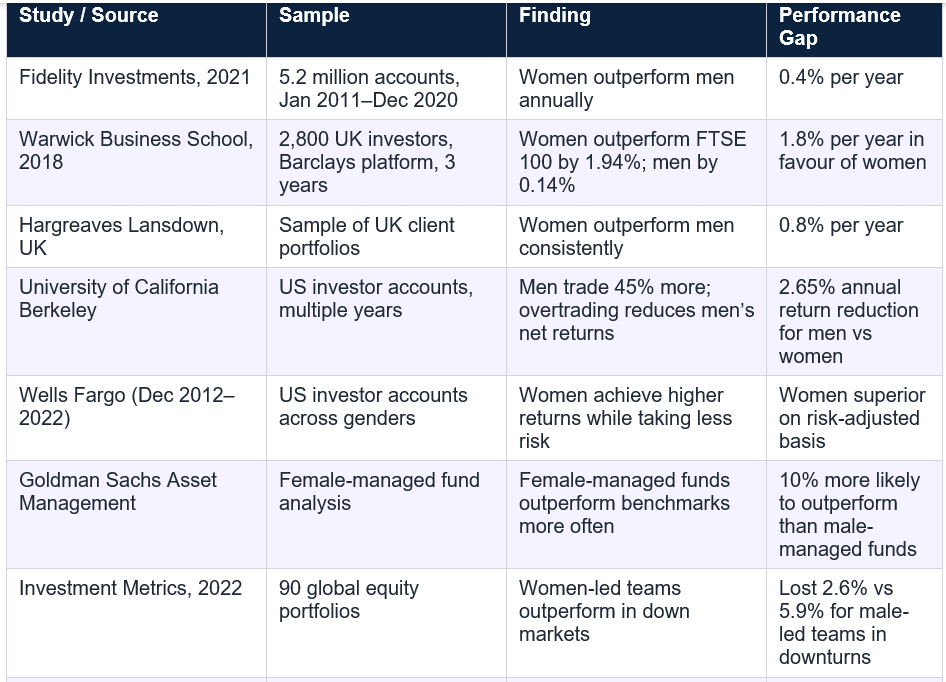

The consistency across institutions, methodologies, countries, and decades is striking. The performance advantage is not enormous in any single year — 0.4 to 1.8 percent annually depending on the study — but compounding makes small annual advantages very large over time. Vestpod’s calculation illustrates this concretely: investing £1 million over 25 years at 7.4 percent (women’s approximate average return) produces £530,000 more than the same investment at 7 percent. A 0.4 percent annual advantage, compounded for a generation, is a transformative sum.
University of California Berkeley’s foundational research found that men trade 45 percent more than women. That additional trading reduced men’s net annual returns by 2.65 percent. This is not a trivial drag: 2.65 percent compounded over 20 or 30 years of investing is a genuinely significant reduction in lifetime wealth.
The behavioural finance explanation for this trading difference connects to overconfidence research. Psychologist James Montier and others have documented that overconfidence is more prevalent among men in financial contexts: the tendency to believe that one’s predictions are more accurate than they are, and that one’s trading decisions are adding value when they are in fact subtracting it. Studies have consistently found that more trading does not improve investment outcomes. It reliably makes them worse, for both genders, but men do more of it.
Finax.eu, June 2026: Women significantly less often faced losses exceeding -30%. This is not just about slightly better average returns — it is about avoiding the catastrophic drawdowns that permanently impair a portfolio and from which recovery can take years.
This difference in crisis behaviour is highly significant. The most reliably documented way to permanently reduce investment returns is to sell during market downturns and thereby convert temporary paper losses into real crystallised losses, while also missing the recovery. The data on the cost of missing the best days is consistent across decades and multiple asset classes: missing just the ten best trading days in any decade eliminates approximately 80 percent of that decade’s returns.
The investors most likely to miss those best days are the ones who sold during the worst days — and the data suggests men are more likely to make panic-driven exit decisions. EQT’s analysis of the April 2026 market volatility following the US tariff announcements specifically noted that women-led companies outperformed the broader S&P 500 during the downturn, with Hypatia Capital’s Women CEO ETF outperforming the S&P 500 by over a percentage point during the rout.
Concentration risk — the risk of having too much of a portfolio in a small number of individual holdings — increases both potential upside and potential downside. Concentrated bets that pay off produce impressive returns. Concentrated bets that fail produce catastrophic losses. Across a large sample of investors, the concentrated approach produces worse average outcomes than diversification, even though the best individual concentrated bets look spectacular in retrospect.
Women’s tendency toward diversification aligns with the evidence on what produces consistently superior risk-adjusted returns: broad exposure to multiple asset classes, geographies, and sectors, rather than concentration in a few high-conviction positions. Diversification is often described as the only free lunch in investing — risk reduction without a corresponding reduction in expected return. The evidence suggests women are more likely to eat this lunch.
This lower participation in speculative assets reflects a broader pattern: women are less likely to invest in assets that are ‘everyone’s talking about,’ regardless of whether that conversation is about cryptocurrency, meme stocks, or any other trending investment vehicle. Meghan Railey, co-founder and CEO of Optas Capital, summarises this directly: male clients tend to eagerly invest in the latest asset class everyone is talking about, while female clients do not generally jump on the shiny bandwagon.
This pattern of lower trend-chasing is consistently associated with better investment outcomes. Research on investor behaviour across multiple asset classes, market cycles, and decades finds that trend-following and momentum-driven retail investment consistently underperforms buy-and-hold index investing, often by a wide margin. Women’s lower engagement with speculative trends is, in effect, a behavioural advantage that the data consistently rewards.
Fidelity’s IRA data found a similar pattern: women exceeded Roth IRA contribution caps in 34 percent of eligible accounts versus 30 percent for men. And DigitalDefynd’s analysis notes that women typically enrol in workplace retirement plans almost two years earlier than men on average, giving their investments a longer compounding horizon from the start of their career.
Earlier enrolment and higher contribution rates, combined with better investment returns, produce a compounding advantage that is larger than any individual year’s performance difference. The time value of money means that money contributed earlier is worth meaningfully more at retirement than money contributed later, even if both earn the same return. Women’s earlier start compounds all of their other performance advantages.
Investment fees compound in the same direction as investment returns — but against you. A fund charging 1.5 percent in annual fees versus an equivalent fund charging 0.1 percent generates a difference of 1.4 percent annually in the investor’s returns. Over 30 years on a large portfolio, this difference is the equivalent of years of additional investment returns. The investor who consistently chooses lower-cost options, all else being equal, will accumulate materially more wealth over a long investment horizon.
The behavioural explanation for women’s higher fee awareness connects to the same research on overconfidence: overconfident investors are less likely to question whether a high-fee fund justifies its cost, because they are more likely to believe they can identify the outperforming manager. Lower overconfidence produces more scepticism about actively managed funds and more scrutiny of costs — both of which are documented advantages in investment research.
The International Finance Corporation and World Bank study provides perhaps the most striking institutional data point: gender-balanced private equity management teams achieved up to 20 percent higher returns than male-dominated teams. This is not a marginal difference. It represents a performance advantage that would be the envy of any fund manager and cannot be attributed to luck across a sufficiently large sample.
The mechanisms proposed for institutional outperformance mirror those at the individual level: better risk management, less overconfident position-taking, more thorough due diligence processes, and more collaborative decision-making that catches individual cognitive biases before they become expensive mistakes. The institutional evidence suggests the behavioural advantages documented among individual women investors are not cultural or demographic artefacts — they are genuine performance drivers that operate at scale.
Goldman Sachs Asset Management: Female-managed funds are 10% more likely to outperform benchmarks compared with male-managed funds. Investment Metrics analysis (2022): women-led teams in 90 global equity portfolios lost 2.6% in down markets versus 5.9% for male-led teams.
The confidence gap manifests in multiple ways. Only 33 percent of women see themselves as ‘investors,’ even among women who are actively investing. Women are less likely to describe themselves as financially knowledgeable, less likely to seek investment advice proactively, and more likely to describe themselves as uncertain about investment decisions.
This confidence gap is not the same as the performance gap. It runs in the opposite direction. Women have lower confidence and higher returns. Men have higher confidence and lower returns. The implication is that financial self-confidence is not a good predictor of investment performance — and that some of what confidence produces, specifically more frequent trading and more speculative bets, is actively harmful to returns.
This savings gap reflects multiple factors: the gender pay gap (women earn less, so have less to save), career breaks for caring responsibilities (which disrupt pension accumulation), and the investment confidence gap (which leads some women to keep money in cash rather than investing it). Each of these factors compounds the others: lower income reduces savings capacity, career breaks reduce state pension entitlement, and lower investment participation means the money that is saved earns lower returns than it would if invested.
Fidelity’s Lorna Kapusta was explicit about the cash problem: we’re still seeing money sitting on the sidelines. Women who keep savings in cash accounts rather than investing them are experiencing real-terms wealth erosion when inflation exceeds savings rates, and missing the compounding returns that investing provides over the medium and long term. The confidence gap is costing women the very returns their behavioural characteristics would otherwise deliver.
Greenwood Capital’s March 2026 analysis notes that roughly 60 percent of women invest in the stock market now, with younger generations reporting even higher percentages. The directional trend is positive. But the stock market participation rate remains lower than for men, the average invested amount is lower, and the confidence gap that acts as the primary barrier to participation has not been closed.
The irony identified by Female Invest’s analysis is precise: the data suggests we need to smash the stereotypes that women are not good investors. This simply is not true, as women outperform men when they do invest. The barrier to women investing more is not lack of ability. It is lack of confidence in an ability they have already demonstrated.
The implication for any investor — male or female — is that the path to better investment outcomes runs through the same set of behaviours that women’s data consistently demonstrate: hold diversified index funds for the long term, resist the impulse to trade in response to market news, maintain regular contributions regardless of market conditions, avoid speculative trends, and minimise costs. These are not novel or complex strategies. They are what the evidence has consistently shown to work across decades of investment research.
The additional value of highlighting women’s investment performance is that it provides a concrete and evidence-based rebuttal to the confidence gap. When women say they are not confident in their investment decisions, the data on actual investment outcomes says: your decisions, collectively and statistically, are producing better results than those of the people who are confident. That is a different relationship between confidence and capability than the financial industry has traditionally projected.
The mechanism is not mysterious. Women trade less, hold more diversified portfolios, invest for longer timeframes, avoid speculative trends, enrol in pensions earlier, contribute more consistently, and scrutinise costs more carefully. All of these behaviours are individually associated with better investment outcomes in decades of behavioural finance research. Women happen to demonstrate them collectively and consistently.
The tragedy of the gender investing gap is that women’s confidence does not match their capability. The data on investment confidence is almost precisely the inverse of the data on investment performance. More women investing, investing more, and investing with the confidence that their demonstrated performance warrants would close a wealth gap that the pay gap alone cannot fully explain — and would direct more capital toward the patient, long-term, diversified investment strategies that the evidence consistently rewards.
Yes, consistently across multiple large-scale studies. Fidelity’s analysis of 5.2 million accounts from 2011 to 2020 found women outperformed men by 0.4% annually. Warwick Business School’s study of 2,800 UK investors found women outperformed men by 1.8% annually and outperformed the FTSE 100 by 1.94% versus men’s 0.14%. Hargreaves Lansdown found a 0.8% advantage. Wells Fargo found women achieved higher returns with less risk. The evidence comes from multiple countries, time periods, and methodologies.
Why do women outperform men in investing?
The research identifies several consistent behavioural factors: women trade less frequently (UC Berkeley found men trade 45% more); women are more likely to stay invested during downturns (51% vs 43% of men according to Fidelity); women build more diversified portfolios; women are less likely to invest in speculative or trend-driven assets; women enrol in workplace pensions earlier and contribute at higher rates; and women are more attentive to investment fees and costs.
How much would 0.4% better annual returns matter over time?
Significantly. Vestpod’s calculation shows that £1 million invested at 7.4% annually (the approximate women’s average) produces £530,000 more than the same investment at 7% over 25 years. A 1% higher annual return over 30 years results in approximately 30% more wealth accumulation. The compounding of small annual advantages produces large differences in lifetime investment wealth.
Do women fund managers also outperform men?
Yes. Goldman Sachs Asset Management analysis found female-managed funds are 10% more likely to outperform their benchmarks than male-managed funds. Investment Metrics’ 2022 analysis of 90 global equity portfolios found women-led teams lost just 2.6% in down markets versus 5.9% for male-led teams. The IFC and World Bank found gender-balanced private equity management teams achieved up to 20% higher returns than male-dominated teams.
Why aren’t more women investing if they outperform men?
The confidence gap is the primary documented barrier. Despite outperforming men, only one-third of women feel confident in their investment decisions, according to Fidelity. Many women do not self-identify as ‘investors’ even when they are actively investing. This confidence gap leads some women to hold savings in cash accounts rather than investing them, which erodes real-terms wealth through inflation and misses the compounding returns that investing delivers over time.
Is the gender investment performance gap getting smaller?
The participation gap is closing, particularly among younger women. Fidelity’s 2021 data showed 67% of women investing outside retirement accounts, up 50% from 2018. Roughly 60% of women now invest in the stock market, with younger generations showing even higher participation rates. The performance gap in favour of women has been consistently documented across multiple decades and does not appear to be narrowing, though participation rates are gradually converging.
What investing behaviours can anyone learn from women’s performance?
The behaviours documented in women’s better outcomes are all applicable regardless of gender: trade less frequently; maintain a long-term perspective and stay invested during downturns; build diversified portfolios rather than concentrating in individual stocks or sectors; avoid speculative trends and assets that everyone is currently excited about; contribute consistently to retirement accounts and start as early as possible; and scrutinise investment fees and choose lower-cost options. These are the behavioural characteristics that the evidence consistently associates with better long-term investment outcomes.
Table of Contents
- The Counterintuitive Evidence
- The Numbers: What the Major Studies Actually Found
- Reason 1: Women Trade Less — and Pay a Lower Behavioural Tax
- Reason 2: Long-Term Focus Over Short-Term Excitement
- Reason 3: More Diversified, Less Concentrated Portfolios
- Reason 4: Fewer Speculative Bets and Trend-Chasing
- Reason 5: Higher Savings Rates and Earlier Pension Enrolment
- Reason 6: Fee Awareness and Cost-Conscious Investing
- Women Fund Managers: The Institutional Evidence
- The Paradox: Better Returns, Less Confidence
- The Investment Confidence Gap: What It Costs Women
- The Gender Investing Gap: Who Invests and Who Doesn’t
- What the Evidence Means for All Investors
- Conclusion: The Investing Behaviours That Win Are Already There
- Frequently Asked Questions
The Counterintuitive Evidence
Investing has been culturally coded as a male activity for most of the modern financial era. The imagery of stock markets — the shouting trading floor, the aggressive risk-taker, the thrill of the deal — is disproportionately male in both representation and stereotype. Finance as a profession remains male-dominated at senior levels. And yet, across multiple rigorous academic studies and analyses of millions of real investor accounts, the data consistently points to the same counterintuitive finding: when women invest, they outperform men.The evidence comes not from one study or one country but from Fidelity’s analysis of 5.2 million customer accounts over a decade, Warwick Business School’s tracking of 2,800 UK investors over three years, University of California Berkeley’s research into trading behaviour, Hargreaves Lansdown’s UK client data, and Wells Fargo’s decade-long analysis of risk and returns. These are not small sample sizes or ideologically motivated research. They are large-scale, peer-reviewed or institutional data analyses pointing to consistent and measurable differences in investment outcomes by gender.
The question worth examining is not only that women outperform men, but why — and what those reasons reveal about the specific behaviours that produce better investment outcomes over time. This article examines the data, the behavioural explanations, the institutional evidence, and the significant paradox that sits at the centre of all of it: despite consistently better results, women are less likely to invest and less confident in their ability to do so.
The Numbers: What the Major Studies Actually Found
The consistency across institutions, methodologies, countries, and decades is striking. The performance advantage is not enormous in any single year — 0.4 to 1.8 percent annually depending on the study — but compounding makes small annual advantages very large over time. Vestpod’s calculation illustrates this concretely: investing £1 million over 25 years at 7.4 percent (women’s approximate average return) produces £530,000 more than the same investment at 7 percent. A 0.4 percent annual advantage, compounded for a generation, is a transformative sum.
Reason 1: Women Trade Less — and Pay a Lower Behavioural Tax
The most consistently documented explanation for women’s investment outperformance is a lower tendency to overtrade. Overtrading is the single most reliably documented destroys investment returns across decades of behavioural finance research. Every time an investor buys or sells, they incur transaction costs, potentially trigger taxable events, and run the risk of making a decision driven by emotion rather than analysis.University of California Berkeley’s foundational research found that men trade 45 percent more than women. That additional trading reduced men’s net annual returns by 2.65 percent. This is not a trivial drag: 2.65 percent compounded over 20 or 30 years of investing is a genuinely significant reduction in lifetime wealth.
The behavioural finance explanation for this trading difference connects to overconfidence research. Psychologist James Montier and others have documented that overconfidence is more prevalent among men in financial contexts: the tendency to believe that one’s predictions are more accurate than they are, and that one’s trading decisions are adding value when they are in fact subtracting it. Studies have consistently found that more trading does not improve investment outcomes. It reliably makes them worse, for both genders, but men do more of it.
Finax.eu, June 2026: Women significantly less often faced losses exceeding -30%. This is not just about slightly better average returns — it is about avoiding the catastrophic drawdowns that permanently impair a portfolio and from which recovery can take years.
Reason 2: Long-Term Focus Over Short-Term Excitement
The second consistently documented behavioural advantage for women investors is a longer time horizon orientation. Fidelity’s 2021 Women and Investing Study found that 51 percent of women who invest say they typically stay the course on their investments when the market experiences a dip, compared to just 43 percent of men.This difference in crisis behaviour is highly significant. The most reliably documented way to permanently reduce investment returns is to sell during market downturns and thereby convert temporary paper losses into real crystallised losses, while also missing the recovery. The data on the cost of missing the best days is consistent across decades and multiple asset classes: missing just the ten best trading days in any decade eliminates approximately 80 percent of that decade’s returns.
The investors most likely to miss those best days are the ones who sold during the worst days — and the data suggests men are more likely to make panic-driven exit decisions. EQT’s analysis of the April 2026 market volatility following the US tariff announcements specifically noted that women-led companies outperformed the broader S&P 500 during the downturn, with Hypatia Capital’s Women CEO ETF outperforming the S&P 500 by over a percentage point during the rout.
Reason 3: More Diversified, Less Concentrated Portfolios
Hargreaves Lansdown’s analysis identified portfolio construction as one of the three key reasons women outperform as investors. Women are more likely to have naturally diversified portfolios, while men are more likely to concentrate positions in individual stocks or sectors where they have high conviction.Concentration risk — the risk of having too much of a portfolio in a small number of individual holdings — increases both potential upside and potential downside. Concentrated bets that pay off produce impressive returns. Concentrated bets that fail produce catastrophic losses. Across a large sample of investors, the concentrated approach produces worse average outcomes than diversification, even though the best individual concentrated bets look spectacular in retrospect.
Women’s tendency toward diversification aligns with the evidence on what produces consistently superior risk-adjusted returns: broad exposure to multiple asset classes, geographies, and sectors, rather than concentration in a few high-conviction positions. Diversification is often described as the only free lunch in investing — risk reduction without a corresponding reduction in expected return. The evidence suggests women are more likely to eat this lunch.
Reason 4: Fewer Speculative Bets and Trend-Chasing
Women are consistently less likely than men to invest in speculative or trend-driven assets. The data on cryptocurrency is illustrative: in 2021, Gallup found that 11 percent of male investors owned Bitcoin compared to just 3 percent of female investors. By 2024, Fidelity found that 43 percent of women who invest outside of retirement bought cryptocurrency versus 55 percent of men. Motley Fool’s 2025 Cryptocurrency Investor Trends Survey found 52 percent of men likely to buy cryptocurrency compared to 32 percent of women.This lower participation in speculative assets reflects a broader pattern: women are less likely to invest in assets that are ‘everyone’s talking about,’ regardless of whether that conversation is about cryptocurrency, meme stocks, or any other trending investment vehicle. Meghan Railey, co-founder and CEO of Optas Capital, summarises this directly: male clients tend to eagerly invest in the latest asset class everyone is talking about, while female clients do not generally jump on the shiny bandwagon.
This pattern of lower trend-chasing is consistently associated with better investment outcomes. Research on investor behaviour across multiple asset classes, market cycles, and decades finds that trend-following and momentum-driven retail investment consistently underperforms buy-and-hold index investing, often by a wide margin. Women’s lower engagement with speculative trends is, in effect, a behavioural advantage that the data consistently rewards.
Reason 5: Higher Savings Rates and Earlier Pension Enrolment
The performance advantage of women’s investing behaviour is reinforced by a savings pattern that gives those investments more time to compound. DigitalDefynd’s 2026 analysis, drawing on Vanguard’s 2025 How America Saves report, found that 29 percent of female 401(k) participants contributed the statutory maximum to their retirement accounts, against 26 percent of male peers — a 12 percent relative edge in maximum contribution frequency.Fidelity’s IRA data found a similar pattern: women exceeded Roth IRA contribution caps in 34 percent of eligible accounts versus 30 percent for men. And DigitalDefynd’s analysis notes that women typically enrol in workplace retirement plans almost two years earlier than men on average, giving their investments a longer compounding horizon from the start of their career.
Earlier enrolment and higher contribution rates, combined with better investment returns, produce a compounding advantage that is larger than any individual year’s performance difference. The time value of money means that money contributed earlier is worth meaningfully more at retirement than money contributed later, even if both earn the same return. Women’s earlier start compounds all of their other performance advantages.
Reason 6: Fee Awareness and Cost-Conscious Investing
DigitalDefynd’s January 2026 analysis identifies fee awareness as a specifically documented behaviour among women investors. Women are more likely to review fund disclosures, compare expense ratios, and scrutinise charges before purchasing investment products. This fee consciousness has a direct and compounding impact on long-term returns.Investment fees compound in the same direction as investment returns — but against you. A fund charging 1.5 percent in annual fees versus an equivalent fund charging 0.1 percent generates a difference of 1.4 percent annually in the investor’s returns. Over 30 years on a large portfolio, this difference is the equivalent of years of additional investment returns. The investor who consistently chooses lower-cost options, all else being equal, will accumulate materially more wealth over a long investment horizon.
The behavioural explanation for women’s higher fee awareness connects to the same research on overconfidence: overconfident investors are less likely to question whether a high-fee fund justifies its cost, because they are more likely to believe they can identify the outperforming manager. Lower overconfidence produces more scepticism about actively managed funds and more scrutiny of costs — both of which are documented advantages in investment research.
Women Fund Managers: The Institutional Evidence
The individual investor data is reinforced by evidence from professional fund management. Goldman Sachs Asset Management analysis found that female-managed funds are 10 percent more likely to outperform their benchmarks than male-managed funds. Investment Metrics’ 2022 analysis of 90 global equity portfolios found that women-led teams lost just 2.6 percent in down markets versus 5.9 percent for male-led teams — a dramatically better capital preservation outcome that is at least as valuable as outperformance in bull markets.The International Finance Corporation and World Bank study provides perhaps the most striking institutional data point: gender-balanced private equity management teams achieved up to 20 percent higher returns than male-dominated teams. This is not a marginal difference. It represents a performance advantage that would be the envy of any fund manager and cannot be attributed to luck across a sufficiently large sample.
The mechanisms proposed for institutional outperformance mirror those at the individual level: better risk management, less overconfident position-taking, more thorough due diligence processes, and more collaborative decision-making that catches individual cognitive biases before they become expensive mistakes. The institutional evidence suggests the behavioural advantages documented among individual women investors are not cultural or demographic artefacts — they are genuine performance drivers that operate at scale.
Goldman Sachs Asset Management: Female-managed funds are 10% more likely to outperform benchmarks compared with male-managed funds. Investment Metrics analysis (2022): women-led teams in 90 global equity portfolios lost 2.6% in down markets versus 5.9% for male-led teams.
The Paradox: Better Returns, Less Confidence
The most significant and frustrating finding in all of the gender and investing research is that women outperform men consistently — and simultaneously have far less confidence in their investment abilities. Fidelity’s 2021 Women and Investing Study found that only one-third of women feel confident in their ability to make investment decisions, even as their accounts were outperforming men’s by measurable margins across 5.2 million accounts.The confidence gap manifests in multiple ways. Only 33 percent of women see themselves as ‘investors,’ even among women who are actively investing. Women are less likely to describe themselves as financially knowledgeable, less likely to seek investment advice proactively, and more likely to describe themselves as uncertain about investment decisions.
This confidence gap is not the same as the performance gap. It runs in the opposite direction. Women have lower confidence and higher returns. Men have higher confidence and lower returns. The implication is that financial self-confidence is not a good predictor of investment performance — and that some of what confidence produces, specifically more frequent trading and more speculative bets, is actively harmful to returns.
The Investment Confidence Gap: What It Costs Women
The confidence gap has a concrete financial cost, separate from and additional to the gender pay gap. Motley Fool’s 2026 Women and Investing Statistics analysis documents that women are less likely to invest than men and that the median retirement savings is $50,000 for women compared to $157,000 for men, according to Prudential’s 2024 report.This savings gap reflects multiple factors: the gender pay gap (women earn less, so have less to save), career breaks for caring responsibilities (which disrupt pension accumulation), and the investment confidence gap (which leads some women to keep money in cash rather than investing it). Each of these factors compounds the others: lower income reduces savings capacity, career breaks reduce state pension entitlement, and lower investment participation means the money that is saved earns lower returns than it would if invested.
Fidelity’s Lorna Kapusta was explicit about the cash problem: we’re still seeing money sitting on the sidelines. Women who keep savings in cash accounts rather than investing them are experiencing real-terms wealth erosion when inflation exceeds savings rates, and missing the compounding returns that investing provides over the medium and long term. The confidence gap is costing women the very returns their behavioural characteristics would otherwise deliver.
The Gender Investing Gap: Who Invests and Who Doesn’t
The progress over the past decade is real but incomplete. Fidelity’s 2021 data showed that 67 percent of women were then investing outside of their retirement accounts, up 50 percent from 2018, with the onset of the COVID-19 pandemic contributing to the surge. Younger women, in particular, are closing the investment participation gap with their male peers.Greenwood Capital’s March 2026 analysis notes that roughly 60 percent of women invest in the stock market now, with younger generations reporting even higher percentages. The directional trend is positive. But the stock market participation rate remains lower than for men, the average invested amount is lower, and the confidence gap that acts as the primary barrier to participation has not been closed.
The irony identified by Female Invest’s analysis is precise: the data suggests we need to smash the stereotypes that women are not good investors. This simply is not true, as women outperform men when they do invest. The barrier to women investing more is not lack of ability. It is lack of confidence in an ability they have already demonstrated.
What the Evidence Means for All Investors
The findings on women’s investment outperformance are not really about gender. They are about investment behaviours. The specific characteristics that produce women’s better outcomes — lower trading frequency, longer time horizons, better diversification, less trend-chasing, higher savings rates, and fee awareness — are all learnable, applicable behaviours. They are not sex-linked traits. They are habits.The implication for any investor — male or female — is that the path to better investment outcomes runs through the same set of behaviours that women’s data consistently demonstrate: hold diversified index funds for the long term, resist the impulse to trade in response to market news, maintain regular contributions regardless of market conditions, avoid speculative trends, and minimise costs. These are not novel or complex strategies. They are what the evidence has consistently shown to work across decades of investment research.
The additional value of highlighting women’s investment performance is that it provides a concrete and evidence-based rebuttal to the confidence gap. When women say they are not confident in their investment decisions, the data on actual investment outcomes says: your decisions, collectively and statistically, are producing better results than those of the people who are confident. That is a different relationship between confidence and capability than the financial industry has traditionally projected.
Conclusion
The evidence is consistent, large-scale, and spans multiple decades, countries, and institutions: when women invest, they outperform men. Fidelity’s 0.4 percent annual advantage across 5.2 million accounts. Warwick Business School’s 1.8 percent advantage across 2,800 UK investors. Goldman Sachs’ finding that female-managed funds are 10 percent more likely to outperform benchmarks. Investment Metrics’ finding that women-led teams lose half as much in down markets. The IFC’s finding of up to 20 percent higher returns from gender-balanced private equity teams.The mechanism is not mysterious. Women trade less, hold more diversified portfolios, invest for longer timeframes, avoid speculative trends, enrol in pensions earlier, contribute more consistently, and scrutinise costs more carefully. All of these behaviours are individually associated with better investment outcomes in decades of behavioural finance research. Women happen to demonstrate them collectively and consistently.
The tragedy of the gender investing gap is that women’s confidence does not match their capability. The data on investment confidence is almost precisely the inverse of the data on investment performance. More women investing, investing more, and investing with the confidence that their demonstrated performance warrants would close a wealth gap that the pay gap alone cannot fully explain — and would direct more capital toward the patient, long-term, diversified investment strategies that the evidence consistently rewards.
Frequently Asked Questions
Do women really outperform men as investors?Yes, consistently across multiple large-scale studies. Fidelity’s analysis of 5.2 million accounts from 2011 to 2020 found women outperformed men by 0.4% annually. Warwick Business School’s study of 2,800 UK investors found women outperformed men by 1.8% annually and outperformed the FTSE 100 by 1.94% versus men’s 0.14%. Hargreaves Lansdown found a 0.8% advantage. Wells Fargo found women achieved higher returns with less risk. The evidence comes from multiple countries, time periods, and methodologies.
Why do women outperform men in investing?
The research identifies several consistent behavioural factors: women trade less frequently (UC Berkeley found men trade 45% more); women are more likely to stay invested during downturns (51% vs 43% of men according to Fidelity); women build more diversified portfolios; women are less likely to invest in speculative or trend-driven assets; women enrol in workplace pensions earlier and contribute at higher rates; and women are more attentive to investment fees and costs.
How much would 0.4% better annual returns matter over time?
Significantly. Vestpod’s calculation shows that £1 million invested at 7.4% annually (the approximate women’s average) produces £530,000 more than the same investment at 7% over 25 years. A 1% higher annual return over 30 years results in approximately 30% more wealth accumulation. The compounding of small annual advantages produces large differences in lifetime investment wealth.
Do women fund managers also outperform men?
Yes. Goldman Sachs Asset Management analysis found female-managed funds are 10% more likely to outperform their benchmarks than male-managed funds. Investment Metrics’ 2022 analysis of 90 global equity portfolios found women-led teams lost just 2.6% in down markets versus 5.9% for male-led teams. The IFC and World Bank found gender-balanced private equity management teams achieved up to 20% higher returns than male-dominated teams.
Why aren’t more women investing if they outperform men?
The confidence gap is the primary documented barrier. Despite outperforming men, only one-third of women feel confident in their investment decisions, according to Fidelity. Many women do not self-identify as ‘investors’ even when they are actively investing. This confidence gap leads some women to hold savings in cash accounts rather than investing them, which erodes real-terms wealth through inflation and misses the compounding returns that investing delivers over time.
Is the gender investment performance gap getting smaller?
The participation gap is closing, particularly among younger women. Fidelity’s 2021 data showed 67% of women investing outside retirement accounts, up 50% from 2018. Roughly 60% of women now invest in the stock market, with younger generations showing even higher participation rates. The performance gap in favour of women has been consistently documented across multiple decades and does not appear to be narrowing, though participation rates are gradually converging.
What investing behaviours can anyone learn from women’s performance?
The behaviours documented in women’s better outcomes are all applicable regardless of gender: trade less frequently; maintain a long-term perspective and stay invested during downturns; build diversified portfolios rather than concentrating in individual stocks or sectors; avoid speculative trends and assets that everyone is currently excited about; contribute consistently to retirement accounts and start as early as possible; and scrutinise investment fees and choose lower-cost options. These are the behavioural characteristics that the evidence consistently associates with better long-term investment outcomes.
0 Comments
Be the first to share your thoughts on this article.