Blog Image
Financial Literacy

10 Greatest Personal Finance Lessons That Changed My Life

September 8, 2026 12:00 AM
5 min read
0 views
27% of Americans have zero emergency savings — the highest ever recorded. 59% cannot cover a $1,000 emergency. 53% are living paycheck to paycheck. Poor financial literacy cost Americans $246 billion in 2025 alone. These are not inevitable outcomes. They are the consequence of lessons that most people were never taught. This is the list of the ones that changed everything.

Table of Contents

  • The Financial Education Nobody Gave You
  • Lesson 1: Your Income Is Not Your Wealth
  • Lesson 2: The Emergency Fund Is Non-Negotiable
  • Lesson 3: Compound Interest Works Both Ways
  • Lesson 4: Pay Yourself First — Or You Won’t Pay Yourself at All
  • Lesson 5: Lifestyle Inflation Is the Silent Wealth Killer
  • Lesson 6: The Difference Between Good Debt and Bad Debt
  • Lesson 7: A Budget Isn’t a Restriction — It’s a Permission Slip
  • Lesson 8: Your Net Worth Is More Important Than Your Salary
  • Lesson 9: Most Investment Complexity Is Unnecessary — and Expensive
  • Lesson 10: Financial Decisions Are Emotional Decisions
  • The 10 Lessons at a Glance: A Reference Table
  • Conclusion: The Money Lessons That Were Always Worth Learning
  • Frequently Asked Questions

image_png_1788860361.png

The Financial Fragility Picture

image_png_1788860420.png

10 Lessons: Annual Saving Each One Unlocks

image_png_1788860506.png

The Financial Education Nobody Gave You

Most people learn about money the same way: by making expensive mistakes with it. Nobody sat them down at 18 and explained compound interest. Nobody showed them what a budget actually does, or why an emergency fund is not optional, or what ‘lifestyle inflation’ costs over twenty years. They learned by going into debt, by arriving at 35 with no savings, by watching a $3,000 emergency spiral into a $5,000 debt.

The statistics in 2026 confirm how widespread this experience is. 27% of US adults have zero emergency savings — the highest level ever recorded (Bankrate 2026 Emergency Savings Report). 59% cannot cover a $1,000 unexpected expense from their savings. 53% are living paycheck to paycheck, including 32.3% of those earning over $100,000. 88% of Americans entered 2026 reporting financial stress. Poor financial literacy cost Americans more than $246 billion in 2025 alone (Fortunly, March 2026). Only 48% of Americans can correctly answer basic financial literacy questions (The Motley Fool, cited Capital Counselor). Americans answered only 52% of personal finance questions correctly on average in the TIAA Institute-GFLEC Personal Finance Index 2025.

These are not outcomes produced by bad luck or bad character. They are the consequence of a specific set of lessons that most people were never taught. The ten lessons below are not theoretical. They are the ones that, once understood, produce measurable, lasting changes in financial outcomes. They are the ones most consistently cited by financially stable people — when you ask them to name what changed things for them.

27% of Americans: zero emergency savings (Bankrate 2026 — highest ever). 59%: can't cover a $1,000 emergency. 53%: living paycheck to paycheck. 88%: reported financial stress entering 2026 (National Endowment for Financial Education). Poor financial literacy cost Americans $246bn in 2025 (Fortunly, March 2026). US household debt: record $18.59 trillion in 2026.

Lesson 1: Your Income Is Not Your Wealth

This is the lesson that reshapes the most fundamental assumption most people carry about money. The assumption is: earn more, have more. The reality is more complicated and more important than that.

Wealth is not income. Wealth is the gap between what you earn and what you spend, accumulated and compounded over time. Two people earning identical salaries can arrive at 50 with radically different financial positions, depending entirely on how large that gap was and how consistently it was maintained. A household earning $120,000 and spending $118,000 is financially fragile — it has high income and no wealth. A household earning $60,000 and spending $48,000 is building wealth — it has lower income and a $12,000 annual gap that compounds.

This is why 32.3% of Americans earning over $100,000 are living paycheck to paycheck in 2026 (Capital Counselor). Income above a certain level does not automatically produce financial security. What produces security is the margin — the gap — and the discipline to protect it from lifestyle expansion.

The question to ask every year is not 'Did I earn more?' It is 'Did my gap grow?' Net worth is the score. Income is just the tool.

Stop measuring financial progress by salary and start measuring it by net worth: assets minus liabilities. Calculate it once per quarter. The number should trend upward over time regardless of income fluctuations.

Lesson 2: The Emergency Fund Is Non-Negotiable

An emergency fund is not a savings goal. It is insurance against the financial system you already depend on. Without it, every financial shock — a car repair, a medical bill, a job loss, a broken appliance — becomes a debt event. The repair gets paid for with a credit card at 24% APR, or a payday loan at rates that can exceed 400% APR. The emergency resolves but the financial hole deepens.

The data in 2026 makes the scale of this problem visible. According to Bankrate’s 2026 Emergency Savings Report, 27% of US adults have zero emergency savings — the highest ever recorded. 59% cannot cover a $1,000 emergency from savings. By generation, 29% of Gen Z adults cannot cover a $400 emergency (DontPayFull, April 2026; Fortunly 2026). Over five years, the opportunity cost of absent emergency savings can exceed $15,000 in compound interest payments on debt borrowed to cover emergencies (ECIKS.org, May 2026).
The standard target is three to six months of essential living expenses, held in an accessible savings account earning competitive interest. Start with $1,000. Then build to one month. Then three months. The specific target matters less than having something between your financial life and the next shock.

The savings rate in the US hit just 2.6% in April 2026 (Bureau of Economic Analysis, cited ECIKS.org). At that rate, a person earning $50,000 saves approximately $1,300 per year. That covers one car repair. It does not cover a job loss. The emergency fund is the single most impactful improvement most households can make, because it breaks the debt spiral that prevents all other financial progress.

Before any investment, any extra mortgage payment, or any discretionary saving goal: build the emergency fund. Open a dedicated savings account, name it 'Emergency Fund Only', and automate a fixed amount to it each payday. Do not merge it with your current account.

Lesson 3: Compound Interest Works Both Ways

Compound interest is described everywhere as the eighth wonder of the world. What gets less attention is that compounding is directionally neutral — it works just as relentlessly on debt as it does on savings. The same mathematical force that makes $7,500 per year in a Roth IRA worth $1.49 million over 30 years is the force that makes a $3,000 credit card balance grow to $8,000 over a decade of minimum payments at 24% APR.

The FINRA Foundation and TIAA Institute data are consistent: the question on compounding debt is the lowest-scored among all financial literacy questions (Fortunly, March 2026). Americans understand compounding in the abstract. They do not apply it to their own borrowing behaviour. This gap is expensive: those with very low financial literacy are three times more likely to be financially fragile and five times less likely to have a month’s emergency savings (Fortunly).

The practical lesson is arithmetic. A $5,000 credit card balance at 24% APR, making only the minimum payment, will take approximately 27 years to clear and cost approximately $12,000 in interest on top of the original $5,000. The debt that felt small when it was incurred costs 3.4 times its face value before it is gone. WalletGrower (June 2026) quantifies the investment-side equivalent: the gap between a 0.04% index fund and a 1.0% actively managed fund is about $215,000 over 30 years on a $300,000 portfolio. Both sides of the compounding equation matter.

Compounding is the most powerful force in personal finance — and it will work against you or for you with equal efficiency depending on which side of it you are on. Eliminating high-interest debt is not just a savings exercise. It is a decision to redirect the power of compounding from your creditor's benefit to your own.

List all debts with their interest rates. Any debt above 7%–8% should be the priority for accelerated repayment. Use the avalanche method (highest interest rate first) to minimise total interest paid, or the snowball method (smallest balance first) if behavioural momentum matters more than pure maths.

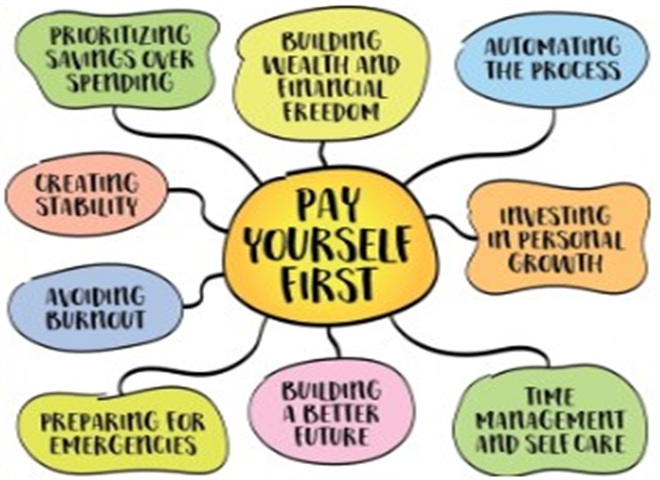
Lesson 4: Pay Yourself First — Or You Won’t Pay Yourself at All

Every financial plan that relies on saving what is left over at the end of the month fails. Not because people lack discipline, but because discretionary spending is genuinely infinite in a consumer economy — there is always somewhere for the money to go before it reaches a savings account. The solution is structural: automate the saving to happen before the spending decisions begin.

Pay yourself first is the principle of directing a fixed amount of every paycheck to savings, investment, or debt repayment before any other expense is paid. The mechanism is an automated transfer that moves the money the moment it arrives in the account, before the spending that would otherwise consume it. 401(k) contributions work this way because they are deducted from payroll before the money ever reaches a bank account. The same logic applies to any savings goal.

The evidence for this approach is robust. ECIKS.org’s May 2026 emergency savings analysis specifically identifies automation as one of the key behavioural interventions that reliably increases savings rates: ‘awareness of the problem has increased — articles, apps, and financial institutions are highlighting automation tools and phased approaches.’ Behaviour change that requires active decision-making every month fails; structural change that requires no decision fails far less often.

The amount you save is less important than the consistency. $200 per month automated beats $500 per month intended. Start with an amount that is uncomfortable but survivable, automate it, and increase it annually. Within 12 months, most people adapt to the reduced take-home as if it was always the budget.

Set up an automatic transfer for the day after payday — not the day before rent is due. The amount can be modest. The automation is the change. Capture any employer 401(k) match before any other saving priority: it is an immediate 50%–100% return on the matched amount.

Lesson 5: Lifestyle Inflation Is the Silent Wealth Killer

Lifestyle inflation is the phenomenon of spending rising in proportion to income, so that no matter how much more you earn, the gap between income and expenditure never actually grows. It is one of the most reliable and least discussed explanations for why income increases rarely produce proportional improvements in financial security.

The pattern is predictable: a raise produces a better car payment. A promotion produces a bigger apartment. A bonus produces a better holiday. Each individual decision is reasonable. The cumulative effect is that a $20,000 salary increase from age 25 to 35 produces no measurable improvement in savings rate or net worth because every dollar of it found a corresponding new expense.

The 53% of Americans living paycheck to paycheck in 2026 who earn over $100,000 (Capital Counselor) are the visible result of lifestyle inflation at scale. High income does not protect against it. The protection against lifestyle inflation is a deliberate, pre-committed rule: every time income increases, a specific percentage of the increase is directed to savings or debt repayment before the spending baseline can adjust to absorb it.

Lifestyle inflation is invisible while it is happening. The car that feels normal now was a luxury three years ago. The restaurant spend that feels standard now was a treat before the last promotion. The way to see it is to look at your savings rate, not your spending habits. If your savings rate has not grown proportionally to your income growth over the past five years, lifestyle inflation is the explanation.

Commit to saving 50% of every future income increase before it becomes 'normal' income. If a raise of $5,000 per year arrives, direct $2,500 to savings or retirement before adjusting any spending. The spending baseline adapts to whatever arrives in the current account; the $2,500 that never arrives there is never missed.

Lesson 6: The Difference Between Good Debt and Bad Debt

Not all debt is the same. Understanding the distinction between debt that creates value and debt that destroys it is one of the most practically important financial concepts, because it changes the way debt decisions are made.

Good debt, broadly defined, is borrowing that is used to acquire an asset that either appreciates in value or produces income — a mortgage on a property that appreciates, a student loan for a degree that increases lifetime earning potential, a business loan that generates profit. The key tests: is the interest rate below the return on what the borrowed money produces? Does the underlying asset retain or increase in value?

Bad debt is borrowing used to fund consumption — purchases that have no lasting value or earning potential. Credit card debt for non-essential purchases, buy-now-pay-later for items that will depreciate to zero, personal loans for holidays. The interest on bad debt is the cost of a purchase that has already been consumed. It produces nothing. US household debt hit a record $18.59 trillion in 2026 (Capital Counselor), with credit card debt at rates averaging 24.4% representing the most destructive category for household wealth.

The practical test for any borrowing decision: at the interest rate being charged, does the use of the borrowed money create more value than the interest costs? A mortgage at 5% on a property appreciating at 4% plus the utility of housing is borderline defensible. A credit card at 24% for a restaurant meal is unambiguously wealth-destructive. The higher the interest rate and the less productive the use, the worse the debt.

Apply the 'interest rate vs return' test to every borrowing decision. If the interest rate exceeds the return (financial or life quality) of what the money buys, do not borrow for it. Build the emergency fund first so that bad debt never needs to be used to cover emergencies.

Lesson 7: A Budget Isn’t a Restriction — It’s a Permission Slip

The word budget carries connotations of deprivation, scarcity, and anxiety. For most people who have never used one consistently, it represents a set of rules designed to prevent them from spending money on things they enjoy. This framing is exactly backwards.

A budget is a plan for where money goes before it decides for itself. Without a budget, spending decisions are made reactively, under social pressure, under the influence of marketing, or in moments of boredom or stress. With a budget, spending decisions are made in advance, rationally, in alignment with actual priorities. The budget does not prevent spending — it decides which spending happens deliberately and which does not.

The paradox is that people who budget consistently often feel more financially free than those who do not, because the money allocated to guilt-free spending — the dining budget, the entertainment budget, the clothing budget — can be spent without anxiety or second-guessing. The money is already allocated. It is already designated. Spending it is the point, not a lapse.

Only 47% of Americans can cover a $1,000 emergency from savings (Fortunly 2026) and 2 in 3 Americans do not believe they will ever feel financially secure (Credible 2025). These outcomes are consistent with what happens when spending is unmanaged rather than planned.

Build a zero-based budget at the start of each month: assign every dollar of expected income to a category (rent, food, transport, savings, debt repayment, fun) until income minus allocations equals zero. Every dollar has a job before it arrives. Review actual vs budgeted at month-end and adjust the following month's categories. Two months of this reveals every financial leak that has been invisible for years.

Lesson 8: Your Net Worth Is More Important Than Your Salary

Salary is the most discussed financial number in most people’s lives. It is the number that determines social status in professional settings, determines mortgage eligibility, and is the figure most often cited in discussions of financial progress. It is also a deeply incomplete measure of financial health.

Net worth — total assets minus total liabilities — is the actual score of financial progress. Two people with identical salaries can have net worths that differ by hundreds of thousands of dollars over the course of a decade, depending on their savings rate, investment decisions, debt levels, and whether they bought assets or consumed income. The salary tells you how much is coming in. The net worth tells you whether any of it is staying.

Federal Reserve data on household wealth confirms this dynamic: households in higher income quintiles have significantly higher retirement account balances, are more likely to have emergency savings, less likely to carry high-interest debt, and generally have more financial flexibility (Paladin Advisor Group, July 2026). But income quintile and net worth quintile do not perfectly overlap, because wealth is built by behaviour, not salary level.

Track net worth, not salary. Calculate: all assets (savings accounts, investment accounts, retirement accounts, property equity, vehicle value) minus all liabilities (mortgage balance, car loan balance, student loans, credit card balances, any other debt). The number should trend upward consistently over time. If salary is growing but net worth is not, lifestyle inflation and debt are consuming the entire income increase.

Calculate net worth today, in writing. Schedule a net worth review every quarter. The act of measuring it regularly is itself one of the most powerful financial habits, because it makes the trend visible and therefore actionable in a way that day-to-day spending does not.

Lesson 9: Most Investment Complexity Is Unnecessary — and Expensive

The investment industry generates enormous complexity. New products, new strategies, new asset classes, new allocation frameworks appear constantly. Most of this complexity does not produce better outcomes for investors — it produces better margins for the people who sell it. The academic evidence on this is not ambiguous: the majority of actively managed funds underperform their benchmark index over ten and fifteen-year periods, after fees are deducted.

WalletGrower (June 2026) makes this concrete: the gap between a 0.04% index fund and a 1.0% actively managed fund is approximately $215,000 over 30 years on a $300,000 portfolio. That $215,000 difference is created entirely by the fee structure, not by the fund manager’s skill. The index fund that charges 0.04% delivers the same market return as the actively managed fund — and then keeps the 0.96% fee difference compounding in the investor’s account instead of the manager’s.

For most individuals building wealth over a career, the optimal investment strategy is genuinely simple: a broad low-cost equity index fund (such as those discussed in this series), funded regularly, held consistently through market cycles, and not touched during downturns. The strategy requires no specialised knowledge, no market timing, and no active management. It does require consistency and patience — which are the two attributes that distinguish the outcomes of financially successful individuals more reliably than any investment product.

The best investment strategy is the simplest one you will actually stick to. Complexity creates friction, friction creates inaction, inaction produces the worst outcome of all. A person who invests $300/month in a single broad index fund for 30 years will almost certainly outperform a person who researches ten different strategies and switches between four of them.

If you have investments with expense ratios above 0.20%, review whether they are justified by any specific return above the benchmark. If not, consider switching to a low-cost index fund equivalent. The difference in cost will compound significantly over time.

Lesson 10: Financial Decisions Are Emotional Decisions

The final and perhaps most important lesson is the one that explains all the others: human beings do not make financial decisions rationally. They make them emotionally, then rationalise them afterwards. Understanding this — genuinely accepting it as a description of your own behaviour, not just other people’s — is the foundational shift that makes every other financial lesson implementable.

The emotional drivers of poor financial decisions are well-documented in behavioural economics: retail therapy for stress and loneliness; social comparison spending (the visible consumer purchases that signal status); present bias (the systematic overvaluing of immediate gratification over long-term benefit); loss aversion (holding losing investments too long and selling winning ones too early); fear-based selling during market downturns. None of these are flaws of character. They are documented features of human psychology.

Recognising the emotional driver behind a financial decision creates the single most valuable gap in personal finance: the pause. Before making any significant financial decision — a large purchase, a debt-financed choice, an investment switch, a career move — identifying the emotion that is generating the impulse allows for a different kind of evaluation. Is this decision driven by a genuine assessment of value, or by anxiety, loneliness, social pressure, or fear?

Only 57% of Americans can correctly answer the ‘Big Three’ financial literacy questions on interest rates, inflation, and risk diversification (WalletGrower, June 2026). Financial literacy matters — but emotional literacy about money matters equally. The person who understands compound interest but sells their index fund in a recession because fear feels more persuasive than the maths has not translated knowledge into behaviour.

The most important financial skill is not knowing what to do — it is doing it when the emotional pull is toward something different. Automation, pre-commitment, and rule-based decision-making all reduce the number of decisions made under emotional pressure. Structure replaces willpower; the goal is a financial life that works well even on the worst days.

Identify your two or three most common emotional money triggers (stress spending, social comparison purchases, fear-based selling). For each one, design a specific pre-committed response: a 72-hour rule before any unbudgeted purchase above a set amount, or a 'do not sell' rule during any market decline above 20%. Write the rules down before the emotions appear, not while they are present.

The 10 Lessons at a Glance: A Reference Table

image_png_1788861551.png
image_png_1788861588.png

Conclusion

Financial security is not the result of exceptional income, exceptional luck, or exceptional intelligence. It is the result of a specific set of habits and mental models, applied consistently over time. The ten lessons in this guide are not secret. They are not advanced. They are the foundational principles that financially stable people consistently cite when asked what changed their trajectory — and they are the principles that the data shows most Americans have never been explicitly taught.

27% of Americans have zero emergency savings. 59% cannot cover a $1,000 emergency. 88% entered 2026 under financial stress. These are not permanent conditions. They are the starting point for most people who eventually improve their financial lives, because almost everyone starts without these lessons. The difference is not the starting point. It is whether the lessons arrive before or after the most expensive mistakes.

The most productive single action any reader can take after finishing this article is to choose one lesson — just one — and implement its first action this week. Build the emergency fund. Calculate net worth. Set up the automated transfer. Make the zero-based budget. Understand the compounding cost of the highest-rate debt. One lesson, implemented, changes the conditions for the next one. They are not independent lessons. They are a system, and any entry point into the system produces better outcomes than no entry point.

Frequently Asked Questions

What is the single most important personal finance lesson?

If forced to choose one, it is the emergency fund. Without a buffer between your financial life and unexpected events, every other financial goal is permanently at risk. A $3,000 emergency that cannot be covered from savings becomes $3,000 in high-interest debt. That debt delays the investment you were planning to make, increases the interest cost you are paying, and keeps you in the reactive financial cycle that makes all other progress difficult. The Bankrate 2026 Emergency Savings Report found that 27% of US adults have zero emergency savings and 59% cannot cover a $1,000 emergency — both at or near all-time highs. Building even $1,000 in accessible savings changes the trajectory of financial decision-making more than almost any other single action.

Why do so many high-income earners live paycheck to paycheck?

Because income does not automatically produce wealth — spending behaviour does. The Capital Counselor September 2026 data shows 32.3% of Americans earning over $100,000 living paycheck to paycheck in 2026. The explanation is lifestyle inflation: as income rises, spending rises to match or exceed it. The car payment upgrades with the raise. The apartment improves with the promotion. The holiday becomes a luxury version of the same holiday. Each decision is individually defensible and collectively wealth-destroying. The gap between income and spending is what determines financial progress, and high income without a protected savings gap produces no more financial security than a lower income with a smaller but consistent gap.

How do I start budgeting if I've never done it before?

The most accessible starting point is the 50/30/20 framework: 50% of take-home income to needs (rent, utilities, food, transport), 30% to wants (dining, entertainment, hobbies), 20% to financial goals (savings, debt repayment, investing). This is a rough framework, not a precise rule — the specific percentages should be adjusted for housing costs in high-cost areas and for the urgency of debt repayment. The first step is to track actual spending for one month without changing any behaviour. Most people discover categories they had significantly underestimated. Once the baseline is known, the zero-based budget — where every dollar of income is assigned to a category before it is spent — is the most effective structure for consistent progress.

What is compound interest and why does it matter so much?

Compound interest is the process of earning interest on interest (or returns on returns) over time. When $1,000 earns 7% in year one, it becomes $1,070. In year two, the 7% applies to $1,070, not $1,000, producing $1,144.90. Over decades, this exponential growth produces results that feel mathematically implausible: $7,500 per year contributed to a Roth IRA at 10.5% annual growth for 30 years becomes approximately $1.49 million. The same logic applies in reverse to debt: a $5,000 credit card balance at 24% APR, minimum payments only, takes approximately 27 years to clear and costs approximately $12,000 in interest. The Fortunly March 2026 data identifies compound debt as the most poorly understood concept in financial literacy surveys. Understanding it — on both sides — is the difference between building wealth and funding someone else's wealth.

When should I start investing vs paying off debt?

The general hierarchy: (1) capture any employer 401(k) match first — it is an immediate 50–100% return on the matched contribution, which beats any debt interest rate except payday products; (2) build a minimum emergency fund of $1,000; (3) pay off any debt above 7–8% interest aggressively — this debt's interest cost exceeds the realistic expected investment return, making repayment the higher-return use of the money; (4) build the emergency fund to three months of expenses; (5) invest the surplus in tax-advantaged accounts (Roth IRA, 401(k)) and low-cost index funds. Debt below 3–4% can be carried alongside investing, since the historical investment return typically exceeds the low debt rate. The specific threshold (around 6–8%) reflects the long-run equity market return that most investors can realistically expect over decades.

Is financial literacy really that important?

Significantly so, and the cost of the deficit is measurable. Fortunly's March 2026 analysis found poor financial literacy cost Americans more than $246 billion in 2025. The National Financial Educators Council estimates Americans lose an average of $1,015 per person each year due to financial illiteracy. Those with very low financial literacy levels are three times more likely to be financially fragile and five times less likely to have even one month's emergency savings (Fortunly). Only 57% of Americans can correctly answer the 'Big Three' financial literacy questions on interest rates, inflation, and risk diversification — and this figure has not improved in over a decade (WalletGrower, June 2026). WalletGrower also quantifies the value: for families earning $50,000–$100,000, improving just three of these financial concepts typically produces $2,000–$5,000 in annual savings.
user's profile

Ernest Robinson

Expert Author

Some text here...

2565 Articles
3K Readers
3.7 Rating

0 Comments Comments

Leave a Reply

;