
Knowledge
2026 Midterm Elections: 6 Issues to Watch (Nov 3)

Every two years, the United States holds a midterm election that functions partly as a verdict on the current administration and partly as a window into what Americans genuinely care about. The 2026 midterms, scheduled for November 3, are more charged than most. Three in four voters say they are following the elections closely. Forty-two percent of registered voters say their vote is explicitly in opposition to President Trump. The economy dominates the issue landscape — 48% of likely voters in Rasmussen’s 2026 polling name it the single most important factor in their vote. But below that headline number, six distinct issue areas are shaping races across the country: economic anxiety, immigration, the war in Iran and foreign policy, healthcare, government corruption, and the state of democratic institutions. This article explains each issue, presents the current polling data, and identifies specifically what to watch as November approaches. All polling figures are from named, published sources. This article presents voter data, not political endorsements.
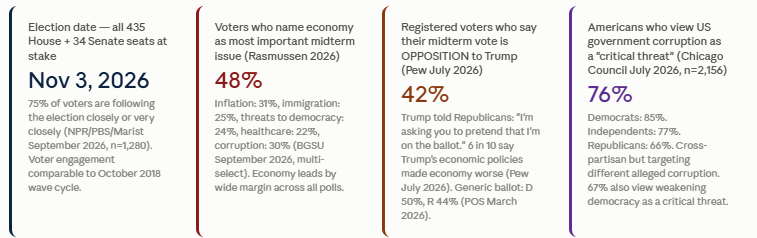
All 435 seats in the House of Representatives are on the ballot on November 3, 2026, along with 34 Senate seats. Control of Congress — which party chairs committees, controls the legislative calendar, and shapes the direction of oversight and appropriations — hangs in the balance. Midterm elections historically function as a referendum on the sitting president and the governing party, and 2026 is no exception. The POS/Public Opinion Strategies March 2026 midterm overview confirmed that 2026 is a high-engagement cycle: 64% of voters expressed very high interest in March, comparable to October 2018 (65%), which produced a significant Democratic wave.
The generic congressional ballot as of March 2026 showed Democrats at 50% and Republicans at 44% — a 6-point Democratic advantage that analysts cautioned was not necessarily a wave forecast given the geographic distribution of competitive seats. By September 2026, the NPR/PBS NewsHour/Marist Poll of 1,280 registered voters found 3 in 4 following the elections either closely (40%) or very closely (35%). Engagement is high on both sides, but Trump-opposing voters are tracking the election more actively. The Republican Party’s traditional advantages on the economy and immigration have both eroded substantially since early 2026.
What follows is an issue-by-issue analysis of where voters stand on the six issues driving the 2026 congressional vote, based entirely on published polling data from named, methodologically documented sources. Not a political endorsement.
The 2026 midterm snapshot: Election date: November 3, 2026. Seats at stake: 435 House, 34 Senate. Voter engagement: 75% following closely or very closely (NPR/PBS/Marist September 2026, n=1,280). Generic ballot: D 50%, R 44% in March 2026 (POS). Trump factor: 42% view their vote as opposition to Trump (Pew July 2026). Top issue: economy/inflation at 48% most important (Rasmussen 2026). Democrats lead on: economy, healthcare, foreign policy, gas prices (NPR/PBS/Marist September 2026). Sources: POS March 2026; Pew July 2026; Rasmussen 2026; NPR/PBS/Marist September 2026.
This article presents polling data and voter sentiment information for informational purposes only. It does not endorse any political party, candidate, or policy position. All polling figures are from named, published sources. Political polling has inherent margins of error and methodological variation. The article presents perspectives from across the political spectrum and reflects what voters themselves report as their priorities. Not political, legal, or financial advice.
The NPR/PBS NewsHour/Marist Poll of September 2026 found that Trump 2024 voters are actually less likely to say they are following the midterm elections closely than those who voted for former Vice President Kamala Harris — suggesting an enthusiasm asymmetry that could shape turnout. POS’s March 2026 analysis described 2026 as ‘not a Republican wave election’ but noted that the competitive races remain close. The critical swing category, as in past cycles, is independents: the narrow slice of registered voters who disapprove of Trump but not strongly (12%) were split evenly in their midterm preferences at 31%-31% in Pew’s July data — the true battleground within the battleground. Not a political position; these are polling findings.
What makes the economic issue particularly volatile in 2026 is who voters trust on it. The Republican Party historically owns economic credibility — but that advantage has eroded sharply. Six in ten Americans now say Trump’s economic policies have made the economy worse, per Pew’s July 2026 survey. Only 28% rated the economy as excellent or good in July — a majority view it negatively. NPR/PBS/Marist’s September 2026 poll of 1,280 registered voters found Democrats holding a lead on who would better handle the economy: 42% Democratic Party versus 34% Republican Party. Among independents, that gap widened to 19 points (41% D vs 22% R). Gas prices followed a similar pattern: Democrats 40%, Republicans 27%.
Both sides say: On the economy: Republican candidates argue that pre-2025 economic policies set a stronger foundation and that Democratic spending contributed to inflation. Democratic candidates argue that Trump’s tariff policies and trade disruptions worsened consumer prices. Voters in September 2026 polling give Democrats a broader advantage on this issue than in prior cycles, though the overall economic satisfaction numbers remain negative for all incumbents. Neither party is rated positively on economic management by a majority of voters (Pew July 2026). Not a political position.
Economic what to watch: Whether November consumer price data, released in the weeks before the election, shifts the economic narrative. Races in Ohio, Pennsylvania, Michigan, and Nevada where tariff impacts on manufacturing employment are central to Senate contests. Gas price trajectory through October 2026 given Democrats’ specific advantage on this issue over Republicans.
NPR/PBS NewsHour/Marist’s September 2026 poll found a reversal of the traditional partisan dynamic: 41% say the Democratic Party would do better handling immigration, versus 38% saying Republicans. That 3-point Democratic edge on an issue Republicans dominated for years is a significant shift. The Chicago Council on Global Affairs survey of July 2026 (n=2,156) adds nuance: 39% of Americans say US leaders are giving immigration too much attention — but this breaks sharply by party, with 53% of Democrats saying too much attention and only 19% of Republicans agreeing. Among Independents, 18% say neither party would handle immigration well, per NPR/PBS/Marist.
Wesleyan Media Project analysis found immigration and policing among the leading issues in Senate advertising from both parties — suggesting that both sides see the issue as a mobiliser even as overall trust numbers have shifted. The shift in immigration issue ownership, if it holds through November, would represent one of the most significant changes in issue-party alignment in recent midterm history. Not a political position.
The immigration reversal: historically Republicans consistently polled as the more trusted party on immigration; the September 2026 NPR/PBS/Marist data showing a narrow Democratic edge (41-38%) is a notable shift. Whether this reflects genuine public reassessment of immigration policy management or short-term reaction to specific enforcement controversies is debated by analysts. 18% of independents trust neither party on the issue — that disaffection may suppress immigration's role as a mobiliser for both bases. Sources: NPR/PBS/Marist September 2026; Chicago Council July 2026; Rasmussen 2026.
On foreign policy overall, the September 2026 NPR/PBS/Marist poll showed Democrats holding a substantial advantage: 42% of voters say the Democratic Party would do better on foreign policy versus 36% for Republicans. Among independents, that margin expanded to 22 points (47% Democratic, 25% Republican). The Chicago Council survey (July 2026) found 27% of Americans saying the war in Iran receives too much attention from US leaders, with Democrats (31%) slightly more likely than Republicans (22%) to say this.
National security was cited as the most important issue by 9% of likely voters in Rasmussen’s 2026 survey — a meaningful share but well below economic concerns. The foreign policy picture is complicated by the fact that the Iran conflict has elevated both national security anxieties (which traditionally benefit Republicans) and anti-war sentiment (which benefits Democrats). The net effect in polling has benefitted Democrats on the foreign policy issue ownership question. Not a political position.
In terms of issue salience, healthcare ranks third or fourth depending on the poll: 11% of likely voters name it most important in Rasmussen, 22% include it in their top concerns in BGSU’s multi-select format, and 5% place it as their single most important issue in Pew’s open-ended format. The Wesleyan Media Project found healthcare advertising spending reached $104 million by mid-January 2026, ahead of $76 million for immigration — a signal of where both parties see competitive opportunity. The Ohio Senate race specifically has centred heavily on healthcare expansion, prescription drug costs, and coverage affordability.
The Economist/YouGov survey of February 2026 placed healthcare third at 11% as a single most important issue. The cost of healthcare premiums was cited by 21% of voters as most important in the POS March 2026 survey. The persistent pattern across surveys is that while healthcare is rarely the top-ranked issue, its consistent presence across polls and the magnitude of the Democratic advantage on it make it a reliable mobilising issue for Democratic voters and a vulnerability for Republican incumbents in competitive districts. Not a political position.
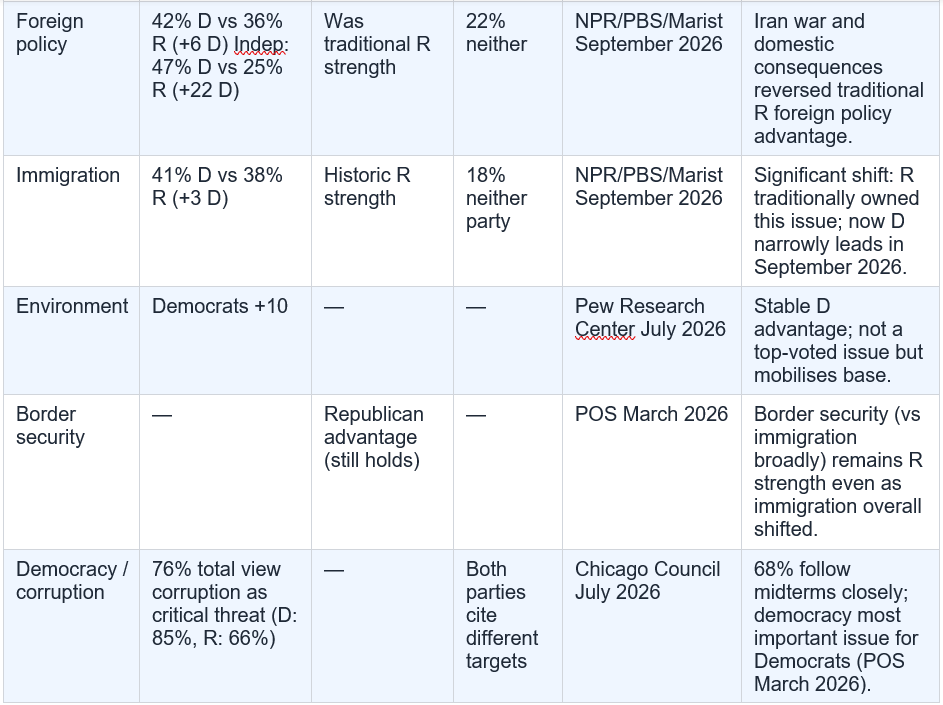
The Chicago Council on Global Affairs survey of July 2026 produced the most striking corruption-related finding: 76% of Americans view US government corruption as a critical threat. That cross-partisan agreement breaks down when you examine partisan detail — 85% of Democrats and 66% of Republicans both view government corruption as a critical threat, suggesting it is a significant concern across the political spectrum, even if the specific corruption accusations made by each party differ sharply. Independents at 77% are virtually aligned with the overall average.
Both sides say: On corruption and justice: Republican-aligned voters and candidates focus on what they describe as politicised prosecution, weaponisation of the justice system, and institutional overreach. Democratic-aligned voters and candidates focus on executive accountability, obstruction of oversight, and what they describe as rule-of-law concerns. The 76% overall corruption concern rating (Chicago Council July 2026) suggests the issue resonates across party lines, even as the specific accusations are entirely different. Not a political position.
The framing of what constitutes a threat to democracy differs significantly between partisan groups. Democrats disproportionately cite executive power concentration, judicial independence, and election integrity as threats. Republicans disproportionately cite media bias, administrative state overreach, and free speech restrictions as threats. Both groups, in their own framing, are describing institutional concerns that motivate midterm participation.
The 67% who view democratic weakening as a critical threat is a notably high number for any single threat category in Chicago Council’s survey, and it crosses partisan lines more than most issues. Ninety-one days before the November 3 election — as this article is published — it is the issue most likely to drive Democratic turnout and least likely to motivate Republican voters who see the issue in opposite terms. Not a political position; this describes where polling data shows voters standing.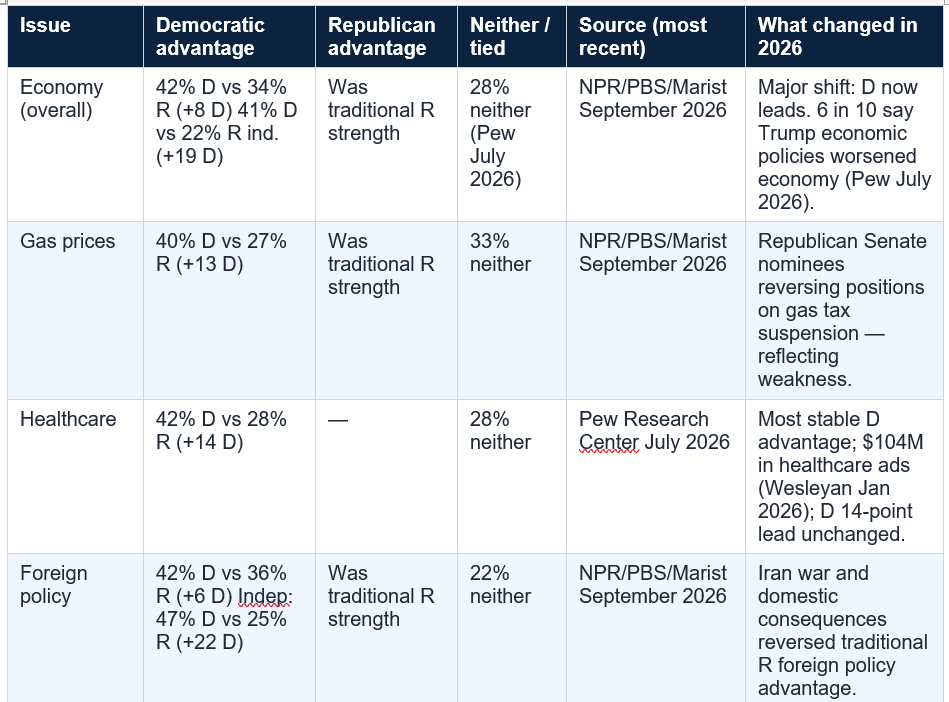
The POS March 2026 midterm overview noted that voter interest in 2026 — at 64% — is comparable to October 2018 (65%), which was a high-wave Democratic election year. The consistent finding across multiple polls that 42% of registered voters describe their vote as opposition to Trump (Pew July 2026) suggests a motivated anti-Trump coalition. Whether that motivation sustains through November — or whether Republican voters who appear less engaged in September polling respond to late-cycle turnout operations — is the central structural uncertainty of the 2026 cycle.
For the House, the battlegrounds are concentrated in suburban districts in states like Pennsylvania, Michigan, Virginia, and California — districts that flipped in 2018 and 2022 and remain competitive in both directions. The POS March 2026 data found competitive toss-up and lean races totalling approximately 18 seats in each direction — fewer than the number needed to flip the House, but enough to make the chamber’s control genuinely uncertain. These districts tend to have higher concentrations of the college-educated suburban voters who show the strongest opposition to Trump and the strongest alignment with Democrats on healthcare, foreign policy, and democratic norms.
The corruption and justice issue is most likely to break through in races involving specific local or national scandals. The 30% of BGSU respondents citing government corruption as a top concern represents a large, broad-based constituency that both parties are trying to claim rather than one clearly owned by either. Not a political position.
The six issues driving the 2026 vote — economic anxiety, immigration, the Iran war, healthcare, government corruption, and threats to democracy — are not equally distributed across the electorate. The economy mobilises everyone. Healthcare and democracy concerns mobilise Democrats disproportionately. Border security and immigration mobilise Republican-leaning voters, even as Democrats have narrowed the gap on the broader immigration issue. Corruption resonates at 76% as a critical threat regardless of party, but what voters mean by corruption varies entirely depending on which party they align with.
What to watch on November 3: whether the Democratic leads in September polling translate into vote shares, whether the Republican enthusiasm gap noted in NPR/PBS/Marist’s data closes in the final weeks, and whether the specific competitive Senate races in Ohio, Pennsylvania, and Nevada break as the generic ballot suggests or follow their own local dynamics. This article presents polling data and voter sentiment. Not a political endorsement or position. All sources are named, dated, and independently verifiable.
The 2026 midterm elections are scheduled for November 3, 2026. All 435 seats in the US House of Representatives are on the ballot, along with 34 of the 100 US Senate seats. Control of Congress — which determines which party chairs committees, controls the legislative agenda, and conducts oversight of the executive branch — hangs in the balance. Midterm elections are traditionally viewed as a referendum on the sitting president and the governing party. The 2026 cycle is notable for very high voter engagement: 75% of voters say they are following the elections closely or very closely per the NPR/PBS NewsHour/Marist Poll (September 14-15, 2026, n=1,280). Source: NPR/PBS/Marist September 2026; futureuae.com July 2026. Not a political position.
What do voters say is the most important issue in the 2026 midterms?
The economy. By a substantial margin across multiple polls: 48% of Likely US Midterm Voters in Rasmussen Reports' 2026 survey; 38% (economy) and 31% (inflation) in BGSU's September 2026 poll of likely voters; economic issues as the top category by wide margin in Pew Research Center's July 6-12, 2026 survey; and inflation ranked first at 26% as the single most important issue in an Economist/YouGov February 2026 survey (n=1,730). Immigration ranked second (17% in Rasmussen; 25% in BGSU's multi-select), healthcare third (11% Rasmussen; 22% BGSU; 11% Economist/YouGov), and national security fourth (9% Rasmussen). Government corruption ranked third in BGSU's format at 30%. Sources: Rasmussen Reports 2026; BGSU/WTVG September 2026; Pew Research Center July 2026; Economist/YouGov February 2026.
Which party do voters trust more on the key issues in 2026?
As of September 2026 polling, voters give Democrats advantages on most of the top issues — a notable shift from prior cycles where Republicans held strengths on the economy and immigration. NPR/PBS NewsHour/Marist (September 2026, n=1,280): economy (D 42%, R 34%); gas prices (D 40%, R 27%); foreign policy (D 42%, R 36%); immigration (D 41%, R 38%). Pew Research Center (July 2026): healthcare policy (D 42%, R 28%, D+14); environmental policy (D+10). The one area where Republicans maintain an advantage is border security specifically (POS March 2026). Democrats hold their largest advantage on healthcare (+14 points per Pew July 2026). These are polling figures representing voter preferences, not editorial positions. Sources: NPR/PBS/Marist September 2026; Pew July 2026; POS March 2026.
How significant is the Trump factor in the 2026 midterms?
Substantial, according to multiple polls. Pew Research Center's July 6-12, 2026 survey of registered voters found that 42% view their midterm vote explicitly as opposition to Trump. Trump told Republicans at a midterm convention in Dallas: 'I'm asking you to pretend that I'm on the ballot.' Six in ten Americans say Trump's economic policies have made the economy worse per Pew's July survey. The NPR/PBS/Marist September 2026 poll found that Trump 2024 voters are less likely to say they are closely following the midterm elections than those who voted for Kamala Harris — suggesting an enthusiasm asymmetry. POS's March 2026 overview described 2026 as 'not a Republican wave election' but noted competitive races remain close. The narrow group of voters who disapprove of Trump but not strongly (12%) were split evenly at 31-31 in Pew's July data. Sources: Pew July 2026; NPR/PBS/Marist September 2026; POS March 2026. Not a political position.
How concerned are Americans about government corruption in 2026?
Significantly and bipartisanly. The Chicago Council on Global Affairs survey (July 10-21, 2026, n=2,156) found 76% of Americans view US government corruption as a critical threat — including 85% of Democrats, 66% of Republicans, and 77% of Independents. The same survey found 67% view weakening democracy in the United States as a critical threat (Democrats 80%, Republicans 56%, Independents 66%). In BGSU's September 2026 poll, government corruption ranked third among voters' top concerns at 30% — behind only the economy (38%) and inflation (31%). In the Reuters/Ipsos September 17-20, 2026 poll (n=1,277), corruption was cited as a top issue by 12% of respondents overall. Both the high threshold (76% viewing it as a critical threat) and the cross-partisan nature of the concern are notable — though the specific corruption allegations that concern Democrats and Republicans differ entirely in their political targeting. Sources: Chicago Council July 2026; BGSU September 2026; Reuters/Ipsos September 2026. Not a political position.
Table of Contents
- The 2026 Midterms: What’s Actually at Stake on November 3
- The Trump Factor: A Vote For or Against
- Issue #1: Economic Anxiety — Prices, Jobs, and Who Voters Trust
- Issue #2: Immigration — A Once-Safe Republican Issue Under Pressure
- Issue #3: The War in Iran and Foreign Policy Anxiety
- Issue #4: Healthcare — Democrats’ Most Consistent Strength
- Issue #5: Government Corruption and Justice
- Issue #6: Democracy, Threats, and Institutional Trust
- The Issue Ownership Map: Who Voters Trust on What
- What the Polls Don’t Capture: The Enthusiasm Gap
- What to Watch on Election Night: The Bellwether Races
- Conclusion: This Is the Referendum Election
- Frequently Asked Questions
The 2026 Midterms: What’s Actually at Stake on November 3
All 435 seats in the House of Representatives are on the ballot on November 3, 2026, along with 34 Senate seats. Control of Congress — which party chairs committees, controls the legislative calendar, and shapes the direction of oversight and appropriations — hangs in the balance. Midterm elections historically function as a referendum on the sitting president and the governing party, and 2026 is no exception. The POS/Public Opinion Strategies March 2026 midterm overview confirmed that 2026 is a high-engagement cycle: 64% of voters expressed very high interest in March, comparable to October 2018 (65%), which produced a significant Democratic wave.The generic congressional ballot as of March 2026 showed Democrats at 50% and Republicans at 44% — a 6-point Democratic advantage that analysts cautioned was not necessarily a wave forecast given the geographic distribution of competitive seats. By September 2026, the NPR/PBS NewsHour/Marist Poll of 1,280 registered voters found 3 in 4 following the elections either closely (40%) or very closely (35%). Engagement is high on both sides, but Trump-opposing voters are tracking the election more actively. The Republican Party’s traditional advantages on the economy and immigration have both eroded substantially since early 2026.
What follows is an issue-by-issue analysis of where voters stand on the six issues driving the 2026 congressional vote, based entirely on published polling data from named, methodologically documented sources. Not a political endorsement.
The 2026 midterm snapshot: Election date: November 3, 2026. Seats at stake: 435 House, 34 Senate. Voter engagement: 75% following closely or very closely (NPR/PBS/Marist September 2026, n=1,280). Generic ballot: D 50%, R 44% in March 2026 (POS). Trump factor: 42% view their vote as opposition to Trump (Pew July 2026). Top issue: economy/inflation at 48% most important (Rasmussen 2026). Democrats lead on: economy, healthcare, foreign policy, gas prices (NPR/PBS/Marist September 2026). Sources: POS March 2026; Pew July 2026; Rasmussen 2026; NPR/PBS/Marist September 2026.
This article presents polling data and voter sentiment information for informational purposes only. It does not endorse any political party, candidate, or policy position. All polling figures are from named, published sources. Political polling has inherent margins of error and methodological variation. The article presents perspectives from across the political spectrum and reflects what voters themselves report as their priorities. Not political, legal, or financial advice.
The Trump Factor: A Vote For or Against
In 2026, the most important single dynamic is the extent to which the election is a referendum on Donald Trump rather than on any specific issue. Trump himself made this explicit, telling Republicans at an unprecedented midterm convention in Dallas in September 2026: ‘I’m asking you to pretend that I’m on the ballot.’ The polling shows that many voters are already doing exactly that — but not in the direction Trump intended. Pew Research Center’s July 2026 survey found that 42% of registered voters describe their midterm vote explicitly as opposition to Trump, while a separate, smaller share view it as support.The NPR/PBS NewsHour/Marist Poll of September 2026 found that Trump 2024 voters are actually less likely to say they are following the midterm elections closely than those who voted for former Vice President Kamala Harris — suggesting an enthusiasm asymmetry that could shape turnout. POS’s March 2026 analysis described 2026 as ‘not a Republican wave election’ but noted that the competitive races remain close. The critical swing category, as in past cycles, is independents: the narrow slice of registered voters who disapprove of Trump but not strongly (12%) were split evenly in their midterm preferences at 31%-31% in Pew’s July data — the true battleground within the battleground. Not a political position; these are polling findings.
Issue #1: Economic Anxiety — Prices, Jobs, and Who Voters Trust
The economy is the dominant issue of the 2026 midterms by a substantial margin. Rasmussen Reports found that 48% of Likely US Midterm Voters name the economy as the most important factor in their vote. Pew Research Center’s July 2026 survey of adults, conducted July 6-12, found that economic issues are the top priority ‘by a wide margin,’ with voters specifically mentioning prices and affordability. The BGSU Poll of September 2026 found economy selected by 38% and inflation by 31% as top concerns (multi-select format). The Economist/YouGov February 2026 survey of 1,730 registered adults placed inflation first at 26% as the single most important issue.What makes the economic issue particularly volatile in 2026 is who voters trust on it. The Republican Party historically owns economic credibility — but that advantage has eroded sharply. Six in ten Americans now say Trump’s economic policies have made the economy worse, per Pew’s July 2026 survey. Only 28% rated the economy as excellent or good in July — a majority view it negatively. NPR/PBS/Marist’s September 2026 poll of 1,280 registered voters found Democrats holding a lead on who would better handle the economy: 42% Democratic Party versus 34% Republican Party. Among independents, that gap widened to 19 points (41% D vs 22% R). Gas prices followed a similar pattern: Democrats 40%, Republicans 27%.
Both sides say: On the economy: Republican candidates argue that pre-2025 economic policies set a stronger foundation and that Democratic spending contributed to inflation. Democratic candidates argue that Trump’s tariff policies and trade disruptions worsened consumer prices. Voters in September 2026 polling give Democrats a broader advantage on this issue than in prior cycles, though the overall economic satisfaction numbers remain negative for all incumbents. Neither party is rated positively on economic management by a majority of voters (Pew July 2026). Not a political position.
Economic what to watch: Whether November consumer price data, released in the weeks before the election, shifts the economic narrative. Races in Ohio, Pennsylvania, Michigan, and Nevada where tariff impacts on manufacturing employment are central to Senate contests. Gas price trajectory through October 2026 given Democrats’ specific advantage on this issue over Republicans.
Issue #2: Immigration — A Once-Safe Republican Issue Under Pressure
Immigration has been one of the Republican Party’s most reliable political assets for a decade. The 2026 midterms may be the cycle in which that ownership begins to shift. Rasmussen Reports found 17% of likely voters name immigration as the most important single issue — the second-highest after the economy. BGSU’s September 2026 poll found 25% include it among their top concerns in a multi-select format. But the question of who is trusted on the issue tells a different story than in prior years.NPR/PBS NewsHour/Marist’s September 2026 poll found a reversal of the traditional partisan dynamic: 41% say the Democratic Party would do better handling immigration, versus 38% saying Republicans. That 3-point Democratic edge on an issue Republicans dominated for years is a significant shift. The Chicago Council on Global Affairs survey of July 2026 (n=2,156) adds nuance: 39% of Americans say US leaders are giving immigration too much attention — but this breaks sharply by party, with 53% of Democrats saying too much attention and only 19% of Republicans agreeing. Among Independents, 18% say neither party would handle immigration well, per NPR/PBS/Marist.
Wesleyan Media Project analysis found immigration and policing among the leading issues in Senate advertising from both parties — suggesting that both sides see the issue as a mobiliser even as overall trust numbers have shifted. The shift in immigration issue ownership, if it holds through November, would represent one of the most significant changes in issue-party alignment in recent midterm history. Not a political position.
The immigration reversal: historically Republicans consistently polled as the more trusted party on immigration; the September 2026 NPR/PBS/Marist data showing a narrow Democratic edge (41-38%) is a notable shift. Whether this reflects genuine public reassessment of immigration policy management or short-term reaction to specific enforcement controversies is debated by analysts. 18% of independents trust neither party on the issue — that disaffection may suppress immigration's role as a mobiliser for both bases. Sources: NPR/PBS/Marist September 2026; Chicago Council July 2026; Rasmussen 2026.
Issue #3: The War in Iran and Foreign Policy Anxiety
The United States became involved in a conflict with Iran — described in multiple 2026 polling sources as ‘the war in Iran’ — and its domestic consequences have been a defining element of the 2026 political environment. The POS/Public Opinion Strategies March 2026 midterm overview noted that the Iran war and its domestic implications have elevated ‘threats to democracy’ as a top issue for Democrats and contributed to rising gas prices and national security anxiety among all voters. Republican Senate nominees in multiple key races reversed their positions in favour of ending the Iran war and calling for suspension of gas taxes, according to NPR’s September 2026 reporting.On foreign policy overall, the September 2026 NPR/PBS/Marist poll showed Democrats holding a substantial advantage: 42% of voters say the Democratic Party would do better on foreign policy versus 36% for Republicans. Among independents, that margin expanded to 22 points (47% Democratic, 25% Republican). The Chicago Council survey (July 2026) found 27% of Americans saying the war in Iran receives too much attention from US leaders, with Democrats (31%) slightly more likely than Republicans (22%) to say this.
National security was cited as the most important issue by 9% of likely voters in Rasmussen’s 2026 survey — a meaningful share but well below economic concerns. The foreign policy picture is complicated by the fact that the Iran conflict has elevated both national security anxieties (which traditionally benefit Republicans) and anti-war sentiment (which benefits Democrats). The net effect in polling has benefitted Democrats on the foreign policy issue ownership question. Not a political position.
Issue #4: Healthcare — Democrats’ Most Consistent Strength
Healthcare has been one of the most reliably Democratic issues in American politics for more than a decade, and 2026 is no exception. Pew Research Center’s July 2026 survey found Democrats holding a 14-point advantage on healthcare policy: 42% of voters trust Democrats to handle healthcare, 28% trust Republicans, and 28% trust neither. That 14-point gap is Democrats’ largest partisan advantage on any of the major issues tested.In terms of issue salience, healthcare ranks third or fourth depending on the poll: 11% of likely voters name it most important in Rasmussen, 22% include it in their top concerns in BGSU’s multi-select format, and 5% place it as their single most important issue in Pew’s open-ended format. The Wesleyan Media Project found healthcare advertising spending reached $104 million by mid-January 2026, ahead of $76 million for immigration — a signal of where both parties see competitive opportunity. The Ohio Senate race specifically has centred heavily on healthcare expansion, prescription drug costs, and coverage affordability.
The Economist/YouGov survey of February 2026 placed healthcare third at 11% as a single most important issue. The cost of healthcare premiums was cited by 21% of voters as most important in the POS March 2026 survey. The persistent pattern across surveys is that while healthcare is rarely the top-ranked issue, its consistent presence across polls and the magnitude of the Democratic advantage on it make it a reliable mobilising issue for Democratic voters and a vulnerability for Republican incumbents in competitive districts. Not a political position.
Issue #5: Government Corruption and Justice
Government corruption emerged as the third-ranked issue in the BGSU September 2026 poll of likely voters, cited by 30% of respondents — behind only the economy (38%) and inflation (31%), and ahead of immigration (25%). The Reuters/Ipsos September 17-20, 2026 poll (n=1,277, MOE ±2.8 percentage points) found corruption cited as a top issue by 12% of all respondents, including 13% of Democrats, 9% of Republicans, 10% of Independents, and 15% of other-party respondents.The Chicago Council on Global Affairs survey of July 2026 produced the most striking corruption-related finding: 76% of Americans view US government corruption as a critical threat. That cross-partisan agreement breaks down when you examine partisan detail — 85% of Democrats and 66% of Republicans both view government corruption as a critical threat, suggesting it is a significant concern across the political spectrum, even if the specific corruption accusations made by each party differ sharply. Independents at 77% are virtually aligned with the overall average.
Both sides say: On corruption and justice: Republican-aligned voters and candidates focus on what they describe as politicised prosecution, weaponisation of the justice system, and institutional overreach. Democratic-aligned voters and candidates focus on executive accountability, obstruction of oversight, and what they describe as rule-of-law concerns. The 76% overall corruption concern rating (Chicago Council July 2026) suggests the issue resonates across party lines, even as the specific accusations are entirely different. Not a political position.
Issue #6: Democracy, Threats, and Institutional Trust
The health of democratic institutions is a significant issue in the 2026 midterms, particularly for Democratic-leaning voters. The POS/Public Opinion Strategies March 2026 midterm overview identified ‘threats to democracy’ as the single most important issue for Democratic voters in 2026. The BGSU September 2026 poll found 24% of voters include threats to democracy among their top concerns. The Chicago Council on Global Affairs survey (July 2026) found 67% of Americans view weakening democracy in the United States as a critical threat — Democrats at 80%, Independents at 66%, Republicans at 56%.The framing of what constitutes a threat to democracy differs significantly between partisan groups. Democrats disproportionately cite executive power concentration, judicial independence, and election integrity as threats. Republicans disproportionately cite media bias, administrative state overreach, and free speech restrictions as threats. Both groups, in their own framing, are describing institutional concerns that motivate midterm participation.
The 67% who view democratic weakening as a critical threat is a notably high number for any single threat category in Chicago Council’s survey, and it crosses partisan lines more than most issues. Ninety-one days before the November 3 election — as this article is published — it is the issue most likely to drive Democratic turnout and least likely to motivate Republican voters who see the issue in opposite terms. Not a political position; this describes where polling data shows voters standing.
The Issue Ownership Map: Who Voters Trust on What
What the Polls Don’t Capture: The Enthusiasm Gap
Issue polling tells you what voters say they care about. It does not capture the asymmetry in how passionately different groups of voters care about issues relative to one another — which often determines turnout more than issue preferences do. In September 2026, the NPR/PBS/Marist poll found a telling pattern: Trump’s 2024 voters are less likely to say they are closely following the midterm elections than those who voted for former Vice President Kamala Harris. That enthusiasm gap, if it holds through Election Day, has historically translated into significant shifts in the composition of the midterm electorate.The POS March 2026 midterm overview noted that voter interest in 2026 — at 64% — is comparable to October 2018 (65%), which was a high-wave Democratic election year. The consistent finding across multiple polls that 42% of registered voters describe their vote as opposition to Trump (Pew July 2026) suggests a motivated anti-Trump coalition. Whether that motivation sustains through November — or whether Republican voters who appear less engaged in September polling respond to late-cycle turnout operations — is the central structural uncertainty of the 2026 cycle.
What to Watch on Election Night: The Bellwether Races
Midterm election nights have a geography. Some races close early and serve as indicators of how the rest of the night will go. In 2026, the Senate races in Ohio, Pennsylvania, Nevada, and Wisconsin are the competitive contests most likely to signal whether Democrats retain or gain Senate seats. Ohio specifically has become a proxy for multiple major issues: the Husted-Brown race has centred on prices, electricity, healthcare, and taxes, while Collins and Jackson in another contest have combined healthcare and affordability with immigration, abortion, and their records.For the House, the battlegrounds are concentrated in suburban districts in states like Pennsylvania, Michigan, Virginia, and California — districts that flipped in 2018 and 2022 and remain competitive in both directions. The POS March 2026 data found competitive toss-up and lean races totalling approximately 18 seats in each direction — fewer than the number needed to flip the House, but enough to make the chamber’s control genuinely uncertain. These districts tend to have higher concentrations of the college-educated suburban voters who show the strongest opposition to Trump and the strongest alignment with Democrats on healthcare, foreign policy, and democratic norms.
The corruption and justice issue is most likely to break through in races involving specific local or national scandals. The 30% of BGSU respondents citing government corruption as a top concern represents a large, broad-based constituency that both parties are trying to claim rather than one clearly owned by either. Not a political position.
Conclusion
Every midterm is described as a referendum on the sitting president, and every cycle that description is truer or less true depending on conditions. In 2026, it is genuinely true. Forty-two percent of registered voters say explicitly that their vote is in opposition to Trump. The Republican Party’s traditional advantages on the economy, immigration, and foreign policy have all eroded in 2026 polling, with Democrats holding measurable leads on all three as of September. Democratic advantages on healthcare and environment remain stable and large.The six issues driving the 2026 vote — economic anxiety, immigration, the Iran war, healthcare, government corruption, and threats to democracy — are not equally distributed across the electorate. The economy mobilises everyone. Healthcare and democracy concerns mobilise Democrats disproportionately. Border security and immigration mobilise Republican-leaning voters, even as Democrats have narrowed the gap on the broader immigration issue. Corruption resonates at 76% as a critical threat regardless of party, but what voters mean by corruption varies entirely depending on which party they align with.
What to watch on November 3: whether the Democratic leads in September polling translate into vote shares, whether the Republican enthusiasm gap noted in NPR/PBS/Marist’s data closes in the final weeks, and whether the specific competitive Senate races in Ohio, Pennsylvania, and Nevada break as the generic ballot suggests or follow their own local dynamics. This article presents polling data and voter sentiment. Not a political endorsement or position. All sources are named, dated, and independently verifiable.
Frequently Asked Questions
When is the 2026 midterm election and what is at stake?The 2026 midterm elections are scheduled for November 3, 2026. All 435 seats in the US House of Representatives are on the ballot, along with 34 of the 100 US Senate seats. Control of Congress — which determines which party chairs committees, controls the legislative agenda, and conducts oversight of the executive branch — hangs in the balance. Midterm elections are traditionally viewed as a referendum on the sitting president and the governing party. The 2026 cycle is notable for very high voter engagement: 75% of voters say they are following the elections closely or very closely per the NPR/PBS NewsHour/Marist Poll (September 14-15, 2026, n=1,280). Source: NPR/PBS/Marist September 2026; futureuae.com July 2026. Not a political position.
What do voters say is the most important issue in the 2026 midterms?
The economy. By a substantial margin across multiple polls: 48% of Likely US Midterm Voters in Rasmussen Reports' 2026 survey; 38% (economy) and 31% (inflation) in BGSU's September 2026 poll of likely voters; economic issues as the top category by wide margin in Pew Research Center's July 6-12, 2026 survey; and inflation ranked first at 26% as the single most important issue in an Economist/YouGov February 2026 survey (n=1,730). Immigration ranked second (17% in Rasmussen; 25% in BGSU's multi-select), healthcare third (11% Rasmussen; 22% BGSU; 11% Economist/YouGov), and national security fourth (9% Rasmussen). Government corruption ranked third in BGSU's format at 30%. Sources: Rasmussen Reports 2026; BGSU/WTVG September 2026; Pew Research Center July 2026; Economist/YouGov February 2026.
Which party do voters trust more on the key issues in 2026?
As of September 2026 polling, voters give Democrats advantages on most of the top issues — a notable shift from prior cycles where Republicans held strengths on the economy and immigration. NPR/PBS NewsHour/Marist (September 2026, n=1,280): economy (D 42%, R 34%); gas prices (D 40%, R 27%); foreign policy (D 42%, R 36%); immigration (D 41%, R 38%). Pew Research Center (July 2026): healthcare policy (D 42%, R 28%, D+14); environmental policy (D+10). The one area where Republicans maintain an advantage is border security specifically (POS March 2026). Democrats hold their largest advantage on healthcare (+14 points per Pew July 2026). These are polling figures representing voter preferences, not editorial positions. Sources: NPR/PBS/Marist September 2026; Pew July 2026; POS March 2026.
How significant is the Trump factor in the 2026 midterms?
Substantial, according to multiple polls. Pew Research Center's July 6-12, 2026 survey of registered voters found that 42% view their midterm vote explicitly as opposition to Trump. Trump told Republicans at a midterm convention in Dallas: 'I'm asking you to pretend that I'm on the ballot.' Six in ten Americans say Trump's economic policies have made the economy worse per Pew's July survey. The NPR/PBS/Marist September 2026 poll found that Trump 2024 voters are less likely to say they are closely following the midterm elections than those who voted for Kamala Harris — suggesting an enthusiasm asymmetry. POS's March 2026 overview described 2026 as 'not a Republican wave election' but noted competitive races remain close. The narrow group of voters who disapprove of Trump but not strongly (12%) were split evenly at 31-31 in Pew's July data. Sources: Pew July 2026; NPR/PBS/Marist September 2026; POS March 2026. Not a political position.
How concerned are Americans about government corruption in 2026?
Significantly and bipartisanly. The Chicago Council on Global Affairs survey (July 10-21, 2026, n=2,156) found 76% of Americans view US government corruption as a critical threat — including 85% of Democrats, 66% of Republicans, and 77% of Independents. The same survey found 67% view weakening democracy in the United States as a critical threat (Democrats 80%, Republicans 56%, Independents 66%). In BGSU's September 2026 poll, government corruption ranked third among voters' top concerns at 30% — behind only the economy (38%) and inflation (31%). In the Reuters/Ipsos September 17-20, 2026 poll (n=1,277), corruption was cited as a top issue by 12% of respondents overall. Both the high threshold (76% viewing it as a critical threat) and the cross-partisan nature of the concern are notable — though the specific corruption allegations that concern Democrats and Republicans differ entirely in their political targeting. Sources: Chicago Council July 2026; BGSU September 2026; Reuters/Ipsos September 2026. Not a political position.
0 Comments
Be the first to share your thoughts on this article.