

Budgeting
3 Ways to Budget Your Money: Which Method Is Right?
Only 53% of Americans have a budget in 2026. Among those living paycheck to paycheck, just 23% say it is because they can't stick to a budget — the most common reason is that essentials consume 66% of income when the 50/30/20 rule assumes only 50%. Every budgeting method is solving a different problem. The 50/30/20 rule is for people who need simple structure without tracking every dollar. Zero-based budgeting is for people who need complete visibility and control. Paying yourself first is for people who know they will spend whatever they see. This guide explains all three clearly — and shows you which one matches your situation.
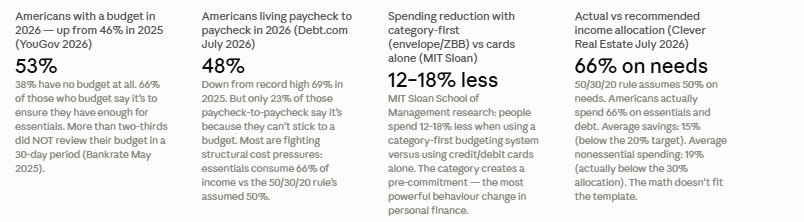
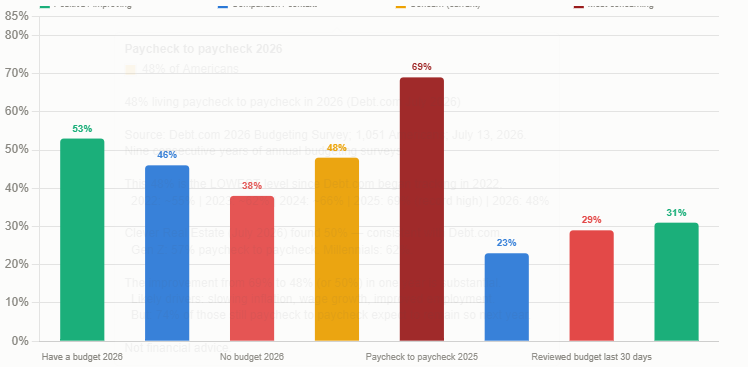
Budgeting is one of those financial habits that almost everyone agrees they should do and only about half actually do. YouGov's 2026 Consumer Spending and Budgeting Trends survey found that 53% of Americans have a budget for 2026 — an improvement from 46% in 2025, but still leaving 38% with no budget at all. Bankrate's Money and Mental Health Survey found that more than two-thirds of Americans did not review their budget in a 30-day period. And Schwab's research found that 33% of Americans have no financial plan of any kind, while another 36% have 'thought about' their goals without documenting them.
The cost of not budgeting shows up directly in the paycheck-to-paycheck statistics. Debt.com's 2026 Budgeting Survey, conducted across 1,051 Americans in July 2026, found that 48% are living paycheck to paycheck — down from a record 69% in 2025, but still representing nearly half the country. Clever Real Estate's 2026 Reckless Spending Habits Survey (1,000 Americans, July 2026) found 50% living paycheck to paycheck, with 74% of them believing they will still be in that position a year from now.
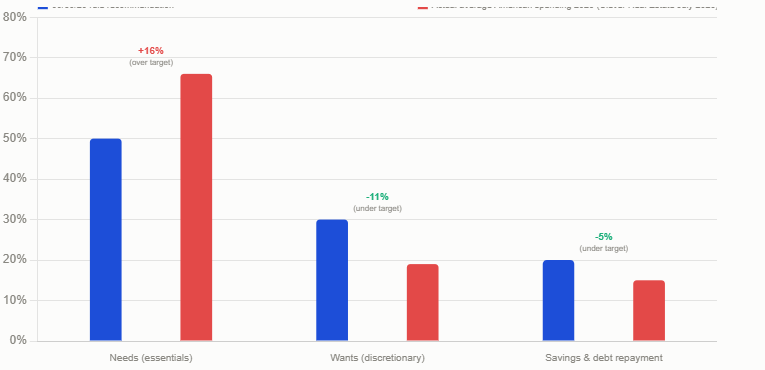
But the data contains a crucial nuance. When Clever Real Estate asked why people live paycheck to paycheck, only 23% said it was because they struggle to stick to a budget. The most common structural driver is that essentials — housing, food, transportation, utilities — consume 66% of income for the average American, while the 50/30/20 rule assumes only 50% will go to needs. The budgeting method fails when the structural reality does not match the framework. This is why method matters. The right budgeting method for you is the one that reflects your actual income structure, your actual spending patterns, and your actual financial goals — not a predetermined template.
53% of Americans have a budget in 2026 (up from 46% in 2025) (YouGov 2026). 48% living paycheck to paycheck — down from 69% record high in 2025 (Debt.com July 2026). 66% of American income goes to essentials — vs the 50/30/20 rule's assumed 50% (Clever Real Estate July 2026). Americans save 15%/year on average — below the recommended 20% (Clever Real Estate July 2026). MIT Sloan research: envelope/category-first budgeting reduces spending 12-18% vs cards alone (EnvelopeBudgeting.com August 2026). 80% of budgeting app users engage weekly — habits form fast once the right tool is chosen (Academy Bank; EnvelopeBudgeting.com August 2026).
A budgeting method is a system that allocates money before it is spent — not a record of where it went after the fact. Each of the three methods in this guide does this differently. The 50/30/20 rule allocates income into three broad categories at the start of each pay period. Zero-based budgeting assigns every dollar to a specific purpose before the month begins. Pay yourself first removes savings from the equation before discretionary spending begins. All three are pre-commitment systems. None of them require perfect willpower because the decision is made in advance, when emotions are neutral, rather than in the moment, when an appealing purchase is in front of you.
Budgeting app research from Academy Bank (cited EnvelopeBudgeting.com August 2026) found that nearly 80% of budgeting app users engage with their platforms at least weekly. The habit forms fast — but only when the tool matches the person using it. The method that requires you to track 47 specific spending categories when you hate tracking details will last two weeks. The method that gives you total flexibility after one automatic savings transfer will not give you enough visibility if you regularly overspend on food. The goal of this guide is to help you identify which system matches how you actually behave.
50/30/20 applied to common income levels (monthly take-home after tax, 2026). $3,000/month take-home: Needs max $1,500 / Wants max $900 / Savings-Debt $600. $4,500/month: Needs max $2,250 / Wants max $1,350 / Savings-Debt $900. $6,000/month: Needs max $3,000 / Wants max $1,800 / Savings-Debt $1,200. $8,000/month: Needs max $4,000 / Wants max $2,400 / Savings-Debt $1,600. Note: at lower incomes, the 50% needs allocation is frequently insufficient. Clever Real Estate's July 2026 data found Americans spend an average of 66% on essentials — in high cost-of-living areas this can reach 70-80%. Adjust percentages to reflect your actual situation. The 50/30/20 is a starting framework, not a constraint. Not financial advice.
50/30/20 is best for: people new to budgeting who want a simple starting framework; those with stable, predictable income (salary earners); those who generally have spending under control but want a high-level structure; anyone who finds detailed expense tracking unsustainable. Not ideal for: those with tight finances where 50% genuinely does not cover needs (common in high-cost cities); those in active debt payoff mode who need more control; those with irregular income.
The adjustment that most guides skip: if your needs genuinely consume 60% or 65% of income (as is common in high-cost cities), the 50/30/20 framework becomes 60/20/20 or 65/15/20. The proportions can shift; the principle of allocating income into three categories before spending it does not need to. Ramsey Solutions' April 2026 budgeting comparison notes this limitation directly: 'The percentages don't work for most Americans' — which is why they recommend zero-based budgeting as more universally applicable.
The Needs vs Wants distinction is the most important judgment call in the 50/30/20 system — and it is not always obvious. A smartphone is a Need if it is required for work. The most expensive smartphone plan is a Want. A car is a Need in a city with no public transit. A leased luxury vehicle is a Want. Groceries are a Need. Restaurant meals are Wants. Monthly subscriptions for professional software needed for your job are Needs. Streaming services are Wants. Making these distinctions honestly is what makes the method accurate.
Starting the 50/30/20 rule this month. Step 1: Calculate your actual after-tax monthly take-home income (all sources). Step 2: List every non-negotiable expense and total it. Divide by your income. If it exceeds 50%, adjust your percentages accordingly. Step 3: Total your typical Wants spending. If it exceeds 30%, identify which Want categories are driving it — this is your first actionable finding. Step 4: Calculate whether your current savings/debt payments equal 20%. If not, the gap is your savings shortfall. Step 5: Set up automatic transfers to savings the day you get paid so the 20% happens before discretionary spending begins. Not financial advice.
The name can be confusing — zero-based budgeting does not mean having zero money in your bank account. It means having zero dollars unaccounted for in your budget. The distinction is critical. A person with $4,500 in take-home income who uses zero-based budgeting might allocate: $1,400 rent, $300 groceries, $150 utilities, $200 car payment, $100 insurance, $300 gas, $200 dining out, $100 entertainment, $150 clothing, $600 savings, $500 extra debt payment, $500 emergency fund contribution. The total is $4,500. Every dollar is spoken for. When the dining out category is gone, it is gone — there are no unallocated dollars to pull from.
Ramsey Solutions' April 2026 budgeting methods guide describes the structural appeal: 'If your paycheck hits and disappears before the next payday, you don't have a money or a math problem — you have a budget problem! And to break the cycle of disappearing paychecks, you need a budgeting method that actually works.' Their recommendation is zero-based budgeting precisely because it eliminates the unaccounted-for spending that drains accounts invisibly — the subscriptions that continue after trial periods, the small daily purchases that seem trivial individually but accumulate to hundreds of dollars monthly.
The MIT Sloan School of Management research, cited by EnvelopeBudgeting.com's August 2026 budgeting app analysis, supports the category-first approach: people spend 12-18% less when using a category-first system versus using cards alone. The category creates a pre-commitment constraint. Once $200 is labelled 'dining out,' spending $201 on dining out is not an accident — it is a visible, deliberate override of a prior decision. That visibility is where the behavioural power comes from.
Also called 'reverse budgeting,' the method flips the conventional budgeting order. Most people pay their expenses, then spend what's left, then save whatever remains — which is often nothing. Pay yourself first removes the option of spending the savings. By automating the savings transfer before discretionary spending begins, the savings goal becomes treated the same way as rent: a non-negotiable payment made before the rest of the budget is touched.
Britannica Money's August 2026 guide to budgeting methods explains the mechanism: 'With this approach, a portion of your income is automatically directed from your paycheck or bank account to savings or investments. You then use the remaining money for your other expenses. This method works best if you can comfortably live on the money that's left after saving.' The last sentence is the key qualifier: if you cannot comfortably cover your bills and basic needs on the remaining amount, pay yourself first in its pure form will lead to overdrafts and reversed transfers.
The psychological power of pay yourself first is in the automation. Research on automatic savings transfers consistently finds that people who automate savings transfers are far more likely to maintain them than those who intend to transfer whatever is left over at month end. The transfer happens before the money is visible in the checking account, which means it is never mentally available to spend. What you do not see, you do not miss — and you do not spend.
Pay yourself first is best for: people whose spending is generally under control but who consistently end the month with nothing saved; those who find detailed budgeting unsustainable; those with stable predictable bills; retirement-focused savers who want to maximise 401(k) contributions without monthly tracking. Not ideal for: those who overspend on discretionary categories and need category-level visibility; those with irregular income where the fixed savings transfer amount may not be supportable every month; those carrying high-interest debt that needs aggressive, structured repayment.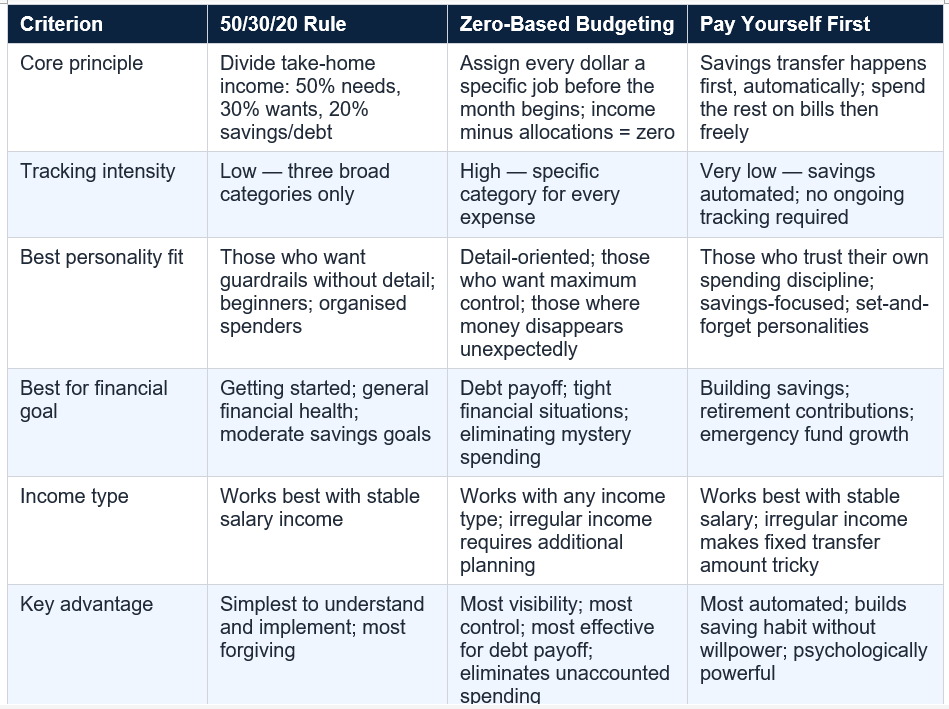
Kiplinger's September 2026 budgeting guide makes this explicit: 'You also don't have to follow one method perfectly. You might use the 50/30/20 framework to set your overall spending targets while automatically paying yourself first each payday.' Britannica Money's August 2026 analysis describes how the methods naturally complement each other: 'If you like the structure of a zero-based budget but need firmer spending limits, the envelope budget may give you the boundaries you need.'
The most common effective hybrid for people trying to pay off debt while building savings: use pay yourself first for the savings/debt payment portion (automate the transfers so they happen regardless of monthly spending decisions), then apply zero-based budgeting to the discretionary remainder (so every dollar of spending money has a specific category and a visible limit). This combines the psychological power of automation for savings with the control and visibility of category budgeting for spending — and it is exactly the approach recommended by SenticMoney's April 2026 comparison: 'You might use 50/30/20 for your high-level split, envelope budgeting for discretionary spending, and pay-yourself-first for savings goals.'
Pocket Clear's April 2026 complete budgeting guide suggests a practical starting point: 'Give your chosen method a full three months before switching. The first month is always awkward as you learn your real spending patterns. By month three, you will know whether the method clicks or needs to change.' The three-month test is important because the first month of any new budgeting method involves discovering what your actual spending patterns are — not what you thought they were. The adjustments made in months two and three are usually what make the method work.
The 50/30/20 rule offers the simplest entry point: three categories, minimal tracking, and a framework that creates financial awareness without demanding financial perfectionism. Zero-based budgeting offers the maximum control: every dollar accounted for, no invisible spending, the most powerful tool for aggressive debt payoff or tight financial management. Pay yourself first offers the most automated path to consistent saving: remove the savings before the spending decisions begin, and the savings happens regardless of willpower or monthly circumstances.
You may start with one and move to another. You may combine two. What the Britannica Money August 2026 guide notes is the destination: 'Budgeting is simply a tool to help you achieve your financial goals. You may start with one method and move to another as you age and as your income and priorities change.' The goal is not methodological purity. The goal is the financial stability, the emergency fund, the paid-off debt, the retirement account that grows — whatever you are working toward. The budget is the tool. Use the one that works. Not financial advice.
The 50/30/20 rule divides your after-tax (take-home) income into three categories: 50% for needs (rent, utilities, groceries, insurance, minimum debt payments), 30% for wants (dining out, entertainment, subscriptions, hobbies), and 20% for savings and debt repayment. It was popularised by Elizabeth Warren and Amelia Warren Tyagi in their 2005 book All Your Worth. The rule still works in 2026 as a framework, but the 50% needs allocation is increasingly difficult to maintain in high-cost-of-living areas. Clever Real Estate's July 2026 Reckless Spending Habits Survey of 1,000 Americans found that the average American spends 66% of income on essentials — significantly above the 50% the rule assumes. The solution is to adjust the percentages to match your actual situation: if needs genuinely consume 60-65% of your income, your budget becomes 60/20/20 or 65/15/20. The principle (allocate income into broad categories before spending) remains sound. The specific percentages are a starting point, not a constraint. Not financial advice.
How does zero-based budgeting work and is it better than 50/30/20?
Zero-based budgeting assigns every dollar of your income a specific purpose before the month begins, so that income minus all expenses and savings allocations equals zero. Zero does not mean your bank account has zero — it means zero dollars are unaccounted for. You create a specific category for every expense (rent, groceries, gas, dining out, entertainment, savings, debt payment) and allocate an amount to each. Throughout the month, you track spending against each category; when a category runs out, you stop spending in that category or consciously move money from another. Ramsey Solutions (April 2026) recommends zero-based budgeting for those who regularly wonder where their money went — the method eliminates invisible or unplanned spending. MIT Sloan research found that category-first budgeting systems reduce spending by 12-18% versus using cards without categories. Whether it is 'better' than 50/30/20 depends on your personality and goals: zero-based requires more time and detailed tracking, which some find empowering and others find unsustainable. For debt payoff, zero-based generally delivers more control. For a simple ongoing structure, 50/30/20 is more sustainable for most people. Not financial advice.
What is 'pay yourself first' budgeting and how is it different?
Pay yourself first (also called reverse budgeting) is a savings-first approach: the moment your income arrives, an automatic transfer sends a set amount to savings or investments before any other spending occurs. Bills and expenses are then paid from what remains, and whatever is left after that can be spent freely without tracking or categorising. It is the opposite of the conventional pattern (spend what you need, then save whatever is left, which is often nothing). The method is most powerful when combined with automation — the transfer happens regardless of monthly spending decisions. Britannica Money's August 2026 guide notes: 'This method works best if you can comfortably live on the money that's left after saving.' It is most effective for people whose primary problem is not getting around to saving rather than overspending. It does not address discretionary overspending — if you spend too much on dining out or entertainment, pay yourself first will save reliably but the remaining budget may still run out before month end. It works best when combined with stable, predictable expenses. Not financial advice.
How much of my income should I save each month?
The most widely cited starting target is 20% of take-home income, as suggested by the 50/30/20 rule. However, the appropriate savings rate depends on your specific financial situation and goals. If you have high-interest credit card debt, prioritise paying it off aggressively — that is a higher-return 'investment' than most savings vehicles. If you have no emergency fund, prioritise building three to six months of essential expenses in a liquid savings account before investing. If you have an emergency fund and no high-interest debt, 15-20% directed toward retirement savings is a reasonable long-term target. Clever Real Estate's July 2026 data found Americans save an average of 15% of income — below the recommended 20%. If 20% is not immediately achievable, start with any amount you can automate and increase it by 1 percentage point every few months. Consistency of contribution matters more than reaching 20% immediately. Not financial advice — individual targets depend on income, expenses, debt, and financial goals.
Can I combine budgeting methods?
Yes — and hybrid approaches often work better than any single method applied rigidly. Kiplinger's September 2026 budgeting methods guide explicitly recommends considering combination approaches: 'You might use the 50/30/20 framework to set your overall spending targets while automatically paying yourself first each payday.' SenticMoney's April 2026 comparison notes that combining methods gives access to different strengths: '50/30/20 for the high-level split, envelope budgeting for discretionary spending, and pay-yourself-first for savings goals.' A common effective hybrid for debt payoff: automate savings and debt payments (pay yourself first logic) then apply zero-based category tracking to the discretionary remainder. This delivers savings consistency through automation and spending control through category visibility. Pocket Clear's April 2026 advice applies regardless of method or combination: 'Give your chosen method a full three months before switching. The first month is always awkward as you learn your real spending patterns. By month three, you will know whether the method clicks or needs to change.' Not financial advice.
Table of Contents
- Why Most People Don't Budget — and Why That's Costly
- The Problem With 'Just Track Your Spending' (and Why You Need a Method)
- Method #1 — The 50/30/20 Rule: Simple Structure Without Tracking Every Dollar
- How to Apply the 50/30/20 Rule in 2026 (With the Adjustment Most Guides Skip)
- Method #2 — Zero-Based Budgeting: Give Every Dollar a Job
- How Zero-Based Budgeting Works in Practice: A Monthly Walkthrough
- Method #3 — Pay Yourself First: Savings Before Everything Else
- How Pay Yourself First Works — and Why It Is Psychologically Powerful
- Method Comparison: 50/30/20 vs Zero-Based vs Pay Yourself First
- The Hybrid Approach: Combining Methods for Better Results
- How to Choose the Right Method for Your Situation
- Conclusion: The Best Budget Is the One You Will Actually Use
- Frequently Asked Questions
Budgeting reality: who budgets, who doesn't, what it costs
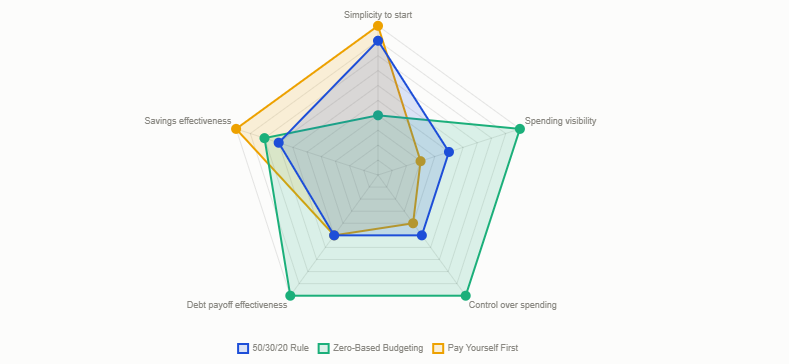
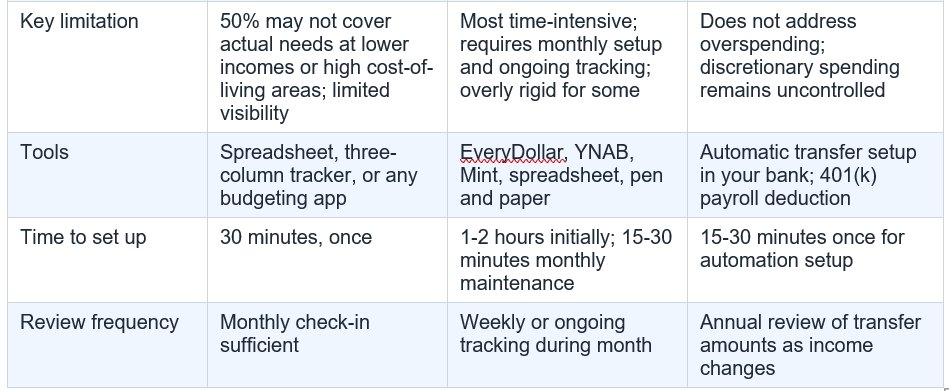
Method comparison: 50/30/20 vs zero-based vs pay yourself first
Actual vs recommended spending: where the 50/30/20 breaks down
Why Most People Don't Budget — and Why That's Costly
Budgeting is one of those financial habits that almost everyone agrees they should do and only about half actually do. YouGov's 2026 Consumer Spending and Budgeting Trends survey found that 53% of Americans have a budget for 2026 — an improvement from 46% in 2025, but still leaving 38% with no budget at all. Bankrate's Money and Mental Health Survey found that more than two-thirds of Americans did not review their budget in a 30-day period. And Schwab's research found that 33% of Americans have no financial plan of any kind, while another 36% have 'thought about' their goals without documenting them.The cost of not budgeting shows up directly in the paycheck-to-paycheck statistics. Debt.com's 2026 Budgeting Survey, conducted across 1,051 Americans in July 2026, found that 48% are living paycheck to paycheck — down from a record 69% in 2025, but still representing nearly half the country. Clever Real Estate's 2026 Reckless Spending Habits Survey (1,000 Americans, July 2026) found 50% living paycheck to paycheck, with 74% of them believing they will still be in that position a year from now.
But the data contains a crucial nuance. When Clever Real Estate asked why people live paycheck to paycheck, only 23% said it was because they struggle to stick to a budget. The most common structural driver is that essentials — housing, food, transportation, utilities — consume 66% of income for the average American, while the 50/30/20 rule assumes only 50% will go to needs. The budgeting method fails when the structural reality does not match the framework. This is why method matters. The right budgeting method for you is the one that reflects your actual income structure, your actual spending patterns, and your actual financial goals — not a predetermined template.
53% of Americans have a budget in 2026 (up from 46% in 2025) (YouGov 2026). 48% living paycheck to paycheck — down from 69% record high in 2025 (Debt.com July 2026). 66% of American income goes to essentials — vs the 50/30/20 rule's assumed 50% (Clever Real Estate July 2026). Americans save 15%/year on average — below the recommended 20% (Clever Real Estate July 2026). MIT Sloan research: envelope/category-first budgeting reduces spending 12-18% vs cards alone (EnvelopeBudgeting.com August 2026). 80% of budgeting app users engage weekly — habits form fast once the right tool is chosen (Academy Bank; EnvelopeBudgeting.com August 2026).
The Problem With 'Just Track Your Spending' (and Why You Need a Method)
The most common first piece of personal finance advice is to 'track your spending.' Write down everything you buy. Review the totals at the end of the month. This is better than not tracking. But tracking alone solves a diagnostic problem, not a behavioural one. Knowing you spent $680 on restaurants last month does not change what you spend on restaurants next month, unless you have a system that makes the decision for you before the money is spent.A budgeting method is a system that allocates money before it is spent — not a record of where it went after the fact. Each of the three methods in this guide does this differently. The 50/30/20 rule allocates income into three broad categories at the start of each pay period. Zero-based budgeting assigns every dollar to a specific purpose before the month begins. Pay yourself first removes savings from the equation before discretionary spending begins. All three are pre-commitment systems. None of them require perfect willpower because the decision is made in advance, when emotions are neutral, rather than in the moment, when an appealing purchase is in front of you.
Budgeting app research from Academy Bank (cited EnvelopeBudgeting.com August 2026) found that nearly 80% of budgeting app users engage with their platforms at least weekly. The habit forms fast — but only when the tool matches the person using it. The method that requires you to track 47 specific spending categories when you hate tracking details will last two weeks. The method that gives you total flexibility after one automatic savings transfer will not give you enough visibility if you regularly overspend on food. The goal of this guide is to help you identify which system matches how you actually behave.
Method #1 — The 50/30/20 Rule: Simple Structure Without Tracking Every Dollar
The 50/30/20 rule is the most widely recognised personal budgeting framework in the English-speaking world. It was popularised by Senator Elizabeth Warren and her daughter Amelia Warren Tyagi in their 2005 book All Your Worth: The Ultimate Lifetime Money Plan, and it has appeared in virtually every major personal finance publication since. The rule divides your after-tax (take-home) income into three categories:- 50% for Needs: housing (rent or mortgage), utilities, groceries, transportation to work, insurance, minimum debt payments. These are the non-negotiable expenses that must be paid regardless of what else happens in the month.
- 30% for Wants: dining out, entertainment, subscriptions, hobbies, gym memberships, shopping, travel. These are the things that improve quality of life but could be reduced or eliminated without immediate hardship.
- 20% for Savings and Debt Repayment: emergency fund contributions, retirement account contributions, additional debt payments above the minimum (extra credit card payments, accelerated mortgage payments), and other financial goals.
50/30/20 applied to common income levels (monthly take-home after tax, 2026). $3,000/month take-home: Needs max $1,500 / Wants max $900 / Savings-Debt $600. $4,500/month: Needs max $2,250 / Wants max $1,350 / Savings-Debt $900. $6,000/month: Needs max $3,000 / Wants max $1,800 / Savings-Debt $1,200. $8,000/month: Needs max $4,000 / Wants max $2,400 / Savings-Debt $1,600. Note: at lower incomes, the 50% needs allocation is frequently insufficient. Clever Real Estate's July 2026 data found Americans spend an average of 66% on essentials — in high cost-of-living areas this can reach 70-80%. Adjust percentages to reflect your actual situation. The 50/30/20 is a starting framework, not a constraint. Not financial advice.
50/30/20 is best for: people new to budgeting who want a simple starting framework; those with stable, predictable income (salary earners); those who generally have spending under control but want a high-level structure; anyone who finds detailed expense tracking unsustainable. Not ideal for: those with tight finances where 50% genuinely does not cover needs (common in high-cost cities); those in active debt payoff mode who need more control; those with irregular income.
How to Apply the 50/30/20 Rule in 2026 (With the Adjustment Most Guides Skip)
Most 50/30/20 guides skip the step that makes or breaks the method in practice: calculating whether your Needs genuinely fit within 50%. The first time you apply the 50/30/20 rule, list every non-negotiable monthly expense — rent or mortgage, car payment, insurance, utilities, groceries, minimum credit card payments, medical expenses, childcare — and total them. If that total exceeds 50% of your take-home pay, the standard 50/30/20 allocation does not fit your life without adjustment.The adjustment that most guides skip: if your needs genuinely consume 60% or 65% of income (as is common in high-cost cities), the 50/30/20 framework becomes 60/20/20 or 65/15/20. The proportions can shift; the principle of allocating income into three categories before spending it does not need to. Ramsey Solutions' April 2026 budgeting comparison notes this limitation directly: 'The percentages don't work for most Americans' — which is why they recommend zero-based budgeting as more universally applicable.
The Needs vs Wants distinction is the most important judgment call in the 50/30/20 system — and it is not always obvious. A smartphone is a Need if it is required for work. The most expensive smartphone plan is a Want. A car is a Need in a city with no public transit. A leased luxury vehicle is a Want. Groceries are a Need. Restaurant meals are Wants. Monthly subscriptions for professional software needed for your job are Needs. Streaming services are Wants. Making these distinctions honestly is what makes the method accurate.
Starting the 50/30/20 rule this month. Step 1: Calculate your actual after-tax monthly take-home income (all sources). Step 2: List every non-negotiable expense and total it. Divide by your income. If it exceeds 50%, adjust your percentages accordingly. Step 3: Total your typical Wants spending. If it exceeds 30%, identify which Want categories are driving it — this is your first actionable finding. Step 4: Calculate whether your current savings/debt payments equal 20%. If not, the gap is your savings shortfall. Step 5: Set up automatic transfers to savings the day you get paid so the 20% happens before discretionary spending begins. Not financial advice.
Method #2 — Zero-Based Budgeting: Give Every Dollar a Job
Zero-based budgeting is the most granular and most control-oriented of the three methods. The core principle: at the start of each month (or pay period), you assign every dollar of your income a specific purpose. Income minus expenses equals zero. Every dollar has a job before it is spent. Nothing is left 'floating' to be consumed by unplanned purchases.The name can be confusing — zero-based budgeting does not mean having zero money in your bank account. It means having zero dollars unaccounted for in your budget. The distinction is critical. A person with $4,500 in take-home income who uses zero-based budgeting might allocate: $1,400 rent, $300 groceries, $150 utilities, $200 car payment, $100 insurance, $300 gas, $200 dining out, $100 entertainment, $150 clothing, $600 savings, $500 extra debt payment, $500 emergency fund contribution. The total is $4,500. Every dollar is spoken for. When the dining out category is gone, it is gone — there are no unallocated dollars to pull from.
Ramsey Solutions' April 2026 budgeting methods guide describes the structural appeal: 'If your paycheck hits and disappears before the next payday, you don't have a money or a math problem — you have a budget problem! And to break the cycle of disappearing paychecks, you need a budgeting method that actually works.' Their recommendation is zero-based budgeting precisely because it eliminates the unaccounted-for spending that drains accounts invisibly — the subscriptions that continue after trial periods, the small daily purchases that seem trivial individually but accumulate to hundreds of dollars monthly.
The MIT Sloan School of Management research, cited by EnvelopeBudgeting.com's August 2026 budgeting app analysis, supports the category-first approach: people spend 12-18% less when using a category-first system versus using cards alone. The category creates a pre-commitment constraint. Once $200 is labelled 'dining out,' spending $201 on dining out is not an accident — it is a visible, deliberate override of a prior decision. That visibility is where the behavioural power comes from.
How Zero-Based Budgeting Works in Practice: A Monthly Walkthrough
Zero-based budgeting requires one focused session at the start of each month, followed by ongoing tracking as the month progresses. The tools can range from a spreadsheet to a dedicated app like EveryDollar (Dave Ramsey's zero-based budgeting app), YNAB (You Need A Budget), or a paper notebook.- Step 1 — Write down your total monthly income. If income varies (gig work, commission, freelance), use the prior month's actual income or a conservative estimate from your last three months.
- Step 2 — List every fixed expense first: rent/mortgage, car payment, insurance, minimum debt payments, subscriptions, utilities (estimate if variable). Subtract the total.
- Step 3 — Allocate to savings goals next: emergency fund target, retirement contribution, specific savings goal (vacation, home down payment). Subtract these before discretionary spending.
- Step 4 — Allocate the remaining balance across discretionary categories: groceries, dining out, gas, entertainment, clothing, personal care, household. Be specific and realistic.
- Step 5 — Verify the total equals zero. If income minus all allocations equals zero, every dollar has a job. If there is a surplus, allocate it deliberately (additional savings, extra debt payment). If there is a deficit, reduce discretionary categories until balanced.
- Step 6 — Track spending throughout the month. Deduct each purchase from its category as it occurs. When a category hits zero, stop spending in that category — or make a conscious decision to move money from another category.
Method #3 — Pay Yourself First: Savings Before Everything Else
Pay yourself first is the simplest of the three methods in execution, though it requires the most trust in your own spending discipline for discretionary categories. The concept: the moment your income arrives, you immediately transfer a set amount to savings or investments before any other spending occurs. Then you pay bills. Then you spend the rest however you choose, without tracking or categorising.Also called 'reverse budgeting,' the method flips the conventional budgeting order. Most people pay their expenses, then spend what's left, then save whatever remains — which is often nothing. Pay yourself first removes the option of spending the savings. By automating the savings transfer before discretionary spending begins, the savings goal becomes treated the same way as rent: a non-negotiable payment made before the rest of the budget is touched.
Britannica Money's August 2026 guide to budgeting methods explains the mechanism: 'With this approach, a portion of your income is automatically directed from your paycheck or bank account to savings or investments. You then use the remaining money for your other expenses. This method works best if you can comfortably live on the money that's left after saving.' The last sentence is the key qualifier: if you cannot comfortably cover your bills and basic needs on the remaining amount, pay yourself first in its pure form will lead to overdrafts and reversed transfers.
The psychological power of pay yourself first is in the automation. Research on automatic savings transfers consistently finds that people who automate savings transfers are far more likely to maintain them than those who intend to transfer whatever is left over at month end. The transfer happens before the money is visible in the checking account, which means it is never mentally available to spend. What you do not see, you do not miss — and you do not spend.
How Pay Yourself First Works — and Why It Is Psychologically Powerful
Setting up pay yourself first requires three decisions made once, rather than ongoing tracking: how much to save, where the money goes, and when the transfer happens.- How much: the 20% savings target from the 50/30/20 rule is a reasonable starting point. If 20% is not immediately achievable, start with 5% or 10% and increase by 1% every three months. Any amount saved automatically is better than a larger amount intended but not transferred.
- Where it goes: the savings destination matters. For emergency fund building, a high-yield savings account separate from the checking account creates friction (you cannot accidentally spend it) and earns better returns than a standard savings account. For retirement savings, a 401(k) deferral through your employer already operates as pay yourself first — the contribution is deducted before take-home pay is calculated. For other goals, a dedicated savings account per goal improves psychological commitment.
- When the transfer happens: the most effective timing is the same day as the paycheck deposit, or through a 401(k) payroll deduction that never reaches the checking account at all. The further the transfer is from the paycheck date, the more likely it is to be deferred or cancelled because other expenses have already consumed the funds.
Pay yourself first is best for: people whose spending is generally under control but who consistently end the month with nothing saved; those who find detailed budgeting unsustainable; those with stable predictable bills; retirement-focused savers who want to maximise 401(k) contributions without monthly tracking. Not ideal for: those who overspend on discretionary categories and need category-level visibility; those with irregular income where the fixed savings transfer amount may not be supportable every month; those carrying high-interest debt that needs aggressive, structured repayment.
Method Comparison: 50/30/20 vs Zero-Based vs Pay Yourself First
The Hybrid Approach: Combining Methods for Better Results
The three methods in this guide are not mutually exclusive. Most experienced budgeters end up using a combination — and the research and expert consensus suggest that hybrid approaches often outperform any single method applied rigidly.Kiplinger's September 2026 budgeting guide makes this explicit: 'You also don't have to follow one method perfectly. You might use the 50/30/20 framework to set your overall spending targets while automatically paying yourself first each payday.' Britannica Money's August 2026 analysis describes how the methods naturally complement each other: 'If you like the structure of a zero-based budget but need firmer spending limits, the envelope budget may give you the boundaries you need.'
The most common effective hybrid for people trying to pay off debt while building savings: use pay yourself first for the savings/debt payment portion (automate the transfers so they happen regardless of monthly spending decisions), then apply zero-based budgeting to the discretionary remainder (so every dollar of spending money has a specific category and a visible limit). This combines the psychological power of automation for savings with the control and visibility of category budgeting for spending — and it is exactly the approach recommended by SenticMoney's April 2026 comparison: 'You might use 50/30/20 for your high-level split, envelope budgeting for discretionary spending, and pay-yourself-first for savings goals.'
Pocket Clear's April 2026 complete budgeting guide suggests a practical starting point: 'Give your chosen method a full three months before switching. The first month is always awkward as you learn your real spending patterns. By month three, you will know whether the method clicks or needs to change.' The three-month test is important because the first month of any new budgeting method involves discovering what your actual spending patterns are — not what you thought they were. The adjustments made in months two and three are usually what make the method work.
How to Choose the Right Method for Your Situation
The right budgeting method is not determined by which one is theoretically best. It is determined by the intersection of your income pattern, your spending personality, your current financial goals, and how much time and energy you are willing to invest in the system. The following decision framework draws on the consensus from Kiplinger, Ramsey Solutions, Britannica Money, Pocket Clear, and Experian's September 2026 analyses.- Start with 50/30/20 if: you have never budgeted before and need the simplest possible starting point; your income is stable and your spending is generally under control but unfocused; you find detailed tracking overwhelming or unsustainable; your primary goal is general financial health rather than aggressive debt payoff.
- Choose zero-based budgeting if: you regularly wonder where your money went at the end of the month; you are carrying credit card or consumer debt and want to accelerate payoff; your income is variable and you need to allocate what you actually receive, not a projected amount; you are a detail-oriented personality who finds the category-level control reassuring rather than stifling.
- Use pay yourself first if: you have stable expenses you can reliably cover with what remains after savings; your primary challenge is not getting around to saving rather than overspending; you are building an emergency fund or maximising retirement contributions; you want the simplest possible system with the least ongoing maintenance.
- Consider a hybrid if: you have been frustrated by a single method that solves one problem but not another; you want the automation of pay yourself first for savings combined with more control over discretionary spending; you have both a savings goal and a debt payoff goal running simultaneously.
Conclusion
The statistics at the start of this guide contain a telling data point: 48% of Americans are living paycheck to paycheck in 2026, but only 23% of them attribute it to difficulty sticking to a budget. The majority are dealing with structural cost pressures — housing, food, utilities, transportation consuming two-thirds of income rather than the half the 50/30/20 rule assumes. A budgeting method does not solve structural affordability problems. But it does solve the visibility problem — the inability to see clearly where money is going, where it is leaking, and where there is room to direct it toward goals.The 50/30/20 rule offers the simplest entry point: three categories, minimal tracking, and a framework that creates financial awareness without demanding financial perfectionism. Zero-based budgeting offers the maximum control: every dollar accounted for, no invisible spending, the most powerful tool for aggressive debt payoff or tight financial management. Pay yourself first offers the most automated path to consistent saving: remove the savings before the spending decisions begin, and the savings happens regardless of willpower or monthly circumstances.
You may start with one and move to another. You may combine two. What the Britannica Money August 2026 guide notes is the destination: 'Budgeting is simply a tool to help you achieve your financial goals. You may start with one method and move to another as you age and as your income and priorities change.' The goal is not methodological purity. The goal is the financial stability, the emergency fund, the paid-off debt, the retirement account that grows — whatever you are working toward. The budget is the tool. Use the one that works. Not financial advice.
Frequently Asked Questions
What is the 50/30/20 budget rule and does it still work in 2026?The 50/30/20 rule divides your after-tax (take-home) income into three categories: 50% for needs (rent, utilities, groceries, insurance, minimum debt payments), 30% for wants (dining out, entertainment, subscriptions, hobbies), and 20% for savings and debt repayment. It was popularised by Elizabeth Warren and Amelia Warren Tyagi in their 2005 book All Your Worth. The rule still works in 2026 as a framework, but the 50% needs allocation is increasingly difficult to maintain in high-cost-of-living areas. Clever Real Estate's July 2026 Reckless Spending Habits Survey of 1,000 Americans found that the average American spends 66% of income on essentials — significantly above the 50% the rule assumes. The solution is to adjust the percentages to match your actual situation: if needs genuinely consume 60-65% of your income, your budget becomes 60/20/20 or 65/15/20. The principle (allocate income into broad categories before spending) remains sound. The specific percentages are a starting point, not a constraint. Not financial advice.
How does zero-based budgeting work and is it better than 50/30/20?
Zero-based budgeting assigns every dollar of your income a specific purpose before the month begins, so that income minus all expenses and savings allocations equals zero. Zero does not mean your bank account has zero — it means zero dollars are unaccounted for. You create a specific category for every expense (rent, groceries, gas, dining out, entertainment, savings, debt payment) and allocate an amount to each. Throughout the month, you track spending against each category; when a category runs out, you stop spending in that category or consciously move money from another. Ramsey Solutions (April 2026) recommends zero-based budgeting for those who regularly wonder where their money went — the method eliminates invisible or unplanned spending. MIT Sloan research found that category-first budgeting systems reduce spending by 12-18% versus using cards without categories. Whether it is 'better' than 50/30/20 depends on your personality and goals: zero-based requires more time and detailed tracking, which some find empowering and others find unsustainable. For debt payoff, zero-based generally delivers more control. For a simple ongoing structure, 50/30/20 is more sustainable for most people. Not financial advice.
What is 'pay yourself first' budgeting and how is it different?
Pay yourself first (also called reverse budgeting) is a savings-first approach: the moment your income arrives, an automatic transfer sends a set amount to savings or investments before any other spending occurs. Bills and expenses are then paid from what remains, and whatever is left after that can be spent freely without tracking or categorising. It is the opposite of the conventional pattern (spend what you need, then save whatever is left, which is often nothing). The method is most powerful when combined with automation — the transfer happens regardless of monthly spending decisions. Britannica Money's August 2026 guide notes: 'This method works best if you can comfortably live on the money that's left after saving.' It is most effective for people whose primary problem is not getting around to saving rather than overspending. It does not address discretionary overspending — if you spend too much on dining out or entertainment, pay yourself first will save reliably but the remaining budget may still run out before month end. It works best when combined with stable, predictable expenses. Not financial advice.
How much of my income should I save each month?
The most widely cited starting target is 20% of take-home income, as suggested by the 50/30/20 rule. However, the appropriate savings rate depends on your specific financial situation and goals. If you have high-interest credit card debt, prioritise paying it off aggressively — that is a higher-return 'investment' than most savings vehicles. If you have no emergency fund, prioritise building three to six months of essential expenses in a liquid savings account before investing. If you have an emergency fund and no high-interest debt, 15-20% directed toward retirement savings is a reasonable long-term target. Clever Real Estate's July 2026 data found Americans save an average of 15% of income — below the recommended 20%. If 20% is not immediately achievable, start with any amount you can automate and increase it by 1 percentage point every few months. Consistency of contribution matters more than reaching 20% immediately. Not financial advice — individual targets depend on income, expenses, debt, and financial goals.
Can I combine budgeting methods?
Yes — and hybrid approaches often work better than any single method applied rigidly. Kiplinger's September 2026 budgeting methods guide explicitly recommends considering combination approaches: 'You might use the 50/30/20 framework to set your overall spending targets while automatically paying yourself first each payday.' SenticMoney's April 2026 comparison notes that combining methods gives access to different strengths: '50/30/20 for the high-level split, envelope budgeting for discretionary spending, and pay-yourself-first for savings goals.' A common effective hybrid for debt payoff: automate savings and debt payments (pay yourself first logic) then apply zero-based category tracking to the discretionary remainder. This delivers savings consistency through automation and spending control through category visibility. Pocket Clear's April 2026 advice applies regardless of method or combination: 'Give your chosen method a full three months before switching. The first month is always awkward as you learn your real spending patterns. By month three, you will know whether the method clicks or needs to change.' Not financial advice.

0 Comments Comments