

Financial Literacy
5 Financial Nightmares Keeping Millions Awake and the Escape

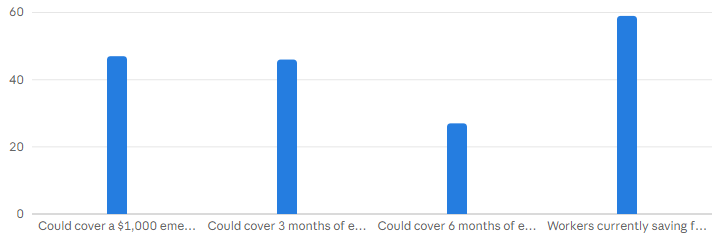
78% lost sleep over money (AASM, 2025); 67% regularly lose sleep over finances (MoneyLion, 2026); Americans lose an average of three nights a month and only 14% feel in control of their finances (Penny Hoarder, April 2026). Nightmare 1: only 47% could cover a $1,000 emergency; 46% three months; 27% six months (Bankrate 2026). Nightmare 2: inflation 3.7% (September 2026); real hourly earnings −0.7% over the year; gasoline +9.1% in a month. Nightmare 3: payrolls +29,000; unemployment 4.2%; 27.1% of the unemployed out 27+ weeks; only 27% of unemployed received UI in 2024. Nightmare 4: 30-year mortgage 7.40%; median home $417,500; payment about $2,313 a month (my calculation); each point of rate adds about $223 a month. Nightmare 5: median retirement savings $955 (all workers) / $40,000 (savers); Social Security 78%–83% payable after 2032–2034; retiree healthcare $185,500.
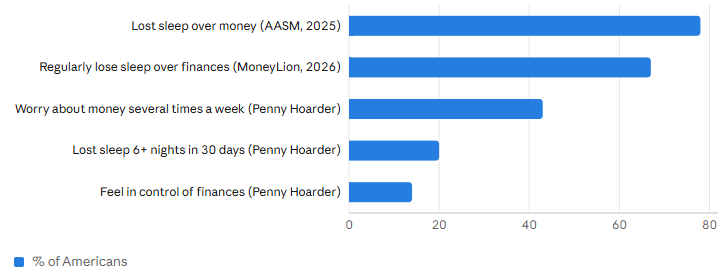
The Penny Hoarder’s 2026 Financial Anxiety Barometer adds texture. Its April survey of 1,000 adults found that Americans lose an average of three nights of sleep a month to money worries, that 43% worry about finances several times a week and that only 14% feel in control. Sixty-five percent named the cost of essentials as their biggest source of anxiety. Notice that last number. Control is the missing ingredient. Wendy Troxel, a RAND sleep scientist, told MoneyLion that financial worry is uniquely disruptive because it often feels unpredictable and out of our control. The good news is that control can be built, one small step at a time.
How to escape: build the cushion in steps rather than all at once. First, a $1,000 starter fund, which at $167 a month takes six months and stops many small crises from turning into card debt. Next, one month of essentials, then three, then six. Keep it in an insured savings account that pays something. In mid-October the best savings accounts paid 4.34% to 4.50%, versus 0.38% for the average savings account. If you carry card balances, pay the highest interest rate first while making minimums on the rest, and call your issuer to ask about a lower rate or hardship plan.
Bankrate 2026: 47% can cover a $1,000 emergency; 46% three months; 27% six months; 29% have more card debt than emergency savings. At $167 a month, $1,000 takes six months. Your first move: Open a separate savings account and set an automatic $25 or $50 transfer on payday. The amount matters less than the habit.
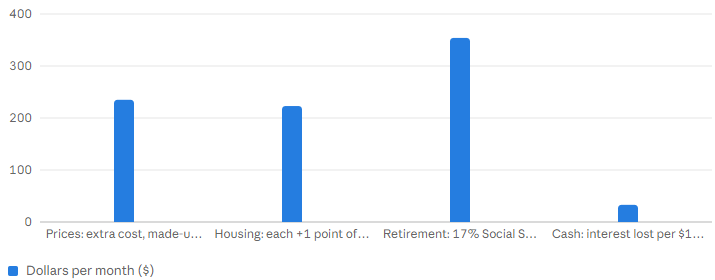
How to escape: aim at the biggest lines, not the smallest. Write down your top five costs and compare each with a year ago. Shop insurance and phone plans at renewal, challenge a rent increase, plan fuel and trips and cancel subscriptions you do not use. Then stop the leak you cannot see: money earning 0.38% in a bank is losing ground to inflation, while 4.34% roughly holds its value. On $10,000, that is about $396 a year, or $33 a month, for a ten-minute transfer. Finally, remember Bankrate’s observation that raising income usually does more for savings than cutting more expenses. List your five biggest monthly costs and call the one with the highest bill. Ask for a better rate before you cancel.
How to escape: know your six-month number. Add up your essential monthly costs, then multiply by six. If essentials are $3,800 a month, that is $22,800. You may not have it yet, but knowing it turns a vague dread into a target. In the meantime, keep your resume and network warm, learn the skills your employer or industry values and understand your benefits. If you do lose your job, file for unemployment right away and call lenders and utilities early. Reducing fixed costs now makes any future gap smaller. Calculate your essentials, multiply by three and six, and write both numbers on a sticky note where you will see them.
How to escape: judge a home by its payment, not its price. For buyers, run the full monthly cost, plan to stay at least five to seven years and negotiate. With inventory rising, sellers may offer a price cut or a credit, and a permanent rate buydown can beat a price cut if you stay long enough. For current owners with a low rate, think twice before giving it up. For renters, the cost of renting is often lower than owning, so the key is to invest the difference rather than spend it. And watch variable-rate debt, which rises when the Federal Reserve hikes.
Calculate your housing cost as a percentage of gross income. If it is above about 28% to 30%, list one change that could move it down.
How to escape: begin with free money. If your employer matches contributions, capture the full match; on a $60,000 salary, a 3% match is worth $1,800 a year. Then raise your savings rate by one percentage point. On that salary, $600 a year invested at an assumed constant 7% would grow to roughly $56,700 over 30 years, an illustration and not a promise. Stress-test your plan by multiplying your expected Social Security by 0.78 and 0.83, and plan for healthcare. If you are within ten years of retiring, consider working longer and delaying benefits. Log in to your retirement plan and check two things: whether you are getting the full employer match and your current contribution rate.
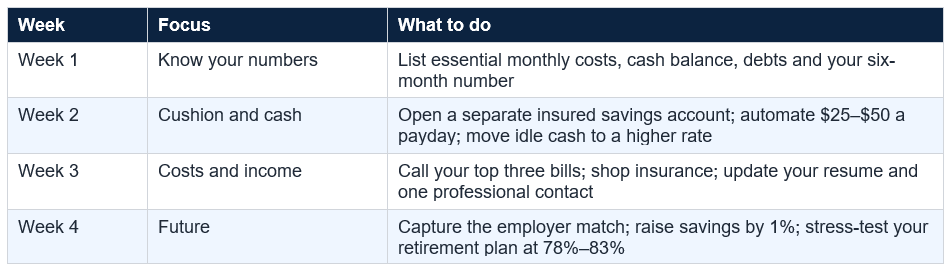
Repeat the cycle each month and revisit the biggest pain point first. Small steps taken in sequence beat grand plans abandoned in week two.
The thread that connects them is control. The Penny Hoarder found that only 14% of Americans feel in control of their finances, and Troxel points to unpredictability as what makes money stress so hard on sleep. Plans make the unpredictable a little more predictable. Start with one page of numbers, one automatic transfer and one phone call. Tonight, the ceiling will still be there, but you will know what you are going to do about it. This is general education, not personalized advice, and a qualified professional can help with your situation.
Money itself. The American Academy of Sleep Medicine’s 2025 survey of 2,007 adults found that 78% had lost sleep over financial concerns, the top worry on its list, ahead of work (65%) and job security (56%). A MoneyLion survey reported in August 2026 found that 67% of Americans regularly lose sleep over finances.
Where should I start if everything feels urgent?
Start with the smallest step that creates control: write down your essential monthly costs and your cash balance. That single page shows how many months you could cover and which problem is most pressing. Then build a $1,000 starter fund, which prevents many small crises from becoming debt.
Is it realistic to fix all five problems at once?
No. Pick one nightmare a month and take one small step on the others. The 30-day plan in this article is built around that idea. Progress on one area, such as an emergency fund, often reduces stress in the others, because it gives you a cushion while you work.
Do I need a financial adviser?
Not for the first steps. A budget, a starter emergency fund and an employer match need only your own effort. A fee-only adviser can help with larger questions such as retirement withdrawals, buying a home or handling a large debt. This article is general education, not personal advice.
What if money stress is hurting my sleep or health?
Take it seriously. Sleep experts suggest writing worries down so your mind does not rehearse them at night, keeping a consistent wake-up time and addressing any medical sleep issue separately. If worry persistently disrupts your rest or mood, a doctor or counselor can help.
Money and sleep: what Americans report (%)
% of respondents by Different surveys, dates and methods; not directly comparable
How prepared are Americans? (%, 2026 surveys)
% of Americans by Bankrate 2026 Emergency Savings Report; EBRI 2026 Retirement Confidence Survey
Monthly dollars at stake in the nightmares (illustrations, $ per month)
Dollars per month by Author's arithmetic; illustrative, not forecasts
Table of Contents
- The 3 A.M. Ceiling
- The Short Answer
- Nightmare 1: The Surprise Bill
- Nightmare 2: Prices That Outrun Your Pay
- Nightmare 3: The Job That Could Disappear
- Nightmare 4: The Housing Payment
- Nightmare 5: The Retirement Gap
- The 30-Day Escape Plan
- Sleeping Better While You Fix It
- Conclusion
- Frequently Asked Questions
The 3 A.M. Ceiling
You know the ceiling. At 3 a.m. it has a way of becoming a spreadsheet: the rent, the card balance, the car repair that might come, the job that might not. You are not alone in staring at it. The American Academy of Sleep Medicine found in a 2025 survey of 2,007 adults that 78% had lost sleep over money matters, the most common worry on its list. A MoneyLion survey reported in August 2026 put the share who regularly lose sleep over finances at 67%.The Penny Hoarder’s 2026 Financial Anxiety Barometer adds texture. Its April survey of 1,000 adults found that Americans lose an average of three nights of sleep a month to money worries, that 43% worry about finances several times a week and that only 14% feel in control. Sixty-five percent named the cost of essentials as their biggest source of anxiety. Notice that last number. Control is the missing ingredient. Wendy Troxel, a RAND sleep scientist, told MoneyLion that financial worry is uniquely disruptive because it often feels unpredictable and out of our control. The good news is that control can be built, one small step at a time.
The Short Answer
Five financial nightmares account for much of that lost sleep: the surprise bill you cannot cover, prices that rise faster than your pay, the job that could disappear, the housing payment that eats your income and the retirement gap that grows quietly. Each has a number behind it, and each has an escape that starts with a first move you can make this week. Escaping does not require a windfall. It requires a plan, a few automatic habits and a willingness to look at your own numbers.Nightmare 1: The Surprise Bill
The fear is simple: something breaks, and there is no money. Bankrate’s 2026 emergency savings report suggests the fear is well founded. Only 47% of Americans have enough liquidity to cover a $1,000 emergency, and just 46% could cover three months of expenses. Only 27% could cover six. Twenty-nine percent have more credit card debt than emergency savings, and about 8 in 10 contributed nothing to emergency savings in 2025. The reason is not carelessness. Fifty-four percent say they are saving less because of inflation.How to escape: build the cushion in steps rather than all at once. First, a $1,000 starter fund, which at $167 a month takes six months and stops many small crises from turning into card debt. Next, one month of essentials, then three, then six. Keep it in an insured savings account that pays something. In mid-October the best savings accounts paid 4.34% to 4.50%, versus 0.38% for the average savings account. If you carry card balances, pay the highest interest rate first while making minimums on the rest, and call your issuer to ask about a lower rate or hardship plan.
Bankrate 2026: 47% can cover a $1,000 emergency; 46% three months; 27% six months; 29% have more card debt than emergency savings. At $167 a month, $1,000 takes six months. Your first move: Open a separate savings account and set an automatic $25 or $50 transfer on payday. The amount matters less than the habit.
Nightmare 2: Prices That Outrun Your Pay
The second nightmare is the slow squeeze. In September, consumer prices rose 0.6% for the month and 3.7% over the year, with gasoline up 9.1% in a single month. Real average hourly earnings, which adjust pay for inflation, fell 0.7% over the year. So the same paycheck stretches less. In a made-up family budget of $6,630 a month, my arithmetic suggests the same purchases cost about $235 more than a year ago, roughly $2,800 a year, with housing and gasoline the biggest drivers.How to escape: aim at the biggest lines, not the smallest. Write down your top five costs and compare each with a year ago. Shop insurance and phone plans at renewal, challenge a rent increase, plan fuel and trips and cancel subscriptions you do not use. Then stop the leak you cannot see: money earning 0.38% in a bank is losing ground to inflation, while 4.34% roughly holds its value. On $10,000, that is about $396 a year, or $33 a month, for a ten-minute transfer. Finally, remember Bankrate’s observation that raising income usually does more for savings than cutting more expenses. List your five biggest monthly costs and call the one with the highest bill. Ask for a better rate before you cancel.
Nightmare 3: The Job That Could Disappear
The third nightmare is the one with a number you cannot control. The Bureau of Labor Statistics reported that employers added only 29,000 jobs in September and that unemployment rose to 4.2%, with 7.1 million people unemployed. About 27.1% of the unemployed had been jobless for 27 weeks or more, and the average spell lasts about 24.8 weeks. Little wonder 56% of respondents in the AASM survey had lost sleep over job security. And the safety net is thinner than it looks: only 27% of unemployed workers received unemployment benefits in 2024, and benefits typically replace around 40% of wages.How to escape: know your six-month number. Add up your essential monthly costs, then multiply by six. If essentials are $3,800 a month, that is $22,800. You may not have it yet, but knowing it turns a vague dread into a target. In the meantime, keep your resume and network warm, learn the skills your employer or industry values and understand your benefits. If you do lose your job, file for unemployment right away and call lenders and utilities early. Reducing fixed costs now makes any future gap smaller. Calculate your essentials, multiply by three and six, and write both numbers on a sticky note where you will see them.
Nightmare 4: The Housing Payment
The fourth nightmare is the biggest bill most of us pay. The 30-year mortgage rate reached 7.40% on October 15, up from 6.36% in May. On the September median price of $417,500, with 20% down, the payment is about $2,313 a month in principal and interest, by my calculation. That is 31.7% of the $87,460 median household income, before taxes and insurance, and it would take roughly $99,000 of income to meet a common 28% guideline. Each percentage point of rate adds about $223 a month to that loan.How to escape: judge a home by its payment, not its price. For buyers, run the full monthly cost, plan to stay at least five to seven years and negotiate. With inventory rising, sellers may offer a price cut or a credit, and a permanent rate buydown can beat a price cut if you stay long enough. For current owners with a low rate, think twice before giving it up. For renters, the cost of renting is often lower than owning, so the key is to invest the difference rather than spend it. And watch variable-rate debt, which rises when the Federal Reserve hikes.
Calculate your housing cost as a percentage of gross income. If it is above about 28% to 30%, list one change that could move it down.
Nightmare 5: The Retirement Gap
The fifth nightmare is the quietest. The National Institute on Retirement Security found a median of just $955 saved for retirement among all employed Americans aged 21 to 64, and $40,000 among those with an account. EBRI’s 2026 survey found worker retirement confidence at its lowest since 2017, with 59% of workers saving, down from 64%. Meanwhile, the 2026 Social Security Trustees Report projects that benefits could be cut to about 78% to 83% of scheduled levels in 2032 to 2034 without legislation, and Fidelity estimates $185,500 of healthcare costs for a 65-year-old retiring this year.How to escape: begin with free money. If your employer matches contributions, capture the full match; on a $60,000 salary, a 3% match is worth $1,800 a year. Then raise your savings rate by one percentage point. On that salary, $600 a year invested at an assumed constant 7% would grow to roughly $56,700 over 30 years, an illustration and not a promise. Stress-test your plan by multiplying your expected Social Security by 0.78 and 0.83, and plan for healthcare. If you are within ten years of retiring, consider working longer and delaying benefits. Log in to your retirement plan and check two things: whether you are getting the full employer match and your current contribution rate.
The 30-Day Escape Plan
You do not need to fix everything this month. You need to start. Here is a simple 30-day plan that touches all five nightmares without overwhelming you.Repeat the cycle each month and revisit the biggest pain point first. Small steps taken in sequence beat grand plans abandoned in week two.
Sleeping Better While You Fix It
The plan will take time, and you still need to sleep tonight. Sleep experts have simple suggestions. The AASM recommends jotting worries in a notebook to reassure yourself you will address them later, and exercising regularly, though not intensely near bedtime. Troxel advises keeping a consistent wake-up time when stress is high. And if your sleep problems run deeper than financial stress, address any medical issue separately, according to University of Arizona researcher Michael Grandner. If worry persistently disrupts your rest or mood, a doctor or counselor can help. Money problems are real and solvable, but they are easier to solve with sleep. Treat rest as part of the plan, not a reward for finishing it.Conclusion
Five nightmares, one pattern. Each is real: only 47% of Americans can cover a $1,000 emergency, prices are up 3.7% while real pay slips, 27.1% of the unemployed have been out of work for over six months, a median home needs about $2,313 a month at 7.40%, and the median worker has saved $955 for retirement. And each has a way out that begins with a number and a first move.The thread that connects them is control. The Penny Hoarder found that only 14% of Americans feel in control of their finances, and Troxel points to unpredictability as what makes money stress so hard on sleep. Plans make the unpredictable a little more predictable. Start with one page of numbers, one automatic transfer and one phone call. Tonight, the ceiling will still be there, but you will know what you are going to do about it. This is general education, not personalized advice, and a qualified professional can help with your situation.
Frequently Asked Questions
What financial worry keeps Americans awake most?Money itself. The American Academy of Sleep Medicine’s 2025 survey of 2,007 adults found that 78% had lost sleep over financial concerns, the top worry on its list, ahead of work (65%) and job security (56%). A MoneyLion survey reported in August 2026 found that 67% of Americans regularly lose sleep over finances.
Where should I start if everything feels urgent?
Start with the smallest step that creates control: write down your essential monthly costs and your cash balance. That single page shows how many months you could cover and which problem is most pressing. Then build a $1,000 starter fund, which prevents many small crises from becoming debt.
Is it realistic to fix all five problems at once?
No. Pick one nightmare a month and take one small step on the others. The 30-day plan in this article is built around that idea. Progress on one area, such as an emergency fund, often reduces stress in the others, because it gives you a cushion while you work.
Do I need a financial adviser?
Not for the first steps. A budget, a starter emergency fund and an employer match need only your own effort. A fee-only adviser can help with larger questions such as retirement withdrawals, buying a home or handling a large debt. This article is general education, not personal advice.
What if money stress is hurting my sleep or health?
Take it seriously. Sleep experts suggest writing worries down so your mind does not rehearse them at night, keeping a consistent wake-up time and addressing any medical sleep issue separately. If worry persistently disrupts your rest or mood, a doctor or counselor can help.
0 Comments
Be the first to share your thoughts on this article.