

Hustle
5 Money Questions to Ask Before Starting Passive Income

Passive income through dividend stocks, REITs, and online businesses typically requires 7 to 12 years to replace a salary. Most passive income is not passive at the start. And most people skip the five questions that determine whether it’s the right financial move right now.
The phrase ‘passive income’ has become one of the most powerful three words in personal finance. It promises freedom from the work-for-income-for-bills cycle, the financial base from which real choices become possible, the version of money that does not require you to show up. The problem is that between the promise and the reality lies a gap that most passive income content does not discuss honestly. Passive income through dividend stocks, REITs, and online businesses typically requires seven to twelve years of concentrated effort before generating sufficient cash flow to replace employment income. The setup phase is almost never passive. The tax implications are almost never simple. The opportunity cost is almost never zero. Before you start any passive income project — a rental property, an index portfolio, a digital course, an affiliate website, a vending machine route — there are five financial questions worth asking. Not because the answers will necessarily talk you out of it. Because the answers determine whether this is the right financial move right now, whether you are sequencing decisions correctly, and whether your money is being deployed where it will work hardest.
The passive income industry has a very effective emotional hook: the image of money arriving while you sleep, of income streams that run without your active presence, of financial freedom built one stream at a time. It is a compelling image, and it is not entirely false. Passive income is real, achievable, and genuinely transformative for the people who pursue it with accurate expectations, adequate preparation, and the right financial sequencing. The problem is not the destination. The problem is the journey between ‘I want to build a passive income stream’ and ‘I have a passive income stream that meaningfully changes my financial situation.’ That journey is harder, longer, and more expensive than the marketing version suggests. Finance.katadata.co.id’s analysis of passive income myths states directly: ‘Statistics reveal that only a small percentage of individuals genuinely achieve substantial passive income, debunking the myths that it comes without hard work.’ These five questions are designed to be asked before the excitement of a new project idea overrides the financial reasoning. They are not designed to kill the idea. They are designed to ensure you are starting from the right financial position and with honest expectations.
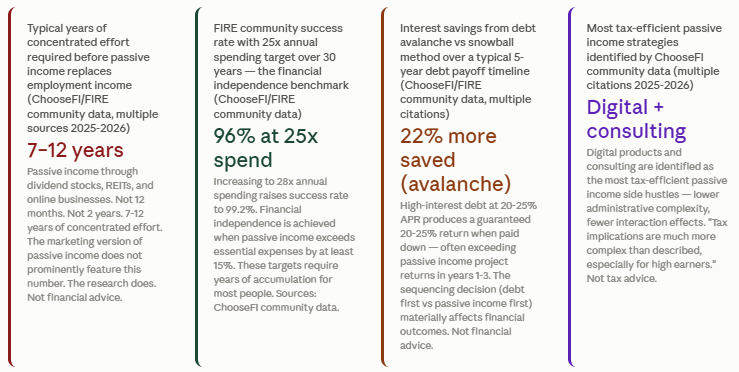
Passive income through dividend stocks, REITs, and online businesses typically requires 7-12 years of concentrated effort before generating sufficient cash flow to replace employment income (ChooseFI / FIRE community data, multiple sources 2025-2026). Only a small percentage of individuals genuinely achieve substantial passive income (finance.katadata.co.id October 2025). 30% of small businesses are built around passive income models (SBA research cited by finance.katadata.co.id).
None of this means passive income is not worth pursuing. It means the frame around the decision matters. Starting a dividend portfolio at 28 with a seven-to-twelve-year timeline in mind is a sound financial strategy. Starting one at 28 expecting it to replace your salary in two years is a recipe for frustration and potentially bad financial decisions made in response to unrealistic expectations. Finance.katadata.co.id’s conclusion is useful: ‘Success in passive income ventures often hinges on careful research and ongoing involvement.’ Careful research includes the timeline.
What is the average interest rate across all my current debts? If any rate exceeds my realistic projected passive income return from this project, the maths favours debt paydown first.
The debt avalanche method saves 22% more in interest than the snowball method (ChooseFI / FIRE community data). A credit card at 23% APR produces a guaranteed 23% return when paid down — exceeding most passive income project returns in years one through three.
Before you start: List every debt with its interest rate. Calculate the weighted average interest rate across all debts. If this exceeds your realistic projected passive income return in year one or two: clear high-rate debt first. The passive income project will still be there when you return to it debt-free.
Do I have three to six months of essential expenses in accessible savings, separate from the capital I plan to deploy into this project? If not, the project capital is at risk from life events entirely unrelated to the project.
Why this matters: Without an emergency fund, a passive income project operates under constant threat of forced early exit — which creates pressure to monetise before readiness and turns you into a forced seller. Most passive income ventures require time before returning capital.
Before you start: Before committing any capital to a passive income project: verify you have three months of essential expenses in accessible savings that would not need to be touched for this project. If not: build that first. The most tax-efficient passive income strategy is the one you can afford to let develop at its own pace.
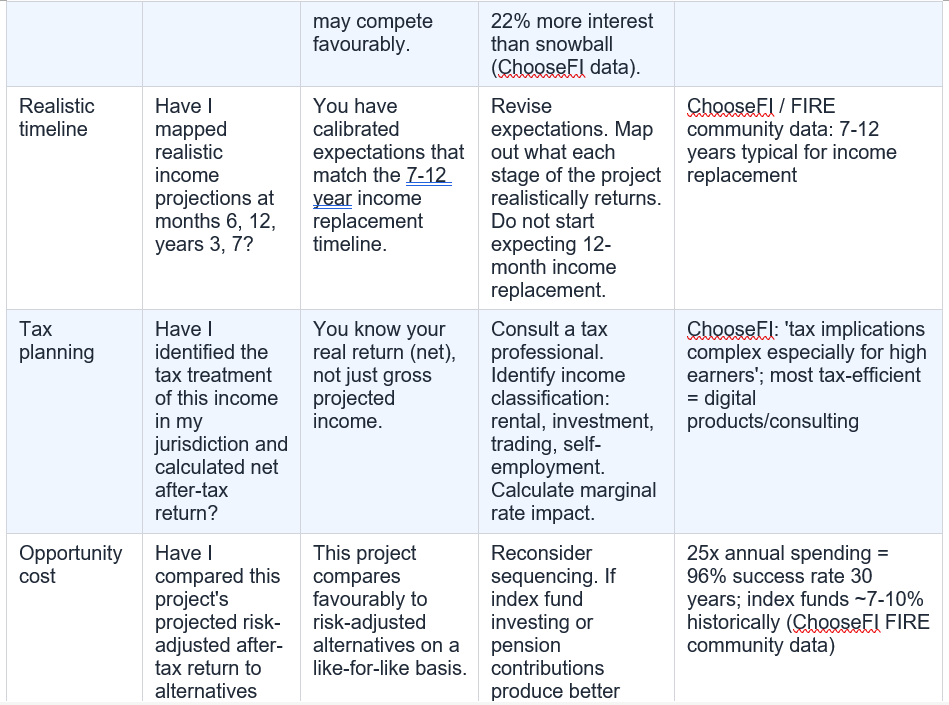
What is my realistic income target from this project and by when? Am I prepared for the setup phase to be intensive, not passive? Have I looked at seven to twelve years as the income replacement timeline, not twelve months?
Why this matters: Passive income through dividend stocks, REITs, and online businesses typically requires 7 to 12 years of concentrated effort before generating sufficient cash flow to replace employment income (ChooseFI / FIRE community data). The setup phase is nearly always intensive.
Before you start: Map a realistic income projection for this project at month three, month twelve, year three, and year seven. If the realistic year-one income does not justify the opportunity cost and setup effort, either adjust the project to start smaller and test the thesis first, or accept the long-term timeline explicitly.
What is the tax treatment of this income in my jurisdiction? What is my effective net return after tax on the projected income? Have I factored in reporting obligations and any interaction effects with my existing income?
Why this matters: ChooseFI community data: 'the tax implications are much more complex than described, especially for high earners.' The most tax-efficient passive income strategies involve digital products and consulting. Self-employment tax, income type classification, and marginal rate effects can significantly reduce net returns.
Before you start: Before starting: identify the tax classification of your projected passive income in your jurisdiction (UK: HMRC; US: IRS self-employment, investment income, rental income rules). Calculate net after-tax projected return. Consult a tax professional if the sum involved is material. Gross income is not your return — net income is.
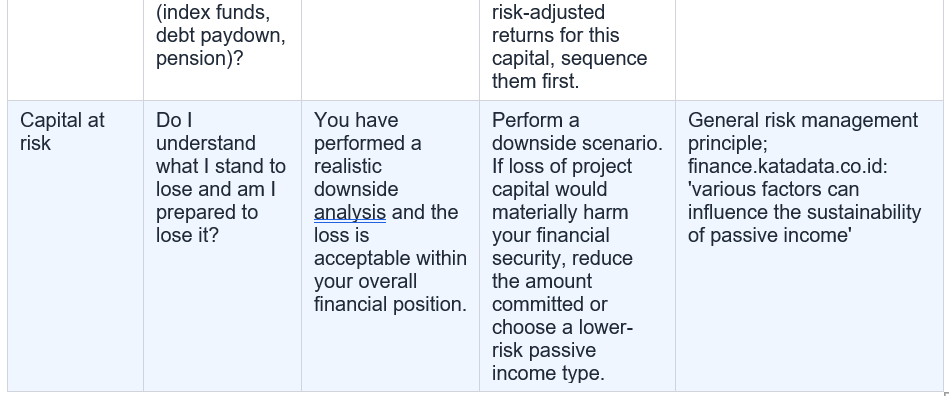
What would happen to this capital if I did not deploy it into this passive income project? Would it go to debt, index fund investing, pension contributions, or emergency savings? How does the risk-adjusted, after-tax, after-effort return of this project compare to those alternatives?
Why this matters: Index fund investing has historically returned approximately 7-10% annually (pre-costs). Employer pension matching produces an immediate 50-100% return. HYSA currently paying 4-5% APY is risk-free. The passive income project must compare favourably to these alternatives to justify the complexity and risk.
Before you start: Build a simple comparison table: (1) deploy capital into this passive income project — projected net return, risk level, effort required, timeline. (2) Alternative use — projected return, risk level, effort. If the passive income project does not compare well on a risk-adjusted after-tax basis, it may be better sequenced for later.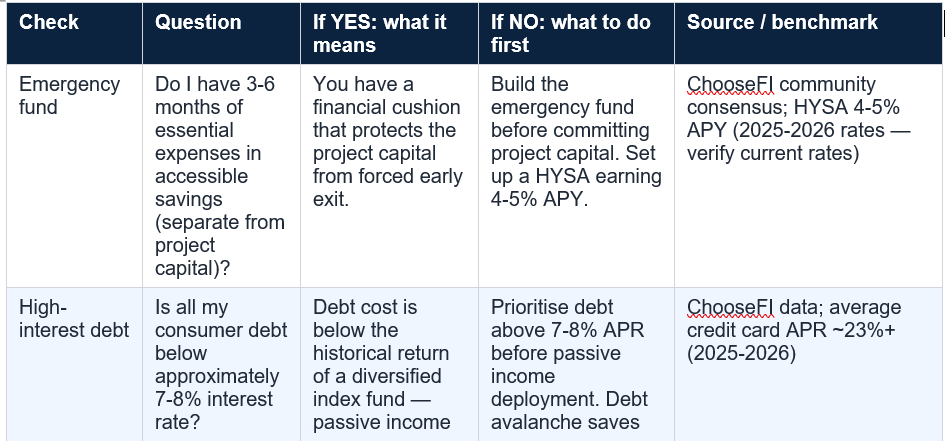
The right time to start a passive income project is when you can answer all five questions honestly and still want to proceed. When you know your high-interest debt situation. When your emergency fund is intact and separate from the project capital. When you have mapped a realistic timeline and accepted it. When you understand the after-tax return, not just the gross projection. When you have compared it to alternatives and chosen it on its merits. That version of starting a passive income project has a significantly better chance of producing what you actually want from it. Not financial or investment advice. Consult a qualified financial adviser for guidance specific to your circumstances.
Yes — with accurate expectations and the right financial sequencing. Finance.katadata.co.id's analysis notes that 'success in passive income ventures often hinges on careful research and ongoing involvement.' The SBA research cited there found that nearly 30% of small businesses are built around passive income models. The FIRE community has documented clear pathways from starting a passive income project to financial independence — but with honest timelines of 7-12 years for income replacement, not 12 months. Passive income is worth pursuing when the five financial questions in this article have been answered honestly, when the financial prerequisites (emergency fund, high-interest debt cleared, realistic timeline accepted) are in place, and when the opportunity cost comparison favours this specific project.
Should I start a passive income project while I still have debt?
The answer depends on the interest rate of the debt. If you carry high-interest consumer debt (credit cards at 20-25% APR), paying that down first is mechanically a better financial move than most passive income projects in years one through three. The debt avalanche method saves 22% more in interest than the snowball method over a typical 5-year payoff timeline (ChooseFI / FIRE community data). If the debt is lower-rate (a mortgage at 4-5%, a student loan at 3%), the calculation is more nuanced — the opportunity cost of debt paydown may not exceed the projected return from the passive income project. The question is: does the risk-adjusted after-tax return from this passive income project exceed the guaranteed return from paying down this debt?
How much capital do I need to start building meaningful passive income?
The honest answer: more than most passive income content suggests, and the amount depends entirely on which type of passive income you are pursuing. Dividend investing requires significant capital to generate meaningful income — at a 4% dividend yield, generating £1,000/$1,000 per month requires approximately £300,000/$300,000 invested. A rental property requires a deposit plus costs (typically 20-25% in most markets). Digital products (courses, ebooks) require lower capital but significant time in the creation phase. The FIRE community's 25x annual spending target and 96% success rate framework implies that meaningful income replacement requires accumulating 25 times your annual essential spending in income-generating assets. For someone with £30,000/$30,000 annual essential expenses, that is £750,000/$750,000. Starting small, testing the thesis, and scaling is usually more practical than waiting until full capitalisation is available.
What are the most tax-efficient passive income strategies?
ChooseFI community data specifically identifies that the most tax-efficient side hustles and passive income strategies involve digital products and consulting — which typically have lower administrative complexity, fewer interaction effects with other income types, and lower ongoing overheads. Within investment-based passive income, holding assets within tax-advantaged accounts (ISA in the UK, Roth IRA/401k in the US) protects income and gains from tax. Rental income carries deductibility of many legitimate expenses (mortgage interest in some jurisdictions, maintenance, letting agent fees) which reduces the net taxable amount. Dividends are taxed differently from income in most jurisdictions — dividend allowances and lower dividend tax rates apply in the UK; qualified vs non-qualified dividend treatment applies in the US. Tax implications are complex and individual — consult a tax professional before starting any passive income project where the projected income is material.
How do I compare a passive income project to just investing in index funds?
The comparison requires putting both on the same basis: risk-adjusted, after-tax, after-cost, after-effort return per pound or dollar deployed. Index fund investing in a diversified global portfolio has historically returned approximately 7-10% annually before inflation and costs, with near-zero ongoing effort after initial setup. The passive income project you are considering needs to be compared to this benchmark, not to zero return. The FIRE community data is specific: a 25x annual spending target with a 96% success rate over 30 years is achievable through consistent index fund investing. If your passive income project requires significant capital, significant ongoing time, significant tax complexity, and produces a return that does not clearly exceed the index fund benchmark on a risk-adjusted basis — the index fund may be the better use of that capital at this stage. This is the opportunity cost question (Question 5) put into specific terms.
The phrase ‘passive income’ has become one of the most powerful three words in personal finance. It promises freedom from the work-for-income-for-bills cycle, the financial base from which real choices become possible, the version of money that does not require you to show up. The problem is that between the promise and the reality lies a gap that most passive income content does not discuss honestly. Passive income through dividend stocks, REITs, and online businesses typically requires seven to twelve years of concentrated effort before generating sufficient cash flow to replace employment income. The setup phase is almost never passive. The tax implications are almost never simple. The opportunity cost is almost never zero. Before you start any passive income project — a rental property, an index portfolio, a digital course, an affiliate website, a vending machine route — there are five financial questions worth asking. Not because the answers will necessarily talk you out of it. Because the answers determine whether this is the right financial move right now, whether you are sequencing decisions correctly, and whether your money is being deployed where it will work hardest.
Table of Contents
- 1. Why These Questions Matter Before the Excitement Kicks In
- 2. The Honest Truth About Passive Income Timelines
- 3. Question 1 Do You Have High-Interest Debt That Earns More Than This Project Will?
- 4. Question 2 Do You Have an Emergency Fund That Protects This Capital If Things Go Wrong?
- 5. Question 3 What Is the Real Timeline, and Are You Prepared for How Non-Passive the Setup Phase Is?
- 6. Question 4 Have You Fully Accounted for the Tax Implications of This Income Stream?
- 7. Question 5 What Is the True Opportunity Cost — What Else Could This Capital Do?
- 8. The Pre-Start Financial Readiness Checklist
- 9. Conclusion: The Right Time to Start Is When the Answers Are Honest
- 10. Frequently Asked Questions
Why These Questions Matter Before the Excitement Kicks In
The passive income industry has a very effective emotional hook: the image of money arriving while you sleep, of income streams that run without your active presence, of financial freedom built one stream at a time. It is a compelling image, and it is not entirely false. Passive income is real, achievable, and genuinely transformative for the people who pursue it with accurate expectations, adequate preparation, and the right financial sequencing. The problem is not the destination. The problem is the journey between ‘I want to build a passive income stream’ and ‘I have a passive income stream that meaningfully changes my financial situation.’ That journey is harder, longer, and more expensive than the marketing version suggests. Finance.katadata.co.id’s analysis of passive income myths states directly: ‘Statistics reveal that only a small percentage of individuals genuinely achieve substantial passive income, debunking the myths that it comes without hard work.’ These five questions are designed to be asked before the excitement of a new project idea overrides the financial reasoning. They are not designed to kill the idea. They are designed to ensure you are starting from the right financial position and with honest expectations.Passive income through dividend stocks, REITs, and online businesses typically requires 7-12 years of concentrated effort before generating sufficient cash flow to replace employment income (ChooseFI / FIRE community data, multiple sources 2025-2026). Only a small percentage of individuals genuinely achieve substantial passive income (finance.katadata.co.id October 2025). 30% of small businesses are built around passive income models (SBA research cited by finance.katadata.co.id).
The Honest Truth About Passive Income Timelines
Before the five questions, one foundational truth deserves its own space: the timeline between starting a passive income project and having a passive income stream that meaningfully supplements or replaces employment income is measured in years, not months. The FIRE community, which represents the most analytically rigorous segment of the personal finance world, has consistently identified seven to twelve years as the typical timeline for passive income through dividend stocks, REITs, and online businesses to generate sufficient cash flow to replace employment income. The 25x annual spending target that provides a 96% success rate over 30 years requires decades of accumulation for most people, not quarters. Financial independence is achieved when passive income exceeds essential expenses by at least 15% — which is a bar that most people are years from reaching when they start their first passive income project.None of this means passive income is not worth pursuing. It means the frame around the decision matters. Starting a dividend portfolio at 28 with a seven-to-twelve-year timeline in mind is a sound financial strategy. Starting one at 28 expecting it to replace your salary in two years is a recipe for frustration and potentially bad financial decisions made in response to unrealistic expectations. Finance.katadata.co.id’s conclusion is useful: ‘Success in passive income ventures often hinges on careful research and ongoing involvement.’ Careful research includes the timeline.
Question 1 Do You Have High-Interest Debt That Earns More Than This Project Will?
The first question cuts to the arithmetic before the excitement. If you carry high-interest consumer debt — credit card balances at 20-25% APR, for example — every pound or dollar you deploy into a passive income project is competing with a guaranteed risk-free return of 20-25% from paying that debt down instead. Most passive income projects do not return 20-25% in their first year. Many do not return that in their third. The debt avalanche method saves 22% more in interest compared to the debt snowball method over a typical five-year payoff timeline, according to FIRE community research cited across multiple ChooseFI sources. The broader principle: paying down high-interest debt is the closest thing available to a guaranteed, risk-free, tax-free investment return. No stock market index, rental property, or digital product income stream offers a guaranteed return before you even start. The passive income industry has a persistent and damaging blind spot around this. The content that promotes passive income streams almost never prominently features the question ‘how much high-interest debt do you currently carry?’ because the honest answer for many beginners is enough to make the passive income project the wrong financial priority right now. This is not a reason not to pursue passive income eventually. It is a reason to sequence the decisions correctly. If your debt carries interest above approximately 7-8% — the rough historical average return of a diversified global equity index fund — paying it down is mechanically a better risk-adjusted financial move than deploying that capital into most passive income projects.What is the average interest rate across all my current debts? If any rate exceeds my realistic projected passive income return from this project, the maths favours debt paydown first.
The debt avalanche method saves 22% more in interest than the snowball method (ChooseFI / FIRE community data). A credit card at 23% APR produces a guaranteed 23% return when paid down — exceeding most passive income project returns in years one through three.
Before you start: List every debt with its interest rate. Calculate the weighted average interest rate across all debts. If this exceeds your realistic projected passive income return in year one or two: clear high-rate debt first. The passive income project will still be there when you return to it debt-free.
Question 2 Do You Have an Emergency Fund That Protects This Capital If Things Go Wrong?
The second question is about the financial environment in which you are starting a passive income project. Most passive income projects require upfront capital — the initial investment, the tools, the initial inventory, the course platform, the real estate deposit. This capital is being committed to a venture that will take time to produce returns. If an emergency arrives in the meantime — a job loss, an unexpected medical bill, a car repair, a boiler replacement — and you have no emergency reserve, the capital you deployed into the passive income project may need to be retrieved at the worst possible moment: before it has produced anything, and potentially at a loss. Many financial experts recommend keeping three to six months of essential expenses in accessible savings before committing significant capital to any investment strategy. The ChooseFI community framework suggests structuring emergency funds in three tiers: one month in checking, two months in a high-yield savings account, and three months in a conservative balanced fund. The reason the emergency fund question precedes the passive income question is mechanical: without a financial cushion, the passive income project is not operating in the conditions it needs to succeed. It is operating under the constant threat of forced early exit. That threat changes the psychology and the economics of the project. It creates pressure to monetise before the project is ready. It makes you a forced seller or withdrawer at a time of someone else’s choosing. An adequate emergency fund is not a nice-to-have before starting a passive income project. It is the financial immune system that protects the project’s long-term viability. Not financial advice.Do I have three to six months of essential expenses in accessible savings, separate from the capital I plan to deploy into this project? If not, the project capital is at risk from life events entirely unrelated to the project.
Why this matters: Without an emergency fund, a passive income project operates under constant threat of forced early exit — which creates pressure to monetise before readiness and turns you into a forced seller. Most passive income ventures require time before returning capital.
Before you start: Before committing any capital to a passive income project: verify you have three months of essential expenses in accessible savings that would not need to be touched for this project. If not: build that first. The most tax-efficient passive income strategy is the one you can afford to let develop at its own pace.
Question 3 What Is the Real Timeline, and Are You Prepared for How Non-Passive the Setup Phase Is?
The third question is the one that most passive income content gets most wrong. Passive income is almost never passive at the beginning. Finance.katadata.co.id’s analysis of passive income myths is direct: ‘The initial setup usually demands significant time, research, and investment. While it’s true that passive income can generate revenue with minimal ongoing work, the initial setup demands significant time, research, and investment.’ The chaindesk.ai analysis of passive income as a concept adds: ‘Many so-called passive income strategies require upfront capital and ongoing effort, making them less passive than claimed.’ The FIRE community timeline data from ChooseFI is the most sobering: passive income through dividend stocks, REITs, and online businesses typically requires seven to twelve years of concentrated effort before generating sufficient cash flow to replace employment income. Seven to twelve years. Not twelve months. This is the number most passive income marketing does not feature. The gap between ‘set up a passive income stream’ and ‘passive income has replaced my salary’ is measured in years and in effort, not in days and in automation. This does not mean the timeline is not worth accepting. It means the realistic version of the timeline needs to be on the table before you commit. Someone who starts a dividend portfolio, a rental property, or a digital product business knowing that the realistic income replacement timeline is seven to twelve years is making a completely different decision from someone who starts it expecting meaningful income in three months.What is my realistic income target from this project and by when? Am I prepared for the setup phase to be intensive, not passive? Have I looked at seven to twelve years as the income replacement timeline, not twelve months?
Why this matters: Passive income through dividend stocks, REITs, and online businesses typically requires 7 to 12 years of concentrated effort before generating sufficient cash flow to replace employment income (ChooseFI / FIRE community data). The setup phase is nearly always intensive.
Before you start: Map a realistic income projection for this project at month three, month twelve, year three, and year seven. If the realistic year-one income does not justify the opportunity cost and setup effort, either adjust the project to start smaller and test the thesis first, or accept the long-term timeline explicitly.
Question 4 Have You Fully Accounted for the Tax Implications of This Income Stream?
The fourth question is the one that most beginners completely skip, and it is the one with some of the most significant financial consequences if ignored. Passive income is rarely tax-free, and in some structures it is taxed at the least advantageous rates available. ChooseFI community members repeatedly note that ‘the tax implications are much more complex than what is described here, especially for high earners,’ and that ‘you should also consider your state tax implications before making this move.’ The specific tax considerations depend on the type of passive income and the investor’s jurisdiction, but they cluster around four areas. First, income type classification: whether the income is classified as investment income, trading income, rental income, or other — each may be taxed differently in the relevant jurisdiction. Second, self-employment tax in the US: passive income from a business activity can attract self-employment tax on top of income tax, significantly reducing the net return. Third, the interaction with existing income: additional income can push a person into a higher marginal tax bracket, reducing the after-tax return substantially. Fourth, reporting and record-keeping requirements: passive income from multiple sources (affiliate links, rental income, dividends, royalties) may create complex reporting obligations. ChooseFI data specifically identifies that the most tax-efficient passive income strategies involve digital products and consulting — which tend to have lower administrative complexity. The practical implication: before you start, run the projected income through your tax situation. What does £1,000 or $1,000 of gross passive income net after tax in your specific circumstances? That after-tax number is the real return you are comparing to alternatives. Not financial or tax advice. Consult a tax professional.What is the tax treatment of this income in my jurisdiction? What is my effective net return after tax on the projected income? Have I factored in reporting obligations and any interaction effects with my existing income?
Why this matters: ChooseFI community data: 'the tax implications are much more complex than described, especially for high earners.' The most tax-efficient passive income strategies involve digital products and consulting. Self-employment tax, income type classification, and marginal rate effects can significantly reduce net returns.
Before you start: Before starting: identify the tax classification of your projected passive income in your jurisdiction (UK: HMRC; US: IRS self-employment, investment income, rental income rules). Calculate net after-tax projected return. Consult a tax professional if the sum involved is material. Gross income is not your return — net income is.
Question 5 What Is the True Opportunity Cost — What Else Could This Capital Do?
The fifth question is the most philosophically rigorous and the one most rarely asked. Opportunity cost is the return foregone by choosing one use of capital over another. Every pound or dollar you deploy into a specific passive income project could instead go to: clearing high-interest debt (generating a guaranteed return equal to the interest rate); contributing to a tax-advantaged retirement account (pension, ISA, 401k, Roth IRA) with potential employer matching; investing in a diversified global equity index fund (historical returns approximately 7-10% annually, pre-costs); or building a cash emergency fund in a high-yield savings account currently paying 4-5% APY. The FIRE community has identified that a 25x annual spending target provides a 96% success rate over 30 years, and that financial independence is achieved when passive income exceeds essential expenses by at least 15%. The opportunity cost calculation connects to these targets: if your capital is needed to build toward a 25x annual spending target, the question of whether a specific passive income project builds toward that target more or less effectively than index fund investing is the core question to answer. Finance.katadata.co.id’s analysis of the passive income myths concludes: ‘Success in passive income ventures often hinges on careful research and ongoing involvement.’ The opportunity cost question asks: given that involvement, is this the best use of this capital and this time? The honest answer is sometimes yes. More often than the passive income industry admits, the answer is:What would happen to this capital if I did not deploy it into this passive income project? Would it go to debt, index fund investing, pension contributions, or emergency savings? How does the risk-adjusted, after-tax, after-effort return of this project compare to those alternatives?
Why this matters: Index fund investing has historically returned approximately 7-10% annually (pre-costs). Employer pension matching produces an immediate 50-100% return. HYSA currently paying 4-5% APY is risk-free. The passive income project must compare favourably to these alternatives to justify the complexity and risk.
Before you start: Build a simple comparison table: (1) deploy capital into this passive income project — projected net return, risk level, effort required, timeline. (2) Alternative use — projected return, risk level, effort. If the passive income project does not compare well on a risk-adjusted after-tax basis, it may be better sequenced for later.
The Pre-Start Financial Readiness Checklist
Conclusion
The five questions in this article are not a checklist to be passed before permission is granted. They are a calibration tool. They are designed to replace the emotional frame — the excitement of a new income stream idea, the vision of financial freedom, the image of money arriving while you sleep — with the financial frame, just long enough to make a decision that serves you well over a seven-to-twelve-year period rather than just feeling right in week one. Finance.katadata.co.id concludes: ‘Creating passive income is not a straightforward endeavour. Success in passive income ventures often hinges on careful research and ongoing involvement.’ The chaindesk.ai analysis adds: ‘Success in passive income ventures relies on factors like timing, luck, and sustained effort.’The right time to start a passive income project is when you can answer all five questions honestly and still want to proceed. When you know your high-interest debt situation. When your emergency fund is intact and separate from the project capital. When you have mapped a realistic timeline and accepted it. When you understand the after-tax return, not just the gross projection. When you have compared it to alternatives and chosen it on its merits. That version of starting a passive income project has a significantly better chance of producing what you actually want from it. Not financial or investment advice. Consult a qualified financial adviser for guidance specific to your circumstances.
Frequently Asked Questions
Is passive income actually worth pursuing?Yes — with accurate expectations and the right financial sequencing. Finance.katadata.co.id's analysis notes that 'success in passive income ventures often hinges on careful research and ongoing involvement.' The SBA research cited there found that nearly 30% of small businesses are built around passive income models. The FIRE community has documented clear pathways from starting a passive income project to financial independence — but with honest timelines of 7-12 years for income replacement, not 12 months. Passive income is worth pursuing when the five financial questions in this article have been answered honestly, when the financial prerequisites (emergency fund, high-interest debt cleared, realistic timeline accepted) are in place, and when the opportunity cost comparison favours this specific project.
Should I start a passive income project while I still have debt?
The answer depends on the interest rate of the debt. If you carry high-interest consumer debt (credit cards at 20-25% APR), paying that down first is mechanically a better financial move than most passive income projects in years one through three. The debt avalanche method saves 22% more in interest than the snowball method over a typical 5-year payoff timeline (ChooseFI / FIRE community data). If the debt is lower-rate (a mortgage at 4-5%, a student loan at 3%), the calculation is more nuanced — the opportunity cost of debt paydown may not exceed the projected return from the passive income project. The question is: does the risk-adjusted after-tax return from this passive income project exceed the guaranteed return from paying down this debt?
How much capital do I need to start building meaningful passive income?
The honest answer: more than most passive income content suggests, and the amount depends entirely on which type of passive income you are pursuing. Dividend investing requires significant capital to generate meaningful income — at a 4% dividend yield, generating £1,000/$1,000 per month requires approximately £300,000/$300,000 invested. A rental property requires a deposit plus costs (typically 20-25% in most markets). Digital products (courses, ebooks) require lower capital but significant time in the creation phase. The FIRE community's 25x annual spending target and 96% success rate framework implies that meaningful income replacement requires accumulating 25 times your annual essential spending in income-generating assets. For someone with £30,000/$30,000 annual essential expenses, that is £750,000/$750,000. Starting small, testing the thesis, and scaling is usually more practical than waiting until full capitalisation is available.
What are the most tax-efficient passive income strategies?
ChooseFI community data specifically identifies that the most tax-efficient side hustles and passive income strategies involve digital products and consulting — which typically have lower administrative complexity, fewer interaction effects with other income types, and lower ongoing overheads. Within investment-based passive income, holding assets within tax-advantaged accounts (ISA in the UK, Roth IRA/401k in the US) protects income and gains from tax. Rental income carries deductibility of many legitimate expenses (mortgage interest in some jurisdictions, maintenance, letting agent fees) which reduces the net taxable amount. Dividends are taxed differently from income in most jurisdictions — dividend allowances and lower dividend tax rates apply in the UK; qualified vs non-qualified dividend treatment applies in the US. Tax implications are complex and individual — consult a tax professional before starting any passive income project where the projected income is material.
How do I compare a passive income project to just investing in index funds?
The comparison requires putting both on the same basis: risk-adjusted, after-tax, after-cost, after-effort return per pound or dollar deployed. Index fund investing in a diversified global portfolio has historically returned approximately 7-10% annually before inflation and costs, with near-zero ongoing effort after initial setup. The passive income project you are considering needs to be compared to this benchmark, not to zero return. The FIRE community data is specific: a 25x annual spending target with a 96% success rate over 30 years is achievable through consistent index fund investing. If your passive income project requires significant capital, significant ongoing time, significant tax complexity, and produces a return that does not clearly exceed the index fund benchmark on a risk-adjusted basis — the index fund may be the better use of that capital at this stage. This is the opportunity cost question (Question 5) put into specific terms.
0 Comments
Be the first to share your thoughts on this article.