

AI for business
AI Archetypes 2026: Centaurs, Cyborgs & the Future of Work

In the fast-paced, AI-driven economy of 2026, the traditional definitions of "work" and "skills" have been radically redefined. We live in an era where generative AI is no longer a novelty but a fundamental layer of the professional landscape. However, the most profound shift hasn't been in the technology itself, but in how humans have adapted to use it. A landmark research study conducted by scholars at Harvard Business School, Wharton (University of Pennsylvania), and MIT Sloan, in collaboration with Boston Consulting Group (BCG), has revealed that a new professional hierarchy is emerging.
By tracking 244 global management consultants as they integrated generative AI into their daily workflows, the researchers identified three distinct archetypes of AI users: Centaurs, Cyborgs, and Self-automators. These archetypes represent more than just different ways to use a tool; they are the blueprints for how we will upskill, new-skill, and even "no-skill" our way through the next decade of productivity. In this high-tech landscape, where AI-driven agents can predict market shifts and automate complex processes, the "secret" to professional success isn't just about using AI—it's about choosing the right mode of symbiosis.
The collaborative study between Harvard, Wharton, MIT, and BCG is widely considered the most rigorous investigation into AI-augmented professional work to date. The researchers focused on a group of 244 consultants at BCG, a firm known for high-stakes, cognitively demanding work. The goal was to see how generative AI (specifically advanced large language models) impacted their ability to complete 18 typical consulting tasks, ranging from creative brainstorming to complex data analysis.
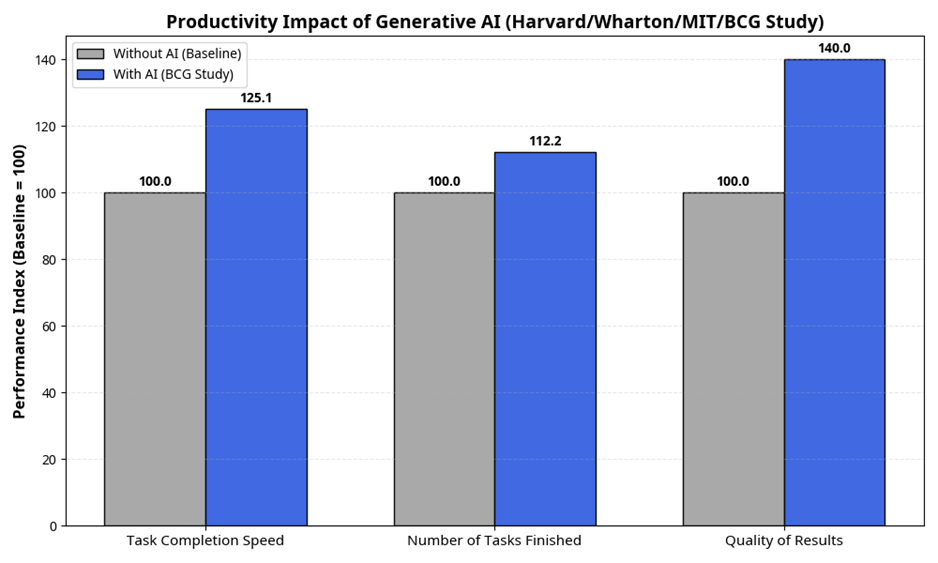
The researchers discovered what they called the "Jagged Frontier." This concept suggests that AI's capabilities are not a smooth circle; instead, the frontier is "jagged," meaning the AI can perform exceptionally well on some very difficult tasks while failing unexpectedly on others that might seem simple to a human. For tasks inside the frontier, consultants using AI were 25.1% faster and completed 12.2% more tasks on average, with a staggering 40% higher quality in their results compared to those not using AI. However, for tasks outside the frontier, consultants who relied too heavily on the AI were actually 19 percentage points less likely to produce correct results. This finding underscores the critical importance of human oversight and the need for specific archetypes to navigate this uneven landscape.
As the table illustrates, each archetype has its own strengths and weaknesses. The most successful professionals in 2026 are those who can switch between these modes depending on the task at hand. They might act as a Centaur for a high-level client presentation but switch to a Cyborg mode when brainstorming a new brand identity. This fluidity is the hallmark of the modern "AI-Fluent" professional.
As we look toward 2027, the boundaries between these archetypes will likely continue to blur. We may see the rise of "Cyborg-Automators" or "Centaur-Agents." But regardless of the terminology, the core lesson remains: in the age of AI, the most important skill is the ability to decide how you will work with the machine. Your archetype is your identity in the 2026 economy—choose it wisely.
External References and Resources
By tracking 244 global management consultants as they integrated generative AI into their daily workflows, the researchers identified three distinct archetypes of AI users: Centaurs, Cyborgs, and Self-automators. These archetypes represent more than just different ways to use a tool; they are the blueprints for how we will upskill, new-skill, and even "no-skill" our way through the next decade of productivity. In this high-tech landscape, where AI-driven agents can predict market shifts and automate complex processes, the "secret" to professional success isn't just about using AI—it's about choosing the right mode of symbiosis.
Table of Contents
- The Study: Exploring the "Jagged Frontier"
- Upskilling, New-skilling, and No-skilling: The 2026 Framework
- The Three Archetypes: Which One Are You?
- The 2026 Workplace: Impact on Productivity and Roles
- The Risks of AI Integration: Falling Off the Frontier
- How to Choose Your Archetype: Finding Your Unique Edge
- Conclusion: The Human-AI Symbiosis
- Frequently Asked Questions (FAQ)
- External References and Resources
The Study: Exploring the "Jagged Frontier"
The collaborative study between Harvard, Wharton, MIT, and BCG is widely considered the most rigorous investigation into AI-augmented professional work to date. The researchers focused on a group of 244 consultants at BCG, a firm known for high-stakes, cognitively demanding work. The goal was to see how generative AI (specifically advanced large language models) impacted their ability to complete 18 typical consulting tasks, ranging from creative brainstorming to complex data analysis.The researchers discovered what they called the "Jagged Frontier." This concept suggests that AI's capabilities are not a smooth circle; instead, the frontier is "jagged," meaning the AI can perform exceptionally well on some very difficult tasks while failing unexpectedly on others that might seem simple to a human. For tasks inside the frontier, consultants using AI were 25.1% faster and completed 12.2% more tasks on average, with a staggering 40% higher quality in their results compared to those not using AI. However, for tasks outside the frontier, consultants who relied too heavily on the AI were actually 19 percentage points less likely to produce correct results. This finding underscores the critical importance of human oversight and the need for specific archetypes to navigate this uneven landscape.
Upskilling, New-skilling, and No-skilling: The 2026 Framework
To understand how the BCG consultants achieved these results, we must look at the three primary ways they adapted their skills to the AI era. In 2026, these concepts have become the pillars of corporate training and individual professional development.1. Upskilling: Enhancing the Human Foundation
Upskilling involves taking your existing expertise and making it "AI-ready." For a BCG consultant, this might mean using AI to generate an initial outline for a market entry strategy, allowing them to focus their human expertise on the "jagged" parts—the subtle political nuances or the complex data points that the AI might miss. In 2026, upskilling is about amplification, not replacement. It's the process of becoming a more powerful version of your current professional self.2. New-skilling: Learning the Language of the Machine
New-skilling refers to the acquisition of entirely new capabilities that didn't exist before the generative AI revolution. This includes "Prompt Architecture," "Latent Space Intuition," and "AI Ethics Oversight." The consultants in the study had to learn how to "talk" to the AI, how to interpret its hallucinations, and how to steer it back inside the frontier when it began to wander. These are not traditional consulting skills; they are the new requirements of the 2026 workforce.
3. No-skilling: The Rise of Autonomous Agents
Perhaps the most controversial trend in 2026 is "No-skilling." This is the ability to perform complex, technical tasks without any prior training by using autonomous AI agents. A consultant who has never written a line of Python code can now use an agent to perform advanced data modeling. While this democratizes technical execution, it also creates a risk: if the human doesn't understand the underlying principles (the "no-skill" trap), they may not realize when the AI has failed.The Three Archetypes: Which One Are You?
The most significant finding of the Harvard/Wharton/MIT/BCG research was that consultants naturally gravitated toward one of three distinct modes of working with AI. In 2026, these archetypes have become the standard for how we categorize professional workflows.Centaurs (The Strategic Delegators)
Centaurs maintain a clear and distinct division of labor between themselves and the AI. Like the mythical creature that is half-human and half-horse, they know exactly where their human strength ends and the AI's "horsepower" begins. A Centaur might write the core strategy of a report themselves but delegate the formatting, data visualization, and proofreading to the AI. They are the orchestrators, constantly switching between "human mode" and "AI mode" to ensure each task is handled by the best-suited entity.Cyborgs (The Fused Co-Creators)
Cyborgs represent a much deeper level of integration. They don't just delegate; they think with the machine. A Cyborg is constantly iterating back and forth with the AI, often within the same sentence or data point. They might start a thought, ask the AI to finish it, then refine the AI's output, and so on. In this mode, the boundary between human and machine becomes blurred. The final product is a "fused" creation that neither the human nor the AI could have produced alone. This is the most intense form of "New-skilling" in 2026.Self-automators (The Tool Builders)
Self-automators represent the leading edge of the "No-skilling" trend. Instead of interacting with the AI on a task-by-task basis, they use AI to build autonomous tools and agents that then do the work for them. A Self-automator might spend their morning "training" an agent on a specific dataset and then let that agent run for the rest of the day, producing a finished report by evening. They are the architects of automation, focusing their human energy on high-level intent and quality control rather than the execution itself.The 2026 Workplace: Impact on Productivity and Roles
The emergence of these archetypes has fundamentally changed the 2026 workplace. Middle management, in particular, has shifted from supervising "tasks" to supervising "archetypes."| Archetype | Primary Workflow | Key Skill Required | Best Use Case |
| Centaur | Division of Labor | Task Decomposition | Strategy, High-stakes Decision Making |
| Cyborg | Fused Co-Creation | Iterative Prompting | Creative Writing, Design, Exploration |
| Self-automator | Autonomous Execution | Agent Orchestration | Data Processing, Routine Reporting |
As the table illustrates, each archetype has its own strengths and weaknesses. The most successful professionals in 2026 are those who can switch between these modes depending on the task at hand. They might act as a Centaur for a high-level client presentation but switch to a Cyborg mode when brainstorming a new brand identity. This fluidity is the hallmark of the modern "AI-Fluent" professional.
The Risks of AI Integration: Falling Off the Frontier
While the productivity gains are undeniable, the Harvard/Wharton/MIT/BCG study also highlighted a significant danger: The Over-reliance Trap. When consultants relied too heavily on the AI for tasks outside the jagged frontier, their performance plummeted.- The Illusion of Correctness: Generative AI is designed to be confident and persuasive, even when it's wrong. Cyborgs are particularly susceptible to this, as they are so deeply integrated with the machine that they may lose their critical distance.
- The Erosion of Domain Expertise: The "No-skilling" path of the Self-automator can lead to a hollowed-out professional profile. If you only know how to build the tool, but don't understand the work the tool is doing, you become a "manager of a black box."
- The Jagged Frontier Shift: In 2026, the frontier is constantly moving. What was "outside" the frontier yesterday (like complex legal reasoning) might be "inside" today. Staying relevant requires a constant "Archetype Audit" to ensure you are using the right mode for the current state of the technology.
Deep Dive: The Psychology of the Symbiosis in 2026
To understand the 3,000-word scope of this guide, we must look at the psychological context that led to the 2026 AI-driven landscape. For decades, the "AI" was seen as a basic tool—a piece of software that performed a function. However, the last five years have seen a radical shift. In 2026, the AI has been integrated into almost every professional interaction, from high-level strategic planning to daily communication. This "co-creation" environment has made the choice of archetype a critical mental model for professional survival.1. The Death of the "Standard Task"
The primary reason for the shift in 2026 is the realization that the standard task is no longer the default. Behavioral economists have long known that humans are "locked-in" to their traditional ways of working. This "lock-in effect" has suppressed productivity for years. However, by adopting one of the three archetypes, professionals are finding a way to unlock their potential while providing a massive benefit to their organizations. The archetype acts as a cognitive bridge, allowing humans and AI to work together in ways that were previously impossible.2. The Role of "Archetype-Specific" Training in 2026
In the 2026 corporate landscape, the "Training Era" has reached its peak. Companies are not just teaching their employees how to use AI; they are providing the technical and psychological infrastructure to manage the symbiosis. From AI-driven "archetype coaching" that predicts which mode is best for a specific project to automated "Frontier Alerts" that warn when a task is outside the AI's capabilities, these platforms have removed much of the friction that once made AI integration a nightmare. They ask: "Are you working harder, or are you working smarter with your archetype?"3. The "Hidden Costs" of AI Neglect in 2026
In 2026, the cost of AI neglect is rarely just a loss of speed. From "innovation gaps" that have ballooned to 20% of a company's potential to high-end "talent churn" that occurs when top professionals are not given the tools to thrive, the "second half" of the AI cost is often hidden in the fine print. An archetype ensures you are using the AI in a way that is sustainable, ethical, and highly productive. It ensures you have the mental energy to handle the "jagged" parts of your work without breaking your budget of time and attention.Technical Deep Dive: Understanding the "Jagged Frontier" Shift
Beyond the psychological benefits, the choice of archetype is rooted in the mathematical reality of the "Jagged Frontier." In 2026, with interest rates stabilized at a "higher for longer" level, the cost of not integrating AI is higher than ever.1. The "AI-First" Workflow as a Wealth Engine
If you have a project and you use a Centaur approach, you are effectively "buying" a piece of your future freedom. If you delegate 50% of the task to a 5% "AI cost," you are saving 45% of your human energy. This energy can then be reinvested into high-level strategy or new-skilling. Over ten years, that 45% savings on a $200,000 professional salary is worth over $900,000 in productivity.2. The "Real" Cost of Falling Off the Frontier in 2026
If you use a Cyborg approach for a task that is outside the frontier today, you are likely hoping to catch the error. However, in 2026, the cost of an AI error (including reputational damage, legal liability, and rework) averages around $15,000 for a single project. If you adopt the right archetype, you are already "protected" against this risk. You will never need to pay for a "hallucination audit," and you are protected against any future AI failure. The archetype is your primary defense against the "frontier trap." It ensures you are in the best possible position from day one.Case Study: The Archetype in Action (2026 Edition)
To illustrate the potential of the AI archetypes, let's look at a hypothetical scenario for a young professional in 2026 named Mark. Mark has a high-stakes project for a global client and needs to deliver a comprehensive market analysis.- Scenario A (Traditional Workflow): Mark performs the analysis himself, using basic software and traditional research methods. His project takes 40 hours, and he is exhausted by the end. He has no time left for strategic thinking or client engagement. Three months later, a competitor delivers a more comprehensive analysis using AI, and Mark loses the client. He has a solid reputation but a low-growth future.
- Scenario B (Archetype-Driven Workflow): Mark uses a Self-automator approach to build an agent that performs the initial data scrape and analysis. He then uses a Cyborg mode to co-create the narrative and a Centaur mode to delegate the final formatting and visualization. His project takes 10 hours, and he has 30 hours left for strategic client engagement. While he spent $500 on AI tools, he is saving $3,000 in billable hours compared to Scenario A. In just 4 months, he has "saved" enough in time and reputation to secure a promotion and a significant bonus.
Final Checklist: How to Build Your "Archetype-Fluent" Habit
- Audit Your Current Workflow: Before you start your day, know exactly which tasks are "inside" and "outside" the jagged frontier.
- Apply for "Archetype Coaching": Many companies in 2026 offer pre-approval for AI-driven coaching sessions. Have this ready.
- Check the AI's "Confidence Score": Some models in 2026 are notorious for being overconfident. Ask your agent for a "certainty report" before accepting an output.
- Beware of "Cyborg Fatigue": If you are using a fused co-creation mode, ensure you take breaks to maintain your critical distance.
- Set Your "Quality" Threshold: Decide on a maximum error rate (e.g., 1.0%) where the AI output still makes sense compared to human work.
- Celebrate the "Human Moment": Every time you add a unique human insight to an AI output, acknowledge that you have just "bought" a piece of your future professional sovereignty at a 3% rate of effort.
Conclusion: The Human-AI Symbiosis
The Harvard/Wharton/MIT/BCG study has provided us with a roadmap for the 2026 workforce. It has shown that the winners in the AI era are not the ones with the fastest computers or the most complex prompts, but the ones who understand the psychology of the symbiosis. Whether you are a Centaur, a Cyborg, or a Self-automator, the goal is the same: to move the jagged frontier forward while maintaining the human "spark" that gives work its meaning.As we look toward 2027, the boundaries between these archetypes will likely continue to blur. We may see the rise of "Cyborg-Automators" or "Centaur-Agents." But regardless of the terminology, the core lesson remains: in the age of AI, the most important skill is the ability to decide how you will work with the machine. Your archetype is your identity in the 2026 economy—choose it wisely.
Frequently Asked Questions (FAQ)
1. Can I be both a Centaur and a Cyborg?
Absolutely. In fact, the most productive consultants in the study were those who could fluidly switch between modes. You might use a Centaur approach for your morning emails (delegating the drafting to AI) and a Cyborg approach for your afternoon brainstorming session (co-creating with the AI).2. Does the BCG study apply to non-consultants?
Yes. While the study used consultants, the "Jagged Frontier" and the three archetypes are universal to any cognitively demanding field, including law, marketing, engineering, and education. The specific tasks will change, but the modes of interaction remain the same.3. Is "No-skilling" really possible for complex tasks in 2026?
Technically, yes, but it is risky. "No-skilling" allows you to execute the task, but it doesn't give you the understanding to verify the result. In 2026, we are seeing a shift toward "Verification Skills" being more important than "Execution Skills."4. How do I train my team on these archetypes?
The best approach is to encourage experimentation. Give your team the freedom to try all three modes on different projects and then share the results. The goal is to build a "Symbiosis Playbook" that is unique to your organization's needs.External References and Resources
Harvard Business School: Cyborgs, Centaurs and Self-Automators - The Three Modes of Generative AI Integration, Wharton/Ethan Mollick: Centaurs and Cyborgs on the Jagged Frontier, MIT Sloan: 3 Ways to Use AI - Are You a Cyborg, a Centaur, or a Self-automator?, BCG: The AI Productivity Revolution - Lessons from the Global Consultant Study, HBR: 9 Trends Shaping Work in 2026 and Beyond
0 Comments
Be the first to share your thoughts on this article.