
Credits
Balance Transfer vs Debt Consolidation: Explained

DEBT PAYOFF OPTIONS 2026 | Average US credit card debt: $8,000. Average credit card APR: 20%+. Balance transfer: 0% for up to 18 months + 3-5% fee. Debt consolidation loan: fixed 9-25% APR. Wrong choice costs thousands. Right choice could save the interest entirely. Here is how to pick.
GreenPath Financial Wellness (February 6, 2026): 'The average American carries nearly $8,000 in credit card debt, according to data from the Federal Reserve and US Census Bureau. Dealing with debt can be overwhelming, but there are strategies to help you manage it more effectively. Two popular options are debt consolidation loans and balance transfers. Both can simplify your debt repayment process, but they work differently and have their own advantages and disadvantages.' Credible (February 20, 2026): 'Credit card debt is the most commonly consolidated or refinanced type of debt.' With average credit card APRs exceeding 20%, the interest alone on $8,000 in card debt costs more than $1,600 per year -- money that builds no equity, reduces no principal, and produces no financial progress.
This guide compares both options side by side -- in a direct head-to-head comparison table, a worked example showing real dollar costs on a typical $8,000 debt, and a detailed breakdown of when each option is the right choice. Bankrate (July 7, 2025): 'Understanding the differences between the two can help you decide which is best for your debt consolidation goals.' The right choice depends on your specific debt amount, credit score, monthly budget, and -- critically -- your confidence that you can clear the balance within a specific timeframe. This guide helps you determine which category you are in.
Bankrate (July 7, 2025): 'Two of the most popular methods to help pay down debt and save money along the way are balance transfer credit cards, which let you transfer debt from other sources and pay as low as 0 percent interest for an introductory period.' The key word is introductory. The 0% rate is a promotional tool, not a permanent feature. The card's standard APR -- which kicks in after the promotional period -- is typically higher than the rate on a consolidation loan. The 0% period is the entire financial case for the balance transfer card, and the strategy only works if the balance is cleared before the period ends.
Bankrate (July 7, 2025): 'A debt consolidation loan is a personal loan with a fixed rate and set payment, usually between 12 and 84 months. You receive all of your funds at once in a lump sum.' Credible (February 20, 2026): 'The average interest rate for a 24-month personal loan was 11.66% in 2025, according to the Federal Reserve.' At 11.66%, a consolidation loan charges significantly less than a typical credit card's 20%+ APR -- and unlike the balance transfer card's post-intro rate, the consolidation loan's rate is fixed for the life of the loan. You know exactly what you will pay, every month, until the debt is gone.
The debt comparison in key numbers: US credit card avg APR: 20%+. Avg personal loan rate: 11.66% (Fed Reserve 2025). Balance transfer 0% for 6-18 months + 3-5% fee. $8,000 avg US credit card balance. — GreenPath (Feb 2026): 'Average American carries $8,000 in credit card debt.' Credible (Feb 2026): 'Average 24-month personal loan rate: 11.66% (Federal Reserve 2025).' BHG Financial (June 22, 2026 -- most current): 'Balance transfer fee 3-5%; intro period 6-18 months; post-intro APR can exceed 20%.' Bankrate (July 2025): 'Credit card debt is most commonly consolidated type of debt.' TransUnion 2023 (via GreenPath): '18 months after consolidation, card balances rebounded to pre-consolidation levels without disciplined habits.'
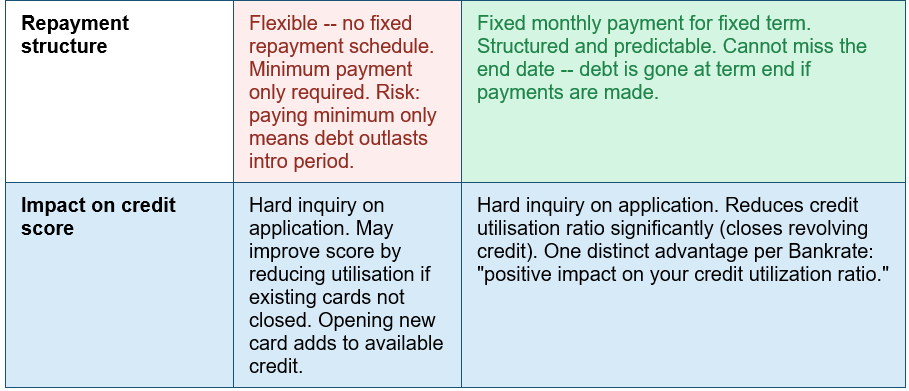
Impact on credit score Hard inquiry on application. May improve score by reducing utilisation if existing cards not closed. Opening new card adds to available credit. Hard inquiry on application. Reduces credit utilisation ratio significantly (closes revolving credit). One distinct advantage per Bankrate: "positive impact on your credit utilization ratio."
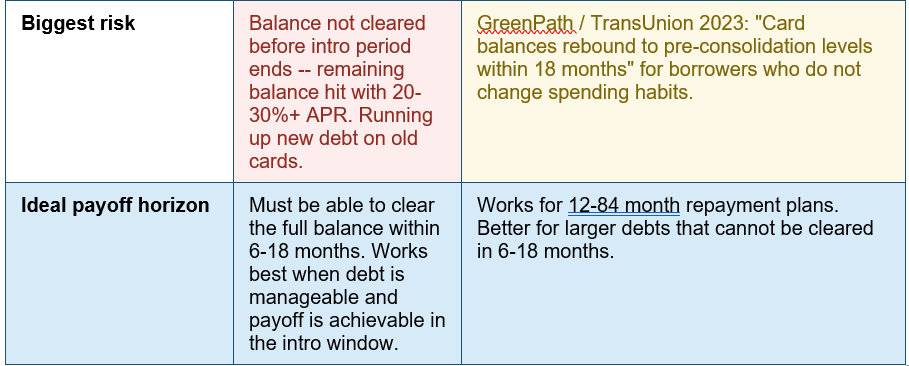
Biggest risk Balance not cleared before intro period ends -- remaining balance hit with 20-30%+ APR. Running up new debt on old cards. GreenPath / TransUnion 2023: "Card balances rebound to pre-consolidation levels within 18 months" for borrowers who do not change spending habits.
Ideal payoff horizon Must be able to clear the full balance within 6-18 months. Works best when debt is manageable and payoff is achievable in the intro window. Works for 12-84 month repayment plans. Better for larger debts that cannot be cleared in 6-18 months.
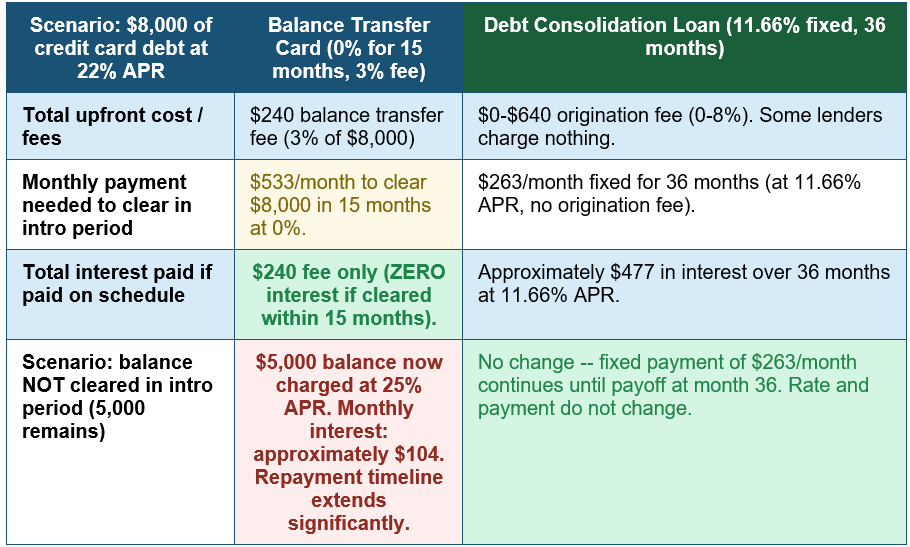
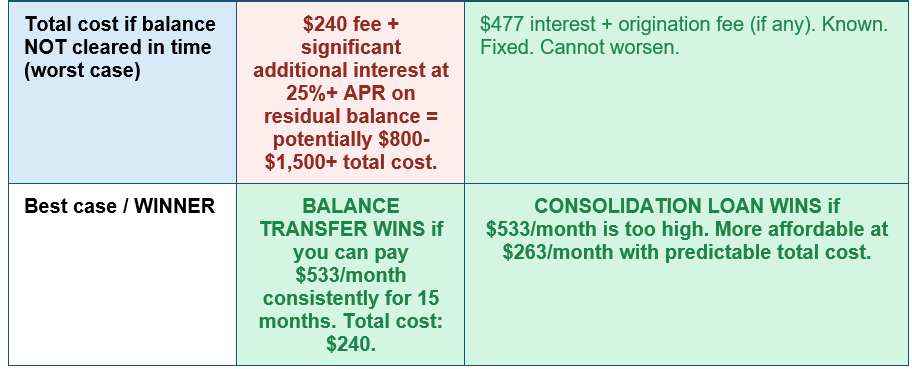
The #1 risk with a balance transfer that most people underestimate: what happens if you don't pay it off in time. BHG Financial (June 22, 2026): 'Any remaining balance at the end of the promotional period will typically revert to the card's standard variable APR, which can exceed 20%.' Consider the scenario: you transfer $8,000 to a 0% card for 15 months. Life intervenes -- an unexpected expense, a month of reduced income, a medical bill. You reach month 16 with $4,000 still on the card. That $4,000 is now accruing interest at the card's standard APR -- typically 22-28%. At 25% APR, month 16 interest charge: approximately $83. This continues for as long as the balance persists. If you had chosen the consolidation loan instead, month 16 would be payment 16 of 36 at the same fixed $263/month -- the rate unchanged, the payoff date unchanged, the outcome certain. Bankrate (July 2025): 'Credit card debt consolidation with transfer cards usually limits you to consolidating other credit card debt.' The 'what if' scenario is not pessimism -- it is the analysis that determines whether the balance transfer's attractive 0% headline is actually the better deal for your specific situation. If the answer is 'I am confident I can clear $533 per month for 15 months and will not use the old cards,' the balance transfer is likely the better choice. If the answer involves any uncertainty, the consolidation loan's fixed certainty becomes very valuable.
FIVE MISTAKES THAT TURN A GOOD DEBT STRATEGY INTO A WORSE PROBLEM: (1) UNDERESTIMATING THE MONTHLY PAYMENT NEEDED FOR A BALANCE TRANSFER. On a $10,000 transfer with a 15-month intro period, you need to pay $667/month to clear the debt at 0%. If you can only afford $400/month, $4,000 will be hit with the standard APR at month 16. Calculate the required monthly payment before applying. If you cannot meet it, the consolidation loan is the safer choice. (2) RUNNING UP NEW DEBT ON THE CARDS YOU JUST PAID OFF. This is the most common failure mode for both strategies. GreenPath / TransUnion 2023: credit card balances rebounded to pre-consolidation levels within 18 months for borrowers who did not change spending habits. After a consolidation loan pays off the cards, or after a balance transfer moves the debt to a new card, the old cards have zero balances. The correct action: either close them or place them somewhere inaccessible. They are not available spending capacity -- they are debt traps waiting to be filled. (3) IGNORING THE BALANCE TRANSFER FEE WHEN CALCULATING SAVINGS. The 0% APR is not free. The 3-5% transfer fee is paid upfront. On $10,000 transferred, the fee is $300-$500. This needs to be factored into the savings calculation when comparing to a consolidation loan. For short debts with short payoff timelines, the fee may be outweighed by interest savings. For longer timelines, a consolidation loan's lower ongoing rate may be cheaper overall. (4) ACCEPTING THE FIRST CONSOLIDATION LOAN OFFER WITHOUT COMPARING. Credible (February 20, 2026): personal loan rates vary widely based on creditworthiness. A borrower with a 720 credit score may be offered 9-11% APR; a borrower with 620 may be offered 18-25% APR. Always compare at least three lenders (banks, credit unions, and online lenders) before accepting any offer. Credible, NerdWallet, and Bankrate all offer multi-lender personal loan comparison tools. (5) APPLYING FOR MULTIPLE CREDIT PRODUCTS SIMULTANEOUSLY. Each application for a balance transfer card or consolidation loan triggers a hard credit inquiry. Multiple hard inquiries in a short period can reduce your credit score by 5-15 points each. Apply strategically: compare using soft-inquiry pre-qualification tools first (most lenders and cards offer this), then make a formal application only for the product you are most likely to be approved for.
YOUR DEBT PAYOFF DECISION CHECKLIST -- USE THIS BEFORE APPLYING: STEP 1 -- CALCULATE YOUR NUMBERS: (a) Total debt amount: $___. (b) Current average APR on all debts: ___%. (c) Number of months available to pay off (intro period available on best balance transfer card): ___. (d) Monthly payment needed to clear in intro period: Total debt ÷ months = $___/month. (e) Can you comfortably commit to that monthly payment? Yes/No. STEP 2 -- IDENTIFY YOUR DEBT TYPES: (f) Is all debt credit card debt? Yes/No. If No, a balance transfer card cannot consolidate the non-credit-card debt -- consider a consolidation loan. STEP 3 -- CHECK YOUR CREDIT SCORE: (g) Above 720? Best balance transfer offers available. (h) 680-720? Good consolidation loan rates available. (i) Below 680? Credit union consolidation loans or bad-credit lenders may be appropriate. Consider credit building first if time allows. STEP 4 -- COMPARE OFFERS: Balance transfer: compare at MoneySuperMarket.com (UK) or CreditKarma.com / Bankrate.com (US). Look for: longest intro period + lowest or zero transfer fee. Consolidation loan: compare at Credible.com, NerdWallet.com, or Bankrate.com (US). Look for: lowest APR + no or low origination fee. STEP 5 -- PLAN FOR AFTER: What happens to the paid-off credit cards? Decision: [Close / Freeze / Zero-balance only policy]. WITHOUT THIS STEP, BOTH OPTIONS STATISTICALLY FAIL WITHIN 18 MONTHS. FREE GUIDANCE: UK: MoneyHelper 0800 138 7777 | StepChange 0800 138 1111. US: CFPB consumerfinance.gov | NFCC nfcc.org.
The debt consolidation loan wins when the debt is larger, includes non-credit-card balances, or requires a longer repayment timeline than any intro period offers. Its fixed rate, fixed payment, and certain payoff date provide a structure that the balance transfer card's open-ended minimum-payment model does not. Bankrate (July 7, 2025): 'One distinct advantage of using a debt consolidation loan to pay off credit cards is its positive impact on your credit utilization ratio.' The immediate utilisation improvement and the fixed monthly accountability of a loan make it the better long-term tool for most borrowers with substantial debt.
The tool that works is the one chosen for the right reasons and managed with discipline afterward. GreenPath (February 2026) and TransUnion's data make clear: without addressing spending behaviour, 18 months after consolidation the balances typically return. The right choice is the debt tool that matches your financial reality and the behaviour change that ensures the old cards stay empty. Choose the right tool. Change the behaviour. Both conditions are required.
Neither is better in every situation -- the right choice depends on your specific debt amount, debt types, credit score, and monthly budget. BHG Financial (June 22, 2026 -- most current): 'Choosing the right solution depends on a few factors, including your balance size, debt type, and the level of structure you want in your repayment plan.' A balance transfer card is better if your total debt can realistically be cleared within the 0% introductory period (typically 6-18 months), all your debt is credit card debt, and you have a good-to-excellent credit score. In this scenario, the only cost is the transfer fee (3-5%), and you pay zero interest. A debt consolidation loan is better if your debt is too large to clear in 6-18 months, includes non-credit-card debt types, or if you want the certainty of a fixed monthly payment and a definite payoff date. Credible (February 20, 2026): 'The average interest rate for a 24-month personal loan was 11.66% in 2025, according to the Federal Reserve.' At 11.66%, a consolidation loan is significantly cheaper than the 20%+ APR you are currently paying on credit cards -- even though it is more expensive than the 0% balance transfer intro rate. The balance transfer is better in ideal conditions. The consolidation loan is more reliable across a wider range of real-world conditions.
What happens if I don't pay off a balance transfer in time?
If you do not clear the full balance before the introductory 0% period ends, any remaining balance is charged the card's standard variable APR -- which BHG Financial (June 22, 2026) notes 'can exceed 20%.' This is the primary risk of the balance transfer strategy. BHG Financial: 'Any remaining balance at the end of the promotional period will typically revert to the card's standard variable APR.' Using the worked example: if you transfer $8,000 to a 15-month 0% card and clear only $5,000 before month 16, the remaining $3,000 is now accruing interest at, say, 25% APR. At 25%, the monthly interest charge on $3,000 is approximately $62.50. If you had been paying $533/month to clear the balance on time but your budget can only sustain $300/month from month 16 onward, the debt will persist for many more months at escalating cost. The risk is compounded if you also ran up new spending on the card during the intro period. Bankrate (July 2025): 'Transfer cards usually limit you to consolidating other credit card debt. If you have other forms of unsecured debt, a balance transfer card won't be the right fit.' The reversion risk is why the balance transfer card is recommended only for borrowers who can honestly commit to the required monthly payment for the full introductory period.
Does a balance transfer or debt consolidation loan hurt my credit score?
Both options involve a hard credit inquiry when you apply, which temporarily reduces your credit score by approximately 5-10 points. Beyond the initial inquiry, the two options have different effects on your credit profile. Balance transfer card: opening a new credit card increases your total available credit, which can reduce your overall credit utilisation ratio and benefit your score. However, it also adds a new account and reduces the average age of your credit accounts, which can have a small negative effect. If you close old cards after the transfer, you lose available credit and utilisation may increase -- generally inadvisable. Debt consolidation loan: Bankrate (July 2025): 'One distinct advantage of using a debt consolidation loan to pay off credit cards is its positive impact on your credit utilization ratio.' When a consolidation loan pays off credit card balances, those cards show zero balances, dramatically reducing your credit utilisation ratio (which counts for approximately 30% of your FICO score). This is often the most significant credit score benefit of consolidation. GreenPath (February 2026): 'Debt consolidation can temporarily hurt your credit score due to credit inquiries, but proper management can lead to long-term improvements.' Both options are generally credit-score neutral to positive in the long run if payments are made on time and new debt is not accumulated on the freed credit cards.
Can I do both a balance transfer AND a consolidation loan?
Yes -- for borrowers with multiple types of debt, a combination approach can be optimal. Consider a borrower with $5,000 in credit card debt and $15,000 in personal loans. The credit card debt can be transferred to a 0% balance transfer card (where the intro period rate is advantageous). The personal loans -- which cannot be transferred to a balance transfer card -- can be consolidated into a new personal loan at a lower rate. This hybrid approach uses each tool for the debt category it is most effective for. Credible (February 20, 2026): 'Debt consolidation loans may have larger available loan amounts and longer repayment terms than balance transfers. They can also be used on a wide variety of debts, as well as for credit card consolidation.' The combination approach does involve two hard credit inquiries (one for each application), two new accounts, and two separate payment obligations -- which adds management complexity. The key is sequencing: apply for both within a short window (14-30 days) to minimise multiple hard inquiry impact on the credit score, then automate both payments on separate dates. Experian (2026): 'Comparing the two can be important if you're trying to strategically pay off debt. Which option is right for you likely will come down to your credit, how much you need to borrow, and what type of debt you have.'
What credit score do I need for a balance transfer or consolidation loan?
Both options are more accessible with better credit, but they have different thresholds. Balance transfer cards with 0% introductory offers: Discover (November 2025) and Experian both confirm that the best balance transfer offers -- longest 0% period, lowest or zero transfer fee -- typically require good-to-excellent credit, generally defined as a FICO score of 700 or above. Cards with the most attractive offers (18-month 0% periods, 0% transfer fees) usually require 720+. Borrowers with scores in the 660-700 range may qualify for balance transfer cards with shorter intro periods or higher transfer fees. Debt consolidation loans: Credible (February 20, 2026): 'You may also be able to find bad-credit loans if your credit score is low.' Personal loans for debt consolidation are available across a wider credit score range than balance transfer cards. Credit unions are particularly accommodating of members with lower credit scores. Online lenders like Upstart, LendingClub, and Avant specifically market to borrowers with fair credit (580-669). However, the interest rate on a bad-credit consolidation loan may be 18-25%+ -- which is comparable to current credit card rates and diminishes the benefit of consolidation. Improving your credit score before applying (even by 20-40 points) can substantially reduce the rate you are offered. GreenPath (February 2026): 'A debt consolidation loan might offer a lower fixed rate, while a balance transfer can provide temporary relief with 0% interest. Fees: Consider the fees associated with each option. Interest rates: Compare the interest rates of both options.'
Table of Contents
- Two Routes to the Same Destination -- Which Is Faster?
- What Is a Balance Transfer Card? What Is a Debt Consolidation Loan?
- The Balance Transfer Card
- The Debt Consolidation Loan
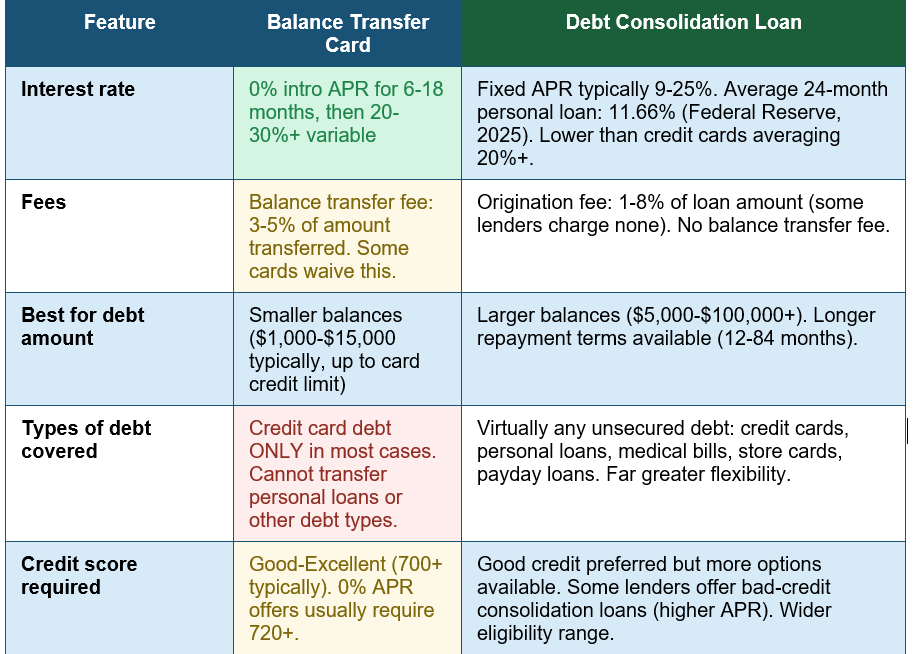
- Head-to-Head Comparison: Balance Transfer vs Debt Consolidation Loan
- The Real Cost: A Worked Example on $8,000 of Credit Card Debt
- The Case for Each Option: When Each One Wins
- Which One Should You Choose? The Decision Guide
- Conclusion: Both Work -- When Chosen for the Right Reasons
- Frequently Asked Questions (FAQ)
- Is a balance transfer better than a debt consolidation loan?
- What happens if I don't pay off a balance transfer in time?
- Does a balance transfer or debt consolidation loan hurt my credit score?
- Can I do both a balance transfer AND a consolidation loan?
- What credit score do I need for a balance transfer or consolidation loan?
- External References & Further Reading
Two Routes to the Same Destination -- Which Is Faster?
If you are carrying high-interest debt -- credit card balances, personal loans, store cards, or a combination -- two strategies are consistently recommended as the most financially effective paths to reducing what you owe: the balance transfer credit card and the debt consolidation loan. Both can reduce your interest costs. Both can simplify multiple payments into one. Both can accelerate your route to being debt-free. But they work very differently, suit different financial situations, and carry very different risks when the conditions they depend on do not materialise.GreenPath Financial Wellness (February 6, 2026): 'The average American carries nearly $8,000 in credit card debt, according to data from the Federal Reserve and US Census Bureau. Dealing with debt can be overwhelming, but there are strategies to help you manage it more effectively. Two popular options are debt consolidation loans and balance transfers. Both can simplify your debt repayment process, but they work differently and have their own advantages and disadvantages.' Credible (February 20, 2026): 'Credit card debt is the most commonly consolidated or refinanced type of debt.' With average credit card APRs exceeding 20%, the interest alone on $8,000 in card debt costs more than $1,600 per year -- money that builds no equity, reduces no principal, and produces no financial progress.
This guide compares both options side by side -- in a direct head-to-head comparison table, a worked example showing real dollar costs on a typical $8,000 debt, and a detailed breakdown of when each option is the right choice. Bankrate (July 7, 2025): 'Understanding the differences between the two can help you decide which is best for your debt consolidation goals.' The right choice depends on your specific debt amount, credit score, monthly budget, and -- critically -- your confidence that you can clear the balance within a specific timeframe. This guide helps you determine which category you are in.
What Is a Balance Transfer Card? What Is a Debt Consolidation Loan?
The Balance Transfer Card
BHG Financial (June 22, 2026): 'A balance transfer is the process of moving existing credit card debt to a new card with a low or 0% introductory APR. The goal is to use the promotional window (typically six to 18 months) to make interest-free payments. Unlike a loan, there's no cash payout with balance transfers -- the new card's credit limit is used to cover your transferred balances. You may pay a one-time transfer fee of 3% to 5% of the amount moved, but some credit cards waive those fees. Keep in mind that any remaining balance at the end of the promotional period will typically revert to the card's standard variable APR, which can exceed 20%.'Bankrate (July 7, 2025): 'Two of the most popular methods to help pay down debt and save money along the way are balance transfer credit cards, which let you transfer debt from other sources and pay as low as 0 percent interest for an introductory period.' The key word is introductory. The 0% rate is a promotional tool, not a permanent feature. The card's standard APR -- which kicks in after the promotional period -- is typically higher than the rate on a consolidation loan. The 0% period is the entire financial case for the balance transfer card, and the strategy only works if the balance is cleared before the period ends.
The Debt Consolidation Loan
Credible (February 20, 2026): 'A debt consolidation loan is a loan you use to pay off other debts. Consolidating debts can save you money if your new loan has a lower interest rate than your other debts. You'll also have fewer payments to manage, and your monthly payment might be lower than the previous combined monthly payments. Unsecured personal loans are a popular option for debt consolidation loans. Debt consolidation loans may have larger available loan amounts and longer repayment terms than balance transfers. They can also be used on a wide variety of debts, as well as for credit card consolidation.'Bankrate (July 7, 2025): 'A debt consolidation loan is a personal loan with a fixed rate and set payment, usually between 12 and 84 months. You receive all of your funds at once in a lump sum.' Credible (February 20, 2026): 'The average interest rate for a 24-month personal loan was 11.66% in 2025, according to the Federal Reserve.' At 11.66%, a consolidation loan charges significantly less than a typical credit card's 20%+ APR -- and unlike the balance transfer card's post-intro rate, the consolidation loan's rate is fixed for the life of the loan. You know exactly what you will pay, every month, until the debt is gone.
The debt comparison in key numbers: US credit card avg APR: 20%+. Avg personal loan rate: 11.66% (Fed Reserve 2025). Balance transfer 0% for 6-18 months + 3-5% fee. $8,000 avg US credit card balance. — GreenPath (Feb 2026): 'Average American carries $8,000 in credit card debt.' Credible (Feb 2026): 'Average 24-month personal loan rate: 11.66% (Federal Reserve 2025).' BHG Financial (June 22, 2026 -- most current): 'Balance transfer fee 3-5%; intro period 6-18 months; post-intro APR can exceed 20%.' Bankrate (July 2025): 'Credit card debt is most commonly consolidated type of debt.' TransUnion 2023 (via GreenPath): '18 months after consolidation, card balances rebounded to pre-consolidation levels without disciplined habits.'
Head-to-Head Comparison: Balance Transfer vs Debt Consolidation Loan
The following table compares both options across every key dimension -- rates, fees, debt types, credit requirements, repayment structure, and risks:Impact on credit score Hard inquiry on application. May improve score by reducing utilisation if existing cards not closed. Opening new card adds to available credit. Hard inquiry on application. Reduces credit utilisation ratio significantly (closes revolving credit). One distinct advantage per Bankrate: "positive impact on your credit utilization ratio."
Biggest risk Balance not cleared before intro period ends -- remaining balance hit with 20-30%+ APR. Running up new debt on old cards. GreenPath / TransUnion 2023: "Card balances rebound to pre-consolidation levels within 18 months" for borrowers who do not change spending habits.
Ideal payoff horizon Must be able to clear the full balance within 6-18 months. Works best when debt is manageable and payoff is achievable in the intro window. Works for 12-84 month repayment plans. Better for larger debts that cannot be cleared in 6-18 months.
The Real Cost: A Worked Example on $8,000 of Credit Card Debt
Numbers make the comparison concrete. The following table uses the most current available rate data to show exactly what each option costs on a typical $8,000 credit card balance:
The Case for Each Option: When Each One Wins
BALANCE TRANSFER CARD | CHOOSE THIS IF: you can clear the full balance within the intro period
The balance transfer card is the mathematically superior option in a specific and narrow set of circumstances: when you have good-to-excellent credit (typically 700+ for any card, 720+ for the best 0% offers), when your total debt is within the range of the card's credit limit, when the debt is credit card debt (transfer cards typically cannot consolidate other debt types), and -- most critically -- when you can realistically clear the entire balance within the promotional 0% period. BHG Financial (June 22, 2026 -- most current): 'A balance transfer is a stronger fit when you're dealing with smaller amounts of credit card debt and want to save the most money in the short term. It's a particularly strong option when you have a clear plan to pay off the balance before the introductory rate expires.' The maximum saving from a balance transfer is achieved when the balance is cleared entirely within the 0% window. At that point, the only cost is the transfer fee (typically 3-5% of the amount transferred). On $8,000, a 3% fee is $240. That is your entire interest cost. Compare that to 36 months of a consolidation loan at 11.66% ($477 in interest), and the balance transfer wins decisively -- but only if the full $8,000 is cleared within 15 months, requiring approximately $533 per month. Discover (November 2025): 'Getting a credit card with a balance transfer offer allows you to move high-interest debt to a new card that charges little or no interest for a period of time.' Experian (2026): 'You generally don't earn rewards on balance transfers, but some rewards cards also offer an intro 0% APR on purchases.' The additional purchase 0% offer can be useful for planned large purchases -- but only if the balance transfer is being managed rigorously and the purchase is independently budgeted.DEBT CONSOLIDATION LOAN | CHOOSE THIS IF: you need more time, larger amounts, or debt types other than credit cards
The debt consolidation loan is the better option in a broader range of circumstances: when the total debt is too large to clear within a 6-18 month window, when the debt includes personal loans or other non-credit-card balances that cannot be transferred, when the borrower wants the certainty of a fixed payment and fixed payoff date, or when the borrower is not confident they can resist running up new balances on the cards after a transfer. Credible (February 20, 2026): 'Debt consolidation loans may have larger available loan amounts and longer repayment terms than balance transfers. They can also be used on a wide variety of debts, as well as for credit card consolidation.' Bankrate (July 7, 2025): 'One distinct advantage of using a debt consolidation loan to pay off credit cards is its positive impact on your credit utilization ratio. This ratio measures how much of your available revolving debt you're using.' When a consolidation loan pays off credit card balances, the credit utilisation ratio falls to zero on those cards, which typically produces a meaningful credit score improvement within one to two reporting cycles. The fixed structure of a consolidation loan is also a psychological advantage. BHG Financial (June 22, 2026): 'Debt consolidation loans pay off multiple balances at once with a fixed-rate personal loan. They're a stronger fit when you're juggling larger or mixed debt across multiple accounts and want a structured repayment plan.' Renee Newman, chief experience officer at First United Bank (via Credible): 'A debt consolidation loan is just like any other debt -- it will only work if you are disciplined in making your payments on time and don't take out any new credit.' The loan's fixed end date -- the debt is definitively gone at the term's end if every payment is made -- provides a psychological accountability that a balance transfer card's open-ended minimum payment structure does not.The #1 risk with a balance transfer that most people underestimate: what happens if you don't pay it off in time. BHG Financial (June 22, 2026): 'Any remaining balance at the end of the promotional period will typically revert to the card's standard variable APR, which can exceed 20%.' Consider the scenario: you transfer $8,000 to a 0% card for 15 months. Life intervenes -- an unexpected expense, a month of reduced income, a medical bill. You reach month 16 with $4,000 still on the card. That $4,000 is now accruing interest at the card's standard APR -- typically 22-28%. At 25% APR, month 16 interest charge: approximately $83. This continues for as long as the balance persists. If you had chosen the consolidation loan instead, month 16 would be payment 16 of 36 at the same fixed $263/month -- the rate unchanged, the payoff date unchanged, the outcome certain. Bankrate (July 2025): 'Credit card debt consolidation with transfer cards usually limits you to consolidating other credit card debt.' The 'what if' scenario is not pessimism -- it is the analysis that determines whether the balance transfer's attractive 0% headline is actually the better deal for your specific situation. If the answer is 'I am confident I can clear $533 per month for 15 months and will not use the old cards,' the balance transfer is likely the better choice. If the answer involves any uncertainty, the consolidation loan's fixed certainty becomes very valuable.
Which One Should You Choose? The Decision Guide
BHG Financial (June 22, 2026 -- most current): 'Choosing the right solution depends on a few factors, including your balance size, debt type, and the level of structure you want in your repayment plan.' The following framework maps your specific situation to the right option:- Choose a BALANCE TRANSFER CARD if: (1) Your total debt is below $15,000 and within the likely credit limit of a transfer card. (2) Your debt is exclusively credit card debt (not personal loans, auto loans, or medical bills). (3) You have good-to-excellent credit (700+) and are likely to qualify for a 0% offer. (4) You can realistically commit to the monthly payment needed to clear the full balance before the intro period expires. (5) You have the discipline to not use the old credit cards or the new card for additional spending during the payoff period. Credible (February 20, 2026): "You may also find that the transfer fees are lower than the origination fees on some consolidation loans." Calculate whether the fee (typically 3-5% of transferred amount) is less than the interest you would pay on a consolidation loan over the same period.
- Choose a DEBT CONSOLIDATION LOAN if: (1) Your total debt exceeds what can be cleared within 6-18 months. (2) Your debt includes personal loans, medical bills, or other non-credit-card balances. (3) You want a fixed payment and fixed payoff date with no uncertainty about the end. (4) You are concerned about your ability to maintain the high monthly payment needed to clear a balance transfer on time. (5) You want to improve your credit utilisation ratio immediately (paying off revolving credit with a loan reduces utilisation). Bankrate (July 2025): "One distinct advantage of using a debt consolidation loan to pay off credit cards is its positive impact on your credit utilization ratio."
- Consider NEITHER if: You have not addressed the behaviour that created the debt. GreenPath (February 2026) cites a TransUnion 2023 survey: "Consumers who opened a personal loan for debt consolidation often saw their credit card balances rebound to pre-consolidation levels within 18 months." Both options fail if the underlying spending behaviour does not change. Before choosing either, create a plan for the old credit cards: either close them (accepting the short-term credit score impact) or commit to a zero-balance policy on any card whose balance has been transferred or paid off. The tool only works if the behaviour changes alongside it.
FIVE MISTAKES THAT TURN A GOOD DEBT STRATEGY INTO A WORSE PROBLEM: (1) UNDERESTIMATING THE MONTHLY PAYMENT NEEDED FOR A BALANCE TRANSFER. On a $10,000 transfer with a 15-month intro period, you need to pay $667/month to clear the debt at 0%. If you can only afford $400/month, $4,000 will be hit with the standard APR at month 16. Calculate the required monthly payment before applying. If you cannot meet it, the consolidation loan is the safer choice. (2) RUNNING UP NEW DEBT ON THE CARDS YOU JUST PAID OFF. This is the most common failure mode for both strategies. GreenPath / TransUnion 2023: credit card balances rebounded to pre-consolidation levels within 18 months for borrowers who did not change spending habits. After a consolidation loan pays off the cards, or after a balance transfer moves the debt to a new card, the old cards have zero balances. The correct action: either close them or place them somewhere inaccessible. They are not available spending capacity -- they are debt traps waiting to be filled. (3) IGNORING THE BALANCE TRANSFER FEE WHEN CALCULATING SAVINGS. The 0% APR is not free. The 3-5% transfer fee is paid upfront. On $10,000 transferred, the fee is $300-$500. This needs to be factored into the savings calculation when comparing to a consolidation loan. For short debts with short payoff timelines, the fee may be outweighed by interest savings. For longer timelines, a consolidation loan's lower ongoing rate may be cheaper overall. (4) ACCEPTING THE FIRST CONSOLIDATION LOAN OFFER WITHOUT COMPARING. Credible (February 20, 2026): personal loan rates vary widely based on creditworthiness. A borrower with a 720 credit score may be offered 9-11% APR; a borrower with 620 may be offered 18-25% APR. Always compare at least three lenders (banks, credit unions, and online lenders) before accepting any offer. Credible, NerdWallet, and Bankrate all offer multi-lender personal loan comparison tools. (5) APPLYING FOR MULTIPLE CREDIT PRODUCTS SIMULTANEOUSLY. Each application for a balance transfer card or consolidation loan triggers a hard credit inquiry. Multiple hard inquiries in a short period can reduce your credit score by 5-15 points each. Apply strategically: compare using soft-inquiry pre-qualification tools first (most lenders and cards offer this), then make a formal application only for the product you are most likely to be approved for.
YOUR DEBT PAYOFF DECISION CHECKLIST -- USE THIS BEFORE APPLYING: STEP 1 -- CALCULATE YOUR NUMBERS: (a) Total debt amount: $___. (b) Current average APR on all debts: ___%. (c) Number of months available to pay off (intro period available on best balance transfer card): ___. (d) Monthly payment needed to clear in intro period: Total debt ÷ months = $___/month. (e) Can you comfortably commit to that monthly payment? Yes/No. STEP 2 -- IDENTIFY YOUR DEBT TYPES: (f) Is all debt credit card debt? Yes/No. If No, a balance transfer card cannot consolidate the non-credit-card debt -- consider a consolidation loan. STEP 3 -- CHECK YOUR CREDIT SCORE: (g) Above 720? Best balance transfer offers available. (h) 680-720? Good consolidation loan rates available. (i) Below 680? Credit union consolidation loans or bad-credit lenders may be appropriate. Consider credit building first if time allows. STEP 4 -- COMPARE OFFERS: Balance transfer: compare at MoneySuperMarket.com (UK) or CreditKarma.com / Bankrate.com (US). Look for: longest intro period + lowest or zero transfer fee. Consolidation loan: compare at Credible.com, NerdWallet.com, or Bankrate.com (US). Look for: lowest APR + no or low origination fee. STEP 5 -- PLAN FOR AFTER: What happens to the paid-off credit cards? Decision: [Close / Freeze / Zero-balance only policy]. WITHOUT THIS STEP, BOTH OPTIONS STATISTICALLY FAIL WITHIN 18 MONTHS. FREE GUIDANCE: UK: MoneyHelper 0800 138 7777 | StepChange 0800 138 1111. US: CFPB consumerfinance.gov | NFCC nfcc.org.
Conclusion
The balance transfer card and the debt consolidation loan both reduce interest costs and simplify multiple debt payments into one. Neither is universally better. The balance transfer card wins when the debt is manageable enough to clear within the 0% introductory window -- typically 6-18 months -- and the borrower has the discipline to commit to the required monthly payment without using the old credit cards. When those conditions are met, the 0% intro rate means the only cost is the transfer fee: potentially $240 on $8,000 of debt, versus $477 in interest on a consolidation loan.The debt consolidation loan wins when the debt is larger, includes non-credit-card balances, or requires a longer repayment timeline than any intro period offers. Its fixed rate, fixed payment, and certain payoff date provide a structure that the balance transfer card's open-ended minimum-payment model does not. Bankrate (July 7, 2025): 'One distinct advantage of using a debt consolidation loan to pay off credit cards is its positive impact on your credit utilization ratio.' The immediate utilisation improvement and the fixed monthly accountability of a loan make it the better long-term tool for most borrowers with substantial debt.
The tool that works is the one chosen for the right reasons and managed with discipline afterward. GreenPath (February 2026) and TransUnion's data make clear: without addressing spending behaviour, 18 months after consolidation the balances typically return. The right choice is the debt tool that matches your financial reality and the behaviour change that ensures the old cards stay empty. Choose the right tool. Change the behaviour. Both conditions are required.
Frequently Asked Questions (FAQ)
Is a balance transfer better than a debt consolidation loan?Neither is better in every situation -- the right choice depends on your specific debt amount, debt types, credit score, and monthly budget. BHG Financial (June 22, 2026 -- most current): 'Choosing the right solution depends on a few factors, including your balance size, debt type, and the level of structure you want in your repayment plan.' A balance transfer card is better if your total debt can realistically be cleared within the 0% introductory period (typically 6-18 months), all your debt is credit card debt, and you have a good-to-excellent credit score. In this scenario, the only cost is the transfer fee (3-5%), and you pay zero interest. A debt consolidation loan is better if your debt is too large to clear in 6-18 months, includes non-credit-card debt types, or if you want the certainty of a fixed monthly payment and a definite payoff date. Credible (February 20, 2026): 'The average interest rate for a 24-month personal loan was 11.66% in 2025, according to the Federal Reserve.' At 11.66%, a consolidation loan is significantly cheaper than the 20%+ APR you are currently paying on credit cards -- even though it is more expensive than the 0% balance transfer intro rate. The balance transfer is better in ideal conditions. The consolidation loan is more reliable across a wider range of real-world conditions.
What happens if I don't pay off a balance transfer in time?
If you do not clear the full balance before the introductory 0% period ends, any remaining balance is charged the card's standard variable APR -- which BHG Financial (June 22, 2026) notes 'can exceed 20%.' This is the primary risk of the balance transfer strategy. BHG Financial: 'Any remaining balance at the end of the promotional period will typically revert to the card's standard variable APR.' Using the worked example: if you transfer $8,000 to a 15-month 0% card and clear only $5,000 before month 16, the remaining $3,000 is now accruing interest at, say, 25% APR. At 25%, the monthly interest charge on $3,000 is approximately $62.50. If you had been paying $533/month to clear the balance on time but your budget can only sustain $300/month from month 16 onward, the debt will persist for many more months at escalating cost. The risk is compounded if you also ran up new spending on the card during the intro period. Bankrate (July 2025): 'Transfer cards usually limit you to consolidating other credit card debt. If you have other forms of unsecured debt, a balance transfer card won't be the right fit.' The reversion risk is why the balance transfer card is recommended only for borrowers who can honestly commit to the required monthly payment for the full introductory period.
Does a balance transfer or debt consolidation loan hurt my credit score?
Both options involve a hard credit inquiry when you apply, which temporarily reduces your credit score by approximately 5-10 points. Beyond the initial inquiry, the two options have different effects on your credit profile. Balance transfer card: opening a new credit card increases your total available credit, which can reduce your overall credit utilisation ratio and benefit your score. However, it also adds a new account and reduces the average age of your credit accounts, which can have a small negative effect. If you close old cards after the transfer, you lose available credit and utilisation may increase -- generally inadvisable. Debt consolidation loan: Bankrate (July 2025): 'One distinct advantage of using a debt consolidation loan to pay off credit cards is its positive impact on your credit utilization ratio.' When a consolidation loan pays off credit card balances, those cards show zero balances, dramatically reducing your credit utilisation ratio (which counts for approximately 30% of your FICO score). This is often the most significant credit score benefit of consolidation. GreenPath (February 2026): 'Debt consolidation can temporarily hurt your credit score due to credit inquiries, but proper management can lead to long-term improvements.' Both options are generally credit-score neutral to positive in the long run if payments are made on time and new debt is not accumulated on the freed credit cards.
Can I do both a balance transfer AND a consolidation loan?
Yes -- for borrowers with multiple types of debt, a combination approach can be optimal. Consider a borrower with $5,000 in credit card debt and $15,000 in personal loans. The credit card debt can be transferred to a 0% balance transfer card (where the intro period rate is advantageous). The personal loans -- which cannot be transferred to a balance transfer card -- can be consolidated into a new personal loan at a lower rate. This hybrid approach uses each tool for the debt category it is most effective for. Credible (February 20, 2026): 'Debt consolidation loans may have larger available loan amounts and longer repayment terms than balance transfers. They can also be used on a wide variety of debts, as well as for credit card consolidation.' The combination approach does involve two hard credit inquiries (one for each application), two new accounts, and two separate payment obligations -- which adds management complexity. The key is sequencing: apply for both within a short window (14-30 days) to minimise multiple hard inquiry impact on the credit score, then automate both payments on separate dates. Experian (2026): 'Comparing the two can be important if you're trying to strategically pay off debt. Which option is right for you likely will come down to your credit, how much you need to borrow, and what type of debt you have.'
What credit score do I need for a balance transfer or consolidation loan?
Both options are more accessible with better credit, but they have different thresholds. Balance transfer cards with 0% introductory offers: Discover (November 2025) and Experian both confirm that the best balance transfer offers -- longest 0% period, lowest or zero transfer fee -- typically require good-to-excellent credit, generally defined as a FICO score of 700 or above. Cards with the most attractive offers (18-month 0% periods, 0% transfer fees) usually require 720+. Borrowers with scores in the 660-700 range may qualify for balance transfer cards with shorter intro periods or higher transfer fees. Debt consolidation loans: Credible (February 20, 2026): 'You may also be able to find bad-credit loans if your credit score is low.' Personal loans for debt consolidation are available across a wider credit score range than balance transfer cards. Credit unions are particularly accommodating of members with lower credit scores. Online lenders like Upstart, LendingClub, and Avant specifically market to borrowers with fair credit (580-669). However, the interest rate on a bad-credit consolidation loan may be 18-25%+ -- which is comparable to current credit card rates and diminishes the benefit of consolidation. Improving your credit score before applying (even by 20-40 points) can substantially reduce the rate you are offered. GreenPath (February 2026): 'A debt consolidation loan might offer a lower fixed rate, while a balance transfer can provide temporary relief with 0% interest. Fees: Consider the fees associated with each option. Interest rates: Compare the interest rates of both options.'
0 Comments
Be the first to share your thoughts on this article.