

Credits
Choose the Right Debt Payoff Strategy for You

Table of Contents
- The Strategy Question Nobody Asks First
- Why Choosing the Right Strategy Matters More Than Choosing the Fastest One
- The Five Major Debt Payoff Strategies: How They Work in 2026
- The Debt Avalanche: The Mathematical Winner
- How the Debt Avalanche Works
- The Avalanche's One Significant Weakness
- The Debt Snowball: The Psychological Champion
- How the Debt Snowball Works
- The Snowball's Cost: Honest Accounting
- The Hybrid Approach: When One Size Does Not Fit All
- Which Strategy Fits Your Circumstances? The Decision Matcher
- When DIY Strategies Are Not Enough: Professional Options for 2026
- Debt Management Plan (DMP)
- Debt Consolidation Loan or 0% Balance Transfer
- More Serious Options: IVA (UK) / Bankruptcy (UK and US)
- How to Implement Your Chosen Strategy: A 4-Step Start Plan
- Conclusion
- Frequently Asked Questions (FAQ)
The Strategy Question Nobody Asks First
Most people in debt think about how much to pay, not how to pay it. They focus on whether they can afford an extra £100 or $100 a month, not on whether that extra £100 or $100 is being directed to the right place. But the 'where' matters enormously. Two people with identical debts and identical extra monthly payments can have dramatically different debt-free dates and dramatically different total interest costs depending entirely on which debt they pay down first.UMB Blog (June 1, 2026), citing Experian data: 'As of the third quarter of 2025, the average American held $105,444 in debt.' In the UK, average household debt (excluding mortgages) runs into the tens of thousands of pounds for many families managing overlapping credit card balances, personal loans, car finance, and overdrafts. Swift Debt Relief (March 4, 2026): 'In 2026, with interest rates remaining a primary hurdle for many households, the choice between the Debt Snowball and the Debt Avalanche is not just a matter of preference -- it is about choosing the engine that will actually get you to the finish line.'
This guide is not a theoretical comparison of debt strategies. It is a decision-making framework -- a practical tool for identifying which strategy is most likely to work for you given your specific combination of debts, psychology, cash flow, and credit position. Discover (June 11, 2026): 'Choosing an effective debt reduction strategy that works for you can help you build confidence.' The word 'works' here does two things: it means works mathematically (reduces total interest paid), and it means works behaviourally (you actually stick to it). Both matter. A mathematically optimal strategy abandoned after three months produces worse results than a slightly less optimal strategy maintained for three years.
Why Choosing the Right Strategy Matters More Than Choosing the Fastest One
The most common framing of the debt strategy question is: 'Which method saves the most money?' The answer is almost always the debt avalanche -- paying highest-interest debts first mathematically minimises total interest paid. But this framing misses the more important question: 'Which method am I most likely to maintain for the entire duration of my debt payoff journey?'Thrivent (March 24, 2026): 'Paying off debt can feel like an uphill battle. Every statement, every minimum payment and every interest charge can be a reminder of the work ahead. If you are juggling multiple debts, it is natural to feel unsure where to begin. You do not have to tackle it all at once. You just need a plan.' The plan that gets you to debt-free is the right plan -- regardless of whether a different plan would have saved £500 or $500 more in interest if you had managed to stick to it.
This distinction is critical because debt payoff is not a short-term sprint. It is typically a multi-year commitment requiring consistent behaviour across hundreds of individual financial decisions. Swift Debt Relief (March 2026): 'Both methods assume you have extra money at the end of the month. However, the 2026 economy has seen many households cash flow swallowed by rising essential costs.' If the strategy you choose does not account for your psychological reality, your cash flow constraints, and the specific structure of your debts, it will fail -- not because the strategy is wrong in theory, but because it was wrong for you specifically.
Debt in 2026 -- the context for strategy choice: Average US consumer debt: $105,444 (Experian, Q3 2025). Credit card APRs remain elevated. The best strategy is the one you will actually maintain. — UMB Blog (June 1, 2026): 'According to Experian, as of the third quarter of 2025, the average American held $105,444 in debt.' Swift Debt Relief (March 2026): 'In 2026, with credit card APRs remaining elevated this year, the Avalanche can save you thousands of dollars in interest and shave months off your repayment timeline.' Discover (June 11, 2026): 'Choosing an effective debt reduction strategy that works for you can help you build confidence.' Thrivent (March 2026): 'The best approach does not have to be rigidly following one or the other.'
The Five Major Debt Payoff Strategies: How They Work in 2026
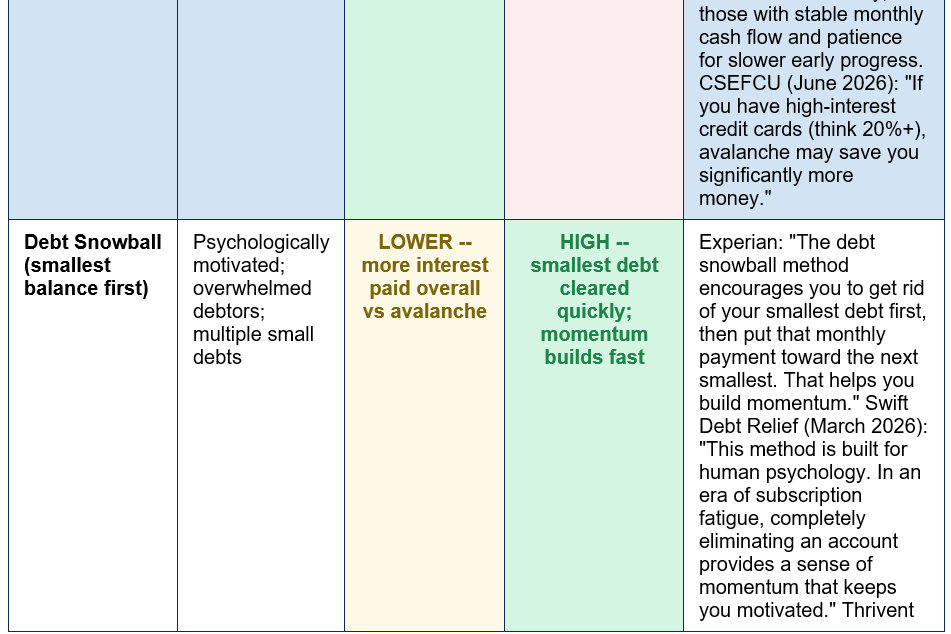
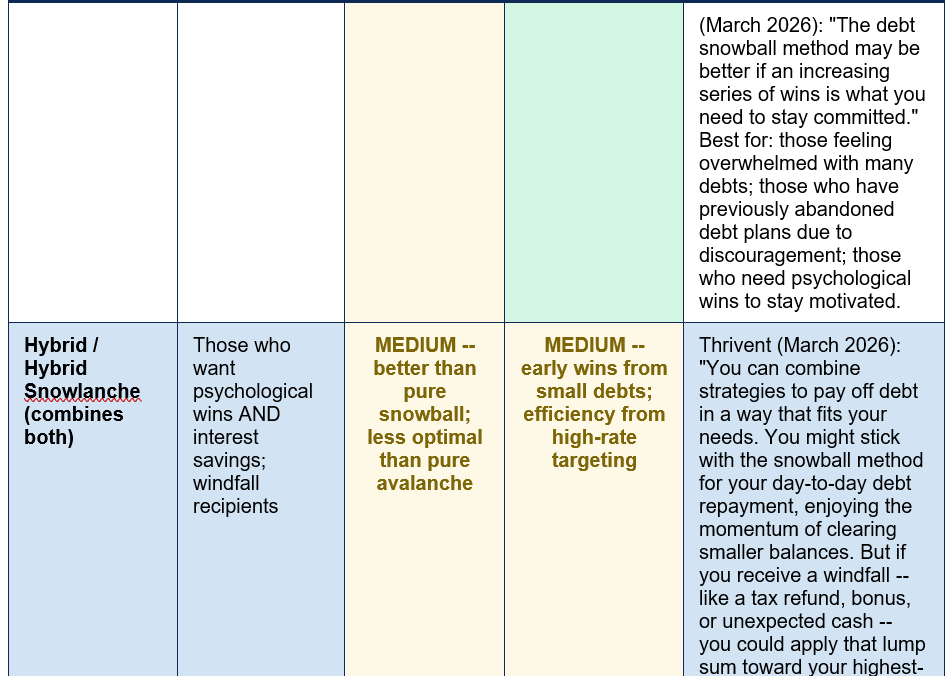
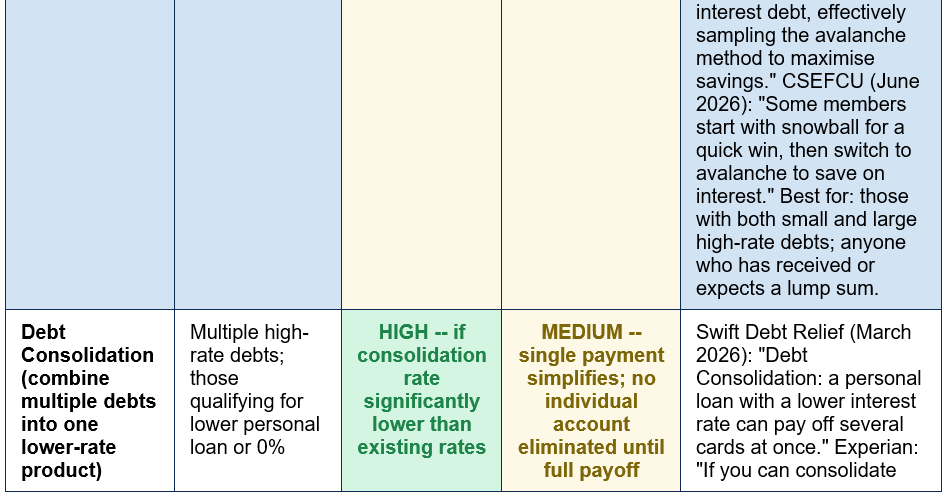
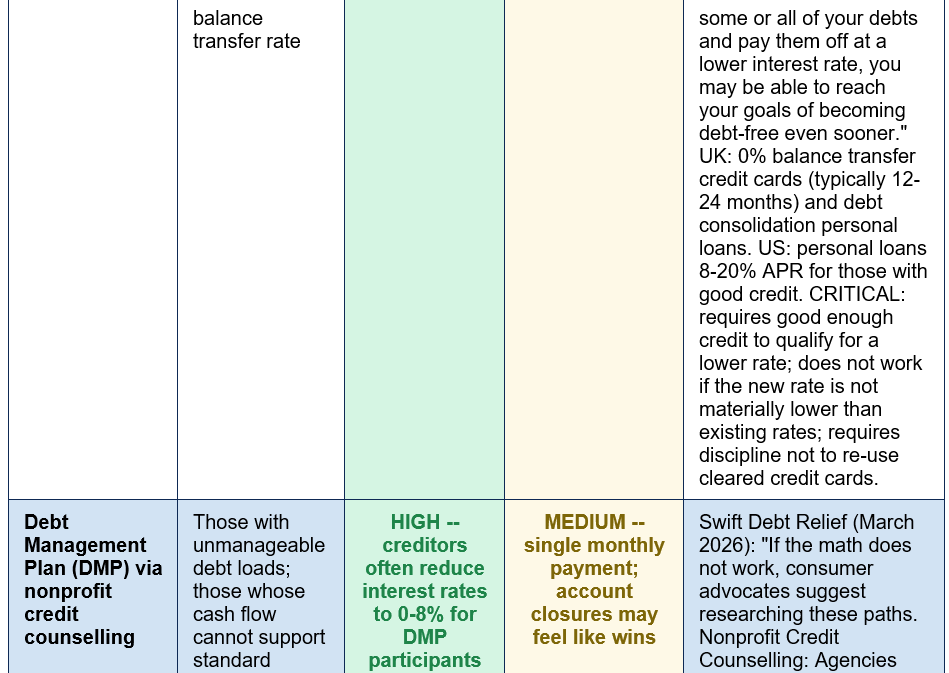
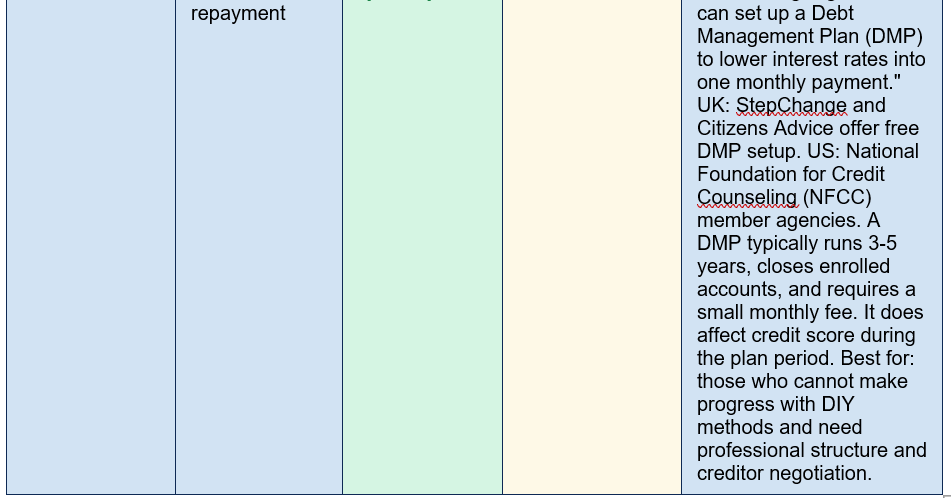
Before selecting a strategy, understand all available options. The following table maps every major debt payoff approach with its interest savings potential, speed of early wins, and the specific circumstances where each is most effective: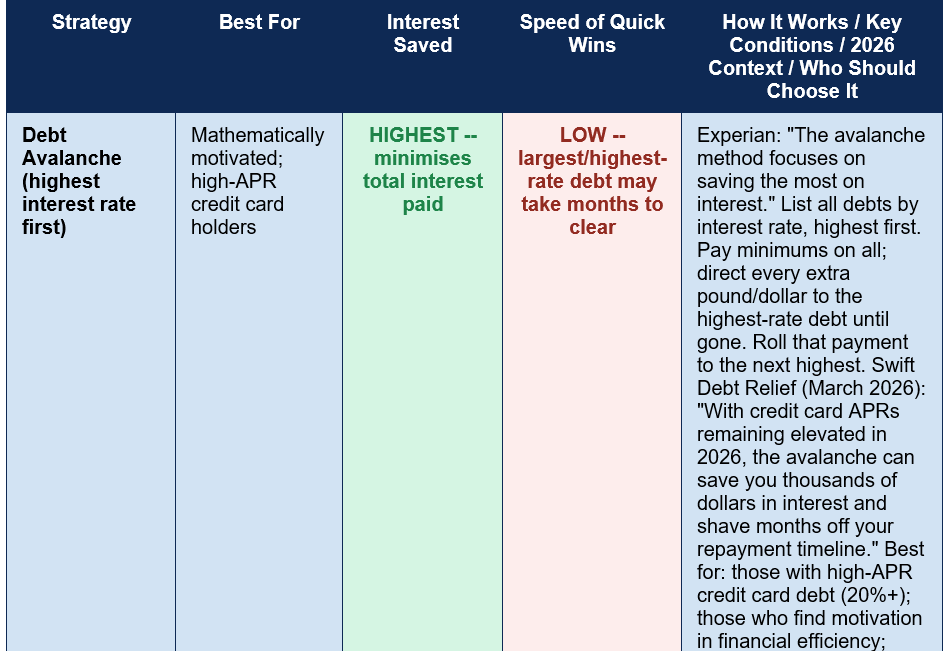
The Debt Avalanche: The Mathematical Winner
How the Debt Avalanche Works
The debt avalanche is the strategy that minimises total interest paid across all debts. The mechanics are straightforward: list all debts by interest rate, highest first. Pay the minimum required on every debt each month. Direct every available extra pound or dollar above the minimum payments to the debt with the highest interest rate. When that debt is cleared, roll the entire payment (minimum plus extra) to the next highest-rate debt. Continue until all debts are cleared.Experian: 'The avalanche method focuses on saving the most on interest.' Swift Debt Relief (March 2026): 'With credit card APRs remaining elevated in 2026, the avalanche can save you thousands of dollars in interest and shave months off your repayment timeline.' In an environment where UK credit card rates average around 24-35% APR and US rates sit at similar or higher levels, the compounding effect of leaving high-rate debt untouched while clearing lower-rate debt is substantial. Every month a 30% APR credit card balance goes unpaid generates significantly more interest than the same balance at 10% APR.
The Avalanche's One Significant Weakness
The avalanche's weakness is motivational, not mathematical. If the highest-rate debt is also the largest balance, it can take many months of consistent extra payments before any debt is cleared to zero. During that period, the person following the avalanche sees statements decreasing incrementally -- which is progress, but lacks the psychological punch of eliminating an account entirely. CSEFCU (June 2026): 'If you are feeling stuck or discouraged, snowball may help you stay consistent.' The avalanche is the right strategy for people who are genuinely motivated by the knowledge that they are minimising interest costs and who can tolerate a sustained period of slow visible progress.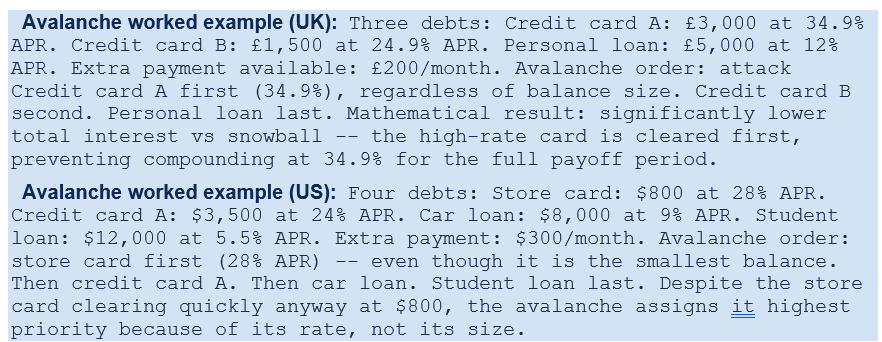
The Debt Snowball: The Psychological Champion
How the Debt Snowball Works
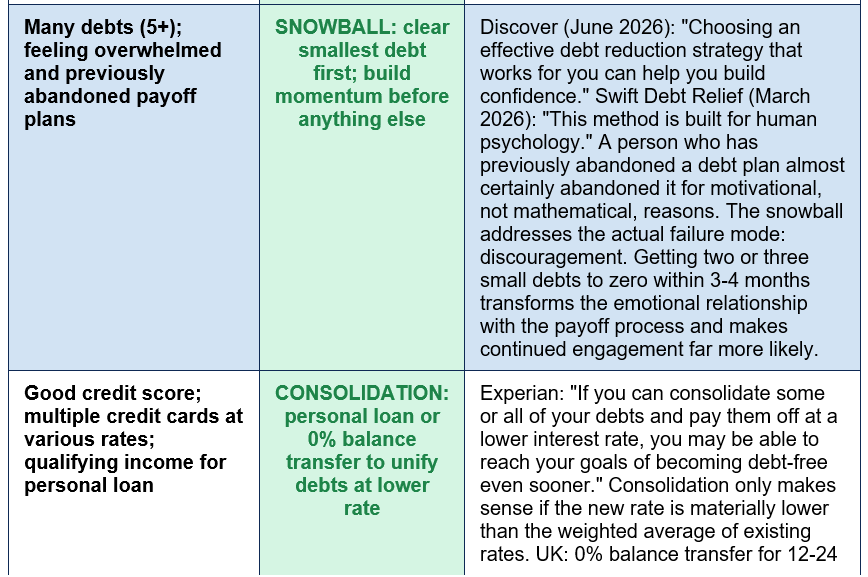
The debt snowball operates on the opposite sorting principle from the avalanche: list debts by balance, smallest first. Pay minimums on all debts. Direct every extra pound or dollar to the smallest balance. When that debt is cleared, roll the full payment to the next smallest. The name captures the mechanic -- payments compound ('snowball') as each cleared debt adds its minimum payment to the next target.Experian: 'The debt snowball method encourages you to get rid of your smallest debt first, then put that monthly payment toward the next smallest. That helps you build momentum by snowballing your payments as you pay off each debt.' Swift Debt Relief (March 2026): 'This method is built for human psychology. In an era of subscription fatigue, completely eliminating an account provides a sense of momentum that keeps you motivated.' The first debt cleared -- even if it is only a £200 catalogue balance or $500 store card -- represents a complete account removal. That tangible victory, the act of physically crossing a debt off the list, has documented positive effects on sustained financial behaviour.
The Snowball's Cost: Honest Accounting
The snowball costs more in interest than the avalanche in most scenarios where the smallest debts do not happen to also be the highest-rate debts. Experian: 'Less interest savings: the debt snowball method does not consider interest rates; it focuses on each debt's balance.' If a high-rate debt sits at a large balance while small low-rate debts are cleared first, the high-rate balance compounds through the entire early payoff period. The honest comparison: the snowball's extra interest cost is the price of maintaining motivation. For many people, that cost is worth paying -- because the alternative (abandoning the avalanche) costs infinitely more.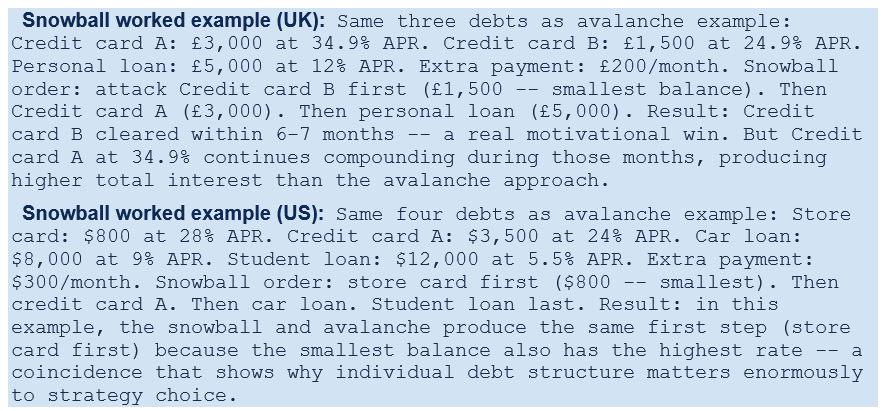
The Hybrid Approach: When One Size Does Not Fit All
Thrivent (March 24, 2026): 'The best approach does not have to be rigidly following one or the other. You can combine strategies to pay off debt in a way that fits your needs. For example, you might stick with the snowball method for your day-to-day debt repayment, enjoying the momentum of clearing smaller balances. But if you receive a windfall -- like a tax refund, bonus, or unexpected cash -- you could apply that lump sum toward your highest-interest debt, effectively sampling the avalanche method to maximise savings.' CSEFCU (June 2026): 'Some members start with snowball for a quick win, then switch to avalanche to save on interest. It is not about being perfect -- it is about being strategic and realistic.'The hybrid approach is particularly well-suited to the person who has both a psychological need for early wins (multiple small debts creating a sense of being overwhelmed) and a financial logic argument for targeting the highest-rate debt (a large credit card at 30%+ APR). The practical structure: identify any debts under £/$ 500-1,000 that can be cleared within 1-2 months using the snowball approach. Clear those immediately for the motivational reset they provide. Then switch to pure avalanche mechanics for all remaining debts. This sequence delivers the psychological benefit without abandoning the mathematical efficiency for the main payoff journey.
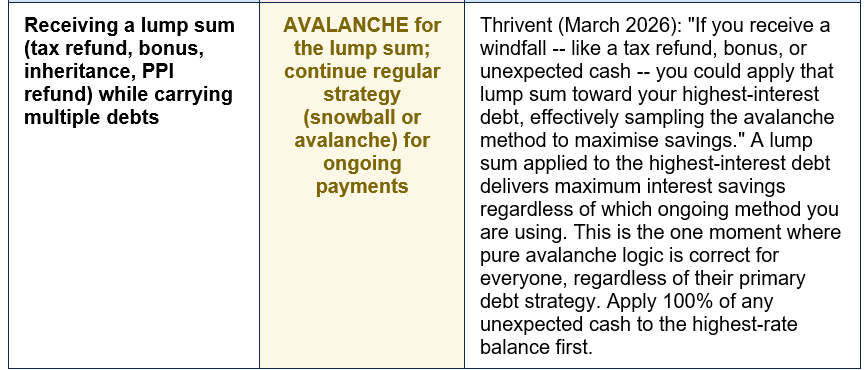
The windfall rule: the one moment where avalanche logic always wins. Regardless of which primary strategy you are following -- snowball, hybrid, or anything else -- when an unexpected lump sum arrives, always direct it to the highest-interest debt. Thrivent (March 2026): 'If you receive a windfall -- like a tax refund, bonus, or unexpected cash -- you could apply that lump sum toward your highest-interest debt to maximise savings.' A tax refund of £500 or $500 applied to a 34% APR credit card saves significantly more than the same amount applied to a 12% personal loan. The windfall rule is the single most financially effective application of debt repayment logic for most households, and it applies regardless of which ongoing method is being used.
Which Strategy Fits Your Circumstances? The Decision Matcher
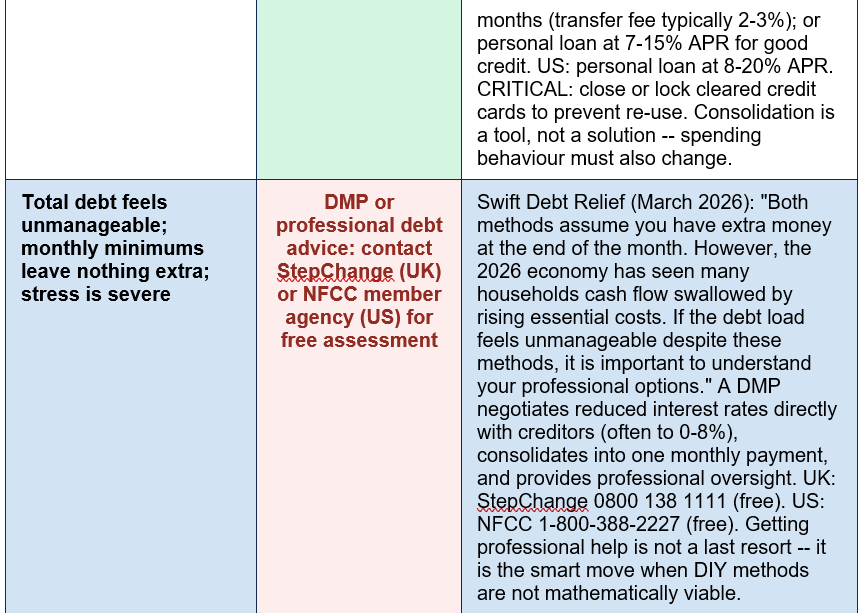
The right strategy depends on the specific combination of your debt structure, psychology, and cash flow. The following table maps six common financial circumstances to the strategy that best fits each, with the reasoning: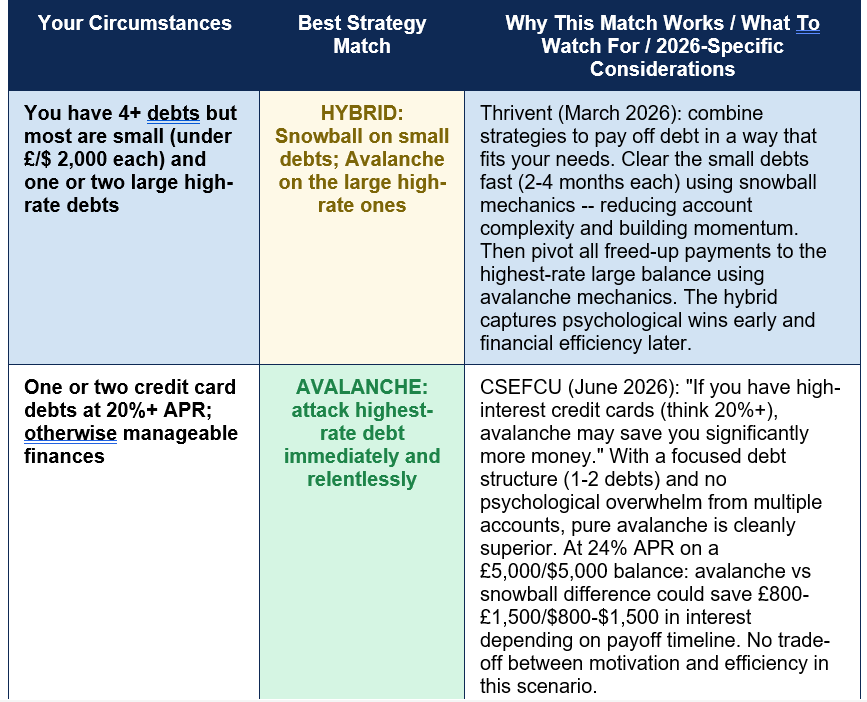
When DIY Strategies Are Not Enough: Professional Options for 2026
Not every debt situation is solvable with a self-directed strategy. Swift Debt Relief (March 4, 2026): 'Both methods assume you have extra money at the end of the month. However, the 2026 economy has seen many households cash flow swallowed by rising essential costs. If your debt load feels unmanageable despite these methods, it is important to understand your professional options.' Recognising when a DIY strategy cannot work is not failure -- it is financially intelligent realism.Debt Management Plan (DMP)
A Debt Management Plan is arranged through a nonprofit credit counselling agency (UK: StepChange, Citizens Advice, MoneyHelper; US: NFCC member agencies). The agency negotiates reduced interest rates directly with creditors -- often to 0-8% for enrolled accounts -- and consolidates all enrolled debts into a single affordable monthly payment to the agency, which distributes it to creditors. DMPs typically run 3-5 years. Enrolled accounts are closed. There is a mild credit score impact during the plan period. For people whose minimum payments alone consume most of their available cash, a DMP is frequently the most practical path to becoming debt-free. UK: StepChange 0800 138 1111 (free). US: NFCC 1-800-388-2227 (free).Debt Consolidation Loan or 0% Balance Transfer
For those with good enough credit to qualify, a debt consolidation loan (personal loan at a rate below the weighted average of existing debts) or a 0% balance transfer credit card (UK: typically 12-24 months at 0% APR with a 2-3% transfer fee) can dramatically reduce interest costs and simplify repayment to a single monthly payment. The critical discipline requirement: do not use the cleared credit cards for new spending. The consolidation creates the opportunity to become debt-free faster; spending on cleared cards destroys that opportunity by adding new debt at the original high rate.More Serious Options: IVA (UK) / Bankruptcy (UK and US)
For situations where total debt significantly exceeds repayment capacity even with professional negotiation -- Individual Voluntary Arrangement (IVA) in the UK, or Chapter 7/Chapter 13 bankruptcy in the US -- exist as formal legal mechanisms. These have significant credit consequences and require professional legal advice. They are not tools to be entered lightly, but they represent legitimate and legal paths for genuinely unmanageable debt situations. Free advice on whether these options are appropriate is available from: UK: MoneyHelper 0800 138 7777 | Citizens Advice 0800 144 8848. US: NFCC 1-800-388-2227 | consumerfinance.gov.How to Implement Your Chosen Strategy: A 4-Step Start Plan
- 1. Step 1 -- Map all your debts completely: Before any strategy can be applied, you need a complete, accurate list of every debt. For each debt: lender name and account number; current outstanding balance; interest rate (APR or EAR); minimum monthly payment; any promotional rate end date (for 0% balance transfers). UMB Blog (June 2026): 'Debt can pile up faster than snow in a blizzard.' Most people underestimate their total debt until they write it all down in one place. A spreadsheet or a notes document -- whatever format you will maintain -- is sufficient.
- 2. Step 2 -- Calculate your available extra monthly payment: Total your net monthly income. Subtract all fixed essential outgoings (rent/mortgage, utilities, essential groceries, minimum debt payments, insurance, transport). The remainder is your discretionary amount. From this, subtract a realistic estimate of non-negotiable variable spending. What remains -- even if it is only £50 or $50 per month -- is your extra debt payment. This is the number that gets directed strategically. If this number is zero or negative, DIY strategies are not viable and professional advice is the right next step.
- 3. Step 3 -- Sort your debts according to your chosen strategy: Snowball: sort by balance, lowest first. Avalanche: sort by interest rate, highest first. Hybrid: identify any debts under £/$ 1,000 that can be cleared in 1-2 months (snowball those first), then sort remaining debts by interest rate (avalanche from there). The sort order determines where your extra payment goes each month. Every other debt receives only the minimum. No exceptions.
- 4. Step 4 -- Automate and protect the strategy: Protective: 'You cannot change what you do not measure.' Set up a standing order or automatic payment for the minimum on every debt that is not your current target. Set up the extra payment to the target debt as a manual or additional payment each month. Track progress monthly -- seeing the target balance fall each month is the feedback mechanism that sustains the behaviour. Protect the strategy from disruption: build a small emergency fund (£500-£1,000 / $500-$1,000) before accelerating debt payments, so an unexpected cost does not trigger credit card use that resets progress.
YOUR DEBT STRATEGY SELECTION CHECKLIST -- 2026: QUESTION 1: Do I have any debts under £/$1,000 that I could clear within 1-2 months with focused extra payments? YES: consider starting with snowball on those for a motivational reset, then re-evaluate. NO: proceed to Question 2. QUESTION 2: Are any of my debts at 20%+ APR? YES: avalanche is strongly indicated -- CSEFCU (June 2026): "avalanche may save significantly more money." NO: snowball or hybrid may be appropriate since the interest savings from avalanche are smaller. QUESTION 3: Have I previously abandoned a debt payoff plan? YES: strong indicator for snowball or hybrid -- the previous abandonment was probably motivational. NO: avalanche remains viable if you can tolerate slow early progress. QUESTION 4: Do I have good credit and could I qualify for a consolidation loan or 0% balance transfer at a rate below my current weighted average? YES: consolidation should be modelled -- it may be faster and cheaper than either snowball or avalanche. QUESTION 5: After paying all minimum payments and essential living costs, do I have any money left over each month? NO: contact StepChange (UK: 0800 138 1111) or NFCC (US: 1-800-388-2227) for free professional assessment. A DMP may be more appropriate than a DIY strategy. YES: proceed with your chosen strategy. Remember: the best strategy is the one you will maintain. An imperfect strategy consistently applied beats a perfect strategy abandoned.
FIVE DEBT STRATEGY MISTAKES THAT SLOW PROGRESS OR CAUSE ABANDONMENT: (1) CHOOSING AVALANCHE WHEN YOUR HIGHEST-RATE DEBT IS ALSO YOUR LARGEST AND MOST DEMORALISING. The avalanche is mathematically optimal but motivationally demanding. If your 30% APR credit card also happens to be your largest balance, you may face 12-18 months of slow progress before any account clears to zero. If previous debt plans have failed for motivational reasons, the avalanche may be wrong for you regardless of its interest savings. (2) IGNORING THE WINDFALL RULE. Thrivent (March 2026): if you receive a windfall -- tax refund, bonus, or unexpected cash -- apply it to your highest-interest debt. Many people spend unexpected income on purchases rather than debt, missing the single most impactful debt reduction opportunity available to them. (3) CONSOLIDATING DEBT AND THEN RE-USING THE CLEARED CREDIT CARDS. Experian: consolidation only works if the cleared cards are not re-used. The consolidation creates a lower-rate single payment; spending on cleared cards creates high-rate new debt simultaneously. Consolidation without changed spending behaviour produces a net increase in total debt. (4) NOT BUILDING A SMALL EMERGENCY FUND BEFORE ACCELERATING DEBT REPAYMENT. Without a £500-£1,000 or $500-$1,000 buffer, any unexpected cost (car repair, medical bill, appliance failure) will be charged to a credit card -- potentially wiping out months of debt progress in a single transaction. Thrivent (March 2026): 'You could accrue credit card debt for things like an unexpected medical bill or car repair, which could derail your progress toward becoming debt-free.' (5) SWITCHING STRATEGIES TOO FREQUENTLY. Changing from snowball to avalanche to hybrid every 6-8 weeks because a different approach 'sounds better' produces no consistent execution on any method and wastes months. Choose a strategy, implement it for at least 6 months, and only adjust if the circumstances that determined the choice have materially changed.
Conclusion
The question 'which debt payoff strategy is best?' does not have a universal answer -- and that is precisely the point of this guide. Discover (June 11, 2026): 'The method you choose for paying off debt depends on your mindset and your approach to finances.' The debt avalanche minimises total interest paid and is mathematically superior for most debt structures -- particularly in 2026 with credit card APRs remaining elevated. The debt snowball maximises early psychological wins and is behaviourally superior for people who need momentum to maintain commitment. The hybrid combines both. Consolidation resets the interest environment. A DMP or professional support intervenes when DIY methods are not viable.The decision tree is straightforward: if your highest-rate debt is also manageable in size and you can tolerate slow early progress, use avalanche. If you are overwhelmed, have many debts, or have previously abandoned a debt plan, use snowball or hybrid. If you have good credit and multiple high-rate debts, explore consolidation. If your cash flow cannot support extra payments above minimums, seek free professional debt advice before anything else. Thrivent (March 24, 2026): 'You just need a plan.'
The implementation discipline that makes any strategy work is consistent: map all debts completely; calculate your real available extra payment; sort debts according to your chosen method; direct the extra payment there every single month without exception; automate minimums everywhere else; build a small emergency buffer to protect the strategy from disruption; and apply any unexpected lump sums to the highest-rate balance regardless of which ongoing strategy you are using. CSEFCU (June 2026): 'It is not about being perfect -- it is about being strategic and realistic.' The strategy that gets you to debt-free is always the right one.
Frequently Asked Questions (FAQ)
What is the debt avalanche method and how does it work?The debt avalanche is a debt payoff strategy that prioritises debts by interest rate, targeting the highest-rate debt first regardless of its balance size. Experian: 'The avalanche method focuses on saving the most on interest.' The steps: list all debts by interest rate, highest first; pay the minimum required on every debt each month; direct every extra pound or dollar above minimums to the debt with the highest interest rate; when that debt is cleared, roll the full payment (minimum plus extra) to the next highest-rate debt. Swift Debt Relief (March 2026): 'With credit card APRs remaining elevated in 2026, the avalanche can save you thousands of dollars in interest and shave months off your repayment timeline.' The avalanche is mathematically optimal in almost all scenarios where the goal is minimising total interest paid. Its main weakness is motivational: if the highest-rate debt is also the largest balance, progress is slow in the early months and no account clears to zero quickly. This can be demoralising for some people. CSEFCU (June 2026): 'If you have high-interest credit cards (think 20%+), avalanche may save you significantly more money.'
What is the debt snowball method and who should use it?
The debt snowball is a debt payoff strategy that prioritises debts by balance, targeting the smallest balance first regardless of interest rate. Experian: 'The debt snowball method encourages you to get rid of your smallest debt first, then put that monthly payment toward the next smallest. That helps you build momentum by snowballing your payments.' The steps: list all debts by balance, smallest first; pay minimums on all; direct every extra payment to the smallest balance; when cleared, roll the entire payment to the next smallest. Swift Debt Relief (March 2026): 'This method is built for human psychology. In an era of subscription fatigue, completely eliminating an account provides a sense of momentum that keeps you motivated.' The snowball is most appropriate for: people who feel overwhelmed by multiple debts and need early wins to maintain commitment; people who have previously abandoned debt plans; people with many small debts that can be cleared quickly. Its cost: it typically produces more total interest paid than the avalanche because high-rate large debts are left compounding while small low-rate debts are cleared first. Thrivent (March 2026): 'The debt snowball method may be better if an increasing series of wins is what you need to stay committed.'
Is the debt avalanche or debt snowball better in 2026?
Neither is universally better -- the best method is the one that fits your circumstances and that you will actually maintain. Swift Debt Relief (March 2026): 'The choice between the Debt Snowball and the Debt Avalanche is not just a matter of preference -- it is about choosing the engine that will actually get you to the finish line.' In 2026 specifically, with credit card APRs remaining elevated, the avalanche carries greater financial advantage than in lower-rate environments -- because the cost of leaving high-rate debt untouched while clearing low-rate balances is higher when APRs are high. CSEFCU (June 2026): 'If you have high-interest credit cards (think 20%+), avalanche may save you significantly more money.' But Discover (June 11, 2026): 'The method you choose for paying off debt depends on your mindset and your approach to finances. One is not necessarily better than the other.' If the avalanche's slow early progress means you abandon the plan within 6 months, the snowball (which you maintain for 3 years) produces a better outcome. Thrivent (March 2026): 'You can combine strategies -- start with snowball for a quick win, then switch to avalanche to save on interest.' The hybrid approach is the practical answer for most people who find the pure choice difficult.
What is a hybrid debt payoff strategy?
A hybrid debt payoff strategy combines elements of the debt snowball and the debt avalanche to capture the psychological benefits of early wins while preserving the financial efficiency of targeting high-rate debt. Thrivent (March 24, 2026): 'The best approach does not have to be rigidly following one or the other. You can combine strategies to pay off debt in a way that fits your needs. You might stick with the snowball method for your day-to-day debt repayment, enjoying the momentum of clearing smaller balances. But if you receive a windfall -- like a tax refund, bonus, or unexpected cash -- you could apply that lump sum toward your highest-interest debt, effectively sampling the avalanche method to maximise savings.' CSEFCU (June 2026): 'Some members start with snowball for a quick win, then switch to avalanche to save on interest. It is not about being perfect -- it is about being strategic and realistic.' In practice: a useful hybrid structure is to identify any debts under £/$1,000 that can be cleared within 1-2 months using snowball mechanics -- delivering immediate psychological wins -- then switch to pure avalanche mechanics for all remaining debts. This provides the motivational reset of the snowball without sacrificing the long-term mathematical efficiency of the avalanche for the bulk of the payoff journey.
What should I do if I cannot afford extra payments above the minimums?
If your monthly cash flow after all essential costs and minimum debt payments leaves nothing available as an extra payment, self-directed debt payoff strategies (snowball, avalanche, hybrid) are not mathematically viable -- and attempting them without acknowledging this produces guilt and discouragement without progress. Swift Debt Relief (March 2026): 'Both methods assume you have extra money at the end of the month. However, the 2026 economy has seen many households cash flow swallowed by rising essential costs. If the debt load feels unmanageable despite these methods, it is important to understand your professional options.' The appropriate next step is free professional debt advice: in the UK, contact StepChange (0800 138 1111), MoneyHelper (0800 138 7777), or Citizens Advice (0800 144 8848). In the US, contact the NFCC (1-800-388-2227) or the CFPB at consumerfinance.gov. A nonprofit credit counsellor can assess whether a Debt Management Plan (which negotiates reduced interest rates with creditors and consolidates into one affordable monthly payment) is appropriate for your situation. Getting professional help is not a last resort -- it is the right move when the maths of self-directed repayment do not work. It is also free from regulated nonprofit agencies in both the UK and the US.

0 Comments Comments