

Credits
Can You Inherit Debt? Accountant Explains

Table of Contents
- The Question That Arrives at the Worst Possible Moment
- The Core Answer: What Actually Happens to Debt When Someone Dies?
- UK Rules: What Happens to Each Type of Debt After Death?
- The Priority Order: How an Insolvent Estate Pays Its Debts
- UK vs US: The Key Differences in Inheriting Debt
- When Can Creditors Legally Contact You About Someone Else's Debt?
- UK Rules on Creditor Contact After Death
- US Rules on Creditor Contact After Death
- Practical Scenarios: The Accountant's Worked Examples
- How to Protect Your Family From Debt at Death: Planning Ahead
- Conclusion
- Frequently Asked Questions (FAQ)
The Question That Arrives at the Worst Possible Moment
When a loved one dies, grief is typically the first overwhelming reality. The letters from banks and credit card companies often come second -- sometimes before the funeral, and occasionally written in language that implies personal liability for debts the recipient never took out. The question these letters force is one of the most feared in personal finance: can you inherit someone else's debt? Can a parent's credit card balance become your legal responsibility? Can a spouse's loans follow you beyond their death?Wilkin Chapman (January 2025): '44% of Brits are now classed as financially vulnerable. 7.4 million of us feel heavily burdened by debt and the average household is steadily incurring more debt.' With this backdrop, the question of inherited debt is no longer academic -- it is a practical, urgent reality for a significant proportion of families dealing with bereavement. And yet it is also a question surrounded by widespread misunderstanding, often exploited by creditors who contact family members with demands that have no legal basis.
The accountant's answer to 'can you inherit debt?' is neither a simple yes nor a simple no. The accurate answer depends on: whether the debt was in the deceased's sole name or held jointly; whether anyone was a guarantor for the debt; what assets the estate contains and whether those assets cover the debts; what type of debt it is (mortgage, credit card, student loan, tax); and -- in the US -- what state the person lived in. This guide covers every variation of the answer in detail, for both the UK (England and Wales) and the US, grounded in current 2026 guidance and real legal rules rather than the myths that circulate widely at moments of bereavement.
The Core Answer: What Actually Happens to Debt When Someone Dies?
The starting point -- and for most people, the reassuring answer -- is this: in the UK and in most US states, you do not personally inherit debt from a deceased family member simply by virtue of being related to them or being named in their will. Octopus Legacy (March 2026, Legacy Adviser Eliza Elliott): 'In England and Wales, debts are not inherited by your family. Instead, they are paid from your estate -- everything you own -- after you die. If there is not enough in the estate to cover what is owed, most debts are simply written off. Your loved ones will not be chased for the shortfall.'This is the foundational rule. Debts belong to the person who incurred them. When that person dies, the debts become the responsibility of their estate -- not of their relatives. The estate is the legal entity comprising everything the deceased owned at the time of death: money, property, investments, possessions, business interests. The executor of the will (or the administrator of the estate if there is no will) is responsible for identifying all debts, and settling them from estate assets before distributing any inheritance to beneficiaries. MP Estate Planning (November 2025): 'The executor or administrator is responsible for identifying all outstanding liabilities -- including mortgages, personal loans, credit cards, and inheritance tax bills -- and settling them in a specific order of priority set by law.'
This process is called probate in England and Wales (and a similar process operates in the US). It can take months for complex estates and the debts owed reduce what beneficiaries ultimately receive -- sometimes to nothing if the estate is insolvent. But the critical point stands: the reduction in inheritance is not the same as personal liability for the debt. A beneficiary who receives £0 because debts consumed the estate has not inherited debt. They have inherited a smaller (or zero) sum. The distinction is legally and financially significant.
Debt and death in 2026 -- the context: 44% of Brits financially vulnerable. 7.4 million feel heavily burdened by debt. Estate pays debts first. Student loans written off on death. Joint debts pass to survivor. — Wilkin Chapman (January 2025): '44% of Brits are now classed as financially vulnerable. 7.4 million of us feel heavily burdened by debt.' Octopus Legacy (March 2026): 'Debts are not inherited by your family. Instead they are paid from your estate. If there is not enough in the estate, most debts are simply written off. Your loved ones will not be chased for the shortfall.' UK Debt Expert: 'In the UK, you cannot inherit debt from a parent or spouse after they die.' NBS (September 2025): 'Joint debts become the full responsibility of the surviving account holder.'
UK Rules: What Happens to Each Type of Debt After Death?
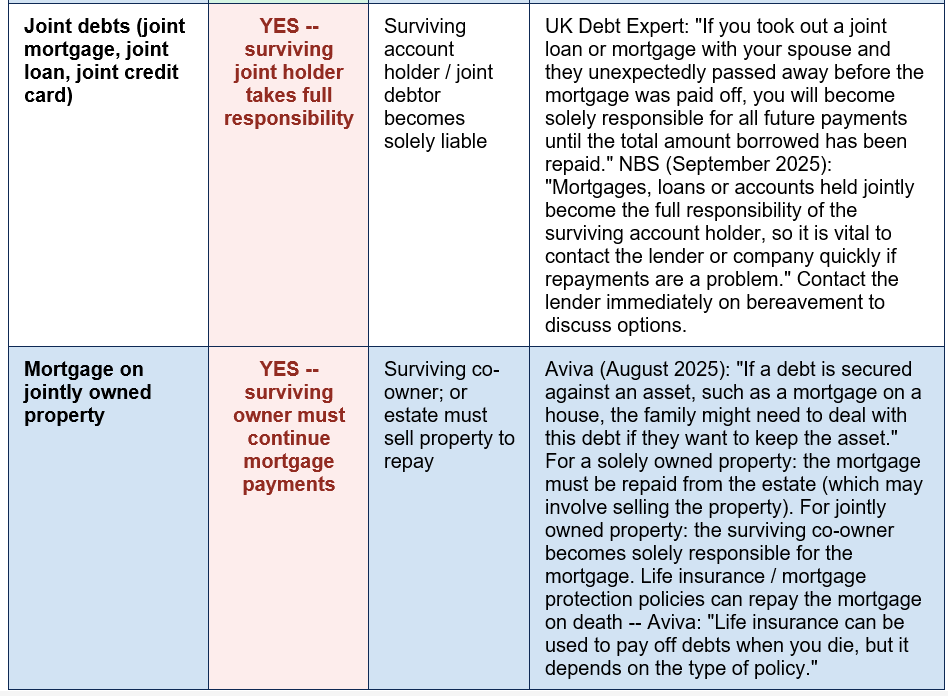
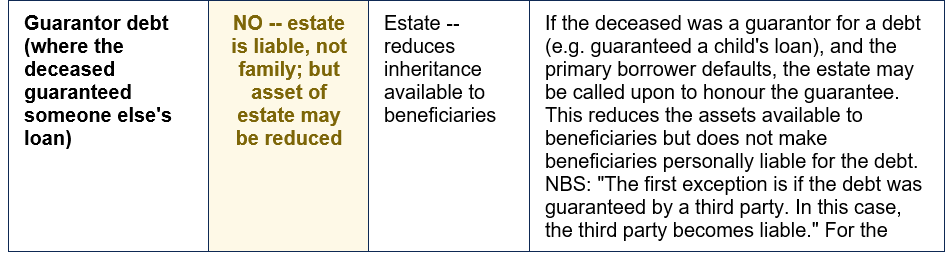
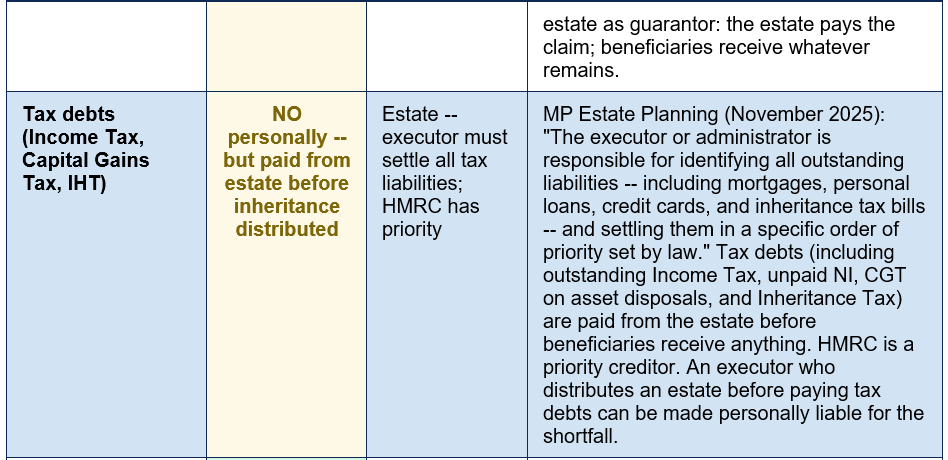
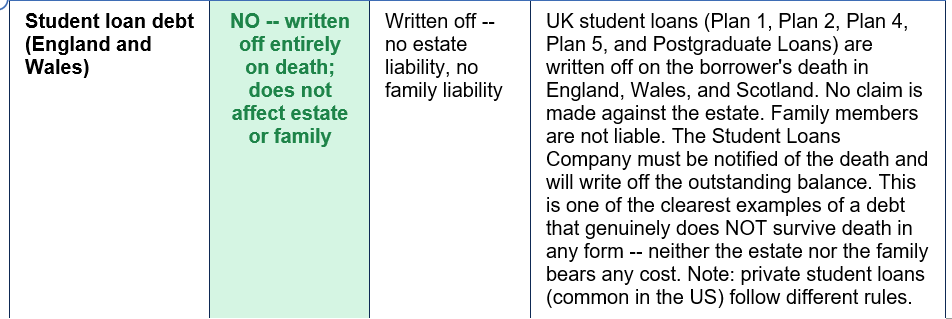
The general rule that debt is not personally inherited by family has important exceptions and nuances that vary by debt type. The following table maps every major debt category with who is responsible, who pays, and the applicable 2026 rules in England and Wales: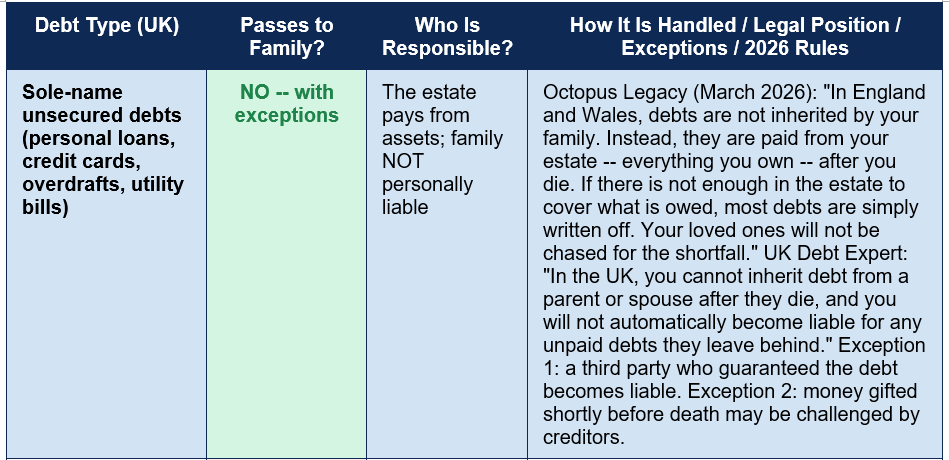
The Priority Order: How an Insolvent Estate Pays Its Debts
When an estate has insufficient assets to pay all its debts -- an 'insolvent estate' -- the law in England and Wales sets out a strict priority order for which creditors are paid first. Understanding this order is important for executors (who must follow it to avoid personal liability) and for beneficiaries (who need to understand why they may receive less than expected):- First -- Funeral expenses and testamentary costs: Reasonable funeral costs and the costs of administering the estate (executor fees, probate court fees, solicitor fees for estate administration) are paid first, before any creditors. MP Estate Planning (November 2025): 'Certain funeral expenses and testamentary costs generally take precedence.' This means that even in an insolvent estate, a dignified funeral can typically be funded from the estate assets.
- Second -- Secured debts: Debts secured against specific assets -- typically mortgages on property. If a mortgage is unpaid, the lender can enforce their security against the property. If the property is sold to repay the mortgage, any surplus goes into the estate; any shortfall remains a claim against the estate.
- Third -- Preferential debts: Under the Insolvency Act 1986, certain creditors have preferential status. In practice for personal estates, this category includes employee wages owed by a deceased employer.
- Fourth -- HMRC and tax debts: Outstanding Income Tax, National Insurance, Capital Gains Tax, and Inheritance Tax are paid at this priority level. HMRC is a significant creditor in many estates and must be paid before unsecured commercial creditors.
- Fifth -- Unsecured creditors: Credit card companies, personal loan providers, utility companies, and other unsecured creditors are paid at this level. If the estate is insolvent and assets are exhausted before reaching this category, these creditors receive proportionally less or nothing -- and the family is not personally liable for the shortfall.
- Last -- Beneficiaries receive the remainder: Only after all debts, taxes, and administration costs are paid do the beneficiaries of the will receive their inheritance. Unwildered: 'If there is £50,000 in the bank and £10,000 in debt, beneficiaries get £40,000.' If the estate is insolvent: beneficiaries receive nothing, but owe nothing personally.
The executor's personal liability risk: the most critical rule for anyone acting as executor. An executor who distributes estate assets to beneficiaries before all debts and taxes are paid can be made personally liable for those debts up to the value of assets distributed. This is not a hypothetical risk -- HMRC in particular actively pursues executors who distribute estates with outstanding tax liabilities. Before distributing any inheritance: obtain a full list of all debts (request a deceased estates notice in the London Gazette to identify unknown creditors); confirm all HMRC liabilities are settled; and consider seeking indemnity insurance. MP Estate Planning (November 2025): 'The executor or administrator is responsible for identifying all outstanding liabilities and settling them in a specific order of priority set by law.' If in doubt, seek a probate solicitor's advice before distributing.
UK vs US: The Key Differences in Inheriting Debt
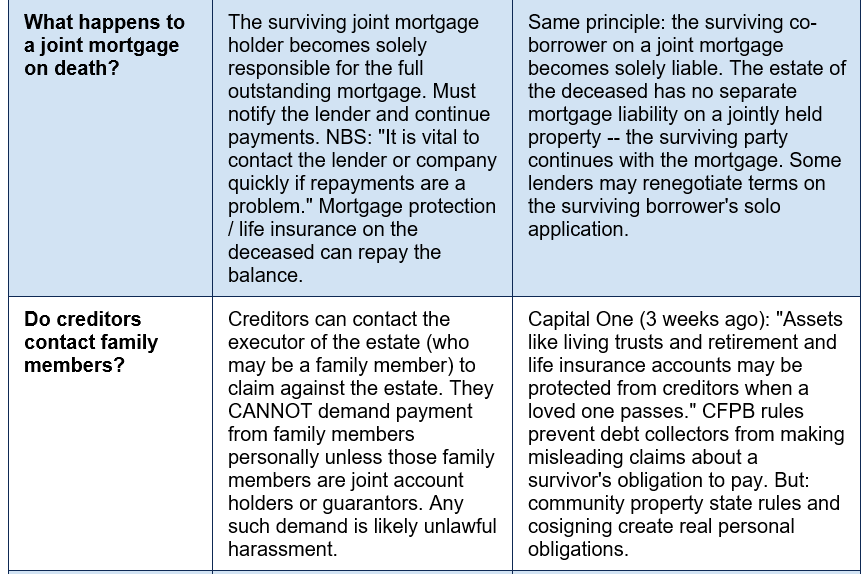
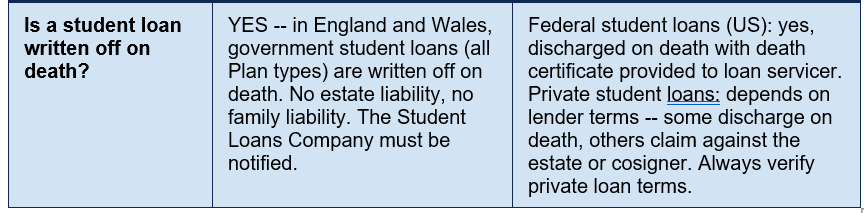
The UK and US share the foundational principle that debts belong to the estate, not automatically to the family -- but the US adds complexity through state-level variation. The following table maps the key questions across both jurisdictions: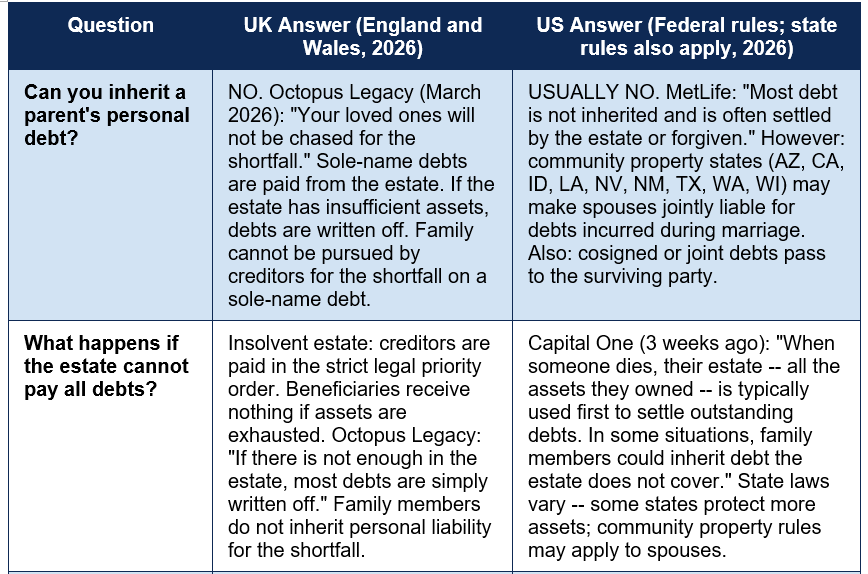
When Can Creditors Legally Contact You About Someone Else's Debt?
One of the most distressing experiences following a bereavement is receiving letters or calls from creditors demanding payment for the deceased's debts. Understanding the legal boundaries of what creditors can and cannot do is essential:UK Rules on Creditor Contact After Death
In the UK, creditors have the right to contact the executor of the estate to pursue a claim against the estate. They do NOT have the right to demand personal payment from family members who are not joint account holders or guarantors. A creditor who contacts a family member and implies or demands that they personally pay the deceased's sole-name debt is making a demand with no legal basis. UK Debt Expert: 'Even if you are the executor of their will, you will not be responsible for repaying the debt, only ensuring the debt gets paid from the person's estate. This means that the debt can be repaid through the sale of their assets, and the money does not necessarily have to come from you or your bank account.'If you receive a demand for payment of a deceased person's sole-name debt addressed to you personally (not as executor), you should: write to the creditor confirming you are not a joint account holder or guarantor; state that you are not personally liable for this debt; provide the name of the executor who should be contacted for estate claims; and if harassment continues, report the creditor to the Financial Conduct Authority (FCA) or the Financial Ombudsman Service. UK Debt Expert: 'Inherited debt is any financial obligation passed down to an heir after a bereavement. The only way you will become legally responsible for a debt after a loved one dies is if you are listed on the credit agreement as a co-signer, guarantor, or joint debtor.'
US Rules on Creditor Contact After Death
In the US, the Fair Debt Collection Practices Act (FDCPA) governs what debt collectors can do when pursuing a deceased person's debts. Collectors can contact the deceased's spouse, executor, administrator, or -- in community property states -- the surviving spouse about shared debts. They cannot demand that other family members (children, siblings, parents) pay debts they did not sign for. Capital One (3 weeks ago): 'Assets like living trusts and retirement and life insurance accounts may be protected from creditors when a loved one passes.' MetLife: 'If someone dies with debt, it is important to know that debt collectors are not allowed to mislead survivors about their responsibility for the deceased's debts.' If you believe a debt collector is making unlawful demands about a deceased person's sole-name debt, report the complaint to the Consumer Financial Protection Bureau (CFPB) at consumerfinance.gov.Practical Scenarios: The Accountant's Worked Examples
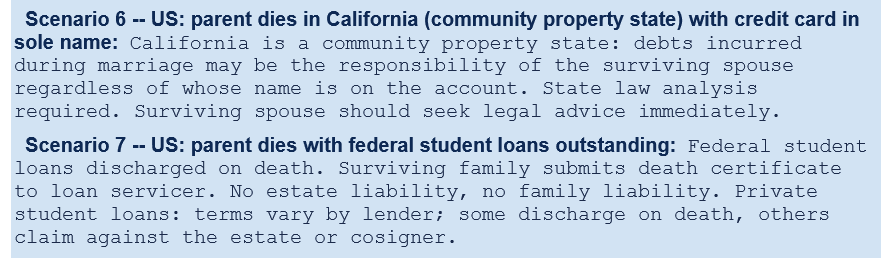
The rules become clearer through real-world scenarios. The following examples illustrate how the rules apply to common situations: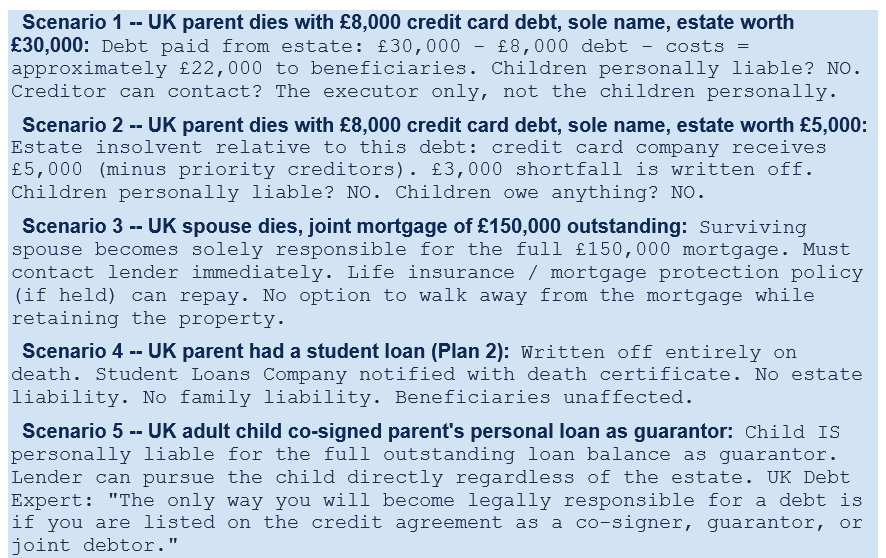
How to Protect Your Family From Debt at Death: Planning Ahead
Understanding what happens to debt after death is valuable both when dealing with a bereavement and when planning for your own death. The following actions reduce the financial burden on your family when you die:- Write a will and keep it updated: An up-to-date will enables the estate to be administered efficiently and in accordance with your wishes. Without a will, intestacy rules apply -- which determine how assets are distributed and who acts as administrator. Both the UK and US have well-defined intestacy rules, but they may not reflect your actual wishes and can create complications that delay debt settlement and distribution.
- Maintain a debt and financial summary document: Leave a clear, accessible record of all debts (lender name, account number, outstanding balance, direct debit details), all assets (bank accounts, investments, property, insurance policies), and all regular financial commitments. This document dramatically reduces the administrative burden on the executor and reduces the risk of unknown debts emerging after distribution has begun. Store it with or near your will.
- Consider life insurance and mortgage protection policies: Aviva (August 2025): 'Life insurance can be used to pay off debts when you die, but it depends on the type of policy.' A level-term or decreasing-term life insurance policy (UK) or term life policy (US) can ensure that a mortgage or other significant debt is repaid on death, protecting the surviving family member from financial hardship. Mortgage protection insurance specifically matches the outstanding mortgage balance -- particularly important for joint mortgage holders.
- Be cautious before becoming a guarantor or joint account holder: UK Debt Expert: 'The only way you will become legally responsible for a debt after a loved one dies is if you are listed on the credit agreement as a co-signer, guarantor, or joint debtor.' Before agreeing to guarantee someone else's debt or open a joint account, understand that this creates personal liability that survives their death. It is not the most common way to inherit debt -- but it is one that is fully preventable by careful decision-making at the point of signing.
- Consider placing assets in trust where appropriate: Capital One (3 weeks ago): 'Assets like living trusts and retirement and life insurance accounts may be protected from creditors when a loved one passes.' In the US, assets placed in a properly structured living trust can bypass probate and may be protected from creditors. In the UK, certain trust structures can protect assets from estate creditors. This is a complex area -- seek qualified legal advice specific to your jurisdiction before taking action.
- Review jointly held debts and joint accounts regularly: Any debt held jointly is the full responsibility of the surviving party. Review all joint financial products regularly to understand the exposure. Where a joint debt is primarily the responsibility of one party but held jointly for practical reasons, consider whether a specific insurance product or repayment plan would protect the other party's position on death.
WHAT TO DO IF A LOVED ONE HAS JUST DIED -- IMMEDIATE DEBT MANAGEMENT STEPS: STEP 1: Do not pay any debts from your own money. UK Debt Expert: "Even if you are the executor, you are not responsible for repaying debts from your own funds." Debts are settled from estate assets, not from your personal money. STEP 2: Contact all lenders to notify them of the death. Most lenders have bereavement teams. They will freeze accounts and stop adding interest in many cases while probate is in progress. Provide the death certificate. STEP 3: Do not distribute any assets or money until all debts and taxes are identified and settled. An executor who distributes before paying debts can be made personally liable for the shortfall. STEP 4: Advertise for unknown creditors via a notice in the London Gazette (UK) or equivalent (US) to protect the executor from future claims. STEP 5: If creditors contact you personally demanding payment for a sole-name debt you did not co-sign or guarantee, write to them stating you are not personally liable. Report unlawful demands to the FCA (UK) or CFPB (US). STEP 6: Seek professional advice for complex estates. UK: Citizens Advice 0800 144 8848 | MoneyHelper 0800 138 7777 | probate solicitor. US: estate attorney | CFPB consumerfinance.gov. STEP 7: Check for life insurance or mortgage protection policies that can repay debts on death -- these significantly reduce the burden on the estate and surviving family members.
FIVE INHERITED DEBT MYTHS THAT CAUSE REAL HARM: (1) 'I HAVE TO PAY MY PARENT'S CREDIT CARD DEBT.' UK Debt Expert: 'In the UK, you cannot inherit debt from a parent or spouse after they die.' Sole-name debts are paid from the estate. Family members are not personally liable for the shortfall. If a creditor tells you otherwise about a sole-name debt, this is misinformation. (2) 'AS THE EXECUTOR, I AM RESPONSIBLE FOR THE DEBTS.' The executor is responsible for ADMINISTERING the estate and paying debts from estate assets -- not from their own money. UK Debt Expert: 'Even if you are the executor of their will, you will not be responsible for repaying the debt, only ensuring the debt gets paid from the person's estate.' The exception: an executor who distributes estate assets before paying debts CAN be made personally liable. (3) 'STUDENT LOANS ARE AN INHERITED DEBT.' UK government student loans (all Plan types) are written off entirely on death. No estate liability. No family liability. (4) 'THE ESTATE DOES NOT HAVE MUCH SO THE DEBT COLLECTORS CANNOT GET ANYTHING FROM FAMILY.' This is correct -- but there is an important nuance. If any family member is a joint account holder or guarantor for any debt, they ARE personally liable for that specific debt regardless of the estate position. Insolvent estate protects family from the deceased's sole-name debts; it does not protect a guarantor from their own legal obligation. (5) 'DEBTS DISAPPEAR WHEN YOU DIE.' Octopus Legacy (March 2026): 'No -- your debts do not automatically die with you.' They become the estate's responsibility. This means they reduce the inheritance available to beneficiaries and, if the estate is insolvent, beneficiaries may receive nothing.
Conclusion
The accountant's answer to 'can you inherit debt?' is reassuringly clear in most cases, but requires careful attention to the specific circumstances. In the UK (England and Wales), sole-name debts are not personally inherited by family -- they are paid from the deceased's estate, and if the estate is insufficient, most debts are written off with no personal liability passing to relatives. In the US, the same principle generally applies to most states, with important exceptions for community property states and cosigned debts.The exceptions that create genuine personal liability are consistent across both jurisdictions: joint debts (mortgages, loans, credit accounts held jointly) pass fully to the surviving party; guarantor obligations create personal liability for the guarantor; and in US community property states, spouses may be jointly liable for debts incurred during marriage. These exceptions are not obscure edge cases -- they are the situations that millions of families encounter during bereavement, and understanding them before death (not after) enables planning that reduces or eliminates the exposure.
Octopus Legacy (March 2026) captures the nuanced truth precisely: 'There are two common myths about what happens to your debts when you die -- that debts simply vanish, and that your family inherits your debt. Neither is true.' The reality sits between these myths: debts do not vanish (they are paid from the estate) but they are not personally inherited by family (unless the exceptions above apply). Understanding this distinction reduces the distress of bereavement, enables better estate planning decisions, and protects families from creditors who make demands with no legal basis.
Frequently Asked Questions (FAQ)
Do you inherit debt when a parent dies in the UK?In the UK (England and Wales), you do not personally inherit your parent's sole-name debts when they die. Octopus Legacy (March 2026): 'In England and Wales, debts are not inherited by your family. Instead, they are paid from your estate -- everything you own -- after you die. If there is not enough in the estate to cover what is owed, most debts are simply written off. Your loved ones will not be chased for the shortfall.' UK Debt Expert: 'In the UK, you cannot inherit debt from a parent or spouse after they die, and you will not automatically become liable for any unpaid debts they leave behind.' The debts are paid from the estate (your parent's assets, money, and property). If the estate has sufficient assets, the debts are settled and you receive whatever remains as inheritance. If the estate does not have enough assets (an insolvent estate), the debts are written off -- you do not personally owe the shortfall. The exception is if you are a joint account holder or guarantor for any specific debt -- in that case, you are personally liable for that debt regardless of the estate position. Any creditor who contacts you personally demanding payment for your parent's sole-name debt -- implying you are personally liable -- is making a demand with no legal basis.
What is an insolvent estate and what happens to the debts?
An insolvent estate is one where the total value of the deceased person's assets is less than the total value of their debts and liabilities. When an estate is insolvent, creditors are paid in a strict legal priority order: funeral and administration costs first, then secured creditors (such as mortgage lenders), then preferential debts, then HMRC and tax liabilities, then unsecured creditors (credit card companies, personal loan providers, utility companies). If the assets are exhausted before all creditors are paid, the remaining unsecured creditors receive either a proportional payment or nothing. Unwildered: 'If there is £50,000 in the bank and £10,000 in debt, beneficiaries get £40,000. An insolvent estate means creditors may be paid proportionally and beneficiaries may get less or nothing.' The critical point for family members: an insolvent estate means beneficiaries receive nothing. It does not mean beneficiaries owe anything personally. The legal obligation for the estate's debts ends with the estate's assets -- it does not pass on to the deceased's relatives. MP Estate Planning (November 2025): 'Beneficiaries may receive reduced inheritances or nothing at all, depending on the circumstances.'
What happens to a joint mortgage when one person dies?
When one person on a joint mortgage dies, the surviving borrower becomes solely and fully responsible for the entire outstanding mortgage balance. This is perhaps the most financially significant consequence of death for the surviving family member, and it applies regardless of what the deceased's will says, because the mortgage is a joint contractual obligation that the surviving party entered into independently. NBS (September 2025): 'Mortgages, loans or accounts held jointly become the full responsibility of the surviving account holder, so it is vital to contact the lender or company quickly if repayments are a problem.' The practical steps after a joint mortgage holder dies: notify the lender immediately with a copy of the death certificate; ask the lender to remove the deceased from the account and update it to a sole mortgage; check whether any life insurance or mortgage protection policy exists that could repay some or all of the outstanding balance. Aviva (August 2025): 'Life insurance can be used to pay off debts when you die, but it depends on the type of policy.' Many couples specifically take out joint life insurance or mortgage protection insurance for exactly this scenario -- ensuring the surviving partner can repay the mortgage on the death of the other.
Are student loans written off when you die in the UK?
Yes -- UK government student loans are fully written off on the borrower's death, with no liability passing to the estate or to the family. This applies to all UK government student loan Plan types: Plan 1 (loans before 2012), Plan 2 (loans 2012-2023 in England), Plan 4 (Scotland), Plan 5 (loans from August 2023 in England), and Postgraduate Loans. The Student Loans Company must be notified of the death and provided with a death certificate. Once notified, the outstanding balance is written off entirely. No estate assets are used to repay it, and no family member has any liability for the outstanding balance. This is one of the clearest examples of a debt that genuinely does not survive death in any form in the UK. The distinction with US student loans is important: US federal student loans are also discharged on death (with death certificate provided to the loan servicer), but US private student loans may not be -- terms vary by lender, and some private lenders will claim against the estate or pursue a cosigner. Always check the specific terms of any private student loan.
Can creditors chase family members for a deceased person's debt?
In the UK, creditors can contact the executor of the estate to pursue claims against estate assets. They cannot legitimately demand personal payment from family members who are not joint account holders or guarantors of the specific debt. UK Debt Expert: 'The only way you will become legally responsible for a debt after a loved one dies is if you are listed on the credit agreement as a co-signer, guarantor, or joint debtor.' A creditor who contacts a family member and implies they are personally liable for a deceased person's sole-name debt is making a misleading demand. If you receive such a demand: write to the creditor stating you are not a joint account holder or guarantor; confirm you are not personally liable for this debt; provide the executor's contact details for legitimate estate claims; and if the creditor continues, report them to the Financial Conduct Authority or the Financial Ombudsman Service. In the US, the Fair Debt Collection Practices Act prohibits debt collectors from misleading survivors about their responsibility for the deceased's debts. MetLife: 'Debt collectors are not allowed to mislead survivors about their responsibility for the deceased's debts.' Exceptions apply for cosigned debts and, in community property states, potentially for debts incurred during marriage.

0 Comments Comments