
Savings
Best Cash ISAs UK 2026 – Earn Up to 4.8% Tax-Free

The best easy-access cash ISA pays 4.61% AER. The best fixed-rate ISA pays 4.87% AER over five years. 2026/27 is the last tax year when under-65s can put the full £20,000 into a cash ISA. Every penny of interest is tax-free, forever. Here’s exactly where the top rates are right now.

ISA Rates By Type & Term
Annual Tax Free Income on £20,000
The case for putting savings inside a cash ISA rather than a standard savings account has also strengthened over the past two years. The Personal Savings Allowance (PSA) — the annual amount of savings interest a basic-rate taxpayer can receive without paying tax on it — has been frozen at £1,000 since 2016, while interest rates have risen substantially. At 4.61 percent, a basic-rate taxpayer exhausts their entire £1,000 PSA with just over £21,000 in non-ISA savings. Any savings above that threshold are generating taxable interest. Inside a cash ISA, there is no PSA limit, no reporting, and no tax, regardless of how much interest is earned.
Important: Many of the highest easy-access ISA rates include a bonus rate for the first 6 or 12 months. When the bonus expires, the rate drops materially. Set a calendar reminder 2 months before the bonus period ends to check whether a better deal is available and switch via a formal ISA transfer if so. The bonus rate footnotes in comparison tables (marked (a), (b), (c) etc. in MoneyfactsCompare) will tell you what rate applies after the bonus period.
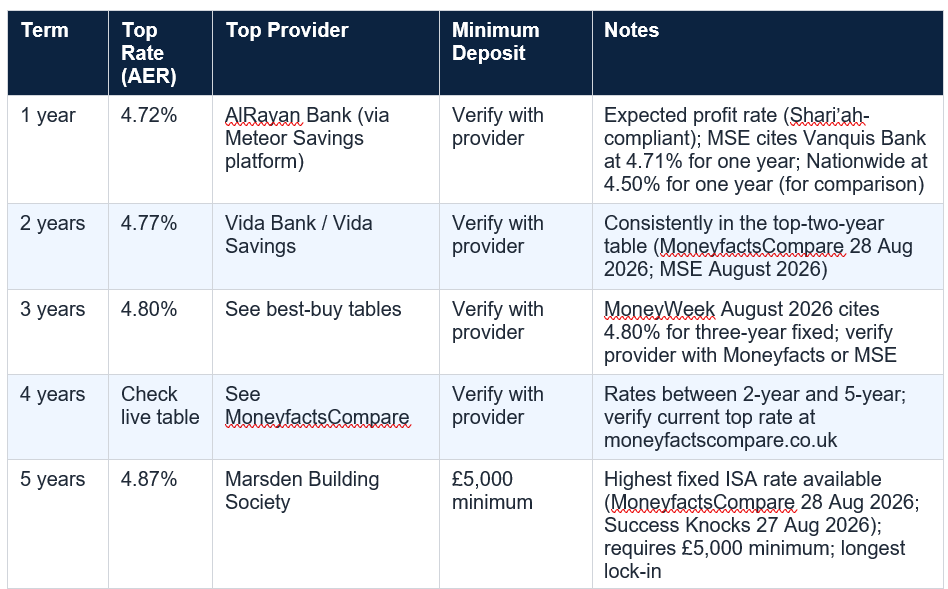
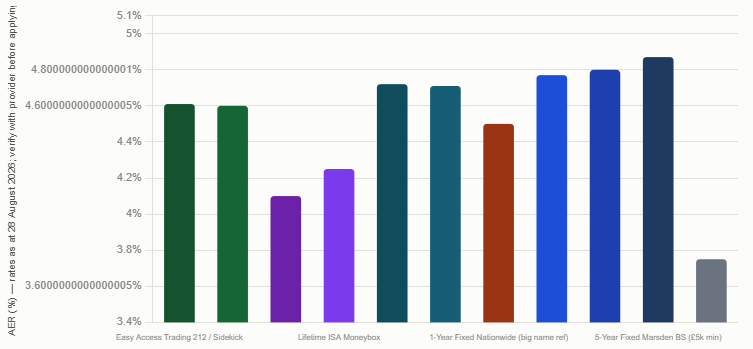
The pattern in the fixed-rate market is straightforward: longer terms generally offer higher rates, with the five-year Marsden Building Society account at 4.87 percent AER currently the highest available fixed ISA in the UK market. However, the rate premium for locking in for five years over one year is approximately 0.15 percentage points (4.87 percent vs 4.72 percent) — a relatively small premium for a significantly longer commitment.
The Bank of England base rate context: the MPC cut the base rate four times in 2025, dropping it from 4.75 percent to 3.75 percent. Fixed ISA rates fell in response. However, the expectation of further cuts in 2026 has been reassessed following geopolitical developments, and some market participants now expect the base rate to remain stable or potentially rise (MoneyfactsCompare fixed ISA page, 28 August 2026). This environment suggests that locking in at current rates for a medium term — one or two years — represents a reasonable hedge against further rate movement in either direction.
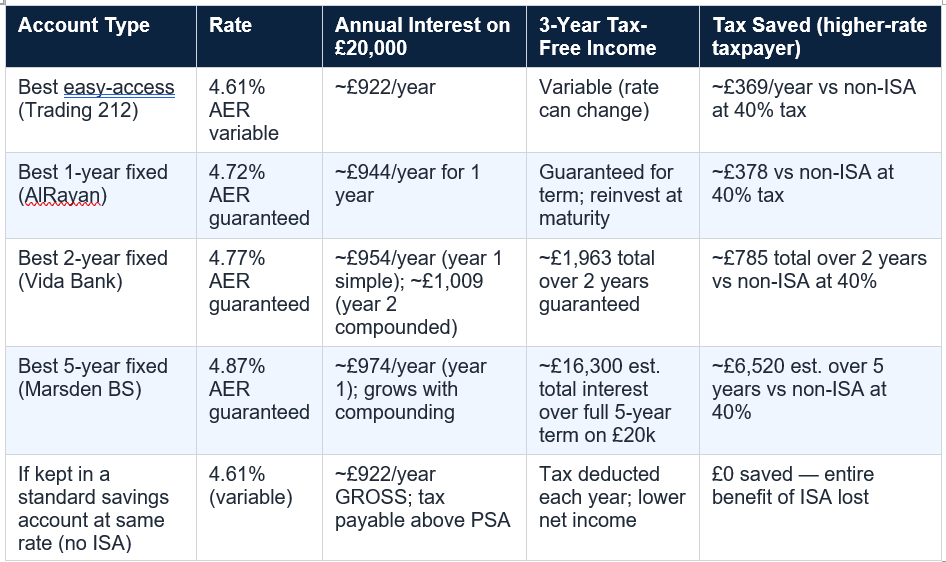
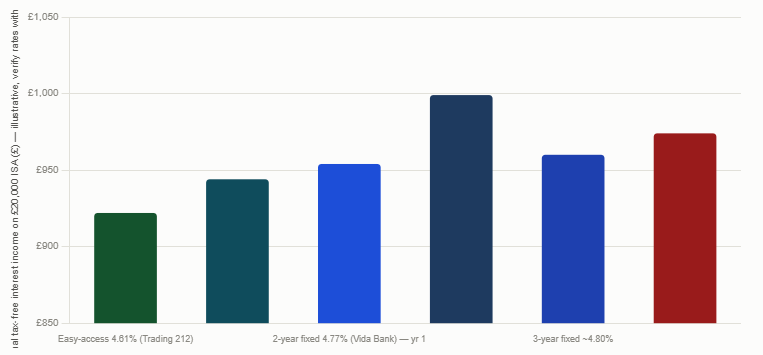
These figures illustrate the compounding tax benefit of the ISA wrapper over time. The higher the tax rate and the longer the holding period, the more the ISA’s tax-free status is worth relative to a non-ISA account offering the same headline rate.
The 2027 rule change affects new contributions only. All money already in your cash ISA from this year and previous years remains permanently tax-free. But if you have not yet used your 2026/27 allowance and you are under 65, you have until 5 April 2027 to put up to £20,000 into a cash ISA. This window will not come back.
The more pressing reason to act is the 2027 rule change. From 6 April 2027, under-65s will be limited to £12,000 in new annual cash ISA contributions. The current tax year — ending 5 April 2027 — is the last opportunity to deposit up to £20,000 into a cash ISA. Money contributed now is sheltered permanently, regardless of what happens to the rules afterwards. The urgency is real and the deadline is fixed.
For most UK savers with savings above approximately £10,000 to £20,000, the cash ISA is simply the right place for the money: same safety (FSCS protection), same access, same or better rates than equivalent non-ISA accounts, and no tax on the interest. The comparison with a non-ISA account becomes more favourable with every additional rate rise and with every year the Personal Savings Allowance remains frozen at £1,000. The ISA wrapper does not expire. Once money is inside it, it stays tax-free forever.
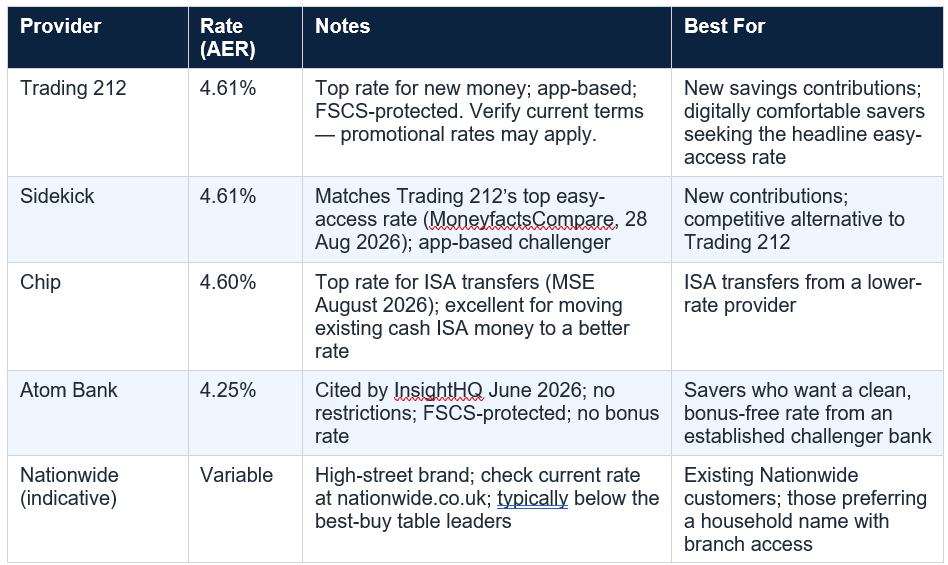
As at 28 August 2026, the highest easy-access cash ISA rate is 4.61% AER, offered by both Trading 212 and Sidekick (MoneyfactsCompare; MSE; Which?). Chip offers 4.60% AER and is considered the top rate for ISA transfers specifically in August 2026. These rates include or exclude bonus rates depending on the account — always check whether the rate includes a time-limited bonus before applying, and set a reminder to review the rate when any bonus period expires. Rates change frequently; always verify at MoneyfactsCompare.co.uk or MoneySavingExpert.com before applying. Note: the advertised ISA rate from Trading 212 in August 2026 includes a promotional element — check current terms directly with the provider.
What is the best fixed-rate cash ISA rate in August 2026?
The highest fixed-rate cash ISA as at 28 August 2026 is 4.87% AER from Marsden Building Society on its five-year product (minimum deposit £5,000). For shorter terms: best one-year fixed is 4.72% AER from AlRayan Bank (via the Meteor Savings platform; Shari'ah-compliant expected profit rate); MSE cites Vanquis Bank at 4.71% AER for one year. Best two-year is 4.77% AER from Vida Bank. Best three-year is approximately 4.80% AER. Rates are sourced from MoneyfactsCompare (28 August 2026) and should be verified directly with the provider before opening an account. Always read the early access penalty terms before locking in.
What is the cash ISA allowance for 2026/27?
The cash ISA allowance for 2026/27 is £20,000 — the full total ISA allowance can be deposited into a cash ISA. This is the last tax year in which savers under 65 can use the full £20,000 in a cash ISA. From 6 April 2027, the cash ISA allowance drops to £12,000 for under-65s, while the overall £20,000 ISA allowance remains unchanged. Savers aged 65 and over retain the full £20,000 cash ISA limit from April 2027. Unused allowance cannot be carried forward; it resets on 6 April each year.
Are cash ISAs safe? What happens if my bank fails?
Cash ISAs held with UK-regulated financial institutions are protected by the Financial Services Compensation Scheme (FSCS) up to £85,000 per person per institution (£120,000 in certain qualifying temporary circumstances). This is the same protection that applies to bank current accounts and standard savings accounts. The protection is per institution, not per account — if you have multiple accounts with the same bank, they count together toward the £85,000 limit. Less familiar names on best-buy tables (such as Vida Bank, AlRayan Bank, Marsden Building Society) carry identical FSCS protection to high-street banks. FSCS aims to pay compensation within seven working days of a bank failure. Always check which banking group a provider belongs to before depositing large sums, using the MSE 'which banks are linked' tool.
Should I choose an easy-access or a fixed-rate cash ISA?
Choose an easy-access cash ISA if: you may need to access the money during the savings period; it is your emergency fund; or you want flexibility to switch to a better rate if rates rise. Choose a fixed-rate cash ISA if: you will not need the money during the fixed term; you want the certainty of a guaranteed rate; or you believe rates may fall (locking in now protects against future rate cuts). A common approach is to keep some savings in easy-access (for emergencies) and some in fixed-rate (for long-term goals where access is not needed). The fixed-rate premium at 28 August 2026 is approximately 0.26 percentage points between the best easy-access (4.61%) and the best one-year fixed (4.72%) — a relatively small premium for a one-year commitment.
What is changing about the cash ISA from April 2027?
From 6 April 2027 (announced at Autumn Budget 2025, confirmed in GOV.UK factsheet June 2026), the annual cash ISA allowance for savers under 65 will be reduced from £20,000 to £12,000. The overall ISA allowance remains £20,000 — under-65s must put the remaining £8,000 into a Stocks and Shares ISA, Innovative Finance ISA, or Lifetime ISA. Savers aged 65 and over retain the full £20,000 cash ISA limit. Anti-circumvention rules include: a ban on transferring from Stocks and Shares ISAs or IFISAs into cash ISAs for under-65s; and a new 22% flat-rate tax on interest earned on uninvested cash inside Stocks and Shares ISAs. The 2026/27 tax year (ending 5 April 2027) is the last year in which under-65s can deposit up to £20,000 into a cash ISA.
Table of Contents
- Why the Cash ISA Is the Right Home for Your Savings Right Now
- The 2026/27 Rules at a Glance
- Best Easy-Access Cash ISAs (August 2026)
- Best Fixed-Rate Cash ISAs (August 2026)
- Best Notice Cash ISAs and Lifetime ISAs
- The Income You Can Earn: What £20,000 at Different Rates Produces
- The 2027 Rule Change: This Is the Last Year for the Full £20,000 Cash Limit
- Cash ISA vs Standard Savings Account: When Does the ISA Win?
- How to Open or Transfer a Cash ISA
- FSCS Protection: How Safe Is Your ISA?
- Conclusion: Act Now Before the 2027 Rule Change Closes the Window
- Frequently Asked Questions
ISA Rates By Type & Term
Annual Tax Free Income on £20,000
Why the Cash ISA Is the Right Home for Your Savings Right Now
There are two reasons the cash ISA is the most important savings vehicle in the UK in August 2026. The first is that it is paying genuinely good rates: the best easy-access accounts are offering 4.61 percent AER and the best fixed-rate accounts are reaching 4.87 percent AER, both well above the current rate of inflation. The second reason is that 2026/27 is the last tax year in which every adult in the UK can put up to £20,000 into a cash ISA. From 6 April 2027, that limit drops to £12,000 for anyone under 65. The window is open right now, and it will not be this wide again.The case for putting savings inside a cash ISA rather than a standard savings account has also strengthened over the past two years. The Personal Savings Allowance (PSA) — the annual amount of savings interest a basic-rate taxpayer can receive without paying tax on it — has been frozen at £1,000 since 2016, while interest rates have risen substantially. At 4.61 percent, a basic-rate taxpayer exhausts their entire £1,000 PSA with just over £21,000 in non-ISA savings. Any savings above that threshold are generating taxable interest. Inside a cash ISA, there is no PSA limit, no reporting, and no tax, regardless of how much interest is earned.
The 2026/27 Rules at a Glance
Before comparing rates, it is worth understanding the framework. Cash ISA rules in 2026/27:- Annual allowance: £20,000 per person per tax year (this is the total across all ISA types combined).
- Tax treatment: all interest earned inside a cash ISA is completely tax-free, does not count toward the Personal Savings Allowance, and does not need to be declared on a Self Assessment return.
- Multiple ISAs permitted: since the April 2024 rule change, you can open and pay into more than one cash ISA in a single tax year, as long as the total contributions across all ISAs do not exceed £20,000.
- Transfers: you can transfer existing ISA money between providers without it counting as a new contribution. Always use a formal ISA transfer rather than withdrawing and re-depositing, to preserve the ISA wrapper.
- Unused allowance: unused allowance from the current tax year cannot be carried forward. It resets on 6 April each year. If you do not use it, you lose it.
- Existing balances: money already held in cash ISAs from previous years remains sheltered indefinitely. There is no cap on the total amount an ISA can hold.
- FSCS protection: up to £85,000 per person per UK-regulated institution (up to £120,000 under the temporary higher limit in some circumstances — verify with the institution).
Best Easy-Access Cash ISAs (August 2026)
Easy-access cash ISAs pay a variable rate and allow withdrawals whenever needed, with no penalties. They are the right choice for emergency funds and savings you may need at short notice. Rates are correct as at 28 August 2026 from MoneyfactsCompare, MSE, and Which?; always verify the current rate directly with the provider before applying, as rates can change at short notice.Important: Many of the highest easy-access ISA rates include a bonus rate for the first 6 or 12 months. When the bonus expires, the rate drops materially. Set a calendar reminder 2 months before the bonus period ends to check whether a better deal is available and switch via a formal ISA transfer if so. The bonus rate footnotes in comparison tables (marked (a), (b), (c) etc. in MoneyfactsCompare) will tell you what rate applies after the bonus period.
Best Fixed-Rate Cash ISAs (August 2026)
Fixed-rate cash ISAs offer a guaranteed rate for a set term — typically one to five years — in exchange for locking away your cash. They are the right choice for money you will not need during the fixed term and for savers who want certainty of income. The trade-off: early access either incurs a penalty or is not available at all, depending on the account. Rates at 28 August 2026:The pattern in the fixed-rate market is straightforward: longer terms generally offer higher rates, with the five-year Marsden Building Society account at 4.87 percent AER currently the highest available fixed ISA in the UK market. However, the rate premium for locking in for five years over one year is approximately 0.15 percentage points (4.87 percent vs 4.72 percent) — a relatively small premium for a significantly longer commitment.
The Bank of England base rate context: the MPC cut the base rate four times in 2025, dropping it from 4.75 percent to 3.75 percent. Fixed ISA rates fell in response. However, the expectation of further cuts in 2026 has been reassessed following geopolitical developments, and some market participants now expect the base rate to remain stable or potentially rise (MoneyfactsCompare fixed ISA page, 28 August 2026). This environment suggests that locking in at current rates for a medium term — one or two years — represents a reasonable hedge against further rate movement in either direction.
Best Notice Cash ISAs and Lifetime ISAs
Notice ISAs
Notice ISAs require advance notice before withdrawal — typically 30, 60, or 95 days. They generally pay more than easy-access accounts but less than fixed-rate accounts, offering a middle ground for savers who can plan withdrawals in advance. The best notice ISA rate as at 28 August 2026 is 4.10 percent AER from The Stafford Building Society (MoneyfactsCompare). This sits notably below both the best easy-access (4.61 percent) and the best one-year fixed (4.72 percent), making notice ISAs less attractive than either alternative at the current rate spread. Check current best-buy tables before opening one.Lifetime ISAs (LISAs)
The Lifetime ISA offers a 25 percent government bonus on contributions up to £4,000 per year, producing a bonus of up to £1,000 annually. The LISA can be used to buy a first home (on properties up to £450,000) or accessed penalty-free from age 60. The best Lifetime ISA rate as at 28 August 2026 is 4.25 percent AER including the bonus, from Moneybox (MoneyfactsCompare). Important restrictions: the LISA can only be opened by those aged 18 to 39, contributions must stop at age 50, and withdrawing for any other purpose than a first home purchase or retirement after 60 incurs a 25 percent government penalty charge that effectively returns less than the original amount contributed. From April 2028, the government has signalled the LISA may be replaced by a new first-time buyer product.6. The Income You Can Earn: What £20,000 at Different Rates Produces
The annual tax-free interest income from investing the full £20,000 ISA allowance in cash:These figures illustrate the compounding tax benefit of the ISA wrapper over time. The higher the tax rate and the longer the holding period, the more the ISA’s tax-free status is worth relative to a non-ISA account offering the same headline rate.
The 2027 Rule Change: This Is the Last Year for the Full £20,000 Cash Limit
The single most important piece of information for UK savers in August 2026 is the forthcoming reduction in the cash ISA allowance. Announced at Autumn Budget 2025 and confirmed in a GOV.UK factsheet in June 2026, from 6 April 2027:- The annual cash ISA allowance for savers under 65 falls from £20,000 to £12,000. The overall ISA allowance remains £20,000 — the remaining £8,000 must go into a Stocks and Shares ISA or Innovative Finance ISA.
- Savers aged 65 or over retain the full £20,000 cash ISA limit with no changes. The 65+ entitlement applies from the start of the tax year in which you turn 65.
- Anti-circumvention rules: under-65s will no longer be able to transfer funds from a Stocks and Shares ISA or Innovative Finance ISA into a cash ISA. Transfers in the opposite direction remain permitted.
- A new 22 percent flat-rate tax will apply to interest earned on uninvested cash held within a Stocks and Shares ISA, to prevent the rule being circumvented by holding excess cash there.
The 2027 rule change affects new contributions only. All money already in your cash ISA from this year and previous years remains permanently tax-free. But if you have not yet used your 2026/27 allowance and you are under 65, you have until 5 April 2027 to put up to £20,000 into a cash ISA. This window will not come back.
Cash ISA vs Standard Savings Account: When Does the ISA Win?
At current interest rates, the ISA wins in most cases for any taxpayer who has, or expects to have, savings above the Personal Savings Allowance threshold. The key comparison:- Basic-rate taxpayer: PSA is £1,000. At 4.61 percent, the PSA is exhausted with just £21,691 in non-ISA savings. Above that level, every pound of additional non-ISA savings interest is taxed at 20 percent. A cash ISA pays the same rate with zero tax.
- Higher-rate taxpayer: PSA is £500. At 4.61 percent, the PSA is exhausted with just £10,846 in non-ISA savings. Every pound above that is taxed at 40 percent. The ISA advantage is immediate and substantial for any higher-rate saver.
- Additional-rate taxpayer: no PSA. Every pound of non-ISA savings interest is taxed at 45 percent. The ISA eliminates 45 percent tax on all interest inside the wrapper.
- From April 2027: savings interest tax rates rise by 2 percentage points across all bands (basic 20 percent to 22 percent, higher 40 percent to 42 percent). The ISA advantage becomes more valuable with each rate rise.
How to Open or Transfer a Cash ISA
Opening a new cash ISA:- Choose a provider from the best-buy tables (verify the current rate directly before applying — comparison table rates can be stale).
- Apply online in most cases. You will need proof of identity, a UK address, and your National Insurance number.
- Minimum deposits vary: some accounts accept as little as £1, others require £1,000, £2,000, or £5,000.
- You can open and contribute to more than one cash ISA in the same tax year under the April 2024 rules, as long as your total across all ISA types does not exceed £20,000.
- To transfer ISA money from one provider to another, you must use a formal ISA transfer — not withdraw and re-deposit. Withdrawal and re-deposit would count as a new subscription against your current-year allowance.
- Contact the new provider and request an ISA transfer. They will manage the process with your existing provider. The transfer typically takes between 7 and 30 days depending on the provider.
- You can transfer all or part of previous years’ ISA money at any time. For current-year contributions, partial transfers may be available depending on the receiving provider.
- From April 2027, under-65s will not be able to transfer from Stocks and Shares ISAs or IFISAs into cash ISAs. Transfers from cash to Stocks and Shares remain permitted.
FSCS Protection: How Safe Is Your ISA?
All the cash ISAs in the best-buy tables are provided by UK-regulated financial institutions and carry Financial Services Compensation Scheme (FSCS) protection. If the institution fails, the FSCS protects:- £85,000 per person per UK-regulated financial institution (not per account).
- £170,000 per person for joint accounts.
- Up to £120,000 temporarily in certain qualifying circumstances (including recent property proceeds and life events — known as the Temporary High Balance protection).
- Protection is per institution, not per account. If you have both a current account and a cash ISA at the same bank totalling more than £85,000, the excess above £85,000 is not protected.
- Some banks share FSCS protection because they are part of the same banking group. For example, HSBC and First Direct share a single FSCS limit. Check the MSE ‘Which banks are linked?’ tool or the FSCS website before placing large sums.
- Less familiar names on the best-buy tables — such as Vida Bank, AlRayan Bank, and Marsden Building Society — carry exactly the same FSCS protection as high-street names.
Conclusion
The UK cash ISA market in August 2026 is offering genuinely competitive rates: 4.61 percent for easy-access, 4.72 to 4.87 percent for fixed terms, all completely tax-free. Every pound of interest earned inside a cash ISA is shielded from income tax permanently — today, next year, and in 30 years if the ISA is maintained.The more pressing reason to act is the 2027 rule change. From 6 April 2027, under-65s will be limited to £12,000 in new annual cash ISA contributions. The current tax year — ending 5 April 2027 — is the last opportunity to deposit up to £20,000 into a cash ISA. Money contributed now is sheltered permanently, regardless of what happens to the rules afterwards. The urgency is real and the deadline is fixed.
For most UK savers with savings above approximately £10,000 to £20,000, the cash ISA is simply the right place for the money: same safety (FSCS protection), same access, same or better rates than equivalent non-ISA accounts, and no tax on the interest. The comparison with a non-ISA account becomes more favourable with every additional rate rise and with every year the Personal Savings Allowance remains frozen at £1,000. The ISA wrapper does not expire. Once money is inside it, it stays tax-free forever.
Frequently Asked Questions
What is the best easy-access cash ISA rate in the UK right now?As at 28 August 2026, the highest easy-access cash ISA rate is 4.61% AER, offered by both Trading 212 and Sidekick (MoneyfactsCompare; MSE; Which?). Chip offers 4.60% AER and is considered the top rate for ISA transfers specifically in August 2026. These rates include or exclude bonus rates depending on the account — always check whether the rate includes a time-limited bonus before applying, and set a reminder to review the rate when any bonus period expires. Rates change frequently; always verify at MoneyfactsCompare.co.uk or MoneySavingExpert.com before applying. Note: the advertised ISA rate from Trading 212 in August 2026 includes a promotional element — check current terms directly with the provider.
What is the best fixed-rate cash ISA rate in August 2026?
The highest fixed-rate cash ISA as at 28 August 2026 is 4.87% AER from Marsden Building Society on its five-year product (minimum deposit £5,000). For shorter terms: best one-year fixed is 4.72% AER from AlRayan Bank (via the Meteor Savings platform; Shari'ah-compliant expected profit rate); MSE cites Vanquis Bank at 4.71% AER for one year. Best two-year is 4.77% AER from Vida Bank. Best three-year is approximately 4.80% AER. Rates are sourced from MoneyfactsCompare (28 August 2026) and should be verified directly with the provider before opening an account. Always read the early access penalty terms before locking in.
What is the cash ISA allowance for 2026/27?
The cash ISA allowance for 2026/27 is £20,000 — the full total ISA allowance can be deposited into a cash ISA. This is the last tax year in which savers under 65 can use the full £20,000 in a cash ISA. From 6 April 2027, the cash ISA allowance drops to £12,000 for under-65s, while the overall £20,000 ISA allowance remains unchanged. Savers aged 65 and over retain the full £20,000 cash ISA limit from April 2027. Unused allowance cannot be carried forward; it resets on 6 April each year.
Are cash ISAs safe? What happens if my bank fails?
Cash ISAs held with UK-regulated financial institutions are protected by the Financial Services Compensation Scheme (FSCS) up to £85,000 per person per institution (£120,000 in certain qualifying temporary circumstances). This is the same protection that applies to bank current accounts and standard savings accounts. The protection is per institution, not per account — if you have multiple accounts with the same bank, they count together toward the £85,000 limit. Less familiar names on best-buy tables (such as Vida Bank, AlRayan Bank, Marsden Building Society) carry identical FSCS protection to high-street banks. FSCS aims to pay compensation within seven working days of a bank failure. Always check which banking group a provider belongs to before depositing large sums, using the MSE 'which banks are linked' tool.
Should I choose an easy-access or a fixed-rate cash ISA?
Choose an easy-access cash ISA if: you may need to access the money during the savings period; it is your emergency fund; or you want flexibility to switch to a better rate if rates rise. Choose a fixed-rate cash ISA if: you will not need the money during the fixed term; you want the certainty of a guaranteed rate; or you believe rates may fall (locking in now protects against future rate cuts). A common approach is to keep some savings in easy-access (for emergencies) and some in fixed-rate (for long-term goals where access is not needed). The fixed-rate premium at 28 August 2026 is approximately 0.26 percentage points between the best easy-access (4.61%) and the best one-year fixed (4.72%) — a relatively small premium for a one-year commitment.
What is changing about the cash ISA from April 2027?
From 6 April 2027 (announced at Autumn Budget 2025, confirmed in GOV.UK factsheet June 2026), the annual cash ISA allowance for savers under 65 will be reduced from £20,000 to £12,000. The overall ISA allowance remains £20,000 — under-65s must put the remaining £8,000 into a Stocks and Shares ISA, Innovative Finance ISA, or Lifetime ISA. Savers aged 65 and over retain the full £20,000 cash ISA limit. Anti-circumvention rules include: a ban on transferring from Stocks and Shares ISAs or IFISAs into cash ISAs for under-65s; and a new 22% flat-rate tax on interest earned on uninvested cash inside Stocks and Shares ISAs. The 2026/27 tax year (ending 5 April 2027) is the last year in which under-65s can deposit up to £20,000 into a cash ISA.
0 Comments
Be the first to share your thoughts on this article.