

Financial Literacy
10 Habits That Help You Get Out of Debt: Accountants' Guide

Table of Contents
- Why Habits Matter More Than Strategy
- Why Habits Rather Than Willpower: The Science of Debt Payoff
- The 10 Habits That Get People Out of Debt
- Money Recycling: Turning Everyday Savings into Debt Payments
- Habits That Build vs Habits That Destroy Debt Progress
- The Minimum Payment Habit That Costs Thousands
- How to Make These Habits Stick: The Practical Framework
- Conclusion
- Frequently Asked Questions (FAQ)
Why Habits Matter More Than Strategy
Ask most people how to get out of debt and they will talk about strategies — the debt avalanche, the debt snowball, balance transfers, consolidation loans. These strategies are real, proven, and important. But they are not the primary reason people succeed or fail at getting out of debt. The primary reason is behavioural. The strategy that works is the one you actually follow consistently for months and years. And the ones that get followed consistently are the ones that have been transformed from deliberate decisions made under willpower into automatic habits that happen without a daily decision at all.Financer.com's June 2026 guide — one of the most current comprehensive debt guides available — states this directly: 'Most people can become debt-free in 2-5 years with consistent effort.' Not with a single dramatic intervention. Not with luck. With consistent effort — which is a description of habits applied over time. Experian's June 2026 research adds the scale context: the average American now carries $105,444 in total debt, and severely late payments are rising in 2026 compared to the prior year. The UK equivalent shows average credit card APR at 24.65% — a rate at which inaction costs roughly £40 per £2,000 of balance per month, every month, until the habit of paying it down begins.
This guide identifies the 10 habits that research and financial advisers consistently associate with successful debt payoff — not the strategies for clearing debt (which we cover in our companion guides) but the daily, weekly, and monthly behaviours that determine whether any strategy actually produces results. Each habit is grounded in current 2026 data and research, explained with the practical mechanics of how to build it, and supported by the evidence of what it actually achieves in pounds, dollars, and months shaved off the payoff timeline.
Why Habits Rather Than Willpower: The Science of Debt Payoff
The core insight from behavioural finance research is that willpower is a limited resource — and managing debt on willpower alone is inherently unsustainable. Every decision about money — whether to spend or save, whether to pay extra on debt or buy something desired — depletes the same cognitive resource. Over time, decision fatigue sets in. The monthly resolution to pay more than the minimum weakens. The budget that felt manageable in January starts to feel restrictive by March. The debt repayment plan that seemed achievable collapses not because circumstances changed dramatically, but because the decision to stick to it had to be made repeatedly, under stress, competing with hundreds of other daily demands.The solution that behavioural finance consistently identifies is automation and habit formation — converting the key debt repayment decisions from active choices requiring willpower into automatic behaviours that happen by default. NerdWallet (March 2026): 'Use technology to make budgeting easier by letting you keep track of all of your financial accounts, categorise your expenses and automate your payments.' BestMoney (May 2026): 'Remember that your budget is a living document that changes as your income and expenses change.' These are not just tips — they are descriptions of how to remove debt repayment from the daily willpower budget and make it automatic.
Comerica sums up the habit-based approach: 'You don't need to overhaul your life. These strategies work by redirecting money you already spend. Small, steady changes can make a big difference in how fast you pay off debt and how free you feel along the way.' The key phrase is 'redirecting money you already spend' — not finding new money from nothing, but changing what existing money does. This is the foundation of every habit in this guide.
The debt habit reality — 2026 data: $105,444 average US total debt per person. 2-5 years to debt-free with consistent effort. 15-minute negotiation call = $240-$600/year extra toward debt. — Experian (June 4, 2026): 'The average total debt per person reached $105,444 in 2025. Severely late payments are also up in 2026 compared to the same time last year.' Financer.com (June 10, 2026): 'Most people can become debt-free in 2-5 years with consistent effort.' US average credit card APR 2026: above 20%. UK average credit card APR: 24.65% (NDH Financial, April 2026). Financer.com: '15-minute phone call to service providers can save $20-$50 per month = $240-$600 per year toward debt payoff.'
The 10 Habits That Get People Out of Debt
HABIT 1 Know Your Complete Debt Picture — Every Month
The foundational habit is maintaining a complete, current view of every debt you carry — balance, APR, minimum payment — updated monthly. BestMoney (May 2026): 'Start with a complete debt inventory and a realistic budget — without these, no payoff strategy will stick.' Most people in debt have a vague sense of the total but not the precise breakdown. This vagueness is not neutral — it makes prioritisation impossible and allows interest charges to grow unnoticed. Habit to build: on the 1st of every month, open a spreadsheet or notes app and update every debt: current balance, this month's payment, interest charged. Calculate the total. This ten-minute monthly habit transforms the debt from an amorphous weight into a concrete, measurable, shrinking number.HABIT 2 Always Pay More Than the Minimum
Financer.com (June 2026): 'Stop paying just the minimum.' BestMoney (May 2026): 'Paying more than the minimum is one of the most effective ways to pay off credit cards faster — even on a tight budget. Small changes to your payment schedule or habits make a meaningful difference.' The mathematics are stark: on a £3,000 credit card balance at 24.65% APR, the minimum payment (approximately 2% of balance = £60/month) generates approximately £61.60 in interest that month — the balance actually grows. Adding just £20/month above the minimum changes this entirely: the balance begins falling, the interest charge falls each month with the balance, and the payoff accelerates compoundingly. Habit to build: set up a direct debit for minimum payment plus a fixed additional amount — even £10 or £20 above the minimum. Automate it so it happens without a monthly decision.HABIT 3 Automate Every Payment on Payday
NerdWallet (March 2026): 'Automate your payments.' Comerica: 'Simple habits — like using autopay — can help you reduce debt over time.' Automation removes the single most powerful obstacle to consistent debt repayment: the monthly decision. When debt payments are automated to run the day after payday, the money is never available to spend on something else. The decision has been made once — when the direct debit was set up — and it runs automatically thereafter. Set up: direct debit for minimum + extra on every debt; separately, a second transfer of additional surplus to the highest-rate debt. Both run on payday. Everything else in the month is managed from what remains.HABIT 4 Build a Realistic Budget — And Update It Monthly
NerdWallet (March 2026): recommends the 50/30/20 budget — 50% of take-home to needs, 30% to wants, 20% to savings and debt repayment. BestMoney (May 2026): 'Remember that your budget is a living document that changes as your income and expenses change. If you decide to cook at home more, adjust your dining out and grocery line items accordingly.' The budget is not a spreadsheet you build once and ignore — it is the monthly operating plan for your money. A realistic budget (one that includes modest treats, not zero discretionary spending) is the only sustainable version. Credit Strategy UK (January 2026): 'Plans that leave no room for small pleasures are often unsustainable, especially when money worries already affect mental health.' Review the budget on the 1st of each month alongside the debt review. What changed? What can be improved? What worked last month?HABIT 5 Recycle Every Windfall Directly at Debt
Comerica: 'Turn small savings into extra payments. The trick is to spot easy places to save, then immediately put those dollars toward your debt — recycling money you were already spending, just with a smarter purpose.' A windfall is any money that arrives outside the normal monthly budget: a tax refund, a pay rise, a work bonus, a birthday gift, a successful eBay sale, a benefits backdating payment, inheritance. The natural behavioural response to unexpected money is to spend it on something desired or simply let it diffuse into general spending. The debt payoff habit is to define in advance that any windfall above a small threshold goes directly to debt — in full, immediately, before it becomes available as general spending. Experian (June 2026): 'Adjust your budget, look for ways to boost your income and put every spare dollar toward your debt.' Put it on the debt first. Keep what feels necessary. Not the other way around.HABIT 6 Track Spending Weekly Using a Free App
NerdWallet (March 2026): 'Use technology to make budgeting easier — letting you keep track of all of your financial accounts, categorise your expenses and automate your payments. There are several budget apps to help you stay on top of your money.' Free apps available in 2026: UK — Monzo (free current account with automated categorisation), Emma (connects to all accounts, categorises all spending, highlights subscriptions), Plum (auto-saves small amounts and shows spending patterns). US — YNAB (You Need A Budget, subscription), Mint (free, discontinued 2023 but successors exist), and most major bank apps now offer automatic spending categorisation. Spending tracking increases awareness of where money actually goes — which consistently differs from where people believe it goes — and creates the information foundation for identifying waste that can be redirected to debt.HABIT 7 Cancel and Downgrade Before New Spending
Credit Strategy UK (January 2026): 'Simple steps include spacing out free trials, reviewing subscriptions one at a time.' The average UK adult unknowingly maintains 3-5 recurring subscriptions they rarely use. A monthly subscription audit — searching bank statements for all recurring card payments — typically reveals £20-£60 of forgotten monthly charges. The habit is: before subscribing to anything new, first cancel something else. And quarterly, review every subscription for active use. Comerica: 'Curbing impulse purchases can help you reduce debt over time. You don't need to overhaul your life.' Reducing what is already being paid for costs nothing and requires no income increase.HABIT 8 Negotiate Lower Rates — Proactively and Regularly
Financer.com (June 2026): 'Call your service providers (internet, phone, insurance) and negotiate lower rates. A 15-minute phone call can save $20-$50 per month, which adds up to $240-$600 per year toward debt payoff.' This applies in the UK too: mobile phone contract renegotiation (ask for retention team, not customer service), broadband renewal calls, home and car insurance renewal challenges, and direct calls to credit card providers to request a rate reduction (this works more often than most people expect, especially with a good payment history). Schedule a quarterly calendar appointment: 'Negotiate service bills.' Use comparison sites for benchmarks before calling. The time-to-saving ratio on these calls is exceptional.HABIT 9 Find an Accountability Partner or Community
Experian (June 2026): 'Find accountability. One idea is to look for an accountability partner — someone you can share your goals and progress with. If they are working toward their own financial goals, you could offer each other support. There are also accountability apps that can help you find motivation.' The research on accountability in behaviour change is consistent: people are more likely to maintain a behaviour when they have committed to it with another person and when there is a regular check-in. Practical options: a trusted friend or partner who is also managing debt (mutual monthly update calls); a free money management community online (Reddit's r/UKPersonalFinance, r/DaveRamsey, or dedicated debt-free communities); or a professional — a free appointment with Citizens Advice or StepChange creates an external accountability structure. The month-by-month visibility that accountability provides is one of the most powerful habit maintenance tools available.HABIT 10 Celebrate Every Milestone — Sustainably
Credit Strategy UK (January 2026): 'Budgeting works best when it is kind as well as practical. Plans that leave no room for small pleasures are often unsustainable.' Comerica: 'Track your progress to build momentum. It is easier to stay motivated when you see your debt shrinking month by month.' The debt payoff journey, which Financer.com identifies typically lasting 2-5 years, requires sustained motivation over a period far longer than any initial burst of enthusiasm naturally lasts. Building in planned, budgeted celebrations at milestones — first debt cleared, total halved, final year begun — maintains the psychological reinforcement that makes the behaviour sustainable. A celebration does not need to be expensive; it needs to be meaningful, planned in advance, and connected to the milestone achieved. The habit is to define milestones and celebrations in advance, not to react to them spontaneously.Money Recycling: Turning Everyday Savings into Debt Payments
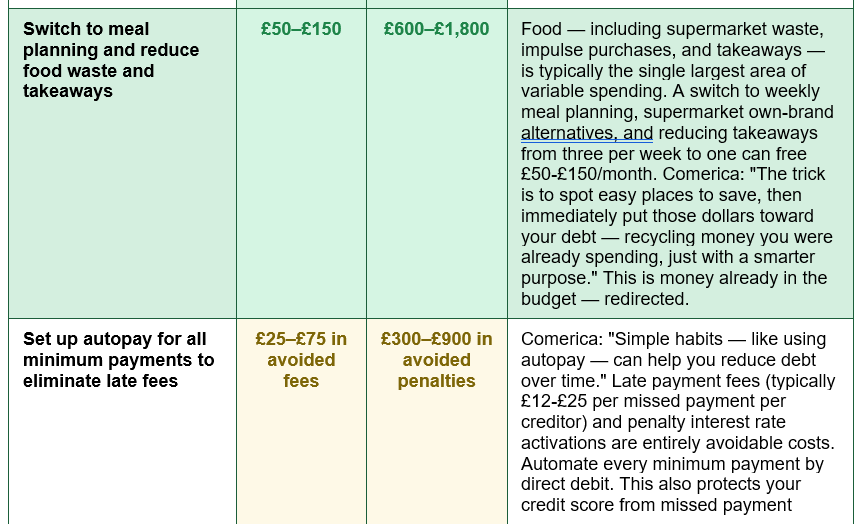
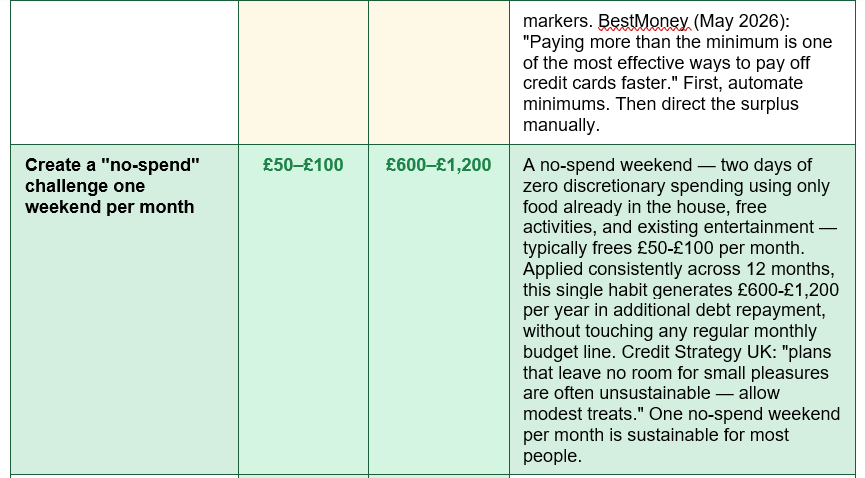
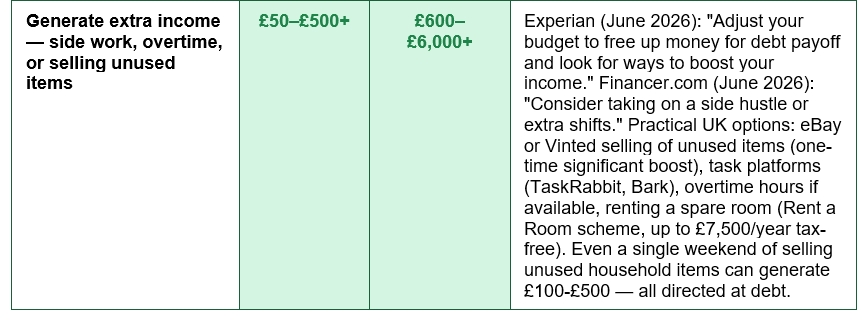
The concept of 'money recycling' — identifying money you are already spending and redirecting it to debt without cutting necessities or dramatically changing lifestyle — is one of the most accessible and least painful ways to increase the monthly debt repayment amount. The following table maps the most impactful money recycling opportunities: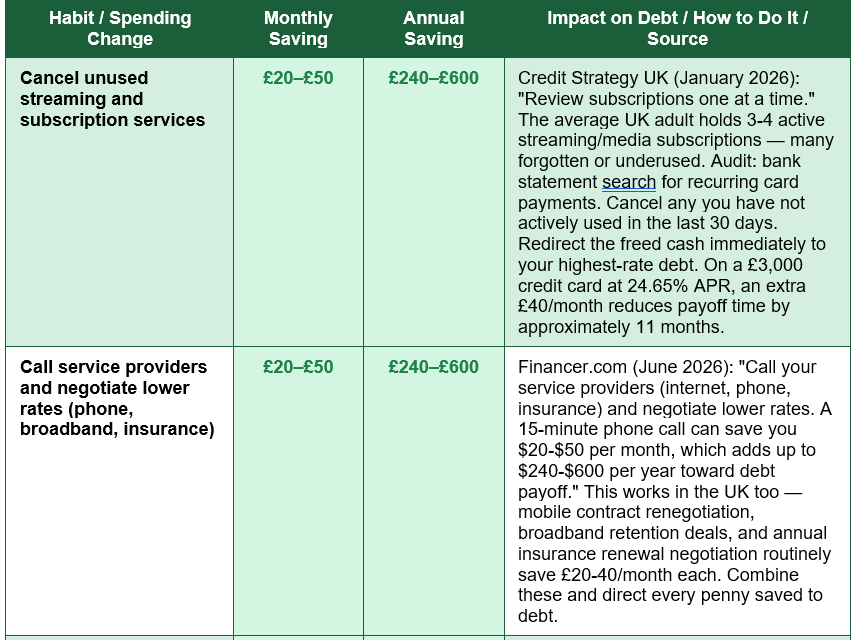
Habits That Build vs Habits That Destroy Debt Progress
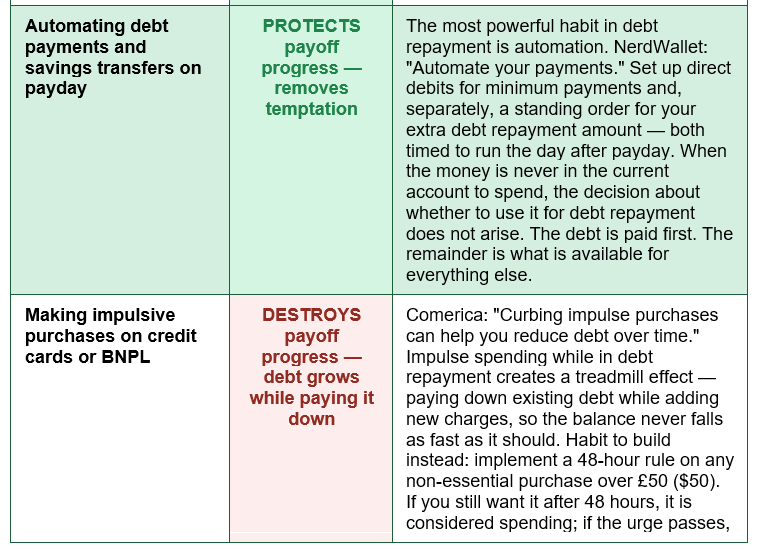
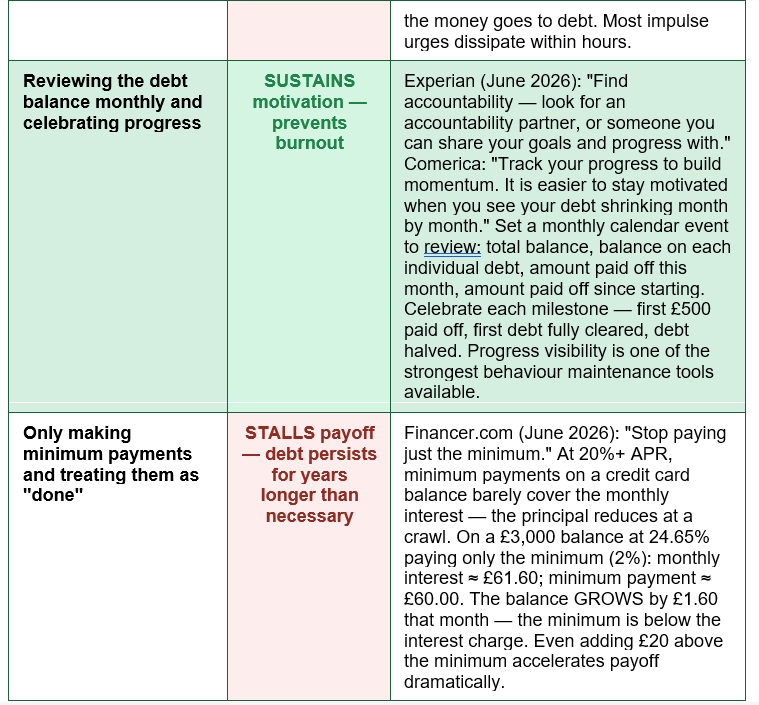
Understanding what accelerates debt payoff is only useful alongside understanding what slows or reverses it. The following table maps the key habits on both sides of the debt payoff outcome, with the specific mechanism through which each helps or harms: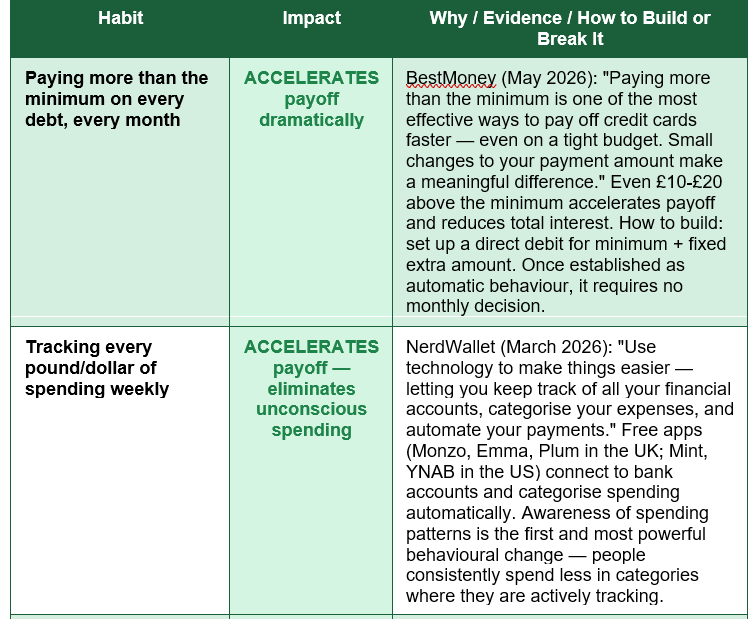
The Minimum Payment Habit That Costs Thousands
The single habit that does more damage to debt payoff progress than any other is the monthly minimum payment — accepted as a fixed cost rather than challenged as a deliberate choice. Financer.com (June 2026): 'Stop paying just the minimum. Credit card debt is the most expensive type of consumer debt, with average APRs above 20% in 2026.' The mathematics of minimum payments at 20-25% APR reveal why this habit is so destructive: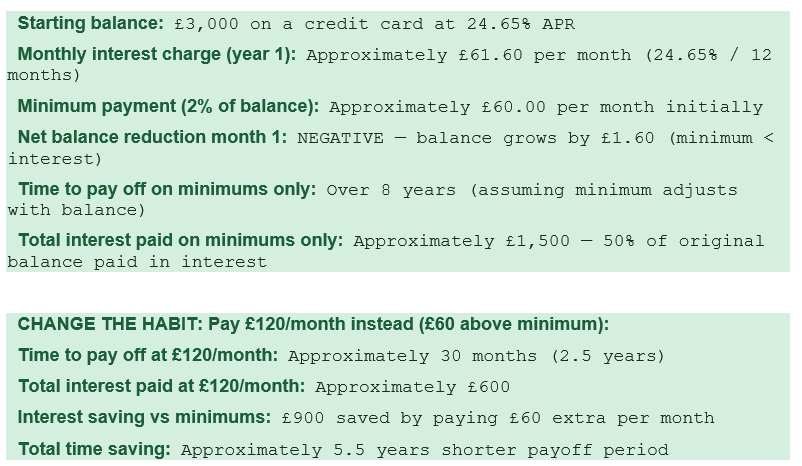
The habit multiplier effect — how habits compound over time: Each habit in this guide is valuable on its own. But the power of habits in debt payoff comes from their cumulative, compounding effect. Automating payments eliminates missed payment fees. Tracking spending identifies waste to recycle into debt. Negotiating bills creates new monthly surplus. Cancelling subscriptions frees monthly cash. Paying above the minimum on every debt accelerates every balance simultaneously. And when the first debt clears, the freed monthly payment cascades to the next — the classic 'debt snowball' or 'debt avalanche' acceleration. Financer.com (June 2026): 'Most people can become debt-free in 2-5 years with consistent effort.' Consistent effort is a description of habits. The timeline compresses dramatically when multiple habits are applied simultaneously.
How to Make These Habits Stick: The Practical Framework
Knowing a habit is beneficial and reliably performing it are different skills. The practical framework for making debt payoff habits stick has three components:- 1. Start with the automatic, not the deliberate: The habits that require the least ongoing willpower are the ones to implement first. Automating all debt payments (Habit 3) and setting up spending tracking via an app (Habit 6) are high-impact habits that, once set up, require almost no ongoing effort. These create the foundation upon which the more behavioural habits (negotiating, cancelling, recycling windfalls) are built.
- 2. Build one habit at a time, not all ten simultaneously: BestMoney (May 2026): 'A budget is a living document that changes as your income and expenses change.' The same principle applies to habits — add one per month, let it become established, then add the next. Attempting all ten simultaneously creates an unsustainable cognitive demand. One new habit per month means all ten are embedded within a year — and each one begins producing results immediately.
- 3. Use implementation intentions: Research consistently shows that specifying exactly when, where, and how a behaviour will happen dramatically increases the probability that it occurs. Instead of 'I will track my spending more,' the implementation intention is: 'Every Sunday at 7pm, I will open the Emma app and review the week's spending categories.' The specific time and trigger transform the intention from a vague commitment into a scheduled appointment.
THE HABITS THAT DESTROY DEBT PROGRESS FASTEST — AND HOW TO BREAK THEM: (1) CONTINUING TO USE CREDIT CARDS WHILE PAYING THEM DOWN. Adding new charges to a balance being paid down is the treadmill effect — you never get ahead. Habit change: physically move the credit card out of your wallet (drawer, envelope, or freeze in a block of ice). Remove it from Apple Pay/Google Pay. Use a debit card only. Do not close the account — closing reduces your available credit limit and can affect your credit score. Just do not use it. (2) TREATING DEBT REPAYMENT AS OPTIONAL IN TIGHT MONTHS. When money is short, debt payments are often the first thing to reduce. But debt at 20-25% APR compounds relentlessly — every missed or reduced payment extends the payoff by more than one month. Automate the payment (Habit 3) so the decision is not available to make in tight months. (3) NOT TELLING ANYONE ABOUT YOUR DEBT GOALS. Experian (June 2026): 'Find accountability.' The social isolation of private debt management is one of the primary reasons people stop when progress slows. Shared goals with an accountability partner — even one person — dramatically improves persistence when motivation dips.
Conclusion
Getting out of debt is not primarily a strategy problem — it is a behaviour problem. The strategies for clearing debt (avalanche, snowball, balance transfers, consolidation) are well documented and broadly understood. The reason most debt payoff plans fail is not that the strategy is wrong but that the daily and monthly behaviours needed to execute it consistently are never converted from conscious decisions into automatic habits. Financer.com (June 2026) confirms that most people can become debt-free in 2-5 years with consistent effort — but that consistency is exactly what habits provide and willpower alone cannot sustain.The 10 habits in this guide address debt payoff at every level: the information habit (knowing your complete debt picture monthly), the payment habit (always more than the minimum, automated on payday), the budgeting habit (realistic, updated monthly, kind enough to sustain), the recycling habits (windfalls to debt, subscriptions cancelled, bills negotiated), the tracking habit (technology-assisted weekly spending review), and the motivation habits (accountability partner, milestone celebrations). Together, applied consistently over months and years, they create a financial environment where getting out of debt is not a constant daily struggle but the natural outcome of how money flows automatically.
The place to start is not with the most ambitious habit — it is with the most automatic. Set up direct debits for minimum plus extra on every debt, running the day after payday. Download a free spending app and connect your accounts. Set a monthly calendar reminder for the 1st: debt review and budget update. These three actions, done this week, create the foundation from which every other habit follows. The debt will not disappear this month. But with the habits in place, it will be smaller every month — and smaller every month is the only trajectory that leads, inevitably, to zero.
0 Comments
Be the first to share your thoughts on this article.