
Spending
12 Amazon Products to Skip on Big Deal Days

Amazon Big Deal Days is genuinely good for some things. Amazon’s own Fire tablets, Echo devices, Ring cameras, and Kindles get the most reliable discounts of any event all year — that part is real. But Big Deal Days is also one of the most systematically manipulated shopping events in retail. A 2025 pricing analysis found that 45.5% of products on sale during Prime Day had actually increased in price compared to the period before the event (MoneyLion, June 2026). Gizmodo found examples of products with prices raised 750% before Big Deal Days, then offered at a 90% discount — making them appear transformatively cheap when they were simply back to normal. Amazon is facing a consumer lawsuit filed in September 2025 alleging fake deals on specific products. And approximately 70% of shoppers say lightning deals have pressured them into buying things they did not need. The twelve product categories below are the ones where price manipulation is most common, product quality is hardest to verify, and the deals are least likely to be genuine. Knowing which ones to skip is worth more than knowing which ones to buy.
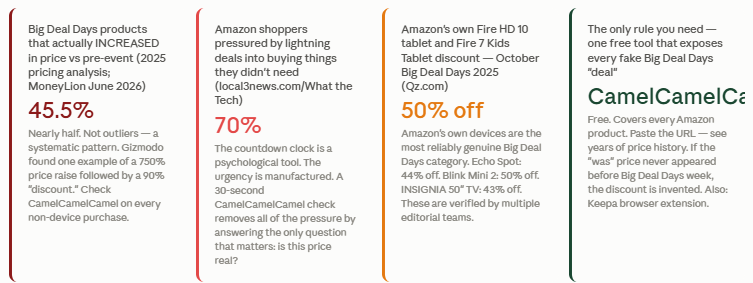
A 2025 pricing analysis found that 45.5% of products promoted during Prime Day had actually increased in price compared to the period before the event (MoneyLion, June 2026). Nearly half. Not outliers, not edge cases — nearly half of everything being marketed as a deal had been more expensive the previous month. Gizmodo found specific examples of sellers raising prices by 750% before Big Deal Days, then offering a 90% discount during the event, so that shoppers would feel they were getting an extraordinary bargain while actually paying close to the normal price. Washington Post columnist Geoffrey Fowler reviewed receipts for nearly 50 items and found a pattern of prices rising in the weeks leading up to Big Deal Days 2025. Amazon disputes the broader characterisation. Amazon spokesperson Jessica Martin told The Post: ‘Amazon offers customers genuine savings and transparent pricing, whether on a regular shopping day or during a major event like Prime Big Deal Day.’ Consumer advocates, the courts, and the price history data tell a more complicated story.
Big Deal Days pricing reality: 45.5% of Prime Day 2025 products increased in price vs pre-event period (MoneyLion June 2026). Gizmodo: one example of 750% price inflation → 90% off = back to normal. Amazon faces consumer lawsuit (September 2025, WA state) alleging fake deal prices on specific products (BGR.com September 2025). ~70% of Amazon shoppers say lightning deals pressured them into buying items they didn't need (local3news.com/What the Tech). Big Deal Days 2025: October 7-8 (two days). Sources cited. Not a legal or consumer advice claim.
The most important thing to understand is that none of these tactics violate Amazon’s terms of service in their entirety, which is why they persist. Amazon has taken steps to combat fake reviews and inflated reference prices, but the scale of the marketplace — hundreds of millions of products, hundreds of thousands of sellers — makes complete enforcement impossible. The protection mechanism is not Amazon’s policy. It is your own price history verification, every single time.
The Skullcandy case (September 2025): Amazon is facing a consumer lawsuit (filed in Washington state, September 2025) alleging fake deals during Prime Day, including specific examples where products were advertised at a large discount from a reference price they had never actually reached. The Skullcandy headphones mentioned in the suit were described as 'never before listed for over $110' before being advertised at a substantial discount from a higher number. This is the documented legal standard for the problem that CamelCamelCamel was built to detect. Source: BGR.com, September 2025. Not legal advice.
CamelCamelCamel: go to the site, paste the Amazon product URL, and the chart shows every price movement since the product was listed. If the ‘was’ price of $199 appears on the chart for exactly three weeks before Big Deal Days started and the item has otherwise sold for $89 for the past year, you are looking at price inflation, not a genuine discount. If the chart shows the current Big Deal Days price is a genuine historical low — lower than any price the item has reached in the past 12 months — you may be looking at a real deal. Keepa works similarly and installs as a browser extension that adds a price history graph directly to the Amazon product page, so you see the chart without leaving the listing.
CamelCamelCamel (camelcamelcamel.com): free, covers virtually all Amazon products, price history going back years — paste the product URL. Keepa (keepa.com): free browser extension, shows price history graph directly on the Amazon listing page. CamelMart (camelmart.com): same team as CamelCamelCamel, tracks Walmart pricing. Google Shopping: real-time price comparison across Amazon, Walmart, Target, Best Buy simultaneously. The rule: if the Big Deal Days price is not below the 90-day average from CamelCamelCamel, it is not a deal worth buying on Big Deal Days. Source: local3news.com/What the Tech; bgr.com; homeandtexture.com; KAAL-TV/What the Tech.
The biggest trap on Big Deal Days is the unknown brand with a suspiciously round discount. A generic power bank listed at $89.99, marked down 78% to $19.99, with 2,000 five-star reviews sounds compelling. The problem with all three of those numbers: the $89.99 reference price was invented; the 78% off is mathematically real but meaningless; and those 2,000 five-star reviews may be for a completely different product — a documented Amazon scam technique in which sellers reuse a high-review ASIN for an unrelated product. As one 2025 Prime Day analysis described: ‘I used Amazon’s AI shopping assistant Rufus to filter out products with fake reviews, and it saved me from buying a “highly rated” generic power bank that had 2,000 five-star reviews for a completely different product — a common scam.’ For cables, charge controllers, and electronics that interface with your laptop or phone, there is also a genuine safety risk from substandard components.
This is one of the most thoroughly documented fake-deal categories on Amazon. The pattern is textbook: a chair with a list price of $1,000 and a sale price of $200 — 80% off! — which sounds extraordinary. A 30-second check on CamelCamelCamel reveals the chair has never been listed at $1,000. The real average price is $223, meaning the ‘deal’ is saving you $23, not $800. As What the Tech reported, citing CamelCamelCamel data: ‘you might find that it’s never been $1,000 and the average price is only $23 more than the “limited-time deal.”’ The reference price on no-name Amazon furniture is almost always fictional. Quality ergonomic chairs from real brands (Herman Miller, Steelcase, Autonomous) are simply not available at genuine deep discounts on Big Deal Days.
A mattress is one of the most consequential purchases you will make for your sleep quality and physical health. It is also one of the items least suited to a two-day urgency sale. Amazon-only mattress brands (those that exist exclusively as Amazon listings without an independent retail presence) frequently use Big Deal Days as their primary marketing event, inflating reference prices to manufacture impressive-looking discounts. The brands you can verify — Casper, Saatva, Purple, Tempur-Pedic — run their own promotional cycles year-round and are not primarily discounted on Amazon. If you want a genuinely good mattress deal, buy directly from an established brand during its own sale season, where you have a tested return policy and a track record of customer reviews across multiple platforms, not just Amazon.
Amazon’s fashion section during Big Deal Days is flooded with clothing from overseas drop-shippers and white-label manufacturers listing items at ‘70% off’ reference prices that bear no relationship to any actual retail price. The practical problems compound: sizing from unknown brands is inconsistent, the product photos are optimised rather than representative, and return shipping on ill-fitting purchases adds cost and friction to an already questionable purchase. The 45.5% of Big Deal Days products that had price increases before the sale (2025 pricing analysis, MoneyLion June 2026) is particularly pronounced in fashion and clothing, where reference prices can be set to almost any number without regulatory scrutiny. If you want clothing deals, established brands with consistent sizing (Levi’s, Carhartt, New Balance) occasionally appear with genuine discounts. Unknown brands with 60-70% off are almost universally price manipulation.
Large-screen TVs from established manufacturers — Samsung, LG, Sony, TCL — can be genuine Big Deal Days buys if the price history checks out. Amazon’s own INSIGNIA TV line gets real discounts: the INSIGNIA 50” Class F50 was genuinely 43% off during Big Deal Days October 2025 (Qz.com). But unknown TV brands with sudden 60-70% discounts are a different story. The shipping damage problem is real and specific: Amazon is great for small electronics, but shipping a massive OLED screen is a logistical challenge that frequently results in cracked panels. Beyond the shipping risk, no-name TVs typically have poor after-sales service, short warranties, and parts availability problems. A broken unknown-brand TV from a Big Deal Days impulse buy is not covered by anyone who cares.
Amazon’s supplement marketplace is one of the most problematic areas for authenticity. Third-party sellers operate without the regulatory oversight of licensed pharmacies, and counterfeit or adulterated supplements are a documented safety risk. During Big Deal Days, the volume of promoted supplement listings increases significantly — exactly when you should be most cautious, not least. A supplement ‖30% off’ from a brand you have never heard of, with a stack of five-star reviews, is not worth the risk. Established supplement brands (Nature Made, Nordic Naturals, Garden of Life, Thorne) are available with equivalent discounts through their own websites, pharmacies, and authorised retailers throughout the year.
Air fryers and blenders are among the most promoted Big Deal Days categories. They’re also among the most manipulated. Tech Advisor noted directly in its 2025 Big Deal Days coverage that ‘electric toothbrushes have inflated prices so we’ve listed the discount off the normal price rather than the original RRP which can make the deal appear far better than it actually is.’ The same problem applies across small kitchen appliances from unknown brands. Reliable kitchen appliances require brand track records: safety certifications, warranty support, replacement parts. A blender from a brand that exists only as an Amazon ASIN with no customer service infrastructure is a risk that a ‘60% off’ sticker cannot offset.
Amazon specifically uses Big Deal Days in October to kickstart holiday season toy buying, and the timing is designed to create urgency: ‘buy now before stock runs out.’ But toy discounts in early October are among the most commonly price-manipulated categories. A toy returned to its standard price after a September inflation, presented as a ‘50% off deal,’ is one of the most common Big Deal Days traps. The smarter move: use CamelCamelCamel to check whether the current ‘deal’ price is genuinely below the 90-day average. If it is not, wait. Black Friday, Cyber Monday, and even December mid-season sales frequently match or beat October toy prices.
Amazon’s beauty category includes both genuine branded products and counterfeit or grey-market items that are visually indistinguishable from authentic packaging in a listing photo. During Big Deal Days, sponsored ‘dupes’ and unverified alternatives to premium skincare brands are heavily promoted. The safety stakes here are not abstract: products applied to your face with unverified formulations present a genuine dermatological risk. For skincare, fragrance, and cosmetics, buy from the brand’s own website or an authorised physical retailer. A Big Deal Days discount on an unverified skincare listing is not worth the risk.
Amazon promotes extended warranty products (primarily through Asurion) heavily during Big Deal Days, positioning them as smart protective investments. They are almost universally poor value. Many items break outside any warranty window regardless; many credit cards provide free purchase protection automatically; and the fine print on Amazon’s extended warranty products contains significant exclusions that limit real-world usefulness. The Big Deal Days urgency pressure — the countdown clock, the ‘limited availability’ language, the ‘70% of shoppers add a protection plan’ messaging — is exactly the psychological architecture designed to sell you a product you do not need.
The October timing of Big Deal Days coincides with consumer awareness of upcoming New Year’s resolutions, and Amazon’s fitness equipment category swells with unknown-brand resistance bands, foam rollers, ‘smart’ jump ropes, and cable machines from sellers with no track record. The reference price inflation here is severe, and there is a genuine safety dimension: cheap resistance bands can snap under load; poorly made weight collars can fail; substandard cable machine components can fail with serious consequences. For exercise equipment, established brands (TRX, Rogue, Bowflex, NordicTrack) with verified safety certifications and warranty support are worth the full price more than unknown brands at a fabricated discount.
If you are planning to spend time on Big Deal Days hunting for book bargains, redirect that energy. Amazon rarely offers significant discounts on physical books or Kindle editions during its sale events. Kindle book pricing is largely set by publishers, not Amazon, and publisher-controlled pricing means Big Deal Days rarely produces genuine book deals. Physical book prices on Amazon during Big Deal Days are similarly unimpressive. The exception: Amazon’s own Kindle hardware devices (Kindle Paperwhite, Kindle Scribe, Kindle Basic) do receive genuine Big Deal Days discounts. The Kindle is a great buy on Big Deal Days. The books you read on it are not. For books, use your library app (Libby, Hoopla), Thriftbooks, or wait for publisher-specific sales.
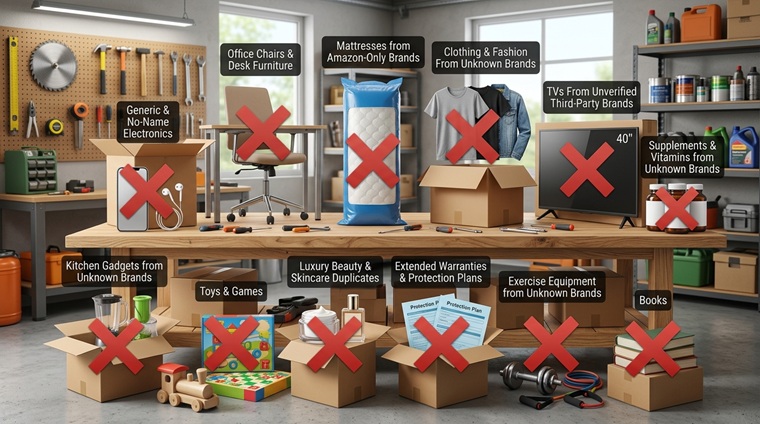
The 12 product categories in this article — unknown-brand electronics, no-name furniture, unverified mattresses, fashion from drop-shippers, unverified TVs, unknown supplements, generic kitchen gadgets, unverified toys, beauty counterfeits, extended warranties, unknown fitness equipment, and books — are the categories where price manipulation is most common, product quality is hardest to verify, and the genuine deals are rarest. Avoiding them costs you nothing. Buying them on impulse, because a countdown clock said you had four minutes left, can cost you considerably more.
Buy the Amazon devices. Buy the household essentials from brands you know. Use CamelCamelCamel on anything else. Everything else is a countdown clock between you and a decision you might regret.
Some are. Some are not. A 2025 pricing analysis found that 45.5% of products promoted during Prime Day had actually increased in price compared to the period before the event (MoneyLion, June 2026). Gizmodo documented examples of prices being raised by 750% before Big Deal Days, then discounted 90% during the event — making the item look dramatically cheaper when it was effectively just back to its normal price. Amazon spokesperson Jessica Martin said: 'Amazon offers customers genuine savings and transparent pricing, whether on a regular shopping day or during a major event like Prime Big Deal Day.' The most reliably genuine deals are on Amazon's own devices (Fire tablets, Echo, Kindle, Ring, Eero), which are typically verified as genuine historical lows by multiple editorial price-tracking teams. For everything else, verify using CamelCamelCamel before purchasing. Sources: MoneyLion June 2026; Qz.com/Gizmodo 2025; Afrotech/Washington Post 2025.
How do I check if a Big Deal Days price is a genuine discount?
Use CamelCamelCamel.com (free): paste the Amazon product URL into the search bar and see the complete price history of the item, typically going back several years. If the current Big Deal Days price is genuinely below the item's 90-day average or represents a historical low, it is likely a real deal. If the 'was' price (the reference price shown as the item's original price) has never actually appeared on the price chart — or appeared only in the few weeks before Big Deal Days — the discount is manufactured. Keepa (keepa.com) is a browser extension that adds the price history graph directly to the Amazon listing page. Google Shopping lets you compare the Amazon price against Walmart, Target, and Best Buy simultaneously. Sources: local3news.com/What the Tech; bgr.com; homeandtexture.com; KAAL-TV/What the Tech.
What are the best things to actually buy on Amazon Big Deal Days?
Amazon's own hardware devices are the most reliably genuine Big Deal Days buys: Fire HD tablets (50% off in October 2025), Fire 7 Kids Tablet, Echo speakers and smart displays, Kindle e-readers (Paperwhite, Scribe, Basic), Ring and Blink cameras, and Eero mesh routers. These receive the most aggressive and most verified discounts of any event all year. Name-brand consumer electronics with verified price histories (Sony, Bose, Samsung, Apple AirPods) can also represent genuine deals when CamelCamelCamel confirms the price is at or below the 90-day average. Household essentials and personal care staples from established brands deliver consistent value. Amazon Fresh and Whole Foods promotional deals (like 50% off frozen items in 2025) are worth checking. Sources: Qz.com 2025; MoneyLion June 2026; Tech Advisor 2025.
Why do so many Big Deal Days 'discounts' look bigger than they really are?
The primary mechanism is the inflated reference price: sellers set the 'was' or 'list' price to a number the item has never actually sold at, making the percentage discount look impressive even when the actual sale price is at or near the product's normal selling price. A second mechanism is price inflation in the weeks before the event — raising the selling price by 20-30%, then dropping it back to normal during Big Deal Days while advertising it as a significant discount. Gizmodo documented specific cases including a 750% price raise followed by a 90% 'discount.' Amazon faces a consumer lawsuit (filed September 2025, Washington state) specifically alleging fake deals during Prime Day with documented examples (BGR.com September 2025). The solution is always the same: check CamelCamelCamel before buying anything. Sources: MoneyLion June 2026; Qz.com/Gizmodo 2025; BGR.com September 2025; What the Tech/KAAL-TV.
Is it worth having Amazon Prime for Big Deal Days?
Big Deal Days is exclusively available to Prime members, so access requires a Prime subscription ($139/year in 2025). Whether the value of Big Deal Days justifies the subscription depends entirely on what you buy and how carefully you buy it. For Amazon device purchases alone — Fire tablets, Echo, Kindle, Ring cameras — Big Deal Days can easily save $50-200+ in a single session if you have specific devices in mind and verify the discounts are genuine. For households that also use Prime for free shipping, Prime Video, and other services year-round, the membership cost is amortised across many benefits. If Big Deal Days is the primary reason you subscribe, the calculus depends on whether the items you plan to buy are genuinely discounted (check CamelCamelCamel first) rather than appearing discounted. Source: Consumer Reports; Techadvisor 2025; Qz.com 2025.
Table of Contents
- The Scale of the Problem: Why Big Deal Days Isn’t Always What It Seems
- The Price Manipulation Playbook Amazon Sellers Use
- The One Rule That Protects You From Every Fake Deal
- Generic & No-Name Electronics
- Office Chairs & Desk Furniture (No-Name Brands)
- Mattresses from Amazon-Only Brands
- Clothing & Fashion From Unknown Brands
- TVs From Unverified Third-Party Brands
- Supplements & Vitamins from Unknown Brands
- Kitchen Gadgets from Unknown Brands
- Toys & Games (Without Price History Verification)
- Luxury Beauty & Skincare Duplicates
- Extended Warranties & Protection Plans
- Exercise Equipment from Unknown Brands
- Books (Unless a Specific Title Is Genuinely Discounted)
- What You SHOULD Buy on Big Deal Days
- Conclusion: Shop With Data, Not With the Countdown Clock
- Frequently Asked Questions
The Scale of the Problem: Why Big Deal Days Isn’t Always What It Seems
Amazon launched Big Deal Days in 2022 as a second Prime Day event — an October kickoff to the holiday shopping season, exclusive to Prime members. Since then, it has grown substantially: Prime Day 2025 expanded to four days and total sales grew 35% year over year (MoneyLion, June 2026). Amazon reported record savings across the event. But the headline sales numbers tell you how much money changed hands, not whether the people spending it actually saved anything.A 2025 pricing analysis found that 45.5% of products promoted during Prime Day had actually increased in price compared to the period before the event (MoneyLion, June 2026). Nearly half. Not outliers, not edge cases — nearly half of everything being marketed as a deal had been more expensive the previous month. Gizmodo found specific examples of sellers raising prices by 750% before Big Deal Days, then offering a 90% discount during the event, so that shoppers would feel they were getting an extraordinary bargain while actually paying close to the normal price. Washington Post columnist Geoffrey Fowler reviewed receipts for nearly 50 items and found a pattern of prices rising in the weeks leading up to Big Deal Days 2025. Amazon disputes the broader characterisation. Amazon spokesperson Jessica Martin told The Post: ‘Amazon offers customers genuine savings and transparent pricing, whether on a regular shopping day or during a major event like Prime Big Deal Day.’ Consumer advocates, the courts, and the price history data tell a more complicated story.
Big Deal Days pricing reality: 45.5% of Prime Day 2025 products increased in price vs pre-event period (MoneyLion June 2026). Gizmodo: one example of 750% price inflation → 90% off = back to normal. Amazon faces consumer lawsuit (September 2025, WA state) alleging fake deal prices on specific products (BGR.com September 2025). ~70% of Amazon shoppers say lightning deals pressured them into buying items they didn't need (local3news.com/What the Tech). Big Deal Days 2025: October 7-8 (two days). Sources cited. Not a legal or consumer advice claim.
The Price Manipulation Playbook Amazon Sellers Use
The tactics are consistent enough to have been documented across multiple independent analyses, consumer technology journalists, and legal proceedings. There are three main plays. First: inflate the ‘list price’ or ‘was’ price to a number the item has never actually sold at. If a blender normally sells for $60, listing the reference price at $200 and then ‘discounting’ to $60 creates the appearance of a 70% saving that is mathematically valid but economically meaningless. Second: raise the actual selling price in the weeks before Big Deal Days, then drop it back to the original price during the event. A $250 item raised to $320 in September and then ‘discounted’ to $250 in October is now a ‘20% off!’ deal that represents no saving whatsoever. Third: purchase or manufacture review volume to push a product to the top of Big Deal Days search results, where it will be seen by the most shoppers at the moment of maximum purchasing pressure.The most important thing to understand is that none of these tactics violate Amazon’s terms of service in their entirety, which is why they persist. Amazon has taken steps to combat fake reviews and inflated reference prices, but the scale of the marketplace — hundreds of millions of products, hundreds of thousands of sellers — makes complete enforcement impossible. The protection mechanism is not Amazon’s policy. It is your own price history verification, every single time.
The Skullcandy case (September 2025): Amazon is facing a consumer lawsuit (filed in Washington state, September 2025) alleging fake deals during Prime Day, including specific examples where products were advertised at a large discount from a reference price they had never actually reached. The Skullcandy headphones mentioned in the suit were described as 'never before listed for over $110' before being advertised at a substantial discount from a higher number. This is the documented legal standard for the problem that CamelCamelCamel was built to detect. Source: BGR.com, September 2025. Not legal advice.
The One Rule That Protects You From Every Fake Deal
Before buying anything on Big Deal Days — anything, regardless of how impressive the discount percentage looks — run the product through CamelCamelCamel.com or Keepa. Both are free. Both take less than 30 seconds per product. Both show you the complete price history of the item going back years.CamelCamelCamel: go to the site, paste the Amazon product URL, and the chart shows every price movement since the product was listed. If the ‘was’ price of $199 appears on the chart for exactly three weeks before Big Deal Days started and the item has otherwise sold for $89 for the past year, you are looking at price inflation, not a genuine discount. If the chart shows the current Big Deal Days price is a genuine historical low — lower than any price the item has reached in the past 12 months — you may be looking at a real deal. Keepa works similarly and installs as a browser extension that adds a price history graph directly to the Amazon product page, so you see the chart without leaving the listing.
CamelCamelCamel (camelcamelcamel.com): free, covers virtually all Amazon products, price history going back years — paste the product URL. Keepa (keepa.com): free browser extension, shows price history graph directly on the Amazon listing page. CamelMart (camelmart.com): same team as CamelCamelCamel, tracks Walmart pricing. Google Shopping: real-time price comparison across Amazon, Walmart, Target, Best Buy simultaneously. The rule: if the Big Deal Days price is not below the 90-day average from CamelCamelCamel, it is not a deal worth buying on Big Deal Days. Source: local3news.com/What the Tech; bgr.com; homeandtexture.com; KAAL-TV/What the Tech.
Product #1 to Skip: Generic & No-Name Electronics
Power banks, earbuds, cables from unknown brandsThe biggest trap on Big Deal Days is the unknown brand with a suspiciously round discount. A generic power bank listed at $89.99, marked down 78% to $19.99, with 2,000 five-star reviews sounds compelling. The problem with all three of those numbers: the $89.99 reference price was invented; the 78% off is mathematically real but meaningless; and those 2,000 five-star reviews may be for a completely different product — a documented Amazon scam technique in which sellers reuse a high-review ASIN for an unrelated product. As one 2025 Prime Day analysis described: ‘I used Amazon’s AI shopping assistant Rufus to filter out products with fake reviews, and it saved me from buying a “highly rated” generic power bank that had 2,000 five-star reviews for a completely different product — a common scam.’ For cables, charge controllers, and electronics that interface with your laptop or phone, there is also a genuine safety risk from substandard components.
Product #2 to Skip: Office Chairs & Desk Furniture (No-Name Brands)
The 80% off chair that has never been full priceThis is one of the most thoroughly documented fake-deal categories on Amazon. The pattern is textbook: a chair with a list price of $1,000 and a sale price of $200 — 80% off! — which sounds extraordinary. A 30-second check on CamelCamelCamel reveals the chair has never been listed at $1,000. The real average price is $223, meaning the ‘deal’ is saving you $23, not $800. As What the Tech reported, citing CamelCamelCamel data: ‘you might find that it’s never been $1,000 and the average price is only $23 more than the “limited-time deal.”’ The reference price on no-name Amazon furniture is almost always fictional. Quality ergonomic chairs from real brands (Herman Miller, Steelcase, Autonomous) are simply not available at genuine deep discounts on Big Deal Days.
Product #3 to Skip: Mattresses from Amazon-Only Brands
You cannot test a mattress on a two-day flash saleA mattress is one of the most consequential purchases you will make for your sleep quality and physical health. It is also one of the items least suited to a two-day urgency sale. Amazon-only mattress brands (those that exist exclusively as Amazon listings without an independent retail presence) frequently use Big Deal Days as their primary marketing event, inflating reference prices to manufacture impressive-looking discounts. The brands you can verify — Casper, Saatva, Purple, Tempur-Pedic — run their own promotional cycles year-round and are not primarily discounted on Amazon. If you want a genuinely good mattress deal, buy directly from an established brand during its own sale season, where you have a tested return policy and a track record of customer reviews across multiple platforms, not just Amazon.
Product #4 to Skip: Clothing & Fashion From Unknown Brands
Fast fashion with invented reference pricesAmazon’s fashion section during Big Deal Days is flooded with clothing from overseas drop-shippers and white-label manufacturers listing items at ‘70% off’ reference prices that bear no relationship to any actual retail price. The practical problems compound: sizing from unknown brands is inconsistent, the product photos are optimised rather than representative, and return shipping on ill-fitting purchases adds cost and friction to an already questionable purchase. The 45.5% of Big Deal Days products that had price increases before the sale (2025 pricing analysis, MoneyLion June 2026) is particularly pronounced in fashion and clothing, where reference prices can be set to almost any number without regulatory scrutiny. If you want clothing deals, established brands with consistent sizing (Levi’s, Carhartt, New Balance) occasionally appear with genuine discounts. Unknown brands with 60-70% off are almost universally price manipulation.
Product #5 to Skip: TVs From Unverified Third-Party Brands
Shipping damage risk plus fake reference pricesLarge-screen TVs from established manufacturers — Samsung, LG, Sony, TCL — can be genuine Big Deal Days buys if the price history checks out. Amazon’s own INSIGNIA TV line gets real discounts: the INSIGNIA 50” Class F50 was genuinely 43% off during Big Deal Days October 2025 (Qz.com). But unknown TV brands with sudden 60-70% discounts are a different story. The shipping damage problem is real and specific: Amazon is great for small electronics, but shipping a massive OLED screen is a logistical challenge that frequently results in cracked panels. Beyond the shipping risk, no-name TVs typically have poor after-sales service, short warranties, and parts availability problems. A broken unknown-brand TV from a Big Deal Days impulse buy is not covered by anyone who cares.
Product #6 to Skip: Supplements & Vitamins from Unknown Brands
Authenticity and quality cannot be verified from a listingAmazon’s supplement marketplace is one of the most problematic areas for authenticity. Third-party sellers operate without the regulatory oversight of licensed pharmacies, and counterfeit or adulterated supplements are a documented safety risk. During Big Deal Days, the volume of promoted supplement listings increases significantly — exactly when you should be most cautious, not least. A supplement ‖30% off’ from a brand you have never heard of, with a stack of five-star reviews, is not worth the risk. Established supplement brands (Nature Made, Nordic Naturals, Garden of Life, Thorne) are available with equivalent discounts through their own websites, pharmacies, and authorised retailers throughout the year.
Product #7 to Skip: Kitchen Gadgets from Unknown Brands
Air fryers, blenders, and juicers with invented reference pricesAir fryers and blenders are among the most promoted Big Deal Days categories. They’re also among the most manipulated. Tech Advisor noted directly in its 2025 Big Deal Days coverage that ‘electric toothbrushes have inflated prices so we’ve listed the discount off the normal price rather than the original RRP which can make the deal appear far better than it actually is.’ The same problem applies across small kitchen appliances from unknown brands. Reliable kitchen appliances require brand track records: safety certifications, warranty support, replacement parts. A blender from a brand that exists only as an Amazon ASIN with no customer service infrastructure is a risk that a ‘60% off’ sticker cannot offset.
Product #8 to Skip: Toys & Games (Without Price History Verification)
October 'holiday head start' deals that may be cheaper by NovemberAmazon specifically uses Big Deal Days in October to kickstart holiday season toy buying, and the timing is designed to create urgency: ‘buy now before stock runs out.’ But toy discounts in early October are among the most commonly price-manipulated categories. A toy returned to its standard price after a September inflation, presented as a ‘50% off deal,’ is one of the most common Big Deal Days traps. The smarter move: use CamelCamelCamel to check whether the current ‘deal’ price is genuinely below the 90-day average. If it is not, wait. Black Friday, Cyber Monday, and even December mid-season sales frequently match or beat October toy prices.
Product #9 to Skip: Luxury Beauty & Skincare Duplicates
Counterfeit risk in an unregulated marketplaceAmazon’s beauty category includes both genuine branded products and counterfeit or grey-market items that are visually indistinguishable from authentic packaging in a listing photo. During Big Deal Days, sponsored ‘dupes’ and unverified alternatives to premium skincare brands are heavily promoted. The safety stakes here are not abstract: products applied to your face with unverified formulations present a genuine dermatological risk. For skincare, fragrance, and cosmetics, buy from the brand’s own website or an authorised physical retailer. A Big Deal Days discount on an unverified skincare listing is not worth the risk.
Product #10 to Skip: Extended Warranties & Protection Plans
Low-value products made worse by Big Deal Days pressureAmazon promotes extended warranty products (primarily through Asurion) heavily during Big Deal Days, positioning them as smart protective investments. They are almost universally poor value. Many items break outside any warranty window regardless; many credit cards provide free purchase protection automatically; and the fine print on Amazon’s extended warranty products contains significant exclusions that limit real-world usefulness. The Big Deal Days urgency pressure — the countdown clock, the ‘limited availability’ language, the ‘70% of shoppers add a protection plan’ messaging — is exactly the psychological architecture designed to sell you a product you do not need.
Product #11 to Skip: Exercise Equipment from Unknown Brands
Safety risks plus inflated reference prices in the fitness categoryThe October timing of Big Deal Days coincides with consumer awareness of upcoming New Year’s resolutions, and Amazon’s fitness equipment category swells with unknown-brand resistance bands, foam rollers, ‘smart’ jump ropes, and cable machines from sellers with no track record. The reference price inflation here is severe, and there is a genuine safety dimension: cheap resistance bands can snap under load; poorly made weight collars can fail; substandard cable machine components can fail with serious consequences. For exercise equipment, established brands (TRX, Rogue, Bowflex, NordicTrack) with verified safety certifications and warranty support are worth the full price more than unknown brands at a fabricated discount.
Product #12 to Skip: Books (Unless a Specific Title Is Genuinely Discounted)
Amazon rarely discounts books — the devices are the deal, not the contentIf you are planning to spend time on Big Deal Days hunting for book bargains, redirect that energy. Amazon rarely offers significant discounts on physical books or Kindle editions during its sale events. Kindle book pricing is largely set by publishers, not Amazon, and publisher-controlled pricing means Big Deal Days rarely produces genuine book deals. Physical book prices on Amazon during Big Deal Days are similarly unimpressive. The exception: Amazon’s own Kindle hardware devices (Kindle Paperwhite, Kindle Scribe, Kindle Basic) do receive genuine Big Deal Days discounts. The Kindle is a great buy on Big Deal Days. The books you read on it are not. For books, use your library app (Libby, Hoopla), Thriftbooks, or wait for publisher-specific sales.
What You SHOULD Buy on Big Deal Days
Now for the good news. Big Deal Days does produce genuine deals in specific categories, and knowing where the real savings are is as valuable as knowing where the fake ones are.- Amazon’s own devices — reliably the best buys: Fire HD 10 tablets (50% off in October 2025), Fire 7 Kids Tablet (50% off), Echo Spot smart alarm clock (44% off), Kindle Paperwhite and Kindle Scribe, Ring cameras (Blink Mini 2 was $19.99 vs $39.99 = 50% off in October 2025), Echo speakers, Eero mesh routers. Amazon discounts its own hardware more aggressively at Big Deal Days than at any other time of year. These prices are typically verified by multiple editorial price-tracking teams (Qz.com; Tech Advisor; woman&home).
- Household essentials and personal care from established brands: toilet paper, laundry detergent, shampoo, and personal care staples from brands you already buy show consistent value on Big Deal Days. These are non-perishable staples where you know the product and can verify the price, and the scale of Amazon’s buying power does produce real savings on everyday essentials (MoneyLion June 2026).
- Name-brand electronics with verified price history: Sony, Samsung, Bose, Apple (AirPods Pro in particular), Dyson. These brands have pricing disciplines that make fake discounts harder to sustain, and multiple editorial teams actively verify their Big Deal Days prices against 90-day history. Check CamelCamelCamel first, but name-brand electronics are where the genuine deals are found.
- Amazon Fresh and Whole Foods promotions: some of the more interesting specific deals — including 50% off frozen items in 2025 — have appeared in the grocery category during Prime Day events (MoneyLion June 2026). These are time-limited but genuinely valued.
Conclusion
Big Deal Days is built around two psychological levers: urgency (the countdown clock, the limited-quantity messaging) and the appearance of savings (the ‘was’ price, the percentage-off badge). Both levers are real, and both work. Approximately 70% of Amazon shoppers have reported buying things they did not need because of lightning deal pressure. The antidote is simple: a 30-second CamelCamelCamel check, applied to every product before purchase, removes both levers simultaneously. If the deal is real, it will appear genuine on the price chart. If the deal is manufactured, the chart will show it.The 12 product categories in this article — unknown-brand electronics, no-name furniture, unverified mattresses, fashion from drop-shippers, unverified TVs, unknown supplements, generic kitchen gadgets, unverified toys, beauty counterfeits, extended warranties, unknown fitness equipment, and books — are the categories where price manipulation is most common, product quality is hardest to verify, and the genuine deals are rarest. Avoiding them costs you nothing. Buying them on impulse, because a countdown clock said you had four minutes left, can cost you considerably more.
Buy the Amazon devices. Buy the household essentials from brands you know. Use CamelCamelCamel on anything else. Everything else is a countdown clock between you and a decision you might regret.
Frequently Asked Questions
Are Amazon Big Deal Days deals actually real?Some are. Some are not. A 2025 pricing analysis found that 45.5% of products promoted during Prime Day had actually increased in price compared to the period before the event (MoneyLion, June 2026). Gizmodo documented examples of prices being raised by 750% before Big Deal Days, then discounted 90% during the event — making the item look dramatically cheaper when it was effectively just back to its normal price. Amazon spokesperson Jessica Martin said: 'Amazon offers customers genuine savings and transparent pricing, whether on a regular shopping day or during a major event like Prime Big Deal Day.' The most reliably genuine deals are on Amazon's own devices (Fire tablets, Echo, Kindle, Ring, Eero), which are typically verified as genuine historical lows by multiple editorial price-tracking teams. For everything else, verify using CamelCamelCamel before purchasing. Sources: MoneyLion June 2026; Qz.com/Gizmodo 2025; Afrotech/Washington Post 2025.
How do I check if a Big Deal Days price is a genuine discount?
Use CamelCamelCamel.com (free): paste the Amazon product URL into the search bar and see the complete price history of the item, typically going back several years. If the current Big Deal Days price is genuinely below the item's 90-day average or represents a historical low, it is likely a real deal. If the 'was' price (the reference price shown as the item's original price) has never actually appeared on the price chart — or appeared only in the few weeks before Big Deal Days — the discount is manufactured. Keepa (keepa.com) is a browser extension that adds the price history graph directly to the Amazon listing page. Google Shopping lets you compare the Amazon price against Walmart, Target, and Best Buy simultaneously. Sources: local3news.com/What the Tech; bgr.com; homeandtexture.com; KAAL-TV/What the Tech.
What are the best things to actually buy on Amazon Big Deal Days?
Amazon's own hardware devices are the most reliably genuine Big Deal Days buys: Fire HD tablets (50% off in October 2025), Fire 7 Kids Tablet, Echo speakers and smart displays, Kindle e-readers (Paperwhite, Scribe, Basic), Ring and Blink cameras, and Eero mesh routers. These receive the most aggressive and most verified discounts of any event all year. Name-brand consumer electronics with verified price histories (Sony, Bose, Samsung, Apple AirPods) can also represent genuine deals when CamelCamelCamel confirms the price is at or below the 90-day average. Household essentials and personal care staples from established brands deliver consistent value. Amazon Fresh and Whole Foods promotional deals (like 50% off frozen items in 2025) are worth checking. Sources: Qz.com 2025; MoneyLion June 2026; Tech Advisor 2025.
Why do so many Big Deal Days 'discounts' look bigger than they really are?
The primary mechanism is the inflated reference price: sellers set the 'was' or 'list' price to a number the item has never actually sold at, making the percentage discount look impressive even when the actual sale price is at or near the product's normal selling price. A second mechanism is price inflation in the weeks before the event — raising the selling price by 20-30%, then dropping it back to normal during Big Deal Days while advertising it as a significant discount. Gizmodo documented specific cases including a 750% price raise followed by a 90% 'discount.' Amazon faces a consumer lawsuit (filed September 2025, Washington state) specifically alleging fake deals during Prime Day with documented examples (BGR.com September 2025). The solution is always the same: check CamelCamelCamel before buying anything. Sources: MoneyLion June 2026; Qz.com/Gizmodo 2025; BGR.com September 2025; What the Tech/KAAL-TV.
Is it worth having Amazon Prime for Big Deal Days?
Big Deal Days is exclusively available to Prime members, so access requires a Prime subscription ($139/year in 2025). Whether the value of Big Deal Days justifies the subscription depends entirely on what you buy and how carefully you buy it. For Amazon device purchases alone — Fire tablets, Echo, Kindle, Ring cameras — Big Deal Days can easily save $50-200+ in a single session if you have specific devices in mind and verify the discounts are genuine. For households that also use Prime for free shipping, Prime Video, and other services year-round, the membership cost is amortised across many benefits. If Big Deal Days is the primary reason you subscribe, the calculus depends on whether the items you plan to buy are genuinely discounted (check CamelCamelCamel first) rather than appearing discounted. Source: Consumer Reports; Techadvisor 2025; Qz.com 2025.
0 Comments
Be the first to share your thoughts on this article.