

Spending
How to Budget for the Holidays and Not Overspend

The holiday season is one of the most emotionally loaded financial events of the year — and the numbers show it. Seventy percent of Americans say they are stressed about holiday spending, according to a 2025 Talker Research survey. The average American plans to spend $1,595 this season (Deloitte 2025), and yet 64% of people who actually make a budget either go over it or expect to (Beyond Finance survey). The problem isn’t that people don’t try to budget. It’s that most holiday budgets are built wrong — they focus only on gifts and forget the food, the travel, the decorations, the new outfit for the work party, the tips, and the charitable giving that always seem to materialise in December. This article is a complete, honest framework for building a holiday budget that covers everything, actually reflects what you can afford, and gives you a specific plan for staying inside it.
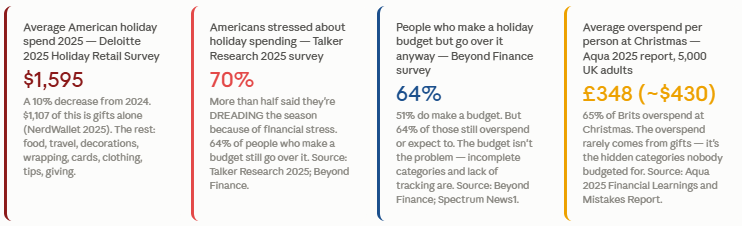
Here is the uncomfortable truth about holiday budgeting: most people who try to budget for Christmas fail not because they lack willpower or financial discipline, but because they build the wrong budget. A 2025 survey by Beyond Finance found that 51% of Americans do make a budget for the holidays. That’s actually a solid majority doing the right thing. And yet, 64% of those budgeters have either already gone over their budget or think they will. Setting a budget and sticking to it are two completely different skills, and the gap between them is where most of the holiday debt is born.
The most common failure mode is a budget that covers gifts and nothing else. You carefully decide that you will spend $600 on gifts this year. You stick to $600 on gifts. And then you spend $200 at the grocery store for Christmas Eve dinner, $80 on a new outfit for the work party, $120 in tips for the building staff and postal worker, $150 on holiday travel, $60 on wrapping paper, cards, and postage, and $100 on decorations you ‘only needed a few of.’ That is $710 in costs that were never in the budget — and is why the Deloitte 2025 Holiday Retail Survey puts the average total holiday spend at $1,595, not $600.
The second failure mode is a budget that was set emotionally rather than mathematically. ‘I’ll spend around $1,000 this year.’ Around is not a number. Around does not have categories. Around does not tell you when to stop. This article is about building a complete, mathematically grounded holiday budget — one that covers every category, reflects what you actually have available to spend, and gives you specific tools to stay inside it. Not financial advice.
Holiday budgeting reality (2025): 51% of Americans make a holiday budget; 64% of those go over or expect to (Beyond Finance, cited Spectrum News1 December 2025). Average total holiday spend: $1,595 (Deloitte 2025). Average spend on gifts alone: $1,107 (NerdWallet 2025). Average overspend: £348 (~$430) among UK holiday shoppers (Aqua 2025, 5,000 adults). 70% of Americans are stressed about holiday spending (Talker Research 2025). 31% still haven't paid off last year's holiday credit card debt (NerdWallet 2025). 3 in 4 holiday gifts cost more in 2025 than 2024 (Bankrate 2025). Sources cited. Not financial advice.
The Nasdaq/GOBankingRates article reporting on the Deloitte 2025 survey calls this a ‘reality check’ and treats it as the mandatory first step: ‘Give yourself a reality check by looking at your holiday spending from last year — for example, reviewing credit card statements and receipts — to see how much you actually spent.’ This number is almost always higher than what people remember. The holiday season has a fog over it — the emotional warmth of the memories makes the financial reality harder to recall accurately. The statement doesn’t have nostalgia. It just has the number.
Once you have last year’s real total, you have a baseline. From that baseline, you can make an informed decision: can you spend the same this year, do you need to cut back, or do you have more room than last year? You can also see exactly which categories surprised you — which is usually where the overspending happens. Not financial advice.
Reality check exercise (takes 30 minutes): Pull November and December statements from last year. Categorise every holiday-related purchase: gifts, food, decorations, travel, clothing, tips, cards/postage, charitable giving, entertainment, other. Add each category. Write down the total. This is your actual last-year holiday spend. It is the foundation of this year's budget. Most people discover their actual spend was 20-40% higher than what they remember. Source: Deloitte 2025; Nasdaq/GOBankingRates. Not financial advice.
Here is the honest way to find it. Start with your take-home pay for November and December. From that, subtract your total fixed monthly obligations for both months (rent or mortgage, utilities, minimum debt payments, insurance, food staples, transport). What is left is your total discretionary income across two months. Your holiday budget is a portion of that — not all of it, because you still need a buffer for unexpected expenses. A common guideline is to allocate no more than one month’s discretionary income to the full holiday season, keeping the other month’s discretionary income as normal breathing room.
If that number is $400, your holiday budget is $400. If it is $2,000, your holiday budget is $2,000. The number that matters is what you have, not what you wish you had, not what the Deloitte average says, and not what you imagine your neighbours are spending. Seventy percent of Americans are already stressed about holiday spending — the antidote to that stress is clarity, not comparison. Not financial advice.
Spectrum News1 expert (December 2025, citing financial counsellor): 'The holiday season creates such an emotional demand on us.' And the practical consequence: 'When you shop for the holidays without a budget, it leads to regret and buyer's remorse.' The budget is not a restriction on joy. It is the tool that protects the joy from the regret that follows when January arrives. Not financial advice.
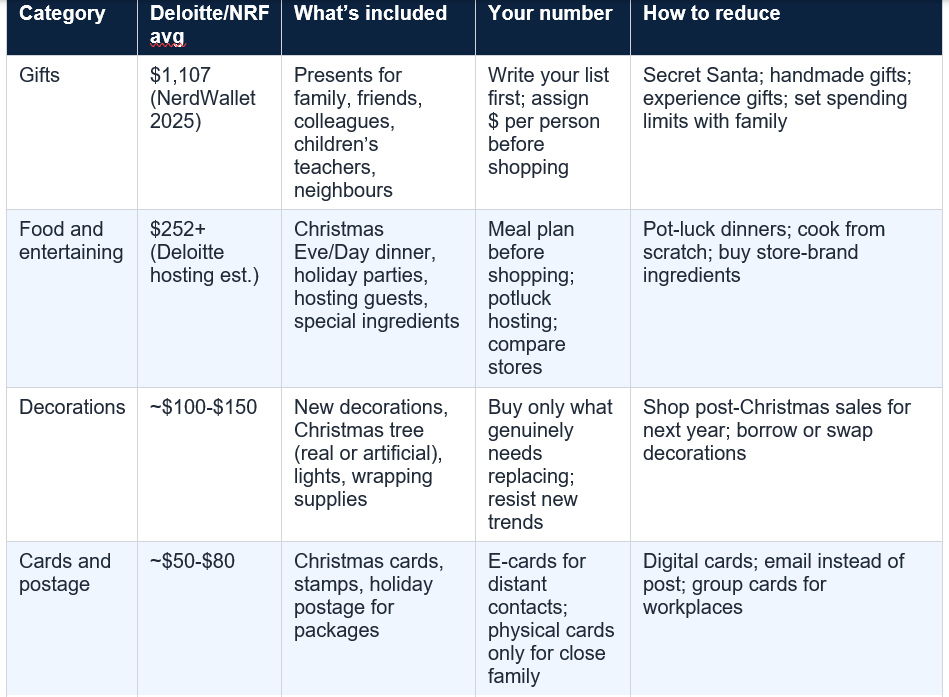
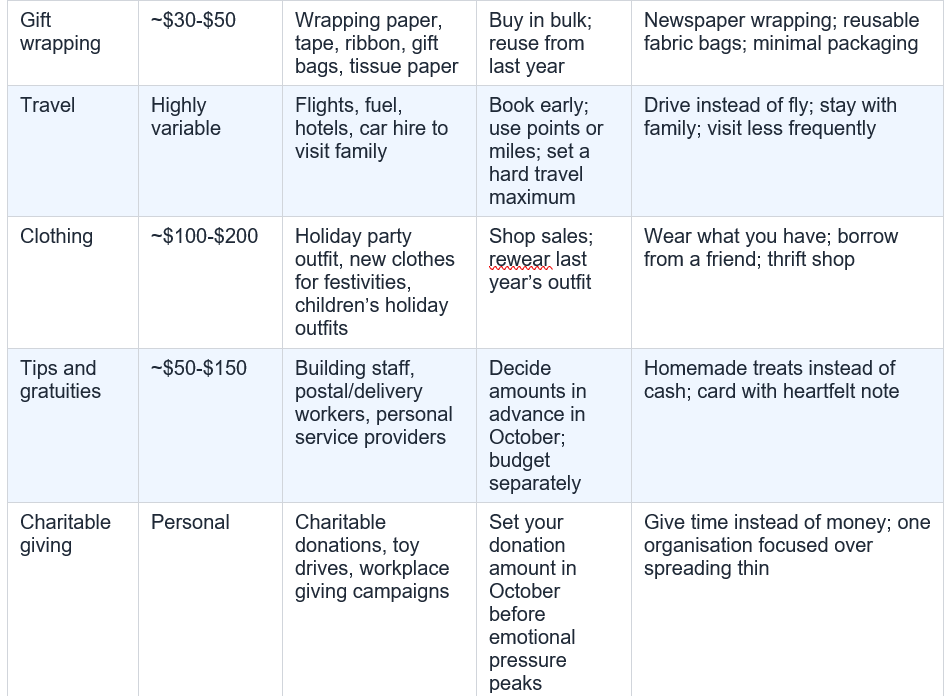
The most effective tool for the gift budget is the list. Write down every person you plan to give a gift to before you buy a single thing. Next to each name, write the maximum amount you will spend on that person. Add up the column. If the total exceeds your gift budget, you have to adjust either the amounts or the list before you walk into a single shop or open a single website. Making those decisions in advance, in writing, is categorically different from making them in real time in front of a display of things that look perfect.
Deloitte’s 2025 survey found that 54% of early holiday shoppers are shopping early specifically to spread out their budget. This is good financial behaviour: spreading purchases over October, November, and December prevents the credit card shock of a compressed late-November/December buying surge. It also gives you time to find better prices, compare options, and avoid panic buying. Not financial advice.
The gift list method: before any shopping, write every recipient's name and a maximum dollar amount. Rule: amounts can go down but not up. Total must fit inside your gift budget. Stick to the list. Secret Santa for family groups dramatically reduces the total gift spend while maintaining the ritual. Setting explicit spending limits between adults ('we’re doing $50 each this year') removes the guessing game and benefits everyone. Source: Spectrum News1; NRF. Not financial advice.
Deloitte’s 2025 survey identifies hosting and gathering costs of $252 as a distinct line item in the average American’s holiday budget. That’s the sit-down dinner, the party drinks, the nicer ingredients, the extra cleaning supplies, the last-minute ice. Then there are the decorations — the ‘I just need a few more lights’ conversation that happens every November and ends with $80 on a credit card. The wrapping supplies. The cards and stamps. The tips for the building super and the letter carrier and the person who cuts your hair. The charitable donation at the office party.
None of these are optional in any meaningful emotional sense. They are all real costs of participating in the holiday season with the people you care about. The only way to prevent them from blowing the budget is to acknowledge them before they happen and put a number on each one. The category template table above does exactly that. The number does not have to be large. It just has to exist. Not financial advice.
The forgotten-category trap: a study by Aqua found the average UK Christmas budget is overshot by £348 (~$430) per person. This overspend rarely comes from gifts alone — it comes from the accumulation of categories nobody budgeted for: the party food, the extra drinks, the last-minute decorations, the work party outfit, the postage. The fix: budget for ALL categories before November starts. If a category has no pre-set number, it has an unlimited number — which is exactly what spending on it feels like in December. Source: Aqua 2025 Financial Learnings and Mistakes Report; Good Money Guide. Not financial advice.
The practical shopping calendar: October is the best time to buy non-perishable gifts at early sales, research prices using tools like Google Shopping Insights (which shows the price history and range for products, helping you avoid ‘sales’ that are not real discounts), and buy gift cards at full face value while you still have budget room. November brings Black Friday and Cyber Monday, which are genuinely good for electronics and specific categories but terrible for impulse spending if you don’t have a specific list already written. December is for finishing purchases, buying fresh food, and resisting everything else.
Bankrate’s 2025 analysis found that three out of four holiday gifts cost more this year than last year, driven by cumulative inflation of approximately 25% since 2021 (Ted Rossman, Bankrate Industry Analyst). This means the same gift basket costs $25 more this year than it did three years ago. Buying early where possible, using price comparison tools, and substituting equivalent-quality options at lower price points are all strategies that partially offset this inflation pressure. Not financial advice.
Shopping calendar to prevent overspending: October: write your complete gift list with amounts; research prices; buy non-perishables; open a dedicated holiday spending account if using one. November 1-20: buy gifts that match your list and that are genuinely discounted; stay off browsing without a list. Black Friday/Cyber Monday: buy ONLY items already on your list with pre-set prices. December 1-15: finish purchases; buy fresh food components; wrap and ship. December 16-25: stop buying unless it replaces something on the list. Rule: if it wasn't on the list before November 1, it's not in the budget. Source: Deloitte 2025; Complete Controller 2025. Not financial advice.
Complete Controller’s 2025 analysis recommends setting budget notifications at 50% and 80% of each category — not just a total, but a per-category alert. Many banking apps and budgeting tools support this. When you hit 50% of your food budget, you get a notification. When you hit 80% of your gift budget, you get a warning. This gives you time to adjust before you are already over, not after. The same principle in a simpler form: a notebook or a Notes app on your phone where you record every holiday purchase the day you make it, with a running category total.
The most powerful psychological tool for staying within a holiday budget is a cash envelope or a dedicated spending account with a fixed balance. The Aqua 2025 research specifically recommends ‘a separate Christmas savings pot’ and ‘switching to debit or prepaid cards for gifts and groceries’ as two of the most effective ways to prevent credit card overspend. When the account is empty or the envelope is empty, spending stops automatically — the limit is physically enforced rather than psychologically enforced. Not financial advice.
The prepaid / separate account method: open a free online savings account and label it 'Holiday 2026.' Fund it with your planned holiday total before November starts. Do all holiday shopping from this account only. When the balance hits zero, shopping stops — no exceptions, no credit card top-up. This converts the abstract budget into a concrete, visible, finite resource. It is the single most reliable method for households that consistently overspend. Source: Aqua 2025 (Good Money Guide); Complete Controller 2025; Pew Research 2024. Not financial advice.
The first move is to run the category budget right now, even mid-season. It is never too late to know where you stand. Pull everything you have spent so far that is holiday-related. Write it down by category. Subtract from what you intended to spend (or from what you can actually afford). The gap is what you have left. Distribute that remaining amount across the categories that still have spending to come, prioritising the categories that are hardest to reduce (food for a family gathering you are hosting, for example) and cutting hardest in the categories that are most optional (decorations, new clothing, non-essential hosting extras).
The second move is to have the conversation. If you have agreed with a partner, family member, or friend group on a spending level and you cannot maintain it, say so now rather than in January when the credit card statement arrives. Most families are relieved when one person starts the conversation about scaling back — because many other members were thinking the same thing and waiting for permission. Proposing a family gift exchange limit, a potluck instead of a catered dinner, or handmade gifts instead of purchased ones is not a failure. It is an adult managing reality. Not financial advice.
A high-yield savings account (currently offering 4-5% APY in 2026) makes the fund grow slightly while it sits. If you saved $150 per month from February through November, you would have approximately $1,505 by the time November's transfer clears — almost exactly enough to cover the NerdWallet average of $1,107 in gifts plus a reasonable amount for the other categories. Credit unions specifically offer Christmas Club accounts that prevent early withdrawal, which is an additional protection against raiding the fund for non-holiday purposes. Not financial advice.
The Aqua 2025 research recommends exactly this approach: ‘Use a separate Christmas savings pot — move a set amount into a dedicated pot or savings account each month in the run-up to Christmas.’ Deloitte’s 2025 data also confirms the direction: 54% of consumers who plan to start holiday shopping early are doing so to spread out their budget. Starting the fund in January simply extends that logic to its most powerful form. Not financial advice.
The holiday season is not going to get cheaper. Bankrate’s 2025 analysis confirms that three out of four gifts cost more than they did last year, and cumulative inflation since 2021 has pushed prices up approximately 25%. The solution is not to spend less on the people you love. It is to plan more deliberately about how to distribute what you have across the categories that actually make a holiday feel complete — the gifts, yes, but also the food, the gathering, the moment of giving $20 to the person who has been delivering your packages all year.
A budget is not the enemy of generosity. It is the condition of sustainable generosity. When you know what you have and where it is going, you can give it freely and joyfully. When you have no plan, the giving is shadowed by anxiety from the moment you hand over the card — because somewhere in the back of your mind, you know you are not sure how you are going to pay for it. The plan removes that shadow. Not financial advice. If you need help managing holiday debt, contact the National Foundation for Credit Counseling (NFCC) for free nonprofit guidance.
The average American plans to spend $1,595 on the 2025 holiday season, according to the Deloitte 2025 Holiday Retail Survey — a 10% decrease from 2024's average. Of that, NerdWallet's 2025 Holiday Spending Report puts the average planned gift spend at $1,107 ($182 more than last year). The remainder covers food, hosting, decorations, travel, clothing, cards, and other categories. However, the right number for you is not the average — it is the number you can afford without going into debt or derailing other financial priorities. The honest method: calculate your total discretionary income for November and December combined, subtract your normal non-holiday spending, and allocate no more than the remaining amount to the full holiday season. A practical starting target: $500-$1,000 for a moderate family budget when keeping within reasonable means. Sources: Deloitte 2025 (Nasdaq/GOBankingRates; First American Bank); NerdWallet 2025 (Scripps/TMJ4). Not financial advice.
What are the biggest hidden costs in a holiday budget most people forget?
According to Deloitte's 2025 Holiday Retail Survey, hosting and gathering alone cost the average American $252 — a line item most people do not budget separately. Beyond that, the consistently underestimated hidden costs are: gift wrapping and packaging (wrapping paper, bags, ribbon, tape — easily $30-$80); cards and postage (holiday cards plus stamps plus package shipping — $50-$80+); tips and gratuities (building staff, delivery workers, service providers — $50-$200 for many households); charitable donations (workplace giving drives, toy box donations, year-end charity giving); new clothing for holiday parties; and the incremental grocery shop upgrades for every holiday gathering. The Aqua 2025 study of 5,000 UK adults found the average person overshoots their Christmas budget by £348 (~$430) — almost entirely from these non-gift categories that were never assigned a number. The fix: budget for every category, not just gifts, before November 1. Source: Deloitte 2025; Aqua 2025 (Good Money Guide). Not financial advice.
What is the most effective way to stick to a holiday budget?
The most reliably effective methods, based on the research and expert guidance: (1) Separate account or cash envelope: open a dedicated holiday spending account or a series of cash envelopes and fund them with your planned total before shopping begins. When the money is gone, shopping stops. This converts a psychological limit into a physical one. (2) Written list with per-person amounts: write every recipient's name with a pre-assigned dollar maximum before entering any shop or website. The list is non-negotiable. (3) Per-category tracking with 50% and 80% alerts: many banking apps allow budget categories with notification thresholds. Set alerts so you know when you are approaching the limit in each category, not after you have crossed it. (4) Early shopping: 54% of early shoppers report doing so specifically to spread out the budget (Deloitte 2025). Spreading purchases over October and November avoids the all-at-once credit card shock of late December. Sources: Aqua 2025 (Good Money Guide); Deloitte 2025; Complete Controller 2025; Pew Research 2024. Not financial advice.
Should I use a credit card or cash for holiday shopping?
The research shows meaningful differences in outcome by payment method. A 2024 Pew Research Center survey found that 54% of Americans who avoid overspending use cash or debit instead of credit. The psychological effect is real: paying with physical money or a debit card creates a felt sense of spending that credit does not. The account balance visibly decreases; the physical cash visibly disappears. Credit, by contrast, defers the pain of paying to January — which is exactly why 31% of holiday shoppers are still paying off last year's credit card debt when the next holiday season arrives (NerdWallet 2025). The Aqua 2025 research recommends: 'Switch to debit or prepaid cards for gifts and groceries — using a prepaid card or a debit account with a fixed spending limit can help keep Christmas costs under control.' The exception: if you have a credit card with strong cashback or rewards that you will pay in full before interest accrues, using it for budgeted holiday purchases and paying the full balance in January is a legitimate way to earn rewards. The key phrase is 'paid in full.' Sources: Pew Research 2024; NerdWallet 2025; Aqua 2025. Not financial advice.
How do I set up a year-round Christmas savings fund?
A year-round Christmas fund is simple to set up and is the most effective long-term solution to holiday financial stress. The steps: (1) Decide your target — your planned total holiday budget (use this year's budget as the starting figure). (2) Divide by 10 (for February through November — 10 months of savings before December starts). (3) Set up an automatic monthly transfer from your checking account to a dedicated savings account labelled 'Holiday [Year]' on the 1st or 2nd of each month. (4) Choose a high-yield savings account (currently 4-5% APY in 2026) to earn a small return while the fund grows. (5) Do not touch it for anything other than holiday spending. Credit unions specifically offer 'Christmas Club' accounts that prevent early withdrawal as an added protection. Examples: $100/month = $1,000 by November. $150/month = $1,500 by November. $130/month = $1,300 by November — enough to cover average NerdWallet gift spending of $1,107 plus some additional categories. Sources: Aqua 2025 (Good Money Guide); Deloitte 2025; NerdWallet 2025. Not financial advice.
Table of Contents
- Why Most Holiday Budgets Fail Before December Starts
- Step One: Face Last Year’s Numbers Honestly
- Step Two: Set Your Real Holiday Number
- Step Three: Build the Complete Budget — Every Category
- The Gift Budget: How to Allocate Without Guilt
- The Hidden Categories Most Budgets Forget
- The Shopping Strategy: When, Where, and How to Buy
- How to Actually Stick to the Budget (The Hard Part)
- If You’re Already Behind: Catching Up Mid-Season
- The Year-Round Holiday Fund: Never Scramble Again
- The Complete Holiday Budget Template
- Conclusion: The Best Gift You Can Give Yourself Is a Plan
- Frequently Asked Questions
- External References and Further Reading
Why Most Holiday Budgets Fail Before December Starts
Here is the uncomfortable truth about holiday budgeting: most people who try to budget for Christmas fail not because they lack willpower or financial discipline, but because they build the wrong budget. A 2025 survey by Beyond Finance found that 51% of Americans do make a budget for the holidays. That’s actually a solid majority doing the right thing. And yet, 64% of those budgeters have either already gone over their budget or think they will. Setting a budget and sticking to it are two completely different skills, and the gap between them is where most of the holiday debt is born.The most common failure mode is a budget that covers gifts and nothing else. You carefully decide that you will spend $600 on gifts this year. You stick to $600 on gifts. And then you spend $200 at the grocery store for Christmas Eve dinner, $80 on a new outfit for the work party, $120 in tips for the building staff and postal worker, $150 on holiday travel, $60 on wrapping paper, cards, and postage, and $100 on decorations you ‘only needed a few of.’ That is $710 in costs that were never in the budget — and is why the Deloitte 2025 Holiday Retail Survey puts the average total holiday spend at $1,595, not $600.
The second failure mode is a budget that was set emotionally rather than mathematically. ‘I’ll spend around $1,000 this year.’ Around is not a number. Around does not have categories. Around does not tell you when to stop. This article is about building a complete, mathematically grounded holiday budget — one that covers every category, reflects what you actually have available to spend, and gives you specific tools to stay inside it. Not financial advice.
Holiday budgeting reality (2025): 51% of Americans make a holiday budget; 64% of those go over or expect to (Beyond Finance, cited Spectrum News1 December 2025). Average total holiday spend: $1,595 (Deloitte 2025). Average spend on gifts alone: $1,107 (NerdWallet 2025). Average overspend: £348 (~$430) among UK holiday shoppers (Aqua 2025, 5,000 adults). 70% of Americans are stressed about holiday spending (Talker Research 2025). 31% still haven't paid off last year's holiday credit card debt (NerdWallet 2025). 3 in 4 holiday gifts cost more in 2025 than 2024 (Bankrate 2025). Sources cited. Not financial advice.
Step One: Face Last Year’s Numbers Honestly
Before you set a single number for this year’s budget, do one thing that most people skip: find out what you actually spent last year. Pull your November and December credit card statements and bank statements from last year and add up everything holiday-related. Not what you planned to spend — what you actually spent, across every category. Gifts, food, decorations, travel, clothing, tips, charitable donations, the random online orders that arrived on December 23. All of it.The Nasdaq/GOBankingRates article reporting on the Deloitte 2025 survey calls this a ‘reality check’ and treats it as the mandatory first step: ‘Give yourself a reality check by looking at your holiday spending from last year — for example, reviewing credit card statements and receipts — to see how much you actually spent.’ This number is almost always higher than what people remember. The holiday season has a fog over it — the emotional warmth of the memories makes the financial reality harder to recall accurately. The statement doesn’t have nostalgia. It just has the number.
Once you have last year’s real total, you have a baseline. From that baseline, you can make an informed decision: can you spend the same this year, do you need to cut back, or do you have more room than last year? You can also see exactly which categories surprised you — which is usually where the overspending happens. Not financial advice.
Reality check exercise (takes 30 minutes): Pull November and December statements from last year. Categorise every holiday-related purchase: gifts, food, decorations, travel, clothing, tips, cards/postage, charitable giving, entertainment, other. Add each category. Write down the total. This is your actual last-year holiday spend. It is the foundation of this year's budget. Most people discover their actual spend was 20-40% higher than what they remember. Source: Deloitte 2025; Nasdaq/GOBankingRates. Not financial advice.
Step Two: Set Your Real Holiday Number
Your holiday budget number is not the average. The average American plans to spend $1,595 this holiday season according to Deloitte’s 2025 survey, and $1,107 specifically on gifts per NerdWallet’s 2025 Holiday Spending Report. But those averages include people with very different income levels, family sizes, and financial situations. The right number for you is the number you can afford to spend without going into debt or derailing other financial priorities.Here is the honest way to find it. Start with your take-home pay for November and December. From that, subtract your total fixed monthly obligations for both months (rent or mortgage, utilities, minimum debt payments, insurance, food staples, transport). What is left is your total discretionary income across two months. Your holiday budget is a portion of that — not all of it, because you still need a buffer for unexpected expenses. A common guideline is to allocate no more than one month’s discretionary income to the full holiday season, keeping the other month’s discretionary income as normal breathing room.
If that number is $400, your holiday budget is $400. If it is $2,000, your holiday budget is $2,000. The number that matters is what you have, not what you wish you had, not what the Deloitte average says, and not what you imagine your neighbours are spending. Seventy percent of Americans are already stressed about holiday spending — the antidote to that stress is clarity, not comparison. Not financial advice.
Spectrum News1 expert (December 2025, citing financial counsellor): 'The holiday season creates such an emotional demand on us.' And the practical consequence: 'When you shop for the holidays without a budget, it leads to regret and buyer's remorse.' The budget is not a restriction on joy. It is the tool that protects the joy from the regret that follows when January arrives. Not financial advice.
Step Three: Build the Complete Budget — Every Category
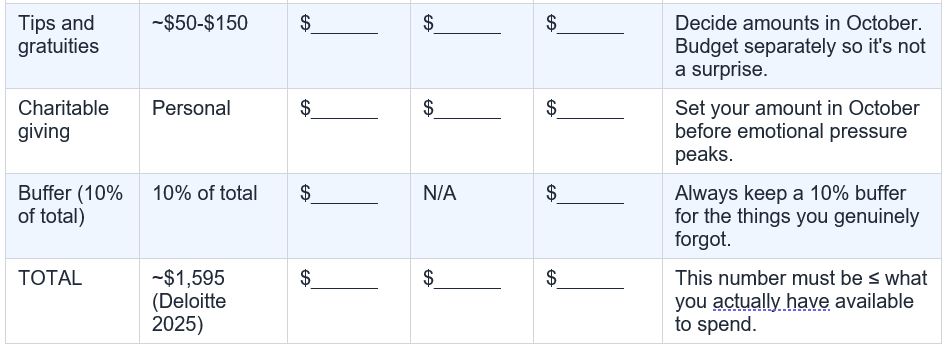
A complete holiday budget has nine categories. Most people budget for one or two. The reason 64% of holiday budgeters still overspend is precisely that they are budgeting for gifts while the other eight categories run unchecked. Every category below contributes to the Deloitte $1,595 average. Every category needs a number before December starts.
The Gift Budget: How to Allocate Without Guilt
Gifts are where most of the holiday budget lives and where most of the emotional complexity lives too. The hardest thing about the gift budget is not the maths — it’s the guilt. The feeling that spending less means loving less. The internal negotiation between what you can afford and what you imagine the recipient expects. This is the emotional demand that the Spectrum News1 financial counsellor described, and it is responsible for a significant portion of the overspending that leaves 31% of people still paying off their holiday debt almost a full year later (NerdWallet 2025).The most effective tool for the gift budget is the list. Write down every person you plan to give a gift to before you buy a single thing. Next to each name, write the maximum amount you will spend on that person. Add up the column. If the total exceeds your gift budget, you have to adjust either the amounts or the list before you walk into a single shop or open a single website. Making those decisions in advance, in writing, is categorically different from making them in real time in front of a display of things that look perfect.
Deloitte’s 2025 survey found that 54% of early holiday shoppers are shopping early specifically to spread out their budget. This is good financial behaviour: spreading purchases over October, November, and December prevents the credit card shock of a compressed late-November/December buying surge. It also gives you time to find better prices, compare options, and avoid panic buying. Not financial advice.
The gift list method: before any shopping, write every recipient's name and a maximum dollar amount. Rule: amounts can go down but not up. Total must fit inside your gift budget. Stick to the list. Secret Santa for family groups dramatically reduces the total gift spend while maintaining the ritual. Setting explicit spending limits between adults ('we’re doing $50 each this year') removes the guessing game and benefits everyone. Source: Spectrum News1; NRF. Not financial advice.
The Hidden Categories Most Budgets Forget
Ask most people what they’ve budgeted for the holidays and they’ll tell you a gift number. Ask them about food, and they’ll say ‘oh, that’s separate.’ Ask about travel, and they’ll say ‘that’s different.’ Ask about the new dress for the office party, and they’ll say it was on sale. None of these count in their mind. All of them count in January.Deloitte’s 2025 survey identifies hosting and gathering costs of $252 as a distinct line item in the average American’s holiday budget. That’s the sit-down dinner, the party drinks, the nicer ingredients, the extra cleaning supplies, the last-minute ice. Then there are the decorations — the ‘I just need a few more lights’ conversation that happens every November and ends with $80 on a credit card. The wrapping supplies. The cards and stamps. The tips for the building super and the letter carrier and the person who cuts your hair. The charitable donation at the office party.
None of these are optional in any meaningful emotional sense. They are all real costs of participating in the holiday season with the people you care about. The only way to prevent them from blowing the budget is to acknowledge them before they happen and put a number on each one. The category template table above does exactly that. The number does not have to be large. It just has to exist. Not financial advice.
The forgotten-category trap: a study by Aqua found the average UK Christmas budget is overshot by £348 (~$430) per person. This overspend rarely comes from gifts alone — it comes from the accumulation of categories nobody budgeted for: the party food, the extra drinks, the last-minute decorations, the work party outfit, the postage. The fix: budget for ALL categories before November starts. If a category has no pre-set number, it has an unlimited number — which is exactly what spending on it feels like in December. Source: Aqua 2025 Financial Learnings and Mistakes Report; Good Money Guide. Not financial advice.
The Shopping Strategy: When, Where, and How to Buy
When you shop matters as much as what you spend. The 2025 holiday season saw record-breaking online sales of $241.4 billion, much of it driven by impulse purchases during high-pressure shopping events like Black Friday ($11.8 billion online in a single day) and Cyber Monday. The research consistently shows that early, planned shopping produces better outcomes than late, pressured shopping. Fifty-four percent of consumers who plan to shop early are doing so explicitly to spread their budget over a longer period (Deloitte 2025).The practical shopping calendar: October is the best time to buy non-perishable gifts at early sales, research prices using tools like Google Shopping Insights (which shows the price history and range for products, helping you avoid ‘sales’ that are not real discounts), and buy gift cards at full face value while you still have budget room. November brings Black Friday and Cyber Monday, which are genuinely good for electronics and specific categories but terrible for impulse spending if you don’t have a specific list already written. December is for finishing purchases, buying fresh food, and resisting everything else.
Bankrate’s 2025 analysis found that three out of four holiday gifts cost more this year than last year, driven by cumulative inflation of approximately 25% since 2021 (Ted Rossman, Bankrate Industry Analyst). This means the same gift basket costs $25 more this year than it did three years ago. Buying early where possible, using price comparison tools, and substituting equivalent-quality options at lower price points are all strategies that partially offset this inflation pressure. Not financial advice.
Shopping calendar to prevent overspending: October: write your complete gift list with amounts; research prices; buy non-perishables; open a dedicated holiday spending account if using one. November 1-20: buy gifts that match your list and that are genuinely discounted; stay off browsing without a list. Black Friday/Cyber Monday: buy ONLY items already on your list with pre-set prices. December 1-15: finish purchases; buy fresh food components; wrap and ship. December 16-25: stop buying unless it replaces something on the list. Rule: if it wasn't on the list before November 1, it's not in the budget. Source: Deloitte 2025; Complete Controller 2025. Not financial advice.
How to Actually Stick to the Budget (The Hard Part)
Building the budget is the easy part. Sticking to it through six weeks of beautiful shop windows, online deals that look too good to pass up, children who really want one more thing, and family members who spent more on you than you spent on them is the genuinely hard part. The research on why budgets fail in-season is consistent: spending momentum builds, tracking falls apart, and by the time the damage is visible it is already done.Complete Controller’s 2025 analysis recommends setting budget notifications at 50% and 80% of each category — not just a total, but a per-category alert. Many banking apps and budgeting tools support this. When you hit 50% of your food budget, you get a notification. When you hit 80% of your gift budget, you get a warning. This gives you time to adjust before you are already over, not after. The same principle in a simpler form: a notebook or a Notes app on your phone where you record every holiday purchase the day you make it, with a running category total.
The most powerful psychological tool for staying within a holiday budget is a cash envelope or a dedicated spending account with a fixed balance. The Aqua 2025 research specifically recommends ‘a separate Christmas savings pot’ and ‘switching to debit or prepaid cards for gifts and groceries’ as two of the most effective ways to prevent credit card overspend. When the account is empty or the envelope is empty, spending stops automatically — the limit is physically enforced rather than psychologically enforced. Not financial advice.
The prepaid / separate account method: open a free online savings account and label it 'Holiday 2026.' Fund it with your planned holiday total before November starts. Do all holiday shopping from this account only. When the balance hits zero, shopping stops — no exceptions, no credit card top-up. This converts the abstract budget into a concrete, visible, finite resource. It is the single most reliable method for households that consistently overspend. Source: Aqua 2025 (Good Money Guide); Complete Controller 2025; Pew Research 2024. Not financial advice.
If You’re Already Behind: Catching Up Mid-Season
Sometimes you realise in mid-November that your budget is already stretched or your holiday spending has already started without a plan. This section is for that moment. Not shame — adjustment.The first move is to run the category budget right now, even mid-season. It is never too late to know where you stand. Pull everything you have spent so far that is holiday-related. Write it down by category. Subtract from what you intended to spend (or from what you can actually afford). The gap is what you have left. Distribute that remaining amount across the categories that still have spending to come, prioritising the categories that are hardest to reduce (food for a family gathering you are hosting, for example) and cutting hardest in the categories that are most optional (decorations, new clothing, non-essential hosting extras).
The second move is to have the conversation. If you have agreed with a partner, family member, or friend group on a spending level and you cannot maintain it, say so now rather than in January when the credit card statement arrives. Most families are relieved when one person starts the conversation about scaling back — because many other members were thinking the same thing and waiting for permission. Proposing a family gift exchange limit, a potluck instead of a catered dinner, or handmade gifts instead of purchased ones is not a failure. It is an adult managing reality. Not financial advice.
The Year-Round Holiday Fund: Never Scramble Again
The most effective holiday budget strategy is one that starts in January rather than November. The year-round holiday fund is simple: divide your planned holiday total by 10 (February through November) and automate that amount into a dedicated savings account every month. By the time November arrives, the money is there, it has not been spent on anything else, and you can walk into December knowing exactly what you have to work with.A high-yield savings account (currently offering 4-5% APY in 2026) makes the fund grow slightly while it sits. If you saved $150 per month from February through November, you would have approximately $1,505 by the time November's transfer clears — almost exactly enough to cover the NerdWallet average of $1,107 in gifts plus a reasonable amount for the other categories. Credit unions specifically offer Christmas Club accounts that prevent early withdrawal, which is an additional protection against raiding the fund for non-holiday purposes. Not financial advice.
The Aqua 2025 research recommends exactly this approach: ‘Use a separate Christmas savings pot — move a set amount into a dedicated pot or savings account each month in the run-up to Christmas.’ Deloitte’s 2025 data also confirms the direction: 54% of consumers who plan to start holiday shopping early are doing so to spread out their budget. Starting the fund in January simply extends that logic to its most powerful form. Not financial advice.
The Complete Holiday Budget Template
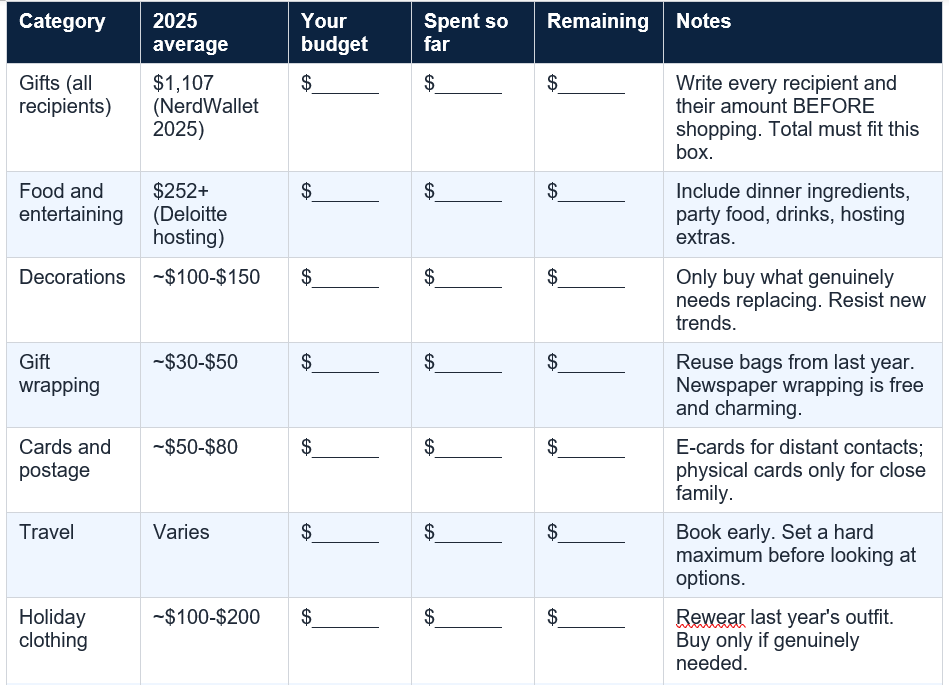
Use this template as your starting point. Fill in your own numbers in the ‘Your budget’ column before any shopping begins. The target is that your column adds up to a number that fits within your available discretionary income for November and December combined. Not financial advice.
Conclusion
Seventy percent of Americans are stressed about holiday spending. Sixty-four percent of people who make a holiday budget still go over it. Thirty-one percent will start next year still paying off this year’s holiday credit card debt. These numbers do not reflect a failure of generosity or a lack of holiday spirit. They reflect a failure of planning — specifically, the failure to build a complete, realistic, category-by-category budget before November’s shopping momentum takes over.The holiday season is not going to get cheaper. Bankrate’s 2025 analysis confirms that three out of four gifts cost more than they did last year, and cumulative inflation since 2021 has pushed prices up approximately 25%. The solution is not to spend less on the people you love. It is to plan more deliberately about how to distribute what you have across the categories that actually make a holiday feel complete — the gifts, yes, but also the food, the gathering, the moment of giving $20 to the person who has been delivering your packages all year.
A budget is not the enemy of generosity. It is the condition of sustainable generosity. When you know what you have and where it is going, you can give it freely and joyfully. When you have no plan, the giving is shadowed by anxiety from the moment you hand over the card — because somewhere in the back of your mind, you know you are not sure how you are going to pay for it. The plan removes that shadow. Not financial advice. If you need help managing holiday debt, contact the National Foundation for Credit Counseling (NFCC) for free nonprofit guidance.
Frequently Asked Questions
How much should I budget for the holidays in 2025/2026?The average American plans to spend $1,595 on the 2025 holiday season, according to the Deloitte 2025 Holiday Retail Survey — a 10% decrease from 2024's average. Of that, NerdWallet's 2025 Holiday Spending Report puts the average planned gift spend at $1,107 ($182 more than last year). The remainder covers food, hosting, decorations, travel, clothing, cards, and other categories. However, the right number for you is not the average — it is the number you can afford without going into debt or derailing other financial priorities. The honest method: calculate your total discretionary income for November and December combined, subtract your normal non-holiday spending, and allocate no more than the remaining amount to the full holiday season. A practical starting target: $500-$1,000 for a moderate family budget when keeping within reasonable means. Sources: Deloitte 2025 (Nasdaq/GOBankingRates; First American Bank); NerdWallet 2025 (Scripps/TMJ4). Not financial advice.
What are the biggest hidden costs in a holiday budget most people forget?
According to Deloitte's 2025 Holiday Retail Survey, hosting and gathering alone cost the average American $252 — a line item most people do not budget separately. Beyond that, the consistently underestimated hidden costs are: gift wrapping and packaging (wrapping paper, bags, ribbon, tape — easily $30-$80); cards and postage (holiday cards plus stamps plus package shipping — $50-$80+); tips and gratuities (building staff, delivery workers, service providers — $50-$200 for many households); charitable donations (workplace giving drives, toy box donations, year-end charity giving); new clothing for holiday parties; and the incremental grocery shop upgrades for every holiday gathering. The Aqua 2025 study of 5,000 UK adults found the average person overshoots their Christmas budget by £348 (~$430) — almost entirely from these non-gift categories that were never assigned a number. The fix: budget for every category, not just gifts, before November 1. Source: Deloitte 2025; Aqua 2025 (Good Money Guide). Not financial advice.
What is the most effective way to stick to a holiday budget?
The most reliably effective methods, based on the research and expert guidance: (1) Separate account or cash envelope: open a dedicated holiday spending account or a series of cash envelopes and fund them with your planned total before shopping begins. When the money is gone, shopping stops. This converts a psychological limit into a physical one. (2) Written list with per-person amounts: write every recipient's name with a pre-assigned dollar maximum before entering any shop or website. The list is non-negotiable. (3) Per-category tracking with 50% and 80% alerts: many banking apps allow budget categories with notification thresholds. Set alerts so you know when you are approaching the limit in each category, not after you have crossed it. (4) Early shopping: 54% of early shoppers report doing so specifically to spread out the budget (Deloitte 2025). Spreading purchases over October and November avoids the all-at-once credit card shock of late December. Sources: Aqua 2025 (Good Money Guide); Deloitte 2025; Complete Controller 2025; Pew Research 2024. Not financial advice.
Should I use a credit card or cash for holiday shopping?
The research shows meaningful differences in outcome by payment method. A 2024 Pew Research Center survey found that 54% of Americans who avoid overspending use cash or debit instead of credit. The psychological effect is real: paying with physical money or a debit card creates a felt sense of spending that credit does not. The account balance visibly decreases; the physical cash visibly disappears. Credit, by contrast, defers the pain of paying to January — which is exactly why 31% of holiday shoppers are still paying off last year's credit card debt when the next holiday season arrives (NerdWallet 2025). The Aqua 2025 research recommends: 'Switch to debit or prepaid cards for gifts and groceries — using a prepaid card or a debit account with a fixed spending limit can help keep Christmas costs under control.' The exception: if you have a credit card with strong cashback or rewards that you will pay in full before interest accrues, using it for budgeted holiday purchases and paying the full balance in January is a legitimate way to earn rewards. The key phrase is 'paid in full.' Sources: Pew Research 2024; NerdWallet 2025; Aqua 2025. Not financial advice.
How do I set up a year-round Christmas savings fund?
A year-round Christmas fund is simple to set up and is the most effective long-term solution to holiday financial stress. The steps: (1) Decide your target — your planned total holiday budget (use this year's budget as the starting figure). (2) Divide by 10 (for February through November — 10 months of savings before December starts). (3) Set up an automatic monthly transfer from your checking account to a dedicated savings account labelled 'Holiday [Year]' on the 1st or 2nd of each month. (4) Choose a high-yield savings account (currently 4-5% APY in 2026) to earn a small return while the fund grows. (5) Do not touch it for anything other than holiday spending. Credit unions specifically offer 'Christmas Club' accounts that prevent early withdrawal as an added protection. Examples: $100/month = $1,000 by November. $150/month = $1,500 by November. $130/month = $1,300 by November — enough to cover average NerdWallet gift spending of $1,107 plus some additional categories. Sources: Aqua 2025 (Good Money Guide); Deloitte 2025; NerdWallet 2025. Not financial advice.
0 Comments
Be the first to share your thoughts on this article.