

Spending
UK Diesel Price Near All-Time High: Iran War Crisis
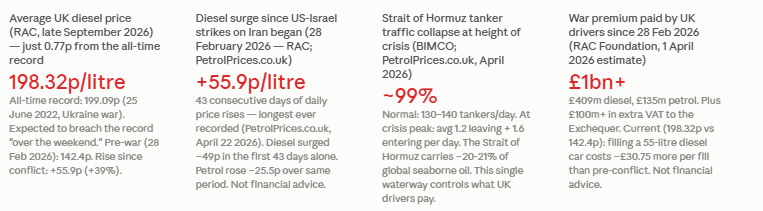
UK diesel stands at 198.32p per litre — just 0.77p away from the 199.09p all-time record set on 25 June 2022 after Russia’s invasion of Ukraine. Prices are expected to breach that record over the weekend as the fallout from the US-Israel war with Iran continues to strangle oil tanker flows through the Strait of Hormuz. Since 28 February 2026, diesel has risen by more than 55p per litre. Drivers have collectively paid over £1 billion in what analysts are calling the ‘war premium.’
The context is important. The price of 198.32p is a national average across all UK forecourts. Prices at motorway service stations are already significantly higher: Euro Garages’ Rivington Services on the M61 in Bolton, Greater Manchester has already charged 200.9p per litre for diesel. Some rural forecourts in Scotland have been selling diesel for as much as 217p per litre. The national average figure is, if anything, a conservative reflection of what many drivers are actually paying.
The speed of the price rise is as striking as the level. On 28 February 2026, the day the United States and Israel launched military strikes on Iran, average UK diesel stood at 142.4p per litre. In the months since, it has risen by more than 55p. That is roughly the equivalent of adding £30 to the cost of filling a typical 55-litre diesel family car. For a driver who fills up twice a month, this crisis alone has added approximately £72 per month to their fuel costs compared to pre-war levels.
Current UK diesel average: 198.32p per litre (RAC motoring body, as cited; September 2026). All-time UK diesel record: 199.09p per litre (25 June 2022, following Russia's invasion of Ukraine). Gap to record: 0.77p per litre. Pre-war diesel price (28 February 2026): 142.4p per litre. Total rise since conflict began: approximately +55.9p per litre. Diesel at 198.32p = a 39% rise from the pre-war level. Cost to fill 55-litre family car at current prices: approximately £109. Sources: RAC; user brief; Alliance News; Market Screener. Not financial advice.
In the UK, diesel is produced from the heavier fractions of crude oil, and UK refineries import a substantial proportion of their diesel precursors — and sometimes pre-refined diesel — from European and global sources. When Russian production and supply was disrupted, global diesel markets tightened rapidly. Wholesale diesel prices rose, and UK pump prices followed. The record of 199.09p was the peak of that crisis. After June 2022, prices gradually fell as the market adjusted, alternative supplies were sourced, and global demand softened.
By February 2026, UK diesel had retreated to 142.4p per litre — still elevated by pre-2022 historical standards but well below the records of that summer. Then came 28 February 2026, and with it, the most significant disruption to Middle Eastern oil supply in years. UK diesel is now not merely approaching the 2022 record; it has very nearly reached it, driven by a different geopolitical shock but a structurally similar mechanism: a conflict that threatens the supply of oil to global markets and sends wholesale prices soaring.
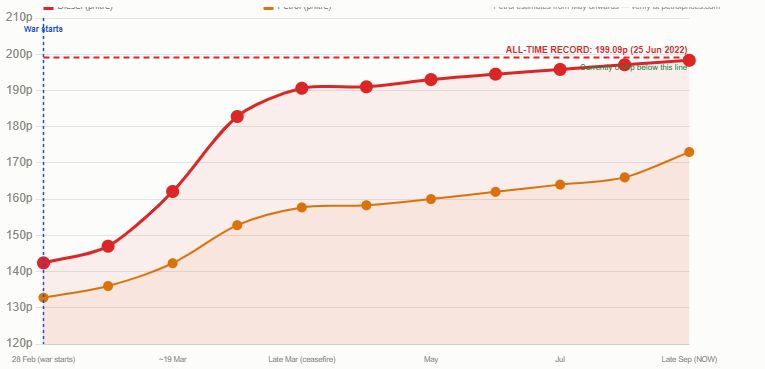
UK diesel price milestones: July 2022 all-time high: 199.09p (25 June 2022, Ukraine war). Pre-Iran war: 142.4p (28 February 2026). 16-month high: 147p (5 March 2026). 162p reached (mid-March 2026). 182.8p (late March): first £100 fill since December 2022. 190.6p (late March/AJ Bell reporting): hopes of 'topping out' after ceasefire. Prices stop rising: 22 April 2026 -- after 43 consecutive days of increases (longest on record). Current: 198.32p (latest RAC figures, late September 2026). Expected: breach of 199.09p record 'over the weekend'. Sources: user brief; PetrolPrices.co.uk; AJ Bell; Alliance News; RAC. Not financial advice.
For UK motorists, the immediate visible effect was modest: on 5 March 2026, just five days after the conflict began, diesel at UK pumps had risen 5p to 147p and petrol had risen 3p to 136p. Simon Williams, RAC head of policy, described diesel’s 147p as a ‘16-month high” and noted that while wholesale costs had already risen 7p per litre, it would typically take two weeks for those increases to filter through to forecourt prices. The RAC was already warning that fuel price averages would ‘rise further over the coming week at least.’
The Petrol Retailers’ Association (PRA) added a crucial caveat: not all retailers would be able to wait the usual two-week wholesale-to-pump lag. Those buying fuel under shorter-cycle contracts — contracts refreshed more frequently against spot market prices — would have to pass on the higher costs immediately. This is why some forecourts spiked before others, and why the AA has repeatedly warned about a ‘pump-price postcode lottery.’
By the time oil had been hovering above $100 per barrel for days, the RAC’s assessment darkened considerably. Williams stated that diesel was on a ‘crash course’ to 170p per litre and that wholesale costs pointed to petrol stabilising — but only if oil did not rise further. It did rise further. Within weeks, diesel surpassed 170p, then 180p, then 190p, before a conditional ceasefire brought a brief pause. The ceasefire, described as conditional, clearly did not hold, or its conditions were not met, because prices have continued to climb toward the September record.
Simon Williams, RAC head of policy (March 2026): 'Petrol has now increased by 3p to 136p a litre since Saturday, while diesel is up by 5p to a 16-month high of 147p. While wholesale costs for any retailer buying in new stock will have gone up, it normally takes two weeks for price changes to work their way through to the forecourt.' (Sky News / multiple regional radio outlets, 5 March 2026). Later: 'Both fuels are now at their most expensive since late 2022. The conditional ceasefire announcement may have taken some heat out of global oil prices, but the outlook for drivers in the UK remains highly uncertain.' (AJ Bell, late March 2026.)
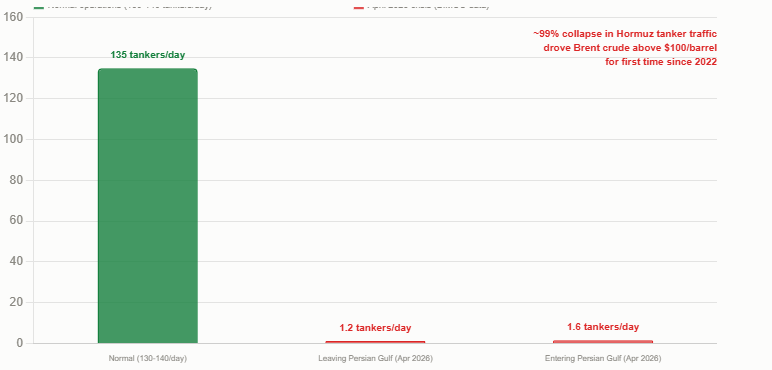
When Iran launched attacks against Gulf nations in retaliation for the US-Israeli strikes, shipping through the strait was reduced to what Sky News described as ‘a trickle.’ BIMCO, the global shipping industry body, recorded an average of just 1.2 tankers leaving and 1.6 entering the Persian Gulf per day during April 2026 — a roughly 99% collapse in shipping traffic compared to normal operations. Even a partial blockade of Hormuz has historically sent oil prices rocketing; a near-total cessation of tanker traffic is in a different category of disruption entirely.
The specific reason diesel is hit harder than petrol by Middle Eastern supply shocks is that Europe, including the UK, is a net importer of diesel but largely self-sufficient in petrol production. European refineries can produce enough petrol for domestic demand, but they do not produce enough diesel. The UK and Europe rely on imports of diesel from refineries in the Middle East, India, Russia, and the United States. When Middle Eastern supply is disrupted and Hormuz is blocked, Europe’s diesel supply tightens faster and more severely than its petrol supply. Petrol prices rose roughly 25.5p per litre in the crisis; diesel rose approximately 49p — almost double.
Why the Strait of Hormuz matters for UK pump prices: approximately 20-21% of global oil traded by sea passes through the Strait of Hormuz. The strait is 33km wide at its narrowest point. When it is effectively closed to tanker traffic, global oil markets price in supply shortages that affect refined fuel prices everywhere, including the UK. Europe's specific vulnerability to diesel supply disruption via Hormuz is structural: Europe cannot produce enough diesel from its own refineries and relies on imports that transit or originate near the strait. Sources: Sky News; PetrolPrices.co.uk; BIMCO. Not financial advice.
The structural explanation has already been outlined in the context of Hormuz: Europe is a net importer of diesel but broadly self-sufficient in petrol. But there are additional layers. Diesel and petrol are produced from different fractions of the crude oil refining process. Diesel (and aviation fuel) come from the middle distillate fractions, which are particularly important to the Gulf’s refinery output. When Gulf production and supply is disrupted, middle distillates are affected disproportionately relative to lighter fractions used in petrol production.
The consequences fall disproportionately on specific groups of motorists and businesses. Diesel is not primarily the fuel of choice for private passenger cars any more — UK new car sales have shifted heavily toward petrol and electric vehicles in recent years following a series of policy and regulatory changes that reduced diesel’s appeal. But diesel remains the dominant fuel for vans, lorries, buses, trains (on non-electrified routes), agricultural machinery, and construction equipment. The businesses and sectors that depend most heavily on diesel — logistics, farming, construction, public transport operators — are absorbing cost increases that translate directly into higher prices for the goods they carry and the services they deliver.
For remaining private diesel drivers, the RAC’s figures are stark. Compared to the start of the Iran conflict, it costs £21.35 more to fill a typical family car that runs on diesel. The equivalent figure for a petrol car was £10.55. The diesel driver is being asked to absorb twice the financial shock of their petrol-driving neighbour, and both are facing the same inflationary consequences of higher freight and delivery costs embedded in the prices of everything they buy.
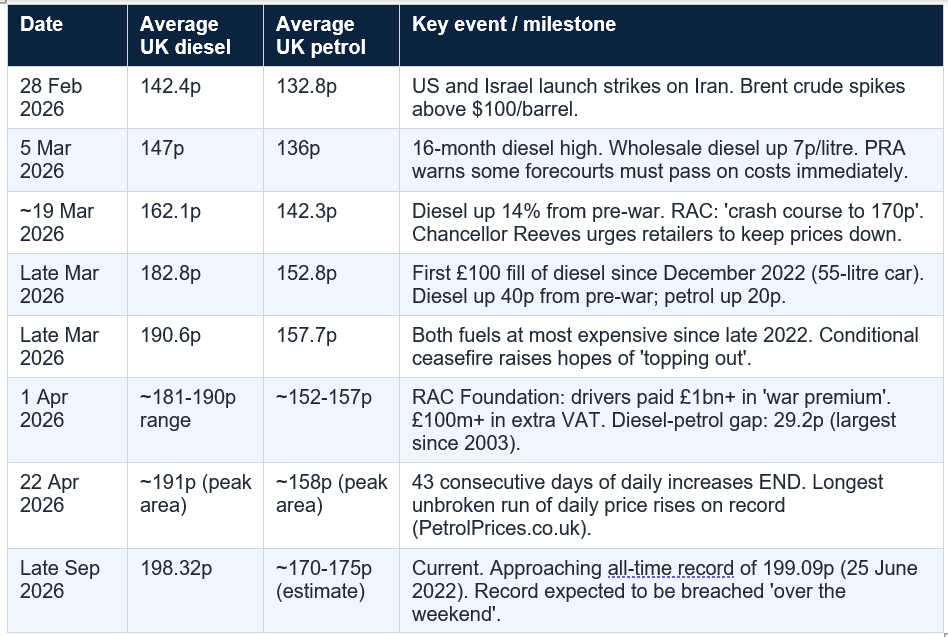
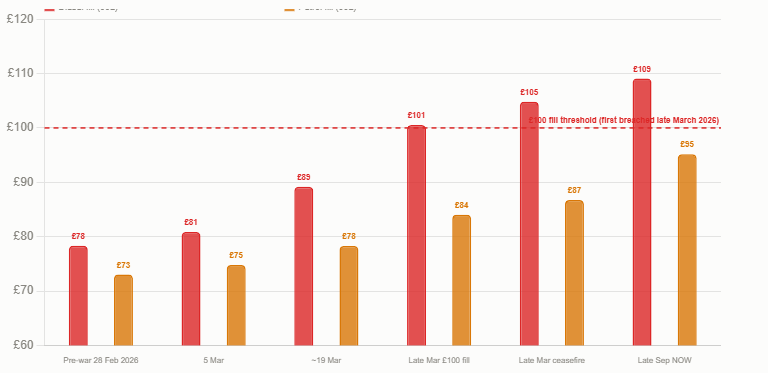
By the time diesel reached 182.8p per litre in late March 2026, the RAC was citing figures of £21.35 more per 55-litre diesel tank fill compared to pre-war levels. The later figure from AJ Bell put the additional fill cost at approximately £26. At current prices of 198.32p per litre, a 55-litre fill costs approximately £109 compared to £78.32 on 28 February 2026 — an increase of approximately £30.68 per fill. For a diesel van driver covering 25,000 miles per year at 40mpg (approximately 56 litres per 40 miles), filling up every 3–4 days, the annual war premium at current prices is approximately £2,900 more per year than they were paying in February 2026.
The indirect costs are harder to quantify but no less real. Every business that runs a diesel-powered vehicle — every delivery van, every lorry, every agricultural tractor — is absorbing higher operating costs that will eventually be passed on in prices. The AA has described this as a ‘knock-on effect across the entire supply chain.’ When diesel costs 55p more per litre, the cost of shipping goods from a warehouse to a shop, from a farm to a processor, from a factory to a port, all rise. The pump price at 198.32p is the visible tip of an inflationary iceberg.
8. The Postcode Lottery: Where Diesel Costs the Most
The national average of 198.32p masks very wide regional and local variation. During the crisis, the AA repeatedly warned about a ‘pump-price postcode lottery’ affecting parts of the UK, particularly more rural areas. PetrolPrices.com data reported that diesel was selling for as high as 217.0p per litre at some forecourts in rural Scotland at the height of the crisis, and motorway service stations were already charging over 200p per litre in late March 2026.
The gap between supermarket and non-supermarket forecourt prices — which widened dramatically during the early part of the crisis as different retailers passed on costs at different speeds — had begun to narrow by the time AJ Bell reported in late March. But ‘narrowing’ does not mean equal. Supermarkets, which typically buy fuel in larger volumes and can absorb short-term cost increases more readily, generally offer lower pump prices. Independent rural forecourts, which buy in smaller quantities and have less leverage in their supply contracts, are often among the most expensive.
With diesel now approaching 200p nationally and expected to breach the record, the practical implication is that drivers in rural areas without access to a supermarket forecourt, or who fill up at motorway service stations, may already be paying prices that the national average will not reach for days or weeks. The pump-price postcode lottery is not a complaint about unfairness; it is a description of the structural reality of how fuel pricing works in the UK, where the recommended retail price is a suggestion and every forecourt sets its own price.
Psychologically, breaking the record matters. Research on consumer behaviour consistently shows that round numbers and records serve as attention-focusing events. A headline of ‘UK diesel at new all-time high’ will generate more public and political pressure on both retailers and government than ‘UK diesel continues to rise.’ The Chancellor’s statement in March 2026 — that petrol retailers had a ‘shared obligation’ to keep prices down — came when prices were lower than they are now. A record breach may prompt stronger political language and possibly stronger action.
For the market, breaking the record is a signal to all participants: oil at current levels produces diesel records in the UK. If oil stays above $100 per barrel and the Hormuz situation does not ease, there is no technical reason the price cannot continue to rise beyond 199p. PetrolPrices.co.uk’s April timeline noted that after the 43-day surge ended, a conditional ceasefire took some heat out of prices. The fact that diesel is now approaching the record again suggests either that the ceasefire has broken down, or that a new escalation in the conflict has renewed the supply anxiety that drives prices.
If diesel breaks the 199.09p record, as expected, it will be the highest UK pump price ever recorded. Drivers should: (1) Fill up as soon as possible if they need diesel, as prices may continue to rise. (2) Check petrolprices.com or the government Fuel Finder scheme before filling up to find the cheapest local forecourt. (3) Consider reducing discretionary diesel mileage if the financial strain is acute. (4) Businesses with diesel fuel costs should review supplier contracts and consider hedging strategies if feasible. Not financial or motoring advice.
The government has published a list of third-party fuel price apps and websites displaying prices from its Fuel Finder scheme. The scheme, which requires fuel retailers to report their pump prices in near real-time to a central database, was introduced in 2023 specifically to increase price transparency and make it easier for drivers to identify cheaper forecourts. It is genuinely useful: apps like PetrolPrices.com, which feed from the Fuel Finder data, allow drivers to find the cheapest local forecourt before they leave home. But it does nothing to reduce the national average price; it simply helps drivers find the cheapest option within the market.
The political pressure on government to reduce fuel duty or VAT on fuel increases during fuel price crises. The current duty rate on both petrol and diesel is 52.95p per litre, frozen since the temporary 5p cut introduced in March 2022 was made permanent (check current duty rates at gov.uk). VAT is charged at 20% on the full pump price including duty. At 198.32p per litre diesel, VAT accounts for approximately 33.05p per litre. Combined, duty and VAT represent approximately 85p — more than 43% of the pump price. A further fuel duty cut is the most direct lever the government could pull; whether the fiscal pressures allow it is a political and economic calculation.
PetrolPrices.co.uk’s analysis from April 2026 is instructive on what causes a crisis like this to ease: the 43-day surge ended when a ceasefire announcement took heat out of oil prices. The site noted that even after the ceasefire, Hormuz tanker flows were not immediately restored — BIMCO recorded just 1.2 tankers leaving the Persian Gulf per day in April, down from 130–140 under normal conditions. Restoring tanker flows would take weeks even after a genuine ceasefire, and after tanker flows normalise, the cargoes shipped must transit to European refineries, be refined, and then be delivered to UK forecourts. The RAC has consistently stated that wholesale changes take approximately two weeks to filter through to pump prices. The return journey — from lower wholesale to lower pump prices — takes the same time.
Historical price response data suggests that if Brent crude fell back below $80 per barrel and stayed there, UK diesel would likely fall toward the 160p–165p range within four to six weeks. But that would require either a comprehensive resolution of the Iran conflict, a significant increase in OPEC+ production to offset lost supply, or an unexpected deterioration in global economic demand. None of these outcomes appears imminent. The near-term expectation from motoring and energy analysts is that prices remain elevated and highly volatile.
The arithmetic for the typical diesel driver is blunt: filling up a 55-litre car now costs approximately £109, against £78 before the conflict started in February. For a van driver or small business running diesel, the war premium over seven months may already exceed £2,000–£3,000 in additional fuel costs. At the national level, UK drivers have collectively paid over £1 billion more than they should have at pre-conflict prices.
The record, when broken, will sit in the books alongside 25 June 2022 as one of two data points showing what geopolitical disruption to oil supply does to the cost of filling up in the UK. It will fall again when peace and shipping normalise. In the meantime, using the cheapest forecourt, driving economically, and reducing unnecessary mileage are the practical tools available to drivers navigating a crisis that began in a waterway 5,000 kilometres from the Midlands but whose consequences are felt at every UK petrol station. Not financial advice.
According to the RAC motoring body, the average price of a litre of diesel at UK forecourts stands at 198.32p, as cited in the brief that informs this article (late September 2026). This is the closest the national average has been to the all-time UK diesel record of 199.09p (set on 25 June 2022) since that record was set. Prices vary significantly by location: motorway service stations and rural forecourts are typically more expensive than supermarket forecourts. Check live prices at petrolprices.com or via the government Fuel Finder scheme before filling up. Not financial advice.
Why is diesel so expensive in the UK in 2026?
The primary cause of the 2026 UK diesel price surge is the US-Israeli military campaign against Iran, which began on 28 February 2026. Iran's retaliatory actions effectively closed the Strait of Hormuz to tanker traffic, reducing ship movements through the strait from a normal 130-140 tankers per day to approximately 1.2-1.6 per day at the height of the crisis in April (BIMCO; PetrolPrices.co.uk). The Strait of Hormuz carries approximately 20-21% of the world's seaborne oil. When it is effectively closed, global oil prices spike (Brent crude exceeded $100 per barrel) and refined fuel prices follow. Diesel was hit harder than petrol because Europe relies on diesel imports from the Middle East but is broadly self-sufficient in petrol production. Diesel rose approximately 49p per litre; petrol approximately 25.5p per litre. Sources: Sky News; RAC; PetrolPrices.co.uk; Alliance News.
What is the UK diesel all-time record?
The UK's all-time average diesel pump price record is 199.09p per litre, recorded on 25 June 2022. That record was set following Russia's full-scale invasion of Ukraine on 24 February 2022, which disrupted global oil supply and sent Brent crude above $120 per barrel. The current price of 198.32p is the closest the national average has been to that record since it was set. The record is expected to be breached over the coming weekend (late September 2026) if the Iran conflict continues to put upward pressure on wholesale fuel costs. Sources: user brief; PetrolPrices.co.uk.
How much extra am I paying to fill up my diesel car because of the Iran conflict?
At current prices of 198.32p per litre versus the pre-war price of 142.4p per litre on 28 February 2026, the difference is approximately 55.9p per litre. For a 55-litre family car, the additional cost per fill is approximately £30.75 (55 × 55.9p). An earlier RAC calculation (when diesel was at 182.8p) put the additional cost at £21.35 per fill; an AJ Bell report (at approximately 190.6p) put it at approximately £26. At current prices, the figure is closer to £30. The RAC Foundation estimated that by 1 April 2026 drivers had collectively paid over £1 billion in additional costs since the conflict began. Sources: RAC; Alliance News; Irish News; AJ Bell.
Where can I find the cheapest diesel near me?
The government's Fuel Finder scheme requires UK fuel retailers to report their pump prices in near real-time. Several apps and websites display this data, including PetrolPrices.com, Waze, and GasBuddy UK. Supermarket forecourts (Tesco, Asda, Sainsbury's, Morrisons) consistently offer among the lowest prices in most areas. Motorway service stations are consistently among the most expensive. In rural Scotland, some forecourts were charging up to 217.0p per litre at the height of the crisis versus the national average; the gap between cheapest and most expensive forecourts can be 20-30p per litre. Always check before you fill up. Sources: Irish News; AJ Bell; general fuel price advice.
Table of Contents
- The Record in Sight: Where UK Diesel Stands Right Now
- The All-Time High and How We Got Back Here
- The Trigger: What the US-Israel War With Iran Did to Oil
- The Strait of Hormuz: Why This Waterway Controls What You Pay at the Pump
- The Diesel-Petrol Divide: Why Diesel Was Hit Hardest
- The Price Timeline: Diesel’s 43-Day Record Surge
- What Drivers Have Already Paid: The £1 Billion War Premium
- The Postcode Lottery: Where Diesel Costs the Most
- What Happens When Diesel Breaks the Record?
- The Business Impact: Who Else Gets Hit by Expensive Diesel
- What the Government Has Said and Done
- How to Cut Your Fuel Bill Right Now
- When Might Prices Fall?
- Conclusion: A Record Nobody Wanted to Break
- Frequently Asked Questions
Price timeline — diesel & petrol 2022 vs 2026 crisis
The fill cost impact — what drivers are actually paying
Hormuz & oil price — why this waterway matters
The Record in Sight: Where UK Diesel Stands Right Now
The average price of a litre of diesel at UK forecourts has reached 198.32p, according to the RAC motoring body. That figure sits just 0.77p below the 199.09p all-time high recorded on 25 June 2022, when global oil markets were reeling from Russia’s full-scale invasion of Ukraine. Prices are expected to breach the record over the coming days as the fallout from the US-Israel military campaign against Iran continues to drive up wholesale fuel costs. The record that took a war in Europe to set is now expected to be exceeded by a war in the Middle East.The context is important. The price of 198.32p is a national average across all UK forecourts. Prices at motorway service stations are already significantly higher: Euro Garages’ Rivington Services on the M61 in Bolton, Greater Manchester has already charged 200.9p per litre for diesel. Some rural forecourts in Scotland have been selling diesel for as much as 217p per litre. The national average figure is, if anything, a conservative reflection of what many drivers are actually paying.
The speed of the price rise is as striking as the level. On 28 February 2026, the day the United States and Israel launched military strikes on Iran, average UK diesel stood at 142.4p per litre. In the months since, it has risen by more than 55p. That is roughly the equivalent of adding £30 to the cost of filling a typical 55-litre diesel family car. For a driver who fills up twice a month, this crisis alone has added approximately £72 per month to their fuel costs compared to pre-war levels.
Current UK diesel average: 198.32p per litre (RAC motoring body, as cited; September 2026). All-time UK diesel record: 199.09p per litre (25 June 2022, following Russia's invasion of Ukraine). Gap to record: 0.77p per litre. Pre-war diesel price (28 February 2026): 142.4p per litre. Total rise since conflict began: approximately +55.9p per litre. Diesel at 198.32p = a 39% rise from the pre-war level. Cost to fill 55-litre family car at current prices: approximately £109. Sources: RAC; user brief; Alliance News; Market Screener. Not financial advice.
The All-Time High and How We Got Back Here
The UK’s all-time diesel high of 199.09p was set on 25 June 2022 in the months following Russia’s full-scale invasion of Ukraine on 24 February of that year. The invasion caused an immediate shock to global energy markets: Russia is one of the world’s largest oil exporters, and the prospect of sanctions cutting Russian supply from global markets sent crude oil prices soaring above $120 per barrel in the weeks after the invasion. European economies, heavily dependent on Russian energy, were particularly exposed.In the UK, diesel is produced from the heavier fractions of crude oil, and UK refineries import a substantial proportion of their diesel precursors — and sometimes pre-refined diesel — from European and global sources. When Russian production and supply was disrupted, global diesel markets tightened rapidly. Wholesale diesel prices rose, and UK pump prices followed. The record of 199.09p was the peak of that crisis. After June 2022, prices gradually fell as the market adjusted, alternative supplies were sourced, and global demand softened.
By February 2026, UK diesel had retreated to 142.4p per litre — still elevated by pre-2022 historical standards but well below the records of that summer. Then came 28 February 2026, and with it, the most significant disruption to Middle Eastern oil supply in years. UK diesel is now not merely approaching the 2022 record; it has very nearly reached it, driven by a different geopolitical shock but a structurally similar mechanism: a conflict that threatens the supply of oil to global markets and sends wholesale prices soaring.
UK diesel price milestones: July 2022 all-time high: 199.09p (25 June 2022, Ukraine war). Pre-Iran war: 142.4p (28 February 2026). 16-month high: 147p (5 March 2026). 162p reached (mid-March 2026). 182.8p (late March): first £100 fill since December 2022. 190.6p (late March/AJ Bell reporting): hopes of 'topping out' after ceasefire. Prices stop rising: 22 April 2026 -- after 43 consecutive days of increases (longest on record). Current: 198.32p (latest RAC figures, late September 2026). Expected: breach of 199.09p record 'over the weekend'. Sources: user brief; PetrolPrices.co.uk; AJ Bell; Alliance News; RAC. Not financial advice.
The Trigger: What the US-Israel War With Iran Did to Oil
On 28 February 2026, the United States and Israel launched military strikes on Iran. The details of the military campaign fall outside the scope of a fuel price analysis, but the economic consequences were immediate and severe. Global financial markets gave their first reaction on the Monday following the initial weekend strikes: Brent crude oil, the international benchmark, spiked above $100 per barrel for the first time since 2022. Oil’s crossing of the psychologically significant $100 mark sent shockwaves through energy markets worldwide.For UK motorists, the immediate visible effect was modest: on 5 March 2026, just five days after the conflict began, diesel at UK pumps had risen 5p to 147p and petrol had risen 3p to 136p. Simon Williams, RAC head of policy, described diesel’s 147p as a ‘16-month high” and noted that while wholesale costs had already risen 7p per litre, it would typically take two weeks for those increases to filter through to forecourt prices. The RAC was already warning that fuel price averages would ‘rise further over the coming week at least.’
The Petrol Retailers’ Association (PRA) added a crucial caveat: not all retailers would be able to wait the usual two-week wholesale-to-pump lag. Those buying fuel under shorter-cycle contracts — contracts refreshed more frequently against spot market prices — would have to pass on the higher costs immediately. This is why some forecourts spiked before others, and why the AA has repeatedly warned about a ‘pump-price postcode lottery.’
By the time oil had been hovering above $100 per barrel for days, the RAC’s assessment darkened considerably. Williams stated that diesel was on a ‘crash course’ to 170p per litre and that wholesale costs pointed to petrol stabilising — but only if oil did not rise further. It did rise further. Within weeks, diesel surpassed 170p, then 180p, then 190p, before a conditional ceasefire brought a brief pause. The ceasefire, described as conditional, clearly did not hold, or its conditions were not met, because prices have continued to climb toward the September record.
Simon Williams, RAC head of policy (March 2026): 'Petrol has now increased by 3p to 136p a litre since Saturday, while diesel is up by 5p to a 16-month high of 147p. While wholesale costs for any retailer buying in new stock will have gone up, it normally takes two weeks for price changes to work their way through to the forecourt.' (Sky News / multiple regional radio outlets, 5 March 2026). Later: 'Both fuels are now at their most expensive since late 2022. The conditional ceasefire announcement may have taken some heat out of global oil prices, but the outlook for drivers in the UK remains highly uncertain.' (AJ Bell, late March 2026.)
The Strait of Hormuz: Why This Waterway Controls What You Pay at the Pump
The Strait of Hormuz is a 33-kilometre-wide channel of water between Iran and the United Arab Emirates, through which an extraordinary share of the world’s seaborne oil supply passes. Under normal conditions, Sky News reported in March 2026 that the strait is used by more than 80 tankers per day. PetrolPrices.co.uk’s April 2026 crisis timeline cited an industry figure of 130–140 tankers per day passing through under normal conditions. The discrepancy likely reflects counting methodology, but the point stands: the Strait of Hormuz is the most important oil shipping chokepoint on Earth.When Iran launched attacks against Gulf nations in retaliation for the US-Israeli strikes, shipping through the strait was reduced to what Sky News described as ‘a trickle.’ BIMCO, the global shipping industry body, recorded an average of just 1.2 tankers leaving and 1.6 entering the Persian Gulf per day during April 2026 — a roughly 99% collapse in shipping traffic compared to normal operations. Even a partial blockade of Hormuz has historically sent oil prices rocketing; a near-total cessation of tanker traffic is in a different category of disruption entirely.
The specific reason diesel is hit harder than petrol by Middle Eastern supply shocks is that Europe, including the UK, is a net importer of diesel but largely self-sufficient in petrol production. European refineries can produce enough petrol for domestic demand, but they do not produce enough diesel. The UK and Europe rely on imports of diesel from refineries in the Middle East, India, Russia, and the United States. When Middle Eastern supply is disrupted and Hormuz is blocked, Europe’s diesel supply tightens faster and more severely than its petrol supply. Petrol prices rose roughly 25.5p per litre in the crisis; diesel rose approximately 49p — almost double.
Why the Strait of Hormuz matters for UK pump prices: approximately 20-21% of global oil traded by sea passes through the Strait of Hormuz. The strait is 33km wide at its narrowest point. When it is effectively closed to tanker traffic, global oil markets price in supply shortages that affect refined fuel prices everywhere, including the UK. Europe's specific vulnerability to diesel supply disruption via Hormuz is structural: Europe cannot produce enough diesel from its own refineries and relies on imports that transit or originate near the strait. Sources: Sky News; PetrolPrices.co.uk; BIMCO. Not financial advice.
The Diesel-Petrol Divide: Why Diesel Was Hit Hardest
One of the defining characteristics of the 2026 fuel price crisis is the dramatically different impact on diesel compared to petrol. Alliance News reported that as the crisis deepened, the price difference between a litre of diesel and a litre of petrol reached 29.2p per litre — the largest gap since at least 2003. PetrolPrices.co.uk summarised the crisis statistics plainly: diesel prices surged roughly 49p per litre while petrol surged roughly 25.5p per litre, making diesel’s rise approximately twice as large in absolute terms.The structural explanation has already been outlined in the context of Hormuz: Europe is a net importer of diesel but broadly self-sufficient in petrol. But there are additional layers. Diesel and petrol are produced from different fractions of the crude oil refining process. Diesel (and aviation fuel) come from the middle distillate fractions, which are particularly important to the Gulf’s refinery output. When Gulf production and supply is disrupted, middle distillates are affected disproportionately relative to lighter fractions used in petrol production.
The consequences fall disproportionately on specific groups of motorists and businesses. Diesel is not primarily the fuel of choice for private passenger cars any more — UK new car sales have shifted heavily toward petrol and electric vehicles in recent years following a series of policy and regulatory changes that reduced diesel’s appeal. But diesel remains the dominant fuel for vans, lorries, buses, trains (on non-electrified routes), agricultural machinery, and construction equipment. The businesses and sectors that depend most heavily on diesel — logistics, farming, construction, public transport operators — are absorbing cost increases that translate directly into higher prices for the goods they carry and the services they deliver.
For remaining private diesel drivers, the RAC’s figures are stark. Compared to the start of the Iran conflict, it costs £21.35 more to fill a typical family car that runs on diesel. The equivalent figure for a petrol car was £10.55. The diesel driver is being asked to absorb twice the financial shock of their petrol-driving neighbour, and both are facing the same inflationary consequences of higher freight and delivery costs embedded in the prices of everything they buy.
The Price Timeline: Diesel’s 43-Day Record Surge
The speed and duration of the 2026 fuel price spike is without modern precedent. PetrolPrices.co.uk, in its April 2026 crisis analysis, identified that UK fuel prices rose for 43 consecutive days from 28 February — the longest unbroken run of daily fuel price increases ever recorded. The site summarised: diesel up 49p per litre; petrol up 25.5p per litre; drivers collectively paying over £1 billion in a ‘war premium’ above pre-conflict prices.
What Drivers Have Already Paid: The £1 Billion War Premium
The cumulative cost of the Iran war to UK motorists is not an abstraction. By 1 April 2026, the RAC Foundation had calculated that the rise in pump prices since 28 February had cost drivers collectively over £1 billion in additional fuel expenditure compared to pre-conflict prices. Of this, approximately £409 million was for diesel and £135 million for petrol. A further £100 million or more had gone to the Exchequer in extra VAT revenues collected on the higher pump prices — since VAT is charged as a percentage of the pump price, higher prices automatically generate more tax revenue.By the time diesel reached 182.8p per litre in late March 2026, the RAC was citing figures of £21.35 more per 55-litre diesel tank fill compared to pre-war levels. The later figure from AJ Bell put the additional fill cost at approximately £26. At current prices of 198.32p per litre, a 55-litre fill costs approximately £109 compared to £78.32 on 28 February 2026 — an increase of approximately £30.68 per fill. For a diesel van driver covering 25,000 miles per year at 40mpg (approximately 56 litres per 40 miles), filling up every 3–4 days, the annual war premium at current prices is approximately £2,900 more per year than they were paying in February 2026.
The indirect costs are harder to quantify but no less real. Every business that runs a diesel-powered vehicle — every delivery van, every lorry, every agricultural tractor — is absorbing higher operating costs that will eventually be passed on in prices. The AA has described this as a ‘knock-on effect across the entire supply chain.’ When diesel costs 55p more per litre, the cost of shipping goods from a warehouse to a shop, from a farm to a processor, from a factory to a port, all rise. The pump price at 198.32p is the visible tip of an inflationary iceberg.
8. The Postcode Lottery: Where Diesel Costs the Most
The national average of 198.32p masks very wide regional and local variation. During the crisis, the AA repeatedly warned about a ‘pump-price postcode lottery’ affecting parts of the UK, particularly more rural areas. PetrolPrices.com data reported that diesel was selling for as high as 217.0p per litre at some forecourts in rural Scotland at the height of the crisis, and motorway service stations were already charging over 200p per litre in late March 2026.
The gap between supermarket and non-supermarket forecourt prices — which widened dramatically during the early part of the crisis as different retailers passed on costs at different speeds — had begun to narrow by the time AJ Bell reported in late March. But ‘narrowing’ does not mean equal. Supermarkets, which typically buy fuel in larger volumes and can absorb short-term cost increases more readily, generally offer lower pump prices. Independent rural forecourts, which buy in smaller quantities and have less leverage in their supply contracts, are often among the most expensive.
With diesel now approaching 200p nationally and expected to breach the record, the practical implication is that drivers in rural areas without access to a supermarket forecourt, or who fill up at motorway service stations, may already be paying prices that the national average will not reach for days or weeks. The pump-price postcode lottery is not a complaint about unfairness; it is a description of the structural reality of how fuel pricing works in the UK, where the recommended retail price is a suggestion and every forecourt sets its own price.
What Happens When Diesel Breaks the Record?
If, as expected, average UK diesel breaches 199.09p per litre over the coming weekend, it will represent the crossing of a threshold that has stood for more than four years. The 2022 record was itself a response to an extraordinary geopolitical event — Russia’s full-scale invasion of Ukraine. The 2026 breach would be the second record in four years, both driven by warfare disrupting global oil supply. The structural question it raises is whether diesel at 200p and above is becoming the ‘new normal’ every time a major Middle Eastern conflict erupts.Psychologically, breaking the record matters. Research on consumer behaviour consistently shows that round numbers and records serve as attention-focusing events. A headline of ‘UK diesel at new all-time high’ will generate more public and political pressure on both retailers and government than ‘UK diesel continues to rise.’ The Chancellor’s statement in March 2026 — that petrol retailers had a ‘shared obligation’ to keep prices down — came when prices were lower than they are now. A record breach may prompt stronger political language and possibly stronger action.
For the market, breaking the record is a signal to all participants: oil at current levels produces diesel records in the UK. If oil stays above $100 per barrel and the Hormuz situation does not ease, there is no technical reason the price cannot continue to rise beyond 199p. PetrolPrices.co.uk’s April timeline noted that after the 43-day surge ended, a conditional ceasefire took some heat out of prices. The fact that diesel is now approaching the record again suggests either that the ceasefire has broken down, or that a new escalation in the conflict has renewed the supply anxiety that drives prices.
If diesel breaks the 199.09p record, as expected, it will be the highest UK pump price ever recorded. Drivers should: (1) Fill up as soon as possible if they need diesel, as prices may continue to rise. (2) Check petrolprices.com or the government Fuel Finder scheme before filling up to find the cheapest local forecourt. (3) Consider reducing discretionary diesel mileage if the financial strain is acute. (4) Businesses with diesel fuel costs should review supplier contracts and consider hedging strategies if feasible. Not financial or motoring advice.
The Business Impact: Who Else Gets Hit by Expensive Diesel
The popular focus on private car diesel drivers understates the economic breadth of the crisis. Diesel is the fuel that powers the UK’s freight economy: the lorries, the vans, the buses, the trains on non-electrified routes, and the agricultural and construction machinery that underlies the physical economy. When diesel prices rise by 55p per litre, the cost of running every diesel-powered vehicle in the UK rises by the same amount per litre consumed, and that cost is absorbed by businesses that must ultimately pass it on to their customers.- Logistics and road haulage: the UK’s road freight sector is almost entirely diesel-dependent. A heavy goods vehicle covering 80,000 miles per year at 8mpg consumes approximately 45,000 litres of diesel annually. At 55p per litre premium, the war has added approximately £24,750 per year per truck to operating costs before the annual figure is worked through to customers in higher delivery charges.
- Agriculture: farm machinery — tractors, combine harvesters, and associated equipment — runs on diesel. Fuel costs are a significant proportion of farming operating costs, and rising diesel prices feed directly into food production costs. This is a pass-through inflationary pressure: more expensive diesel means more expensive food at the supermarket, even without any change in farm productivity or weather conditions.
- Public transport: buses and non-electrified rail services run on diesel. Rising diesel costs for public transport operators either compress already-thin operating margins or translate into higher fares. For local bus services in particular, where most passengers are cost-sensitive and many routes are loss-making before the fuel price spike, the impact can be severe enough to trigger service reductions.
- Construction: plant machinery and generators on construction sites are diesel-powered. Rising diesel costs increase construction operating expenses, which feed into project costs and ultimately into the prices charged for new homes, infrastructure, and commercial buildings.
- Small businesses with vans: trades people, couriers, mobile services, and small retailers making deliveries are often running diesel vans without the negotiating leverage of large fleets. They absorb the price increase directly and typically cannot spread it efficiently across their cost base.
What the Government Has Said and Done
The UK government’s response to the 2026 fuel price crisis has been primarily verbal rather than structural. In mid-March 2026, Chancellor Rachel Reeves publicly told petrol retailers that they had a ‘shared obligation’ to keep prices down for motorists. The statement was widely reported but carried no regulatory force — UK fuel pricing is not subject to government price controls, and forecourts set their own pump prices within the market.The government has published a list of third-party fuel price apps and websites displaying prices from its Fuel Finder scheme. The scheme, which requires fuel retailers to report their pump prices in near real-time to a central database, was introduced in 2023 specifically to increase price transparency and make it easier for drivers to identify cheaper forecourts. It is genuinely useful: apps like PetrolPrices.com, which feed from the Fuel Finder data, allow drivers to find the cheapest local forecourt before they leave home. But it does nothing to reduce the national average price; it simply helps drivers find the cheapest option within the market.
The political pressure on government to reduce fuel duty or VAT on fuel increases during fuel price crises. The current duty rate on both petrol and diesel is 52.95p per litre, frozen since the temporary 5p cut introduced in March 2022 was made permanent (check current duty rates at gov.uk). VAT is charged at 20% on the full pump price including duty. At 198.32p per litre diesel, VAT accounts for approximately 33.05p per litre. Combined, duty and VAT represent approximately 85p — more than 43% of the pump price. A further fuel duty cut is the most direct lever the government could pull; whether the fiscal pressures allow it is a political and economic calculation.
How to Cut Your Fuel Bill Right Now
With diesel prices at near-record levels and expected to go higher, every penny saved at the pump matters. The following practical steps are consistently recommended by the RAC, AA, and independent motoring organisations.- Use PetrolPrices.com or the Fuel Finder apps before filling up: the postcode lottery means prices can vary significantly between nearby forecourts. The cheapest local forecourt is typically a supermarket. Driving significantly out of your way to reach a cheaper forecourt is counterproductive — the extra fuel spent travelling negates a portion of the saving — but choosing between two nearby options based on live price data is always worthwhile.
- Fill up at supermarkets: Tesco, Asda, Sainsbury’s, and Morrisons consistently offer among the cheapest forecourt prices, particularly during periods of market volatility when independent retailers pass on wholesale cost rises more quickly.
- Avoid motorway service stations: at the height of the crisis, motorway diesel was charging over 200p per litre while the national average was in the 180p range. Motorway service station fuel is consistently and significantly more expensive than off-motorway alternatives.
- Drive more economically: the RAC and AA consistently cite that driving style is one of the largest variables in fuel consumption. Accelerating smoothly rather than sharply, maintaining a steady speed, anticipating traffic to avoid unnecessary braking and re-acceleration, and using cruise control on motorways can each reduce fuel consumption by 10–25%. On a £109 fill, 20% fuel economy improvement saves approximately £21.80 per tank.
- Check tyre pressures: under-inflated tyres increase rolling resistance and reduce fuel economy. The recommended tyre pressures for your vehicle are in the owner’s manual and often on a sticker inside the driver’s door frame. Inflating to the correct pressure is a free, two-minute task that can improve fuel economy by 1–3%.
- Reduce unnecessary weight: every extra kilogram in the car increases fuel consumption. Remove roof racks or boxes when not in use (they dramatically increase aerodynamic drag). Empty the boot of heavy items that are not needed for the journey. A lighter car uses less fuel.
When Might Prices Fall?
The trajectory of UK diesel prices depends almost entirely on two variables: the oil price, and the status of the Iran conflict. Both remain highly uncertain at the time of writing. The conditional ceasefire that took some pressure off prices in late March 2026 apparently did not hold, or its effects have been fully absorbed by a market that has since adjusted its base case upward. Prices continuing to rise toward the September record suggests either resumed or ongoing Hormuz disruption, or continued Brent crude above the levels at which UK pump prices can stabilise.PetrolPrices.co.uk’s analysis from April 2026 is instructive on what causes a crisis like this to ease: the 43-day surge ended when a ceasefire announcement took heat out of oil prices. The site noted that even after the ceasefire, Hormuz tanker flows were not immediately restored — BIMCO recorded just 1.2 tankers leaving the Persian Gulf per day in April, down from 130–140 under normal conditions. Restoring tanker flows would take weeks even after a genuine ceasefire, and after tanker flows normalise, the cargoes shipped must transit to European refineries, be refined, and then be delivered to UK forecourts. The RAC has consistently stated that wholesale changes take approximately two weeks to filter through to pump prices. The return journey — from lower wholesale to lower pump prices — takes the same time.
Historical price response data suggests that if Brent crude fell back below $80 per barrel and stayed there, UK diesel would likely fall toward the 160p–165p range within four to six weeks. But that would require either a comprehensive resolution of the Iran conflict, a significant increase in OPEC+ production to offset lost supply, or an unexpected deterioration in global economic demand. None of these outcomes appears imminent. The near-term expectation from motoring and energy analysts is that prices remain elevated and highly volatile.
Conclusion
UK diesel at 198.32p per litre — 0.77p from a record that has stood since the chaos of summer 2022 — represents the cumulative cost of seven months of geopolitical disruption, a near-total collapse in Strait of Hormuz tanker traffic, a structural European dependency on diesel imports, and the full pass-through of $100+ oil to UK forecourt prices. The expected breach of the record over the coming days will generate headlines, political pressure, and real financial pain for millions of drivers and businesses.The arithmetic for the typical diesel driver is blunt: filling up a 55-litre car now costs approximately £109, against £78 before the conflict started in February. For a van driver or small business running diesel, the war premium over seven months may already exceed £2,000–£3,000 in additional fuel costs. At the national level, UK drivers have collectively paid over £1 billion more than they should have at pre-conflict prices.
The record, when broken, will sit in the books alongside 25 June 2022 as one of two data points showing what geopolitical disruption to oil supply does to the cost of filling up in the UK. It will fall again when peace and shipping normalise. In the meantime, using the cheapest forecourt, driving economically, and reducing unnecessary mileage are the practical tools available to drivers navigating a crisis that began in a waterway 5,000 kilometres from the Midlands but whose consequences are felt at every UK petrol station. Not financial advice.
Frequently Asked Questions
What is the current average price of diesel in the UK?According to the RAC motoring body, the average price of a litre of diesel at UK forecourts stands at 198.32p, as cited in the brief that informs this article (late September 2026). This is the closest the national average has been to the all-time UK diesel record of 199.09p (set on 25 June 2022) since that record was set. Prices vary significantly by location: motorway service stations and rural forecourts are typically more expensive than supermarket forecourts. Check live prices at petrolprices.com or via the government Fuel Finder scheme before filling up. Not financial advice.
Why is diesel so expensive in the UK in 2026?
The primary cause of the 2026 UK diesel price surge is the US-Israeli military campaign against Iran, which began on 28 February 2026. Iran's retaliatory actions effectively closed the Strait of Hormuz to tanker traffic, reducing ship movements through the strait from a normal 130-140 tankers per day to approximately 1.2-1.6 per day at the height of the crisis in April (BIMCO; PetrolPrices.co.uk). The Strait of Hormuz carries approximately 20-21% of the world's seaborne oil. When it is effectively closed, global oil prices spike (Brent crude exceeded $100 per barrel) and refined fuel prices follow. Diesel was hit harder than petrol because Europe relies on diesel imports from the Middle East but is broadly self-sufficient in petrol production. Diesel rose approximately 49p per litre; petrol approximately 25.5p per litre. Sources: Sky News; RAC; PetrolPrices.co.uk; Alliance News.
What is the UK diesel all-time record?
The UK's all-time average diesel pump price record is 199.09p per litre, recorded on 25 June 2022. That record was set following Russia's full-scale invasion of Ukraine on 24 February 2022, which disrupted global oil supply and sent Brent crude above $120 per barrel. The current price of 198.32p is the closest the national average has been to that record since it was set. The record is expected to be breached over the coming weekend (late September 2026) if the Iran conflict continues to put upward pressure on wholesale fuel costs. Sources: user brief; PetrolPrices.co.uk.
How much extra am I paying to fill up my diesel car because of the Iran conflict?
At current prices of 198.32p per litre versus the pre-war price of 142.4p per litre on 28 February 2026, the difference is approximately 55.9p per litre. For a 55-litre family car, the additional cost per fill is approximately £30.75 (55 × 55.9p). An earlier RAC calculation (when diesel was at 182.8p) put the additional cost at £21.35 per fill; an AJ Bell report (at approximately 190.6p) put it at approximately £26. At current prices, the figure is closer to £30. The RAC Foundation estimated that by 1 April 2026 drivers had collectively paid over £1 billion in additional costs since the conflict began. Sources: RAC; Alliance News; Irish News; AJ Bell.
Where can I find the cheapest diesel near me?
The government's Fuel Finder scheme requires UK fuel retailers to report their pump prices in near real-time. Several apps and websites display this data, including PetrolPrices.com, Waze, and GasBuddy UK. Supermarket forecourts (Tesco, Asda, Sainsbury's, Morrisons) consistently offer among the lowest prices in most areas. Motorway service stations are consistently among the most expensive. In rural Scotland, some forecourts were charging up to 217.0p per litre at the height of the crisis versus the national average; the gap between cheapest and most expensive forecourts can be 20-30p per litre. Always check before you fill up. Sources: Irish News; AJ Bell; general fuel price advice.

0 Comments Comments