
Spending
Break the Small Purchase Cycle: Mindful Spending Guide

The average Brit spends £786 a year on subscriptions alone — and 1 in 5 rarely use them. Impulse purchases average £254 a month globally. The ‘just one small thing’ rationalisation is one of the most financially expensive thought patterns you have. Here is the science behind why it happens, and the practical techniques that actually stop it.

The average Brit spends £786 per year on subscriptions alone — and one in five rarely use the services they are paying for (Aqua, 2025). Globally, the average consumer makes approximately 9.94 impulse purchases per month at an average of $25.93 each, totalling over $3,000 per year (Capital One Shopping Research, June 2026). A single £5 daily coffee habit costs over £1,800 annually. Spending just £10 per day on things you did not plan to buy adds up to £3,650 per year.
None of this is a moral judgement about coffee or convenience. The issue is not the individual purchase. It is the pattern: the automatic rationalisation that bypasses conscious decision-making, that treats the cost as negligible because each unit is small, and that accumulates into a significant annual drain on financial wellbeing. This guide explains the psychology that drives the pattern — and the practical, research-backed techniques that interrupt it.
Average Brit spends £786/year on subscriptions; 1 in 5 rarely use them (Aqua, 2025, n=2,000). Average consumer: ~9.94 impulse purchases/month at ~$25.93 each = ~$3,045/year (Capital One Shopping Research, June 2026). 91% of active shoppers make impulse purchases; mobile-first buyers 34% more likely to buy impulsively (NRF/Shopify, 2026). 32% of Gen Z say boredom drives unnecessary purchases (Motley Fool, January 2026).
The 'just one small purchase' rationalisation is particularly effective precisely because it is partially true: one coffee is not going to ruin your finances. The problem is not the single purchase; it is the automatic decision-making process that approves every version of 'just one.' The same process that approves the coffee approves the app, the lunch, the impulse click, the subscription that rolled over. Mindful spending is about applying a different decision process — not about eliminating individual pleasures.
Mindspend’s August 2026 guide to mindful spending describes the buyer’s remorse timeline precisely: ‘Regret typically follows a predictable arc: minutes after buying, a small voice questions the decision.’ Simply Psychology’s January 2026 analysis of impulse spending psychology identifies the same pattern: ‘the thrill of shopping often fades the moment the transaction is complete, leaving you with the item and sometimes a dose of regret.’
The Money and Mental Health Policy Institute has found that the mood lift from quick purchases fades fast — while the financial cost remains. This makes impulse spending a particularly inefficient form of emotional regulation: the relief is brief, the cost is lasting, and the underlying emotional need is unaddressed. The next trigger produces the same impulse, and the cycle repeats.
Dopamine peaks before the purchase, not after. The brain is responding to the anticipation of having the item, not to the item itself. This is why window shopping feels almost as satisfying as buying, why adding things to an online basket produces a sense of reward even without checkout, and why the emotional relief from impulse buying is so fleeting. The fix is not to try harder not to want the thing — it is to delay long enough for the dopamine signal to subside.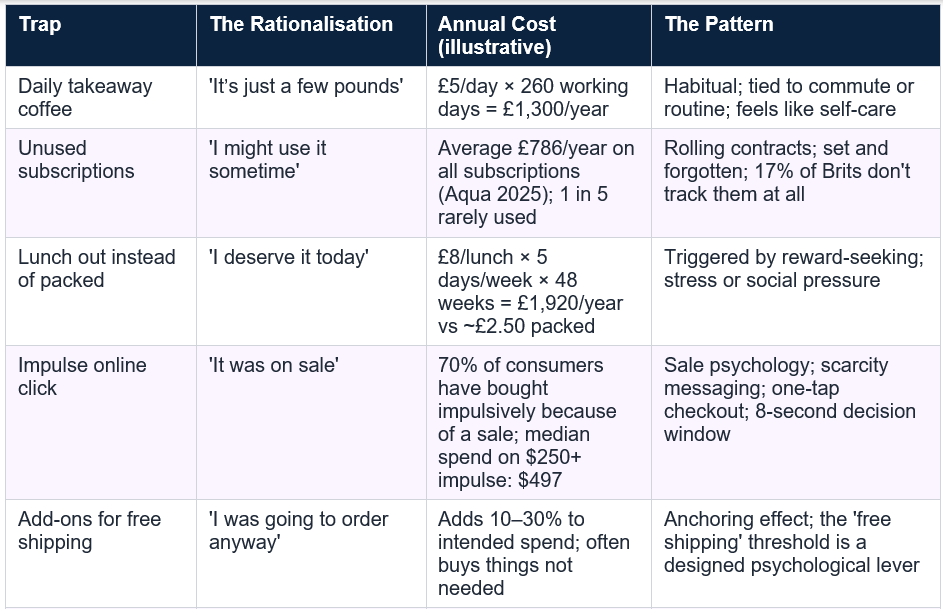
This week, pick three of your habitual small purchases and annualise them. Write the yearly cost next to each one. Then write what that same money would be worth if invested for 10 years at 5% annual growth. The compound arithmetic is the most honest representation of what each habitual small purchase actually costs. For a 35-year-old: £1,825 per year for 30 years at 5% = approximately £120,000 at retirement. That is the real cost of the daily coffee habit — not £5.
The mechanism: reviewing a bank statement at month end is a retrospective audit of decisions already made. Logging a purchase in real time — category, amount, trigger — inserts a small act of awareness into the decision moment itself. The awareness changes the decision-making context.
Practical tools:
A subscription audit takes approximately 30 minutes and typically saves meaningful money:
Simply Psychology’s January 2026 analysis of spending psychology research is direct on this point: ‘Research on financial behavior change suggests that connecting spending decisions to deeply held values — rather than rules or restrictions — produces more durable change. “I prioritize financial security for my family” is more behaviorally motivating than “I shouldn’t spend money.”’
Values-based spending means deciding — not in a moment of impulse, but in advance, deliberately — what money is for in your life. This is not about asceticism or sacrifice. It is about ensuring that the things you spend money on are actually the things you care most about, rather than the things that were in front of you when you had a dopamine signal and a one-tap checkout.
A practical values clarification exercise:
Mindful spending is not the opposite of enjoyment. It is the opposite of automatic. The goal is not to stop spending on things that bring you pleasure — it is to ensure that the things you spend on actually bring you pleasure rather than just briefly activating a dopamine signal. A considered £5 coffee that you enjoy as part of a morning ritual you value is entirely different from an automatic £5 coffee you bought on the way to a meeting without noticing.
Mindful spending means adding friction back into the environments that have deliberately removed it:
A more effective approach is a spending permission slip: a pre-decided, values-aligned allocation of money that is explicitly for guilt-free spending on small pleasures. The permission slip does not eliminate spending; it redirects it into intentional, pre-planned choices rather than reactive, automatic ones.
In practical terms:
Simply Psychology’s January 2026 analysis makes this explicit: ‘Addressing the emotional function: if spending serves emotional regulation, the most effective long-term solution is developing alternative regulation strategies — exercise, social connection, mindfulness, or therapy. Restricting spending without addressing its emotional function often produces rebound spending or substitute behaviors.’
For each identified spending trigger, identify a specific replacement behaviour:
The eight steps in this guide — identifying triggers, applying deliberate pauses, tracking in real time, auditing subscriptions, clarifying values, adding friction by design, building a permission slip, and replacing the emotional habit with a genuine alternative — address the problem at its root rather than at the symptom level. None of them require extraordinary discipline. All of them compound over time.
The compound arithmetic is the most compelling argument: £5 per day, saved and invested at 5 percent for 30 years, produces approximately £125,000. The version of you who implemented these habits at 35 is not a person who denied themselves coffee. They are a person who had £125,000 more at 65 — and who spent every coffee pound they did spend on coffee they actually noticed, chose, and enjoyed.
Mindful spending is the practice of making conscious, intentional purchasing decisions rather than automatic or reactive ones. As Mindspend's August 2026 guide defines it: 'mindful spending is the practice of checking in with yourself before you buy something. It means asking Do I actually want this, or am I just reacting to something? before every non-essential purchase.' The opposite of mindful spending is not frugality — it is autopilot: spending because it is convenient, habitual, triggered by an emotion, or in response to an algorithm, rather than because the purchase aligns with what you actually value. Mindful spending does not require never buying small things. It requires those small things to be chosen, rather than defaulted to.
Why is it so hard to stop buying small things habitually?
Because the brain is designed to find the small purchase extremely easy to approve. Three specific mechanisms work together: proportional thinking (£5 feels trivial relative to a £3,000 income), present bias (the immediate reward is more compelling than the abstract future cost), and decision fatigue (habitual small purchases happen most often when the deliberate decision-making system is most depleted — in the evening, after a stressful day, while tired). Additionally, commercial environments — particularly mobile apps and delivery platforms — are specifically designed to reduce friction and decision time. Average purchase decision time on mobile platforms has fallen to under 8 seconds in 2026 (NRF/Shopify, 2026). The system is working as designed; the issue is whether you are making the decisions or whether the design is making them for you.
How much does the average person spend on impulse purchases?
Globally, the average consumer spent approximately $254 per month on impulse purchases in 2025, totalling approximately $3,045 per year, making an average of 9.94 impulse purchases per month at approximately $25.93 each (Capital One Shopping Research, June 2026). In the UK, average annual subscription spending is £786 per year, with 1 in 5 rarely using the services they pay for (Aqua survey, 2025, n=2,000). 91% of active shoppers make impulse purchases (NRF/Shopify, 2026). 32% of Gen Z report boredom as a primary driver of unnecessary purchases (Motley Fool, January 2026, n=2,000).
Does the 24-hour rule actually work?
Yes, consistently. The 24-hour waiting period works because the dopamine signal that drives an impulse purchase is temporary: it peaks before the purchase and fades quickly. By waiting 24 hours before completing a non-essential purchase, the emotional driver that made the item feel urgent or necessary typically subsides. After the wait, the question 'do I still want this?' is answered by the deliberate, non-dopamine-driven brain rather than the impulse-responding one. Research on spending behaviour change consistently finds that deliberate pauses between impulse and purchase reduce the proportion of impulse buys that are completed. For smaller habitual purchases, even a 10-second pause asking 'do I need this right now?' before an automatic small purchase interrupts the autopilot mechanism and inserts conscious decision-making.
How do I deal with the emotional driver behind impulse spending without just restricting myself?
By identifying and replacing the emotional function of the spending, not just the spending itself. Simply Psychology's January 2026 analysis notes that 'restricting spending without addressing its emotional function often produces rebound spending or substitute behaviors.' If spending provides stress relief, boredom escape, or reward, eliminating the spend without providing an alternative leaves the emotional need unmet. The practical approach: for each spending trigger you identify (stress, boredom, fatigue, social pressure), decide in advance what you will do instead. The replacement needs to genuinely serve the same emotional function — a brief walk or a call to a friend after a stressful meeting is a more effective stress-relief substitute than white-knuckling through the urge to order a delivery. Bajaj AMC's March 2026 guide: 'mindful swaps — instead of adding to your cart, listen to music, cook, or read — often cost nothing and may provide genuine relief.'
What is the best app for tracking spending and reducing impulse purchases?
The research consistently shows that any real-time tracking produces better outcomes than monthly statement review — the specific tool matters less than the habit of real-time awareness. UK-available options include: Emma (open banking; automatic categorisation; spending alerts); YNAB (You Need a Budget; envelope budgeting; zero-based allocation; subscription required); Plum (automatic savings; spending analytics; integrated pots); Monzo and Starling built-in budgeting (pot-based accounts; instant spending notifications; built-in budget limits per category); Snoop (bill analysis; subscription tracker; suggests savings). Most major high-street banks (Lloyds, NatWest, Barclays, HSBC) also offer in-app spending categorisation and notification settings. The most important step is turning on real-time push notifications for all transactions — something available in almost every UK banking app without requiring a third-party service.
Table of Contents
- The Small Purchase Problem Is Bigger Than You Think
- The Brain Science: Why ‘Just One’ Feels So Reasonable
- The Dopamine Trap: Why the Thrill Always Fades
- The Seven Most Common Small-Purchase Traps
- The Annual Cost Calculator: Add It Up Before You Look Away
- Step 1: Identify Your Spending Triggers
- Step 2: The 24-Hour (or 10-Second) Rule
- Step 3: Track in Real Time, Not at Month End
- Step 4: The Subscription Audit
- Step 5: Values-Based Spending — The Only Long-Term Fix
- Step 6: Friction by Design
- Step 7: Build a Spending Permission Slip
- Step 8: Replace the Habit, Not Just the Purchase
- What Mindful Spending Is Not
- Conclusion: Small Decisions, Compounded
- Frequently Asked Questions
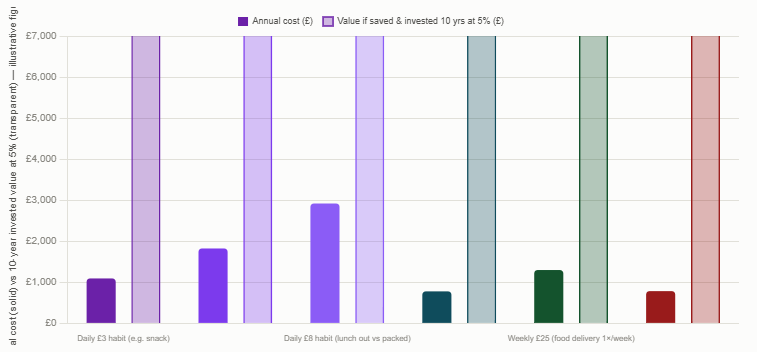
Annual Cost of Daily Habit ( the Annualiser)
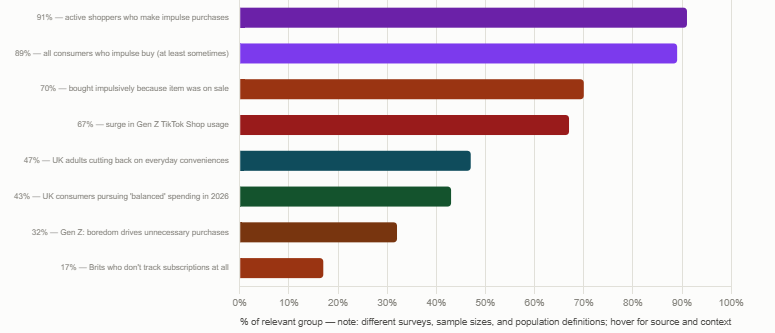
The Impulsive Buying Data (Research 2026
The Small Purchase Problem Is Bigger Than You Think
The phrase ‘just one small thing’ is one of the most financially expensive thoughts most people have on a daily basis. It rationalises the morning coffee, the app subscription, the lunch out, the impulse click on a sale email, the extra item added to hit the free-delivery threshold. Each transaction is individually trivial. The aggregate is not.The average Brit spends £786 per year on subscriptions alone — and one in five rarely use the services they are paying for (Aqua, 2025). Globally, the average consumer makes approximately 9.94 impulse purchases per month at an average of $25.93 each, totalling over $3,000 per year (Capital One Shopping Research, June 2026). A single £5 daily coffee habit costs over £1,800 annually. Spending just £10 per day on things you did not plan to buy adds up to £3,650 per year.
None of this is a moral judgement about coffee or convenience. The issue is not the individual purchase. It is the pattern: the automatic rationalisation that bypasses conscious decision-making, that treats the cost as negligible because each unit is small, and that accumulates into a significant annual drain on financial wellbeing. This guide explains the psychology that drives the pattern — and the practical, research-backed techniques that interrupt it.
Average Brit spends £786/year on subscriptions; 1 in 5 rarely use them (Aqua, 2025, n=2,000). Average consumer: ~9.94 impulse purchases/month at ~$25.93 each = ~$3,045/year (Capital One Shopping Research, June 2026). 91% of active shoppers make impulse purchases; mobile-first buyers 34% more likely to buy impulsively (NRF/Shopify, 2026). 32% of Gen Z say boredom drives unnecessary purchases (Motley Fool, January 2026).
The Brain Science: Why ‘Just One’ Feels So Reasonable
The rationalisation of small purchases is not a character weakness. It is a feature of the human cognitive architecture. Three specific mechanisms make ‘just one small thing’ feel entirely reasonable in the moment:- Proportional thinking: the brain evaluates costs relative to context, not in absolute terms. Spending £5 feels trivial after spending £500 on a flight. Spending £5 on a coffee feels insignificant relative to a monthly income of £3,000. But the £5 is the same £5 regardless of context — and £5 per day for a year is £1,825.
- Present bias: the brain systematically overvalues immediate rewards and undervalues future costs. The pleasure of the coffee is immediate, concrete, and certain. The cost to the savings goal is distant, abstract, and diffuse. The brain assigns more weight to what it can feel now than to what it can calculate later.
- Decision fatigue: willpower and the capacity for deliberate decision-making are finite. By the afternoon, after dozens of work decisions, the brain defaults to automatic behaviours — including habitual spending. This is why late-night online shopping, post-work impulse buys, and end-of-week convenience spending are so common: they happen when the deliberate system is most depleted.
The 'just one small purchase' rationalisation is particularly effective precisely because it is partially true: one coffee is not going to ruin your finances. The problem is not the single purchase; it is the automatic decision-making process that approves every version of 'just one.' The same process that approves the coffee approves the app, the lunch, the impulse click, the subscription that rolled over. Mindful spending is about applying a different decision process — not about eliminating individual pleasures.
The Dopamine Trap: Why the Thrill Always Fades
When you see something you want to buy, your brain releases dopamine — the neurotransmitter associated with anticipation and reward. This is not the same as the pleasure of actually having the thing: dopamine is the anticipation signal, not the satisfaction signal. Critically, dopamine peaks before the purchase, not after. The moment the transaction completes, the dopamine signal fades, and the item itself often delivers less satisfaction than the anticipation promised.Mindspend’s August 2026 guide to mindful spending describes the buyer’s remorse timeline precisely: ‘Regret typically follows a predictable arc: minutes after buying, a small voice questions the decision.’ Simply Psychology’s January 2026 analysis of impulse spending psychology identifies the same pattern: ‘the thrill of shopping often fades the moment the transaction is complete, leaving you with the item and sometimes a dose of regret.’
The Money and Mental Health Policy Institute has found that the mood lift from quick purchases fades fast — while the financial cost remains. This makes impulse spending a particularly inefficient form of emotional regulation: the relief is brief, the cost is lasting, and the underlying emotional need is unaddressed. The next trigger produces the same impulse, and the cycle repeats.
Dopamine peaks before the purchase, not after. The brain is responding to the anticipation of having the item, not to the item itself. This is why window shopping feels almost as satisfying as buying, why adding things to an online basket produces a sense of reward even without checkout, and why the emotional relief from impulse buying is so fleeting. The fix is not to try harder not to want the thing — it is to delay long enough for the dopamine signal to subside.
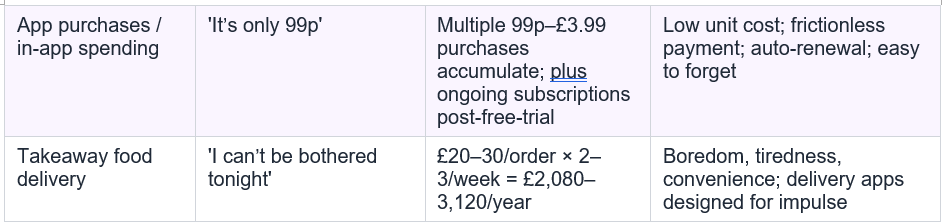
The Seven Most Common Small-Purchase Traps
The Annual Cost Calculator: Add It Up Before You Look Away
One of the most effective behavioural techniques for interrupting the ‘just one’ cycle is to annualise the cost before making the purchase decision. The brain naturally evaluates purchases in their smallest possible unit (the individual transaction). Annualising forces it to evaluate the decision in a more meaningful context:- Daily £3 habit (one item): £1,095 per year
- Daily £5 habit (one item): £1,825 per year
- Daily £8 habit (lunch or equivalent): £2,920 per year
- Weekly £15 habit (takeaway, one per week): £780 per year
- Weekly £25 habit (delivery app, 1.5 times per week): £1,950 per year
- Monthly £10 subscription: £120 per year (x5 unused subscriptions = £600)
This week, pick three of your habitual small purchases and annualise them. Write the yearly cost next to each one. Then write what that same money would be worth if invested for 10 years at 5% annual growth. The compound arithmetic is the most honest representation of what each habitual small purchase actually costs. For a 35-year-old: £1,825 per year for 30 years at 5% = approximately £120,000 at retirement. That is the real cost of the daily coffee habit — not £5.
Step 1: Identify Your Spending Triggers
Mindful spending begins with awareness, not restriction. The most important first step is to identify the emotional and situational triggers that precede your impulse purchases. Simply Psychology’s January 2026 guide to impulse spending psychology recommends a simple one-week spending log:- Write down every purchase, however small.
- Note the emotion or situation immediately before the purchase (bored, stressed, tired, procrastinating, scrolling, hungry, after a difficult meeting, etc.).
- Note the time and location.
- After one week, look for patterns.
- Boredom spending: 32% of Gen Z report boredom as a driver of unnecessary purchases (Motley Fool, January 2026). Scrolling and tapping are low-effort activities that share a digital environment with shopping apps.
- Stress and reward seeking: retail therapy is a documented psychological phenomenon. Shopping temporarily boosts serotonin and provides a sense of control in moments of stress or anxiety. The relief is real but brief (Bajaj AMC, March 2026; Positive Mind Works, February 2026).
- Decision fatigue spending: late-night impulse buying, post-work convenience ordering, and end-of-week spending correlate with depleted executive function.
- Social media and algorithmic discovery: 67% of Gen Z’s increase in impulse buying is attributed to TikTok Shop usage (Gartner, 2026). Average purchase decision time on mobile platforms has fallen to under 8 seconds (NRF/Shopify, 2026).
Step 2: The 24-Hour (or 10-Second) Rule
The single most cited practical technique for reducing impulse spending is a deliberate pause between the purchase impulse and the purchase decision. Two versions, calibrated to the purchase size:- The 24-hour rule for non-essential purchases above a set threshold (e.g. anything above £30 or £50): do not buy immediately. Add the item to a wishlist, a note, or a designated ‘waiting list’ account. Wait 24 hours. Then ask: do I still want this? Does it align with something I actually value? The emotional trigger that drove the original impulse typically fades within hours. Mindspend’s August 2026 guide notes: ‘When you want to buy something non-essential, wait 24 hours before purchasing. This gives your rational brain time to catch up with the dopamine-driven urge.’
- The 10-second pause for small daily purchases: before any habitual small purchase, pause for 10 seconds and ask two questions: ‘Do I need this right now?’ and ‘Will it still feel worth it tonight?’ Therapy Group of DC’s June 2025 guide to doom spending notes: ‘Even a 10-second pause can short-circuit an impulse.’
Step 3: Track in Real Time, Not at Month End
One of the most consistent findings in the research on impulse spending is that real-time tracking of purchases dramatically reduces impulse buying. Simply Psychology’s January 2026 analysis confirms: ‘Tracking spending in real-time (versus reviewing bank statements monthly) creates awareness that reduces impulsive decisions. Apps that track spending by category produce reductions in impulse purchasing in multiple studies.’The mechanism: reviewing a bank statement at month end is a retrospective audit of decisions already made. Logging a purchase in real time — category, amount, trigger — inserts a small act of awareness into the decision moment itself. The awareness changes the decision-making context.
Practical tools:
- Banking apps with real-time transaction notifications (most UK banks now offer these; turn them on).
- Budgeting apps such as YNAB (You Need A Budget), Emma, or Plum that automatically categorise transactions and provide running category totals against a set budget.
- A simple note on your phone: one line per purchase, date and amount. The act of manually recording it provides friction and awareness simultaneously.
Step 4: The Subscription Audit
Subscriptions are the most insidious form of small purchase because they are invisible. They do not require a decision at the moment the charge occurs. Once set up, they continue until actively cancelled. The Aqua 2025 survey found that 17 percent of Brits do not track their subscriptions at all, and one in five pay for services they rarely use. A 2024 LendingTree survey found that nearly 42 percent of Americans forgot they were still paying for at least one unused subscription.A subscription audit takes approximately 30 minutes and typically saves meaningful money:
- Step 1: download your last three months of bank statements and highlight every recurring charge (monthly or annual). Include streaming services, apps, software, gym memberships, meal kits, newsletter subscriptions, cloud storage, and delivery passes.
- Step 2: make a list. For each subscription: when did I last use it? When did I last actively choose to renew it? What would I give up if I cancelled it?
- Step 3: categorise each as ‘keep,’ ‘cancel now,’ or ‘review in 30 days.’ Do not give a subscription a pass just because cancelling feels like effort.
- Step 4: cancel the ones in the ‘cancel now’ category today, not tomorrow. The friction of cancellation is designed to be high; do not let it defer an easy decision.
- Step 5: set a calendar reminder every six months to repeat the audit.
Step 5: Values-Based Spending — The Only Long-Term Fix
Every practical technique in this guide — the 24-hour rule, the real-time tracking, the subscription audit, the friction design — operates at the level of the individual purchase decision. They are useful and effective. But the most durable change in spending behaviour does not come from better decision-making frameworks; it comes from alignment between spending and values.Simply Psychology’s January 2026 analysis of spending psychology research is direct on this point: ‘Research on financial behavior change suggests that connecting spending decisions to deeply held values — rather than rules or restrictions — produces more durable change. “I prioritize financial security for my family” is more behaviorally motivating than “I shouldn’t spend money.”’
Values-based spending means deciding — not in a moment of impulse, but in advance, deliberately — what money is for in your life. This is not about asceticism or sacrifice. It is about ensuring that the things you spend money on are actually the things you care most about, rather than the things that were in front of you when you had a dopamine signal and a one-tap checkout.
A practical values clarification exercise:
- Write down three to five things that genuinely matter most to your wellbeing and security: family, health, experiences, financial independence, a specific goal.
- Assign approximate annual spending amounts that genuinely reflect those values.
- When a purchase does not connect to any of those values, the question becomes explicit: ‘What am I actually buying this for?’
Mindful spending is not the opposite of enjoyment. It is the opposite of automatic. The goal is not to stop spending on things that bring you pleasure — it is to ensure that the things you spend on actually bring you pleasure rather than just briefly activating a dopamine signal. A considered £5 coffee that you enjoy as part of a morning ritual you value is entirely different from an automatic £5 coffee you bought on the way to a meeting without noticing.
Step 6: Friction by Design
The commercial environment is deliberately designed to minimise friction between impulse and purchase. One-tap checkout, saved card details, ‘buy now pay later’ options, free-shipping thresholds that encourage add-ons, push notifications from shopping apps, and algorithmically curated social commerce have reduced average purchase decision time to under 8 seconds on mobile (NRF/Shopify, 2026).Mindful spending means adding friction back into the environments that have deliberately removed it:
- Delete saved payment details from shopping apps and websites. Requiring manual card entry adds a 30-second delay that interrupts most impulse purchases.
- Delete shopping apps from your phone’s home screen or uninstall them. If you want to browse, make it deliberate rather than one notification away.
- Unsubscribe from promotional emails from retailers whose emails reliably trigger impulse purchases. The sale you ‘miss’ almost never mattered.
- Unfollow accounts on social media whose content consistently makes you feel the urge to buy. Positive Mind Works’ February 2026 guide describes this as ‘an essential act of self-care.’
- Keep your physical wallet in a bag or drawer rather than a pocket when at home. The physical friction of having to retrieve it adds enough of a pause to interrupt habitual delivery-app ordering.
Step 7: Build a Spending Permission Slip
One of the reasons rigid spending restrictions fail is that they produce a ‘white bear problem’: trying not to think about buying something makes you think about it more. Rules-based approaches to mindful spending (‘I will not buy coffee this month’) produce resentment, deprivation, and rebound spending.A more effective approach is a spending permission slip: a pre-decided, values-aligned allocation of money that is explicitly for guilt-free spending on small pleasures. The permission slip does not eliminate spending; it redirects it into intentional, pre-planned choices rather than reactive, automatic ones.
In practical terms:
- Set a fixed weekly or monthly ‘fun money’ allowance — an amount that is guilt-free and genuinely no-questions-asked. This is your permission slip. Once it is spent, no more non-essential small purchases until the next period.
- The size of the permission slip should be set deliberately against other financial goals, not reactively against what you have left at the end of the month.
- Separate this money physically or digitally: a separate account, a cash envelope, or a separate pot in your banking app makes the boundary visible and concrete.
Step 8: Replace the Habit, Not Just the Purchase
If the impulse to purchase is serving an emotional function — relieving boredom, managing stress, rewarding effort, providing stimulation — then eliminating the purchase without addressing the underlying function produces either rebound spending on different items or the suppressed need expressing itself in other ways.Simply Psychology’s January 2026 analysis makes this explicit: ‘Addressing the emotional function: if spending serves emotional regulation, the most effective long-term solution is developing alternative regulation strategies — exercise, social connection, mindfulness, or therapy. Restricting spending without addressing its emotional function often produces rebound spending or substitute behaviors.’
For each identified spending trigger, identify a specific replacement behaviour:
- Boredom → keep a dedicated short reading list, podcast, or low-cost activity ready to substitute for the scroll-and-buy reflex.
- Stress relief → a five-minute walk, a brief call with a friend, a breathing exercise, or a ten-minute stretch. Bajaj AMC’s March 2026 guide notes: ‘mindful swaps — instead of adding to your cart, listen to music, cook, or read. These activities often cost nothing and may provide genuine relief.’
- Reward-seeking → identify a non-spending reward for work completed: a walk, a long bath, a specific free entertainment. Pre-planning rewards is significantly more effective than making reward decisions reactively.
- Social spending pressure → agree with yourself in advance about which social spending you genuinely value versus which you join automatically. The coffee with a friend you will actually talk to is different from the coffee you buy because everyone else is getting one.
What Mindful Spending Is Not
Mindful spending is frequently misunderstood as a form of financial restriction or deprivation. It is worth being explicit about what it is not:- It is not a ban on small pleasures: the goal is not to eliminate the daily coffee or the occasional impulse buy. It is to ensure those purchases are conscious choices rather than automatic behaviours. A deliberate, enjoyed coffee is mindful spending. An automatic, unnoticed coffee that you barely tasted is not.
- It is not constant willpower: willpower is finite and unreliable. Mindful spending works precisely because it relies on systems and design — the 24-hour rule, the tracking app, the deleted card details, the permission slip — rather than on the fragile and inconsistent capacity to resist in the moment.
- It is not about judging yourself for past spending: the one-week spending log and the subscription audit reveal existing patterns without attaching moral weight to them. The purpose is awareness, not criticism. As Positive Mind Works’ February 2026 guide states: ‘true financial wellbeing begins not with restriction, but with awareness.’
- It is not a one-time exercise: the 43% of UK consumers who describe themselves as pursuing a ‘balanced’ approach to money management in 2026 (Mindspend, August 2026) are not doing a single budgeting exercise. They are maintaining ongoing, light-touch awareness of their spending as a regular practice. The system sustains itself when it is embedded in routine rather than treated as a crisis intervention.
Conclusion
The ‘just one small purchase’ pattern is not a character flaw or a sign of poor financial management. It is the predictable output of a cognitive architecture designed for immediate rewards, operating in a commercial environment specifically designed to exploit that architecture at scale. The solution is not to try harder; it is to be smarter about the decision environment.The eight steps in this guide — identifying triggers, applying deliberate pauses, tracking in real time, auditing subscriptions, clarifying values, adding friction by design, building a permission slip, and replacing the emotional habit with a genuine alternative — address the problem at its root rather than at the symptom level. None of them require extraordinary discipline. All of them compound over time.
The compound arithmetic is the most compelling argument: £5 per day, saved and invested at 5 percent for 30 years, produces approximately £125,000. The version of you who implemented these habits at 35 is not a person who denied themselves coffee. They are a person who had £125,000 more at 65 — and who spent every coffee pound they did spend on coffee they actually noticed, chose, and enjoyed.
Frequently Asked Questions
What is mindful spending?Mindful spending is the practice of making conscious, intentional purchasing decisions rather than automatic or reactive ones. As Mindspend's August 2026 guide defines it: 'mindful spending is the practice of checking in with yourself before you buy something. It means asking Do I actually want this, or am I just reacting to something? before every non-essential purchase.' The opposite of mindful spending is not frugality — it is autopilot: spending because it is convenient, habitual, triggered by an emotion, or in response to an algorithm, rather than because the purchase aligns with what you actually value. Mindful spending does not require never buying small things. It requires those small things to be chosen, rather than defaulted to.
Why is it so hard to stop buying small things habitually?
Because the brain is designed to find the small purchase extremely easy to approve. Three specific mechanisms work together: proportional thinking (£5 feels trivial relative to a £3,000 income), present bias (the immediate reward is more compelling than the abstract future cost), and decision fatigue (habitual small purchases happen most often when the deliberate decision-making system is most depleted — in the evening, after a stressful day, while tired). Additionally, commercial environments — particularly mobile apps and delivery platforms — are specifically designed to reduce friction and decision time. Average purchase decision time on mobile platforms has fallen to under 8 seconds in 2026 (NRF/Shopify, 2026). The system is working as designed; the issue is whether you are making the decisions or whether the design is making them for you.
How much does the average person spend on impulse purchases?
Globally, the average consumer spent approximately $254 per month on impulse purchases in 2025, totalling approximately $3,045 per year, making an average of 9.94 impulse purchases per month at approximately $25.93 each (Capital One Shopping Research, June 2026). In the UK, average annual subscription spending is £786 per year, with 1 in 5 rarely using the services they pay for (Aqua survey, 2025, n=2,000). 91% of active shoppers make impulse purchases (NRF/Shopify, 2026). 32% of Gen Z report boredom as a primary driver of unnecessary purchases (Motley Fool, January 2026, n=2,000).
Does the 24-hour rule actually work?
Yes, consistently. The 24-hour waiting period works because the dopamine signal that drives an impulse purchase is temporary: it peaks before the purchase and fades quickly. By waiting 24 hours before completing a non-essential purchase, the emotional driver that made the item feel urgent or necessary typically subsides. After the wait, the question 'do I still want this?' is answered by the deliberate, non-dopamine-driven brain rather than the impulse-responding one. Research on spending behaviour change consistently finds that deliberate pauses between impulse and purchase reduce the proportion of impulse buys that are completed. For smaller habitual purchases, even a 10-second pause asking 'do I need this right now?' before an automatic small purchase interrupts the autopilot mechanism and inserts conscious decision-making.
How do I deal with the emotional driver behind impulse spending without just restricting myself?
By identifying and replacing the emotional function of the spending, not just the spending itself. Simply Psychology's January 2026 analysis notes that 'restricting spending without addressing its emotional function often produces rebound spending or substitute behaviors.' If spending provides stress relief, boredom escape, or reward, eliminating the spend without providing an alternative leaves the emotional need unmet. The practical approach: for each spending trigger you identify (stress, boredom, fatigue, social pressure), decide in advance what you will do instead. The replacement needs to genuinely serve the same emotional function — a brief walk or a call to a friend after a stressful meeting is a more effective stress-relief substitute than white-knuckling through the urge to order a delivery. Bajaj AMC's March 2026 guide: 'mindful swaps — instead of adding to your cart, listen to music, cook, or read — often cost nothing and may provide genuine relief.'
What is the best app for tracking spending and reducing impulse purchases?
The research consistently shows that any real-time tracking produces better outcomes than monthly statement review — the specific tool matters less than the habit of real-time awareness. UK-available options include: Emma (open banking; automatic categorisation; spending alerts); YNAB (You Need a Budget; envelope budgeting; zero-based allocation; subscription required); Plum (automatic savings; spending analytics; integrated pots); Monzo and Starling built-in budgeting (pot-based accounts; instant spending notifications; built-in budget limits per category); Snoop (bill analysis; subscription tracker; suggests savings). Most major high-street banks (Lloyds, NatWest, Barclays, HSBC) also offer in-app spending categorisation and notification settings. The most important step is turning on real-time push notifications for all transactions — something available in almost every UK banking app without requiring a third-party service.
0 Comments
Be the first to share your thoughts on this article.