
Spending
Will UK Energy Prices Rise in 2026? Ofgem Cap Guide

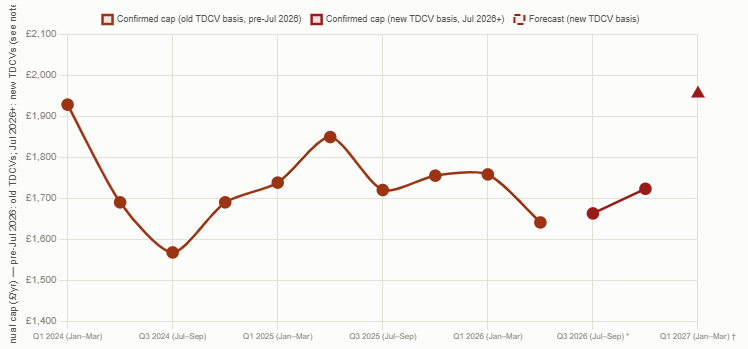
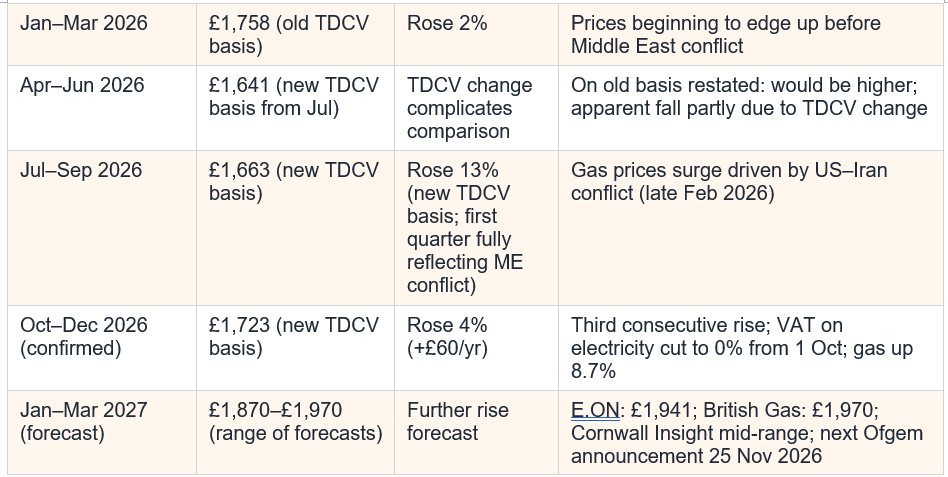
Ofgem confirmed on 26 August 2026 that the energy price cap will rise 4% to £1,723 from 1 October. That is the third consecutive quarterly rise. E.ON forecasts £1,941 in January. British Gas forecasts £1,970. The driver is wholesale gas prices surging after the US–Iran conflict began in late February. Here’s what happened, what’s forecast, and what you can do about it.

The October rise is driven primarily by wholesale gas prices, which surged following geopolitical disruption in the Middle East from late February 2026. Gas unit rates in the October 2026 cap rose by approximately 8.7 percent, while electricity unit rates moved by much less and the electricity standing charge actually fell. The headline rise was cushioned by the government’s decision to remove the 5 percent VAT rate on domestic electricity from 1 October 2026 until 31 March 2027 — a measure announced by Prime Minister Andy Burnham that prevented the headline rise from reaching approximately 6 percent (Energy Made Easy, August 2026).
Around 22 million households are on default (standard variable) tariffs covered by the price cap. Approximately 35 percent of households — around 11 million — are already on fixed tariffs and will not see their bills change on 1 October (Ofgem, 26 August 2026).
October 2026 price cap: £1,723/year (up 4%, +£60, from £1,663 in July 2026). Gas unit rates rose ~8.7%. The rise would have been ~6% without the electricity VAT cut to 0% from 1 October. 22 million households on default tariffs. Third consecutive quarterly rise. Next Ofgem announcement: 25 November 2026 (January 2027 cap level).
The UK’s sensitivity to Middle East conflicts stems from its significant dependence on imported Liquefied Natural Gas (LNG), as well as interconnected global gas markets. The threat to oil and gas supply routes through the Strait of Hormuz, which carries approximately 20 percent of the world’s traded oil and large quantities of LNG, pushed wholesale gas prices sharply higher from March 2026. UK import dependence amplified the domestic impact of this global price surge.
Uswitch notes in its August 2026 energy price cap analysis that with continued instability in the Middle East, gas prices could be ‘a staggering 26% higher than they were last year’ by January 2027. The cap is set each quarter based on wholesale market prices in the preceding observation window, which is why the July 2026 cap was the first to fully reflect the February 2026 geopolitical shock, and why further rises through October and January are being forecast.
In late February 2026, before the conflict began, Cornwall Insight and other major forecasters expected the energy price cap to remain around £1,477 for most of 2026. The geopolitical shock that began in late February 2026 has added an estimated £250–£500 to annual household energy bills for those on the default tariff across 2026. The energy market has once again demonstrated how sensitive UK bills are to events thousands of miles away.
The new TDCVs from July 2026:
This matters for comparing the October 2026 figure to cap levels from before July 2026, which were all calculated on the old, higher consumption assumptions. When Energy Made Easy’s August 2026 guide states that the July 2026 cap was £1,663 (a 13 percent rise on the April–June quarter restated to £1,489 on the same basis), it is using the new TDCV basis throughout. Direct comparison with a January 2026 cap of £1,758 or an April 2026 cap of £1,641 requires using the same consumption basis for both periods.
New TDCVs from July 2026: 2,500 kWh electricity (7% lower) and 9,500 kWh gas (17% lower). The October 2026 cap of £1,723 on new TDCVs is equivalent to £1,935 on old TDCVs — the same unit rates, different consumption assumptions. The cap is approximately 70% above the January 2019 launch level of £1,137 (Electricity Prices, 2026).
Current forecasts as of late August 2026:
If your current tariff is an expensive standard variable tariff and the forecasts for January 2027 prove accurate, fixing now could save you money. EDF Energy's August 2026 price cap predictions guide notes that based on their forecasts, a two-year fixed tariff at £1,711 or less annually could save money compared to staying on a variable tariff for the year. Compare available fixed tariffs against the forecast trajectory using Uswitch, MoneySavingExpert, or your supplier's website. Remember: if prices fall rather than rise, a fixed tariff would cost you more than the cap. Weigh your risk appetite accordingly.
The practical effect: Ofgem has stated that the cap would have risen by approximately 6 percent without the VAT cut. The VAT relief is worth approximately 2.5 percentage points off the headline rise, reducing it from ~6% to the confirmed 4%. E.ON Next notes explicitly that this is a genuine saving but arrived as a ‘smaller rise rather than as money back’ — the VAT cut prevented a larger rise rather than reducing bills from their July level.
Key points about the electricity VAT cut:
The cap protects around 22 million UK households on default tariffs (Ofgem, 26 August 2026). It is reviewed and updated quarterly — in January, April, July, and October — based on changes in the underlying costs of supplying energy, particularly wholesale gas prices. Ofgem typically announces each new quarterly level approximately five weeks before it takes effect.
Customers on fixed tariffs — approximately 35 percent of households, or around 11 million — are not directly affected by each quarterly cap change during their fixed term. The cap level is used as a benchmark to assess whether a fixed tariff is competitively priced, but the actual rate a fixed-tariff customer pays is locked in at the time they took out the deal.
Ofgem urges anyone struggling with energy bills to contact their energy supplier as soon as possible. Suppliers are required to offer affordable repayment plans and routes to financial assistance for customers in difficulty.
The primary drivers of wholesale gas price movements in 2026:
The case for fixing now:
The government’s electricity VAT cut from 5% to 0% between October 2026 and March 2027 reduces the headline impact but does not reverse it. Gas, which is not covered by the VAT cut, rose 8.7% in the October cap. The January 2027 cap is likely to be the most expensive quarterly level since January 2024, according to independent forecasters.
For the 22 million households on default variable tariffs, the practical options are to compare fixed tariff alternatives against the forecast cap trajectory, to reduce energy consumption where possible (driving a smaller cap impact from reduced usage), and to contact suppliers early if bills become unmanageable. For the approximately 9 million households in broader fuel poverty, the combination of the Warm Home Discount, Winter Fuel Payment, and targeted support from suppliers remains the primary safety net — but the adequacy of that net in a winter of further rising prices will be tested.
The Ofgem energy price cap from 1 October 2026 is £1,723 per year for a typical dual-fuel household paying by direct debit. This was confirmed by Ofgem on 26 August 2026. It represents a rise of 4% (approximately £60 per year or £5 per month) from the July–September 2026 cap of £1,663. The October figure is calculated using Ofgem's new Typical Domestic Consumption Values (TDCVs) updated from 1 July 2026 — 2,500 kWh/year for electricity and 9,500 kWh/year for gas — which are lower than the previous assumptions of 2,700 kWh and 11,500 kWh. On the old consumption basis, the same unit rates produce a cap of approximately £1,935 per year. The cap limits the unit rates and standing charges suppliers can charge for gas and electricity but does not cap total bills — households using more than typical will pay more.
Why has the energy price cap been rising in 2026?
The primary driver of energy price cap rises in 2026 is the surge in wholesale gas prices following the geopolitical conflict involving the US, Israel, and Iran, which began in late February 2026. Before this conflict, energy forecasters had expected the cap to remain relatively stable around April's level of £1,477 for much of 2026. The conflict raised fears about supply disruption through the Strait of Hormuz, a critical route for global LNG shipments, and pushed wholesale gas prices sharply higher. The House of Commons Library notes that the July 2026 cap was 'the first to reflect the impact of the Middle East conflict' and was 'much larger for gas'. Gas unit rates in the October 2026 cap rose approximately 8.7%. The UK's dependence on imported LNG makes its energy prices particularly sensitive to global gas market disruptions.
What is the forecast for the energy price cap in January 2027?
Forecasts made in late August 2026 point to a further rise in January 2027. E.ON Next (26 August 2026) predicts the January 2027 cap will rise to £1,941 per year; British Gas (26 August 2026) forecasts £1,970. Both use Ofgem's new TDCVs. These forecasts would represent a 13–14% rise from October's confirmed £1,723. Uswitch notes that standard gas prices could be 26% higher than a year earlier by January 2027. The next Ofgem announcement covering the January–March 2027 cap is scheduled for 25 November 2026. Forecasts are uncertain — wholesale market conditions change rapidly and the January figure will depend on gas prices during the observation period leading to the November announcement. A mild autumn or geopolitical de-escalation could reduce the final figure.
What is the electricity VAT cut and how does it affect my bills?
The UK government has temporarily reduced the VAT rate on domestic electricity from 5% to 0% for the period from 1 October 2026 to 31 March 2027. This was announced by Prime Minister Andy Burnham to soften the impact of rising energy costs. Ofgem has stated that the October 2026 cap rise would have been approximately 6% without this VAT cut — the relief reduced the headline increase to 4%. Energy suppliers will apply the 0% VAT rate automatically to all electricity tariffs, including fixed tariffs, for the duration of the relief period. The cut applies only to electricity, not gas. It is currently scheduled to end on 31 March 2027, unless extended — the next government decision point on this will likely come in the spring 2027 budget or ahead of the April 2027 quarter.
Should I fix my energy tariff now?
Whether to fix depends on the rate available relative to your expectations for the cap trajectory. If you are currently on the standard variable tariff at £1,723 (October cap level) and a fixed tariff is available below this rate, fixing would save you money in October–December 2026 regardless of what January brings. EDF Energy's August 2026 analysis suggests a two-year fixed tariff at £1,711 or below could save money based on their forecast trajectory. If forecasts for January 2027 (£1,941–£1,970) prove accurate, any fix below that level would save money in Q1 2027. However, if wholesale prices fall more than expected — for example, from geopolitical de-escalation or a mild winter — the cap could fall in 2027 and fixed tariff customers would miss those falls. Fixed tariffs also typically carry exit fees. Compare rates at Uswitch, MoneySavingExpert, or with your current supplier, and consider the forecast range against the certainty value of fixing. If in doubt, consult a qualified energy adviser.
How does fuel poverty in the UK compare now vs during the 2022 crisis?
At the peak of the 2022–2023 energy crisis, an estimated 6.7 million households were in fuel poverty when the Energy Price Guarantee came into effect in October 2022. The headline Ofgem cap would have reached £4,279 in January 2023 without government intervention. Government support, including the £400 Energy Bills Support Scheme, the Energy Price Guarantee, and cost-of-living payments, limited what households actually paid and helped prevent even wider fuel poverty. By 2025 (the most recent full-year data), approximately 2.36 million households in England were in fuel poverty under the Low Income Low Energy Efficiency measure — 9.4%, down from 2.47 million in 2024 (DESNZ, March 2026). However, the broader measure (spending more than 10% of income after housing costs on energy) showed 8.99 million households in difficulty in 2024, up from 8.73 million in 2023. With the cap set to rise further through winter 2026–27, these numbers are expected to increase when next reported.
Table of Contents
- What Just Happened: Ofgem’s 26 August 2026 Announcement
- Why Prices Have Been Rising: The Middle East Factor
- The New Consumption Figures: What the 2026 Cap Numbers Actually Mean
- The Price Cap Quarter by Quarter: Where We Have Been and Where We Are Headed
- What the Forecasters Are Saying About January 2027
- The Electricity VAT Cut: A Partial Buffer from October 2026
- How the Price Cap Works and Who It Protects
- Fuel Poverty: How Many UK Households Are Struggling?
- What Is Driving Wholesale Energy Prices?
- What Should You Do Right Now? Fixed Tariffs vs the Cap
- Conclusion: Three Consecutive Rises and a Winter Warning
- Frequently Asked Questions
Price Cap History & Forecast 2024-2027
What Is In Your Energy Bill
What Just Happened: Ofgem’s 26 August 2026 Announcement
Ofgem, the UK’s energy regulator, confirmed on Wednesday 26 August 2026 that the energy price cap will rise by 4 percent — approximately £60 per year, or £5 per month — from 1 October 2026. The new cap level for a typical dual-fuel household paying by direct debit is £1,723 per year, up from £1,663 in the July–September 2026 quarter. This is the third consecutive quarterly increase in the price cap.The October rise is driven primarily by wholesale gas prices, which surged following geopolitical disruption in the Middle East from late February 2026. Gas unit rates in the October 2026 cap rose by approximately 8.7 percent, while electricity unit rates moved by much less and the electricity standing charge actually fell. The headline rise was cushioned by the government’s decision to remove the 5 percent VAT rate on domestic electricity from 1 October 2026 until 31 March 2027 — a measure announced by Prime Minister Andy Burnham that prevented the headline rise from reaching approximately 6 percent (Energy Made Easy, August 2026).
Around 22 million households are on default (standard variable) tariffs covered by the price cap. Approximately 35 percent of households — around 11 million — are already on fixed tariffs and will not see their bills change on 1 October (Ofgem, 26 August 2026).
October 2026 price cap: £1,723/year (up 4%, +£60, from £1,663 in July 2026). Gas unit rates rose ~8.7%. The rise would have been ~6% without the electricity VAT cut to 0% from 1 October. 22 million households on default tariffs. Third consecutive quarterly rise. Next Ofgem announcement: 25 November 2026 (January 2027 cap level).
Why Prices Have Been Rising: The Middle East Factor
The trajectory of UK energy prices in 2026 has been shaped almost entirely by one geopolitical event. In late February 2026, the United States and Israel jointly launched military action against Iran. Before that point, energy price forecasters had been expecting the cap to remain relatively stable — around the April 2026 level of £1,477 (using contemporary consumption assumptions) — for most of the year. The House of Commons Library’s domestic energy prices briefing notes that price increases in July 2026 were ‘the first to reflect the impact of the Middle East conflict’ and were ‘much larger for gas’ than for electricity.The UK’s sensitivity to Middle East conflicts stems from its significant dependence on imported Liquefied Natural Gas (LNG), as well as interconnected global gas markets. The threat to oil and gas supply routes through the Strait of Hormuz, which carries approximately 20 percent of the world’s traded oil and large quantities of LNG, pushed wholesale gas prices sharply higher from March 2026. UK import dependence amplified the domestic impact of this global price surge.
Uswitch notes in its August 2026 energy price cap analysis that with continued instability in the Middle East, gas prices could be ‘a staggering 26% higher than they were last year’ by January 2027. The cap is set each quarter based on wholesale market prices in the preceding observation window, which is why the July 2026 cap was the first to fully reflect the February 2026 geopolitical shock, and why further rises through October and January are being forecast.
In late February 2026, before the conflict began, Cornwall Insight and other major forecasters expected the energy price cap to remain around £1,477 for most of 2026. The geopolitical shock that began in late February 2026 has added an estimated £250–£500 to annual household energy bills for those on the default tariff across 2026. The energy market has once again demonstrated how sensitive UK bills are to events thousands of miles away.
The New Consumption Figures: What the 2026 Cap Numbers Actually Mean
Comparing the October 2026 cap of £1,723 to earlier cap levels requires understanding an important technical change that Ofgem made from 1 July 2026. On that date, Ofgem updated the Typical Domestic Consumption Values (TDCVs) — the assumed usage levels used to calculate the ‘typical household’ cap figure — to reflect the fact that UK households are now using significantly less energy than in the past.The new TDCVs from July 2026:
- Electricity: 2,500 kWh per year (down from 2,700 kWh — a 7% reduction).
- Gas: 9,500 kWh per year (down from 11,500 kWh — a 17% reduction).
This matters for comparing the October 2026 figure to cap levels from before July 2026, which were all calculated on the old, higher consumption assumptions. When Energy Made Easy’s August 2026 guide states that the July 2026 cap was £1,663 (a 13 percent rise on the April–June quarter restated to £1,489 on the same basis), it is using the new TDCV basis throughout. Direct comparison with a January 2026 cap of £1,758 or an April 2026 cap of £1,641 requires using the same consumption basis for both periods.
New TDCVs from July 2026: 2,500 kWh electricity (7% lower) and 9,500 kWh gas (17% lower). The October 2026 cap of £1,723 on new TDCVs is equivalent to £1,935 on old TDCVs — the same unit rates, different consumption assumptions. The cap is approximately 70% above the January 2019 launch level of £1,137 (Electricity Prices, 2026).
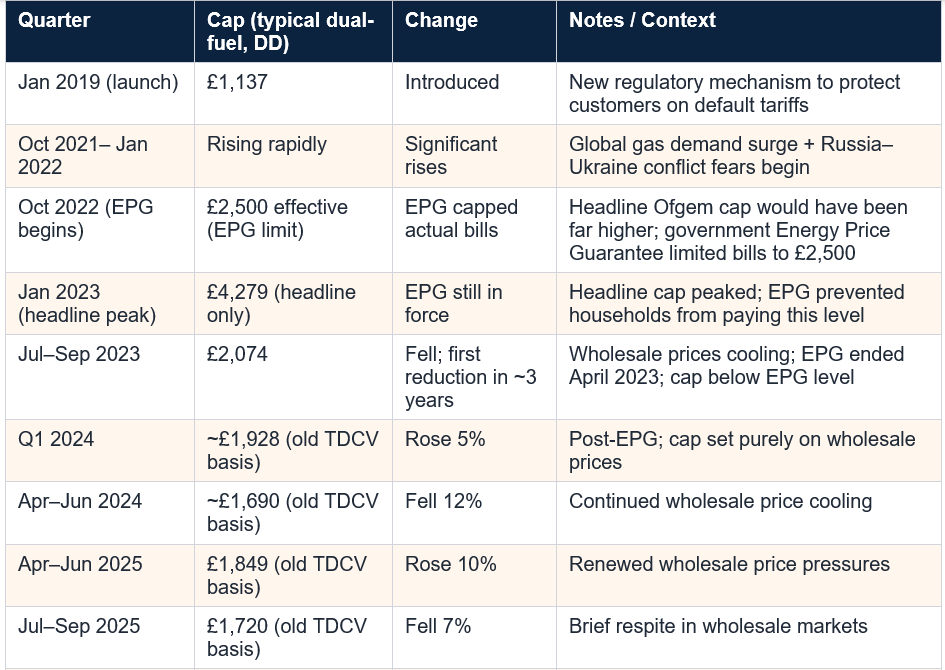
4. The Price Cap Quarter by Quarter: Where We Have Been and Where We Are Headed
The energy price cap has had a volatile history since its introduction in January 2019. The table below shows the key quarterly cap levels, using the consumption basis applicable at the time:
What the Forecasters Are Saying About January 2027
The next quarterly price cap, covering January to March 2027 — typically the coldest quarter of the year and historically the highest cap level — is currently forecast to be the fourth consecutive quarterly rise. The next Ofgem announcement is scheduled for 25 November 2026.Current forecasts as of late August 2026:
- E.ON Next (26 August 2026): predicts the January 2027 cap will rise to £1,941 per year — an increase of approximately £218 (13 percent) from October’s £1,723.
- British Gas (26 August 2026): forecasts the January 2027 cap will rise to £1,970 per year — £247 above the October level.
- Cornwall Insight (25 August 2026, pre-Ofgem announcement): forecast the October 2026 cap at £1,872 (HomeOwners Alliance) — slightly above the confirmed £1,723, suggesting their model may include slightly different consumption basis assumptions.
- Uswitch (August 2026): notes that standard gas prices could be ‘a staggering 26% higher than they were last year’ by January 2027.
If your current tariff is an expensive standard variable tariff and the forecasts for January 2027 prove accurate, fixing now could save you money. EDF Energy's August 2026 price cap predictions guide notes that based on their forecasts, a two-year fixed tariff at £1,711 or less annually could save money compared to staying on a variable tariff for the year. Compare available fixed tariffs against the forecast trajectory using Uswitch, MoneySavingExpert, or your supplier's website. Remember: if prices fall rather than rise, a fixed tariff would cost you more than the cap. Weigh your risk appetite accordingly.
The Electricity VAT Cut: A Partial Buffer from October 2026
The UK government has introduced a temporary cut in the VAT rate on domestic electricity from 5 percent to 0 percent, running from 1 October 2026 to 31 March 2027. This was announced by Prime Minister Andy Burnham as a measure to ‘soften the blow’ of the October cap rise (HomeOwners Alliance, August 2026; E.ON Next, August 2026). The VAT reduction applies automatically to all electricity tariffs — both fixed and variable.The practical effect: Ofgem has stated that the cap would have risen by approximately 6 percent without the VAT cut. The VAT relief is worth approximately 2.5 percentage points off the headline rise, reducing it from ~6% to the confirmed 4%. E.ON Next notes explicitly that this is a genuine saving but arrived as a ‘smaller rise rather than as money back’ — the VAT cut prevented a larger rise rather than reducing bills from their July level.
Key points about the electricity VAT cut:
- It applies only to electricity, not to gas. Since gas unit rates rose by 8.7% in the October cap while electricity barely moved, the VAT cut addresses a smaller component of the overall bill increase.
- It is temporary: the current policy runs to 31 March 2027. The January 2027 cap announcement (25 November 2026) will land while the VAT cut is still in force, but Q2 2027 (April onwards) may see the VAT rate revert to 5% unless extended.
- Fixed tariff customers will also benefit from the electricity VAT reduction on their electricity component during the relief period.
- The effect will be automatically applied by energy suppliers — no action is required from households.
How the Price Cap Works and Who It Protects
The energy price cap does not cap the total amount a household pays for energy. It caps the unit rates (the price per kilowatt-hour of gas and electricity) and the standing charges (the daily fixed charge for having a supply) that energy suppliers can charge customers on default variable tariffs. Households that use more than the typical level will pay more than the cap headline figure; those that use less will pay less.The cap protects around 22 million UK households on default tariffs (Ofgem, 26 August 2026). It is reviewed and updated quarterly — in January, April, July, and October — based on changes in the underlying costs of supplying energy, particularly wholesale gas prices. Ofgem typically announces each new quarterly level approximately five weeks before it takes effect.
Customers on fixed tariffs — approximately 35 percent of households, or around 11 million — are not directly affected by each quarterly cap change during their fixed term. The cap level is used as a benchmark to assess whether a fixed tariff is competitively priced, but the actual rate a fixed-tariff customer pays is locked in at the time they took out the deal.
Fuel Poverty: How Many UK Households Are Struggling?
Rising energy prices have a disproportionate impact on lower-income households, for whom energy costs represent a higher share of total income. The most recent government statistics (DESNZ, published March 2026) show:- England only — Low Income Low Energy Efficiency (LILEE) measure: approximately 2.36 million households were in fuel poverty in 2025 (9.4% of households), down from 2.47 million in 2024. This decline reflects the period before the 2026 wholesale price rises and their improvement in energy efficiency of homes (Heatable, May 2026).
- Broader measure (spending more than 10% of income after housing costs on energy): 8.99 million households were in this category in 2024, up from 8.73 million in 2023 (NEA energy crisis timeline, April 2026, citing DESNZ March 2026 data). This was the first increase after a period of falling numbers from the crisis peak.
Ofgem urges anyone struggling with energy bills to contact their energy supplier as soon as possible. Suppliers are required to offer affordable repayment plans and routes to financial assistance for customers in difficulty.
What Is Driving Wholesale Energy Prices?
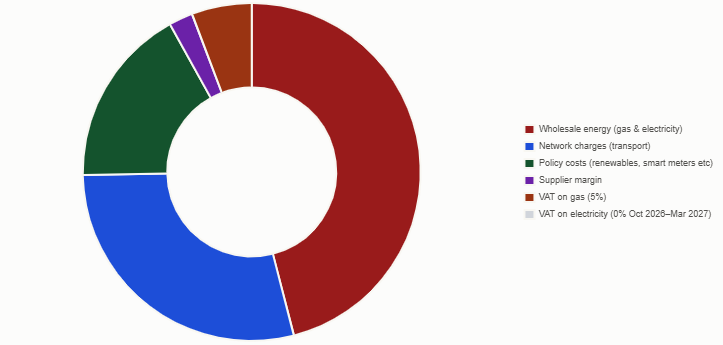
Approximately 40 percent of a typical UK dual-fuel energy bill is attributable to wholesale energy costs — the price suppliers pay to buy gas and electricity on the open market before delivering it to homes. The remaining 60 percent covers network charges (transporting energy to your home, approximately 25%), policy costs (funding renewables, social schemes, and the Smart Meter rollout, approximately 15%), VAT (5%, reduced to 0% for electricity from October 2026), and a supplier margin (approximately 2%) (UK Electricity Prices, June 2026).The primary drivers of wholesale gas price movements in 2026:
- Middle East geopolitical conflict: the US–Israel military action against Iran from late February 2026 raised fears about supply disruptions through the Strait of Hormuz and broader regional instability. This produced a sustained upward shift in global gas prices that has continued to feed through into quarterly cap reviews.
- LNG supply and demand: the UK’s significant dependence on Liquefied Natural Gas imports means global LNG market conditions — including demand from Asia and supply from the US, Qatar, and Australia — directly affect UK wholesale prices. Higher LNG demand from Asia or supply disruptions can push UK import prices up quickly.
- Weather and storage: particularly cold winters increase gas demand and draw down storage reserves, pushing prices higher. The winter of 2026–27 is likely to see elevated demand if temperatures are below average.
- UK renewable capacity: the UK’s growing renewables fleet (wind and solar) reduces electricity generation from gas-fired power stations in favourable weather conditions. However, gas still sets the marginal electricity price during calm, cold periods, keeping bills sensitive to global gas markets.
What Should You Do Right Now? Fixed Tariffs vs the Cap
The October 2026 cap of £1,723 and the forecast trajectory toward £1,941–£1,970 in January 2027 have brought fixed energy tariffs back into focus as a potential hedge against continued price rises. There are currently fixed tariffs available in the market that price below or near the October cap level, and the question for households is whether to fix now or stay on the variable tariff.The case for fixing now:
- If the January 2027 forecasts prove accurate (£1,941–£1,970), a fixed tariff at or below £1,723 today would save money in January to March 2027. EDF Energy's August 2026 analysis suggests a two-year fixed deal at £1,711 or below could save money on current forecasts.
- Fixing provides certainty and protection against further unexpected rises if the geopolitical situation deteriorates further.
- With the electricity VAT cut running to 31 March 2027, fixing during this period locks in rates that include the VAT relief before any reversion to 5% VAT.
- If wholesale prices fall faster than expected — for example, if the Middle East conflict de-escalates or a mild winter reduces demand — the cap could fall in Q2 2027 and beyond. Variable tariff customers would benefit from these falls; fixed tariff customers would not.
- Cornwall Insight and UK Electricity Prices’ June 2026 forecast suggests a gradual decrease through 2027 on a longer-term view.
- Fixed tariffs typically include exit fees, which can reduce the financial benefit if you switch during the fixed term.
Conclusion
The UK energy price cap has risen for three consecutive quarters and is forecast to rise for a fourth in January 2027. The October 2026 cap of £1,723 reflects wholesale gas prices driven sharply higher by the Middle East conflict that began in late February 2026 — a conflict that, at the time of this article’s publication, showed no sign of imminent resolution. Before the conflict, forecasters expected prices to remain stable around £1,477 for most of 2026. The conflict has added an estimated £250 to £500 to annual household bills.The government’s electricity VAT cut from 5% to 0% between October 2026 and March 2027 reduces the headline impact but does not reverse it. Gas, which is not covered by the VAT cut, rose 8.7% in the October cap. The January 2027 cap is likely to be the most expensive quarterly level since January 2024, according to independent forecasters.
For the 22 million households on default variable tariffs, the practical options are to compare fixed tariff alternatives against the forecast cap trajectory, to reduce energy consumption where possible (driving a smaller cap impact from reduced usage), and to contact suppliers early if bills become unmanageable. For the approximately 9 million households in broader fuel poverty, the combination of the Warm Home Discount, Winter Fuel Payment, and targeted support from suppliers remains the primary safety net — but the adequacy of that net in a winter of further rising prices will be tested.
Frequently Asked Questions
What is the Ofgem energy price cap for October 2026?The Ofgem energy price cap from 1 October 2026 is £1,723 per year for a typical dual-fuel household paying by direct debit. This was confirmed by Ofgem on 26 August 2026. It represents a rise of 4% (approximately £60 per year or £5 per month) from the July–September 2026 cap of £1,663. The October figure is calculated using Ofgem's new Typical Domestic Consumption Values (TDCVs) updated from 1 July 2026 — 2,500 kWh/year for electricity and 9,500 kWh/year for gas — which are lower than the previous assumptions of 2,700 kWh and 11,500 kWh. On the old consumption basis, the same unit rates produce a cap of approximately £1,935 per year. The cap limits the unit rates and standing charges suppliers can charge for gas and electricity but does not cap total bills — households using more than typical will pay more.
Why has the energy price cap been rising in 2026?
The primary driver of energy price cap rises in 2026 is the surge in wholesale gas prices following the geopolitical conflict involving the US, Israel, and Iran, which began in late February 2026. Before this conflict, energy forecasters had expected the cap to remain relatively stable around April's level of £1,477 for much of 2026. The conflict raised fears about supply disruption through the Strait of Hormuz, a critical route for global LNG shipments, and pushed wholesale gas prices sharply higher. The House of Commons Library notes that the July 2026 cap was 'the first to reflect the impact of the Middle East conflict' and was 'much larger for gas'. Gas unit rates in the October 2026 cap rose approximately 8.7%. The UK's dependence on imported LNG makes its energy prices particularly sensitive to global gas market disruptions.
What is the forecast for the energy price cap in January 2027?
Forecasts made in late August 2026 point to a further rise in January 2027. E.ON Next (26 August 2026) predicts the January 2027 cap will rise to £1,941 per year; British Gas (26 August 2026) forecasts £1,970. Both use Ofgem's new TDCVs. These forecasts would represent a 13–14% rise from October's confirmed £1,723. Uswitch notes that standard gas prices could be 26% higher than a year earlier by January 2027. The next Ofgem announcement covering the January–March 2027 cap is scheduled for 25 November 2026. Forecasts are uncertain — wholesale market conditions change rapidly and the January figure will depend on gas prices during the observation period leading to the November announcement. A mild autumn or geopolitical de-escalation could reduce the final figure.
What is the electricity VAT cut and how does it affect my bills?
The UK government has temporarily reduced the VAT rate on domestic electricity from 5% to 0% for the period from 1 October 2026 to 31 March 2027. This was announced by Prime Minister Andy Burnham to soften the impact of rising energy costs. Ofgem has stated that the October 2026 cap rise would have been approximately 6% without this VAT cut — the relief reduced the headline increase to 4%. Energy suppliers will apply the 0% VAT rate automatically to all electricity tariffs, including fixed tariffs, for the duration of the relief period. The cut applies only to electricity, not gas. It is currently scheduled to end on 31 March 2027, unless extended — the next government decision point on this will likely come in the spring 2027 budget or ahead of the April 2027 quarter.
Should I fix my energy tariff now?
Whether to fix depends on the rate available relative to your expectations for the cap trajectory. If you are currently on the standard variable tariff at £1,723 (October cap level) and a fixed tariff is available below this rate, fixing would save you money in October–December 2026 regardless of what January brings. EDF Energy's August 2026 analysis suggests a two-year fixed tariff at £1,711 or below could save money based on their forecast trajectory. If forecasts for January 2027 (£1,941–£1,970) prove accurate, any fix below that level would save money in Q1 2027. However, if wholesale prices fall more than expected — for example, from geopolitical de-escalation or a mild winter — the cap could fall in 2027 and fixed tariff customers would miss those falls. Fixed tariffs also typically carry exit fees. Compare rates at Uswitch, MoneySavingExpert, or with your current supplier, and consider the forecast range against the certainty value of fixing. If in doubt, consult a qualified energy adviser.
How does fuel poverty in the UK compare now vs during the 2022 crisis?
At the peak of the 2022–2023 energy crisis, an estimated 6.7 million households were in fuel poverty when the Energy Price Guarantee came into effect in October 2022. The headline Ofgem cap would have reached £4,279 in January 2023 without government intervention. Government support, including the £400 Energy Bills Support Scheme, the Energy Price Guarantee, and cost-of-living payments, limited what households actually paid and helped prevent even wider fuel poverty. By 2025 (the most recent full-year data), approximately 2.36 million households in England were in fuel poverty under the Low Income Low Energy Efficiency measure — 9.4%, down from 2.47 million in 2024 (DESNZ, March 2026). However, the broader measure (spending more than 10% of income after housing costs on energy) showed 8.99 million households in difficulty in 2024, up from 8.73 million in 2023. With the cap set to rise further through winter 2026–27, these numbers are expected to increase when next reported.
0 Comments
Be the first to share your thoughts on this article.