

Spending
How to Reduce Food Spending: 12 Strategies for 2026

Food costs 19.1% more than four years ago. Here are 12 proven strategies that cut bills by 20–35% — without eating worse

The good news is specific: food spending is one of the most responsive household expenses to intentional strategy. PocketClear’s April 2026 guide found that most households can cut their food bill by 20 to 35 percent within 30 days without eating worse — they just need to know where the money is actually going first. Wealthvieu’s July 2026 analysis of grocery spending patterns found that most single adults can cut $100 to $200 per month without significantly changing what they eat.
This guide presents 12 specific, evidence-backed strategies for reducing food spending in 2026, in order of their impact. Each is grounded in current research and includes realistic saving estimates. No strategy here requires eating worse. Several require eating better.
The Numbers: Food costs 19.1% more than 4 years ago (BLS CPI, 2026). Average family of four spends $475/week = $24,700/year (SpendMeNot 2026). Food-at-home prices 26–28% above January 2020 (Wealthvieu). More than 50% of Americans say groceries are a major stressor (AP-NORC, July 2025).
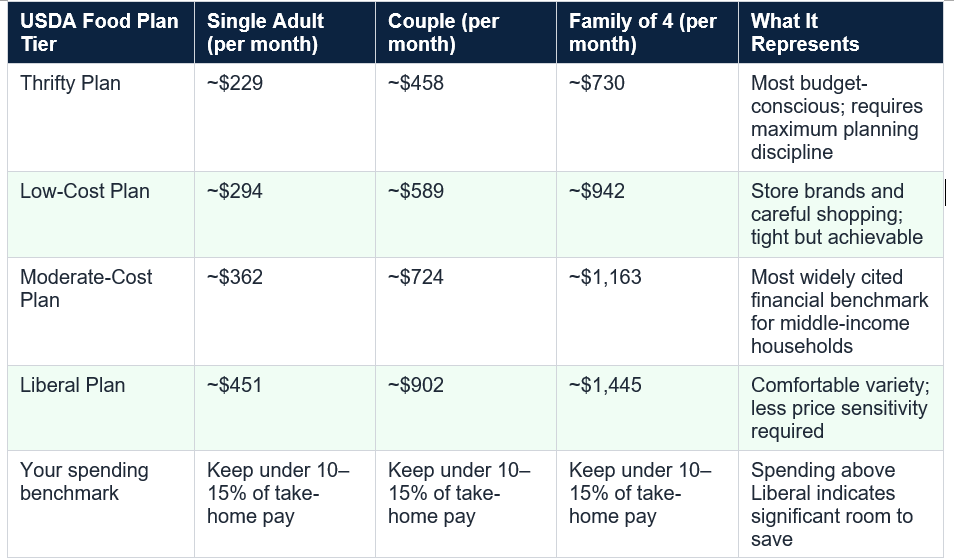
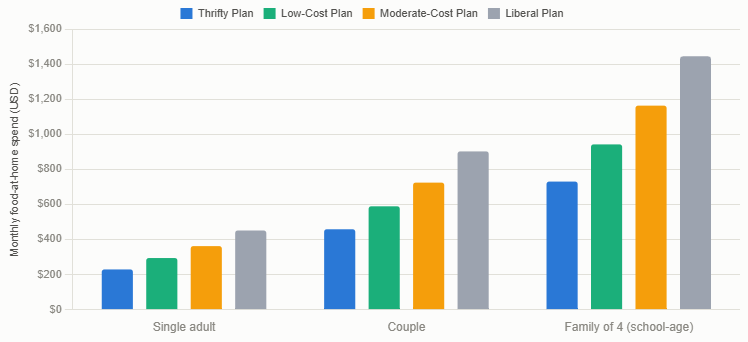
Source: USDA Food Plans (approximate 2026 monthly figures, updated monthly at USDA.gov). Wealthvieu’s July 2026 analysis adds a practical guideline: keep grocery spending under 10 to 15 percent of take-home pay. If your household takes home $4,000 per month and spends $800 on food, you are at 20 percent — and there is almost certainly meaningful room to reduce. If you are at or below the Moderate Plan benchmark, the strategies below will still help, but the gains will be incremental rather than transformational.
Action: Use the USDA’s free grocery budget calculator at USDA.gov to get a personalised monthly spending benchmark for your exact household size and age composition before comparing strategies. Knowing whether you are above or below the Moderate benchmark tells you how aggressively you need to apply the strategies below.
Consumer Reports’ price comparison data, cited by NBC Philadelphia in March 2026, found that Aldi and Target continue to stand out for savings through competitive prices and high-quality store brands. Aldi gained 19 million new shoppers in 2025 as households shifted to discount formats. Aldi prices are typically 8 percent or more below Walmart on a comparable basket; discount grocers are typically 15 to 25 percent below traditional mid-range supermarkets.
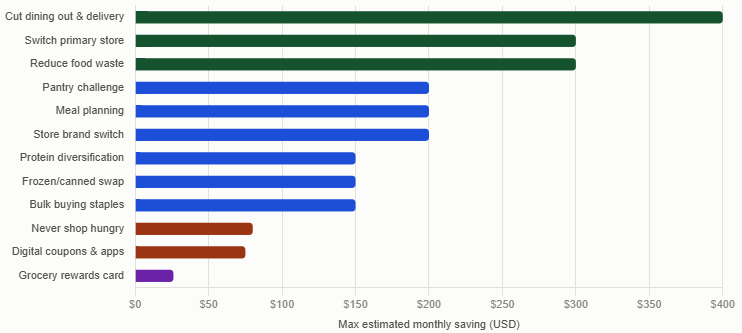
Wealthvieu, July 2026: Store-switching alone saves more than every other strategy combined. The biggest single lever for most people is switching stores — not coupon clipping or budgeting apps.
The practical approach: for one month, do a secondary staples run at Aldi, Lidl, or your area’s discount grocer for canned goods, dairy, eggs, frozen vegetables, and store-brand pantry items. Compare the receipt to what you would have paid at your regular supermarket for the same items. For most households, the saving is immediately visible and larger than expected.
The most effective form of meal planning in 2026 is the reverse-engineering approach: check what is on sale at your supermarket before deciding what to cook this week, then build meals around the discounted items. Benjamin Lorr, author of The Secret Life of Groceries, told AARP: ‘Reverse-engineering your meals is a great way to save money.’ Supermarket sales often rotate on a weekly cycle, meaning popular proteins, produce, and pantry staples take turns being discounted. Whatever is cheapest this week becomes the anchor of this week’s meals.
The practical implementation: check the store circular before shopping, plan 5 to 7 dinners built around the week’s best deals, write a specific shopping list from those meals, and buy only what is on the list. Family Credit’s June 2026 guide notes that this also covers a key waste-reduction mechanism: every ingredient purchased has a purpose, which dramatically reduces the amount of food that expires unused.
The quality argument against store brands has been largely dismantled by evidence. University of Tennessee Extension experts confirmed in January 2026 that generic store brands are often just as high in quality as their name-brand counterparts. Many store-brand products are made by the same manufacturers as the national brands, often in the same facilities, under a different label.
The best categories for store-brand switching with the least quality sacrifice:
Family Credit’s June 2026 guide describes food waste reduction as ‘essentially free savings, since you’ve already paid for the food.’ The behaviours most consistently cited by households that have successfully reduced waste:
The effective approach is not to eliminate dining out entirely — it is to make it intentional rather than default. Family Credit’s June 2026 guide recommends designating specific days or occasions for takeout rather than ordering whenever the mood strikes. Treating a restaurant visit as a planned activity rather than a default response to not knowing what to cook is the practical mechanism that most households use to reduce dining-out spending without resenting the reduction.
The specific tactics that work:
The best categories for bulk purchasing:
AARP’s December 2025 guide to stretching food budgets is direct: buying frozen, store-brand, and shelf-stable foods can stretch budgets without sacrificing nutrition. The financial case is equally strong. Fresh lettuce has risen 32.1 percent year-over-year; frozen spinach has remained stable. Fresh tomatoes are up 19.5 percent; canned tomatoes are essentially the same price as two years ago and are the superior choice for any cooked application.
The arithmetic of protein substitution makes the case clearly:
Ramsey Solutions’ updated grocery guide recommends the same approach alongside writing the list at home and committing to it before entering the store. PocketClear’s April 2026 guide identifies not having a list as the single biggest predictor of impulse purchases, alongside entering the store hungry. The combination of a prepared list and a full stomach removes the two most common environmental triggers for unplanned spending.
Action: Keep your shopping list on your phone (not a scrap of paper you can misplace) and take a few minutes before leaving home to check whether there is anything in the fridge or freezer that needs to be used before you buy more. This five-minute check before each shopping trip prevents the pattern of buying new ingredients while identical ones already in the kitchen are aging toward the bin.
The pantry challenge works on multiple levels simultaneously. It eliminates the grocery bill for the challenge period (or reduces it to produce-only purchasing). It surfaces what is actually in the kitchen — including items that have been forgotten and might otherwise be discarded. It prevents the pattern of buying new ingredients while perfectly good food is already available. And it resets cooking habits toward using what is available rather than shopping for what sounds good in the abstract.
Action: Before your next shopping trip, open every cupboard, fridge shelf, and freezer drawer and list what you have. Then plan three to five meals that use those ingredients before buying anything new. You will almost certainly find enough food for several meals — and you will almost certainly find items you forgot were there, on their way to becoming food waste.
This principle is particularly important in the context of shrinkflation — the practice of reducing package size while maintaining the retail price. BECU’s April 2026 analysis identified this as an increasingly common practice: some manufacturers are shrinking package sizes while charging the same. The unit price catches shrinkflation immediately: the unit price rises even though the sticker price is unchanged. A household that checks unit prices consistently will catch shrinkflation on every product it has been affected by.
Action: On your next shopping trip, check the unit price for every product you put in the basket where you are choosing between two sizes or two brands. You will almost always find at least two or three products where the unit price reveals that the apparently cheaper option is actually more expensive per ounce or per serving than the alternative. These discoveries become habitual once the check is performed consistently.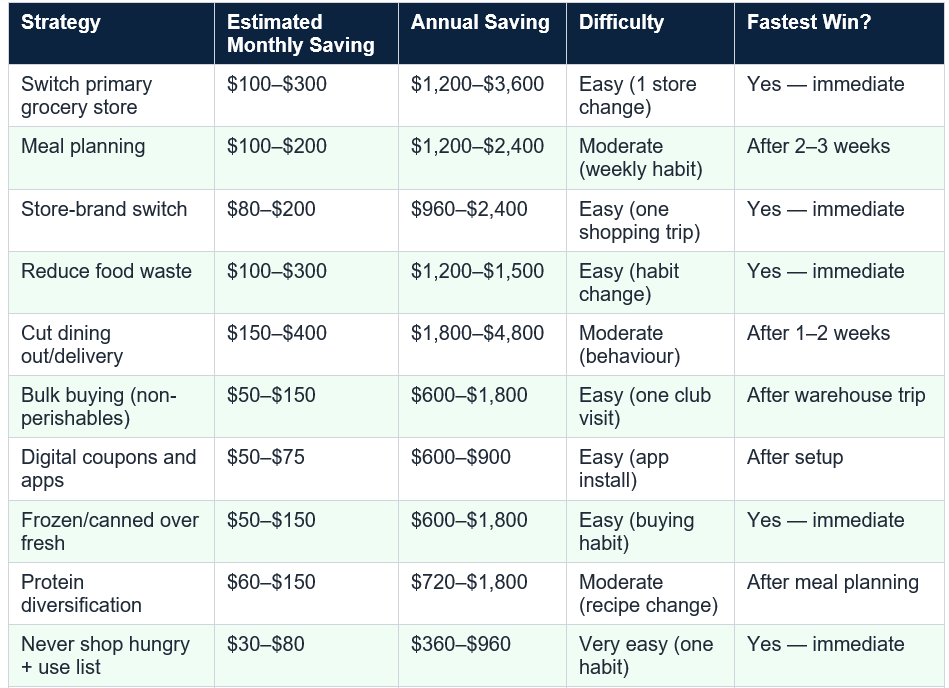
The households that cut their food spending by 20 to 35 percent in 2026 are not those who found a secret discount or moved to a cheaper city. They are those who made a small number of consistent decisions differently: where they shop, what brands they choose, how they plan their meals, what they do with leftovers, and whether they enter a supermarket with a plan or without one. These decisions are available to every household, in every income bracket, starting with the next shopping trip.
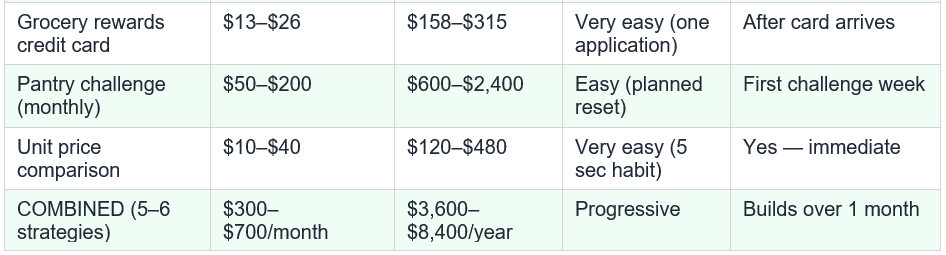
The 12 strategies in this guide, applied consistently across a household over three months, can realistically reduce monthly food spending by $300 to $700 — $3,600 to $8,400 per year. That is real money. And none of it requires eating worse.
The USDA’s Moderate-Cost Food Plan — the most widely cited financial benchmark for middle-income households — suggests approximately $362/month for a single adult, $724/month for a couple, and approximately $1,163/month for a family of four with school-age children (2026 approximate figures; updated monthly at USDA.gov). Wealthvieu’s July 2026 analysis suggests keeping total food spending under 10 to 15 percent of take-home pay. If your food spending significantly exceeds the Liberal Plan for your household size, there is meaningful room to reduce. Verify current USDA figures at ers.usda.gov.
What is the single most effective way to reduce food spending?
According to Wealthvieu’s July 2026 grocery spending analysis, the biggest single lever for most people is switching their primary grocery store — not coupon clipping or budgeting apps. Store-switching alone (to discount formats like Aldi, Lidl, or Walmart) saves more than every other strategy combined for most households. The second highest-impact strategy is consistent meal planning, which reduces food spending by 15 to 25 percent by eliminating impulse purchases and food waste simultaneously.
How much can meal planning save on food spending?
SpendMeNot’s January 2026 grocery statistics guide found that meal planning saves the average family $1,200 per year by reducing impulse buys and food waste. A MealThinker survey of 2,568 meal planners found they reduced food costs by $47 per person per month ($564 per year). PocketClear’s April 2026 guide found that meal planners spend 20 to 25 percent less on groceries than non-planners consistently. The reverse-engineering approach — building meals around what is cheapest this week rather than what sounds good — is the highest-return form of meal planning.
Are store-brand groceries as good as name brands?
For most staple categories, yes. University of Tennessee Extension experts confirmed in January 2026 that generic store brands are often just as high in quality as their name-brand counterparts. A NetCredit April 2026 study of 171 grocery store items found store-brand versions at Walmart, Kroger, or Target can save up to 75% compared to name-brand equivalents. The clearest equivalences are in regulated products like milk, eggs, and pasta. The best approach is to trial store brands category by category and switch permanently where the quality difference is imperceptible.
How much food do Americans waste and how does reducing waste save money?
The EPA estimates that 40 percent of food produced in the US is never consumed. The USDA and GOBankingRates estimate the average American wastes approximately $1,500 worth of food per year. Families throw away 30 to 40 percent of the food they buy. Reducing food waste requires FIFO (First In, First Out) refrigerator organisation, freezing before spoilage, auditing the fridge before shopping, and repurposing leftovers into soup or grain bowls. These behaviours cost nothing and capture savings from food that has already been purchased.
Should I switch to frozen vegetables to save money?
Yes, for cooking applications. Frozen vegetables are typically flash-frozen within hours of harvest at peak nutritional density — often before fresh produce has spent its first day in transit. They are nutritionally comparable to fresh for any cooked application (soups, stir-fries, pasta, curries), significantly cheaper per serving, available year-round at consistent prices, and produce zero food waste because you use only what you need. The categories where this switch is most financially significant in 2026: spinach, broccoli, peas, berries, and mixed vegetables, all of which have remained price-stable while their fresh equivalents have inflated significantly.
Table of Contents
- Why Your Food Bill Keeps Growing
- Know Your Benchmark: What You Should Be Spending
- The Biggest Lever: Switch Your Primary Grocery Store
- Strategy 1: Meal Plan — The Highest-Leverage Starting Point
- Strategy 2: Switch to Store Brands
- Strategy 3: Reduce Food Waste — The Hidden Grocery Bill
- Strategy 4: Cut Dining Out and Delivery Frequency
- Strategy 5: Buy in Bulk for Non-Perishables
- Strategy 6: Use Digital Coupons and Cashback Apps
- Strategy 7: Embrace Frozen and Canned Over Premium Fresh
- Strategy 8: Rethink Protein — Shift Away From Expensive Cuts
- Strategy 9: Never Shop Hungry
- Strategy 10: Use a Grocery Rewards Credit Card
- Strategy 11: Do a Pantry Challenge Before Shopping
- Strategy 12: Compare Unit Prices, Not Sticker Prices
- The Full Savings Summary Table
- Conclusion: The Most Effective Habits Cost Nothing to Start
- Frequently Asked Questions
Monthly Savings By Strategy
USDA Food Plan Benchmark
Why Your Food Bill Keeps Growing
If your food spending feels out of control in 2026, the numbers confirm the feeling. Food costs 19.1 percent more than it did four years ago, according to BLS Consumer Price Index data. The US grocery market exceeded $1.1 trillion in 2025. The average American family of four now spends $475 per week on groceries — approximately $24,700 per year. More than half of Americans say grocery expenses are a major source of stress, according to an AP-NORC survey from July 2025. And food-away-from-home prices rose 3.9 percent in 2025 alone, faster than grocery prices, meaning every restaurant meal and delivery order is costing more than it did a year ago.The good news is specific: food spending is one of the most responsive household expenses to intentional strategy. PocketClear’s April 2026 guide found that most households can cut their food bill by 20 to 35 percent within 30 days without eating worse — they just need to know where the money is actually going first. Wealthvieu’s July 2026 analysis of grocery spending patterns found that most single adults can cut $100 to $200 per month without significantly changing what they eat.
This guide presents 12 specific, evidence-backed strategies for reducing food spending in 2026, in order of their impact. Each is grounded in current research and includes realistic saving estimates. No strategy here requires eating worse. Several require eating better.
The Numbers: Food costs 19.1% more than 4 years ago (BLS CPI, 2026). Average family of four spends $475/week = $24,700/year (SpendMeNot 2026). Food-at-home prices 26–28% above January 2020 (Wealthvieu). More than 50% of Americans say groceries are a major stressor (AP-NORC, July 2025).
Know Your Benchmark: What You Should Be Spending
Before making any changes, establish whether your spending is genuinely high or feels high because prices have risen for everyone. The USDA publishes monthly Food Plans at four budget tiers that serve as the most authoritative US benchmark for food-at-home spending:Source: USDA Food Plans (approximate 2026 monthly figures, updated monthly at USDA.gov). Wealthvieu’s July 2026 analysis adds a practical guideline: keep grocery spending under 10 to 15 percent of take-home pay. If your household takes home $4,000 per month and spends $800 on food, you are at 20 percent — and there is almost certainly meaningful room to reduce. If you are at or below the Moderate Plan benchmark, the strategies below will still help, but the gains will be incremental rather than transformational.
Action: Use the USDA’s free grocery budget calculator at USDA.gov to get a personalised monthly spending benchmark for your exact household size and age composition before comparing strategies. Knowing whether you are above or below the Moderate benchmark tells you how aggressively you need to apply the strategies below.
The Biggest Lever: Switch Your Primary Grocery Store
Before addressing what you buy or how you shop, address where you shop. Wealthvieu’s July 2026 grocery spending analysis makes the most important finding in this entire guide: the biggest single lever for most people is switching stores — not coupon clipping or budgeting apps. Store-switching alone saves more than every other strategy combined.Consumer Reports’ price comparison data, cited by NBC Philadelphia in March 2026, found that Aldi and Target continue to stand out for savings through competitive prices and high-quality store brands. Aldi gained 19 million new shoppers in 2025 as households shifted to discount formats. Aldi prices are typically 8 percent or more below Walmart on a comparable basket; discount grocers are typically 15 to 25 percent below traditional mid-range supermarkets.
Wealthvieu, July 2026: Store-switching alone saves more than every other strategy combined. The biggest single lever for most people is switching stores — not coupon clipping or budgeting apps.
The practical approach: for one month, do a secondary staples run at Aldi, Lidl, or your area’s discount grocer for canned goods, dairy, eggs, frozen vegetables, and store-brand pantry items. Compare the receipt to what you would have paid at your regular supermarket for the same items. For most households, the saving is immediately visible and larger than expected.
Strategy 1: Meal Plan — The Highest-Leverage Starting Point
Meal planning is the most consistently documented high-impact strategy for reducing food spending, and the research in 2026 is specific enough to be compelling. SpendMeNot’s January 2026 grocery statistics guide found that meal planning saves the average family $1,200 per year by reducing impulse buys and food waste. A MealThinker survey of 2,568 meal planners found they reduced food costs by $47 per person per month ($564 per year). PocketClear’s April 2026 guide found that meal planners consistently spend 20 to 25 percent less than non-planners.The most effective form of meal planning in 2026 is the reverse-engineering approach: check what is on sale at your supermarket before deciding what to cook this week, then build meals around the discounted items. Benjamin Lorr, author of The Secret Life of Groceries, told AARP: ‘Reverse-engineering your meals is a great way to save money.’ Supermarket sales often rotate on a weekly cycle, meaning popular proteins, produce, and pantry staples take turns being discounted. Whatever is cheapest this week becomes the anchor of this week’s meals.
The practical implementation: check the store circular before shopping, plan 5 to 7 dinners built around the week’s best deals, write a specific shopping list from those meals, and buy only what is on the list. Family Credit’s June 2026 guide notes that this also covers a key waste-reduction mechanism: every ingredient purchased has a purpose, which dramatically reduces the amount of food that expires unused.
Strategy 2: Switch to Store Brands
Store brands are the most accessible, immediately actionable saving available at any grocery store. CNBC Select’s August 2026 analysis cited a NetCredit study of 171 grocery store items that found buying the store-brand version at Walmart, Kroger, or Target can save up to 75 percent compared to the equivalent name-brand product. SpendMeNot’s January 2026 statistics guide puts the average saving from shopping private-label brands at 25 to 30 percent compared to national brands. A gallon of store-brand whole milk averaged 61 percent in savings at these three stores compared to the name-brand version.The quality argument against store brands has been largely dismantled by evidence. University of Tennessee Extension experts confirmed in January 2026 that generic store brands are often just as high in quality as their name-brand counterparts. Many store-brand products are made by the same manufacturers as the national brands, often in the same facilities, under a different label.
The best categories for store-brand switching with the least quality sacrifice:
- Canned vegetables, beans, and tomatoes: identical nutritional value; the can simply says a different name.
- Pasta, rice, oats, and grains: commodity products regulated to consistent quality standards.
- Dairy — milk, butter, eggs: regulated products where quality is standardised regardless of brand.
- Frozen vegetables and fruit: flash-frozen at peak ripeness; nutritionally equivalent to fresh.
- Cleaning and paper products: while not food, switching these in the same shop frees budget for food.
Strategy 3: Reduce Food Waste — The Hidden Grocery Bill
Food waste is the expense that never appears on a receipt but is embedded in every month’s food total. The EPA estimates that 40 percent of food produced in the United States is never consumed. The USDA and GOBankingRates estimate the average American wastes approximately $1,500 of food per year. Families throw away 30 to 40 percent of the food they buy. This wasted food represents money already spent on items that contributed nothing to any meal.Family Credit’s June 2026 guide describes food waste reduction as ‘essentially free savings, since you’ve already paid for the food.’ The behaviours most consistently cited by households that have successfully reduced waste:
- FIFO in the refrigerator: First In, First Out. Move older items to the front of shelves when new groceries arrive. Older produce, dairy, and leftovers get used before they are forgotten.
- Freeze before the spoil point: bread, meat, cheese, berries, and most cooked meals can be frozen before their use-by date and used later. A loaf of bread two days from staling goes straight to the freezer.
- The weekly fridge audit: before writing the shopping list, check what is already in the refrigerator and plan at least one or two meals around those items. This prevents buying new ingredients when identical ones are aging in the fridge.
- Leftover repurposing: almost any cooked ingredient — roast chicken, cooked grains, vegetables — can be repurposed into soups, stews, fried rice, or grain bowls the following day.
Strategy 4: Cut Dining Out and Delivery Frequency
Restaurant meals and food delivery are among the biggest drivers of high total food spending for American households. Family Credit’s June 2026 guide is explicit: food-away-from-home prices rose 3.9 percent in 2025, faster than grocery prices, meaning every restaurant meal and delivery order costs more than it did a year ago. Cooking at home saves approximately 60 to 75 percent per meal versus dining out or delivery. The delivery fee, service fee, tip, and surge pricing on a single food delivery order routinely add $15 to $25 above the food cost.The effective approach is not to eliminate dining out entirely — it is to make it intentional rather than default. Family Credit’s June 2026 guide recommends designating specific days or occasions for takeout rather than ordering whenever the mood strikes. Treating a restaurant visit as a planned activity rather than a default response to not knowing what to cook is the practical mechanism that most households use to reduce dining-out spending without resenting the reduction.
The specific tactics that work:
- Replace one delivery order per week with a batch-cooked home meal. At an average delivery total of $40 to $60 (food plus fees plus tip), this saves $160 to $240 per month.
- Cook for planned leftovers: making slightly more than needed for dinner ensures tomorrow’s lunch is already cooked. This eliminates the midday restaurant or delivery purchase that often happens when lunch is not planned.
- Keep quick-assembly meals (pasta, eggs, rice and vegetables, grain bowls) available for nights when cooking energy is low. These take 15 to 20 minutes, cost $2 to $4 per serving, and directly replace the ‘just order something’ decision.
Strategy 5: Buy in Bulk for Non-Perishables
Warehouse clubs (Costco, Sam’s Club, BJ’s) deliver consistent per-unit savings of 15 to 20 percent on non-perishable pantry staples, according to SpendMeNot’s January 2026 grocery statistics guide. The critical distinction is between non-perishable staples (where bulk buying is reliably advantageous) and perishable items (where bulk buying only saves money if everything is consumed before spoilage).The best categories for bulk purchasing:
- Rice, pasta, dried beans and lentils, oats, and grains: the staples of any budget-conscious kitchen. Buy 10-pound bags instead of 2-pound bags and store in airtight containers.
- Canned tomatoes, canned fish, and shelf-stable proteins: no spoilage risk; consistent quality; large-format cans reduce cost per serving.
- Paper products, cleaning supplies, and toiletries: while not food, buying these in bulk at warehouse clubs frees money in the monthly food budget for food.
- Proteins for the freezer: buying family-size packs of chicken, ground beef, or pork and portioning into meal-sized bags for the freezer captures the per-unit advantage of bulk buying without spoilage risk.
Strategy 6: Use Digital Coupons and Cashback Apps
The paper coupon clipping era has been replaced by digital tools that are more accessible, more generous, and require less effort than their predecessors. SpendMeNot’s January 2026 grocery statistics guide found that coupons and cashback apps save $600 to $900 per year for active users.- Ibotta: the most widely used grocery cashback app in the US. Submit a receipt photo or link your loyalty card; Ibotta pays cashback on hundreds of qualifying grocery purchases. Users consistently earn $20 to $50 per month in rebates.
- Rakuten: broad cashback on online grocery orders and retailer partnerships. Particularly useful for online grocery ordering and delivery services.
- Store loyalty apps (Kroger, Safeway, Publix, HEB, etc.): virtually every major chain offers a smartphone app with personalised digital coupons based on purchase history. Failing to scan the loyalty card or app consistently is one of the most common ways shoppers forfeit savings they were eligible for.
- Flipp: a digital flyer aggregator that collects weekly circulars from all local supermarkets in one app. Checking Flipp before shopping identifies this week’s best deals across all nearby stores without visiting each chain’s website separately.
Strategy 7: Embrace Frozen and Canned Over Premium Fresh
One of the most persistent and most expensive myths in grocery shopping is that fresh is always nutritionally superior to frozen or canned. For most vegetables and many fruits, nutritional science does not support this: frozen vegetables are typically flash-frozen within hours of harvest at peak nutritional density, often before fresh produce has spent its first day in transit.AARP’s December 2025 guide to stretching food budgets is direct: buying frozen, store-brand, and shelf-stable foods can stretch budgets without sacrificing nutrition. The financial case is equally strong. Fresh lettuce has risen 32.1 percent year-over-year; frozen spinach has remained stable. Fresh tomatoes are up 19.5 percent; canned tomatoes are essentially the same price as two years ago and are the superior choice for any cooked application.
- Frozen spinach, broccoli, peas, and mixed vegetables: nutritionally comparable to fresh for any cooked application; available year-round at consistent prices; zero food waste.
- Canned tomatoes, black beans, chickpeas, and kidney beans: among the most nutritionally dense, most versatile, and most affordable foods available in any supermarket.
- Frozen berries: fresh berries can cost $5 to $7 per punnet; frozen blueberries or mixed berries cost $2 to $3 per pound and are nutritionally equivalent for smoothies, oatmeal, and baking.
Strategy 8: Rethink Protein — Shift Away From Expensive Cuts
Protein is the grocery category where 2026’s inflation is most acutely felt. Beef and veal prices rose 11.8 percent year-over-year; meat overall rose 12.3 percent from September 2024 to September 2025. Cumulatively since 2020, beef is up 41 percent, eggs up 97 percent at peak (though now falling), and cooking oils up 58 percent (Wealthvieu, May 2026).The arithmetic of protein substitution makes the case clearly:
- Eggs: forecast to fall 30.7 percent in 2026 as avian flu-affected flocks recover. A dozen eggs costs $3 to $5 and provides protein for multiple meals. Two eggs deliver approximately 12 grams of complete protein at a cost of 30 to 50 cents.
- Dried lentils and beans: approximately $1.50 to $2.00 per pound, yielding four to six servings. High in protein, fibre, and micronutrients. Half-and-half beans and ground beef in tacos or chilli is indistinguishable in texture and taste from all-beef versions.
- Chicken thighs instead of chicken breasts: 30 to 50 percent cheaper per pound; moister and more flavourful when cooked; same nutritional protein content.
- Canned tuna, sardines, and mackerel: shelf-stable, high in protein and omega-3 fatty acids, significantly cheaper per gram of protein than any fresh fish or beef.
Strategy 9: Never Shop Hungry
Of all the behavioural interventions available to grocery shoppers, this one costs nothing, takes no additional time, and produces immediate results. Family Credit’s June 2026 guide identifies shopping on an empty stomach as one of the most reliable ways to overspend: when hungry, impulse control is lower, nearly everything looks appealing, and the impulse purchase rate increases significantly. Have a snack before leaving home, and you are far more likely to stick to the list.Ramsey Solutions’ updated grocery guide recommends the same approach alongside writing the list at home and committing to it before entering the store. PocketClear’s April 2026 guide identifies not having a list as the single biggest predictor of impulse purchases, alongside entering the store hungry. The combination of a prepared list and a full stomach removes the two most common environmental triggers for unplanned spending.
Action: Keep your shopping list on your phone (not a scrap of paper you can misplace) and take a few minutes before leaving home to check whether there is anything in the fridge or freezer that needs to be used before you buy more. This five-minute check before each shopping trip prevents the pattern of buying new ingredients while identical ones already in the kitchen are aging toward the bin.
Strategy 10: Use a Grocery Rewards Credit Card
A grocery rewards credit card earns cashback on every dollar spent at the supermarket, effectively reducing the total food bill by 3 to 6 percent without changing what you buy, where you shop, or how often you shop. Bankrate’s Ted Rossman noted in a July 2025 analysis that the Amex Blue Cash Preferred earns 6 percent back at US supermarkets on up to $6,000 in annual spending — generating approximately $315 per year in supermarket cashback alone for an average-spending household.- Amex Blue Cash Preferred: 6% cashback at US supermarkets (up to $6,000/year), then 1%. $95 annual fee (after first year). Best for households spending $150+/month at supermarkets.
- Amex Blue Cash Everyday (no annual fee): 3% cashback at US supermarkets with no cap. Generates approximately $158/year for the average household.
- Bank of America Customized Cash Rewards: 3% on the chosen category (including grocery stores), no annual fee; up to 5.25% for Preferred Rewards members.
Strategy 11: Do a Pantry Challenge Before Shopping
A pantry challenge is one of the simplest and most immediately effective food spending reduction exercises available: before doing a regular grocery shop, spend one to two weeks cooking only from what is already in the refrigerator, freezer, and pantry, supplemented only by fresh produce and essential staples that run out. Ramsey Solutions’ August 2026 grocery guide recommends this as a reset exercise for households whose food spending has drifted upward without any deliberate decision to spend more.The pantry challenge works on multiple levels simultaneously. It eliminates the grocery bill for the challenge period (or reduces it to produce-only purchasing). It surfaces what is actually in the kitchen — including items that have been forgotten and might otherwise be discarded. It prevents the pattern of buying new ingredients while perfectly good food is already available. And it resets cooking habits toward using what is available rather than shopping for what sounds good in the abstract.
Action: Before your next shopping trip, open every cupboard, fridge shelf, and freezer drawer and list what you have. Then plan three to five meals that use those ingredients before buying anything new. You will almost certainly find enough food for several meals — and you will almost certainly find items you forgot were there, on their way to becoming food waste.
Strategy 12: Compare Unit Prices, Not Sticker Prices
The sticker price of a grocery item — $3.49 or $5.99 — is nearly meaningless without knowing the quantity it represents. The unit price (per ounce, per pound, per serving) printed in small type on the shelf label is the only comparison that tells you which product is actually cheaper. Yahoo Finance’s April 2026 grocery savings guide is explicit on this: when comparison shopping, do not evaluate the sticker price alone. Consider the cost per unit to find out which product is actually the most affordable.This principle is particularly important in the context of shrinkflation — the practice of reducing package size while maintaining the retail price. BECU’s April 2026 analysis identified this as an increasingly common practice: some manufacturers are shrinking package sizes while charging the same. The unit price catches shrinkflation immediately: the unit price rises even though the sticker price is unchanged. A household that checks unit prices consistently will catch shrinkflation on every product it has been affected by.
Action: On your next shopping trip, check the unit price for every product you put in the basket where you are choosing between two sizes or two brands. You will almost always find at least two or three products where the unit price reveals that the apparently cheaper option is actually more expensive per ounce or per serving than the alternative. These discoveries become habitual once the check is performed consistently.
The Full Savings Summary Table
Conclusion
Food costs 19.1 percent more than four years ago. The strategies that counter those increases cost nothing to start. Meal planning requires a pen and paper. Store-brand switching requires picking a different item from the same shelf. Never shopping hungry requires eating a snack before leaving home. Checking the unit price takes five seconds per product. The pantry challenge uses food that has already been purchased.The households that cut their food spending by 20 to 35 percent in 2026 are not those who found a secret discount or moved to a cheaper city. They are those who made a small number of consistent decisions differently: where they shop, what brands they choose, how they plan their meals, what they do with leftovers, and whether they enter a supermarket with a plan or without one. These decisions are available to every household, in every income bracket, starting with the next shopping trip.
The 12 strategies in this guide, applied consistently across a household over three months, can realistically reduce monthly food spending by $300 to $700 — $3,600 to $8,400 per year. That is real money. And none of it requires eating worse.
Frequently Asked Questions
How much should I be spending on food each month?The USDA’s Moderate-Cost Food Plan — the most widely cited financial benchmark for middle-income households — suggests approximately $362/month for a single adult, $724/month for a couple, and approximately $1,163/month for a family of four with school-age children (2026 approximate figures; updated monthly at USDA.gov). Wealthvieu’s July 2026 analysis suggests keeping total food spending under 10 to 15 percent of take-home pay. If your food spending significantly exceeds the Liberal Plan for your household size, there is meaningful room to reduce. Verify current USDA figures at ers.usda.gov.
What is the single most effective way to reduce food spending?
According to Wealthvieu’s July 2026 grocery spending analysis, the biggest single lever for most people is switching their primary grocery store — not coupon clipping or budgeting apps. Store-switching alone (to discount formats like Aldi, Lidl, or Walmart) saves more than every other strategy combined for most households. The second highest-impact strategy is consistent meal planning, which reduces food spending by 15 to 25 percent by eliminating impulse purchases and food waste simultaneously.
How much can meal planning save on food spending?
SpendMeNot’s January 2026 grocery statistics guide found that meal planning saves the average family $1,200 per year by reducing impulse buys and food waste. A MealThinker survey of 2,568 meal planners found they reduced food costs by $47 per person per month ($564 per year). PocketClear’s April 2026 guide found that meal planners spend 20 to 25 percent less on groceries than non-planners consistently. The reverse-engineering approach — building meals around what is cheapest this week rather than what sounds good — is the highest-return form of meal planning.
Are store-brand groceries as good as name brands?
For most staple categories, yes. University of Tennessee Extension experts confirmed in January 2026 that generic store brands are often just as high in quality as their name-brand counterparts. A NetCredit April 2026 study of 171 grocery store items found store-brand versions at Walmart, Kroger, or Target can save up to 75% compared to name-brand equivalents. The clearest equivalences are in regulated products like milk, eggs, and pasta. The best approach is to trial store brands category by category and switch permanently where the quality difference is imperceptible.
How much food do Americans waste and how does reducing waste save money?
The EPA estimates that 40 percent of food produced in the US is never consumed. The USDA and GOBankingRates estimate the average American wastes approximately $1,500 worth of food per year. Families throw away 30 to 40 percent of the food they buy. Reducing food waste requires FIFO (First In, First Out) refrigerator organisation, freezing before spoilage, auditing the fridge before shopping, and repurposing leftovers into soup or grain bowls. These behaviours cost nothing and capture savings from food that has already been purchased.
Should I switch to frozen vegetables to save money?
Yes, for cooking applications. Frozen vegetables are typically flash-frozen within hours of harvest at peak nutritional density — often before fresh produce has spent its first day in transit. They are nutritionally comparable to fresh for any cooked application (soups, stir-fries, pasta, curries), significantly cheaper per serving, available year-round at consistent prices, and produce zero food waste because you use only what you need. The categories where this switch is most financially significant in 2026: spinach, broccoli, peas, berries, and mixed vegetables, all of which have remained price-stable while their fresh equivalents have inflated significantly.
0 Comments
Be the first to share your thoughts on this article.