
Spending
Will Self-Checkout Become a US Legislative Issue?

BREAKING LEGISLATIVE UPDATE | Rhode Island signed the first US statewide self-checkout law on June 18, 2026. Effective January 1, 2027. 7 states have active proposals. Albany, NY law in effect since September 2025. California cities enforcing local rules. 27% of shoppers admit deliberate theft at self-checkout. Self-checkout causes 16x more shrink than cashier lanes.
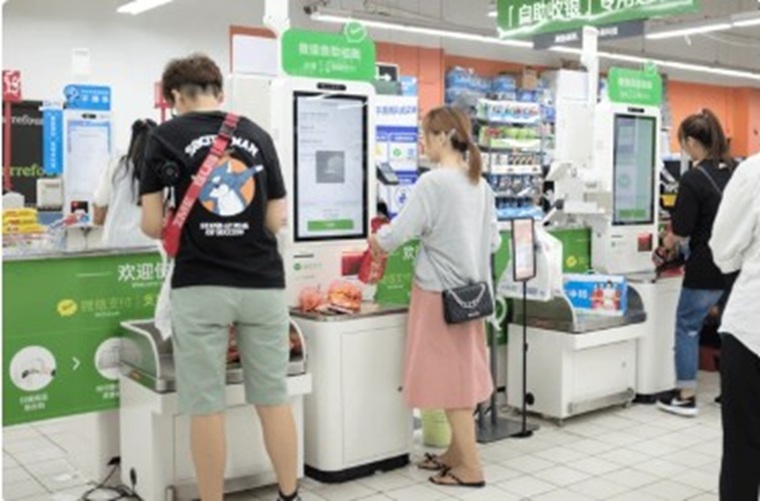
The win-win has not materialised. Rolling Out (May 4, 2026): 'What retailers marketed as a faster, frictionless shopping experience has, in practice, transferred labor costs onto consumers, created surveillance gaps that invite theft, and ignited a political backlash that is now reshaping how states regulate the checkout floor.' The backlash is no longer just consumer frustration about price-check errors and unexpected item alerts in the bagging area. It is now statute. Rhode Island became the first US state to sign a statewide self-checkout restriction law on June 18, 2026. Albany, New York has had a binding local ordinance in effect since September 21, 2025. California cities Long Beach and Costa Mesa have enforced local rules since August 2025 and February 2026 respectively. And according to Forbes (published July 27, 2026 -- one week ago): seven states have active legislative proposals, spanning both political parties, from blue California and Connecticut to red Ohio.
This guide provides the complete 2026 picture: the data driving the legislation, the state-by-state tracker of every active bill and ordinance, the arguments on each side of the debate, and the question of whether self-checkout regulation is heading toward a nationwide moment -- or whether it will remain a patchwork of local responses to a national problem.
The theft data is the legislative foundation. California's SB 442 bill text -- citing peer-reviewed industry research -- states that self-checkout machines cause 16 times more shrink than cashier-staffed lanes, with a shrink rate of 3.5% compared to 0.21% for traditional checkout. In 2022, self-checkout accounted for under 30% of transactions but generated more than $10 billion in annual retail losses. A 2026 Capital One study placed the premium at 65% -- theft rates at self-checkout stations run 65% higher than at traditional checkout. These numbers, cited directly in bill text and committee testimony across multiple states, shifted the political argument from abstract labor concerns to concrete financial loss.
Rolling Out (May 4, 2026) identifies the deeper dynamic: 'A December 2025 survey by LendingTree found that 69% of self-checkout users believe the technology makes theft easier. Matt Schulz, LendingTree's chief consumer finance analyst, noted that the largely unsupervised nature of self-checkout creates opportunity -- and that financial pressure is pushing more shoppers to take advantage of it.' When 69% of consumers believe the technology enables theft and 27% admit to exploiting that belief, the political conditions for regulation have clearly arrived.
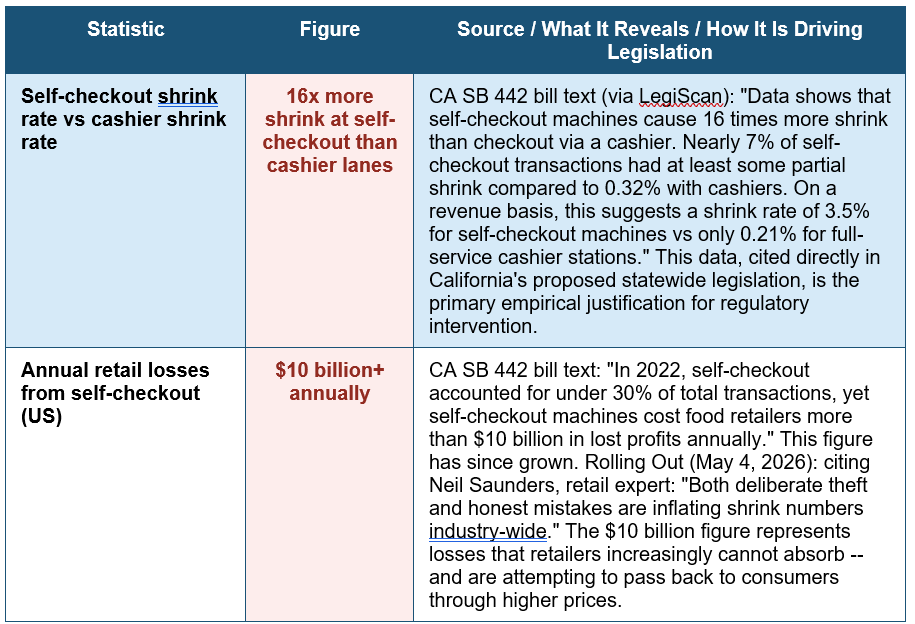
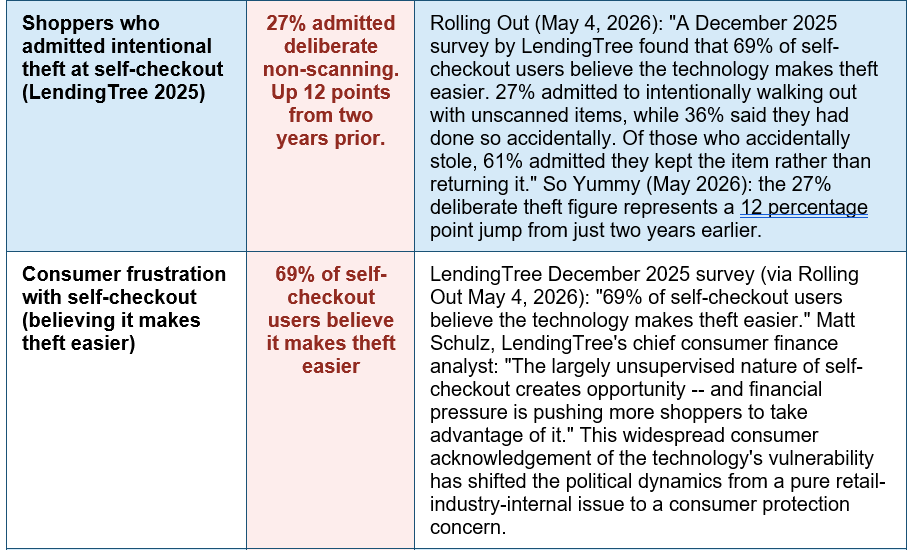
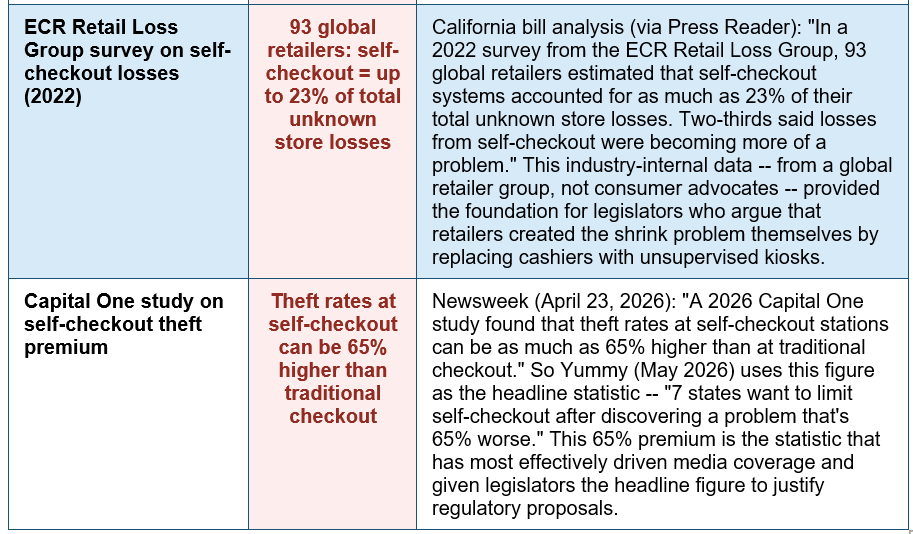
Self-checkout in 2026 -- the defining numbers: 16x more shrink vs cashier. 27% admit deliberate theft (up 12pts in 2 years). 65% higher theft rate. $10B+ annual losses. 1 state law signed. 7 states with active proposals. — CA SB 442 bill text: 'Self-checkout causes 16x more shrink than cashier lanes; 3.5% vs 0.21% shrink rate.' Rolling Out (May 4, 2026): 'LendingTree Dec 2025: 27% admitted intentional theft, up 12 points.' Newsweek (April 23, 2026): '2026 Capital One study: 65% higher theft rate at self-checkout.' CA SB 442: '$10 billion+ in annual retail losses from self-checkout.' Hunton Retail Law (June 15, 2026): 'Rhode Island signed statewide law June 18, 2026.' Forbes (July 27, 2026 -- 1 week ago): '7 states with active proposals spanning both parties.'
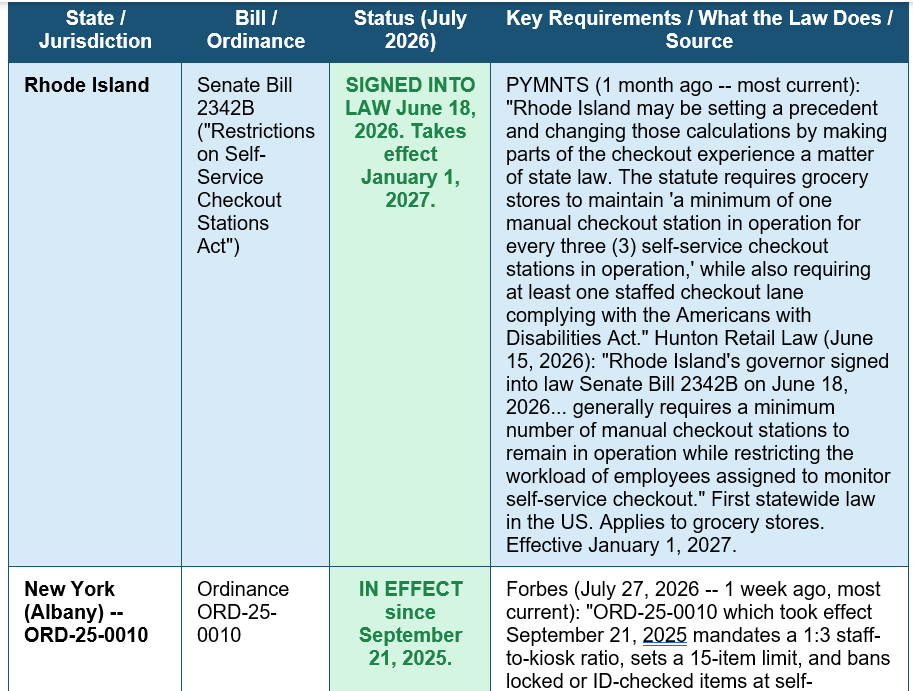
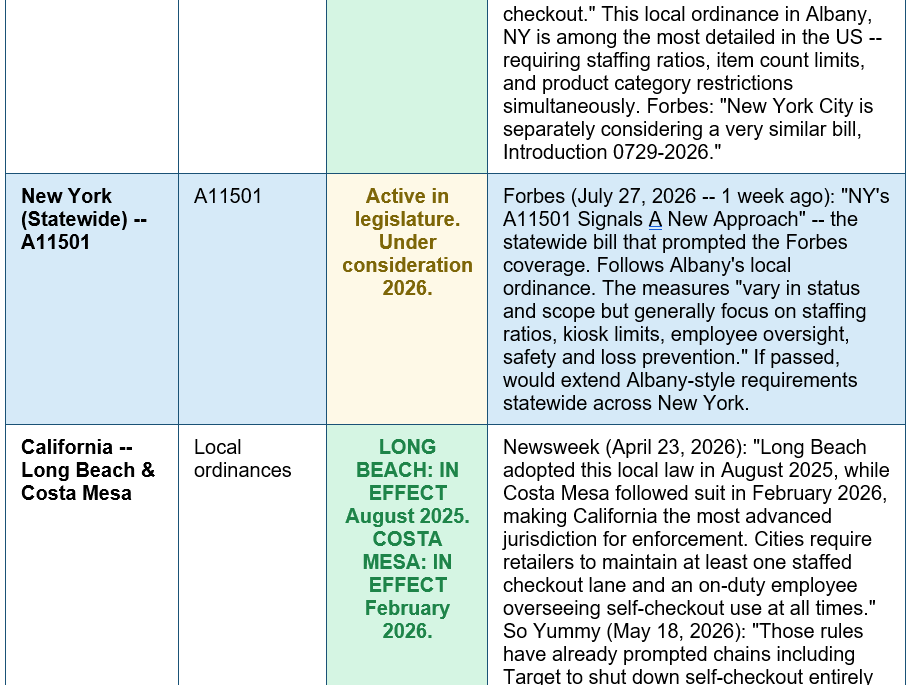
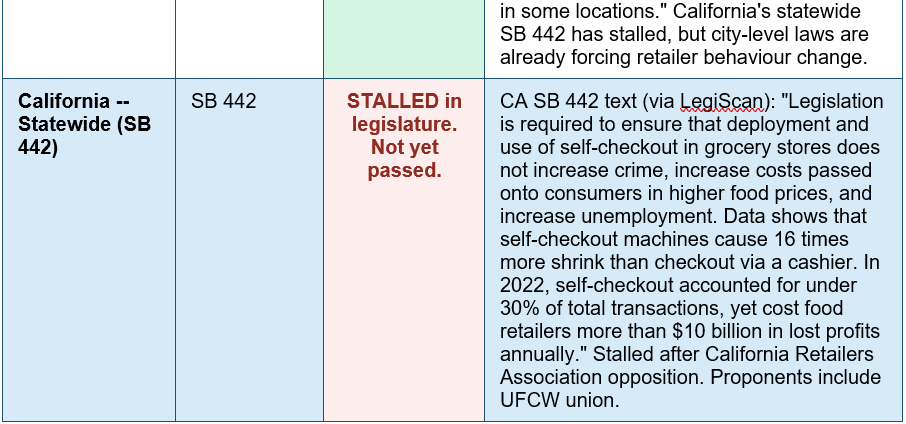
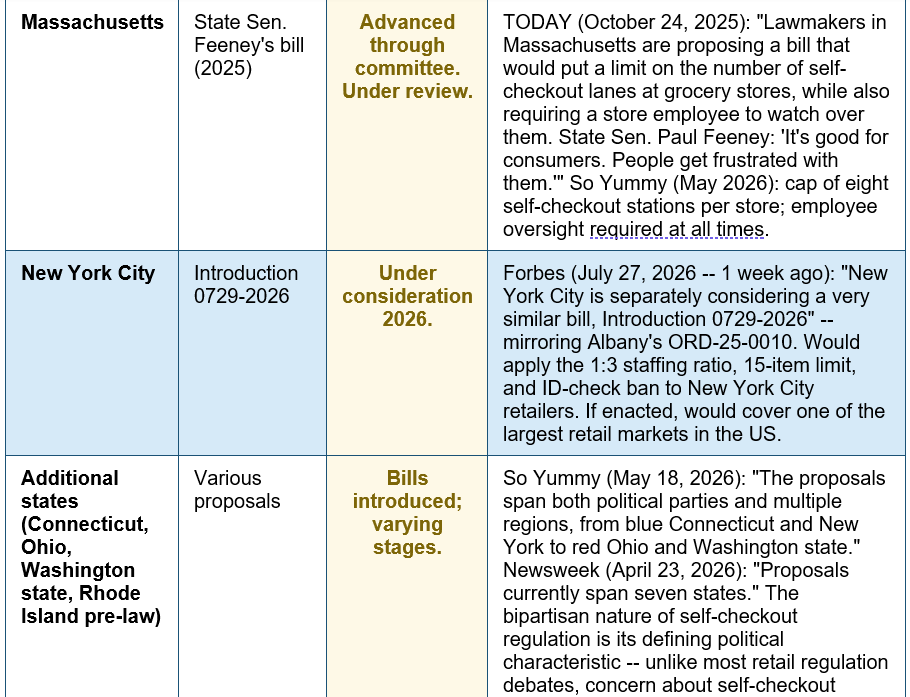

PYMNTS (published approximately one month ago -- most current detailed analysis): 'The statute requires grocery stores to maintain 'a minimum of one manual checkout station in operation for every three (3) self-service checkout stations in operation,' while also requiring at least one staffed checkout lane that complies with the Americans with Disabilities Act.' Hunton Retail Law (June 15, 2026): the law 'generally requires a minimum number of manual checkout stations to remain in operation while restricting the workload of employees assigned to monitor self-service checkout.'
The law's importance extends beyond Rhode Island's borders. PYMNTS: 'Rhode Island may be setting a precedent and changing those calculations by making parts of the checkout experience a matter of state law. If that trend spreads, retailers may redirect technology spending toward shrink prevention, employee support and store operations while adding labor back to the front end. Retailers have treated self-checkout as an operational decision shaped by labor costs, consumer preferences and technology. Rhode Island may be setting a precedent and changing those calculations.' The precedent effect is the key word. Before June 18, 2026, every US self-checkout restriction was either a local ordinance or a proposal that had not cleared the legislative process. Rhode Island's law provides the legal template, the political justification, and the proof of concept for other states to follow. The question is no longer whether statewide self-checkout regulation is constitutionally and politically viable -- Rhode Island has answered that. The question is how many states will follow, and how quickly.
Walmart has reduced self-checkout availability in stores that experienced the highest rates of shrink-related losses. Target has shut down self-checkout entirely in some California locations after the Long Beach and Costa Mesa ordinances took effect -- the compliance cost apparently exceeding the operational benefit. Dollar General -- which had expanded to self-checkout-only configurations in some stores -- reversed course following significant theft-related losses. Kroger has announced limits on self-checkout in several markets.
Rolling Out: 'What retailers marketed as a faster, frictionless shopping experience has, in practice, transferred labor costs onto consumers, created surveillance gaps that invite theft, and ignited a political backlash that is now reshaping how states regulate the checkout floor. Whether Walmart's course correction signals a lasting rethink of automation -- or merely a tactical response to a particularly bad stretch of shrink data -- remains to be seen.' The dual pressure of legislative action and internal financial analysis is producing a similar outcome: more cashier staffing, fewer unmonitored kiosks, and higher item-count restrictions on self-checkout lanes.
The bipartisan coalition: why self-checkout regulation defies the usual political fault lines. Forbes (July 27, 2026 -- 1 week ago): 'The measures vary in status and scope but generally focus on staffing ratios, kiosk limits, employee oversight, safety and loss prevention.' So Yummy (May 2026): 'What makes this moment different from previous retail theft debates is the breadth of states involved. The proposals span both political parties and multiple regions, from blue Connecticut and New York to red Ohio and Washington state.' Self-checkout regulation has found legislative sponsors on both sides of the aisle for distinct reasons. Democrat-aligned legislators emphasise the labor displacement argument -- grocery workers losing jobs to kiosks. Republican-aligned legislators emphasise the theft and public safety argument -- unsupervised technology that facilitates crime and passes the cost to consumers through higher food prices. Both arguments find the same solution: more staffing, more oversight, more regulation of the technology. The convergence of these two arguments from different political directions is why the legislative momentum is accelerating, and why the dismissal of self-checkout regulation as a purely left-wing labor agenda is politically inaccurate. The same outcome -- restrict unmonitored self-checkout -- is being pursued by legislators who typically agree on little else.
WHAT RETAILERS AND CONSUMERS SHOULD WATCH IN THE SECOND HALF OF 2026: (1) NEW YORK CITY INTRODUCTION 0729-2026. Forbes (July 27, 2026 -- 1 week ago): NYC is considering a bill mirroring Albany's ORD-25-0010 (which already mandates 1:3 staffing ratio, 15-item limit, and bans locked/ID-checked items at self-checkout). If NYC passes this, it covers the largest retail market in the US and will immediately force national chains to reconfigure checkout operations in their highest-volume stores. (2) RHODE ISLAND IMPLEMENTATION -- JANUARY 1, 2027. The Restrictions on Self-Service Checkout Stations Act takes effect in five months. Grocery chains operating in Rhode Island must implement 1:3 ratios (one manual lane per three self-checkout stations) and ADA-compliant staffed lanes. How retailers respond will be closely watched by every other state with pending legislation. (3) NEW YORK STATE A11501. Forbes: NY's statewide bill signals a legislative approach that could extend Albany-style rules to all 62 counties in New York state. If passed, this would be the second statewide law after Rhode Island. (4) CALIFORNIA'S STATEWIDE SB 442 REVIVAL. The bill stalled but the issue has not gone away. Two California cities have already passed binding local rules and the union pressure is sustained. A revised bill or ballot initiative remains possible. (5) THE 2026 RETAIL EARNINGS SEASON SHRINK DATA. How major chains report shrink in their Q2 and Q3 2026 earnings will either accelerate or slow legislative momentum. If shrink data shows improvement from voluntary retailer changes, the legislative urgency diminishes. If it worsens, expect more bills.
FOR RETAILERS AND BUSINESSES: HOW TO PREPARE FOR POTENTIAL SELF-CHECKOUT REGULATION: IMMEDIATE ACTIONS: (1) Audit your current self-checkout to cashier lane ratio across all locations in states with active legislation (California, Massachusetts, New York, Connecticut, Ohio, Washington, Rhode Island). (2) Assess compliance cost for the Rhode Island 1:3 ratio model -- this is the enacted standard other states are likely to reference. PYMNTS: "If that trend spreads, retailers may redirect technology spending toward shrink prevention, employee support and store operations." (3) Review item count restrictions -- Albany, NY mandates a 15-item limit. Massachusetts proposed eight machines per store. Understand how these would affect your busiest store configurations. (4) Assess prohibited product categories -- Albany bans locked or ID-checked items at self-checkout. Products currently displayed with security tags or requiring age verification may need to be channelled to staffed lanes even ahead of any legislation. (5) Invest in AI-powered shrink prevention as a compliance alternative. Forbes (July 27, 2026): increased legislation is raising concerns for retailers "leading some to rethink their national strategies." Technology investment in loss prevention may be more cost-effective than full staffing compliance with rigid ratio requirements. FOR CONSUMERS: (6) Understand that self-checkout restrictions, where enacted, are consumer protection measures -- reducing the unpaid labor burden on shoppers and the pricing impact of theft-related losses passed through in food prices. CA SB 442 text: "Legislation is required to ensure deployment does not increase costs passed onto consumers in higher food prices."
Rolling Out (May 4, 2026): 'The self-checkout pullback is a cautionary tale about the limits of automating human interaction. What retailers marketed as a faster, frictionless shopping experience has transferred labor costs onto consumers, created surveillance gaps that invite theft, and ignited a political backlash that is now reshaping how states regulate the checkout floor.' Forbes (July 27, 2026 -- one week ago): 'This increased legislation is raising concerns for retailers, leading some to rethink their national strategies.'
The specific trajectory -- a national federal law, a patchwork of state laws, or a voluntary industry retreat that makes legislation unnecessary -- is not yet determined. But the political conditions for national-level action are present in a way they were not two years ago. A bipartisan coalition of legislators, a growing body of data, consumer frustration that crosses demographic and political lines, and now a Rhode Island statute providing the legal template make self-checkout regulation a permanent feature of the US retail policy landscape. The question is no longer whether. It is how far, how fast, and how the industry responds before legislators write the answer for them.
Yes -- and it is a recent development. Rhode Island became the first US state to enact a statewide self-checkout restriction law when its governor signed Senate Bill 2342B on June 18, 2026. Hunton Retail Law (June 15, 2026 editorial note): 'Rhode Island's governor signed into law Senate Bill 2342B on June 18, 2026. This new law applies to grocery stores in the state that offer shoppers the use of self-service checkout stations and generally requires a minimum number of manual checkout stations to remain in operation while restricting the workload of employees assigned to monitor self-service checkout. The law takes effect on January 1, 2027.' PYMNTS (one month ago -- most current detailed analysis): the statute requires grocery stores to maintain 'a minimum of one manual checkout station in operation for every three (3) self-service checkout stations in operation,' while also requiring at least one ADA-compliant staffed checkout lane. Before Rhode Island, the only binding laws were local ordinances: Albany, New York's ORD-25-0010 took effect September 21, 2025, and California cities Long Beach (August 2025) and Costa Mesa (February 2026) have enforced local rules. Rhode Island's law is the first that applies across an entire state.
What is driving states to regulate self-checkout in 2026?
Three factors are converging to drive legislative action. First, the theft data has become undeniable and quantified. California's SB 442 bill text cites data showing self-checkout machines cause 16 times more shrink than cashier lanes, with a 3.5% shrink rate versus 0.21% at cashier stations. A 2026 Capital One study found theft rates at self-checkout 65% higher than traditional checkout. In 2022, self-checkout accounted for under 30% of transactions but generated more than $10 billion in annual losses. Second, consumer surveys have shifted the issue from retail-internal to publicly political. LendingTree's December 2025 survey found 27% of self-checkout users admitted deliberate theft (up 12 percentage points from two years prior) and 69% believe the technology makes theft easier. Rolling Out (May 4, 2026): 'Financial pressure is pushing more shoppers to take advantage of it.' When consumers broadly acknowledge the technology's vulnerability and significant numbers admit exploiting it, legislators have both the data and the constituent mandate to act. Third, the labor displacement argument has found political expression. The UFCW union's advocacy, combined with legislative sponsors who explicitly frame the issue as job protection for grocery workers, has built the coalition necessary for bills to advance through committee. So Yummy (May 2026): 'The proposals span both political parties and multiple regions' -- the bipartisan nature of the concern is what gives the legislative momentum its durability.
What do these self-checkout laws actually require retailers to do?
The enacted and proposed laws share a consistent set of requirements, though the specific numbers vary by jurisdiction. The most common requirements: staffing ratios (the most common formulation, enacted in Rhode Island and Albany NY, requires one staffed manual checkout lane for every three self-checkout kiosks); item count limits (Albany mandates a 15-item maximum at self-checkout; Massachusetts proposed eight machines per store; California cities require at least one staffed lane to be available at all times); employee oversight (most bills require a dedicated employee to monitor self-checkout operations and be relieved of all other duties while doing so); product category restrictions (Albany bans locked or ID-checked items at self-checkout, meaning products with security tags or requiring age verification must be channelled to staffed lanes); ADA accessibility (Rhode Island specifically requires at least one staffed checkout lane compliant with the Americans with Disabilities Act). Forbes (July 27, 2026 -- 1 week ago): 'The measures vary in status and scope but generally focus on staffing ratios, kiosk limits, employee oversight, safety and loss prevention.' California's stalled SB 442 contained the most comprehensive requirements -- including mandatory worker and consumer impact assessments before any new checkout technology deployment -- but it has not been enacted.
Are retailers voluntarily pulling back from self-checkout?
Yes -- several major chains began reducing self-checkout availability independent of legislative pressure, though the two trends are now reinforcing each other. Rolling Out (May 4, 2026): 'Walmart joins a growing revolt against self-checkout.' Walmart reduced self-checkout availability in high-shrink stores. Target shut down self-checkout entirely in some California locations following the Long Beach and Costa Mesa ordinances -- apparently concluding that compliance with local rules made self-checkout operationally unviable in those specific markets. Dollar General reversed a strategy that had included self-checkout-only store configurations after significant theft-related losses. Kroger announced checkout limitations in several markets. Rolling Out: 'Whether Walmart's course correction signals a lasting rethink of automation -- or merely a tactical response to a particularly bad stretch of shrink data -- remains to be seen.' Retail expert Neil Saunders told Rolling Out that 'forcing more customers through manned checkouts resolves many of these problems while also saving retailers money' -- meaning the voluntary retreat may be financially rational independent of any regulatory compulsion. The California Retailers Association, which opposes legislation, uses this voluntary retreat as evidence that market forces are correcting the problem without government intervention. The counter-argument: voluntary retreats are reversible when financial conditions change, while legislation is not.
Could there be a federal law restricting self-checkout?
As of July 2026, there is no active federal legislation addressing self-checkout. The regulatory activity has been entirely at state and local level. Forbes (July 27, 2026 -- one week ago) covers the legislative landscape without referencing any federal proposals. The political conditions for federal legislation would require either a major national retail crisis attributable to self-checkout, or sufficient state-level momentum that Congress responds to constituent pressure from multiple directions simultaneously. Neither condition currently appears imminent. The more likely near-term trajectory is continued state-by-state adoption of rules based on Rhode Island's template. Hunton Retail Law (June 15, 2026): the article tracking state bills 'should watch closely' was written before Rhode Island's law passed -- the pace of adoption is accelerating. However, federal preemption of state technology regulation would be a significant and contested legislative step. The industry would likely challenge any federal mandate as an unprecedented interference with operational decisions. The labor movement would likely support it as a national floor for worker protection. The political outcome of this conflict is genuinely uncertain, but federal action within 2026 or 2027 appears unlikely given the current congressional environment. The more immediate risk for national retailers is the emergence of a patchwork of state and local laws with inconsistent requirements -- as Forbes (July 27, 2026) notes is already raising concerns about national retail strategy decisions.
Table of Contents
- From Frictionless Shopping to Friction With the Law
- Why Now? The Data That Gave Legislators Political Cover
- State-by-State Legislative Tracker: Where the Law Stands in July 2026
- The Arguments: What Each Side Is Saying
- Rhode Island's Law: America's First Statewide Self-Checkout Statute
- Retailers Are Already Pulling Back -- Even Without Legislative Pressure
- What Comes Next: Will This Go Nationwide?
- Conclusion: A National Moment Has Arrived, Even If Federal Law Has Not
- Frequently Asked Questions (FAQ)
- Has any US state actually passed a law restricting self-checkout?
- What is driving states to regulate self-checkout in 2026?
- What do these self-checkout laws actually require retailers to do?
- Are retailers voluntarily pulling back from self-checkout?
- Could there be a federal law restricting self-checkout?
- External References & Further Reading
From Frictionless Shopping to Friction With the Law
When retailers began deploying self-checkout machines in earnest through the 2000s and 2010s, the pitch was straightforward: faster for customers, cheaper for stores. Skip the line, scan your own items, pay and leave. The technology promised a win-win -- consumer convenience and operational efficiency through reduced cashier headcount. By 2022, self-checkout accounted for roughly 30% of all retail transactions. By 2024, major chains were tripling down: Walmart, Target, Kroger, and Dollar General all expanded their self-checkout footprints aggressively.The win-win has not materialised. Rolling Out (May 4, 2026): 'What retailers marketed as a faster, frictionless shopping experience has, in practice, transferred labor costs onto consumers, created surveillance gaps that invite theft, and ignited a political backlash that is now reshaping how states regulate the checkout floor.' The backlash is no longer just consumer frustration about price-check errors and unexpected item alerts in the bagging area. It is now statute. Rhode Island became the first US state to sign a statewide self-checkout restriction law on June 18, 2026. Albany, New York has had a binding local ordinance in effect since September 21, 2025. California cities Long Beach and Costa Mesa have enforced local rules since August 2025 and February 2026 respectively. And according to Forbes (published July 27, 2026 -- one week ago): seven states have active legislative proposals, spanning both political parties, from blue California and Connecticut to red Ohio.
This guide provides the complete 2026 picture: the data driving the legislation, the state-by-state tracker of every active bill and ordinance, the arguments on each side of the debate, and the question of whether self-checkout regulation is heading toward a nationwide moment -- or whether it will remain a patchwork of local responses to a national problem.
Why Now? The Data That Gave Legislators Political Cover
Self-checkout has been controversial since its introduction. What changed in 2024-2026 was the arrival of data specific enough and alarming enough to convert consumer frustration into legislative proposals. So Yummy (May 18, 2026): 'The push did not come out of nowhere. A 2025 LendingTree survey found that 27% of self-checkout users had deliberately walked out without scanning an item, a jump of 12 percentage points from just two years earlier. Shoppers cited rising grocery prices and unaffordable essentials as their primary reasons. That trend, combined with hard data on theft rates, gave lawmakers exactly the political cover they needed to act.'The theft data is the legislative foundation. California's SB 442 bill text -- citing peer-reviewed industry research -- states that self-checkout machines cause 16 times more shrink than cashier-staffed lanes, with a shrink rate of 3.5% compared to 0.21% for traditional checkout. In 2022, self-checkout accounted for under 30% of transactions but generated more than $10 billion in annual retail losses. A 2026 Capital One study placed the premium at 65% -- theft rates at self-checkout stations run 65% higher than at traditional checkout. These numbers, cited directly in bill text and committee testimony across multiple states, shifted the political argument from abstract labor concerns to concrete financial loss.
Rolling Out (May 4, 2026) identifies the deeper dynamic: 'A December 2025 survey by LendingTree found that 69% of self-checkout users believe the technology makes theft easier. Matt Schulz, LendingTree's chief consumer finance analyst, noted that the largely unsupervised nature of self-checkout creates opportunity -- and that financial pressure is pushing more shoppers to take advantage of it.' When 69% of consumers believe the technology enables theft and 27% admit to exploiting that belief, the political conditions for regulation have clearly arrived.
Self-checkout in 2026 -- the defining numbers: 16x more shrink vs cashier. 27% admit deliberate theft (up 12pts in 2 years). 65% higher theft rate. $10B+ annual losses. 1 state law signed. 7 states with active proposals. — CA SB 442 bill text: 'Self-checkout causes 16x more shrink than cashier lanes; 3.5% vs 0.21% shrink rate.' Rolling Out (May 4, 2026): 'LendingTree Dec 2025: 27% admitted intentional theft, up 12 points.' Newsweek (April 23, 2026): '2026 Capital One study: 65% higher theft rate at self-checkout.' CA SB 442: '$10 billion+ in annual retail losses from self-checkout.' Hunton Retail Law (June 15, 2026): 'Rhode Island signed statewide law June 18, 2026.' Forbes (July 27, 2026 -- 1 week ago): '7 states with active proposals spanning both parties.'
State-by-State Legislative Tracker: Where the Law Stands in July 2026
The following table tracks every active piece of self-checkout legislation in the United States as of 31 July 2026, with current status and key requirements:
The Arguments: What Each Side Is Saying
FOR REGULATION THE CASE FOR LEGISLATIVE INTERVENTION | Labor, theft, and consumer protection arguments
The case for regulation rests on three pillars that have proven sufficiently compelling to move legislation in at least seven states. First, the labor argument: California's SB 442 bill text makes the case explicitly: 'The elimination of workers' jobs due to self-checkout is especially harmful. The reduction in frontline checkers has caused a crisis with chronic understaffing and an overworked workforce.' The UFCW (United Food and Commercial Workers) union -- which represents grocery workers -- has been the most consistent advocate for restrictions, arguing that self-checkout represents a transfer of labor from paid workers to unpaid customers. Second, the theft data: as documented above, the shrink rates at self-checkout stations are 16 times those at cashier lanes. This is not merely a consumer advocacy argument -- it is a financial analysis that resonates even with retailers who oppose the regulation, because it acknowledges that they created the problem by replacing supervised cashiers with unsupervised kiosks. Rolling Out (May 4, 2026): retail expert Neil Saunders concludes that 'forcing more customers through manned checkouts resolves many of these problems while also saving retailers money.' Third, the consumer experience argument: Massachusetts State Sen. Paul Feeney, interviewed on TODAY (October 24, 2025): 'It's good for consumers. People get frustrated with them.' Consumer surveys consistently show dissatisfaction with self-checkout experiences: machine errors, unexpected item alerts, limited assistance, and the sense of performing unpaid labor for corporations reducing staffing costs. Forbes (July 27, 2026): 'This increased legislation is raising concerns for retailers, leading some to rethink their national strategies.'AGAINST REGULATION THE CASE FOR RETAIL AUTONOMY | Industry opposition and consumer choice arguments
The opposition to self-checkout regulation is led primarily by retailer trade associations, who argue that government mandates on checkout technology set a precedent for technology regulation that could restrict any operational automation. Margaret Gladstein, speaking for the California Retailers Association at an April hearing: 'These measures will only serve to frustrate consumers with no evidence that they will reduce theft or provide additional protection to employees.' The California Retailers Association argues that retailers are already rethinking self-checkout deployment -- as evidenced by Walmart, Target, and Dollar General all pulling back in various markets -- and that market forces, not legislation, are the appropriate correction mechanism. Forbes (July 27, 2026): 'This increased legislation is raising concerns for retailers, leading some to rethink their national strategies. Bed Bath & Beyond Executive Chairman and CEO Marcus Lemonis has been vocal about challenges operating in California, citing their regulations.' The business community also points to the risk of unintended consequences: if staffing ratio mandates and item count caps make self-checkout economically unviable, retailers may respond by reducing store hours, closing locations in lower-margin markets, or accelerating other forms of automation. A number of organisations are instead pushing for harsher criminal penalties for those caught stealing -- arguing that enforcement, not technology restrictions, is the appropriate legislative response to retail theft. California has a parallel ballot initiative that would increase criminal penalties for repeat shoplifters.Rhode Island's Law: America's First Statewide Self-Checkout Statute
Rhode Island's Restrictions on Self-Service Checkout Stations Act, signed June 18, 2026, and effective January 1, 2027, is the most significant development in US self-checkout regulation to date. It is the first law -- not a local ordinance, not a proposed bill, but an enacted statute -- to impose statewide operating requirements on retail self-checkout in the United States.PYMNTS (published approximately one month ago -- most current detailed analysis): 'The statute requires grocery stores to maintain 'a minimum of one manual checkout station in operation for every three (3) self-service checkout stations in operation,' while also requiring at least one staffed checkout lane that complies with the Americans with Disabilities Act.' Hunton Retail Law (June 15, 2026): the law 'generally requires a minimum number of manual checkout stations to remain in operation while restricting the workload of employees assigned to monitor self-service checkout.'
The law's importance extends beyond Rhode Island's borders. PYMNTS: 'Rhode Island may be setting a precedent and changing those calculations by making parts of the checkout experience a matter of state law. If that trend spreads, retailers may redirect technology spending toward shrink prevention, employee support and store operations while adding labor back to the front end. Retailers have treated self-checkout as an operational decision shaped by labor costs, consumer preferences and technology. Rhode Island may be setting a precedent and changing those calculations.' The precedent effect is the key word. Before June 18, 2026, every US self-checkout restriction was either a local ordinance or a proposal that had not cleared the legislative process. Rhode Island's law provides the legal template, the political justification, and the proof of concept for other states to follow. The question is no longer whether statewide self-checkout regulation is constitutionally and politically viable -- Rhode Island has answered that. The question is how many states will follow, and how quickly.
Retailers Are Already Pulling Back -- Even Without Legislative Pressure
The legislative developments are running alongside -- and in some cases responding to -- a voluntary retreat by major retailers who have concluded that the self-checkout model was not delivering its promised efficiency gains after all. Rolling Out (May 4, 2026): 'The self-checkout pullback is, in many ways, a cautionary tale about the limits of automating human interaction.'Walmart has reduced self-checkout availability in stores that experienced the highest rates of shrink-related losses. Target has shut down self-checkout entirely in some California locations after the Long Beach and Costa Mesa ordinances took effect -- the compliance cost apparently exceeding the operational benefit. Dollar General -- which had expanded to self-checkout-only configurations in some stores -- reversed course following significant theft-related losses. Kroger has announced limits on self-checkout in several markets.
Rolling Out: 'What retailers marketed as a faster, frictionless shopping experience has, in practice, transferred labor costs onto consumers, created surveillance gaps that invite theft, and ignited a political backlash that is now reshaping how states regulate the checkout floor. Whether Walmart's course correction signals a lasting rethink of automation -- or merely a tactical response to a particularly bad stretch of shrink data -- remains to be seen.' The dual pressure of legislative action and internal financial analysis is producing a similar outcome: more cashier staffing, fewer unmonitored kiosks, and higher item-count restrictions on self-checkout lanes.
The bipartisan coalition: why self-checkout regulation defies the usual political fault lines. Forbes (July 27, 2026 -- 1 week ago): 'The measures vary in status and scope but generally focus on staffing ratios, kiosk limits, employee oversight, safety and loss prevention.' So Yummy (May 2026): 'What makes this moment different from previous retail theft debates is the breadth of states involved. The proposals span both political parties and multiple regions, from blue Connecticut and New York to red Ohio and Washington state.' Self-checkout regulation has found legislative sponsors on both sides of the aisle for distinct reasons. Democrat-aligned legislators emphasise the labor displacement argument -- grocery workers losing jobs to kiosks. Republican-aligned legislators emphasise the theft and public safety argument -- unsupervised technology that facilitates crime and passes the cost to consumers through higher food prices. Both arguments find the same solution: more staffing, more oversight, more regulation of the technology. The convergence of these two arguments from different political directions is why the legislative momentum is accelerating, and why the dismissal of self-checkout regulation as a purely left-wing labor agenda is politically inaccurate. The same outcome -- restrict unmonitored self-checkout -- is being pursued by legislators who typically agree on little else.
What Comes Next: Will This Go Nationwide?
The trajectory as of July 2026 points toward continued legislative expansion, though the pace and scope will vary by state. The key factors that will determine whether self-checkout regulation becomes a nationwide issue:- Rhode Island as the template state: Every state legislature considering self-checkout regulation now has a signed law to cite as precedent. The Restrictions on Self-Service Checkout Stations Act provides both the legal framework and the political model. New York, Massachusetts, and Connecticut -- all with active proposals -- are geographically and politically proximate to Rhode Island and will feel the most immediate pressure to follow.
- Retailer responses to California city rules: So Yummy (May 2026): rules in Long Beach and Costa Mesa have already prompted Target to shut down self-checkout entirely in some locations. If retailers respond to local ordinances with full elimination of self-checkout rather than compliance, this becomes a consumer experience issue that drives further regulation, not less.
- The election-year politics of consumer protection: Self-checkout is a perfect consumer-facing issue for legislators seeking to demonstrate responsiveness to constituent complaints. Unlike abstract economic policy, self-checkout frustration is experienced directly by virtually every adult who shops at a grocery store. The combination of consumer frustration, worker displacement, and theft data provides multiple political narratives for multiple political audiences.
- Federal legislation: unlikely in the short term: Forbes (July 27, 2026) notes that the legislative activity remains at state and local level. No federal bill is currently active. The regulatory landscape is likely to remain a patchwork of state and local rules rather than a single national standard -- at least through 2026 and into 2027.
- Retail industry self-regulation as a counter-argument: The strongest case against mandatory legislation is voluntary retailer retreat. If major chains continue reducing self-checkout deployment and adding cashier hours without legislative compulsion, the political urgency diminishes. The California Retailers Association argument -- that market forces are correcting the problem -- gains credibility as Walmart, Target, and Dollar General pull back voluntarily.
WHAT RETAILERS AND CONSUMERS SHOULD WATCH IN THE SECOND HALF OF 2026: (1) NEW YORK CITY INTRODUCTION 0729-2026. Forbes (July 27, 2026 -- 1 week ago): NYC is considering a bill mirroring Albany's ORD-25-0010 (which already mandates 1:3 staffing ratio, 15-item limit, and bans locked/ID-checked items at self-checkout). If NYC passes this, it covers the largest retail market in the US and will immediately force national chains to reconfigure checkout operations in their highest-volume stores. (2) RHODE ISLAND IMPLEMENTATION -- JANUARY 1, 2027. The Restrictions on Self-Service Checkout Stations Act takes effect in five months. Grocery chains operating in Rhode Island must implement 1:3 ratios (one manual lane per three self-checkout stations) and ADA-compliant staffed lanes. How retailers respond will be closely watched by every other state with pending legislation. (3) NEW YORK STATE A11501. Forbes: NY's statewide bill signals a legislative approach that could extend Albany-style rules to all 62 counties in New York state. If passed, this would be the second statewide law after Rhode Island. (4) CALIFORNIA'S STATEWIDE SB 442 REVIVAL. The bill stalled but the issue has not gone away. Two California cities have already passed binding local rules and the union pressure is sustained. A revised bill or ballot initiative remains possible. (5) THE 2026 RETAIL EARNINGS SEASON SHRINK DATA. How major chains report shrink in their Q2 and Q3 2026 earnings will either accelerate or slow legislative momentum. If shrink data shows improvement from voluntary retailer changes, the legislative urgency diminishes. If it worsens, expect more bills.
FOR RETAILERS AND BUSINESSES: HOW TO PREPARE FOR POTENTIAL SELF-CHECKOUT REGULATION: IMMEDIATE ACTIONS: (1) Audit your current self-checkout to cashier lane ratio across all locations in states with active legislation (California, Massachusetts, New York, Connecticut, Ohio, Washington, Rhode Island). (2) Assess compliance cost for the Rhode Island 1:3 ratio model -- this is the enacted standard other states are likely to reference. PYMNTS: "If that trend spreads, retailers may redirect technology spending toward shrink prevention, employee support and store operations." (3) Review item count restrictions -- Albany, NY mandates a 15-item limit. Massachusetts proposed eight machines per store. Understand how these would affect your busiest store configurations. (4) Assess prohibited product categories -- Albany bans locked or ID-checked items at self-checkout. Products currently displayed with security tags or requiring age verification may need to be channelled to staffed lanes even ahead of any legislation. (5) Invest in AI-powered shrink prevention as a compliance alternative. Forbes (July 27, 2026): increased legislation is raising concerns for retailers "leading some to rethink their national strategies." Technology investment in loss prevention may be more cost-effective than full staffing compliance with rigid ratio requirements. FOR CONSUMERS: (6) Understand that self-checkout restrictions, where enacted, are consumer protection measures -- reducing the unpaid labor burden on shoppers and the pricing impact of theft-related losses passed through in food prices. CA SB 442 text: "Legislation is required to ensure deployment does not increase costs passed onto consumers in higher food prices."
Conclusion:
The question posed by this guide's title -- will self-checkout become a legislative issue nationwide? -- has already been answered in part. It already is a legislative issue. Rhode Island signed the first statewide law on June 18, 2026. Albany, New York has a binding city ordinance in force since September 2025. California cities are enforcing local rules. Seven states have active proposals. New York City is considering legislation that would cover one of the largest retail markets in the world. And the data driving all of this -- 16 times more shrink than cashier lanes, 27% of shoppers admitting theft, $10 billion in annual losses -- continues to accumulate.Rolling Out (May 4, 2026): 'The self-checkout pullback is a cautionary tale about the limits of automating human interaction. What retailers marketed as a faster, frictionless shopping experience has transferred labor costs onto consumers, created surveillance gaps that invite theft, and ignited a political backlash that is now reshaping how states regulate the checkout floor.' Forbes (July 27, 2026 -- one week ago): 'This increased legislation is raising concerns for retailers, leading some to rethink their national strategies.'
The specific trajectory -- a national federal law, a patchwork of state laws, or a voluntary industry retreat that makes legislation unnecessary -- is not yet determined. But the political conditions for national-level action are present in a way they were not two years ago. A bipartisan coalition of legislators, a growing body of data, consumer frustration that crosses demographic and political lines, and now a Rhode Island statute providing the legal template make self-checkout regulation a permanent feature of the US retail policy landscape. The question is no longer whether. It is how far, how fast, and how the industry responds before legislators write the answer for them.
Frequently Asked Questions (FAQ)
Has any US state actually passed a law restricting self-checkout?Yes -- and it is a recent development. Rhode Island became the first US state to enact a statewide self-checkout restriction law when its governor signed Senate Bill 2342B on June 18, 2026. Hunton Retail Law (June 15, 2026 editorial note): 'Rhode Island's governor signed into law Senate Bill 2342B on June 18, 2026. This new law applies to grocery stores in the state that offer shoppers the use of self-service checkout stations and generally requires a minimum number of manual checkout stations to remain in operation while restricting the workload of employees assigned to monitor self-service checkout. The law takes effect on January 1, 2027.' PYMNTS (one month ago -- most current detailed analysis): the statute requires grocery stores to maintain 'a minimum of one manual checkout station in operation for every three (3) self-service checkout stations in operation,' while also requiring at least one ADA-compliant staffed checkout lane. Before Rhode Island, the only binding laws were local ordinances: Albany, New York's ORD-25-0010 took effect September 21, 2025, and California cities Long Beach (August 2025) and Costa Mesa (February 2026) have enforced local rules. Rhode Island's law is the first that applies across an entire state.
What is driving states to regulate self-checkout in 2026?
Three factors are converging to drive legislative action. First, the theft data has become undeniable and quantified. California's SB 442 bill text cites data showing self-checkout machines cause 16 times more shrink than cashier lanes, with a 3.5% shrink rate versus 0.21% at cashier stations. A 2026 Capital One study found theft rates at self-checkout 65% higher than traditional checkout. In 2022, self-checkout accounted for under 30% of transactions but generated more than $10 billion in annual losses. Second, consumer surveys have shifted the issue from retail-internal to publicly political. LendingTree's December 2025 survey found 27% of self-checkout users admitted deliberate theft (up 12 percentage points from two years prior) and 69% believe the technology makes theft easier. Rolling Out (May 4, 2026): 'Financial pressure is pushing more shoppers to take advantage of it.' When consumers broadly acknowledge the technology's vulnerability and significant numbers admit exploiting it, legislators have both the data and the constituent mandate to act. Third, the labor displacement argument has found political expression. The UFCW union's advocacy, combined with legislative sponsors who explicitly frame the issue as job protection for grocery workers, has built the coalition necessary for bills to advance through committee. So Yummy (May 2026): 'The proposals span both political parties and multiple regions' -- the bipartisan nature of the concern is what gives the legislative momentum its durability.
What do these self-checkout laws actually require retailers to do?
The enacted and proposed laws share a consistent set of requirements, though the specific numbers vary by jurisdiction. The most common requirements: staffing ratios (the most common formulation, enacted in Rhode Island and Albany NY, requires one staffed manual checkout lane for every three self-checkout kiosks); item count limits (Albany mandates a 15-item maximum at self-checkout; Massachusetts proposed eight machines per store; California cities require at least one staffed lane to be available at all times); employee oversight (most bills require a dedicated employee to monitor self-checkout operations and be relieved of all other duties while doing so); product category restrictions (Albany bans locked or ID-checked items at self-checkout, meaning products with security tags or requiring age verification must be channelled to staffed lanes); ADA accessibility (Rhode Island specifically requires at least one staffed checkout lane compliant with the Americans with Disabilities Act). Forbes (July 27, 2026 -- 1 week ago): 'The measures vary in status and scope but generally focus on staffing ratios, kiosk limits, employee oversight, safety and loss prevention.' California's stalled SB 442 contained the most comprehensive requirements -- including mandatory worker and consumer impact assessments before any new checkout technology deployment -- but it has not been enacted.
Are retailers voluntarily pulling back from self-checkout?
Yes -- several major chains began reducing self-checkout availability independent of legislative pressure, though the two trends are now reinforcing each other. Rolling Out (May 4, 2026): 'Walmart joins a growing revolt against self-checkout.' Walmart reduced self-checkout availability in high-shrink stores. Target shut down self-checkout entirely in some California locations following the Long Beach and Costa Mesa ordinances -- apparently concluding that compliance with local rules made self-checkout operationally unviable in those specific markets. Dollar General reversed a strategy that had included self-checkout-only store configurations after significant theft-related losses. Kroger announced checkout limitations in several markets. Rolling Out: 'Whether Walmart's course correction signals a lasting rethink of automation -- or merely a tactical response to a particularly bad stretch of shrink data -- remains to be seen.' Retail expert Neil Saunders told Rolling Out that 'forcing more customers through manned checkouts resolves many of these problems while also saving retailers money' -- meaning the voluntary retreat may be financially rational independent of any regulatory compulsion. The California Retailers Association, which opposes legislation, uses this voluntary retreat as evidence that market forces are correcting the problem without government intervention. The counter-argument: voluntary retreats are reversible when financial conditions change, while legislation is not.
Could there be a federal law restricting self-checkout?
As of July 2026, there is no active federal legislation addressing self-checkout. The regulatory activity has been entirely at state and local level. Forbes (July 27, 2026 -- one week ago) covers the legislative landscape without referencing any federal proposals. The political conditions for federal legislation would require either a major national retail crisis attributable to self-checkout, or sufficient state-level momentum that Congress responds to constituent pressure from multiple directions simultaneously. Neither condition currently appears imminent. The more likely near-term trajectory is continued state-by-state adoption of rules based on Rhode Island's template. Hunton Retail Law (June 15, 2026): the article tracking state bills 'should watch closely' was written before Rhode Island's law passed -- the pace of adoption is accelerating. However, federal preemption of state technology regulation would be a significant and contested legislative step. The industry would likely challenge any federal mandate as an unprecedented interference with operational decisions. The labor movement would likely support it as a national floor for worker protection. The political outcome of this conflict is genuinely uncertain, but federal action within 2026 or 2027 appears unlikely given the current congressional environment. The more immediate risk for national retailers is the emergence of a patchwork of state and local laws with inconsistent requirements -- as Forbes (July 27, 2026) notes is already raising concerns about national retail strategy decisions.
0 Comments
Be the first to share your thoughts on this article.