
The Annual UK Consumer Report 2026: Spending, Sentiment, Regions

Table of Contents
- The UK Consumer Map: At a Glance by Region
- A Consumer Economy That Spends Despite Itself
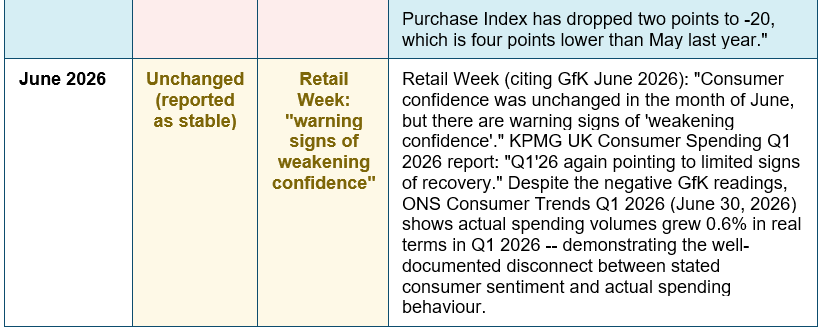
- GfK Consumer Confidence Tracker: January to June 2026
- UK Spending by Category: What Q1 2026 and Annual 2025 Data Show
- UK Consumer Behaviour by Region: The Full Map
- The Five Forces Shaping UK Consumer Behaviour in 2026
- Conclusion: Spending Resilience Behind a Pessimistic Headline
- Frequently Asked Questions (FAQ)
- What is the current UK consumer confidence level in 2026?
- How much did UK household spending grow in 2025 and Q1 2026?
- How does UK consumer spending differ by region?
- Why is UK consumer confidence so negative when spending is growing?
- What are the biggest trends in UK consumer behaviour for 2026?
- External References & Further Reading
The UK Consumer Map: At a Glance by Region
The UK consumer picture varies profoundly by region -- from London's high-spend, experience-first economy to Northern Ireland's cross-border, price-sensitive retail patterns. Here is the map at a glance: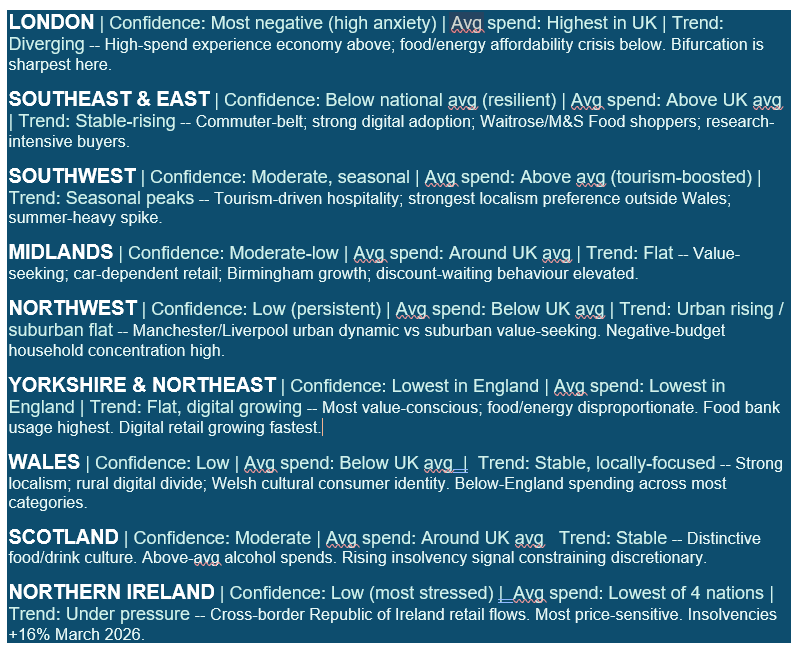
A Consumer Economy That Spends Despite Itself
January 2026 marked 10 years since UK consumer confidence was last in positive territory on the GfK Consumer Confidence Barometer. GfK/NIQ (January 23, 2026): 'January 2026 brings an unwanted anniversary, marking 10 years since consumer confidence was last in positive territory.' By May 2026, the index stood at -23 -- 5 points worse than May 2025. March 2026 saw a 6-point collapse in general economic outlook expectations to -37. The headline from the GfK data: UK consumers do not feel confident.
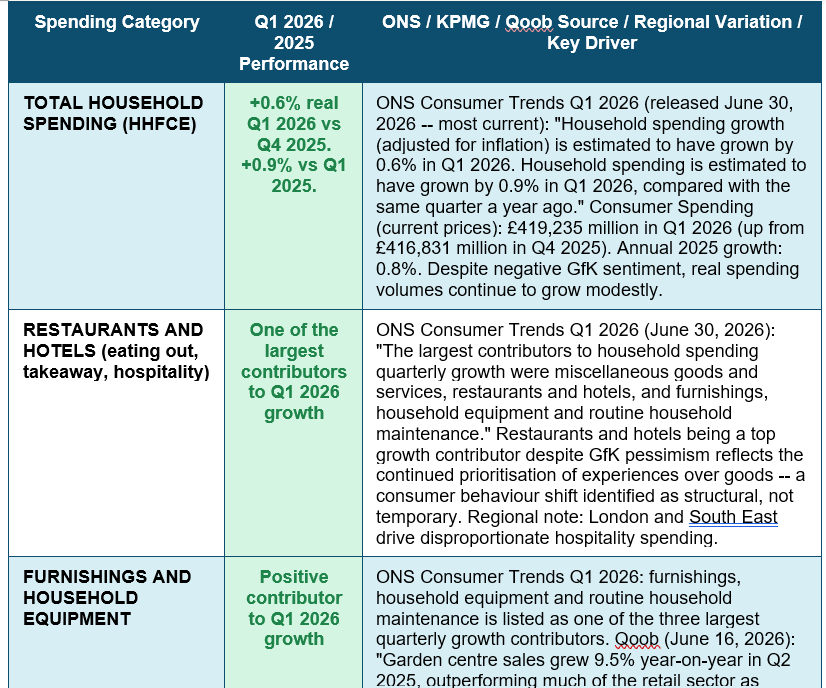
And yet they are spending. ONS Consumer Trends Q1 2026 (released June 30, 2026 -- the most current official data): household spending growth, adjusted for inflation, grew by 0.6% in Q1 2026 versus Q4 2025, and by 0.9% year-on-year versus Q1 2025. Consumer spending in current prices reached £419,235 million in Q1 2026. The largest growth contributors: restaurants and hotels, miscellaneous goods and services, and furnishings and household equipment. UK consumers are pessimistic about the national economy, cautious about major purchases, and still spending on food, experiences, and home improvement at a pace that keeps the consumer economy growing.
This annual consumer report covers the complete 2026 UK consumer picture: the GfK confidence data month by month, the ONS spending data by category, the regional variation that makes 'the UK consumer' a composite fiction of very different spending realities, the five structural forces shaping UK consumer behaviour, and the outlook for the remainder of 2026. Data runs to July 2026 throughout.
GfK Consumer Confidence Tracker: January to June 2026
The GfK Consumer Confidence Barometer -- running continuously since 1974 and surveying approximately 2,000 UK adults monthly -- is the leading indicator of UK consumer sentiment. The following table tracks 2026 month by month:
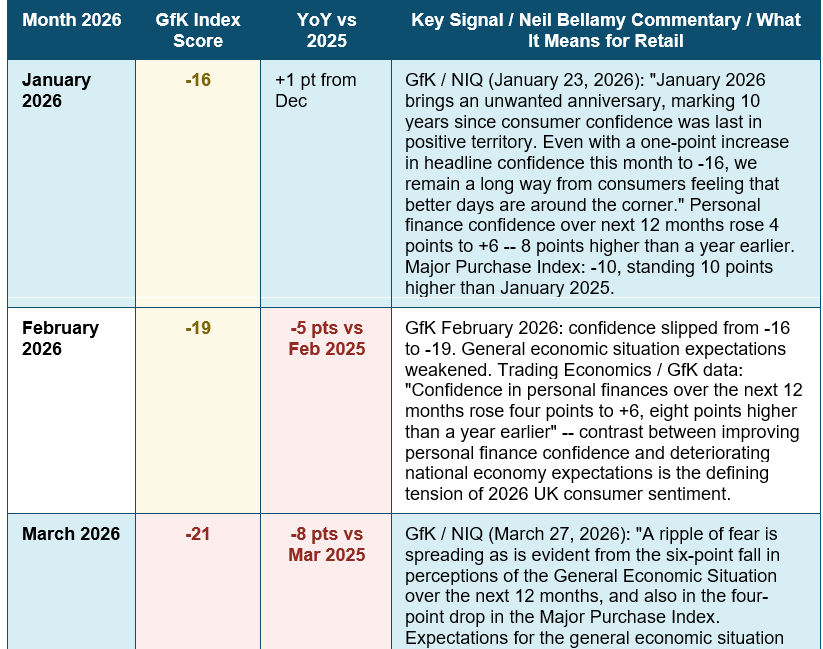
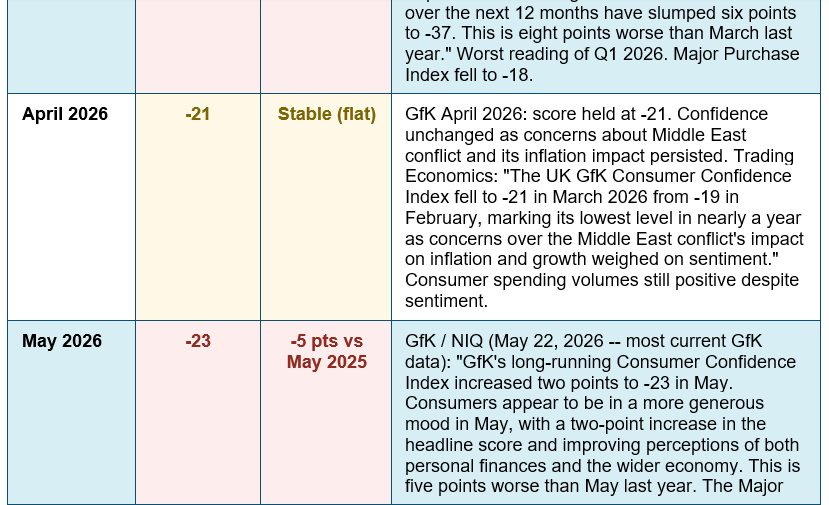
UK consumer confidence 2026 -- the key numbers: -23 GfK May 2026. -37 economic outlook March 2026. Personal finance confidence: +6 (up 8 pts YoY). 10 years since positive territory. Spending still +0.6% real Q1 2026. — GfK/NIQ (May 22, 2026 -- most current): '-23 GfK May 2026. Five points worse than May 2025. Major Purchase Index -20, four points lower than May last year.' GfK January 2026: '10 years since consumer confidence was last in positive territory.' GfK March 2026: 'General economic outlook slumped to -37, eight points worse than March 2025.' ONS Consumer Trends Q1 2026 (June 30, 2026 -- most current ONS data): 'Spending grew 0.6% real Q1 2026 vs Q4 2025. 0.9% vs Q1 2025.' The sentiment-spending gap is the defining feature of UK consumer 2026.
UK Spending by Category: What Q1 2026 and Annual 2025 Data Show
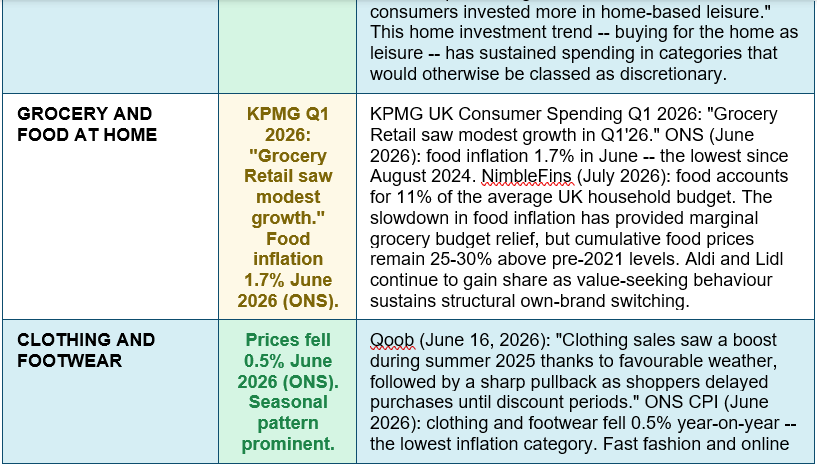
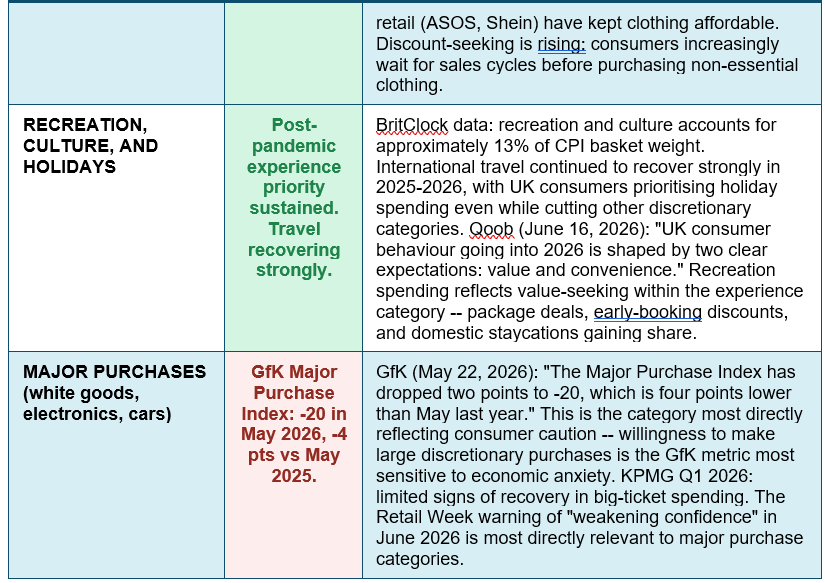
The following table maps UK household spending performance by category, using ONS Consumer Trends Q1 2026 (June 30, 2026), KPMG UK Consumer Spending Q1 2026, and Qoob consumer behaviour research (June 16, 2026):
UK Consumer Behaviour by Region: The Full Map
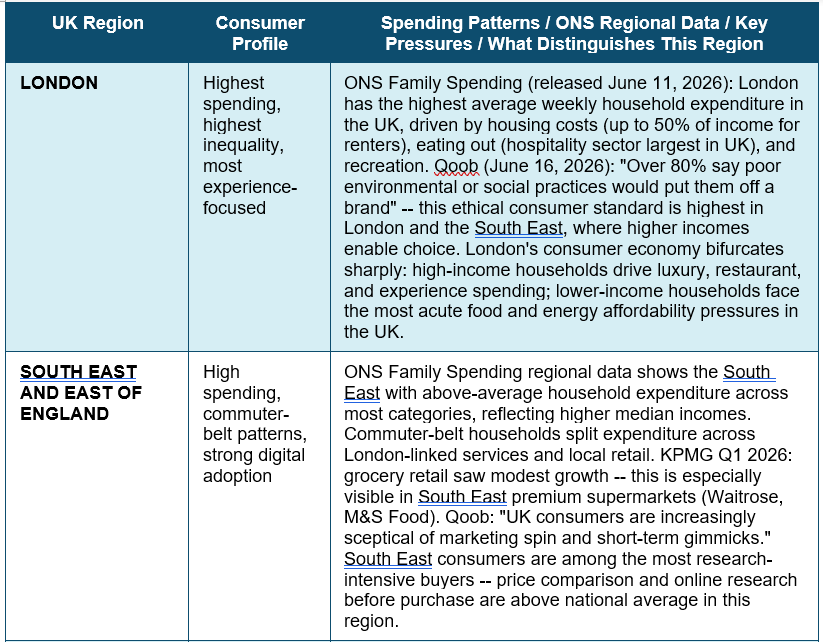
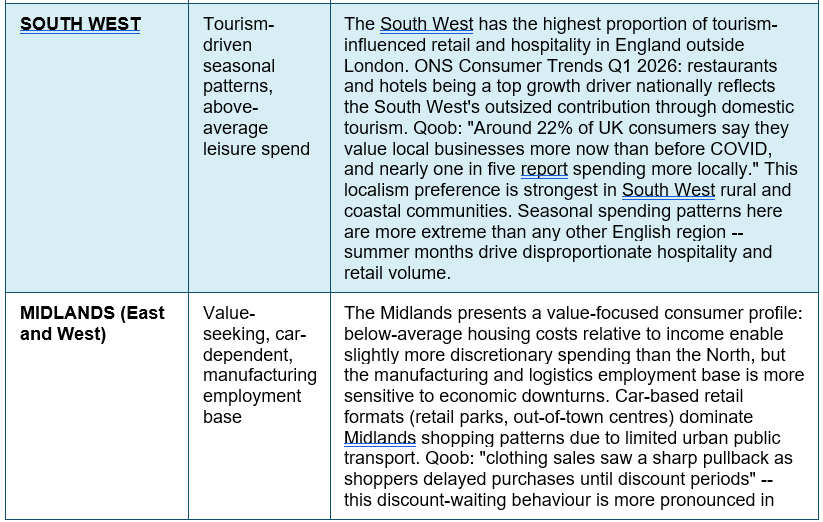
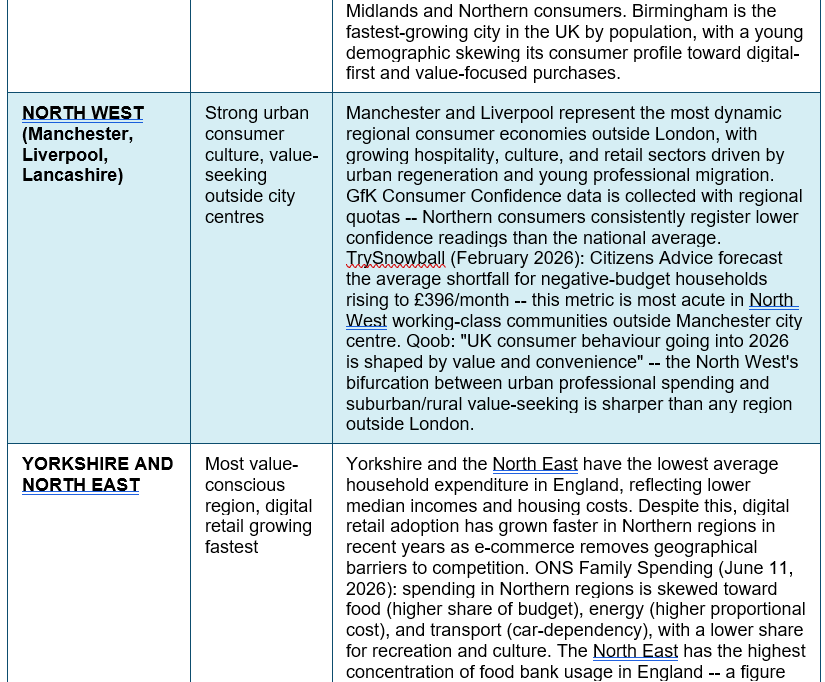
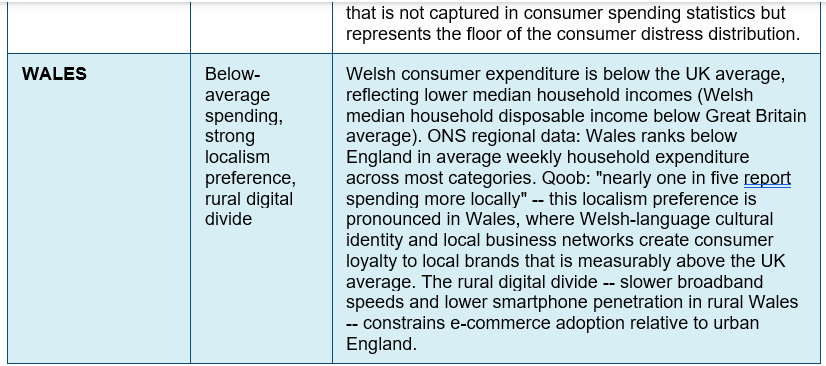
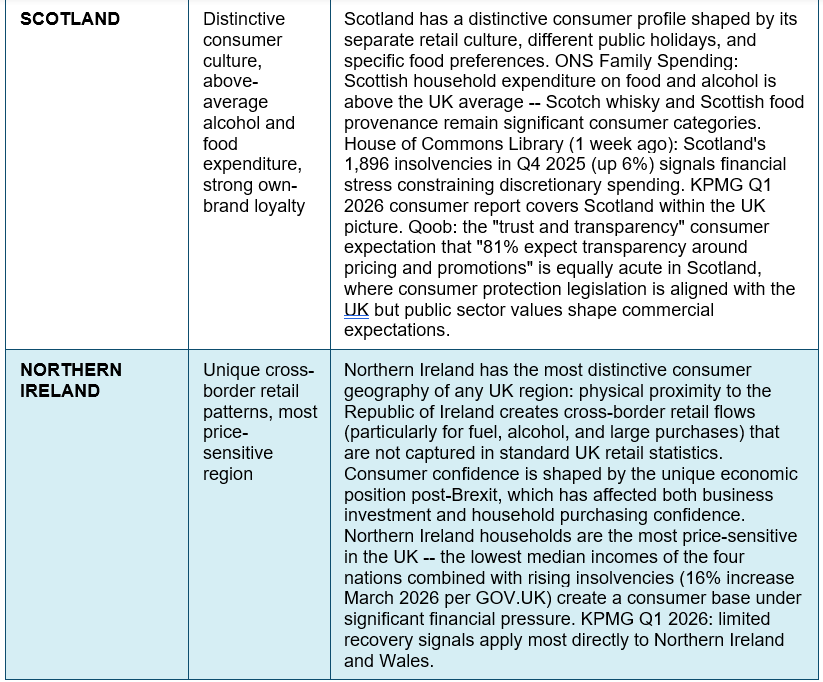
ONS Family Spending data (released June 11, 2026) provides regional breakdowns of average weekly household expenditure across all UK nations and English regions. The following table maps the consumer profile of each UK region:
The Five Forces Shaping UK Consumer Behaviour in 2026
1 VALUE AND TRUST -- THE TWIN PILLARS OF 2026 UK CONSUMER DECISION-MAKING | 81% expect pricing transparency. 80%+ would leave a brand over poor ESG practices.
Qoob (June 16, 2026 -- most current consumer behaviour analysis): 'UK consumer behaviour going into 2026 is shaped by two clear expectations: value and convenience. Shoppers want competitive pricing and flexibility, but they also expect seamless experiences, honest communication and brands they can trust.' The value imperative is the most direct legacy of the cost of living crisis: consumers who spent 2022-2024 scrutinising every purchase have developed a permanent comparison habit. Own-brand switching, price comparison before purchase, and loyalty scheme utilisation are all structurally higher than pre-crisis levels. Qoob: 'Over 80% say poor environmental or social practices would put them off a brand, while 81% expect transparency around pricing and promotions.' The trust imperative is less intuitive but equally powerful: UK consumers are demonstrably more sceptical of promotional claims, more likely to research before buying, and more likely to penalise brands caught with misleading pricing than at any point in the past decade. For retailers and brands: the 2026 UK consumer rewards genuine value and honest communication, and punishes complexity, hidden costs, and short-term promotional gimmicks at a historically high rate.
2 THE EXPERIENCE ECONOMY -- SPENDING ON DOING, NOT HAVING | Restaurants and hotels: top spending growth contributor Q1 2026 (ONS).
ONS Consumer Trends Q1 2026 (June 30, 2026): restaurants and hotels is listed as one of the three largest contributors to household spending growth in Q1 2026. This reflects a structural shift in UK consumer priorities that became visible during the post-pandemic recovery (2022-2023) and has proven persistent through 2025-2026: consumers are increasingly prioritising experience spending over goods spending, even when their overall financial position is constrained. Qoob (June 16, 2026): 'Garden centre sales grew 9.5% year-on-year in Q2 2025, outperforming much of the retail sector as consumers invested more in home-based leisure.' This is the lower-cost version of the experience economy: investing in the home as a leisure environment rather than spending on external experiences. The bifurcation within experience spending: higher-income consumers continue driving international travel and restaurant spending; lower and middle-income consumers are driving domestic leisure, garden, and home improvement spending. Both are experience priorities -- just at different price points. The implication for major purchase retail: while consumers are spending on experiences and home-based leisure, major goods purchases (white goods, electronics, cars) face the most consumer resistance. GfK (May 2026): Major Purchase Index at -20, four points below May last year.
3 LOCALISM AND TRUST IN PROVENANCE -- THE COMMUNITY CONSUMER | 22% value local businesses more than before COVID. One in five spending more locally.
Qoob (June 16, 2026): 'Around 22% of UK consumers say they value local businesses more now than before COVID, and nearly one in five report spending more locally.' This localism preference -- which emerged strongly during the pandemic when local supply chains proved more resilient than global ones -- has persisted into 2026 at a level above pre-COVID baselines. The localism preference is strongest in rural and semi-rural communities (South West, rural Wales, Scottish Highlands, Northern Ireland), where local business networks are more visible and where national chain retail is less accessible. It is also present in urban areas as a values-based choice rather than a necessity. For UK retailers: provenance labelling, local supplier stories, and community engagement programmes have measurable commercial value in 2026 in a way that was less true in 2018 or 2019. The trust dimension of localism is significant: consumers who feel they know the origin of their food, the people running their local businesses, and the supply chain behind their purchases demonstrate higher brand loyalty and lower price sensitivity -- both commercially valuable outcomes at a time when price pressure is intense.
4 DIGITAL-FIRST, DISCOUNT-TIMING -- THE NEW PURCHASE PATTERN | Clothing pullbacks until discount seasons. Online retail gap closing between North and South.
Qoob (June 16, 2026): 'Clothing sales saw a boost during summer 2025 thanks to favourable weather, followed by a sharp pullback as shoppers delayed purchases until discount periods. For brands, this reinforces the importance of demand forecasting, promotional strategy and margin discipline.' The discount-timing behaviour -- deliberate delay of non-essential purchases until promotional periods (Black Friday, January sales, summer sale windows) -- has become a dominant purchase pattern across UK income groups. What began as a survival tactic during the cost of living crisis has become a habit: UK consumers in 2026 are far more likely than their pre-2021 counterparts to postpone a clothing or home goods purchase while waiting for a discount. This creates lumpy demand patterns for retailers and erodes margin unless promotional calendars are actively managed. Simultaneously, the North-South digital retail gap is narrowing: faster broadband rollout, rising smartphone penetration, and the normalisation of online grocery delivery in Northern regions are bringing Northern consumer behaviour patterns closer to the Southern baseline. ONS Consumer Trends Q1 2026 growth in furnishings and household equipment partly reflects the continued shift of these categories to online retail platforms.
5 THE SENTIMENT-SPENDING PARADOX -- CONFIDENT ENOUGH TO SPEND, NOT ENOUGH TO SAY SO | GfK at -23. Spending +0.9% real year-on-year. The gap has never been wider.
The most analytically interesting feature of UK consumer 2026 is the persistent gap between stated consumer confidence (GfK at -23 in May, 10 years below positive territory) and actual consumer spending behaviour (ONS: +0.6% real in Q1 2026, +0.8% for full year 2025). GfK Consumer Insights Director Neil Bellamy (January 2026): 'Even with a one-point increase in headline confidence this month to -16, we remain a long way from consumers feeling that better days are around the corner.' Yet the ONS spending data shows that UK households are increasing real spending volume modestly but consistently. KPMG Q1 2026: 'Q1'26 again pointing to limited signs of recovery' -- KPMG's more cautious framing reflects that growth is present but modest. The paradox resolves when you distinguish between how consumers feel about the national economy (very negative -- only 25% of Americans rate their national economy positively, and UK sentiment follows a similar pattern) and how they manage their own household economy (pragmatic, prioritising experiences and value, cutting major purchases, and continuing to spend on food, hospitality, and home). The GfK index measures sentiment about the macro environment; the ONS data measures what consumers actually do with their money. In 2026, the two remain stubbornly disconnected.
The consumer class divide: value-seekers and experience-prioritisers in the same data. The 2026 UK consumer data is produced from a single national survey and single ONS accounting framework, but it captures two fundamentally different consumer realities operating simultaneously. At the top: higher-income households, primarily in London and the South East, who are spending on international travel, premium restaurants, home improvement, and ESG-verified brands, driving the restaurants-and-hotels growth in ONS Q1 2026. At the bottom: lower-income households across the North, Wales, and Northern Ireland, where Citizens Advice forecasts a £396/month budget shortfall for negative-budget households (TrySnowball, February 2026), where food bank usage is at record levels, and where the GfK Major Purchase Index reading of -20 is felt most directly because these households genuinely cannot afford discretionary major purchases. Qoob (June 16, 2026): 'UK consumer behaviour going into 2026 is shaped by two clear expectations: value and convenience.' Value for the lower-income majority means genuine price comparison and own-brand switching. For the higher-income minority, value means quality for money and brand authenticity. Both groups want value -- but they mean different things by it, and they are being served by different market segments responding to different commercial incentives. The ONS average consumption figure that emerges from combining both groups is simultaneously accurate about the statistical centre and misleading about the lived reality of either group.
FIVE KEY SIGNALS FOR UK RETAILERS, BRANDS, AND HOUSEHOLDS IN 2026: (1) MAJOR PURCHASE RESISTANCE IS STRUCTURAL. GfK Major Purchase Index: -20 in May 2026, four points below May 2025. Households are actively deferring big-ticket spending -- white goods, electronics, furniture upgrades, car replacement. For retailers in these categories: promotional periods will be disproportionately important and year-round pricing pressure will intensify. For households: if a major appliance needs replacing, Q4 2026 (Black Friday / pre-Christmas) is historically the optimal buying window for both selection and price. (2) TRUST IS NOW A COMMERCIAL ASSET, NOT A MARKETING ASPIRATION. Qoob (June 16, 2026): 81% of UK consumers expect transparency around pricing and promotions; 80%+ would leave a brand over poor ESG practices. Retailers and brands that embed genuine transparency into pricing, sourcing, and communications will outperform those that rely on promotional tactics. (3) THE NORTH-SOUTH CONSUMER CONFIDENCE GAP IS WIDENING. GfK confidence data is collected with regional quotas (Retail Week confirms regional quotas are applied). Northern and Midlands consumers consistently report lower confidence than the national average. This has implications for regional retail strategy, product ranging, and price architecture. (4) EXPERIENCES ARE WINNING. ONS Q1 2026: restaurants and hotels is a top growth contributor. Qoob: garden centres +9.5% in Q2 2025. Any brand that can reframe its product as an experience or a home-leisure investment is swimming with the structural current. (5) JANUARY MARKS 10 YEARS WITHOUT POSITIVE CONSUMER CONFIDENCE. GfK (January 2026): the index has been negative for a decade. This is not a temporary dip but a structural feature of post-Brexit, post-COVID, post-inflation-crisis UK consumer sentiment. UK retailers must plan for persistent below-neutral consumer confidence as the baseline, not an aberration to wait out.
FOR UK HOUSEHOLDS -- HOW TO NAVIGATE 2026 AS A CONSUMER: VALUE MAXIMISATION: Use loyalty schemes systematically -- Qoob notes most-used UK supermarket loyalty cards include Tesco Clubcard and Sainsbury's Nectar, which provide consistent monetary value on everyday spending. Rotate between Aldi/Lidl for staples (15-30% cheaper per unit) and branded products you genuinely prefer. TIMING MAJOR PURCHASES: GfK Major Purchase Index at -20 means you are not alone in deferring big-ticket items -- and deferring to a promotional window (Black Friday, January sales) typically saves 20-40% on electronics, white goods, and furniture. LOCALISM VALUE: Qoob: 22% of consumers report spending more locally. For small independent retailers, loyalty from local customers in 2026 is commercially significant. For consumers: local businesses in some categories (butchers, greengrocers, independent hardware) now compete on price with supermarkets due to the own-brand war. DIGITAL COMPARISON: Before any purchase above £50, run a Google Shopping or price comparison check. UK consumers who compare online before buying typically save 10-15% on non-promotional prices. EXPERIENCE-FIRST BUDGETING: ONS data shows experiences and home leisure are growing faster than goods. If you are choosing between a new TV and a weekend break, the data suggests the break produces greater reported life satisfaction -- and the TV will be cheaper in 6 months. FREE RESOURCES: MoneyHelper 0800 138 7777 | MSE moneysavingexpert.com | ONS Family Spending data ons.gov.uk.
Conclusion
The 2026 annual UK consumer picture is defined by a persistent paradox: a GfK Consumer Confidence Index that has been negative for a decade, recording -23 in May 2026 and -37 on economic outlook in March, alongside ONS spending data that shows real household expenditure growing 0.6% in Q1 2026 and 0.8% for full year 2025. UK consumers are pessimistic. They are also spending.
Qoob (June 16, 2026): 'UK consumer behaviour going into 2026 is shaped by two clear expectations: value and convenience.' ONS Consumer Trends Q1 2026 identifies restaurants and hotels, household goods, and miscellaneous services as the growth leaders -- not electronics, cars, or clothing. GfK's Major Purchase Index at -20 tells the same story from the other direction: the discretionary goods sector is under the heaviest consumer resistance. KPMG's Q1 2026 report notes 'limited signs of recovery' -- a realistic assessment of a consumer economy that is growing modestly but not accelerating.
The regional picture is the element most lost in national averages. From London's bifurcated high-spend/high-stress consumer economy to Northern Ireland's cross-border price-sensitivity; from Scotland's distinctive food and drink culture to Yorkshire's digital retail growth on a low-income base; from the South West's tourism-driven seasonal surge to the Midlands' discount-timing value-seekers -- the UK consumer is not one thing. The national data is the average of 67 million very different spending decisions, shaped by income, region, tenure, age, and the cumulative impact of three years of above-average inflation on household budgets that have not all recovered at the same rate.
Frequently Asked Questions (FAQ)
What is the current UK consumer confidence level in 2026?
The GfK Consumer Confidence Index -- the primary measure of UK consumer sentiment, running continuously since 1974 and surveying approximately 2,003 UK adults monthly -- stood at -23 in May 2026, according to the GfK/NIQ release of May 22, 2026. This is 5 points worse than May 2025. The 2026 monthly trajectory: January -16 (GfK, January 23, 2026); February -19; March -21 (GfK, March 27, 2026 -- 'a ripple of fear is spreading'); April -21; May -23. GfK Consumer Insights Director Neil Bellamy noted in January 2026 that this marked '10 years since consumer confidence was last in positive territory.' The index has five components: personal financial situation over the past 12 months; personal financial situation over the next 12 months; general economic situation over the past 12 months; general economic situation over the next 12 months; and the Major Purchase Index (willingness to make major discretionary purchases). The most striking 2026 reading is the general economic situation over the next 12 months: in March 2026, this fell to -37, eight points worse than March 2025, following geopolitical pressures in the Middle East and their inflation implications. The Major Purchase Index in May 2026 stood at -20, four points worse than May 2025 -- representing active consumer reluctance to commit to big-ticket discretionary spending. Retail Week (June 2026) reported 'warning signs of weakening confidence' even within the broadly stable June reading.
How much did UK household spending grow in 2025 and Q1 2026?
ONS Consumer Trends Q1 2026, released June 30, 2026 (most current official data): 'Household spending growth (adjusted for inflation) is estimated to have grown by 0.6% in Quarter 1 (Jan to Mar) 2026. Household spending is estimated to have grown by 0.9% in Q1 2026, compared with the same quarter a year ago.' The same ONS bulletin reported that household spending (in current prices) reached £419,235 million in Q1 2026, up from £416,831 million in Q4 2025. For full year 2025: 'Household spending is estimated to have increased by 0.8% annually in 2025' (ONS Consumer Trends Q4 2025, March 31, 2026). The largest contributors to Q1 2026 growth: miscellaneous goods and services, restaurants and hotels, and furnishings, household equipment and routine household maintenance. The categories growing fastest reflect the experience economy shift and home investment trend. The category under most pressure: major discretionary purchases (electronics, white goods, cars) as reflected in the GfK Major Purchase Index at -20. KPMG UK Consumer Spending Q1 2026: 'Grocery Retail saw modest growth in Q1'26.' The distinction between price-driven spending growth (inflation lifting nominal values) and volume growth (consumers actually buying more) is important: the ONS figures cited above are adjusted for inflation, meaning they represent real volume growth -- consumers are genuinely buying more, not just paying more for the same.',
How does UK consumer spending differ by region?
UK consumer spending varies significantly by region, primarily driven by income levels, housing costs, and the structural composition of regional economies. ONS Family Spending (released June 11, 2026) provides the most current regional breakdown of average weekly household expenditure. The highest-spending region in the UK is London, driven by the highest housing costs, highest eating-out expenditure, and the highest share of high-income professional households. The South East is the next highest, reflecting proximity to London and above-average incomes in the commuter belt. At the other end of the spectrum: Yorkshire and the North East have the lowest average household expenditure in England, with a higher proportion of the budget consumed by essentials (food, energy, transport) and a lower proportion available for recreation and culture. Wales and Northern Ireland have below-average UK household expenditure, reflecting lower median household incomes than the English average. Scotland is closer to the UK average but has distinctive spending patterns in food and beverages, reflecting Scottish food and drink cultural preferences. The cost of living crisis has had a distributional effect on regional spending patterns: lower-income regions have seen essential spending (food, energy) consume a larger share of the household budget as cumulative price inflation has reduced the discretionary spending available. The ONS Household Costs Indices (published May 28, 2026) demonstrates that lower-income households -- disproportionately concentrated in Northern England, Wales, and Northern Ireland -- experienced higher effective inflation rates during 2021-2023 because their spending is more heavily weighted toward essentials.
Why is UK consumer confidence so negative when spending is growing?
The sentiment-spending paradox -- negative GfK readings alongside positive ONS spending growth -- is one of the most consistent and analytically interesting features of UK consumer economics in 2024-2026. It resolves when you distinguish between how consumers feel about the national economy versus how they manage their personal household economies. GfK measures perceptions of both personal finances and the general economic situation. In 2026, these two components are moving in opposite directions: GfK January 2026 shows personal finance confidence over the next 12 months at +6 (improving), while general economic outlook stands at -31 (deteriorating). Consumers feel cautiously better about their own financial situation but deeply pessimistic about the macro environment. The spending data captures what consumers actually do with their money -- which reflects their personal financial confidence more than their national economy pessimism. This is consistent with economic research showing that stated consumer sentiment is a lagging indicator of actual behaviour, and that the national economy perception component of confidence indices is heavily influenced by political and media framing of economic conditions rather than by direct financial experience. GfK Consumer Insights Director Neil Bellamy (January 2026): 'We remain a long way from consumers feeling that better days are around the corner.' ONS Q1 2026: real spending grew 0.6%. The paradox is not a contradiction -- it is the difference between how people feel and what they do.
What are the biggest trends in UK consumer behaviour for 2026?
Qoob (June 16, 2026 -- most current consumer behaviour analysis): 'UK consumer behaviour going into 2026 is shaped by two clear expectations: value and convenience.' Five structural trends are most clearly supported by the 2026 data. First, experience prioritisation: ONS Consumer Trends Q1 2026 (June 30, 2026) identifies restaurants and hotels as a top spending growth contributor -- reflecting the structural shift from goods to experience spending that has persisted from post-pandemic recovery through 2026. Second, value-seeking and own-brand loyalty: Aldi and Lidl continue gaining share in UK grocery; branded products face price comparison at every purchase; own-brand switching is structurally higher than pre-2021. Third, trust and transparency as commercial requirements: Qoob: '80% would leave a brand over poor ESG practices; 81% expect pricing transparency.' The consumer who survived the cost of living crisis has become a sceptical, research-intensive buyer who penalises complexity and rewards honesty. Fourth, discount-timing purchases: Qoob: 'clothing sales saw a sharp pullback as shoppers delayed purchases until discount periods.' This deliberate delay has become habitual -- affecting clothing, electronics, and home goods categories seasonally. Fifth, localism: '22% value local businesses more than before COVID; nearly one in five report spending more locally.' This is a post-pandemic preference that has proven durable, particularly in rural and community-oriented markets. For the retail industry in 2026, these five trends collectively reward quality, transparency, competitive pricing, experience-oriented positioning, and authentic community connection.
0 Comments
Be the first to share your thoughts on this article.