

Spending
Why Americans Spend for Joy Then Feel Guilty

72% of Americans feel guilty when they spend money on things that bring them joy. Only 15% say joy is easy to afford. Americans still spend $259–$298 per month on joy — even when they feel they shouldn’t. This is the psychology behind the cycle.

You buy the concert ticket. You go to the restaurant. You take the trip you have been putting off for two years. And for a little while, it is exactly what you needed. Then you check your bank balance or your credit card statement, and the feeling shifts. The joy evaporates and the guilt sets in. You wonder whether you should have saved it. Whether you are behind on some invisible schedule of responsible adulthood. Whether other people would have made a smarter choice.
This is not an isolated experience. It is an epidemic. Nearly three-quarters of Americans — 72 percent — feel guilty when they spend money on things that bring them joy, according to Ally Bank’s inaugural Joy Index survey, conducted by YouGov in July 2026 among more than 5,000 US adults. The finding was published on August 26, 2026, and immediately confirmed what many Americans quietly knew about themselves: they are spending for joy and paying for it twice. Once with money. Once with guilt.
This article examines why. It draws on Ally Bank’s Cost of Life Today report, LendingTree’s emotional spending study, Beyond Finance’s 2025 holiday survey, and the research on behavioral economics and neuroscience to explain the cycle: why we spend for joy, why the guilt follows so reliably, who it hits hardest, and what a healthier relationship between spending and happiness can look like.
The Numbers: 72% of Americans feel guilty spending on joy instead of a financial goal (Ally Bank Joy Index, YouGov July 2026, n=5,000+). Only 15% say joy is easy to afford. Average Joy Index score: 54.2/100 (‘Joy Pressured’ territory). 80% experience joy at least monthly. Women feel more guilt: 75% vs 68% of men.
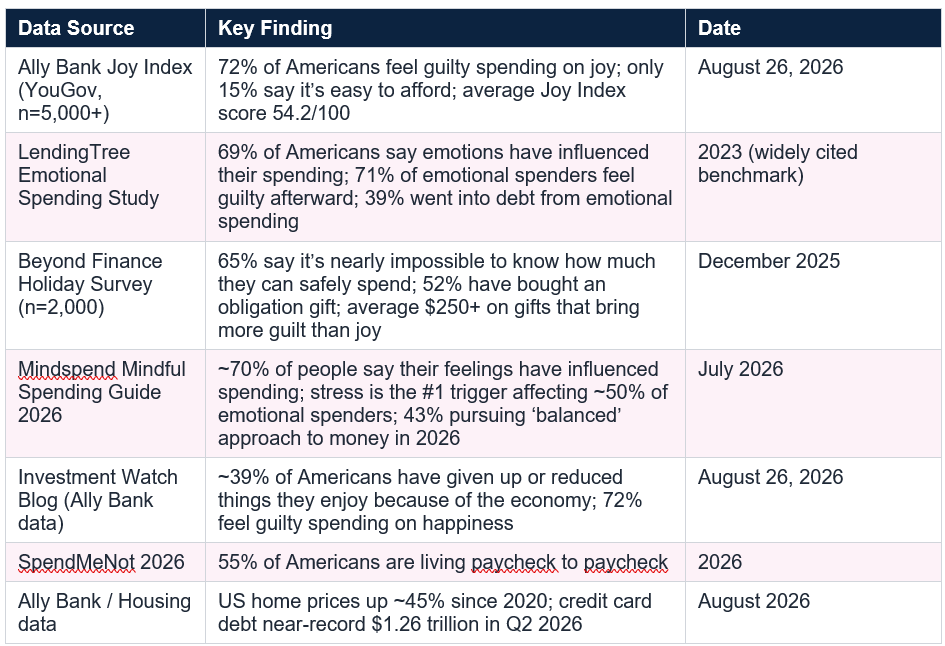
The consistency across these studies from different methodologies and different years is the most important takeaway: the joy-guilt cycle is not a new phenomenon created by the current cost-of-living crisis. It is a structural feature of the American relationship with money and spending. The cost-of-living crisis has intensified it, but it did not create it.
The Joy Index is a composite score based on four equally weighted components, each contributing a maximum of 25 points:
Lee Stafford, Ally’s Chief Economist (USA TODAY, August 26, 2026): Worries about the cost of living are real, and because of them, people are getting more deliberate in their spending. A meaningful share are even cutting back on necessities to make room for the areas they value most. It’s not that people are spending carelessly. Instead, they’re spending to protect something they’ve decided they can’t afford to lose.
Lindsay Sacknoff, Ally’s president of consumer banking, added context on why women feel more guilt: women often manage day-to-day household finances, placing them in closer, more frequent contact with the trade-offs between joy spending and financial obligations. The 75 percent guilt rate among women versus 68 percent among men reflects this structural role, not a character difference.
The problem is temporal. The dopamine spike occurs in anticipation. By the time you have made the purchase, the reward has already been partially consumed by the brain before you have left the store or closed the browser tab. What follows is often a return to baseline, or below it, as the reality of the purchase price settles in. Psychologists call this the ‘hedonic treadmill’: humans rapidly adapt to new pleasures and possessions, returning quickly to a stable happiness baseline regardless of what they acquire.
Research findings on emotional state and spending, cited by Mindspend 2026, show three consistent patterns:
Four specific factors make this guilt particularly intense in 2026:
The survey of 2,000 Americans found that 52 percent admitted to buying at least one gift purely out of obligation, spending an average of more than $250 on gifts they described as generating more guilt than joy. The asymmetry is notable: the guilt-giver spends real money, creates a real financial cost, and receives not joy but guilt. The recipient receives a gift chosen from obligation rather than genuine care. Both parties are diminished by the transaction.
The generational breakdown of guilt-giving mirrors the emotional spending pattern: Gen Z (64%) and Millennials (66%) lead, compared to 50 percent of Gen X and 30 percent of Baby Boomers. Parents of children under 18 are the most affected: 76 percent admit to guilt-giving, compared to 44 percent of non-parents. Beyond Finance described two related phenomena:
This finding aligns with decades of psychological research on subjective well-being, which consistently shows that:
The Investment Watch Blog analysis of the Ally data frames this precisely: ‘Americans aren’t broke enough to stop spending, but they’re broke enough to feel guilty about it.’ Consumer spending is approximately two-thirds of the US economy. The blog notes that discretionary cuts — when they happen — follow a predictable sequence: restaurants first, then entertainment, then travel, then clothing, then furniture. ‘One purchase doesn’t matter. Millions of households making the same decision does.’
For paycheck-to-paycheck Americans, the joy spending that triggers guilt is not irrational. It is a statement about values and quality of life. Lee Stafford’s framing from USA TODAY captures it well: people are ‘spending to protect something they’ve decided they can’t afford to lose.’ That decision — to protect quality of life even under financial pressure — is human, understandable, and worth examining with more compassion than financial advice typically brings to it.
The framework for a simple joy budget:
The guilt is real. In many cases, it is a legitimate financial signal worth listening to. But for many of the 72 percent, the guilt is not a signal about a financial mistake. It is a generalised anxiety about deserving happiness — a belief that joy must be earned, deferred, or rationed in proportion to financial achievement. That belief causes harm. It generates spending anyway (because the need for joy is real), just spending that is reactive and emotionally driven rather than deliberate and values-aligned, followed by guilt that compounds the financial anxiety.
The most sustainable approach to the joy-guilt cycle is not more financial restriction. It is more intentionality. Know what actually brings you lasting joy (the survey says: people, experiences, connection). Build a deliberate monthly allocation for it. Spend within that allocation without guilt because the permission was pre-granted by your planning self. Recognise emotional spending when it is happening and give yourself the 24-hour pause.
You are allowed to spend on what matters to you. That is, in fact, the point of earning money at all. The goal is to do it deliberately, in alignment with what actually generates lasting wellbeing rather than momentary pleasure followed by regret. The joy-guilt cycle can be interrupted. It starts by recognising that the guilt, for most people, is not protecting your finances. It is just costing you twice.
According to Ally Bank's inaugural Joy Index survey (YouGov, July 2026, n=5,000+), 72% of Americans feel guilty when they spend money on things that bring joy instead of putting the money toward a financial goal. The guilt reflects a collision between two legitimate values: present enjoyment and future financial security. The tension is intensified in 2026 by real economic pressures — home prices up 45% since 2020, near-record credit card debt of $1.26 trillion, and persistent inflation — but Ally Bank's PRNewswire release noted that 'the tension is not simply about overspending. Many consumers are second-guessing whether they should make room for joy at all.' For many people, the guilt is not information about a financial mistake. It is a generalised belief that joy must be deferred or earned. Lindsay Sacknoff, Ally's president of consumer banking, noted that women feel more guilt (75%) than men (68%) partly because women often manage day-to-day household finances and are in closer contact with the financial trade-offs.
What is the Ally Bank Joy Index and what did it find?
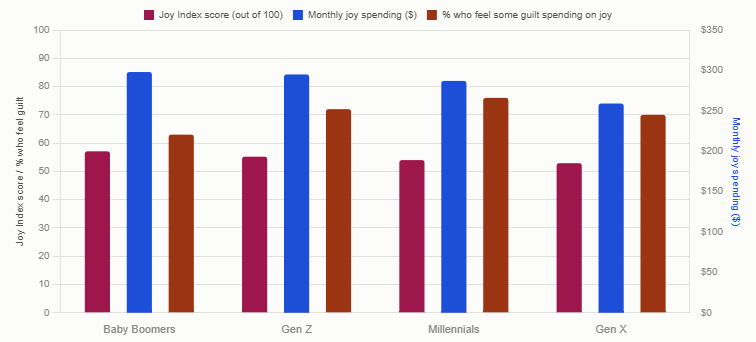
The Ally Bank Joy Index is a proprietary annual benchmark launched on August 26, 2026, as part of Ally's 'Cost of Life Today' consumer research platform. It is designed to measure what traditional economic indicators miss: how people are actually experiencing their financial lives. The Joy Index is a composite score from 0–100 based on four equally weighted components (25 points each): Affordability (financial flexibility to spend on joy), Importance (prioritisation of joy vs. other goals), Experience (frequency of joy), and Resiliency (maintaining joy under financial stress). The research was conducted by YouGov in July 2026 among a nationally representative sample of 5,000+ US adults. Key findings: average Joy Index score of 54.2/100 ('Joy Pressured' territory); only 15% say joy is easy to afford; 72% feel guilty spending on joy; 80% experience joy at least monthly; Boomers score highest (57.1) and spend most ($298/month); Gen Z has highest percentage with a dedicated joy budget (56%).
What triggers emotional spending most?
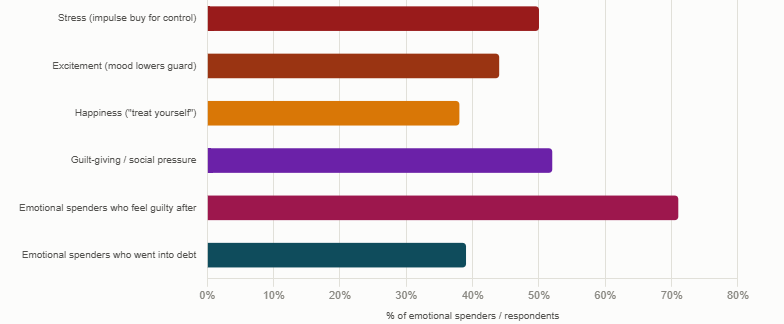
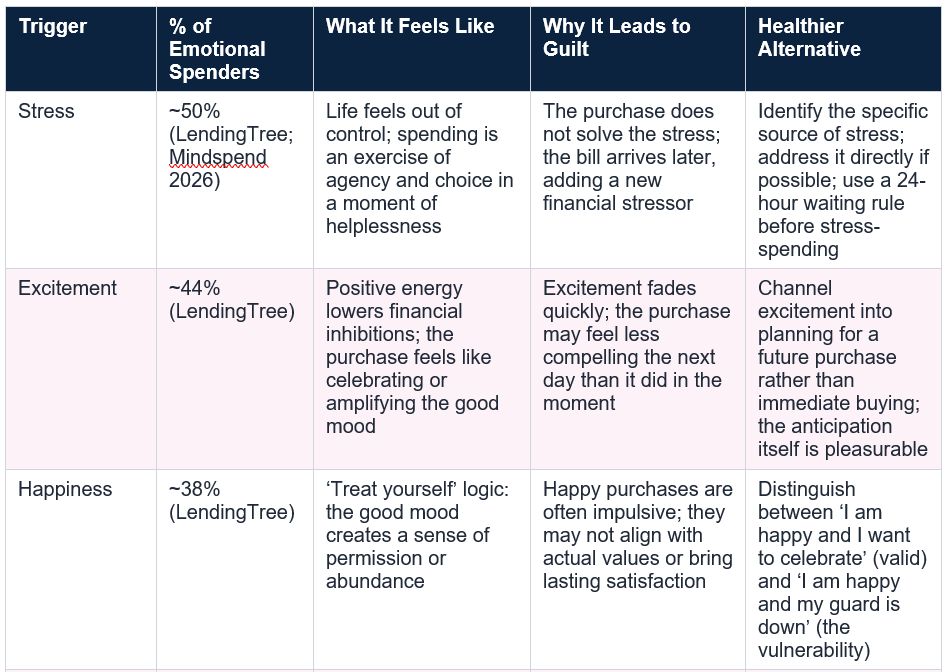
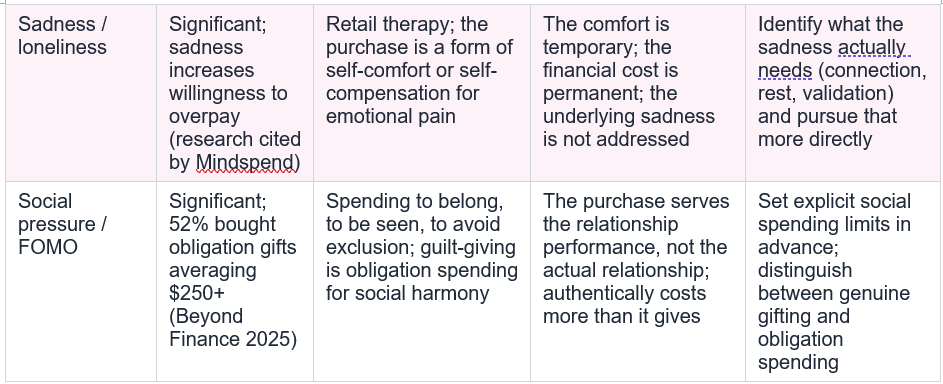
LendingTree's emotional spending study and Mindspend's 2026 Mindful Spending Guide identify the five most common triggers: (1) Stress (~50% of emotional spenders) — spending as a form of control when life feels unmanageable. (2) Excitement (~44%) — positive mood lowers financial inhibitions. (3) Happiness (~38%) — 'treat yourself' logic activates when mood is elevated. (4) Sadness/loneliness — research cited by Mindspend shows sadness increases willingness to overpay; spending becomes self-compensation for emotional pain. (5) Social pressure/FOMO — Beyond Finance's 2025 holiday survey found 52% of Americans bought at least one obligation gift averaging $250+. Overall, 69% of Americans admit emotions have influenced their spending, with Millennials (76%) and Gen Z (75%) most likely to say so (LendingTree). Of emotional spenders, 71% feel guilty afterward and 39% have gone into debt as a result.
Which generation feels the most guilt about spending on joy?
Based on Ally Bank's Joy Index data (August 2026), guilt is most pronounced among younger generations and women specifically. Women across all ages feel more guilt (75%) than men (68%). By generation: Baby Boomers have the lowest guilt levels — 63% feel some guilt, and nearly a third say spending on joy is 'completely worth the cost.' Gen Z and Millennials have higher guilt rates. Millennials lead in guilt-giving (66%) and in emotional spending-related debt (LendingTree; Beyond Finance December 2025). Gen Z scores well on the Joy Index but recognises the trade-off between planning and present enjoyment — their guilt is often about the opportunity cost of not saving, according to USA TODAY's analysis of the Ally survey. Gen X, despite the lowest joy spending ($259/month) and lowest Joy Index score (52.9), is caught between peak financial responsibilities and not yet at the life stage that Boomers feel permits enjoyment spending.
What actually brings joy according to research?
Ally Bank's Joy Index survey found that spending time with family and with a partner or spouse consistently beat all other answers when respondents were asked what brings them the most joy — surpassing consumer purchases, travel, entertainment, and other spending-based activities. This aligns with decades of psychological research on subjective well-being, including the Harvard Study of Adult Development (one of the longest-running studies of human happiness), which found that the quality of close relationships — not income, status, or possessions — is the single most consistent predictor of wellbeing. Research on spending and happiness also consistently shows that experiences generate more lasting satisfaction than material goods; that planned future experiences generate sustained positive emotion; and that social connection is the most reliable predictor of happiness across income levels. The most important practical implication: much of the spending that generates guilt is on things that do not deliver the lasting joy the buyer hoped for.
How can I spend on joy without feeling guilty?
The most effective structural solution, supported by behavioral finance research and practiced by the 56% of Gen Z respondents who already do it, is a deliberate joy budget: a pre-authorised monthly allocation specifically for spending on experiences, relationships, and pleasures that matter to you. Money spent within this budget is guilt-free by design — it was approved by your planning self, not triggered by your emotional state. Steps: (1) Determine how much of your take-home income you can genuinely allocate without financial risk (typically 5–10%). (2) Automate the transfer on payday to a separate named account. (3) Decide in advance what the budget is for. (4) Spend within it without guilt. (5) Apply a 24-hour pause to any unplanned joy purchase outside the budget. The Mindspend 2026 guide also recommends tracking your 'money mood' — the emotional state when you make spending decisions — to recognise emotional spending patterns before they result in purchases that generate regret.
Joy Spending & Guilt By Generation
Emotional Spending Triggers
Table of Contents
- The Joy-Guilt Loop
- The Data: America’s Broken Relationship With Spending for Happiness
- The Joy Index: What Ally Bank’s Landmark 2026 Study Found
- The Neuroscience Behind the Buy: Dopamine, Anticipation, and Let-Down
- Why Joy Spending Triggers Financial Guilt
- The Five Most Common Emotional Spending Triggers
- The Guilt Gap by Generation
- The Economics of Joy in 2026: Why It Feels Harder to Afford
- Guilt-Giving: When Obligation Replaces Desire
- What Actually Brings Joy: The Survey Said Something Surprising
- The 55% Who Are Living Paycheck to Paycheck and Still Spending on Joy
- How to Break the Joy-Guilt Cycle: A Framework That Works
- The Joy Budget: Making Spending on Happiness Intentional
- Conclusion: You Are Allowed to Spend on What Matters to You
- Frequently Asked Questions
The Joy-Guilt Loop
You buy the concert ticket. You go to the restaurant. You take the trip you have been putting off for two years. And for a little while, it is exactly what you needed. Then you check your bank balance or your credit card statement, and the feeling shifts. The joy evaporates and the guilt sets in. You wonder whether you should have saved it. Whether you are behind on some invisible schedule of responsible adulthood. Whether other people would have made a smarter choice.This is not an isolated experience. It is an epidemic. Nearly three-quarters of Americans — 72 percent — feel guilty when they spend money on things that bring them joy, according to Ally Bank’s inaugural Joy Index survey, conducted by YouGov in July 2026 among more than 5,000 US adults. The finding was published on August 26, 2026, and immediately confirmed what many Americans quietly knew about themselves: they are spending for joy and paying for it twice. Once with money. Once with guilt.
This article examines why. It draws on Ally Bank’s Cost of Life Today report, LendingTree’s emotional spending study, Beyond Finance’s 2025 holiday survey, and the research on behavioral economics and neuroscience to explain the cycle: why we spend for joy, why the guilt follows so reliably, who it hits hardest, and what a healthier relationship between spending and happiness can look like.
The Numbers: 72% of Americans feel guilty spending on joy instead of a financial goal (Ally Bank Joy Index, YouGov July 2026, n=5,000+). Only 15% say joy is easy to afford. Average Joy Index score: 54.2/100 (‘Joy Pressured’ territory). 80% experience joy at least monthly. Women feel more guilt: 75% vs 68% of men.
The Data: America’s Broken Relationship With Spending for Happiness
The Ally Bank survey is the most comprehensive measure of joy spending and guilt published in 2026, but it arrives in a landscape already well-documented by multiple data sources. The picture they paint, collectively, is one of a country that wants to spend for happiness, frequently does, and then reliably feels bad about it:The consistency across these studies from different methodologies and different years is the most important takeaway: the joy-guilt cycle is not a new phenomenon created by the current cost-of-living crisis. It is a structural feature of the American relationship with money and spending. The cost-of-living crisis has intensified it, but it did not create it.
The Joy Index: What Ally Bank’s Landmark 2026 Study Found
Ally Bank’s Cost of Life Today platform, launched on August 26, 2026, introduced the Joy Index as a proprietary annual benchmark designed to capture what traditional economic indicators miss: how people are actually experiencing their financial lives, not just how the economy is performing on paper.The Joy Index is a composite score based on four equally weighted components, each contributing a maximum of 25 points:
- Affordability: does the consumer have the financial flexibility to spend on joy without material sacrifice elsewhere?
- Importance: how much does the consumer prioritise joy relative to other financial goals?
- Experience: how frequently does the consumer actually experience joy?
- Resiliency: how well does the consumer maintain their ability to experience joy under financial stress?
Lee Stafford, Ally’s Chief Economist (USA TODAY, August 26, 2026): Worries about the cost of living are real, and because of them, people are getting more deliberate in their spending. A meaningful share are even cutting back on necessities to make room for the areas they value most. It’s not that people are spending carelessly. Instead, they’re spending to protect something they’ve decided they can’t afford to lose.
Lindsay Sacknoff, Ally’s president of consumer banking, added context on why women feel more guilt: women often manage day-to-day household finances, placing them in closer, more frequent contact with the trade-offs between joy spending and financial obligations. The 75 percent guilt rate among women versus 68 percent among men reflects this structural role, not a character difference.
The Neuroscience Behind the Buy: Dopamine, Anticipation, and Let-Down
Understanding why we spend for joy — even when we know it will trigger guilt — requires understanding what happens in the brain during a purchase. The Mindspend Mindful Spending Guide 2026 explains it: when you spot something you want, your brain releases dopamine, the neurotransmitter associated with anticipation and reward. This dopamine release is the pleasurable feeling of wanting. The wanting feels good. The buying feels like relief or resolution.The problem is temporal. The dopamine spike occurs in anticipation. By the time you have made the purchase, the reward has already been partially consumed by the brain before you have left the store or closed the browser tab. What follows is often a return to baseline, or below it, as the reality of the purchase price settles in. Psychologists call this the ‘hedonic treadmill’: humans rapidly adapt to new pleasures and possessions, returning quickly to a stable happiness baseline regardless of what they acquire.
Research findings on emotional state and spending, cited by Mindspend 2026, show three consistent patterns:
- Stress leads to impulse buying as a way to feel in control. The purchase is an exercise of agency in a moment when other forms of control feel unavailable.
- Sadness increases willingness to overpay. Studies find that sad individuals are more likely to spend more than they otherwise would for the same item, as if the purchase is a form of self-compensation.
- Even happiness can trigger ‘treat yourself’ spending that does not always deliver lasting satisfaction. Positive emotions can lower financial inhibitions by creating a sense of abundance or permission.
Why Joy Spending Triggers Financial Guilt
The guilt that follows joy spending is not a character flaw. It is a collision between two legitimate sets of values operating simultaneously: the value of present experience and the value of future security. Most people hold both values. The tension between them is real, not imaginary. The guilt is the emotional signal that the tension is unresolved.Four specific factors make this guilt particularly intense in 2026:
- The cost-of-living context: when home prices have risen approximately 45 percent since 2020 and credit card debt sits at near-record levels of $1.26 trillion (Ally Bank, August 2026), every discretionary purchase occurs against a backdrop of financial anxiety. The guilty awareness that the concert ticket or the restaurant dinner is competing with a real financial goal is not catastrophising — it is accurate.
- The visibility of other people’s financial choices: social media creates the impression that others are either spending more freely (generating ‘FOMO spending’ — the desire to keep up) or saving more responsibly (generating guilt about one’s own spending). Both impressions are often false, but both generate guilt about personal spending choices.
- The internal money narrative: most people carry a set of beliefs about money, sometimes inherited from parents or formative experiences, that govern how money ‘should’ be used. If the inherited narrative is frugality or financial sacrifice, any spending for joy violates the narrative and triggers guilt regardless of whether the spending was actually problematic.
- The 77 percent guilt paradox: Ally Bank’s PRNewswire release of August 26, 2026, noted that 77 percent still feel at least some guilt when spending on joy, adding: ‘That tells us the tension is not simply about overspending. Many consumers are second-guessing whether they should make room for joy at all.’ This is perhaps the most psychologically revealing finding: the guilt is not corrective information about a financial mistake. It is a generalised anxiety about deserving joy.
The Five Most Common Emotional Spending Triggers
LendingTree’s emotional spending study and Mindspend’s 2026 guide converge on the five most common emotional triggers for spending:
The Guilt Gap by Generation
The Ally Bank Joy Index reveals significant generational differences in both how much people spend on joy and how guilty they feel about it:- Baby Boomers: the happiest generation by Joy Index score (57.1/100), the highest monthly joy spenders ($298/month), and the least guilty (63% feel some guilt, the lowest of any generation). Nearly a third say spending on joy is ‘completely worth the cost.’ Boomers’ relationship with joy spending has been normalised over decades of earning, accumulating, and reaching a life stage where spending on enjoyment feels earned rather than irresponsible.
- Gen Z: scores 55.2 on the Joy Index (second-highest). The only generation where a majority (56%) have a dedicated budget for joy — indicating that Gen Z’s approach is more deliberate and intentional than other generations, not more reckless. Spends $295/month on joy. Gen Z’s guilt — which is real — may come, as the USA TODAY analysis of the Ally survey noted, from recognising the trade-off between planning for the future and enjoying the present: a trade-off that is particularly visible for a generation facing student debt, housing unaffordability, and uncertain retirement prospects simultaneously.
- Millennials: the most emotionally driven spenders by LendingTree’s measure (76% say emotions have influenced their spending), with the highest rates of emotional spending-related debt and financial impact. $287/month on joy. Millennials (66%) lead guilt-giving in Beyond Finance’s holiday survey. This generation came of age during the 2008 financial crisis, graduated into a difficult job market, and faces significant financial headwinds — a context that amplifies both the desire to spend for joy and the guilt that follows.
- Gen X: the lowest joy spending ($259/month) and scores 52.9 on the Joy Index (lowest of all generations in the Ally survey). Often characterised as the ‘forgotten generation,’ Gen X is caught in the middle: managing peak financial responsibilities (mortgages, children’s education, ageing parents) while not yet at the life stage where Boomers feel permission to spend on enjoyment.
The Economics of Joy in 2026: Why It Feels Harder to Afford
The guilt over joy spending in 2026 does not exist in a vacuum. It exists in a specific economic context that has genuinely made discretionary spending feel more dangerous:- Home prices up approximately 45 percent since 2020: the monthly cost of housing — either as a mortgage on a home purchased during or after the pandemic or as rent in a market that has similarly inflated — has absorbed a significantly larger share of household income than it did five years ago. This compression of the discretionary budget is real.
- Credit card debt at near-record levels: $1.26 trillion outstanding as of Q2 2026 (Ally Bank, August 2026). Average credit card APR: 19.56 percent (Bankrate June 2026). A household carrying $10,000 in credit card debt at that rate pays approximately $1,956 in annual interest — before paying down any principal. The awareness that discretionary spending may be accumulating on a card at 20 percent interest is a legitimate basis for guilt.
- Inflation persistence: as Investment Watch Blog’s August 2026 analysis of the Ally survey notes, the Fed’s preferred inflation gauge rose 3.7 percent over the preceding year in July. Core PCE was 3.3 percent. ‘Everyday expenses keep taking a bigger bite out of the paycheck.’ Only 20 percent of respondents in the Ally survey said it is easy to cover essential expenses.
- 55 percent paycheck-to-paycheck: more than half of Americans have no financial buffer. For this group, any discretionary spending — even small amounts — genuinely competes with financial obligations. The guilt in this context is not irrational; it reflects a real trade-off.
Guilt-Giving: When Obligation Replaces Desire
Beyond Finance’s December 2025 national survey introduced a concept that the data supports powerfully: guilt-giving. Guilt-giving is spending out of obligation rather than desire — buying gifts not because you want to give them but because social and cultural pressure makes not giving feel unacceptable.The survey of 2,000 Americans found that 52 percent admitted to buying at least one gift purely out of obligation, spending an average of more than $250 on gifts they described as generating more guilt than joy. The asymmetry is notable: the guilt-giver spends real money, creates a real financial cost, and receives not joy but guilt. The recipient receives a gift chosen from obligation rather than genuine care. Both parties are diminished by the transaction.
The generational breakdown of guilt-giving mirrors the emotional spending pattern: Gen Z (64%) and Millennials (66%) lead, compared to 50 percent of Gen X and 30 percent of Baby Boomers. Parents of children under 18 are the most affected: 76 percent admit to guilt-giving, compared to 44 percent of non-parents. Beyond Finance described two related phenomena:
- Guilt-giving: spending out of obligation rather than genuine desire.
- FOMO spending: spending driven by social comparison and digital influence, the fear of being left out or seen as ungenerous.
What Actually Brings Joy: The Survey Said Something Surprising
The Ally Bank Joy Index asked respondents what brings them the most joy. The answer — repeatedly, across age groups and income levels — was not the purchases most associated with ‘treating yourself.’ Spending time with family and with a partner or spouse beat out all other answers. Experiences — being present with people who matter — ranked above possessions.This finding aligns with decades of psychological research on subjective well-being, which consistently shows that:
- Experiences generate more lasting satisfaction than material possessions, partly because experiences are harder to compare and adapt to, and partly because they are integrated into personal identity and memory in ways that objects are not.
- Social connection is one of the most reliable predictors of subjective happiness, across cultures and income levels. The famous Harvard Study of Adult Development — one of the longest-running studies of human happiness — found that the quality of relationships, not income or status, is the single most consistent predictor of wellbeing in later life.
- The pleasure of anticipation is often greater than the pleasure of acquisition. Planned future experiences generate sustained positive emotion in a way that impulse purchases do not.
The 55% Who Are Living Paycheck to Paycheck and Still Spending on Joy
Fifty-five percent of Americans are living paycheck to paycheck in 2026 (SpendMeNot). Yet the Ally Bank survey found that nearly 80 percent experience joy at least monthly and that the average monthly joy spend ranges from $259 to $298 depending on generation. The coexistence of paycheck-to-paycheck living and consistent joy spending is not contradiction — it is the definition of the joy-guilt loop in its most economically pressured form.The Investment Watch Blog analysis of the Ally data frames this precisely: ‘Americans aren’t broke enough to stop spending, but they’re broke enough to feel guilty about it.’ Consumer spending is approximately two-thirds of the US economy. The blog notes that discretionary cuts — when they happen — follow a predictable sequence: restaurants first, then entertainment, then travel, then clothing, then furniture. ‘One purchase doesn’t matter. Millions of households making the same decision does.’
For paycheck-to-paycheck Americans, the joy spending that triggers guilt is not irrational. It is a statement about values and quality of life. Lee Stafford’s framing from USA TODAY captures it well: people are ‘spending to protect something they’ve decided they can’t afford to lose.’ That decision — to protect quality of life even under financial pressure — is human, understandable, and worth examining with more compassion than financial advice typically brings to it.
How to Break the Joy-Guilt Cycle: A Framework That Works
The joy-guilt cycle can be broken. But the solution is not ‘spend less on joy’ — which addresses neither the psychology nor the underlying need. The solution is a framework that allows joy spending to be intentional, values-aligned, and pre-authorised by your own deliberate financial plan rather than triggered by emotion and then punished by guilt.Step 1: Audit what actually brought you lasting joy in the past 12 months
Write down or review the five or ten things in the past year that genuinely produced lasting positive emotion — not just momentary pleasure but sustained satisfaction. For most people, this list will be dominated by experiences and relationships, not purchases. This is your personal joy data, and it is more reliable than any marketing message about what you should want.Step 2: Identify your emotional spending triggers
The LendingTree and Mindspend research identifies the five main triggers: stress, excitement, happiness, sadness, and social pressure. Which ones are active for you? Recognising the emotional state that precedes an unplanned purchase is the first step to choosing a different response. The Mindspend 2026 guide recommends tracking your ‘money mood’ — the emotional state associated with spending decisions — to stop being surprised by your spending and start being in charge of it.Step 3: Create a deliberate joy budget
The 56 percent of Gen Z respondents who have a dedicated joy budget represent the most financially sophisticated approach to this tension. A joy budget is a pre-authorised monthly allocation for spending on experiences, relationships, and pleasures that matter to you. Money spent within this budget is spent with permission — by your deliberate, planned self, not your emotional, reactive self. This is the key structural move that converts guilt-generating spending into guilt-free spending.Step 4: Apply the 24-hour rule to unplanned purchases
For any purchase not in the joy budget: wait 24 hours before completing it. This simple delay re-engages the planning part of the brain, allows the dopamine spike of anticipation to settle, and produces one of two outcomes: either you still want it after 24 hours (and the purchase is more deliberate), or the desire fades and you discover the purchase was primarily emotionally triggered.The Joy Budget: Making Spending on Happiness Intentional
The concept of a joy budget — pioneered by the 56 percent of Gen Z respondents who have deliberately built one — is the most practical structural solution to the joy-guilt cycle. A joy budget works because it shifts spending on happiness from reactive (emotional, unplanned, guilt-generating) to proactive (deliberate, values-aligned, guilt-free).The framework for a simple joy budget:
- Determine the amount: what percentage of take-home income can you genuinely allocate to joy spending without creating financial risk? For most households, 5 to 10 percent of take-home income is the range that balances enjoyment and responsibility. On a $4,500 take-home income, that is $225 to $450 per month — consistent with the Ally Bank survey’s finding that Americans spend $259 to $298 per month on joy.
- Name the account or envelope: call it ‘Joy’ or ‘Living’ or whatever label reduces guilt and increases deliberateness. Named accounts that reflect purpose are used more intentionally.
- Decide in advance what it is for: not in general, but specifically. Dinners out? Concert tickets? Travel? Personal care? Books? A combination? The more specific, the easier it is to spend within the budget without guilt and to resist spending outside it without feeling deprived.
- Automate the transfer: on payday, the joy allocation transfers automatically to a separate account. Once it is there, spending it on joy is guilt-free by design. It has been pre-approved by your planning self.
- When the account is empty, stop: this is the hardest part. But an empty joy account is not a crisis; it is the system working. The guilt that arises when the joy account is empty is far less damaging than the guilt that arises from emotional overspending.
Conclusion
Seventy-two percent of Americans feel guilty when they spend on joy. Only 15 percent say it is easy to afford. The Joy Index score of 54.2 places the typical American adult in ‘Joy Pressured’ territory — wanting joy, seeking it, sometimes buying it, and paying for it twice: with money and with guilt.The guilt is real. In many cases, it is a legitimate financial signal worth listening to. But for many of the 72 percent, the guilt is not a signal about a financial mistake. It is a generalised anxiety about deserving happiness — a belief that joy must be earned, deferred, or rationed in proportion to financial achievement. That belief causes harm. It generates spending anyway (because the need for joy is real), just spending that is reactive and emotionally driven rather than deliberate and values-aligned, followed by guilt that compounds the financial anxiety.
The most sustainable approach to the joy-guilt cycle is not more financial restriction. It is more intentionality. Know what actually brings you lasting joy (the survey says: people, experiences, connection). Build a deliberate monthly allocation for it. Spend within that allocation without guilt because the permission was pre-granted by your planning self. Recognise emotional spending when it is happening and give yourself the 24-hour pause.
You are allowed to spend on what matters to you. That is, in fact, the point of earning money at all. The goal is to do it deliberately, in alignment with what actually generates lasting wellbeing rather than momentary pleasure followed by regret. The joy-guilt cycle can be interrupted. It starts by recognising that the guilt, for most people, is not protecting your finances. It is just costing you twice.
Frequently Asked Questions
Why do Americans feel guilty spending on joy?According to Ally Bank's inaugural Joy Index survey (YouGov, July 2026, n=5,000+), 72% of Americans feel guilty when they spend money on things that bring joy instead of putting the money toward a financial goal. The guilt reflects a collision between two legitimate values: present enjoyment and future financial security. The tension is intensified in 2026 by real economic pressures — home prices up 45% since 2020, near-record credit card debt of $1.26 trillion, and persistent inflation — but Ally Bank's PRNewswire release noted that 'the tension is not simply about overspending. Many consumers are second-guessing whether they should make room for joy at all.' For many people, the guilt is not information about a financial mistake. It is a generalised belief that joy must be deferred or earned. Lindsay Sacknoff, Ally's president of consumer banking, noted that women feel more guilt (75%) than men (68%) partly because women often manage day-to-day household finances and are in closer contact with the financial trade-offs.
What is the Ally Bank Joy Index and what did it find?
The Ally Bank Joy Index is a proprietary annual benchmark launched on August 26, 2026, as part of Ally's 'Cost of Life Today' consumer research platform. It is designed to measure what traditional economic indicators miss: how people are actually experiencing their financial lives. The Joy Index is a composite score from 0–100 based on four equally weighted components (25 points each): Affordability (financial flexibility to spend on joy), Importance (prioritisation of joy vs. other goals), Experience (frequency of joy), and Resiliency (maintaining joy under financial stress). The research was conducted by YouGov in July 2026 among a nationally representative sample of 5,000+ US adults. Key findings: average Joy Index score of 54.2/100 ('Joy Pressured' territory); only 15% say joy is easy to afford; 72% feel guilty spending on joy; 80% experience joy at least monthly; Boomers score highest (57.1) and spend most ($298/month); Gen Z has highest percentage with a dedicated joy budget (56%).
What triggers emotional spending most?
LendingTree's emotional spending study and Mindspend's 2026 Mindful Spending Guide identify the five most common triggers: (1) Stress (~50% of emotional spenders) — spending as a form of control when life feels unmanageable. (2) Excitement (~44%) — positive mood lowers financial inhibitions. (3) Happiness (~38%) — 'treat yourself' logic activates when mood is elevated. (4) Sadness/loneliness — research cited by Mindspend shows sadness increases willingness to overpay; spending becomes self-compensation for emotional pain. (5) Social pressure/FOMO — Beyond Finance's 2025 holiday survey found 52% of Americans bought at least one obligation gift averaging $250+. Overall, 69% of Americans admit emotions have influenced their spending, with Millennials (76%) and Gen Z (75%) most likely to say so (LendingTree). Of emotional spenders, 71% feel guilty afterward and 39% have gone into debt as a result.
Which generation feels the most guilt about spending on joy?
Based on Ally Bank's Joy Index data (August 2026), guilt is most pronounced among younger generations and women specifically. Women across all ages feel more guilt (75%) than men (68%). By generation: Baby Boomers have the lowest guilt levels — 63% feel some guilt, and nearly a third say spending on joy is 'completely worth the cost.' Gen Z and Millennials have higher guilt rates. Millennials lead in guilt-giving (66%) and in emotional spending-related debt (LendingTree; Beyond Finance December 2025). Gen Z scores well on the Joy Index but recognises the trade-off between planning and present enjoyment — their guilt is often about the opportunity cost of not saving, according to USA TODAY's analysis of the Ally survey. Gen X, despite the lowest joy spending ($259/month) and lowest Joy Index score (52.9), is caught between peak financial responsibilities and not yet at the life stage that Boomers feel permits enjoyment spending.
What actually brings joy according to research?
Ally Bank's Joy Index survey found that spending time with family and with a partner or spouse consistently beat all other answers when respondents were asked what brings them the most joy — surpassing consumer purchases, travel, entertainment, and other spending-based activities. This aligns with decades of psychological research on subjective well-being, including the Harvard Study of Adult Development (one of the longest-running studies of human happiness), which found that the quality of close relationships — not income, status, or possessions — is the single most consistent predictor of wellbeing. Research on spending and happiness also consistently shows that experiences generate more lasting satisfaction than material goods; that planned future experiences generate sustained positive emotion; and that social connection is the most reliable predictor of happiness across income levels. The most important practical implication: much of the spending that generates guilt is on things that do not deliver the lasting joy the buyer hoped for.
How can I spend on joy without feeling guilty?
The most effective structural solution, supported by behavioral finance research and practiced by the 56% of Gen Z respondents who already do it, is a deliberate joy budget: a pre-authorised monthly allocation specifically for spending on experiences, relationships, and pleasures that matter to you. Money spent within this budget is guilt-free by design — it was approved by your planning self, not triggered by your emotional state. Steps: (1) Determine how much of your take-home income you can genuinely allocate without financial risk (typically 5–10%). (2) Automate the transfer on payday to a separate named account. (3) Decide in advance what the budget is for. (4) Spend within it without guilt. (5) Apply a 24-hour pause to any unplanned joy purchase outside the budget. The Mindspend 2026 guide also recommends tracking your 'money mood' — the emotional state when you make spending decisions — to recognise emotional spending patterns before they result in purchases that generate regret.
0 Comments
Be the first to share your thoughts on this article.