

Spending
How to Beat a Shopping Addiction

Shopping addiction affects an estimated 5.8% of Americans and up to 16% of the UK population. 65% of those affected have co-occurring depression or anxiety. The average euphoria after a purchase lasts 30–60 minutes. The debt it creates can last years. This guide covers the signs, the science, and the evidence-backed steps that actually work.

Shopping addiction — clinically called compulsive buying disorder (CBD), or oniomania — is a behavioural addiction characterised by repetitive, uncontrolled purchasing that causes financial, psychological, and relational damage. The person with a shopping addiction typically experiences a cycle of pre-purchase anxiety or craving, brief euphoria during the act of buying, followed by guilt, shame, or regret — and then the same urge arising again, often within hours.
It is more common than most people assume. In the UK, estimates place the affected population at between 8% and 16% of adults (Recovery Lighthouse, August 2026). In the US, the lifetime prevalence is approximately 5.8% (the most widely cited figure from a foundational prevalence study, cited across AddictionHelp.com, Valley Spring Recovery, and others). As e-commerce has expanded — now accounting for 16.8% of total US retail sales in Q1 2026 — online shopping addiction has increased by approximately 25% over the last five years. The problem is growing.
This guide is written for two audiences: people who suspect they have a shopping addiction and want a clear explanation of what is happening and what to do about it; and people who are supporting someone they care about. It covers the neuroscience, the warning signs, the emotional triggers, and the evidence-based steps that mental health professionals consistently recommend. It does not replace professional support. It is a starting point.
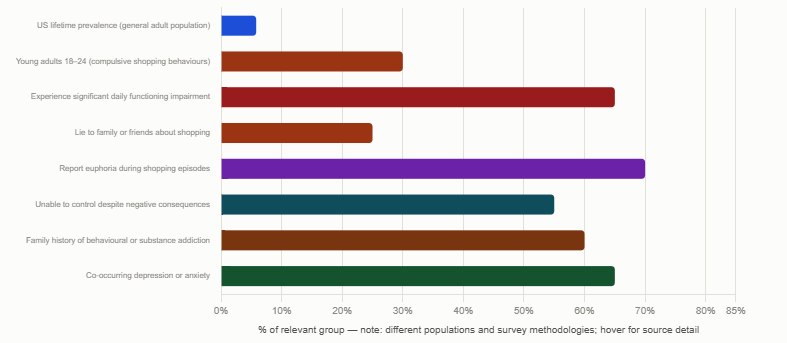
UK: 8%–16% of the population estimated affected (Recovery Lighthouse, Aug 2026). US: 5.8% lifetime prevalence (widely cited prevalence study). Worldwide: 5–8% (University of Iowa meta-analysis). 65% of those with compulsive shopping have co-occurring depression or anxiety. Online shopping addiction: up 25% over 5 years. E-commerce: 16.8% of US retail in Q1 2026.
The defining features, as identified across Recovery.org.uk, Liberty House, Steps Together, and UKAT: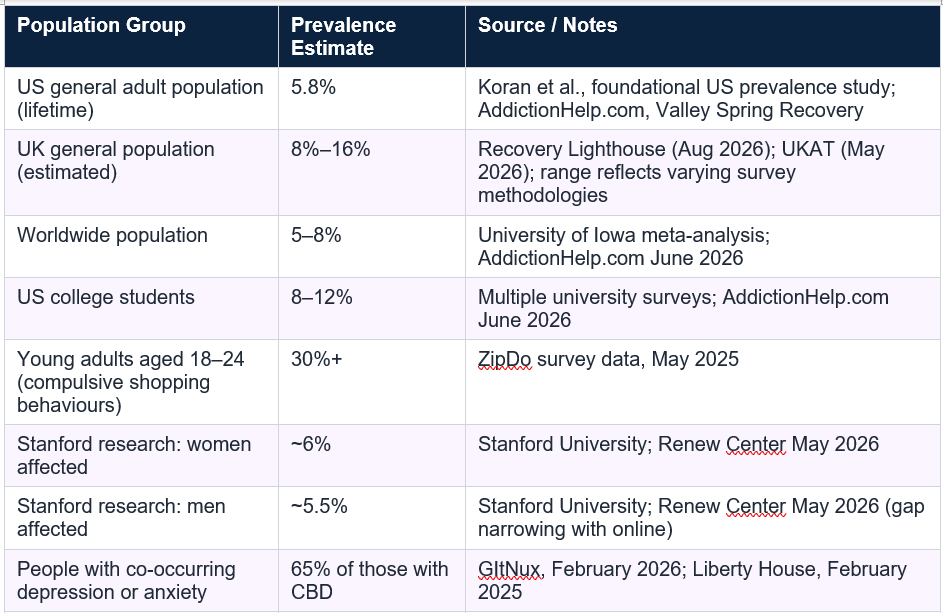

The cycle, described across multiple clinical sources:
The dopamine loop means that the brief pleasure of buying is neurologically real, even if it is short-lived. This is why shopping addiction is genuinely hard to stop without structured support. The brain has learned that shopping provides relief, and it will continue to generate that urge until the underlying emotional need is addressed and the circuit is gradually retrained through consistent alternative behaviours and, for many people, professional therapeutic support.
25% of compulsive shoppers admit to lying about their shopping to family or friends (GItNux). Concealment is a significant behavioural marker of addiction rather than normal overspending. If the response to a purchase is to hide the evidence rather than use the item, this is clinically meaningful. The concealment itself causes psychological harm — the maintenance of a secret spending life increases shame and isolation, which are both triggers for further compulsive buying.
Common emotional triggers identified across clinical sources (Delamere, Liberty House, UKAT, Recovery Lighthouse):
Shopping addiction is a recognised psychological condition with identifiable neurological mechanisms, identifiable psychological risk factors (low self-esteem, anxiety, depression, history of trauma, impulsive personality traits), and identifiable family patterns (around 60% of those with CBD have a family history of addictive behaviour). It is not a character defect.
The first practical step is an honest self-inventory: reviewing bank statements and credit card bills for the past three to six months, not to generate more shame but to establish a factual baseline of what is actually happening. Many people with shopping addiction are not fully aware of the total scale of their spending because each individual purchase felt small or justified in the moment.
Review your last three months of bank and credit card statements and calculate your total discretionary spending on shopping. Write the total down. Not to judge it — to see it. Most people with compulsive buying patterns are shocked by the aggregate figure because the habit feels normal in individual units. Seeing the total is often the first genuine confrontation with the scale of the pattern.
For one to two weeks, keep a simple note every time you feel the urge to shop or make an unplanned purchase. Record:
Practical friction strategies:
For each identified emotional trigger, identify a specific alternative response:
What CBT for shopping addiction addresses specifically (Liberty House, February 2025; Steps Together, October 2025; Delamere, December 2025):
In the UK, CBT is available through the NHS (GP referral) or privately. Waiting times for NHS CBT vary significantly by region; many people access private therapy more quickly. Online CBT platforms are also increasingly available. Steps Together (2025) recommends asking your GP specifically for a referral to a therapist with experience in behavioural addictions, as general CBT practitioners may not be familiar with the specific patterns of compulsive buying disorder.
The recommended approach to financial recovery alongside addiction treatment:
What consistent engagement with therapy and support looks like in practice:
The path out is the same for most behavioural addictions: honest recognition, understanding of the emotional drivers, deliberate environmental changes, structured therapeutic support (CBT is the most evidence-based approach), financial recovery support, and sustained peer connection. None of these steps requires a dramatic gesture or a perfect day. They require consistent, repeated small actions in the direction of change.
If this guide has described your experience — or the experience of someone you care about — the most important next step is to speak to someone. That might be a GP, a therapist, a debt advice charity, or a peer support group. It does not have to be all of them at once. But the first conversation changes everything, because the most isolating thing about shopping addiction is the secrecy that surrounds it, and the most healing thing about seeking help is discovering you are not alone in this.
Yes, it is recognised by mental health professionals as a real behavioural condition, though it is not yet listed as a standalone diagnosis in the DSM-5 or ICD-11. In 2021, a study involving 138 specialists from 35 countries reached consensus that compulsive buying disorder should be classified as a behavioural addiction and established diagnostic criteria (Recovery.org.uk, January 2026). It shares the core features of other behavioural addictions: craving, temporary reward, negative consequences, and compulsive repetition despite motivation to stop. It is not simply 'enjoying shopping' or 'being bad with money' — it is a psychological condition with identifiable neurological and emotional mechanisms that requires structured support to address.
How do I know if I have a shopping addiction or just overspend?
The key difference is control. Overspending means spending more than you intended or can afford but being able to change the behaviour when the consequences become clear. Shopping addiction means being unable to control the behaviour despite awareness that it is causing financial, relational, or psychological harm. Additional markers: experiencing intense urges or anxiety before shopping; hiding purchases from family or friends; buying items you never use; feeling euphoria during purchase followed rapidly by guilt; making repeated failed attempts to cut back. If five or more of the warning signs described in this guide apply to you, it is worth speaking to a GP or mental health professional.
What is the best treatment for shopping addiction?
Cognitive Behavioural Therapy (CBT) is identified as the most effective evidence-based treatment by UK addiction clinics including Delamere, Liberty House, Steps Together, and Recovery.org.uk. CBT helps identify the thought patterns driving compulsive buying, develop practical trigger management skills, and address underlying beliefs about self-worth. Dialectical Behaviour Therapy (DBT) is also used, particularly for emotional regulation. Group therapy, Debtors Anonymous (peer support), and financial counselling through StepChange (UK) or NFCC (US) address the financial and social dimensions. For some people, medication for co-occurring depression or OCD symptoms can reduce the compulsive urge and is worth discussing with a GP or psychiatrist alongside psychological treatment.
How does online shopping make addiction worse?
Online shopping removes most of the natural friction that moderates in-store buying: there are no opening hours, no travel requirement, no social environment, and no physical cost of handing over money. One-tap checkout, saved card details, BNPL, push notifications, and social commerce (TikTok Shop, Instagram) compress the time between impulse and purchase to seconds. A 2024 study found BNPL adoption was linked with a 6.42% increase in online spending. Online shopping also provides privacy that in-store buying does not — research suggests this is a significant reason why male compulsive buyers are underrepresented in treatment statistics. The most effective environmental intervention for online shopping addiction is removing the purchase pathway from the smartphone: uninstall apps, remove saved payment details, block shopping sites during high-risk times.
Where can I get free help for shopping addiction in the UK?
GP: speak to your GP and ask for a referral to CBT or a mental health specialist with experience in behavioural addictions. NHS talking therapies (IAPT services) provide free CBT, though waiting times vary. Debtors Anonymous: free peer support meetings (in person and online) specifically for compulsive spending and debt. stepchangeapp.co.uk: StepChange offers free debt advice and management plans online and by phone (0800 138 1111). Citizens Advice: free debt and financial advice at citizensadvice.org.uk. The Samaritans: 116 123 (free, 24/7) if the distress associated with shopping addiction or debt is acute or affecting your safety. Private therapy: if waiting times are a barrier, organisations like BACP (bacp.co.uk) maintain a register of accredited therapists, many of whom offer sliding-scale fees.
Can shopping addiction be cured?
Recovery from shopping addiction is achievable for most people who engage consistently with appropriate support, though the nature of recovery varies. Some people achieve a state of controlled, conscious shopping with firm boundaries; others find that complete abstinence from non-essential shopping is the most stable long-term approach. Recovery.org.uk (January 2026) describes both outcomes as valid and notes that the individual's response to treatment, the presence of co-occurring conditions, and the level of consistent support all affect the recovery trajectory. Research consistently shows that sustained engagement with therapy plus peer support produces substantial declines in compulsive spending and reversal of debt. Recovery is rarely a straight line but is consistently achievable for people who seek help.
Table of Contents
- When Shopping Stops Being a Pleasure and Becomes a Problem
- What Is Shopping Addiction? The Clinical Picture
- How Common Is It? The Statistics
- The Dopamine Loop: Why Shopping Addiction Feels Like It Works
- Recognising the Signs: Shopping vs Compulsive Buying
- The Emotional Triggers: What Drives the Urge to Buy
- The Financial and Mental Health Consequences
- Step 1: Acknowledge the Pattern Without Shame
- Step 2: Identify Your Triggers
- Step 3: Create Friction Between Impulse and Purchase
- Step 4: Address the Underlying Emotional Driver
- Step 5: Seek Cognitive Behavioural Therapy (CBT)
- Step 6: Financial Recovery — Dealing with the Debt
- Step 7: Build a Support System
- Online Shopping Addiction: A Specific Challenge
- What Recovery Actually Looks Like
- Conclusion: Recovery Is Possible, and It Starts With Recognition
- Frequently Asked Questions
Key Statistics: Who's Affected And Co-occurring Conditions
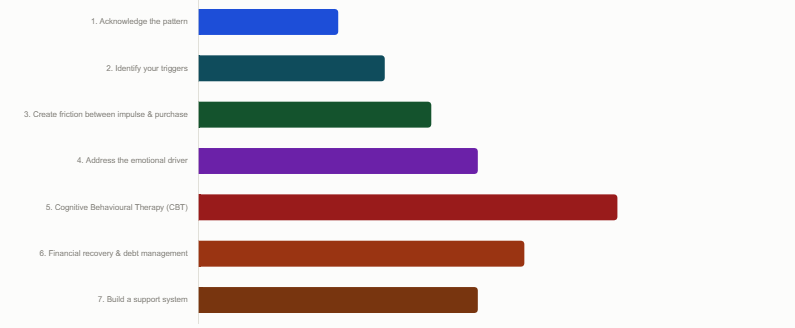
The Recovery Path: 7 Steps And What Each Addresses
When Shopping Stops Being a Pleasure and Becomes a Problem
Everybody shops. Everybody occasionally buys something on impulse and slightly regrets it. Neither of these things is a shopping addiction. The difference between enjoying shopping and being addicted to it is not the frequency or the spending level: it is the inability to stop despite knowing the behaviour is causing harm.Shopping addiction — clinically called compulsive buying disorder (CBD), or oniomania — is a behavioural addiction characterised by repetitive, uncontrolled purchasing that causes financial, psychological, and relational damage. The person with a shopping addiction typically experiences a cycle of pre-purchase anxiety or craving, brief euphoria during the act of buying, followed by guilt, shame, or regret — and then the same urge arising again, often within hours.
It is more common than most people assume. In the UK, estimates place the affected population at between 8% and 16% of adults (Recovery Lighthouse, August 2026). In the US, the lifetime prevalence is approximately 5.8% (the most widely cited figure from a foundational prevalence study, cited across AddictionHelp.com, Valley Spring Recovery, and others). As e-commerce has expanded — now accounting for 16.8% of total US retail sales in Q1 2026 — online shopping addiction has increased by approximately 25% over the last five years. The problem is growing.
This guide is written for two audiences: people who suspect they have a shopping addiction and want a clear explanation of what is happening and what to do about it; and people who are supporting someone they care about. It covers the neuroscience, the warning signs, the emotional triggers, and the evidence-based steps that mental health professionals consistently recommend. It does not replace professional support. It is a starting point.
UK: 8%–16% of the population estimated affected (Recovery Lighthouse, Aug 2026). US: 5.8% lifetime prevalence (widely cited prevalence study). Worldwide: 5–8% (University of Iowa meta-analysis). 65% of those with compulsive shopping have co-occurring depression or anxiety. Online shopping addiction: up 25% over 5 years. E-commerce: 16.8% of US retail in Q1 2026.
What Is Shopping Addiction? The Clinical Picture
Shopping addiction is recognised by mental health professionals as compulsive buying disorder (CBD), though it is not yet listed as a standalone diagnosis in the DSM-5 (the primary US psychiatric diagnostic manual) or the ICD-11. However, in 2021, a study with 138 specialists from 35 countries reached consensus that CBD should be classified as a behavioural addiction and established diagnostic criteria (Recovery.org.uk, January 2026). It is frequently classified in clinical practice under obsessive-compulsive and related disorders or impulse control disorders.The defining features, as identified across Recovery.org.uk, Liberty House, Steps Together, and UKAT:
- A persistent, intrusive preoccupation with shopping, purchasing, or browsing for items to buy.
- Experiencing tension, anxiety, or a craving-like state before making a purchase.
- A brief sense of relief, pleasure, or euphoria during the purchase.
- Rapid onset of regret, guilt, or shame after the purchase.
- Repetition of the cycle despite awareness of the negative consequences.
- Inability to control or stop the behaviour despite sustained motivation to do so.
How Common Is It? The Statistics
The Dopamine Loop: Why Shopping Addiction Feels Like It Works
Understanding why shopping addiction is difficult to stop requires understanding what happens in the brain during the buying cycle. Shopping addiction, like all behavioural addictions, is rooted in the brain’s dopamine reward system — the same neurological pathway involved in substance addiction.The cycle, described across multiple clinical sources:
- Anticipation: browsing, searching, and adding items to a basket triggers a dopamine surge. The brain responds to the prospect of reward, not the reward itself. This is why window shopping and adding items to an online cart feels almost as satisfying as buying.
- Purchase: the moment of buying produces a peak in dopamine — a brief but intense sense of pleasure, relief, or elation. Approximately 70% of people with shopping addiction report a feeling of euphoria or ‘high’ during shopping sprees (GItNux, February 2026).
- Comedown: the euphoria fades rapidly. The average retail therapy mood boost lasts approximately 30 to 60 minutes (GItNux; ZipDo, May 2025). What remains: the item, the cost, the guilt, and the unchanged emotional state that triggered the urge in the first place.
- Craving: the brain, trained to associate shopping with dopamine release, generates the urge to repeat the cycle. The next trigger — an email, a notification, a moment of stress or boredom — produces the familiar craving.
The dopamine loop means that the brief pleasure of buying is neurologically real, even if it is short-lived. This is why shopping addiction is genuinely hard to stop without structured support. The brain has learned that shopping provides relief, and it will continue to generate that urge until the underlying emotional need is addressed and the circuit is gradually retrained through consistent alternative behaviours and, for many people, professional therapeutic support.
Recognising the Signs: Shopping vs Compulsive Buying
Recognising shopping addiction in oneself is often genuinely difficult, because shopping is a normal, everyday activity — and because the guilt and shame associated with the disorder frequently produce denial and concealment. Delamere (December 2025), Liberty House, Recovery Lighthouse, and UKAT all identify similar diagnostic indicators. A pattern of five or more of the following is generally considered clinically significant:- Financial struggles: falling behind on rent, bills, or debt repayments specifically as a result of spending.
- Preoccupation: constantly thinking about shopping, browsing online, or planning the next purchase, even when doing other things.
- Hiding purchases: concealing shopping bags, deleting order confirmation emails, hiding receipts, or lying about what was spent.
- Buying unused items: regularly purchasing things that are worn once or never used, still in packaging months later.
- Emotional relief from buying: using shopping deliberately and repeatedly as a way to manage negative emotions (stress, loneliness, boredom, anxiety, sadness).
- Guilt and regret: experiencing significant guilt or shame after most purchases but continuing to shop anyway.
- Failed attempts to cut back: genuinely trying to reduce shopping but finding it impossible to maintain control over time.
- Relationship problems: hiding financial information from a partner, arguments about spending, or damaged relationships as a result of shopping behaviour.
- Shopping despite inability to afford it: spending money that was needed for other things, or using credit, loans, or BNPL to fund purchases.
25% of compulsive shoppers admit to lying about their shopping to family or friends (GItNux). Concealment is a significant behavioural marker of addiction rather than normal overspending. If the response to a purchase is to hide the evidence rather than use the item, this is clinically meaningful. The concealment itself causes psychological harm — the maintenance of a secret spending life increases shame and isolation, which are both triggers for further compulsive buying.
The Emotional Triggers: What Drives the Urge to Buy
Shopping addiction is almost never primarily about the items purchased. The shopping is a coping mechanism for an emotional state that the person does not know how to manage in another way. Identifying the specific emotional trigger for each individual is one of the most important steps in recovery, because addressing the trigger — rather than just the shopping behaviour — is what produces lasting change.Common emotional triggers identified across clinical sources (Delamere, Liberty House, UKAT, Recovery Lighthouse):
- Stress: shopping provides a sense of control, accomplishment, and reward during periods of work, relationship, or life stress. The purchase decision feels like agency at a moment when everything else feels unmanageable.
- Loneliness and isolation: the interactions with shop staff, the digital community of product reviews and unboxing, and the social validation of visibly owning new things provide a substitute for genuine connection.
- Low self-esteem: for some people, buying things — particularly clothing, beauty products, or aspirational lifestyle items — temporarily produces a sense of worthiness or attractiveness that they struggle to access internally.
- Boredom: shopping, particularly online shopping, is highly stimulating. It provides novelty, anticipation, decision-making, and social comparison content. It is an accessible, private activity that fills time without requiring social engagement.
- Depression and anxiety: up to 65% of those with compulsive buying disorder have co-occurring depression or anxiety (GItNux). Shopping temporarily regulates mood — it produces the dopamine lift that depression suppresses and the sense of certainty that anxiety erodes.
- Celebratory events and sales triggers: retail events (Black Friday, end-of-season sales, birthday, payday) create both urgency and social permission to buy, functioning as environmental triggers for the addictive cycle even for people who have otherwise maintained control.
The Financial and Mental Health Consequences
The consequences of untreated shopping addiction compound over time and extend across multiple life domains:- Debt: the vast majority of people with shopping addiction accrue significant financial debt. This can affect the ability to pay rent, utilities, and other essential bills. Rehab Recovery (April 2025) notes that debt associated with shopping addiction can generate suicidal ideation — and advises anyone in this position to contact the Samaritans and a debt advice service such as Citizens Advice in the UK.
- Relationship damage: compulsive spending — particularly when hidden from a partner — erodes trust. Arguments about money are among the most common relationship stressors; financial deception compounds this significantly. Rehab Recovery describes ‘manipulative behaviours and lying’ as common relationship consequences.
- Mental health: shopping addiction causes significant daily functioning impairment in approximately 65% of cases (ZipDo). The guilt, shame, and secrecy associated with the disorder increase depression and anxiety, creating a feedback loop in which the mental health condition worsens and drives further shopping.
- Reduced life quality: as shopping becomes the primary source of stimulation and relief, other activities, relationships, and interests shrink. Rehab Recovery describes this as losing ‘a well-rounded and colourful life’ in exchange for a narrowly focused existence around the acquisition cycle.
Step 1: Acknowledge the Pattern Without Shame
Recovery from shopping addiction begins with one thing: recognising that what is happening is a compulsive behavioural pattern, not a personal moral failing. This distinction matters because shame is both a consequence of the disorder and one of its most potent fuel sources. A person who believes they are simply ‘weak’ or ‘bad with money’ is less likely to seek help and more likely to use shopping to escape the shame — the opposite of what is needed.Shopping addiction is a recognised psychological condition with identifiable neurological mechanisms, identifiable psychological risk factors (low self-esteem, anxiety, depression, history of trauma, impulsive personality traits), and identifiable family patterns (around 60% of those with CBD have a family history of addictive behaviour). It is not a character defect.
The first practical step is an honest self-inventory: reviewing bank statements and credit card bills for the past three to six months, not to generate more shame but to establish a factual baseline of what is actually happening. Many people with shopping addiction are not fully aware of the total scale of their spending because each individual purchase felt small or justified in the moment.
Review your last three months of bank and credit card statements and calculate your total discretionary spending on shopping. Write the total down. Not to judge it — to see it. Most people with compulsive buying patterns are shocked by the aggregate figure because the habit feels normal in individual units. Seeing the total is often the first genuine confrontation with the scale of the pattern.
Step 2: Identify Your Triggers
Once the pattern is acknowledged, the next step is to map the specific triggers that precede compulsive shopping episodes. This is a clinical exercise used in Cognitive Behavioural Therapy for compulsive buying and can be started independently.For one to two weeks, keep a simple note every time you feel the urge to shop or make an unplanned purchase. Record:
- What time of day it is.
- What you were doing immediately before the urge arose.
- What you were feeling before the urge (stressed, bored, lonely, sad, excited, anxious, celebratory).
- Whether you acted on the urge, and how you felt immediately after.
- Whether you used a physical shop, an online retailer, a social media platform (TikTok Shop, Instagram), or a delivery app.
Step 3: Create Friction Between Impulse and Purchase
Shopping addiction thrives in the absence of friction. E-commerce, one-tap checkout, BNPL, saved card details, and push notifications from apps are all specifically designed to reduce the time between desire and purchase to near zero. Creating deliberate friction is one of the most effective non-therapeutic interventions available.Practical friction strategies:
- Delete saved payment details from all shopping websites and apps. Requiring manual card entry for each purchase introduces a 30 to 60-second pause that interrupts the automatic purchase pipeline. Many impulse purchases do not survive this pause.
- Uninstall shopping apps from your phone. If you want to make a purchase, require yourself to use a desktop computer or explicitly reinstall the app. The additional steps create time for the impulse to subside.
- Implement a 24-hour or 72-hour waiting rule for all non-essential purchases. Add the item to a wishlist and revisit after the waiting period. Most compulsive purchase urges do not survive 24 hours; many do not survive one hour.
- Use cash for all in-store purchases where possible. The physical act of counting and handing over cash engages the brain differently than card payment, producing greater awareness of spending.
- Cancel or block BNPL access. A 2024 study found BNPL adoption was linked with a 6.42% increase in online spending. BNPL removes the last natural psychological friction in the purchase decision — the full price — and is specifically associated with increased compulsive spending.
- Unsubscribe from all promotional emails in a single session. Many compulsive shopping episodes are triggered by a sale alert that creates artificial urgency. Removing the trigger removes a significant proportion of the urge.
Step 4: Address the Underlying Emotional Driver
Friction strategies and behavioural rules manage the symptom. Addressing the emotional driver manages the cause. If shopping is being used to regulate stress, loneliness, depression, or anxiety, restricting shopping without providing an alternative regulation strategy leaves the emotional need unmet — which produces rebound behaviour, increased craving, and often switches to an alternative compulsive behaviour.For each identified emotional trigger, identify a specific alternative response:
- Stress — replace with: a 10-minute walk, a short breathing exercise, a phone call to a friend, or a physical activity. The goal is a dopamine-generating activity that does not produce financial harm.
- Loneliness — replace with: a genuine social interaction (calling someone, attending a group activity, joining a community). Online shopping communities often provide a social environment that reinforces the addiction; genuine social connection does not.
- Boredom — replace with: a specific pre-planned activity that is absorbing enough to substitute (a book, a creative project, cooking, exercise). Having the alternative ready before boredom strikes is critical: deciding what to do when already bored produces the path of least resistance, which is scrolling.
- Low mood or depression — this trigger typically requires professional support rather than self-management alone. CBT, exercise, and social connection are evidence-based responses, but consistent low mood that is driving compulsive behaviour is a signal to consult a GP or mental health professional.
Step 5: Seek Cognitive Behavioural Therapy (CBT)
Cognitive Behavioural Therapy (CBT) is identified by every major UK addiction clinic and recovery resource as the most effective evidence-based treatment for compulsive buying disorder. CBT works by identifying and changing the thought patterns that drive compulsive behaviour, developing practical skills for managing triggers, and addressing the distorted beliefs about self-worth, control, and emotion regulation that underlie the addiction.What CBT for shopping addiction addresses specifically (Liberty House, February 2025; Steps Together, October 2025; Delamere, December 2025):
- Identifying the automatic thoughts that occur before a purchase ('I deserve this,' 'I’ll feel better once I have it,' 'It’s just this once') and evaluating whether they are accurate.
- Developing specific skills for tolerating the discomfort of urges without acting on them — what therapists call ‘urge surfing.’
- Addressing core beliefs about self-worth that are linked to material acquisition.
- Developing practical strategies for avoiding or managing high-risk trigger environments (promotional events, shopping apps, social media shopping features).
In the UK, CBT is available through the NHS (GP referral) or privately. Waiting times for NHS CBT vary significantly by region; many people access private therapy more quickly. Online CBT platforms are also increasingly available. Steps Together (2025) recommends asking your GP specifically for a referral to a therapist with experience in behavioural addictions, as general CBT practitioners may not be familiar with the specific patterns of compulsive buying disorder.
Step 6: Financial Recovery — Dealing with the Debt
For many people with shopping addiction, the debt accumulated is substantial and requires structured attention alongside the psychological recovery work. The financial consequences of untreated shopping addiction are not self-resolving: the debt continues to grow and the interest compounds while the behaviour continues, and the psychological weight of the debt itself can be a trigger for further compulsive buying.The recommended approach to financial recovery alongside addiction treatment:
- Immediate: stop using any credit card, BNPL service, or loan that is being used primarily to fund shopping. This may require physically cutting up cards, removing saved payment details, or asking your bank to place a temporary spending limit.
- Assess the full picture: make a complete list of all debts (credit cards, store cards, BNPL balances, personal loans) with their balances and interest rates. Most people with compulsive buying disorder have a fragmented and underestimated picture of their total debt.
- UK: contact StepChange (0800 138 1111) — a free, independent debt advice charity that provides a debt management plan, negotiates with creditors on your behalf, and makes no judgement about how the debt was accumulated.
- US: contact the National Foundation for Credit Counseling (NFCC, 1-800-388-2227) for free or low-cost credit counselling.
- Debtors Anonymous: a 12-step recovery programme specifically for compulsive spending and debt, with meetings available in person and online in both the UK and US. Steps Together (2025) identifies Debtors Anonymous as a particularly valuable peer support resource specifically for the financial dimension of shopping addiction.
Step 7: Build a Support System
Recovery from any behavioural addiction is significantly more durable with social support than without it. Isolation both triggers compulsive buying episodes and removes the accountability that supports sustained behaviour change. Building a support system for shopping addiction recovery involves three elements:- Disclosure: telling at least one trusted person — a partner, friend, family member, or therapist — about the struggle. The act of disclosure reduces shame, removes the cognitive burden of concealment, and creates accountability. For many people with shopping addiction, this is the hardest single step because the disorder is so often characterised by secrecy.
- Peer support: Debtors Anonymous (UK and US) and Spenders Anonymous provide structured peer support specifically for compulsive spending recovery. These are free, non-judgemental, and available online. They are not a replacement for therapy but function as a valuable adjunct, particularly for the early weeks when urges are most intense.
- Environmental restructuring: ask people in your household to support your recovery by not bringing in unnecessary shopping catalogues, not suggesting retail therapy as a social activity, and not asking you to accompany them on shopping trips during early recovery. This is not avoidance of the real world; it is reducing unnecessary exposure to high-risk environments while the new behavioural habits are being established.
Online Shopping Addiction: A Specific Challenge
Online shopping addiction has features that make it more difficult to address than in-store compulsive buying, and it is growing. US e-commerce reached 16.8% of total retail sales in Q1 2026. Online shopping addiction has increased by approximately 25% over the last five years (GItNux, February 2026). The specific features of online shopping that amplify the addiction:- Availability: online shopping is available 24 hours per day, seven days per week, from any location. There is no physical barrier of having to travel to a shop, no opening hours, and no social environment to monitor behaviour.
- Privacy: online purchases can be made in complete privacy. The social monitoring that provides some regulatory function in physical retail (the judgement of a shop assistant, the awareness of being seen) is absent online. Research suggests this privacy is a significant reason why the gender gap in shopping addiction has narrowed, with men more likely to shop compulsively online than in physical retail.
- Social commerce: TikTok Shop, Instagram Shop, and similar features place purchase opportunities directly inside social media content streams. A product seen in a creator video can be purchased without leaving the app, compressing the time between discovery and purchase to seconds.
- BNPL integration: BNPL options embedded in online checkout remove the full-price barrier and enable spending above current income without a credit check or visible debt accumulation.
What Recovery Actually Looks Like
Recovery from shopping addiction is not linear. It involves setbacks, renewed urges in trigger environments (sales events, payday, difficult periods at work), and the gradual, effortful process of training new neurological responses to old stimuli. Recovery.org.uk (January 2026) describes the realistic horizon: ‘Some people can return to controlled shopping with strict boundaries after treatment. However, many find that complete abstinence from unnecessary shopping is the only way to prevent a relapse.’What consistent engagement with therapy and support looks like in practice:
- Weeks 1–4: the urges are at their most intense. Friction strategies and the 24-hour waiting rule are critical. Withdrawal-like discomfort is normal and temporary.
- Months 1–3: the most common high-risk period for relapse. Sales events, payday, and emotional stress are particularly dangerous. Having a plan for each of these in advance — a written response protocol, a person to call, a specific alternative activity — is more effective than relying on in-the-moment willpower.
- Months 3–6: most people in structured therapy begin to notice the urges decreasing in frequency and intensity. The relationship between the emotional trigger and the shopping response is weakening. New coping behaviours are becoming more automatic.
- Long term: recovery rates from consistent therapy and peer support involvement show ‘substantial declines in compulsive spending and a steady reversal of debt’ (Addiction Group, February 2025). Continued vigilance remains important, particularly during high-risk seasons.
Conclusion
Shopping addiction is more common, more damaging, and more treatable than the cultural trivialisation of ‘retail therapy’ suggests. Between 8% and 16% of the UK population is estimated to be affected. Two-thirds of those affected have co-occurring depression or anxiety. The debt and relational consequences compound over time when untreated.The path out is the same for most behavioural addictions: honest recognition, understanding of the emotional drivers, deliberate environmental changes, structured therapeutic support (CBT is the most evidence-based approach), financial recovery support, and sustained peer connection. None of these steps requires a dramatic gesture or a perfect day. They require consistent, repeated small actions in the direction of change.
If this guide has described your experience — or the experience of someone you care about — the most important next step is to speak to someone. That might be a GP, a therapist, a debt advice charity, or a peer support group. It does not have to be all of them at once. But the first conversation changes everything, because the most isolating thing about shopping addiction is the secrecy that surrounds it, and the most healing thing about seeking help is discovering you are not alone in this.
Frequently Asked Questions
Is shopping addiction a real addiction?Yes, it is recognised by mental health professionals as a real behavioural condition, though it is not yet listed as a standalone diagnosis in the DSM-5 or ICD-11. In 2021, a study involving 138 specialists from 35 countries reached consensus that compulsive buying disorder should be classified as a behavioural addiction and established diagnostic criteria (Recovery.org.uk, January 2026). It shares the core features of other behavioural addictions: craving, temporary reward, negative consequences, and compulsive repetition despite motivation to stop. It is not simply 'enjoying shopping' or 'being bad with money' — it is a psychological condition with identifiable neurological and emotional mechanisms that requires structured support to address.
How do I know if I have a shopping addiction or just overspend?
The key difference is control. Overspending means spending more than you intended or can afford but being able to change the behaviour when the consequences become clear. Shopping addiction means being unable to control the behaviour despite awareness that it is causing financial, relational, or psychological harm. Additional markers: experiencing intense urges or anxiety before shopping; hiding purchases from family or friends; buying items you never use; feeling euphoria during purchase followed rapidly by guilt; making repeated failed attempts to cut back. If five or more of the warning signs described in this guide apply to you, it is worth speaking to a GP or mental health professional.
What is the best treatment for shopping addiction?
Cognitive Behavioural Therapy (CBT) is identified as the most effective evidence-based treatment by UK addiction clinics including Delamere, Liberty House, Steps Together, and Recovery.org.uk. CBT helps identify the thought patterns driving compulsive buying, develop practical trigger management skills, and address underlying beliefs about self-worth. Dialectical Behaviour Therapy (DBT) is also used, particularly for emotional regulation. Group therapy, Debtors Anonymous (peer support), and financial counselling through StepChange (UK) or NFCC (US) address the financial and social dimensions. For some people, medication for co-occurring depression or OCD symptoms can reduce the compulsive urge and is worth discussing with a GP or psychiatrist alongside psychological treatment.
How does online shopping make addiction worse?
Online shopping removes most of the natural friction that moderates in-store buying: there are no opening hours, no travel requirement, no social environment, and no physical cost of handing over money. One-tap checkout, saved card details, BNPL, push notifications, and social commerce (TikTok Shop, Instagram) compress the time between impulse and purchase to seconds. A 2024 study found BNPL adoption was linked with a 6.42% increase in online spending. Online shopping also provides privacy that in-store buying does not — research suggests this is a significant reason why male compulsive buyers are underrepresented in treatment statistics. The most effective environmental intervention for online shopping addiction is removing the purchase pathway from the smartphone: uninstall apps, remove saved payment details, block shopping sites during high-risk times.
Where can I get free help for shopping addiction in the UK?
GP: speak to your GP and ask for a referral to CBT or a mental health specialist with experience in behavioural addictions. NHS talking therapies (IAPT services) provide free CBT, though waiting times vary. Debtors Anonymous: free peer support meetings (in person and online) specifically for compulsive spending and debt. stepchangeapp.co.uk: StepChange offers free debt advice and management plans online and by phone (0800 138 1111). Citizens Advice: free debt and financial advice at citizensadvice.org.uk. The Samaritans: 116 123 (free, 24/7) if the distress associated with shopping addiction or debt is acute or affecting your safety. Private therapy: if waiting times are a barrier, organisations like BACP (bacp.co.uk) maintain a register of accredited therapists, many of whom offer sliding-scale fees.
Can shopping addiction be cured?
Recovery from shopping addiction is achievable for most people who engage consistently with appropriate support, though the nature of recovery varies. Some people achieve a state of controlled, conscious shopping with firm boundaries; others find that complete abstinence from non-essential shopping is the most stable long-term approach. Recovery.org.uk (January 2026) describes both outcomes as valid and notes that the individual's response to treatment, the presence of co-occurring conditions, and the level of consistent support all affect the recovery trajectory. Research consistently shows that sustained engagement with therapy plus peer support produces substantial declines in compulsive spending and reversal of debt. Recovery is rarely a straight line but is consistently achievable for people who seek help.
0 Comments
Be the first to share your thoughts on this article.