
Spending
How to Cut Your Grocery Bills — What Actually Worked
Grocery prices are 29.4% higher than they were in March 2020. The average US household now spends approximately $170 per week — up significantly from 2020. 67.6% of shoppers say they are struggling to pay their grocery bills, and 75.2% have cut spending elsewhere just to keep food on the table. So what is actually working? We pulled the data on the strategies that produce real savings — how much, how fast, and how much effort each one takes.
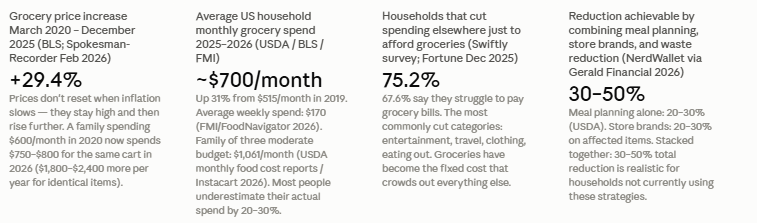
That feeling is real, documented, and widespread. Grocery prices — the official category is ‘food at home’ — rose 29.4% between March 2020 and December 2025, according to the Bureau of Labor Statistics (BLS). A family spending $600 a month on groceries in 2020 could be spending $750 to $800 for the same cart in 2026, according to Gerald Financial’s 2026 household grocery analysis — that’s $1,800 to $2,400 more per year, for identical items.
The cumulative shock is the part that doesn’t get enough attention. The inflation rate in 2026 is approximately 2.7% for at-home food prices (USDA Economic Research Service), which sounds modest. The issue is that this 2.7% is on top of the 11.4% spike in 2022, the 4% in 2021, and years of compound increases before that. Prices don’t reset when inflation slows. They stay high, and then they rise further from the new elevated baseline. This is why 67.6% of shoppers in a Swiftly survey (Fortune, December 2025) said they are struggling to pay their grocery bills — not because of one bad year, but because the bill has compounded for five years.
This guide does not promise to return prices to 2019 levels. It reports what actually works, how much each strategy saves, and how much effort each one requires — based on USDA data, BLS consumer expenditure research, and 2026 grocery savings analysis from multiple industry sources.
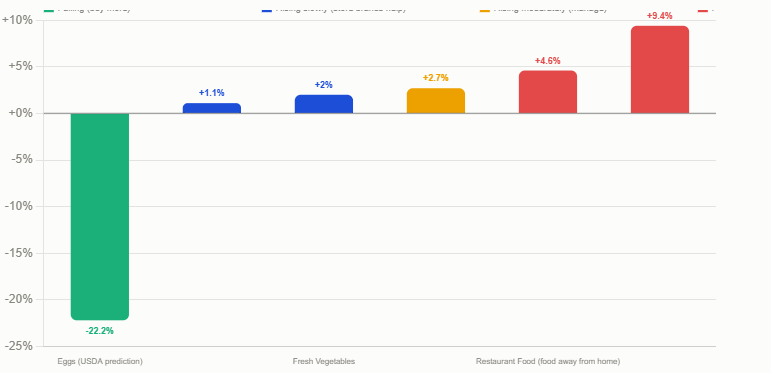
Grocery prices up 29.4% between March 2020 and December 2025 (BLS; CNH/Spokesman-Recorder February 2026). At-home food prices increased 2.7% in 2026 (USDA ERS; Instacart 2026). Average household grocery spend: approximately $677-$700/month ($170/week) in 2025-2026 (Motley Fool/USDA; FMI/FoodNavigator 2026). Up 31% from $515/month in 2019. Family of three moderate budget: $1,061/month (USDA/Instacart 2026). 67.6% say they struggle to pay grocery bills (Swiftly survey; Fortune December 2025). 75.2% cut spending elsewhere to afford groceries (Swiftly; Fortune 2025). Beef: +9.4% predicted in 2026. Eggs: -22.2% predicted (after prior highs). Restaurant food: +4.6% — faster than grocery price growth.
The corrective step is mechanical: pull your last three months of bank and credit card statements and add up every transaction at a grocery store, warehouse club, pharmacy, convenience store, or online delivery service that involved food. Do not estimate. Add the actual numbers. Most people who complete this exercise discover their real monthly grocery spend is $50 to $200 higher than they thought.
Once you have the real number, the USDA’s published monthly food cost benchmarks give you a useful reference point. A moderate-cost plan for a single adult male runs approximately $390 per month; a single adult female $329 per month; a family of three (one adult male, one adult female, one child) approximately $1,061 per month (USDA monthly food cost reports; Instacart 2026). If your number is significantly above these benchmarks, the gap is likely recoverable through the strategies in this guide. If it is at or below these benchmarks, you are already performing well and the goal is to hold the line as prices continue rising.
The baseline step: log into your bank or credit card account and run the numbers for the last 90 days. Search for all grocery, food, and household supply purchases. Include Amazon Fresh/Whole Foods orders, Instacart, DoorDash (the food cost, not the delivery fee, if you are counting grocery items ordered rather than restaurant meals), Costco or Sam’s Club, and gas station food. Divide by three. That is your true monthly baseline. Write it down. This number is the benchmark against which every strategy in this guide produces a measurable result. Savings estimates cited in this article assume you are starting from an accurate baseline, not a guess.
The mechanism has two parts. Planning prevents impulse purchases: when you enter the store knowing exactly what you are making and exactly what you need to make it, the attractive display of charcuterie, the buy-two-get-one promotion on cookies, and the new flavour of ice cream at the end of the aisle have significantly less power. The list is the friction between the impulse and the cart. The second mechanism is waste reduction: you buy what you will use. The produce that was going to go bad because you bought it optimistically with no specific plan now has a specific meal assigned to it, a specific day it will be used, and a much higher probability of actually being eaten.
MoneyLion’s May 2026 grocery savings guide suggests a specific implementation: reverse the planning order. Instead of planning meals and then looking for ingredients, look at the current week’s store sales and plan meals around what is already on discount. This shift produces a compounding benefit: the meals you are planning are built around the cheapest proteins and produce available that week, rather than starting from your ideal recipe list and paying whatever those ingredients cost.
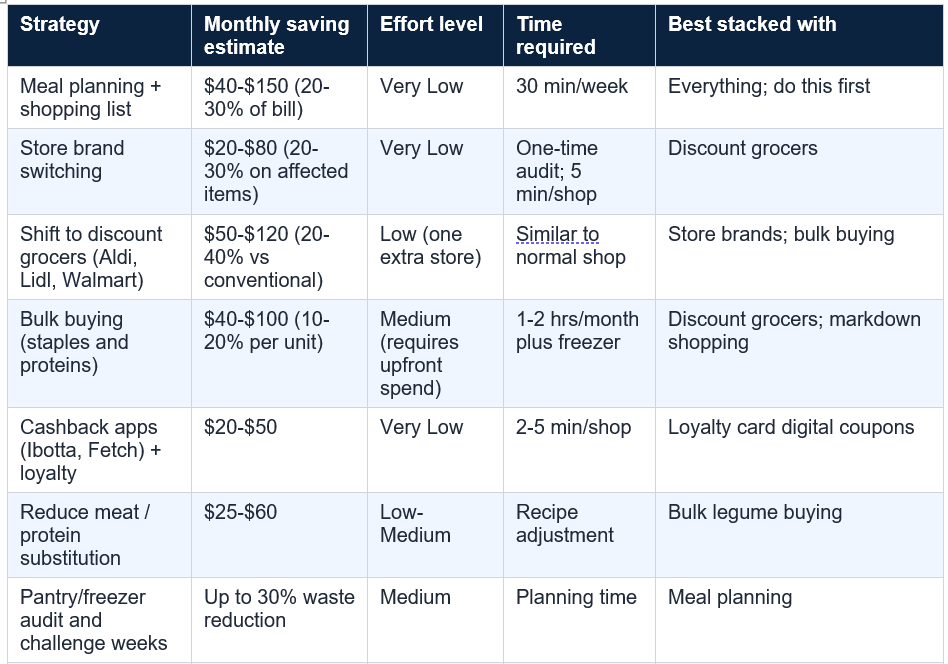
Meal planning savings estimate. Household baseline: $700/month. Conservative saving at 20%: $140/month ($1,680/year). Moderate saving at 25%: $175/month ($2,100/year). High saving at 30%: $210/month ($2,520/year). Time required: approximately 30 minutes per week to plan seven days of meals and build the shopping list from that plan. Annual time investment at 30 minutes/week: approximately 26 hours. Savings per hour of planning time at 25% saving: approximately $80.77/hour. This makes meal planning one of the highest-return-on-time activities in household budgeting. Source: USDA; Gerald Financial August 2026; MoneyLion May 2026. Estimates are approximate. Results vary by household size, location, and current spending habits.
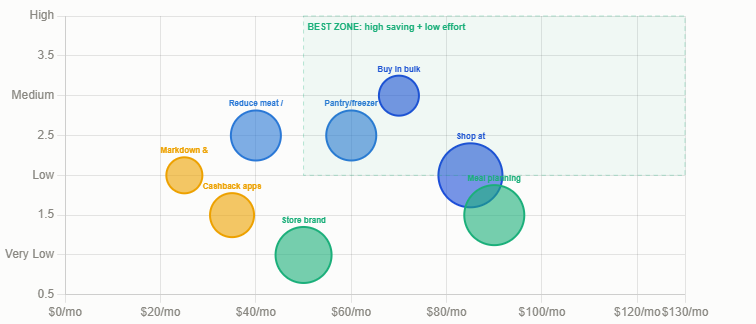
Gerald Financial’s 2026 analysis gives a specific illustration from the pasta aisle: Barilla’s gluten-free rotini runs $2.99 for 12 ounces versus $1.99 for 16 ounces of regular Barilla rotini. But the same comparison applies to conventional pasta: a major grocery chain’s store-brand penne is typically 50 to 70 cents per pound cheaper than the equivalent name-brand product. Applied across a full cart, store brand switching generates $20 to $80 in monthly savings depending on household size and the proportion of the cart previously occupied by name brands.
The items where store brands produce the most consistent value are pantry staples: canned goods (beans, tomatoes, corn, tuna), dried pasta and rice, cooking oils, flour and sugar, coffee, and cleaning products (a related household category). The items where name brand loyalty is most defensible are the specific products where the household actually notices and minds a quality difference — which for most households is a shorter list than the full cart. The practical approach is to trial-swap one or two categories per week and evaluate the quality; most households find the list of genuinely non-substitutable items is far smaller than expected.
The store-brand audit. Take your last grocery receipt and identify every name-brand product on it. For each one, check whether the store sells its own brand of the same product. If yes: buy the store brand next shop. Evaluate quality at home. If acceptable (which it almost always will be for pantry staples): keep the switch. If not acceptable: revert for that specific item. Most households can complete this audit in one shopping trip and achieve $20-$50 in monthly savings without noticing any meaningful quality difference.
The mechanism is operational rather than marketing-led: Aldi and Lidl operate with smaller stores, a limited assortment (approximately 1,500 to 2,000 SKUs versus 30,000+ in a conventional supermarket), predominantly private-label products, and lean staffing models. These efficiencies are passed to the customer. The tradeoff is a smaller selection, no name-brand alternatives for most products, and a shopping experience that requires minor adjustments (bags cost a small amount; carts require a quarter deposit; the store layout changes as stock changes).
For households that are not near an Aldi or Lidl: Walmart’s grocery section — the Great Value store brand in particular — consistently prices below conventional supermarkets. FoodNavigator’s 2026 grocery price outlook notes that Walmart is increasingly used as a grocery comparison benchmark because of its consistent pricing discipline and broad product availability.
The most effective implementation is a split-shop: buy the full cart at Aldi or Lidl, then supplement with any specific name-brand or specialty items the discount grocer does not carry from the conventional supermarket. Gerald Financial’s August 2026 savings guide estimates the average monthly saving from shifting primary grocery shopping to a discount grocer at $50 to $120/month.
The items where bulk buying produces the most reliable savings are: dried beans, lentils, and legumes (which also happen to be the most cost-effective protein sources per gram by a wide margin); rice and oats; pasta; canned goods; frozen proteins (chicken breast, ground beef, fish fillets); and shelf-stable pantry items (oils, vinegars, sauces, condiments). Gerald Financial’s cost-cutting guide emphasises that bulk buying works best for non-perishables and pantry staples, not fresh produce. Buying five pounds of spinach when it is on sale is not the same as buying five pounds of rice when it is on sale.
The freezer is the enabling technology for bulk protein buying. When chicken thighs are $1.49 per pound (on sale, family pack) versus $3.99 per pound for skinless boneless breasts (at full price, small pack), buying the family pack, dividing it into meal-sized portions in freezer bags, and freezing immediately produces a protein cost reduction that compounds every week for as long as the freezer supply lasts. Families who implement this strategy report $40 to $100 in monthly savings on protein costs alone.
Ibotta works on a specific-offer model: before your shopping trip, you activate offers on items you plan to buy (a specific brand of yogurt, a specific cereal, etc.), then upload your receipt to claim the cash back. Fetch Rewards works on a points model tied to any receipt from any store: scan any grocery receipt and earn points redeemable for gift cards. Checkout 51 offers weekly cashback offers available at any store. Store loyalty apps (Kroger, Safeway, Publix, etc.) often provide personalised digital coupons that price items below shelf price for loyalty card holders.
MoneyLion’s May 2026 guide notes that the best result comes from stacking: using store loyalty discounts at the shelf level, applying manufacturer digital coupons where available, and submitting the receipt to a cashback app afterward. Each layer adds a few dollars per trip. The combined monthly saving from this stacked approach is estimated at $20 to $50 per month with minimal additional time per trip.
The most common implementation failure with cashback apps is the activation step: Ibotta requires you to activate specific offers before purchase, not after. If you upload the receipt without having activated the relevant offer, the cashback is not available. Building a two-minute offer activation step into the pre-shop routine — while building the shopping list or in the car before entering the store — resolves this consistently.
The nutritional case for this swap is well established. Dried lentils cost approximately $1.50 to $2.00 per pound and provide approximately 18 grams of protein per cooked cup. Ground beef costs approximately $5.00 to $7.00 per pound (more for lean varieties) and provides approximately 23 grams of protein per 3-ounce cooked portion. The protein cost differential is approximately 10 to 15 times in favour of lentils. Eggs, canned tuna, canned sardines, and edamame all sit well below meat on a cost-per-gram-of-protein basis.
Beyond full meal substitutions, protein stretching — using a smaller portion of expensive meat alongside a larger portion of beans, lentils, or vegetables — preserves the flavour and satisfaction of meat-centred meals while reducing the meat cost per serving. A taco that uses 100 grams of ground beef plus half a can of refried beans costs less than a taco using 200 grams of ground beef alone, with a comparable eating experience for most households.
MoneyLion’s 2026 guide suggests the easiest entry point: replace one or two dinner proteins per week with beans, lentils, or eggs. Estimated monthly saving for a meat-heavy household: $25 to $60, depending on current meat consumption frequency and the price differential between current proteins and alternatives.
Gerald Financial’s July 2026 grocery budget guidebook describes the practice that directly addresses this: shop your freezer and pantry before you shop the store. The refrigerator, freezer, and pantry contain the most expensive inventory a household has — food already paid for that is at risk of being discarded before it is consumed. Building one week’s meals primarily or entirely from existing inventory, supplemented by fresh items that will actually be used in those specific planned meals, eliminates both waste and a full week of grocery expenditure.
The ‘pantry challenge’ — one to two weeks per month where the household commits to eating from the pantry and freezer with minimal new purchases — is a technique reported by frugal living communities as producing grocery bill reductions of 50% or more in the challenge weeks. Gerald’s analysis estimates food waste reduction alone is worth up to 30% of the food budget for households with currently high waste rates.
For meat specifically: approaching-date markdowns at conventional grocery stores can reach 30 to 50% off the regular shelf price. These markdowns typically happen in the morning or late in the evening depending on store policy. The items are still fully safe and of good quality — they are approaching the sell-by date, which is a conservative inventory management date rather than a food safety date. Bought and frozen the same day, they are identical in quality to full-price product.
For planning around weekly sales: every major grocery chain publishes its weekly ad at the start of the week (typically Wednesday or Thursday, starting the sale cycle for that week). Building the meal plan around what is on sale in that week’s ad — rather than deciding what you want to cook and then paying whatever those ingredients cost — is the technique MoneyLion’s 2026 guide describes as ‘reversing the planning order.’ It requires no additional time once the habit is established.
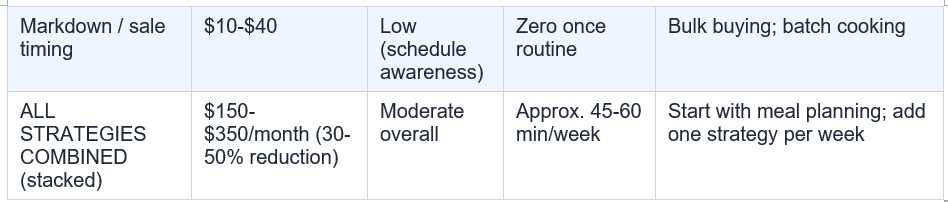
The answer from the research is unambiguous: 20 to 30% is achievable with two or three strategies applied consistently. Thirty to 50% is achievable with the full stack. The highest-impact single action is also the lowest-effort: write a meal plan for the week, build a shopping list from it, and do not deviate from the list in the store. The USDA’s own research finds this single habit produces a 20 to 30% reduction. That is $140 to $210 per month on a $700 baseline. It takes 30 minutes.
The challenge: for the next two weeks, implement just three of the strategies in this guide: the meal plan, the shopping list, and one store-brand switch for three to five pantry staples. Check the receipt total at the end of each shop against your baseline. The number will be lower. Not by 50% — not immediately. But by enough to notice, and by enough to motivate the next strategy. Not financial advice — savings estimates are approximate and results vary.
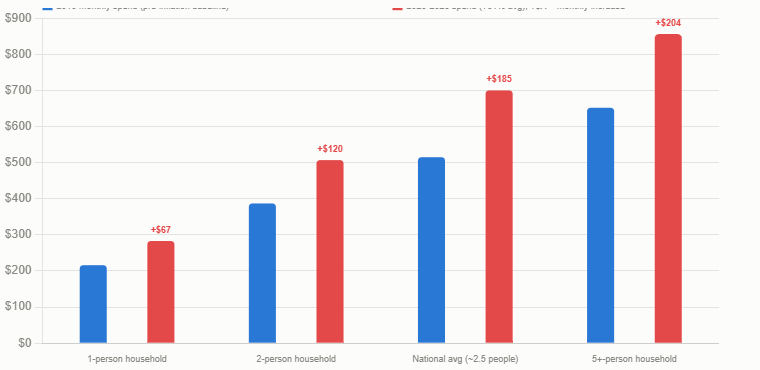
Based on multiple data sources for 2025-2026, the average US household spends approximately $677 to $700 per month on groceries, or approximately $170 per week (USDA Food Expenditure Series; BLS Consumer Expenditure Survey; FMI data via FoodNavigator 2026). This is up 31% from approximately $515 per month in 2019, reflecting the cumulative impact of grocery price inflation from 2020 through 2026. Spending varies significantly by household size: a one-person household averages approximately $283 per month, a two-person household approximately $507 per month, and a five-or-more-person household approximately $856 per month (BLS CEX 2024). USDA moderate-cost food plan benchmarks put a family of three (one adult male, one adult female, one child) at approximately $1,061 per month (USDA monthly food cost reports; Instacart 2026). Geographic location also affects spending significantly, with Hawaii seeing average monthly household grocery costs over $1,500 and Midwest states averaging below the national figure.
What is the most effective single strategy to cut a grocery bill?
Multiple independent sources — the USDA, WCPO, MoneyLion, Gerald Financial, and NerdWallet — all identify meal planning and shopping from a written list as the single most impactful grocery savings habit. The USDA estimates this practice alone reduces grocery bills by 20 to 30%. For a household spending $700 per month, that is $140 to $210 in monthly savings ($1,680 to $2,520 per year). The mechanism is simple: planning what you will cook for the week and buying only what those meals require eliminates impulse purchases and reduces food waste simultaneously. The implementation requires approximately 30 minutes per week. For maximum impact, plan meals around the current week’s store sales rather than planning meals first and paying whatever the ingredients cost — this ‘reverse planning’ approach stacks the sale-timing benefit with the planning benefit.
How much can switching to store brands save?
Switching from name-brand to store-brand products can save 20 to 50% on individual items, and 20 to 30% on the affected portion of a monthly grocery bill (Gerald Financial; MoneyLion 2026). For a household spending $700 per month with approximately 40% of the cart currently occupied by name-brand pantry staples, switching the pantry staple portion to store brands could save $56 to $84 per month. The items where store brands produce the most consistent savings with no meaningful quality difference include: canned goods (beans, tomatoes, corn, tuna), dried pasta and rice, cooking oils, flour and sugar, cleaning and household products, and most dairy products. The items where name-brand loyalty is most defensible are specific products where the household genuinely notices and minds a difference in taste or quality — which most households discover is a much shorter list than their current cart suggests.
Which cashback apps are best for groceries in 2026?
The most widely cited cashback apps for groceries in 2026 are Ibotta, Fetch Rewards, and Checkout 51 (Gerald Financial; MoneyLion May 2026). Ibotta offers cashback on specific items: activate offers before shopping, then upload the receipt to claim cash. It works at most major grocery chains and offers the highest individual offer values of the group, but requires the pre-activation step. Fetch Rewards earns points on any receipt from any grocery store without requiring offer activation — simply scan any receipt to earn points redeemable for gift cards. Checkout 51 offers weekly cashback offers valid at any store. For maximum savings, stack these apps with your store’s own loyalty programme: store loyalty card discounts reduce the shelf price, then cashback app offers add cash back on top. Estimated combined monthly saving: $20 to $50 per month with minimal additional time per trip (Gerald Financial; MoneyLion 2026). Not a financial endorsement of any specific app — app availability and offer terms change frequently.
Is it cheaper to cook at home or eat at restaurants in 2026?
Cooking at home is significantly cheaper than eating at restaurants in 2026, and the gap is widening. USDA ERS predicts food away from home (restaurants) will increase 4.6% in 2026, compared to 2.7% for groceries (at-home food). The long-term ratio is consistent: a home-cooked meal using grocery ingredients typically costs approximately three to five times less per serving than the equivalent meal purchased at a restaurant, accounting for the full cost of the restaurant meal including beverages and tip. For a household eating out twice a week, shifting both meals to home-cooked alternatives could save $200 to $400 per month depending on restaurant price levels and meal choices. Even cooking partially from scratch and supplementing with higher-convenience grocery items (pre-made sauces, rotisserie chicken, prepared side dishes) maintains a significant cost advantage over restaurant dining. Savings estimates are approximate and depend on restaurant choice and meal size.
Table of Contents
- How Much Have Grocery Bills Actually Gone Up?
- First: Know Your Real Number (Most People Are Wrong By 20-30%)
- Strategy #1: Meal Planning and the Shopping List
- Strategy #2: Switch to Store Brands and Generics
- Strategy #3: Shop at Discount Grocers
- Strategy #4: Buy Proteins and Staples in Bulk
- Strategy #5: Cashback Apps and Loyalty Programmes
- Strategy #6: Reduce Meat and Stretch Proteins
- Strategy #7: Audit Your Freezer and Pantry First
- Strategy #8: Time Your Shop Around Sales and Markdowns
- Stacking Strategies: How the Savings Multiply
- What Doesn’t Work: Traps That Feel Like Savings
- The 2026 Category Guide: What to Buy and What to Avoid This Year
- Conclusion: The Two-Week Grocery Challenge
- Frequently Asked Questions
What grocery bills look like by household size
Savings by strategy: effort vs monthly impact
2026 category winners and losers — what to buy now
How Much Have Grocery Bills Actually Gone Up?
There is a specific discomfort that hits when you look at your grocery receipt and it says $220 for what you swear used to be a $160 shop. You didn’t change what you buy. You didn’t add anything. The cart looked identical. But the total is not.That feeling is real, documented, and widespread. Grocery prices — the official category is ‘food at home’ — rose 29.4% between March 2020 and December 2025, according to the Bureau of Labor Statistics (BLS). A family spending $600 a month on groceries in 2020 could be spending $750 to $800 for the same cart in 2026, according to Gerald Financial’s 2026 household grocery analysis — that’s $1,800 to $2,400 more per year, for identical items.
The cumulative shock is the part that doesn’t get enough attention. The inflation rate in 2026 is approximately 2.7% for at-home food prices (USDA Economic Research Service), which sounds modest. The issue is that this 2.7% is on top of the 11.4% spike in 2022, the 4% in 2021, and years of compound increases before that. Prices don’t reset when inflation slows. They stay high, and then they rise further from the new elevated baseline. This is why 67.6% of shoppers in a Swiftly survey (Fortune, December 2025) said they are struggling to pay their grocery bills — not because of one bad year, but because the bill has compounded for five years.
This guide does not promise to return prices to 2019 levels. It reports what actually works, how much each strategy saves, and how much effort each one requires — based on USDA data, BLS consumer expenditure research, and 2026 grocery savings analysis from multiple industry sources.
Grocery prices up 29.4% between March 2020 and December 2025 (BLS; CNH/Spokesman-Recorder February 2026). At-home food prices increased 2.7% in 2026 (USDA ERS; Instacart 2026). Average household grocery spend: approximately $677-$700/month ($170/week) in 2025-2026 (Motley Fool/USDA; FMI/FoodNavigator 2026). Up 31% from $515/month in 2019. Family of three moderate budget: $1,061/month (USDA/Instacart 2026). 67.6% say they struggle to pay grocery bills (Swiftly survey; Fortune December 2025). 75.2% cut spending elsewhere to afford groceries (Swiftly; Fortune 2025). Beef: +9.4% predicted in 2026. Eggs: -22.2% predicted (after prior highs). Restaurant food: +4.6% — faster than grocery price growth.
First: Know Your Real Number (Most People Are Wrong By 20-30%)
Before any saving strategy can work, you need to know your actual baseline. Gerald Financial’s 2026 grocery budget guide is direct about this: most people underestimate their grocery spending by 20 to 30%. This is not laziness or inattention — it is because grocery spending bleeds across categories. The pharmacy run that included a bag of chips. The Target trip where half the cart was food. The gas station snack. None of these feel like ‘grocery spending’ but all of them are.The corrective step is mechanical: pull your last three months of bank and credit card statements and add up every transaction at a grocery store, warehouse club, pharmacy, convenience store, or online delivery service that involved food. Do not estimate. Add the actual numbers. Most people who complete this exercise discover their real monthly grocery spend is $50 to $200 higher than they thought.
Once you have the real number, the USDA’s published monthly food cost benchmarks give you a useful reference point. A moderate-cost plan for a single adult male runs approximately $390 per month; a single adult female $329 per month; a family of three (one adult male, one adult female, one child) approximately $1,061 per month (USDA monthly food cost reports; Instacart 2026). If your number is significantly above these benchmarks, the gap is likely recoverable through the strategies in this guide. If it is at or below these benchmarks, you are already performing well and the goal is to hold the line as prices continue rising.
The baseline step: log into your bank or credit card account and run the numbers for the last 90 days. Search for all grocery, food, and household supply purchases. Include Amazon Fresh/Whole Foods orders, Instacart, DoorDash (the food cost, not the delivery fee, if you are counting grocery items ordered rather than restaurant meals), Costco or Sam’s Club, and gas station food. Divide by three. That is your true monthly baseline. Write it down. This number is the benchmark against which every strategy in this guide produces a measurable result. Savings estimates cited in this article assume you are starting from an accurate baseline, not a guess.
Strategy #1: Meal Planning and the Shopping List
If there is a single strategy that every source agrees is the most impactful, it is this: plan your meals before you shop, and shop from a list. The USDA itself — cited in WCPO Cincinnati’s 2026 grocery savings guide — states that meal planning and using a shopping list can cut your grocery bill by 20 to 30%. That is the most significant savings estimate attributed to any single habit in the entire category.The mechanism has two parts. Planning prevents impulse purchases: when you enter the store knowing exactly what you are making and exactly what you need to make it, the attractive display of charcuterie, the buy-two-get-one promotion on cookies, and the new flavour of ice cream at the end of the aisle have significantly less power. The list is the friction between the impulse and the cart. The second mechanism is waste reduction: you buy what you will use. The produce that was going to go bad because you bought it optimistically with no specific plan now has a specific meal assigned to it, a specific day it will be used, and a much higher probability of actually being eaten.
MoneyLion’s May 2026 grocery savings guide suggests a specific implementation: reverse the planning order. Instead of planning meals and then looking for ingredients, look at the current week’s store sales and plan meals around what is already on discount. This shift produces a compounding benefit: the meals you are planning are built around the cheapest proteins and produce available that week, rather than starting from your ideal recipe list and paying whatever those ingredients cost.
Meal planning savings estimate. Household baseline: $700/month. Conservative saving at 20%: $140/month ($1,680/year). Moderate saving at 25%: $175/month ($2,100/year). High saving at 30%: $210/month ($2,520/year). Time required: approximately 30 minutes per week to plan seven days of meals and build the shopping list from that plan. Annual time investment at 30 minutes/week: approximately 26 hours. Savings per hour of planning time at 25% saving: approximately $80.77/hour. This makes meal planning one of the highest-return-on-time activities in household budgeting. Source: USDA; Gerald Financial August 2026; MoneyLion May 2026. Estimates are approximate. Results vary by household size, location, and current spending habits.
Strategy #2: Switch to Store Brands and Generics
Store brands and generic products are manufactured to the same quality and safety standards as name brands in most categories — and they cost 20 to 50% less. The gap between store-brand and name-brand pricing is not new, but the cost of ignoring it has become significantly larger as name-brand prices have compounded through the inflation years.Gerald Financial’s 2026 analysis gives a specific illustration from the pasta aisle: Barilla’s gluten-free rotini runs $2.99 for 12 ounces versus $1.99 for 16 ounces of regular Barilla rotini. But the same comparison applies to conventional pasta: a major grocery chain’s store-brand penne is typically 50 to 70 cents per pound cheaper than the equivalent name-brand product. Applied across a full cart, store brand switching generates $20 to $80 in monthly savings depending on household size and the proportion of the cart previously occupied by name brands.
The items where store brands produce the most consistent value are pantry staples: canned goods (beans, tomatoes, corn, tuna), dried pasta and rice, cooking oils, flour and sugar, coffee, and cleaning products (a related household category). The items where name brand loyalty is most defensible are the specific products where the household actually notices and minds a quality difference — which for most households is a shorter list than the full cart. The practical approach is to trial-swap one or two categories per week and evaluate the quality; most households find the list of genuinely non-substitutable items is far smaller than expected.
The store-brand audit. Take your last grocery receipt and identify every name-brand product on it. For each one, check whether the store sells its own brand of the same product. If yes: buy the store brand next shop. Evaluate quality at home. If acceptable (which it almost always will be for pantry staples): keep the switch. If not acceptable: revert for that specific item. Most households can complete this audit in one shopping trip and achieve $20-$50 in monthly savings without noticing any meaningful quality difference.
Strategy #3: Shop at Discount Grocers
The single fastest structural change a household can make to its grocery bill is to shift some or all of its shopping to a discount grocer. Aldi, Lidl, WinCo, and Market Basket consistently price 20 to 40% below conventional supermarkets for comparable items. That is not a promotional price or a coupon — it is the everyday price difference between the business models.The mechanism is operational rather than marketing-led: Aldi and Lidl operate with smaller stores, a limited assortment (approximately 1,500 to 2,000 SKUs versus 30,000+ in a conventional supermarket), predominantly private-label products, and lean staffing models. These efficiencies are passed to the customer. The tradeoff is a smaller selection, no name-brand alternatives for most products, and a shopping experience that requires minor adjustments (bags cost a small amount; carts require a quarter deposit; the store layout changes as stock changes).
For households that are not near an Aldi or Lidl: Walmart’s grocery section — the Great Value store brand in particular — consistently prices below conventional supermarkets. FoodNavigator’s 2026 grocery price outlook notes that Walmart is increasingly used as a grocery comparison benchmark because of its consistent pricing discipline and broad product availability.
The most effective implementation is a split-shop: buy the full cart at Aldi or Lidl, then supplement with any specific name-brand or specialty items the discount grocer does not carry from the conventional supermarket. Gerald Financial’s August 2026 savings guide estimates the average monthly saving from shifting primary grocery shopping to a discount grocer at $50 to $120/month.
Strategy #4: Buy Proteins and Staples in Bulk
Buying non-perishable staples and proteins in bulk reduces cost in two ways: the unit price is almost always lower on a per-ounce basis for larger quantities, and stocking up when an item is on sale eliminates the need to buy the same item at full price in a future week. Both mechanisms compound when applied consistently.The items where bulk buying produces the most reliable savings are: dried beans, lentils, and legumes (which also happen to be the most cost-effective protein sources per gram by a wide margin); rice and oats; pasta; canned goods; frozen proteins (chicken breast, ground beef, fish fillets); and shelf-stable pantry items (oils, vinegars, sauces, condiments). Gerald Financial’s cost-cutting guide emphasises that bulk buying works best for non-perishables and pantry staples, not fresh produce. Buying five pounds of spinach when it is on sale is not the same as buying five pounds of rice when it is on sale.
The freezer is the enabling technology for bulk protein buying. When chicken thighs are $1.49 per pound (on sale, family pack) versus $3.99 per pound for skinless boneless breasts (at full price, small pack), buying the family pack, dividing it into meal-sized portions in freezer bags, and freezing immediately produces a protein cost reduction that compounds every week for as long as the freezer supply lasts. Families who implement this strategy report $40 to $100 in monthly savings on protein costs alone.
Strategy #5: Cashback Apps and Loyalty Programmes
Cashback apps sit at the low-effort end of the grocery savings spectrum: they run in the background of a shopping trip that would happen anyway and return a small but real percentage of spending as cash or gift cards. The apps most widely cited in 2026 grocery savings coverage are Ibotta, Fetch Rewards, and Checkout 51.Ibotta works on a specific-offer model: before your shopping trip, you activate offers on items you plan to buy (a specific brand of yogurt, a specific cereal, etc.), then upload your receipt to claim the cash back. Fetch Rewards works on a points model tied to any receipt from any store: scan any grocery receipt and earn points redeemable for gift cards. Checkout 51 offers weekly cashback offers available at any store. Store loyalty apps (Kroger, Safeway, Publix, etc.) often provide personalised digital coupons that price items below shelf price for loyalty card holders.
MoneyLion’s May 2026 guide notes that the best result comes from stacking: using store loyalty discounts at the shelf level, applying manufacturer digital coupons where available, and submitting the receipt to a cashback app afterward. Each layer adds a few dollars per trip. The combined monthly saving from this stacked approach is estimated at $20 to $50 per month with minimal additional time per trip.
The most common implementation failure with cashback apps is the activation step: Ibotta requires you to activate specific offers before purchase, not after. If you upload the receipt without having activated the relevant offer, the cashback is not available. Building a two-minute offer activation step into the pre-shop routine — while building the shopping list or in the car before entering the store — resolves this consistently.
Strategy #6: Reduce Meat and Stretch Proteins
Meat is the most expensive line item in most grocery carts — and the USDA’s 2026 category predictions make clear it is getting more expensive, not less. Beef prices are predicted to rise 9.4% in 2026, potentially as high as 16.6%. Swapping one or two meat-centred dinners per week for bean, lentil, egg, or tofu-based alternatives produces direct and immediate savings.The nutritional case for this swap is well established. Dried lentils cost approximately $1.50 to $2.00 per pound and provide approximately 18 grams of protein per cooked cup. Ground beef costs approximately $5.00 to $7.00 per pound (more for lean varieties) and provides approximately 23 grams of protein per 3-ounce cooked portion. The protein cost differential is approximately 10 to 15 times in favour of lentils. Eggs, canned tuna, canned sardines, and edamame all sit well below meat on a cost-per-gram-of-protein basis.
Beyond full meal substitutions, protein stretching — using a smaller portion of expensive meat alongside a larger portion of beans, lentils, or vegetables — preserves the flavour and satisfaction of meat-centred meals while reducing the meat cost per serving. A taco that uses 100 grams of ground beef plus half a can of refried beans costs less than a taco using 200 grams of ground beef alone, with a comparable eating experience for most households.
MoneyLion’s 2026 guide suggests the easiest entry point: replace one or two dinner proteins per week with beans, lentils, or eggs. Estimated monthly saving for a meat-heavy household: $25 to $60, depending on current meat consumption frequency and the price differential between current proteins and alternatives.
Strategy #7: Audit Your Freezer and Pantry First
The most expensive food a household buys is the food it does not eat. The USDA estimates that the average American household wastes approximately 30 to 40% of the food supply, which translates to $1,500 to $2,500 per year for a typical household in lost food value. Before any food saving strategy can achieve its full potential, the food-waste mechanism needs to be addressed.Gerald Financial’s July 2026 grocery budget guidebook describes the practice that directly addresses this: shop your freezer and pantry before you shop the store. The refrigerator, freezer, and pantry contain the most expensive inventory a household has — food already paid for that is at risk of being discarded before it is consumed. Building one week’s meals primarily or entirely from existing inventory, supplemented by fresh items that will actually be used in those specific planned meals, eliminates both waste and a full week of grocery expenditure.
The ‘pantry challenge’ — one to two weeks per month where the household commits to eating from the pantry and freezer with minimal new purchases — is a technique reported by frugal living communities as producing grocery bill reductions of 50% or more in the challenge weeks. Gerald’s analysis estimates food waste reduction alone is worth up to 30% of the food budget for households with currently high waste rates.
Strategy #8: Time Your Shop Around Sales and Markdowns
Most grocery stores mark down perishables — produce, meat, bakery items, prepared foods — on a predictable cycle based on approaching sell-by dates. Learning the markdown schedule at your primary grocery store creates a specific buying opportunity for heavily discounted fresh items that can be used immediately or frozen.For meat specifically: approaching-date markdowns at conventional grocery stores can reach 30 to 50% off the regular shelf price. These markdowns typically happen in the morning or late in the evening depending on store policy. The items are still fully safe and of good quality — they are approaching the sell-by date, which is a conservative inventory management date rather than a food safety date. Bought and frozen the same day, they are identical in quality to full-price product.
For planning around weekly sales: every major grocery chain publishes its weekly ad at the start of the week (typically Wednesday or Thursday, starting the sale cycle for that week). Building the meal plan around what is on sale in that week’s ad — rather than deciding what you want to cook and then paying whatever those ingredients cost — is the technique MoneyLion’s 2026 guide describes as ‘reversing the planning order.’ It requires no additional time once the habit is established.
Stacking Strategies: How the Savings Multiply
No single strategy in this guide produces a 50% grocery bill reduction on its own. The 30 to 50% household reduction that multiple sources cite as achievable comes from stacking: implementing several strategies simultaneously, so that each one’s savings apply to the base cost as already reduced by the previous strategies.
What Doesn’t Work: Traps That Feel Like Savings
An honest grocery savings guide needs to include the strategies that have a savings veneer but produce no actual reduction in the household bill, or occasionally increase it.- What Doesn’t Work: The bulk-buying trap: buying in bulk saves money per unit on non-perishables. Buying in bulk of perishable items that the household cannot consume before they spoil is not saving money — it is accelerating waste. A 5-pound bag of salad greens at $4.99 is not a better deal than a 1-pound bag at $1.99 if four pounds end up in the compost. The unit price analysis is only valid if the full quantity gets consumed. Apply bulk buying exclusively to shelf-stable or freezer-suitable items.
- What Doesn’t Work: The sale stockpile trap: stocking up on items just because they are on sale, regardless of whether the household was already planning to use them, produces neither a savings nor a consumption need — it produces a pantry full of discounted items the household will eventually have to throw away. Buying more of something you were already going to buy when it is on sale is smart. Buying something new because it is discounted is a marketing victory for the retailer, not a budgeting victory for the household.
- What Doesn’t Work: The couponing time trap: traditional paper coupon clipping, or the modern equivalent of manually researching and aggregating coupons across multiple sources for a single shopping trip, can generate savings — but often at a time cost that is difficult to justify relative to the dollar saving. A 45-minute coupon session that saves $12 is generating $16 per hour in savings, which is below the hourly value of most people’s time. Digital loyalty app savings require a much lower time investment and produce a comparable result.
The 2026 Category Guide: What to Buy and What to Avoid This Year
Grocery savings in 2026 are not uniform across the store. The USDA’s ERS division publishes specific category price predictions, and the 2026 numbers create a specific opportunity set. Understanding which categories are getting cheaper and which are getting more expensive lets you load up on the former and substitute around the latter.- Eggs: USDA predicts a 22.2% price DECREASE in 2026, after the historic avian influenza-driven spike. Eggs are now one of the best-value proteins available and are predicted to be cheaper this year than they have been in years. Load up.
- Beef: predicted to rise 9.4% in 2026, potentially as high as 16.6%. This is the year to reduce beef frequency, substitute with lentils, beans, or eggs, and use beef only for occasions where its flavour specifically matters.
- Cereal and bakery: predicted to rise 1.1% (modest). Store brands in this category price 20-40% below name brands. Switching to store-brand cereals and bread while prices in this category remain relatively stable is a straightforward win.
- Fresh vegetables: predicted to rise approximately 2% in 2026. Frozen vegetables are nutritionally equivalent (in many cases more nutritious, as they are frozen at peak ripeness) and price significantly lower than fresh. Shift the balance of produce buying toward frozen where recipe compatibility allows.
- Restaurant food: predicted to rise 4.6% in 2026 — significantly faster than grocery prices. Every meal cooked at home versus eaten at a restaurant saves an average of approximately three to five times the cost of the grocery ingredients. This year’s price gap between cooking at home and eating out is wider than it has been in years.
Conclusion
Grocery bills are not going back to 2019. Prices are 29.4% higher than they were in early 2020, and they will be 2.7% higher again in 2026, then 2.9% higher in 2027 if the USDA ERS predictions hold. The question is not whether you can undo what has already happened to food prices. The question is how much of your current bill you can recover through smarter shopping, without eating worse or investing unreasonable amounts of time.The answer from the research is unambiguous: 20 to 30% is achievable with two or three strategies applied consistently. Thirty to 50% is achievable with the full stack. The highest-impact single action is also the lowest-effort: write a meal plan for the week, build a shopping list from it, and do not deviate from the list in the store. The USDA’s own research finds this single habit produces a 20 to 30% reduction. That is $140 to $210 per month on a $700 baseline. It takes 30 minutes.
The challenge: for the next two weeks, implement just three of the strategies in this guide: the meal plan, the shopping list, and one store-brand switch for three to five pantry staples. Check the receipt total at the end of each shop against your baseline. The number will be lower. Not by 50% — not immediately. But by enough to notice, and by enough to motivate the next strategy. Not financial advice — savings estimates are approximate and results vary.
Frequently Asked Questions
How much do Americans spend on groceries per month in 2026?Based on multiple data sources for 2025-2026, the average US household spends approximately $677 to $700 per month on groceries, or approximately $170 per week (USDA Food Expenditure Series; BLS Consumer Expenditure Survey; FMI data via FoodNavigator 2026). This is up 31% from approximately $515 per month in 2019, reflecting the cumulative impact of grocery price inflation from 2020 through 2026. Spending varies significantly by household size: a one-person household averages approximately $283 per month, a two-person household approximately $507 per month, and a five-or-more-person household approximately $856 per month (BLS CEX 2024). USDA moderate-cost food plan benchmarks put a family of three (one adult male, one adult female, one child) at approximately $1,061 per month (USDA monthly food cost reports; Instacart 2026). Geographic location also affects spending significantly, with Hawaii seeing average monthly household grocery costs over $1,500 and Midwest states averaging below the national figure.
What is the most effective single strategy to cut a grocery bill?
Multiple independent sources — the USDA, WCPO, MoneyLion, Gerald Financial, and NerdWallet — all identify meal planning and shopping from a written list as the single most impactful grocery savings habit. The USDA estimates this practice alone reduces grocery bills by 20 to 30%. For a household spending $700 per month, that is $140 to $210 in monthly savings ($1,680 to $2,520 per year). The mechanism is simple: planning what you will cook for the week and buying only what those meals require eliminates impulse purchases and reduces food waste simultaneously. The implementation requires approximately 30 minutes per week. For maximum impact, plan meals around the current week’s store sales rather than planning meals first and paying whatever the ingredients cost — this ‘reverse planning’ approach stacks the sale-timing benefit with the planning benefit.
How much can switching to store brands save?
Switching from name-brand to store-brand products can save 20 to 50% on individual items, and 20 to 30% on the affected portion of a monthly grocery bill (Gerald Financial; MoneyLion 2026). For a household spending $700 per month with approximately 40% of the cart currently occupied by name-brand pantry staples, switching the pantry staple portion to store brands could save $56 to $84 per month. The items where store brands produce the most consistent savings with no meaningful quality difference include: canned goods (beans, tomatoes, corn, tuna), dried pasta and rice, cooking oils, flour and sugar, cleaning and household products, and most dairy products. The items where name-brand loyalty is most defensible are specific products where the household genuinely notices and minds a difference in taste or quality — which most households discover is a much shorter list than their current cart suggests.
Which cashback apps are best for groceries in 2026?
The most widely cited cashback apps for groceries in 2026 are Ibotta, Fetch Rewards, and Checkout 51 (Gerald Financial; MoneyLion May 2026). Ibotta offers cashback on specific items: activate offers before shopping, then upload the receipt to claim cash. It works at most major grocery chains and offers the highest individual offer values of the group, but requires the pre-activation step. Fetch Rewards earns points on any receipt from any grocery store without requiring offer activation — simply scan any receipt to earn points redeemable for gift cards. Checkout 51 offers weekly cashback offers valid at any store. For maximum savings, stack these apps with your store’s own loyalty programme: store loyalty card discounts reduce the shelf price, then cashback app offers add cash back on top. Estimated combined monthly saving: $20 to $50 per month with minimal additional time per trip (Gerald Financial; MoneyLion 2026). Not a financial endorsement of any specific app — app availability and offer terms change frequently.
Is it cheaper to cook at home or eat at restaurants in 2026?
Cooking at home is significantly cheaper than eating at restaurants in 2026, and the gap is widening. USDA ERS predicts food away from home (restaurants) will increase 4.6% in 2026, compared to 2.7% for groceries (at-home food). The long-term ratio is consistent: a home-cooked meal using grocery ingredients typically costs approximately three to five times less per serving than the equivalent meal purchased at a restaurant, accounting for the full cost of the restaurant meal including beverages and tip. For a household eating out twice a week, shifting both meals to home-cooked alternatives could save $200 to $400 per month depending on restaurant price levels and meal choices. Even cooking partially from scratch and supplementing with higher-convenience grocery items (pre-made sauces, rotisserie chicken, prepared side dishes) maintains a significant cost advantage over restaurant dining. Savings estimates are approximate and depend on restaurant choice and meal size.

0 Comments Comments