

Spending
10 Things That Are No Longer Worth Your Money
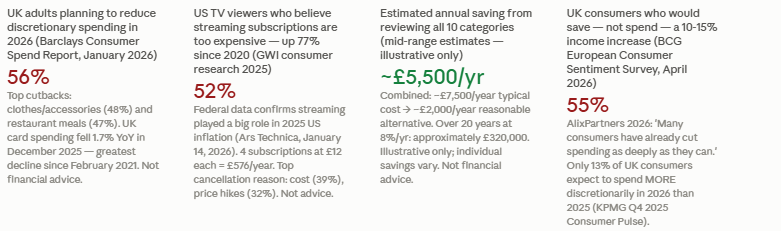
56% of UK adults plan to cut discretionary spending in 2026. 52% of US streaming viewers believe services have become too expensive. Consumer card spending in the UK fell at its fastest rate since February 2021. Something is changing in the relationship between consumers and the things they routinely pay for — and not everything that once felt like a necessity still justifies its price. This guide examines 10 categories where the value has shifted, the alternatives have improved, or the hidden cost was always higher than the headline price suggested.
By 2026, the landscape has shifted. Streaming services that were born as cheap alternatives to cable have themselves become expensive and multiplied. Gym alternatives are genuinely competitive — and free. The secondhand car market has improved. Consumer rights in the UK provide statutory protection that extended warranties charge for. And food delivery apps have been exposed as adding 26–44% to the cost of a meal you could have ordered directly. At the same time, UK consumer card spending fell at its fastest rate since
February 2021, down 1.7% year-on-year in December 2025 (Barclays Consumer Spend report, January 2026). Something is already changing.
This article is not a call for austerity. It is a call for review. The ten categories below are ones where the value has eroded, the alternatives have improved, or the hidden cost has always been higher than the headline price. Not every item applies to everyone. A gym membership is excellent value if you use it five times a week. But if you are paying for six things on this list that do not serve you, you are probably funding several hundred pounds or dollars a year in genuinely waste. Not consumer advice.
UK consumer card spending fell 1.7% YoY in December 2025 -- greatest decline since February 2021 (Barclays Consumer Spend report, January 13, 2026). 56% of UK adults intend to reduce discretionary spending in 2026; top cutbacks: clothes/accessories (48%) and restaurant meals (47%) (Barclays January 2026). Only 13% of UK consumers expect to spend more discretionarily in 2026 vs 2025 (KPMG UK Q4 2025 Consumer Pulse, n=3,000). 55% of UK consumers would put a 10-15% income increase into savings rather than spending (BCG European Consumer Sentiment Survey, April 2026). 52% of US TV viewers believe streaming subscriptions are too expensive -- up 77% since 2020 (GWI). Not consumer advice.
The data confirms the problem: 52% of US TV viewers now believe streaming subscriptions are getting too expensive, a view that has grown 77% since 2020 (GWI consumer research). The GWI report found that cost is the top reason cited for cancelling a streaming service (39% of consumers), followed by price hikes (32%). Federal data (cited by Ars Technica, January 14, 2026) showed that streaming played a significant role in 2025 US inflation, with prices rising faster than both cable TV and general inflation over the past two years.
Marc Mezzacca, consumer savings expert at CouponFollow (MoneyLion, March 2026): ‘It is unnecessary to spend money on multiple streaming services like Hulu, Netflix, HBO and Disney+. Having four or more subscriptions can put you out $60 every month.’ His advice: rotate — subscribe to one service, watch what you want, cancel, move to the next. Many people are binge-series-loyal anyway; the content they want from any given platform can typically be consumed in one or two months before moving on. Not consumer advice.
Four streaming subscriptions at £12 each: £48/month = £576/year. Two subscriptions at £12 each: £24/month = £288/year. Annual saving from cutting to two: £288. Over 10 years invested at 8%/yr: approximately £4,900. Use the rotate-and-cancel strategy: subscribe to one, watch your list, cancel. Downgrade to ad-supported tiers where available (Netflix Basic with Ads: approximately £4.99/month vs Standard at £17.99/month). Free alternatives: BBC iPlayer (free), Channel 4 (free), ITVX (free tier), YouTube (free), your local library's streaming service (often free). Sources: GWI; Forbes 2025; Marc Mezzacca/CouponFollow; MoneyLion March 2026. Not consumer advice.
UK gym memberships range from approximately £15–30/month at budget chains (PureGym, The Gym Group) to £50–80+/month at premium chains (David Lloyd, Nuffield Health, Virgin Active). An underused premium gym membership at £60/month costs £720 per year. If attendance averages twice a month after the initial enthusiasm fades, that is £60 per gym visit — the same amount as 24 months of a budget gym, all spent in exchange for eight visits. The Nasdaq (January 2026) and MoneyLion (March 2026) both list gym memberships among the top bills that frugal consumers eliminate.
The alternative landscape has genuinely improved. The Nike Training Club app (free) offers hundreds of guided workouts. YouTube has millions of exercise videos from qualified instructors. The Couch to 5K (NHS) programme is free and effective. Bodyweight training requires no equipment. Outdoor running, cycling, and swimming are free or low-cost. For anyone who uses the gym primarily for cardio equipment and does not need specific facilities (pool, racket courts, classes), the case for a premium membership is materially weakened by the free digital alternatives. Not consumer advice.
Gym alternatives that cost nothing or close: NHS Couch to 5K (free app); YouTube workout channels (Juice & Toya, FitnessBlender, Joe Wicks); Nike Training Club (free); outdoor running/cycling/swimming; bodyweight exercises (push-ups, pull-ups, lunges) at home. If you need a gym for equipment or motivation: switch to a budget gym (PureGym from ~£17/month, no contract) or consider a pay-as-you-go model rather than monthly commitment. Rule of thumb: if you don't use it at least weekly, cancel it. Not consumer advice.
In the UK, an important statutory protection already exists that makes many retailer extended warranties redundant. Under the Consumer Rights Act 2015 (applicable in England, Wales, and Northern Ireland; the Consumer (Scotland) Act 2020 in Scotland), products must be of satisfactory quality, fit for purpose, and as described. For goods with a longer expected lifespan — a television, a washing machine — this protection extends for up to six years in England and Wales (five years in Scotland). A retailer’s extended warranty for a two-year top-up on a television that should last at least six years under statute is, in many cases, charging for protection you already have by law.
For cheaper electronics — earbuds, toasters, blenders, phone accessories — the calculus is even clearer. If the product costs £30 and the extended warranty costs £8, you are paying 27% of the product’s value for protection on an item that, if it fails, is often cheaper to replace than to repair. The self-insurance approach — banking the extended warranty cost across all purchases and using the fund when something actually breaks — almost always outperforms the warranty financially. Not consumer advice.
The extended warranty sales pitch exploits loss aversion: the fear of being without protection feels more immediate than the small probability of actually needing it. The data reality: 55% of extended warranty buyers never use them (Consumer Reports survey). In the UK: Consumer Rights Act 2015 already gives 6-year protection on durable goods (England and Wales). Self-insurance is almost always more efficient: put the £8-£20 extended warranty cost in a savings account across every purchase, and the fund will outperform expected warranty claims. Sources: Consumer Reports (via FODMAPEveryday/MSN 2026); Citizens Advice UK. Not legal or consumer advice.
A 2–3 year old version of the same car at £14,000–£16,000 — after the steepest part of the depreciation curve has already occurred — represents the same car with the same expected reliability for the remaining life, at 56–64% of the new price. The same 4-year finance arrangement on the used car results in significantly lower monthly payments, lower total interest, and the same vehicle at the same stage of technology evolution (most mechanical and safety features are unchanged across minor model years). KPMG UK Q4 2025 Consumer Pulse found 42% of UK consumers plan no big-ticket spending in Q1 2026 — the new car is the archetypal big-ticket decision being deferred.
This is not an argument that all car finance is bad or that all used cars are superior choices. A new car with a manufacturer warranty, known maintenance history, and specific technology requirements (EV charging infrastructure, particular safety ratings) may represent genuine value in specific circumstances. The argument is that the default choice of ‘new car on PCP every three to four years’ is one of the most expensive default habits in British consumer life, and it is largely unquestioned. Not consumer advice.
Sky TV packages (including entertainment, sports, and cinema) can cost £60–£120+ per month = £720–£1,440 per year. For comparison: Freeview provides 70+ channels for free with a £20 aerial; the BBC iPlayer, All 4, ITVX, and Channel 5 are all free on a smart TV; and a single streaming service provides on-demand access to far more content than any given cable subscriber watches in a typical month. The bundling model depends on inertia — the customer who does not actively re-evaluate the bundle continues paying for content they consume at a rate vastly below the per-unit cost it implies.
Over 40% of viewers reported ‘streaming fatigue’ in 2025 — suggesting that the cable-plus-streaming combination is producing the worst of both worlds: high cost and too much choice. The Barclays January 2026 consumer spending data showed non-essential spending on its greatest decline since February 2021. Not consumer advice.
Free and cheap TV alternatives in 2026 (UK): Freeview (70+ channels, one-time aerial cost ~£20); BBC iPlayer (free); Channel 4 / All 4 (free); ITVX (free tier); Channel 5 (free online); YouTube (free). For sports specifically: Now TV Sports passes (pay per month, cancel anytime; approximately £33.99/month vs £40-£60 for Sky Sports via full package). Digital aerial upgrade for HD local channels: approximately £20-£40 one-time cost. Annual saving vs full Sky bundle (£80/month): approximately £960 - £408 (Now TV sports when needed) = £552/year. Not consumer advice.
Barclays Consumer Spend data (January 2026) showed that restaurant meals (47%) are among the top discretionary cuts planned by UK consumers in 2026 — and food delivery orders are effectively restaurant meals with an additional platform premium attached. A household that orders via food delivery apps twice a week at £25 per order is spending approximately £200/month or £2,400/year, against a direct ordering or home cooking alternative that could reduce the same food spend by 30–44%.
The convenience argument is real and valid for specific circumstances: time pressure, no transport, late hours, missing ingredients. But used as a default for regular evening meals, food delivery app ordering represents one of the most expensive substitutions in the modern consumer budget. The platform is extracting significant value from every transaction, from both sides of the marketplace. Not consumer advice.
The problem is not the product; it is the audit gap. Most packaged account holders do not review the included benefits annually to verify they are still relevant, accessible, and not duplicated elsewhere. The travel insurance may exclude the medical condition acquired since taking out the account. The breakdown cover may be lower-grade than the RAC or AA policy elsewhere. The mobile phone insurance may have excess charges that make it uncompetitive for actual claims. And in many cases, the credit card used for purchases already includes travel insurance as a benefit, making the packaged account’s travel cover entirely redundant.
Which? and MoneySavingExpert both regularly advise account holders to compare the cost of purchasing each benefit individually against the monthly fee. For many customers, switching to a free current account and purchasing only the specific insurances they need costs less — and the coverage is better matched to their actual circumstances. The packaged account defaults to paying for a bundle; the alternative is paying only for what you need. Not consumer advice.
MoneySavingExpert / Martin Lewis (ongoing; general UK consumer advice): 'Check if your packaged bank account is worth it.' Key questions: Do you travel abroad regularly? (If not, the travel insurance is wasted.) Do you drive? (If not, breakdown cover is wasted.) Is your mobile phone covered by your home contents policy? (Many are.) Is the travel insurance on your credit card already sufficient? If the answer to 2+ of these questions means the benefits don't apply to you, the monthly fee is almost certainly not worth paying. Switch to a free account. Source: MoneySavingExpert.com (general guidance). Not financial or legal advice.
A daily £5 coffee shop purchase (five days a week) costs approximately £25 per week, £108 per month, or £1,300 per year. Over 30 years at 8% annual investment return, the same £108/month produces approximately £185,000 in compound wealth. This is not an argument against ever buying a coffee; it is an argument for having made a deliberate decision about the habit rather than treating it as invisible. The Barclays January 2026 data specifically found that 30% of UK consumers setting financial goals in 2026 cited spending less on eating and drinking out as a priority.
High-quality home brewing alternatives have dramatically improved: a Nespresso or bean-to-cup machine produces coffee that most daily coffee shop visitors rate comparably to £3–£5 shop purchases, at a per-cup cost of approximately 30–70p. The machine amortises across thousands of cups. This is not advice to give up coffee; it is a suggestion to spend £1 instead of £5 for the same outcome, and redirect the £4 difference. Not consumer advice.
Self Financial 2025 data found that 58.9% of Caviar subscribers and 54.1% of Grubhub users had not used their subscription service in the past month — among the most extreme examples of paying for something unused. Beyond food delivery subscriptions, the typical household subscription portfolio includes: music streaming, video streaming (multiple), cloud storage, magazine or newsletter subscriptions, software licences, gaming services, delivery membership, loyalty membership schemes with annual fees, and fitness apps. The average UK household has approximately seven active subscriptions by most market estimates.
The audit is the intervention. MoneyLion (January 2026) specifically recommends reviewing bank statements and app subscription menus to identify and cancel anything unused. The process takes 30–45 minutes and typically reveals £20–£60/month (£240–£720/year) in subscriptions that are either completely unused or redundant. Not consumer advice.
The subscription audit: 30-45 minutes, one time per year. Step 1: review bank statements for all recurring charges. Step 2: list every subscription and its monthly/annual cost. Step 3: mark each as: (a) used regularly, (b) used occasionally, (c) rarely/never used. Step 4: cancel all (c) immediately; evaluate all (b) against alternatives. Step 5: check phone settings (iOS: Settings → Apple ID → Subscriptions; Android: Play Store → Subscriptions) for in-app subscriptions not visible in bank statements. Estimated saving from a thorough audit: £20-£60/month for a typical household. Not consumer advice.
The mathematics are straightforward. The UK National Lottery returns approximately 50p per £1 spent in prize money (50% return-to-player rate). Scratch cards are similar or lower. A household spending £10 per week on lottery products is spending £520 per year with an expected return of £260 — a guaranteed negative expected return of £260 per year before any lucky wins. Over 30 years, the same £10 per week invested at 8% annual return produces approximately £65,000. The lottery produces an expected terminal value (in present-value terms) of less than the amount spent; the investment produces a terminal value of approximately £65,000 above the original contributions.
The UK Gambling Commission’s 2025 data indicates that lottery spend remains disproportionately concentrated among lower-income households, who spend a larger proportion of their income on lottery and gambling products than higher-income households. The irony of the lottery as a wealth strategy is that it transfers money most reliably from those who have the least to spare toward those who have the most. Not consumer advice.
The lottery as a savings vehicle: £10/week (£520/year) at 50% return-to-player (UK National Lottery approximate RTP) = expected annual return of approximately £260. Expected annual loss: £260. Same £10/week invested in a stocks and shares ISA at 8%/yr for 30 years: approximately £65,000. The lottery is entertainment with a well-defined price (expected loss). It is not a savings strategy. For anyone who treats lottery tickets as part of their financial future planning, the alternative is not exciting but it is approximately £65,000 more reliable.
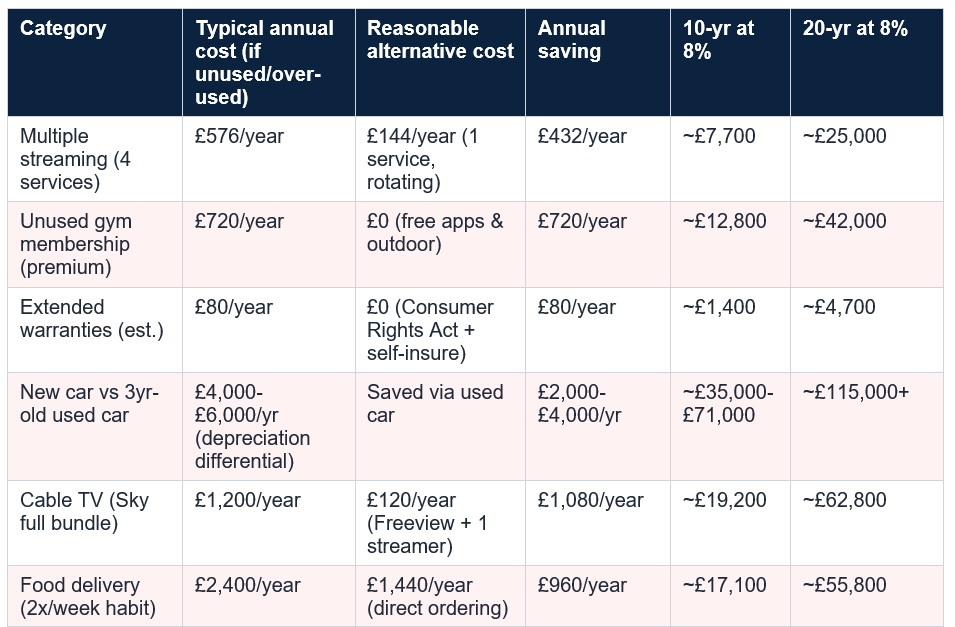
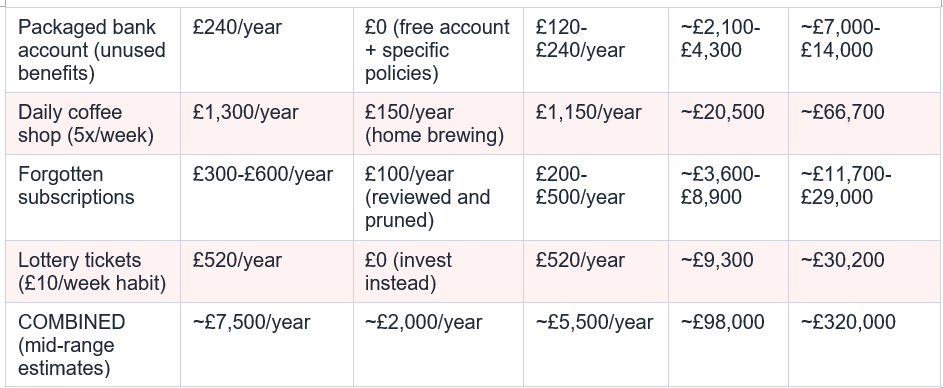
All future-value projections use FV of annuity formula at 8%/yr. Illustrative only. Not forecasts or guarantees. All costs are approximate; verify current prices with your providers. Not financial advice. Individual savings will vary.
The question is not whether these things have value in principle. It is whether they have value for you, specifically, in their current form, at their current price, given the alternatives now available. The consumer who has not reviewed their subscriptions in 12 months, who pays for a gym they visit twice a month, and who orders food delivery three times a week has probably never done the calculation that this article has done. That calculation is the point.
56% of UK adults are planning to reduce discretionary spending in 2026, according to Barclays. The smartest version of that reduction is not across-the-board austerity; it is targeted elimination of the spending that produces the least value relative to its cost. The ten categories in this article are the ones where the value-to-cost ratio has most clearly shifted against the consumer in recent years. Reviewing them takes an afternoon. The potential annual saving — which this article estimates at up to £5,000–£6,000 for a household with all ten habits — compounds over time into something considerably more significant. Not consumer or financial advice. Always assess your own circumstances.
Yes, substantially. Federal (US) data cited by Ars Technica (January 14, 2026) showed that streaming subscription prices played a significant role in 2025 inflation, rising faster than both traditional cable TV and general consumer price inflation over the past two years. GWI consumer research found that 52% of US TV viewers now believe streaming subscriptions are too expensive -- a view that has grown 77% since 2020. Deloitte's 2024 Digital Media Trends survey found that 48% of US consumers would cancel their favourite streaming service if it went up by $5. In the UK, standard streaming tiers have roughly doubled in price since 2020 for major services including Netflix and Disney+. The original value proposition of streaming as a cheap cable alternative is significantly less compelling in 2026 than it was in 2019. Sources: Ars Technica January 2026; GWI; Deloitte 2024. Not consumer advice.
Is it worth having a gym membership in 2026?
It depends entirely on how often you use it. A gym membership used 3+ times per week represents reasonable value relative to the health benefits and available alternatives. An unused or rarely used gym membership is poor value by any measure -- you are paying for a service you are not consuming. The alternatives in 2026 are significantly better than they were in 2015: Nike Training Club (free), YouTube workout channels from qualified instructors (free), NHS Couch to 5K (free), outdoor exercise (free), and bodyweight training at home (free) all provide structured fitness programmes without a monthly commitment. Budget gyms (PureGym from approximately £17/month, no contract) provide an intermediate option for those who want equipment access without the premium price. The recommendation: cancel premium gym memberships if attendance is below twice per week; switch to a no-contract budget option if equipment access is genuinely needed. Not consumer or health advice.
Why is buying a new car a bad financial decision?
A new car is not universally a bad decision, but the financial case against it is strong for most buyers. New cars depreciate approximately 15-35% in their first year and up to 50% in three years -- meaning a significant fraction of the purchase price is lost as soon as the car is driven off the forecourt, regardless of condition. Combining new-car depreciation with PCP finance charges (5-9% APR typical in 2026) produces a total cost of ownership in the first 4 years that can approach or exceed the original purchase price. A 2-3 year old certified used car of the same model is typically available at 55-70% of the new-car price, with the steepest depreciation already absorbed by the first owner, and often with remaining manufacturer warranty. For most buyers, a used car in good condition represents materially better value than a new equivalent. Not consumer or financial advice. Individual circumstances vary.
How do I find and cancel subscriptions I've forgotten about?
Four steps: (1) Review the last 3 months of bank statements and identify every recurring charge. (2) Check your phone's subscription management: on iPhone, go to Settings → your name → Subscriptions; on Android, open the Play Store → click your profile → Subscriptions. This shows all active App Store/Play Store subscriptions, some of which may not appear as obvious bank charges. (3) Check your email inbox for receipts with the word 'subscription', 'renewal', or 'payment' in the subject. (4) For each subscription found, ask: have I used this in the past month? If no: cancel it today. MoneyLion (January 2026) estimates this process takes 30-45 minutes and typically reveals £20-£60/month in unused subscriptions. Not consumer advice.
Is the daily coffee habit really worth cutting?
The financial answer: a daily £5 coffee shop purchase (5 days/week) costs approximately £1,300/year. Over 30 years at 8% annual investment return, that £108/month redirected to investment produces approximately £185,000. The practical answer: it depends on what the coffee represents. If it is a genuine daily pleasure that improves mood, productivity, and social connection, the value may well exceed the cost. If it is a default habit -- something you do without particularly noticing or enjoying it -- the £1,300/year is less defensible. The recommendation is not to eliminate coffee but to make the choice consciously. High-quality home brewing reduces the cost per cup to 30-70p versus £4-5 in a shop, producing similar sensory outcomes for committed coffee drinkers. Barclays (January 2026) found 30% of UK consumers setting financial goals cited spending less on eating and drinking out as a priority. Not financial advice.
Table of Contents
- When Value Shifts, Smart Spenders Shift With It
- #1 Multiple Streaming Subscriptions
- #2 Gym Memberships You Don’t Actually Use
- #3 Extended Warranties on Cheap Electronics
- #4 Brand-New Cars on Finance
- #5 Cable TV and Premium Broadcast Bundles
- #6 Food Delivery Apps as a Regular Habit
- #7 Packaged Bank Accounts You Never Audit
- #8 The Daily Coffee Shop Habit
- #9 Subscription Creep: The Bill You’ve Forgotten
- #10 Lottery Tickets as a Financial Strategy
- The Full Savings Table: What You Could Free Up
- Conclusion: This Is Not About Deprivation
- Frequently Asked Questions
Annual cost of each habit — and what to pay instead
If you redirected the savings — 10 and 20 year growth
UK consumer spending mood — 2025 to 2026
When Value Shifts, Smart Spenders Shift With It
The list of things that genuinely represent good value changes over time. A gym membership in 2010 had no free-app equivalent. A cable TV subscription was the only way to watch certain content. A new car was the only reliable option when used-car supply was uncertain and finance rates were high. Extended warranties came before consumer rights legislation gave buyers protection for free.By 2026, the landscape has shifted. Streaming services that were born as cheap alternatives to cable have themselves become expensive and multiplied. Gym alternatives are genuinely competitive — and free. The secondhand car market has improved. Consumer rights in the UK provide statutory protection that extended warranties charge for. And food delivery apps have been exposed as adding 26–44% to the cost of a meal you could have ordered directly. At the same time, UK consumer card spending fell at its fastest rate since
February 2021, down 1.7% year-on-year in December 2025 (Barclays Consumer Spend report, January 2026). Something is already changing.
This article is not a call for austerity. It is a call for review. The ten categories below are ones where the value has eroded, the alternatives have improved, or the hidden cost has always been higher than the headline price. Not every item applies to everyone. A gym membership is excellent value if you use it five times a week. But if you are paying for six things on this list that do not serve you, you are probably funding several hundred pounds or dollars a year in genuinely waste. Not consumer advice.
UK consumer card spending fell 1.7% YoY in December 2025 -- greatest decline since February 2021 (Barclays Consumer Spend report, January 13, 2026). 56% of UK adults intend to reduce discretionary spending in 2026; top cutbacks: clothes/accessories (48%) and restaurant meals (47%) (Barclays January 2026). Only 13% of UK consumers expect to spend more discretionarily in 2026 vs 2025 (KPMG UK Q4 2025 Consumer Pulse, n=3,000). 55% of UK consumers would put a 10-15% income increase into savings rather than spending (BCG European Consumer Sentiment Survey, April 2026). 52% of US TV viewers believe streaming subscriptions are too expensive -- up 77% since 2020 (GWI). Not consumer advice.
#1 Multiple Streaming Subscriptions
When Netflix launched in the UK in 2012, a single subscription to one streaming service was a straightforward cost-saving alternative to cable TV. By 2026, the streaming market has fragmented into a collection of competing platforms — Netflix, Disney+, Apple TV+, Amazon Prime Video, NOW TV, Paramount+, ITVX Premium, and others — each requiring a separate subscription to access their content. The combined cost of four or more subscriptions at £10–£15 each is approximately £40–£60 per month, or £480–£720 per year. The streaming alternative has, in many cases, become as expensive as the cable bundle it replaced.The data confirms the problem: 52% of US TV viewers now believe streaming subscriptions are getting too expensive, a view that has grown 77% since 2020 (GWI consumer research). The GWI report found that cost is the top reason cited for cancelling a streaming service (39% of consumers), followed by price hikes (32%). Federal data (cited by Ars Technica, January 14, 2026) showed that streaming played a significant role in 2025 US inflation, with prices rising faster than both cable TV and general inflation over the past two years.
Marc Mezzacca, consumer savings expert at CouponFollow (MoneyLion, March 2026): ‘It is unnecessary to spend money on multiple streaming services like Hulu, Netflix, HBO and Disney+. Having four or more subscriptions can put you out $60 every month.’ His advice: rotate — subscribe to one service, watch what you want, cancel, move to the next. Many people are binge-series-loyal anyway; the content they want from any given platform can typically be consumed in one or two months before moving on. Not consumer advice.
Four streaming subscriptions at £12 each: £48/month = £576/year. Two subscriptions at £12 each: £24/month = £288/year. Annual saving from cutting to two: £288. Over 10 years invested at 8%/yr: approximately £4,900. Use the rotate-and-cancel strategy: subscribe to one, watch your list, cancel. Downgrade to ad-supported tiers where available (Netflix Basic with Ads: approximately £4.99/month vs Standard at £17.99/month). Free alternatives: BBC iPlayer (free), Channel 4 (free), ITVX (free tier), YouTube (free), your local library's streaming service (often free). Sources: GWI; Forbes 2025; Marc Mezzacca/CouponFollow; MoneyLion March 2026. Not consumer advice.
#2 Gym Memberships You Don’t Actually Use
The gym membership is perhaps the most classic entry on any ‘things not worth your money’ list, and it earns its place not because gyms are bad value but because unused gym memberships are spectacularly bad value. The pattern is well-established: January sign-up, strong attendance for six to eight weeks, gradual decline through March, and then a membership sitting quietly on a bank statement from April through December, charging monthly, generating guilt but no fitness benefit.UK gym memberships range from approximately £15–30/month at budget chains (PureGym, The Gym Group) to £50–80+/month at premium chains (David Lloyd, Nuffield Health, Virgin Active). An underused premium gym membership at £60/month costs £720 per year. If attendance averages twice a month after the initial enthusiasm fades, that is £60 per gym visit — the same amount as 24 months of a budget gym, all spent in exchange for eight visits. The Nasdaq (January 2026) and MoneyLion (March 2026) both list gym memberships among the top bills that frugal consumers eliminate.
The alternative landscape has genuinely improved. The Nike Training Club app (free) offers hundreds of guided workouts. YouTube has millions of exercise videos from qualified instructors. The Couch to 5K (NHS) programme is free and effective. Bodyweight training requires no equipment. Outdoor running, cycling, and swimming are free or low-cost. For anyone who uses the gym primarily for cardio equipment and does not need specific facilities (pool, racket courts, classes), the case for a premium membership is materially weakened by the free digital alternatives. Not consumer advice.
Gym alternatives that cost nothing or close: NHS Couch to 5K (free app); YouTube workout channels (Juice & Toya, FitnessBlender, Joe Wicks); Nike Training Club (free); outdoor running/cycling/swimming; bodyweight exercises (push-ups, pull-ups, lunges) at home. If you need a gym for equipment or motivation: switch to a budget gym (PureGym from ~£17/month, no contract) or consider a pay-as-you-go model rather than monthly commitment. Rule of thumb: if you don't use it at least weekly, cancel it. Not consumer advice.
#3 Extended Warranties on Cheap Electronics
The extended warranty is one of the most reliably profitable products in retail — for the retailer. Consumer Reports found that 55% of people who purchased extended warranties never used them (cited by multiple sources, 2026). Those who do try to use them often encounter exclusions in the fine print that prevent the claim. The warranty is sold at the moment of peak commitment to the product — the purchase — when the buyer is least focused on reading terms and conditions and most willing to spend a few extra pounds for peace of mind.In the UK, an important statutory protection already exists that makes many retailer extended warranties redundant. Under the Consumer Rights Act 2015 (applicable in England, Wales, and Northern Ireland; the Consumer (Scotland) Act 2020 in Scotland), products must be of satisfactory quality, fit for purpose, and as described. For goods with a longer expected lifespan — a television, a washing machine — this protection extends for up to six years in England and Wales (five years in Scotland). A retailer’s extended warranty for a two-year top-up on a television that should last at least six years under statute is, in many cases, charging for protection you already have by law.
For cheaper electronics — earbuds, toasters, blenders, phone accessories — the calculus is even clearer. If the product costs £30 and the extended warranty costs £8, you are paying 27% of the product’s value for protection on an item that, if it fails, is often cheaper to replace than to repair. The self-insurance approach — banking the extended warranty cost across all purchases and using the fund when something actually breaks — almost always outperforms the warranty financially. Not consumer advice.
The extended warranty sales pitch exploits loss aversion: the fear of being without protection feels more immediate than the small probability of actually needing it. The data reality: 55% of extended warranty buyers never use them (Consumer Reports survey). In the UK: Consumer Rights Act 2015 already gives 6-year protection on durable goods (England and Wales). Self-insurance is almost always more efficient: put the £8-£20 extended warranty cost in a savings account across every purchase, and the fund will outperform expected warranty claims. Sources: Consumer Reports (via FODMAPEveryday/MSN 2026); Citizens Advice UK. Not legal or consumer advice.
#4 Brand-New Cars on Finance
A new car loses approximately 15–35% of its value in the first year alone, with some models depreciating by up to 50% in the first three years. This is not a hidden fact; it is widely known. What is less viscerally understood is what it means in financial terms when combined with PCP (Personal Contract Purchase) finance. A car purchased new at £25,000 on PCP finance at 8% APR over four years involves monthly payments of approximately £450–£550. During the four years, depreciation reduces the car’s market value from £25,000 to approximately £10,000–£12,000. The finance charges add £4,000–£6,000 in interest. The total economic cost of the four-year ownership period is therefore approximately £17,000–£19,000 for a car whose market value went from £25,000 to £10,000.A 2–3 year old version of the same car at £14,000–£16,000 — after the steepest part of the depreciation curve has already occurred — represents the same car with the same expected reliability for the remaining life, at 56–64% of the new price. The same 4-year finance arrangement on the used car results in significantly lower monthly payments, lower total interest, and the same vehicle at the same stage of technology evolution (most mechanical and safety features are unchanged across minor model years). KPMG UK Q4 2025 Consumer Pulse found 42% of UK consumers plan no big-ticket spending in Q1 2026 — the new car is the archetypal big-ticket decision being deferred.
This is not an argument that all car finance is bad or that all used cars are superior choices. A new car with a manufacturer warranty, known maintenance history, and specific technology requirements (EV charging infrastructure, particular safety ratings) may represent genuine value in specific circumstances. The argument is that the default choice of ‘new car on PCP every three to four years’ is one of the most expensive default habits in British consumer life, and it is largely unquestioned. Not consumer advice.
#5 Cable TV and Premium Broadcast Bundles
The original premise of cable and satellite TV bundles was that they provided access to content not otherwise available. In 2026, this premise has eroded to a single remaining stronghold: live sport. For sports fans, Sky Sports or BT Sport (TNT Sports) may still represent value — particularly for Premier League football, Formula 1, and tennis Grand Slams. For everyone else, the traditional cable or satellite bundle is paying for a channel lineup of which most households watch a small fraction.Sky TV packages (including entertainment, sports, and cinema) can cost £60–£120+ per month = £720–£1,440 per year. For comparison: Freeview provides 70+ channels for free with a £20 aerial; the BBC iPlayer, All 4, ITVX, and Channel 5 are all free on a smart TV; and a single streaming service provides on-demand access to far more content than any given cable subscriber watches in a typical month. The bundling model depends on inertia — the customer who does not actively re-evaluate the bundle continues paying for content they consume at a rate vastly below the per-unit cost it implies.
Over 40% of viewers reported ‘streaming fatigue’ in 2025 — suggesting that the cable-plus-streaming combination is producing the worst of both worlds: high cost and too much choice. The Barclays January 2026 consumer spending data showed non-essential spending on its greatest decline since February 2021. Not consumer advice.
Free and cheap TV alternatives in 2026 (UK): Freeview (70+ channels, one-time aerial cost ~£20); BBC iPlayer (free); Channel 4 / All 4 (free); ITVX (free tier); Channel 5 (free online); YouTube (free). For sports specifically: Now TV Sports passes (pay per month, cancel anytime; approximately £33.99/month vs £40-£60 for Sky Sports via full package). Digital aerial upgrade for HD local channels: approximately £20-£40 one-time cost. Annual saving vs full Sky bundle (£80/month): approximately £960 - £408 (Now TV sports when needed) = £552/year. Not consumer advice.
#6 Food Delivery Apps as a Regular Habit
This blog series has already covered the hidden costs of Deliveroo, Uber Eats, and Just Eat in detail. The summary: Which? found that ordering the same meal through Deliveroo cost 44% more than ordering directly from the restaurant with a loyalty discount. The platforms charge restaurants 25–35% commission (invisible on the receipt), allow or encourage menu price markups, add delivery fees of £2–£4.49 and service fees of 50p–£2.99, and keep a grocery basket 15–34% more expensive than supermarket websites on their platform.Barclays Consumer Spend data (January 2026) showed that restaurant meals (47%) are among the top discretionary cuts planned by UK consumers in 2026 — and food delivery orders are effectively restaurant meals with an additional platform premium attached. A household that orders via food delivery apps twice a week at £25 per order is spending approximately £200/month or £2,400/year, against a direct ordering or home cooking alternative that could reduce the same food spend by 30–44%.
The convenience argument is real and valid for specific circumstances: time pressure, no transport, late hours, missing ingredients. But used as a default for regular evening meals, food delivery app ordering represents one of the most expensive substitutions in the modern consumer budget. The platform is extracting significant value from every transaction, from both sides of the marketplace. Not consumer advice.
#7 Packaged Bank Accounts You Never Audit
Packaged bank accounts — accounts that charge a monthly fee (typically £10–£25/month in the UK) in exchange for bundled benefits including travel insurance, breakdown cover, mobile phone insurance, and sometimes airport lounge access or exclusive offers — can represent genuine value for the right customer. A regular traveller with multiple trips per year who also needs breakdown cover and mobile phone insurance may find the bundle cheaper than equivalent standalone policies.The problem is not the product; it is the audit gap. Most packaged account holders do not review the included benefits annually to verify they are still relevant, accessible, and not duplicated elsewhere. The travel insurance may exclude the medical condition acquired since taking out the account. The breakdown cover may be lower-grade than the RAC or AA policy elsewhere. The mobile phone insurance may have excess charges that make it uncompetitive for actual claims. And in many cases, the credit card used for purchases already includes travel insurance as a benefit, making the packaged account’s travel cover entirely redundant.
Which? and MoneySavingExpert both regularly advise account holders to compare the cost of purchasing each benefit individually against the monthly fee. For many customers, switching to a free current account and purchasing only the specific insurances they need costs less — and the coverage is better matched to their actual circumstances. The packaged account defaults to paying for a bundle; the alternative is paying only for what you need. Not consumer advice.
MoneySavingExpert / Martin Lewis (ongoing; general UK consumer advice): 'Check if your packaged bank account is worth it.' Key questions: Do you travel abroad regularly? (If not, the travel insurance is wasted.) Do you drive? (If not, breakdown cover is wasted.) Is your mobile phone covered by your home contents policy? (Many are.) Is the travel insurance on your credit card already sufficient? If the answer to 2+ of these questions means the benefits don't apply to you, the monthly fee is almost certainly not worth paying. Switch to a free account. Source: MoneySavingExpert.com (general guidance). Not financial or legal advice.
#8 The Daily Coffee Shop Habit
The daily coffee shop visit occupies a special place in personal finance discourse — sometimes dismissed as an overstated concern (the ‘avocado toast’ argument: blaming small luxuries for large structural problems) and sometimes held up as the emblematic example of painless savings. The truth is that it depends entirely on the habit’s frequency and the alternative’s cost, not on any intrinsic virtue or vice of coffee shop visits.A daily £5 coffee shop purchase (five days a week) costs approximately £25 per week, £108 per month, or £1,300 per year. Over 30 years at 8% annual investment return, the same £108/month produces approximately £185,000 in compound wealth. This is not an argument against ever buying a coffee; it is an argument for having made a deliberate decision about the habit rather than treating it as invisible. The Barclays January 2026 data specifically found that 30% of UK consumers setting financial goals in 2026 cited spending less on eating and drinking out as a priority.
High-quality home brewing alternatives have dramatically improved: a Nespresso or bean-to-cup machine produces coffee that most daily coffee shop visitors rate comparably to £3–£5 shop purchases, at a per-cup cost of approximately 30–70p. The machine amortises across thousands of cups. This is not advice to give up coffee; it is a suggestion to spend £1 instead of £5 for the same outcome, and redirect the £4 difference. Not consumer advice.
#9 Subscription Creep: The Bill You’ve Forgotten
Subscription creep is the gradual accumulation of recurring charges across a bank statement — services signed up for and forgotten, free trials that rolled into paid subscriptions, memberships taken out for a specific event that never renewed, apps upgraded and never downgraded. MoneyLion (January 13, 2026): ‘With so many expenses set to autopay, it’s easy to overlook where you’re hemorrhaging cash.’Self Financial 2025 data found that 58.9% of Caviar subscribers and 54.1% of Grubhub users had not used their subscription service in the past month — among the most extreme examples of paying for something unused. Beyond food delivery subscriptions, the typical household subscription portfolio includes: music streaming, video streaming (multiple), cloud storage, magazine or newsletter subscriptions, software licences, gaming services, delivery membership, loyalty membership schemes with annual fees, and fitness apps. The average UK household has approximately seven active subscriptions by most market estimates.
The audit is the intervention. MoneyLion (January 2026) specifically recommends reviewing bank statements and app subscription menus to identify and cancel anything unused. The process takes 30–45 minutes and typically reveals £20–£60/month (£240–£720/year) in subscriptions that are either completely unused or redundant. Not consumer advice.
The subscription audit: 30-45 minutes, one time per year. Step 1: review bank statements for all recurring charges. Step 2: list every subscription and its monthly/annual cost. Step 3: mark each as: (a) used regularly, (b) used occasionally, (c) rarely/never used. Step 4: cancel all (c) immediately; evaluate all (b) against alternatives. Step 5: check phone settings (iOS: Settings → Apple ID → Subscriptions; Android: Play Store → Subscriptions) for in-app subscriptions not visible in bank statements. Estimated saving from a thorough audit: £20-£60/month for a typical household. Not consumer advice.
#10 Lottery Tickets and Scratch Cards as a Financial Strategy
Lottery tickets and scratch cards are legal, regulated entertainment products. As entertainment, they have a clear and legitimate role: the £2 ticket buys a brief fantasy and the pleasure of anticipation, and the expected entertainment value is knowable even if the expected financial return is not. The issue is not with occasional lottery participation; it is with the habit of treating lottery tickets as a financial strategy — as a route to wealth accumulation or retirement funding.The mathematics are straightforward. The UK National Lottery returns approximately 50p per £1 spent in prize money (50% return-to-player rate). Scratch cards are similar or lower. A household spending £10 per week on lottery products is spending £520 per year with an expected return of £260 — a guaranteed negative expected return of £260 per year before any lucky wins. Over 30 years, the same £10 per week invested at 8% annual return produces approximately £65,000. The lottery produces an expected terminal value (in present-value terms) of less than the amount spent; the investment produces a terminal value of approximately £65,000 above the original contributions.
The UK Gambling Commission’s 2025 data indicates that lottery spend remains disproportionately concentrated among lower-income households, who spend a larger proportion of their income on lottery and gambling products than higher-income households. The irony of the lottery as a wealth strategy is that it transfers money most reliably from those who have the least to spare toward those who have the most. Not consumer advice.
The lottery as a savings vehicle: £10/week (£520/year) at 50% return-to-player (UK National Lottery approximate RTP) = expected annual return of approximately £260. Expected annual loss: £260. Same £10/week invested in a stocks and shares ISA at 8%/yr for 30 years: approximately £65,000. The lottery is entertainment with a well-defined price (expected loss). It is not a savings strategy. For anyone who treats lottery tickets as part of their financial future planning, the alternative is not exciting but it is approximately £65,000 more reliable.
The Full Savings Table: What You Could Free Up
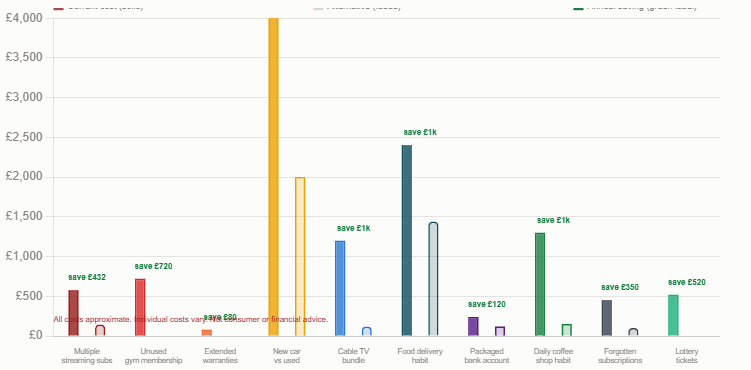
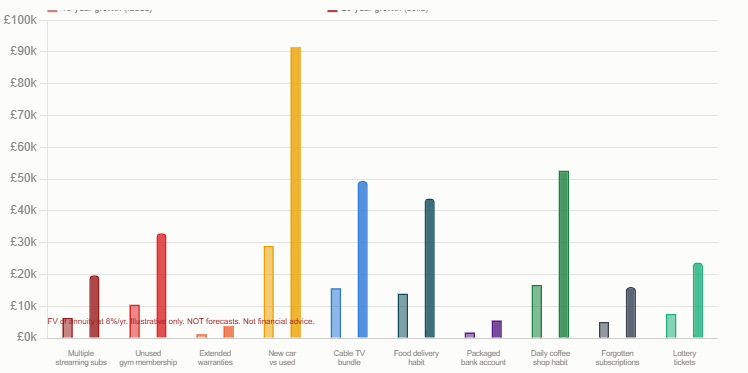
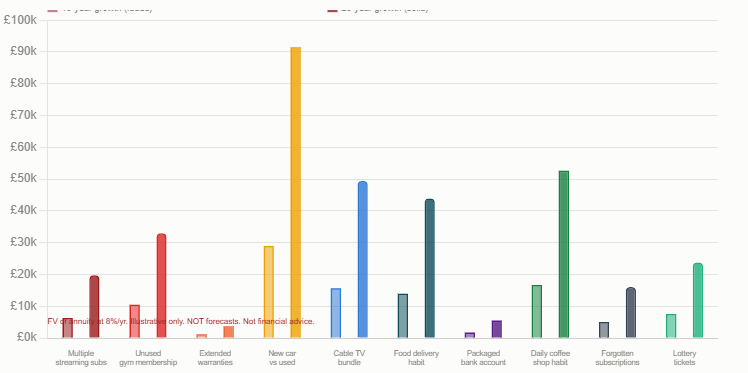
The table below shows approximate annual savings from reviewing or cutting each of the 10 categories, and what those savings could produce if redirected to investment over 10 and 20 years at 8% annual return. These are illustrative estimates. Actual savings depend on individual pricing and usage. Not financial advice.All future-value projections use FV of annuity formula at 8%/yr. Illustrative only. Not forecasts or guarantees. All costs are approximate; verify current prices with your providers. Not financial advice. Individual savings will vary.
Conclusion
Every item on this list has a legitimate version. A gym membership used four times a week is excellent value. A single streaming service you actually watch is a reasonable entertainment spend. A coffee shop visit as an occasional treat or a deliberate social ritual is not the enemy of anyone’s finances. A new car with a known service history and manufacturer warranty makes sense for specific needs.The question is not whether these things have value in principle. It is whether they have value for you, specifically, in their current form, at their current price, given the alternatives now available. The consumer who has not reviewed their subscriptions in 12 months, who pays for a gym they visit twice a month, and who orders food delivery three times a week has probably never done the calculation that this article has done. That calculation is the point.
56% of UK adults are planning to reduce discretionary spending in 2026, according to Barclays. The smartest version of that reduction is not across-the-board austerity; it is targeted elimination of the spending that produces the least value relative to its cost. The ten categories in this article are the ones where the value-to-cost ratio has most clearly shifted against the consumer in recent years. Reviewing them takes an afternoon. The potential annual saving — which this article estimates at up to £5,000–£6,000 for a household with all ten habits — compounds over time into something considerably more significant. Not consumer or financial advice. Always assess your own circumstances.
Frequently Asked Questions
Are streaming subscriptions actually getting more expensive?Yes, substantially. Federal (US) data cited by Ars Technica (January 14, 2026) showed that streaming subscription prices played a significant role in 2025 inflation, rising faster than both traditional cable TV and general consumer price inflation over the past two years. GWI consumer research found that 52% of US TV viewers now believe streaming subscriptions are too expensive -- a view that has grown 77% since 2020. Deloitte's 2024 Digital Media Trends survey found that 48% of US consumers would cancel their favourite streaming service if it went up by $5. In the UK, standard streaming tiers have roughly doubled in price since 2020 for major services including Netflix and Disney+. The original value proposition of streaming as a cheap cable alternative is significantly less compelling in 2026 than it was in 2019. Sources: Ars Technica January 2026; GWI; Deloitte 2024. Not consumer advice.
Is it worth having a gym membership in 2026?
It depends entirely on how often you use it. A gym membership used 3+ times per week represents reasonable value relative to the health benefits and available alternatives. An unused or rarely used gym membership is poor value by any measure -- you are paying for a service you are not consuming. The alternatives in 2026 are significantly better than they were in 2015: Nike Training Club (free), YouTube workout channels from qualified instructors (free), NHS Couch to 5K (free), outdoor exercise (free), and bodyweight training at home (free) all provide structured fitness programmes without a monthly commitment. Budget gyms (PureGym from approximately £17/month, no contract) provide an intermediate option for those who want equipment access without the premium price. The recommendation: cancel premium gym memberships if attendance is below twice per week; switch to a no-contract budget option if equipment access is genuinely needed. Not consumer or health advice.
Why is buying a new car a bad financial decision?
A new car is not universally a bad decision, but the financial case against it is strong for most buyers. New cars depreciate approximately 15-35% in their first year and up to 50% in three years -- meaning a significant fraction of the purchase price is lost as soon as the car is driven off the forecourt, regardless of condition. Combining new-car depreciation with PCP finance charges (5-9% APR typical in 2026) produces a total cost of ownership in the first 4 years that can approach or exceed the original purchase price. A 2-3 year old certified used car of the same model is typically available at 55-70% of the new-car price, with the steepest depreciation already absorbed by the first owner, and often with remaining manufacturer warranty. For most buyers, a used car in good condition represents materially better value than a new equivalent. Not consumer or financial advice. Individual circumstances vary.
How do I find and cancel subscriptions I've forgotten about?
Four steps: (1) Review the last 3 months of bank statements and identify every recurring charge. (2) Check your phone's subscription management: on iPhone, go to Settings → your name → Subscriptions; on Android, open the Play Store → click your profile → Subscriptions. This shows all active App Store/Play Store subscriptions, some of which may not appear as obvious bank charges. (3) Check your email inbox for receipts with the word 'subscription', 'renewal', or 'payment' in the subject. (4) For each subscription found, ask: have I used this in the past month? If no: cancel it today. MoneyLion (January 2026) estimates this process takes 30-45 minutes and typically reveals £20-£60/month in unused subscriptions. Not consumer advice.
Is the daily coffee habit really worth cutting?
The financial answer: a daily £5 coffee shop purchase (5 days/week) costs approximately £1,300/year. Over 30 years at 8% annual investment return, that £108/month redirected to investment produces approximately £185,000. The practical answer: it depends on what the coffee represents. If it is a genuine daily pleasure that improves mood, productivity, and social connection, the value may well exceed the cost. If it is a default habit -- something you do without particularly noticing or enjoying it -- the £1,300/year is less defensible. The recommendation is not to eliminate coffee but to make the choice consciously. High-quality home brewing reduces the cost per cup to 30-70p versus £4-5 in a shop, producing similar sensory outcomes for committed coffee drinkers. Barclays (January 2026) found 30% of UK consumers setting financial goals cited spending less on eating and drinking out as a priority. Not financial advice.

0 Comments Comments