

AI for business
AI Automation for Nursing Home Practice Managers

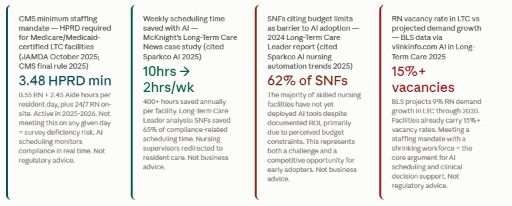
The CMS mandate requires 3.48 nursing hours per resident day. Vacancy rates exceed 15% in most regions. AI scheduling cuts scheduling time from 10 hours to 2 hours weekly. The operational and compliance case for AI in LTC has never been stronger.
Running a nursing home or skilled nursing facility (SNF) in 2025-2026 means operating under three simultaneous and intensifying pressures. The first is regulatory: the Centers for Medicare & Medicaid Services (CMS) has implemented a staffing mandate requiring a minimum of 3.48 nursing hours per resident day, alongside a 24/7 registered nurse on-site requirement — a standard that a significant proportion of the existing SNF market cannot currently meet without structural changes to their workforce and scheduling practices. The second is workforce: the Bureau of Labor Statistics projects 9% demand growth for registered nurses in long-term care through 2030, against a sector already carrying vacancy rates exceeding 15% in many regions. The third is financial: PDPM reimbursement under Medicare requires precise MDS documentation to capture the acuity that drives revenue per patient day — and inaccurate documentation means direct, recoverable revenue loss that compounds across every resident stay. AI automation does not eliminate any of these pressures. But it meaningfully changes the practice manager’s ability to navigate them simultaneously. This article covers five specific areas where AI automation is delivering documented operational, compliance, clinical, and financial value in nursing homes and SNFs, with the research and real-world case studies behind each.
AI automation addresses all three. Not comprehensively or automatically. But with documented efficiency gains, compliance monitoring capabilities, and clinical quality improvements that change the operational baseline from which a practice manager works.
The JAMDA October 2025 article notes that the regulation was designed to improve safety and quality but has ‘sparked significant debate, particularly regarding feasibility.’ For facilities operating with reduced census and constrained budgets — the 2024 Long-Term Care Leader report found that 62% of SNFs identified budget limits as a key factor in deferring technology adoption — the mandate presents a genuine operational challenge. AI scheduling tools that can monitor staffing ratios against census in real time, generate compliance documentation automatically, and alert managers to projected shortfalls before a shift begins convert this from a daily crisis management problem to a proactive planning function. Not regulatory or legal advice.
AI scheduling: 10 hours/week → 2 hours (McKnight's LTC News case study via Sparkco AI). 65% reduction in compliance-related scheduling time (Long-Term Care Leader analysis). CMS mandate: 3.48 HPRD minimum total; 0.55 RN + 2.45 Aide; 24/7 RN on-site (JAMDA October 2025). 15%+ vacancy rates make AI demand forecasting critical (BLS/vlinkinfo.com).
Sparkco AI: SNF-specific AI scheduling designed for CMS mandate compliance monitoring with real-time HPRD tracking. ShiftWise/Workforce Management Tools: healthcare-specific scheduling with compliance reporting. NetSmart Technologies: scheduling and clinical management for post-acute and LTC. PointClickCare: the dominant LTC EHR with integrated scheduling and compliance modules. Axxess: home health and LTC scheduling with compliance tracking.
400+ hours saved annually per facility (McKnight's LTC case study via Sparkco AI). At $35/hour nursing supervisor time: $14,000+ per facility in recovered time. Agency nurse usage reduction (AI demand forecasting reduces last-minute agency calls at $65-90/hour vs $25-35/hour employed staff) can save $50,000-$200,000 annually depending on current agency dependency. Not financial advice.
CMS mandate compliance is a legal obligation, not a management preference. AI scheduling tools used for compliance must produce audit-trail documentation that meets CMS survey requirements. Verify that any scheduling AI produces daily HPRD reports in a CMS-compatible format before relying on it for compliance evidence. Consult qualified healthcare compliance counsel for your specific situation.
PDPM acuity-based reimbursement: MDS accuracy directly determines Medicare revenue per patient day. NuAIg highlights case-mix and PDPM visibility as core AI application (nuaig.ai). AI documentation tools can identify MDS coding gaps that affect PDPM classification before finalisation. PointClickCare: dominant LTC EHR; AI integration enables real-time MDS tracking and case-mix analysis (NuAIg/PointClickCare integration).
AI data strategy for SNFs including case-mix/PDPM visibility via PointClickCare integration; MDS and documentation tracking; real-time compliance dashboards. PointClickCare: built-in MDS analytics and PDPM optimisation within the dominant LTC EHR. NetSmart: MDS management and care planning in LTC. Netsmart myAvatar: post-acute EHR with MDS and clinical documentation. Casamba: MDS and therapy documentation for SNFs.
A 1-point improvement in average case-mix index (CMI) in a 100-bed facility doing $300-400/day Medicare rates can be worth $100,000+ annually. PDPM clinical category misclassification identified by AI documentation review before MDS finalisation is direct recoverable revenue. Not financial advice. Verify coding accuracy with a qualified MDS coordinator and compliance counsel.
MDS coding accuracy must be clinically defensible — AI-flagged documentation gaps should be reviewed and validated by a qualified RN MDS coordinator before the assessment is submitted. AI tools that suggest additions must be verified against actual clinical evidence. Upcoding without clinical justification is a compliance violation.
ArchCare, the continuing care community of the Archdiocese of New York, partnered with NuAIg to automate CMS compliance tracking across service requests, assessments, and external appointments for participants requiring nursing-home-level care. Result: 5 compliance areas automated; CMS audit-ready reporting achieved; HIPAA-compliant infrastructure; advancing goal of 100% audit compliance while freeing staff time for direct resident care. Source: nuaig.ai.
ArchCare (NuAIg case study): 5 compliance areas automated; goal 100% audit compliance; CMS audit-ready reporting; HIPAA-compliant infrastructure (nuaig.ai). AI and RPA reduce human error in documentation including medication administration and ADLs (nuaig.ai). NuAIg offers 45-day AI assessment for SNF operations — compliance, HR, and beyond (nuaig.ai). HL7 and FHIR standards alignment for interoperability (nuaig.ai).
AI compliance automation for SNFs and LTC — ArchCare case study; CMS tracking; HIPAA infrastructure. Sparkco AI: compliance reporting automation integrated with scheduling. PointClickCare: compliance dashboards and survey prep within LTC EHR. ACHIEVE Platform: healthcare compliance and survey management. SimpleAnalytics/LTC analytics platforms: compliance monitoring and benchmarking.
A single CMS civil monetary penalty can range from $2,058 to $22,320 per day (current CMS CMPs, subject to annual adjustment). Avoiding one Immediate Jeopardy citation through proactive compliance monitoring can save more than the cost of AI compliance software for an entire year. Not legal or financial advice. Consult qualified healthcare compliance counsel.
HIPAA compliance is not optional for any AI tool processing resident health information. Before deploying any AI compliance or documentation tool, verify the vendor has signed a Business Associate Agreement (BAA) and that their platform architecture meets HIPAA Security Rule requirements. Failure to maintain HIPAA compliance is a separate regulatory exposure from CMS citations.
AI-powered monitoring shifts LTC from reactive to proactive care paradigm (JAMDA October 2025; vlinkinfo.com 2025). Foundational research (Management Science 2018): automation improved clinical quality ratings by 6.9%. BLS: demand for RNs in LTC will grow 9% through 2030 vs current >15% vacancy rates — AI clinical decision support compensates for staffing gaps. AI behavioural health monitoring represents particularly innovative LTC application (vlinkinfo.com).
CarePredict: AI-powered resident monitoring using wearable technology for early decline detection. HCI (Health Catalyst): predictive analytics for LTC outcomes and hospitalisation prevention. PointClickCare Insights: clinical analytics and early warning within the dominant LTC EHR. GUSS Health: nursing home-specific clinical intelligence. Palantir Healthcare: enterprise-level clinical analytics (large operators). VitalCare/iN2L: resident engagement and monitoring technology for LTC.
CMS penalises excess readmissions under various quality programmes. A 1% reduction in 30-day readmission rate in a 100-bed facility with average 30% Medicare census can represent meaningful quality measure improvement and referral growth. Five-Star Quality Rating improvement from preventable hospitalisation reduction has direct occupancy and referral impact.
AI monitoring tools that generate clinical alerts must be integrated into a clinical response workflow before deployment. An alert that is not acted on within a defined timeframe is not just useless — it creates documentation that a warning sign was observed and ignored, which is potentially a greater liability than not having the alert system. Establish clinical escalation protocols before go-live.
Data strategy + clinical/financial/compliance integration; MDS tracking; real-time compliance dashboards; staffing recommendation copilot (nuaig.ai). Sparkco AI: compliance reporting automation generates CMS-format documentation from scheduling data. NLP sentiment analysis of resident/family feedback identifies patterns in preferences and concerns (nuaig.ai). AI LLMs assist with documentation, communications, policy drafting.
Multi-pillar SNF AI — data strategy, AI agents, compliance automation from admissions to finance. Sparkco AI: scheduling + compliance reporting integration. PointClickCare: the backbone EHR for most SNFs with integrated analytics and reporting modules. Claude (Anthropic) / GPT-4 (OpenAI): general-purpose LLMs for documentation drafting, family communications, policy development. NetSmart: LTC operations management. Aline (formerly ALIS): assisted living and LTC administrative platform.
Reduction in state survey deficiencies reduces both financial penalties and the management time (often 100+ hours) required to respond to Plans of Correction. LLM-assisted documentation can reduce care planning and incident report writing time by 40-60% per document. Multi-facility dashboard automation reduces daily reporting from 1-2 hours per facility to 15-20 minutes across all facilities.
Any AI tool used to draft resident care documentation, incident reports, or compliance records must be reviewed and approved by a qualified clinical or compliance professional before submission. AI-generated documentation that is not reviewed and signed off carries liability risk equivalent to unsigned documentation. Establish a human review and co-signature workflow for all AI-assisted regulatory documents.
The ArchCare case study from NuAIg demonstrates the compliance automation case: five compliance areas automated, CMS audit-ready reporting, and a goal of 100% audit compliance achieved while freeing staff for direct resident contact. These are not aspirational statistics. They are documented outcomes from real facilities using AI tools that exist today. The academic evidence (Management Science 2018) adds the long-term quality dimension: automation correlates with a 6.9% improvement in clinical quality ratings. For the practice manager, the argument is not whether to adopt AI — it is which area to start in, what the data prerequisites are, and how to sequence deployment so that the compliance and revenue benefits arrive before the operational complexity of multi-tool implementation accumulates. Start with scheduling. Get the HPRD compliance picture right. Then build from there.
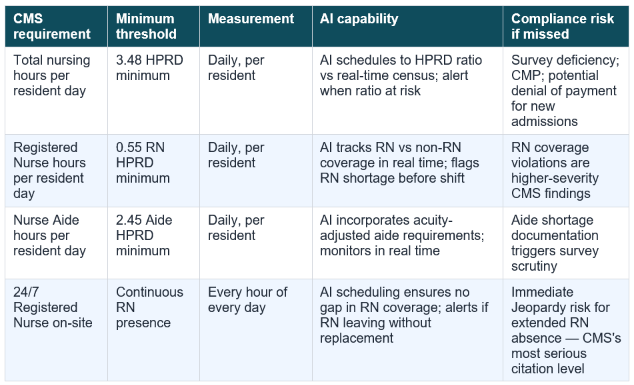
The CMS final rule on minimum staffing in nursing homes, active in 2025-2026, requires Medicare- and Medicaid-certified facilities to provide a minimum of 3.48 nursing hours per resident day (HPRD), including 0.55 hours from Registered Nurses and 2.45 from Nurse Aides, with a 24/7 RN on-site requirement. As detailed in the JAMDA October 2025 article, this mandate has been debated for feasibility but is legally in effect for certified facilities. AI scheduling tools help by: monitoring staff hours against current resident census in real time; alerting managers before a shift when HPRD ratios are projected to fall below mandate; automatically generating the daily HPRD documentation needed for CMS survey evidence; and reducing the scheduling time required to manage compliance from a 10-hour weekly task to approximately 2 hours (McKnight's LTC case study via Sparkco AI). Always consult qualified compliance counsel.
Is AI scheduling software HIPAA-compliant for use in nursing homes?
HIPAA compliance is not a property of AI software categories — it is a property of specific implementations by specific vendors. Any AI tool used in a nursing home that handles protected health information (PHI) — including resident names, census data, care acuity levels, or health records — must be deployed under a signed Business Associate Agreement (BAA) with the vendor, and the vendor's platform must meet the HIPAA Security Rule's technical, administrative, and physical safeguard requirements. The NuAIg case study with ArchCare specifically notes 'HIPAA-compliant infrastructure' as a feature of their deployment. Before deploying any AI tool in a nursing home context, verify BAA availability and HIPAA compliance documentation.
How does AI improve MDS documentation accuracy and PDPM revenue?
The Minimum Data Set (MDS) drives Medicare reimbursement under PDPM through the case-mix group assigned to each resident. AI documentation tools analyse clinical records, nursing notes, therapy documentation, and physician orders to identify coding items that affect PDPM classification but may not yet be captured in the MDS — flagging these gaps for MDS coordinator review before the assessment is finalised. NuAIg's platform specifically highlights case-mix and PDPM visibility via PointClickCare integration as a core AI application for SNFs. Any AI-identified documentation gap must be clinically validated by a qualified RN MDS coordinator before coding — AI flags, humans verify, MDS coordinator signs. Not medical, coding, or legal advice.
What did the ArchCare AI case study actually demonstrate?
ArchCare, the continuing care community of the Archdiocese of New York, partnered with NuAIg to automate CMS compliance tracking for participants requiring nursing-home-level care. According to NuAIg's published case study (nuaig.ai), the deployment automated five compliance areas including service requests, assessments, and external appointments; produced CMS audit-ready reporting; operated within a HIPAA-compliant infrastructure; and advanced the organisation's goal of 100% audit compliance while freeing staff to spend more time with residents. This is a vendor-published case study and should be interpreted accordingly — it describes outcomes as reported by the implementation partner. Not an endorsement of NuAIg or any specific vendor.
Where should a nursing home practice manager start with AI implementation?
The consistent guidance from all sources in this article is to start with scheduling and staffing compliance: this is where the regulatory risk is highest (CMS mandate), the efficiency gain is most immediately measurable (10 hours → 2 hours per week, per McKnight's case study), and the data prerequisites are most likely to already be in reasonable shape (payroll data, census data). The NuAIg 45-day AI assessment model — which maps operations across all departments before recommending deployments — reflects the right sequencing principle for SNF AI: assess first, deploy second, scale to additional modules as data quality and team confidence improve. Do not start with clinical predictive analytics before the scheduling and compliance data foundation is clean.
Running a nursing home or skilled nursing facility (SNF) in 2025-2026 means operating under three simultaneous and intensifying pressures. The first is regulatory: the Centers for Medicare & Medicaid Services (CMS) has implemented a staffing mandate requiring a minimum of 3.48 nursing hours per resident day, alongside a 24/7 registered nurse on-site requirement — a standard that a significant proportion of the existing SNF market cannot currently meet without structural changes to their workforce and scheduling practices. The second is workforce: the Bureau of Labor Statistics projects 9% demand growth for registered nurses in long-term care through 2030, against a sector already carrying vacancy rates exceeding 15% in many regions. The third is financial: PDPM reimbursement under Medicare requires precise MDS documentation to capture the acuity that drives revenue per patient day — and inaccurate documentation means direct, recoverable revenue loss that compounds across every resident stay. AI automation does not eliminate any of these pressures. But it meaningfully changes the practice manager’s ability to navigate them simultaneously. This article covers five specific areas where AI automation is delivering documented operational, compliance, clinical, and financial value in nursing homes and SNFs, with the research and real-world case studies behind each.
Table of Contents
- The Triple Pressure Facing Nursing Home Practice Managers in 2026
- The Regulatory Context: CMS Mandate and Why AI Is the Answer
- Automation Area 1 AI-Powered Staffing Scheduling and CMS Compliance
- Automation Area 2 Automated MDS Documentation and PDPM Revenue Optimisation
- Automation Area 3 Compliance Tracking, Survey Readiness, and Audit Automation
- Automation Area 4 Predictive Analytics for Resident Health Monitoring
- Automation Area 5 Administrative Automation: Reporting, HR, and Resident Family Communications
- The Implementation Roadmap for SNF Practice Managers
- Conclusion: Compliance, Quality, and the Multi-Facility Leverage Case
- Frequently Asked Questions
The Triple Pressure Facing Nursing Home Practice Managers in 2026
The nursing home industry entered 2026 managing three simultaneous and compounding pressures that have no parallel in the sector’s modern history. The regulatory pressure is the most immediate: the CMS staffing mandate, implemented in 2025, requires a minimum of 3.48 nursing hours per resident day — a standard that the JAMDA October 2025 analysis notes has ‘sparked significant debate, particularly regarding feasibility and the imposition of uniform standards across diverse facilities.’ The workforce pressure is the most structural: the Bureau of Labor Statistics projects that demand for registered nurses in long-term care will grow 9% through 2030 while vacancy rates already exceed 15% in many regions (vlinkinfo.com 2025). Meeting a compliance mandate that requires more nurse hours when fewer nurses are available is the central operational paradox of the current moment. The financial pressure is the most consequential for long-term viability: under the Patient Driven Payment Model (PDPM), Medicare reimbursement is directly tied to the accuracy of MDS documentation — which means documentation gaps are not just a compliance risk but a revenue loss that accumulates across every resident’s stay.AI automation addresses all three. Not comprehensively or automatically. But with documented efficiency gains, compliance monitoring capabilities, and clinical quality improvements that change the operational baseline from which a practice manager works.
The Regulatory Context: CMS Mandate and Why AI Is the Answer
The Centers for Medicare & Medicaid Services (CMS) final rule on minimum staffing in nursing homes establishes specific, measurable requirements that must be documented and demonstrated on a daily basis. The minimum of 3.48 nursing hours per resident day includes 0.55 hours from Registered Nurses and 2.45 hours from Nurse Aides — with the additional requirement of a Registered Nurse present on-site at all times. This is not a target. It is a minimum threshold below which a facility is in compliance violation.The JAMDA October 2025 article notes that the regulation was designed to improve safety and quality but has ‘sparked significant debate, particularly regarding feasibility.’ For facilities operating with reduced census and constrained budgets — the 2024 Long-Term Care Leader report found that 62% of SNFs identified budget limits as a key factor in deferring technology adoption — the mandate presents a genuine operational challenge. AI scheduling tools that can monitor staffing ratios against census in real time, generate compliance documentation automatically, and alert managers to projected shortfalls before a shift begins convert this from a daily crisis management problem to a proactive planning function. Not regulatory or legal advice.
Automation Area 1 AI-Powered Staffing Scheduling and CMS Compliance
The CMS staffing mandate is the single most consequential regulatory development for nursing home practice managers in 2025-2026. The final rule requires Medicare- and Medicaid-certified facilities to demonstrate a minimum of 3.48 nursing hours per resident day, including at least 0.55 hours from Registered Nurses and 2.45 hours from Nurse Aides, alongside a 24/7 RN on-site requirement. Meeting this mandate manually — with a staffing coordinator working from a spreadsheet while tracking daily census, acuity mix, staff availability, agency usage, and call-outs — is not just inefficient. It is genuinely risky. A single day below mandate creates a documented deficiency in a CMS survey. A pattern of deficiencies creates enforcement risk. AI scheduling addresses this at the systems level. Sparkco AI’s platform, citing a McKnight’s Long-Term Care News case study, documents that SNFs using AI scheduling reduced weekly scheduling time from an average of 10 hours to just 2 hours — saving over 400 hours annually per facility. A Long-Term Care Leader analysis found that SNFs saved up to 65% of the time typically spent on compliance-related scheduling tasks. But the more important metric than time saved is compliance accuracy: AI scheduling systems that monitor staff hours against resident acuity in real time provide the practice manager with a continuous compliance dashboard rather than a retrospective crisis. For practice managers overseeing multiple facilities, the ability to see all sites’ staffing ratios simultaneously — and receive alerts when a site is trending toward a compliance gap before the shift begins — is transformative.AI scheduling: 10 hours/week → 2 hours (McKnight's LTC News case study via Sparkco AI). 65% reduction in compliance-related scheduling time (Long-Term Care Leader analysis). CMS mandate: 3.48 HPRD minimum total; 0.55 RN + 2.45 Aide; 24/7 RN on-site (JAMDA October 2025). 15%+ vacancy rates make AI demand forecasting critical (BLS/vlinkinfo.com).
Sparkco AI: SNF-specific AI scheduling designed for CMS mandate compliance monitoring with real-time HPRD tracking. ShiftWise/Workforce Management Tools: healthcare-specific scheduling with compliance reporting. NetSmart Technologies: scheduling and clinical management for post-acute and LTC. PointClickCare: the dominant LTC EHR with integrated scheduling and compliance modules. Axxess: home health and LTC scheduling with compliance tracking.
400+ hours saved annually per facility (McKnight's LTC case study via Sparkco AI). At $35/hour nursing supervisor time: $14,000+ per facility in recovered time. Agency nurse usage reduction (AI demand forecasting reduces last-minute agency calls at $65-90/hour vs $25-35/hour employed staff) can save $50,000-$200,000 annually depending on current agency dependency. Not financial advice.
CMS mandate compliance is a legal obligation, not a management preference. AI scheduling tools used for compliance must produce audit-trail documentation that meets CMS survey requirements. Verify that any scheduling AI produces daily HPRD reports in a CMS-compatible format before relying on it for compliance evidence. Consult qualified healthcare compliance counsel for your specific situation.
Automation Area 2 Automated MDS Documentation and PDPM Revenue Optimisation
The Minimum Data Set (MDS) assessment is the clinical and financial engine of the skilled nursing facility. It is also one of the most time-intensive documentation requirements in healthcare. Completed by an RN with MDS certification, the MDS captures the full picture of each resident’s functional status, clinical conditions, cognitive impairment, and care needs. This data drives two critical outcomes: the resident’s care plan, and the facility’s reimbursement under Medicare’s Patient Driven Payment Model (PDPM). Under PDPM, the case-mix group assigned to each resident directly determines the Medicare rate paid per day for that resident’s stay. Inaccurate or incomplete MDS documentation means residents are assigned to lower-acuity case-mix groups than their clinical complexity warrants — resulting in direct, measurable revenue loss. The NuAIg skilled nursing platform specifically highlights case-mix and PDPM visibility via PointClickCare integration as a core AI application — using AI to ensure that MDS documentation captures the full clinical picture and assigns the correct PDPM classification. AI tools in this space analyse clinical notes, nursing assessments, physician orders, and therapy records to identify documentation gaps before the MDS is finalised — flagging conditions that affect PDPM classification but have not yet been documented in the required fields. For a practice manager overseeing multiple facilities with several MDS coordinators, this capability provides both revenue protection and documentation quality assurance simultaneously.PDPM acuity-based reimbursement: MDS accuracy directly determines Medicare revenue per patient day. NuAIg highlights case-mix and PDPM visibility as core AI application (nuaig.ai). AI documentation tools can identify MDS coding gaps that affect PDPM classification before finalisation. PointClickCare: dominant LTC EHR; AI integration enables real-time MDS tracking and case-mix analysis (NuAIg/PointClickCare integration).
AI data strategy for SNFs including case-mix/PDPM visibility via PointClickCare integration; MDS and documentation tracking; real-time compliance dashboards. PointClickCare: built-in MDS analytics and PDPM optimisation within the dominant LTC EHR. NetSmart: MDS management and care planning in LTC. Netsmart myAvatar: post-acute EHR with MDS and clinical documentation. Casamba: MDS and therapy documentation for SNFs.
A 1-point improvement in average case-mix index (CMI) in a 100-bed facility doing $300-400/day Medicare rates can be worth $100,000+ annually. PDPM clinical category misclassification identified by AI documentation review before MDS finalisation is direct recoverable revenue. Not financial advice. Verify coding accuracy with a qualified MDS coordinator and compliance counsel.
MDS coding accuracy must be clinically defensible — AI-flagged documentation gaps should be reviewed and validated by a qualified RN MDS coordinator before the assessment is submitted. AI tools that suggest additions must be verified against actual clinical evidence. Upcoding without clinical justification is a compliance violation.
Automation Area 3 Compliance Tracking, Survey Readiness, and Audit Automation
A CMS survey deficiency is not just a paperwork problem. Citations — particularly those resulting in Immediate Jeopardy (IJ) or Substandard Quality of Care (SQC) findings — can trigger civil monetary penalties, denial of payment for new admissions, and in the most serious cases, termination from Medicare and Medicaid programs. For a practice manager overseeing multiple facilities, survey readiness is a permanent operational posture, not a pre-visit sprint. AI compliance tools transform survey readiness from reactive preparation into continuous monitoring. NuAIg’s case study of ArchCare — the continuing care community of the Archdiocese of New York — demonstrates the practical application: the organisation automated CMS compliance tracking across service requests, assessments, and external appointments for participants requiring nursing-home-level care, automating five compliance areas and advancing its goal of 100% audit compliance while freeing staff to spend more time with residents. NuAIg’s platform produces CMS audit-ready reporting within a HIPAA-compliant infrastructure. The nuaig.ai documentation on assisted living compliance automation identifies the specific functions: AI can review resident care plans for regulatory compliance; Robotic Process Automation (RPA) can accurately document resident care including medication administration and Activities of Daily Living (ADLs), reducing human error risk. These processes align with HL7 and FHIR interoperability standards. For a practice manager, the most valuable output is not the automation itself but the real-time compliance dashboard: a single view of all facilities’ regulatory standing, with alerts for documentation gaps, overdue assessments, and care plan deviations before they become survey findings.ArchCare, the continuing care community of the Archdiocese of New York, partnered with NuAIg to automate CMS compliance tracking across service requests, assessments, and external appointments for participants requiring nursing-home-level care. Result: 5 compliance areas automated; CMS audit-ready reporting achieved; HIPAA-compliant infrastructure; advancing goal of 100% audit compliance while freeing staff time for direct resident care. Source: nuaig.ai.
ArchCare (NuAIg case study): 5 compliance areas automated; goal 100% audit compliance; CMS audit-ready reporting; HIPAA-compliant infrastructure (nuaig.ai). AI and RPA reduce human error in documentation including medication administration and ADLs (nuaig.ai). NuAIg offers 45-day AI assessment for SNF operations — compliance, HR, and beyond (nuaig.ai). HL7 and FHIR standards alignment for interoperability (nuaig.ai).
AI compliance automation for SNFs and LTC — ArchCare case study; CMS tracking; HIPAA infrastructure. Sparkco AI: compliance reporting automation integrated with scheduling. PointClickCare: compliance dashboards and survey prep within LTC EHR. ACHIEVE Platform: healthcare compliance and survey management. SimpleAnalytics/LTC analytics platforms: compliance monitoring and benchmarking.
A single CMS civil monetary penalty can range from $2,058 to $22,320 per day (current CMS CMPs, subject to annual adjustment). Avoiding one Immediate Jeopardy citation through proactive compliance monitoring can save more than the cost of AI compliance software for an entire year. Not legal or financial advice. Consult qualified healthcare compliance counsel.
HIPAA compliance is not optional for any AI tool processing resident health information. Before deploying any AI compliance or documentation tool, verify the vendor has signed a Business Associate Agreement (BAA) and that their platform architecture meets HIPAA Security Rule requirements. Failure to maintain HIPAA compliance is a separate regulatory exposure from CMS citations.
Automation Area 4 Predictive Analytics for Resident Health Monitoring
Long-term care has historically operated in a reactive clinical model: nurses observe changes in resident status, document them, notify the physician, and initiate a care response. For residents with multiple comorbidities, complex medication regimens, and conditions that deteriorate gradually, the gap between the first subtle sign of decline and the documented intervention is where preventable hospitalisations occur. The JAMDA October 2025 article on AI in long-term care facilities identifies predictive analytics as a flexible, data-driven response to exactly this problem. AI-powered monitoring analyses continuous streams of data — vital signs captured by wearable sensors, weight change records, sleep pattern monitoring through motion sensors, food intake observations, mobility data from bed sensor systems — to identify early warning signals of deterioration before clinical symptoms become obvious. VLinkInfo’s 2025 analysis of AI in long-term care identifies this as a fundamentally different care paradigm: ‘shifting from reactive responses to proactive interventions.’ For the practice manager, the financial and regulatory implications are direct: hospital re-admissions within 30 days of discharge are measured, reported, and can affect star ratings under CMS’s Five-Star Quality Rating System. A reduction in preventable hospitalisations improves both resident outcomes and the facility’s quality measures — which in turn affect occupancy, referral patterns, and reimbursement under value-based care programmes. The foundational academic evidence (Lu, Rui & Seidmann, Management Science, 2018) found that increased automation improved clinical quality ratings by 6.9% in nursing homes — a finding that aligns with the directional evidence from newer AI monitoring tools.AI-powered monitoring shifts LTC from reactive to proactive care paradigm (JAMDA October 2025; vlinkinfo.com 2025). Foundational research (Management Science 2018): automation improved clinical quality ratings by 6.9%. BLS: demand for RNs in LTC will grow 9% through 2030 vs current >15% vacancy rates — AI clinical decision support compensates for staffing gaps. AI behavioural health monitoring represents particularly innovative LTC application (vlinkinfo.com).
CarePredict: AI-powered resident monitoring using wearable technology for early decline detection. HCI (Health Catalyst): predictive analytics for LTC outcomes and hospitalisation prevention. PointClickCare Insights: clinical analytics and early warning within the dominant LTC EHR. GUSS Health: nursing home-specific clinical intelligence. Palantir Healthcare: enterprise-level clinical analytics (large operators). VitalCare/iN2L: resident engagement and monitoring technology for LTC.
CMS penalises excess readmissions under various quality programmes. A 1% reduction in 30-day readmission rate in a 100-bed facility with average 30% Medicare census can represent meaningful quality measure improvement and referral growth. Five-Star Quality Rating improvement from preventable hospitalisation reduction has direct occupancy and referral impact.
AI monitoring tools that generate clinical alerts must be integrated into a clinical response workflow before deployment. An alert that is not acted on within a defined timeframe is not just useless — it creates documentation that a warning sign was observed and ignored, which is potentially a greater liability than not having the alert system. Establish clinical escalation protocols before go-live.
Automation Area 5 Administrative Automation: Reporting, HR, and Resident Family Communications
A nursing home practice manager’s administrative burden is qualitatively different from other healthcare settings. It includes CMS Five-Star Quality Measure reporting, state survey preparation, incident reporting to state agencies, HR documentation for a workforce subject to ongoing background check and training certification requirements, resident and family communications, financial reporting to ownership groups, and the daily operational dashboard that allows the practice manager to know the census, the staffing ratio, the revenue picture, and the compliance status of every facility in the group simultaneously. AI and automation tools address each of these without requiring a complete technology replacement. NuAIg’s skilled nursing platform identifies the core administrative AI applications: data strategy across clinical, financial, and compliance systems; MDS and documentation tracking; real-time compliance dashboards; staffing recommendation copilot. Sparkco AI’s compliance reporting automation generates CMS-format documentation from scheduling data, reducing the manual work of assembling the evidence for a survey. For resident and family communications, natural language processing tools can analyse family satisfaction survey responses and identify sentiment patterns — surfacing emerging concerns before they escalate into formal complaints or ombudsman referrals. Large language model tools (GPT-4 class, Claude) can assist with drafting family communications, incident report narratives, staff performance documentation, and policy updates. For a practice manager across multiple facilities, the ability to generate consistent, professionally worded documentation across all sites — rather than depending on the writing quality of individual staff members — reduces both documentation time and inconsistency risk.Data strategy + clinical/financial/compliance integration; MDS tracking; real-time compliance dashboards; staffing recommendation copilot (nuaig.ai). Sparkco AI: compliance reporting automation generates CMS-format documentation from scheduling data. NLP sentiment analysis of resident/family feedback identifies patterns in preferences and concerns (nuaig.ai). AI LLMs assist with documentation, communications, policy drafting.
Multi-pillar SNF AI — data strategy, AI agents, compliance automation from admissions to finance. Sparkco AI: scheduling + compliance reporting integration. PointClickCare: the backbone EHR for most SNFs with integrated analytics and reporting modules. Claude (Anthropic) / GPT-4 (OpenAI): general-purpose LLMs for documentation drafting, family communications, policy development. NetSmart: LTC operations management. Aline (formerly ALIS): assisted living and LTC administrative platform.
Reduction in state survey deficiencies reduces both financial penalties and the management time (often 100+ hours) required to respond to Plans of Correction. LLM-assisted documentation can reduce care planning and incident report writing time by 40-60% per document. Multi-facility dashboard automation reduces daily reporting from 1-2 hours per facility to 15-20 minutes across all facilities.
Any AI tool used to draft resident care documentation, incident reports, or compliance records must be reviewed and approved by a qualified clinical or compliance professional before submission. AI-generated documentation that is not reviewed and signed off carries liability risk equivalent to unsigned documentation. Establish a human review and co-signature workflow for all AI-assisted regulatory documents.
The Implementation Roadmap for SNF Practice Managers
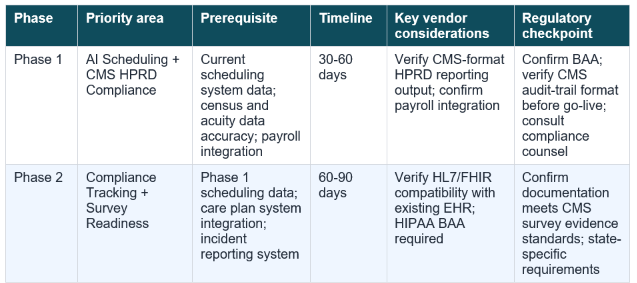
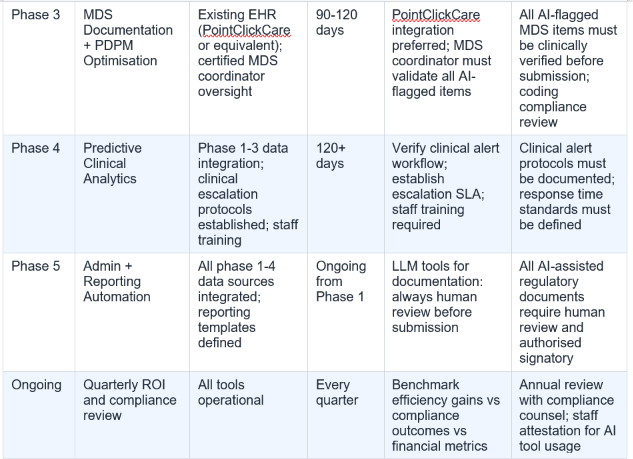
The NuAIg skilled nursing platform approach — a 45-day AI assessment that maps operations across every department before deployment — reflects the correct sequencing principle for nursing home AI implementation. Unlike restaurant or retail AI deployment, SNF implementation must account for HIPAA compliance verification, CMS documentation requirements, clinical workflow integration, and state-specific licensing considerations at every stage. Not regulatory or legal advice.
Conclusion
For a nursing home practice manager overseeing multiple facilities in 2026, the confluence of the CMS staffing mandate, workforce scarcity, and PDPM reimbursement complexity creates a management environment where the margin for operational inefficiency is genuinely slim. The McKnight’s Long-Term Care News case study cited by Sparkco AI puts the scheduling efficiency gain in concrete terms: 10 hours per week reduced to 2 — saving over 400 hours annually per facility. At a three-facility group, that is 1,200 hours of nursing supervisor time per year that can be redirected from scheduling administration to resident care, staff development, and quality management.The ArchCare case study from NuAIg demonstrates the compliance automation case: five compliance areas automated, CMS audit-ready reporting, and a goal of 100% audit compliance achieved while freeing staff for direct resident contact. These are not aspirational statistics. They are documented outcomes from real facilities using AI tools that exist today. The academic evidence (Management Science 2018) adds the long-term quality dimension: automation correlates with a 6.9% improvement in clinical quality ratings. For the practice manager, the argument is not whether to adopt AI — it is which area to start in, what the data prerequisites are, and how to sequence deployment so that the compliance and revenue benefits arrive before the operational complexity of multi-tool implementation accumulates. Start with scheduling. Get the HPRD compliance picture right. Then build from there.
Frequently Asked Questions
What is the CMS staffing mandate and how does AI help nursing homes comply?The CMS final rule on minimum staffing in nursing homes, active in 2025-2026, requires Medicare- and Medicaid-certified facilities to provide a minimum of 3.48 nursing hours per resident day (HPRD), including 0.55 hours from Registered Nurses and 2.45 from Nurse Aides, with a 24/7 RN on-site requirement. As detailed in the JAMDA October 2025 article, this mandate has been debated for feasibility but is legally in effect for certified facilities. AI scheduling tools help by: monitoring staff hours against current resident census in real time; alerting managers before a shift when HPRD ratios are projected to fall below mandate; automatically generating the daily HPRD documentation needed for CMS survey evidence; and reducing the scheduling time required to manage compliance from a 10-hour weekly task to approximately 2 hours (McKnight's LTC case study via Sparkco AI). Always consult qualified compliance counsel.
Is AI scheduling software HIPAA-compliant for use in nursing homes?
HIPAA compliance is not a property of AI software categories — it is a property of specific implementations by specific vendors. Any AI tool used in a nursing home that handles protected health information (PHI) — including resident names, census data, care acuity levels, or health records — must be deployed under a signed Business Associate Agreement (BAA) with the vendor, and the vendor's platform must meet the HIPAA Security Rule's technical, administrative, and physical safeguard requirements. The NuAIg case study with ArchCare specifically notes 'HIPAA-compliant infrastructure' as a feature of their deployment. Before deploying any AI tool in a nursing home context, verify BAA availability and HIPAA compliance documentation.
How does AI improve MDS documentation accuracy and PDPM revenue?
The Minimum Data Set (MDS) drives Medicare reimbursement under PDPM through the case-mix group assigned to each resident. AI documentation tools analyse clinical records, nursing notes, therapy documentation, and physician orders to identify coding items that affect PDPM classification but may not yet be captured in the MDS — flagging these gaps for MDS coordinator review before the assessment is finalised. NuAIg's platform specifically highlights case-mix and PDPM visibility via PointClickCare integration as a core AI application for SNFs. Any AI-identified documentation gap must be clinically validated by a qualified RN MDS coordinator before coding — AI flags, humans verify, MDS coordinator signs. Not medical, coding, or legal advice.
What did the ArchCare AI case study actually demonstrate?
ArchCare, the continuing care community of the Archdiocese of New York, partnered with NuAIg to automate CMS compliance tracking for participants requiring nursing-home-level care. According to NuAIg's published case study (nuaig.ai), the deployment automated five compliance areas including service requests, assessments, and external appointments; produced CMS audit-ready reporting; operated within a HIPAA-compliant infrastructure; and advanced the organisation's goal of 100% audit compliance while freeing staff to spend more time with residents. This is a vendor-published case study and should be interpreted accordingly — it describes outcomes as reported by the implementation partner. Not an endorsement of NuAIg or any specific vendor.
Where should a nursing home practice manager start with AI implementation?
The consistent guidance from all sources in this article is to start with scheduling and staffing compliance: this is where the regulatory risk is highest (CMS mandate), the efficiency gain is most immediately measurable (10 hours → 2 hours per week, per McKnight's case study), and the data prerequisites are most likely to already be in reasonable shape (payroll data, census data). The NuAIg 45-day AI assessment model — which maps operations across all departments before recommending deployments — reflects the right sequencing principle for SNF AI: assess first, deploy second, scale to additional modules as data quality and team confidence improve. Do not start with clinical predictive analytics before the scheduling and compliance data foundation is clean.
0 Comments
Be the first to share your thoughts on this article.