

Computer
AI Bubble May Burst: 5 Ways to Protect Your Portfolio

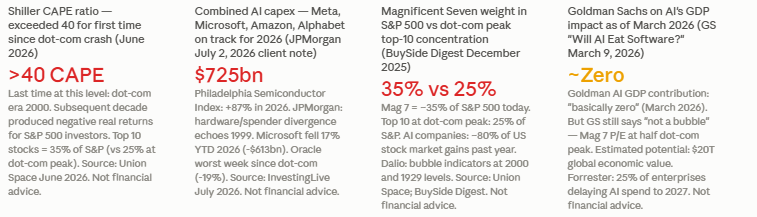
The Shiller CAPE ratio exceeded 40 for the first time since the dot-com crash. The top ten stocks make up 35% of the S&P 500 — more concentrated than the dot-com peak. Combined AI capex from Meta, Microsoft, Amazon and Alphabet is on track to reach $725 billion in 2026. JPMorgan’s July 2026 client note drew explicit parallels to 1999, just before the bubble burst. Goldman Sachs says it’s not a bubble yet. Bridgewater’s Ray Dalio says bubble indicators are at 2000 and 1929 levels. Somebody is wrong. This article is not financial advice, but it does walk through five concrete portfolio protection strategies that every investor overexposed to AI megacaps should understand.
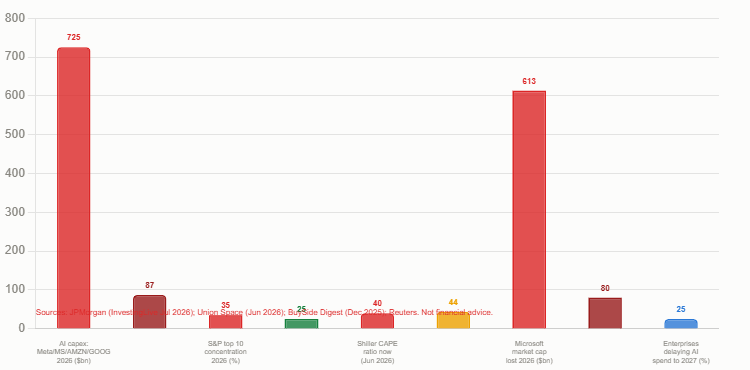
The AI capital expenditure numbers are staggering in their own right. Combined AI capex from Meta, Microsoft, Amazon and Alphabet is on track to reach approximately $725 billion in 2026 (JPMorgan client note, July 2, 2026). Citi’s most optimistic projections put total AI capex through 2030 at $8.9 trillion. Microsoft alone earmarked $80 billion for AI data centres in 2025. Meta’s 2026 AI spending is projected to potentially exceed $103 billion. Amazon expects capital spending to jump more than 50% in 2026. These are not marginal investments; they are transformative bets on a single technology at levels that have historically preceded significant market dislocations.
The specific stock damage has already begun. Microsoft fell approximately 17% year-to-date in 2026, erasing roughly $613 billion in market value. Nvidia, Apple, and Alphabet collectively shed more than $434 billion in market cap since the start of 2026 (Reuters/Colorado Biz). Oracle closed its worst week since the dot-com bubble with a 19% drop in the June 2026 sell-off. These are not peripheral companies; they are the core holdings of almost every index fund and most actively managed funds. Not financial advice.
Shiller CAPE ratio: exceeded 40 in June 2026 (first time since dot-com crash). Top 10 stocks: ~35% of S&P 500 (vs 25% at dot-com peak). AI companies: ~80% of US stock market gains past year. Combined AI capex (Meta/Microsoft/Amazon/Alphabet): on track for ~$725bn in 2026 (JPMorgan July 2026). Microsoft: -17% YTD 2026, -$613bn market cap. Oracle: -19% in one week (June 2026). Bridgewater (Ray Dalio): 'bubble indicators' at 2000 and 1929 levels. Sources: Union Space June 2026; JPMorgan client note (InvestingLive July 2026); Reuters/Colorado Biz 2026. Not financial advice.
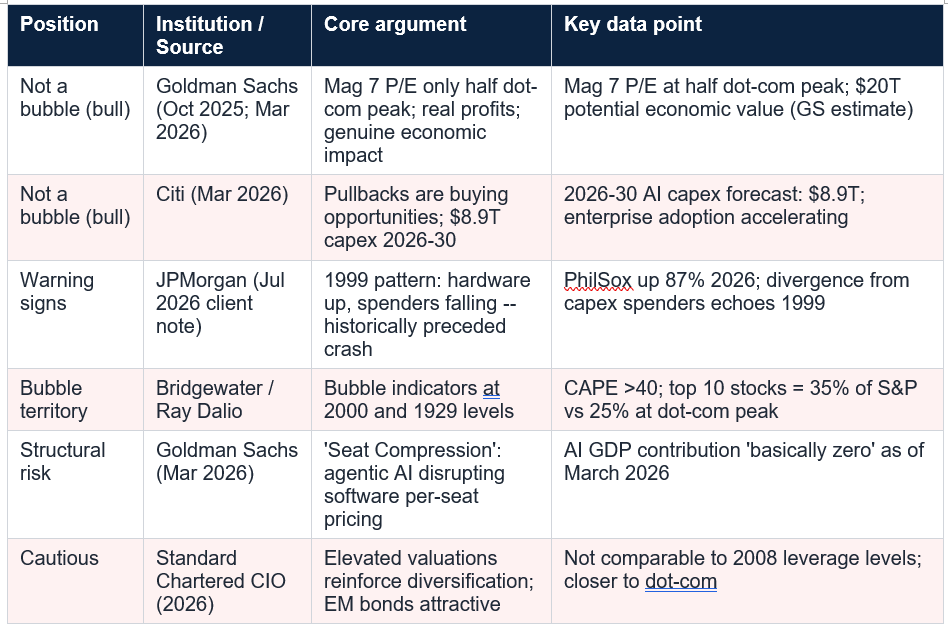
The bull case, led most visibly by Goldman Sachs, rests on two core arguments. First, unlike the dot-com era, the leading AI companies are genuinely profitable. The Magnificent Seven generate billions in real earnings, fund their AI investments from ongoing cash flows rather than speculative capital raises, and have balance sheets that would have been unimaginable for 1999’s Pets.com equivalents. Goldman Sachs’s chief global equity strategist Peter Oppenheimer stated in the bank’s ‘AI: In a Bubble?’ report: ‘Even as those stocks have rallied substantially, they don’t appear to be in a bubble.’ Second, the economic potential is real: Goldman’s economist Joseph Briggs estimates generative AI could generate $20 trillion in global economic value. The current capex would need to reach approximately $700 billion to match the telecom investment peak as a share of GDP in the late 1990s.
The bear case is led by Bridgewater’s Ray Dalio (bubble indicators at 2000 and 1929 levels), JPMorgan’s Jamie Dimon (voiced concern), and JPMorgan’s July 2026 client note explicitly comparing the current hardware-versus-spender divergence to 1999. The most pointed observation: Goldman Sachs itself acknowledged in its March 2026 ‘Will AI Eat Software?’ report that AI’s contribution to GDP was ‘basically zero’ at that point. There is also the SoftBank signal: in October 2025, SoftBank sold all of its Nvidia stock for $5.83 billion — right at Nvidia’s peak value, just weeks before AI stocks started sliding. Not financial advice.
The parallel is not a prediction that 2026’s AI market will replicate 2000’s dot-com crash. JPMorgan did not call a bubble. What it identified was a historical risk marker: the specific divergence between infrastructure suppliers (benefiting from current AI spend) and heavy AI capex spenders (whose returns on that spend have not yet materialised) is the same divergence that preceded the dot-com bust. The question the market is beginning to price is not whether AI is real, but whether the companies spending $725 billion in 2026 will generate sufficient return on that capital to justify the spending.
Goldman Sachs’ own March 2026 report contributed to this concern from an unexpected direction. ‘Will AI Eat Software?’ described what Goldman called ‘Seat Compression’: agentic AI systems that can execute tasks autonomously are threatening to replace, rather than augment, traditional software subscriptions. If AI agents replace the software that enterprise companies pay per-seat licensing for, the software sector — one of the primary claimed beneficiaries of AI — faces structural revenue decline. The AI revolution might simultaneously enable and disrupt technology investment theses. Not financial advice.
The dot-com template (1999-2000): Phase 1: hardware/infrastructure outperforms (Cisco, Lucent -- now Nvidia, Broadcom). Phase 2: internet companies/heavy spenders begin to underperform. Phase 3: hardware peaked; then crashed with everything else (-80% from peak). The JPMorgan signal (July 2026): PhilSox Index +87% in 2026; AI capex spenders (Microsoft, Alphabet, Meta) underperforming. This divergence first became visible in late 1999 -- roughly 12 months before the crash. Source: JPMorgan client note (InvestingLive, July 2, 2026). Historical context only; not a prediction. Not financial advice.
This is not the diversification that the phrase ‘I hold an index fund’ intuitively implies to most investors. Holding the S&P 500 in October 2026 means approximately 35% of every dollar is in ten companies, and a substantial proportion of that 35% is in companies whose valuations are partly driven by AI expectations. If AI sentiment shifts sharply — as it did in June 2026’s 5% Nasdaq sell-off, and as it did for Microsoft (-17% YTD 2026) — the index fund is not insulated. It moves with the concentrated positions.
The BuySide Digest quarterly letter (December 2025) is direct: ‘The Magnificent Seven tech companies represent 35% of the S&P 500 and 30% of all capex.’ Passive investing has produced outstanding long-run returns; but it currently means accepting the specific concentration risk of the AI megacap trade, regardless of the investor’s individual view on whether AI valuations are sustainable. This is the context in which the five protection strategies below should be understood. Not financial advice.
The historical evidence from the dot-com bust is instructive. The BuySide Digest quarterly letter (December 2025) is explicit: ‘Historical evidence from the dot-com bust shows how small-cap and international allocations helped when large growth stocks declined.’ During the 2000–2002 dot-com crash, international developed market equities and emerging markets significantly outperformed US large-cap growth stocks. US investors heavily concentrated in the S&P 500 lost more than 40%; investors with significant international allocations lost far less.
In practical terms for October 2026: increasing allocation to MSCI World ex-US index funds, European equities, UK mid-cap, or Asia ex-Japan reduces the percentage of the portfolio exposed to the specific AI megacap premium. It does not eliminate equity risk — a severe global recession would affect all markets — but it reduces concentration in the specific segment that JPMorgan, Dalio, and others have flagged as carrying bubble-like characteristics. Not financial advice.
Geographic diversification action: review the geographic exposure of your equity portfolio. If more than 50% is in US large-cap equities: consider whether the allocation to international stocks (MSCI World ex-US, MSCI Emerging Markets, MSCI Europe, or single-country funds) reflects deliberate diversification or simply index-tracking default. Goldman Sachs Oppenheimer recommendation: maintain balance across regions. Sources: Goldman Sachs Oppenheimer (Wealth Professional Canada); Standard Chartered CIO 2026; BuySide Digest December 2025. Not financial advice.
The logic: in the late 1990s, massive overbuilding of fibre-optic networks caused Lucent, Cisco, and Nortel to collapse when demand did not materialise at the pace assumed. But the companies that used cheap internet capacity — Google, Amazon, eBay — thrived on the overbuilt infrastructure. If AI data centres are similarly overbuilt, the companies that access cheap AI computing services benefit from the excess capacity at lower prices. These are: enterprise software companies adopting AI capabilities; healthcare companies using AI diagnostics; financial services companies using AI underwriting; manufacturing companies using AI process optimisation.
This thesis has a complication that Goldman Sachs itself identified in March 2026: agentic AI may cause ‘Seat Compression’ — AI agents replacing traditional software subscriptions. Investors rotating from AI infrastructure builders to AI software adopters need to verify that the specific software companies in question are adapting to the agentic AI disruption rather than being threatened by it. Not financial advice.
Sector rotation action: review exposure to AI infrastructure (data centres, GPU manufacturers, semiconductor fabs) vs AI adopters (companies applying AI to improve products and services in non-tech sectors: healthcare, financials, industrials, energy, utilities). The Goldman Oppenheimer framework (cited in Decrypt): Pioneers, Enablers, Adapters, Reformers, Laggards. If overexposed to Enablers (hardware/infrastructure): consider reducing in favour of Adapters (companies changing their business models to implement AI solutions). Not financial advice. Individual securities involve individual risks.
The BuySide Digest’s December 2025 quarterly letter specifically identifies this as the relevant historical lesson: ‘small-cap and international allocations helped when large growth stocks declined’ during the dot-com bust. The current AI bubble risk is concentrated in large-cap growth. The antidote — historically — was small-cap and value. This is the academic ‘Fama-French factor’ argument: small-cap and value premia tend to be rewarded over time, and they are structurally less correlated with the specific valuation excess in large-cap AI names.
In practical terms: increasing allocation to a US small-cap value fund (Russell 2000 Value, for example), or to international value funds, reduces the weight of the portfolio in the specific segment that carries the AI premium. These positions underperform in a continued AI bull market; that is the trade-off. The protection is that they do not carry the same AI valuation risk. Not financial advice.
Concentration risk: approximately 35% of the S&P 500 is in 10 stocks (Union Space June 2026). Approximately 35% of the S&P 500 weight is in the Magnificent Seven alone (BuySide Digest December 2025). AI-linked companies accounted for approximately 80% of US stock market gains over the past year. Holding a standard US index fund means approximately a third of every invested dollar is in the AI megacap premium, regardless of the investor's individual view on AI valuation. Source: Union Space June 2026; BuySide Digest December 2025. Not financial advice.
For bonds specifically: JPMorgan American Investment Trust’s Felise Agranoff noted in MoneyWeek that ‘corporate bond markets — often the first to spot trouble — remain calm, with credit spreads close to record lows.’ This is actually a cautiously reassuring signal: if corporate bonds were pricing in AI bubble risk, spreads would be widening. They are not (as of available data). US Treasury bonds and investment-grade corporate bonds remain a traditional safe-haven from equity market corrections, though in the current rate environment (Fed at 3.75–4.00%) they carry their own duration risk. Not financial advice.
Real assets — real estate investment trusts (REITs), infrastructure funds, commodities — provide returns that are driven by fundamentally different economic variables than the AI earnings expectations embedded in megacap tech valuations. The addition of real assets to a portfolio dominated by US large-cap equity reduces correlation with the specific AI trade. Not financial advice. Individual assets within each of these categories carry their own specific risks.
Alternative assets action: review the non-equity portion of your portfolio. If more than 80% is in equities (particularly US large-cap equities): consider whether an allocation to gold (via ETF), Treasury bonds or TIPS, investment-grade corporate bonds, or real assets (REITs, infrastructure) provides meaningful diversification vs the AI concentration risk. Standard Chartered CIO: EM bonds offer 'attractive credit quality, higher yields and diversification.' Gold as wealth preservation during market stress: cited in multiple AI bubble analyses. Not financial advice.
The discipline strategy: periodically rebalance back to a target allocation. If you had a target of 5% Nvidia and it is now 15%, sell the excess and redistribute to the diversification strategies above. This is not a prediction that Nvidia will fall; it is a systematic method of preventing any single position or sector from becoming so large that a correction causes disproportionate portfolio damage. The mechanism is identical to the rebalancing embedded in target-date funds, which automatically sell what has risen and buy what has fallen to maintain the target allocation.
SoftBank’s October 2025 decision to sell its entire Nvidia position for $5.83 billion was explicitly noted in multiple analyses as ‘smart money exiting early’ — right at Nvidia’s peak, weeks before AI stocks began declining. Individual investors rarely have SoftBank’s information advantage; but the discipline of systematic profit-taking — selling when a position exceeds its target allocation rather than when sentiment changes — is the closest equivalent available. Not financial advice.
Position sizing action: calculate the current weight of AI-exposed positions in your total portfolio (include Nvidia, Microsoft, Alphabet, Meta, Amazon, Apple, and any AI-specific ETFs or funds). If the combined AI-exposed equity concentration exceeds a percentage you would have deliberately chosen if starting fresh today: rebalance toward the target. The mechanism: sell the excess on a set schedule (quarterly, semi-annually) and reinvest in diversifying assets (international equities, small-cap, bonds, alternatives). This is systematic discipline, not timing. Not financial advice. Consult a qualified financial adviser.
Most serious market commentators in 2026 fall into the ‘correction risk’ rather than ‘bubble burst’ camp. Goldman Sachs’ Oppenheimer is explicit: the current situation shows ‘similarities but key differences’ from past bubbles. Key differences: strong balance sheets, genuine profit generation, real revenue. MoneyWeek’s Henry Wu (Alpine Macro) frames it well: ‘The AI capex boom will likely create excesses, but neither its size nor its leverage is extreme.’ The standard bullish case is not that AI is cheap but that AI companies can grow into their valuations.
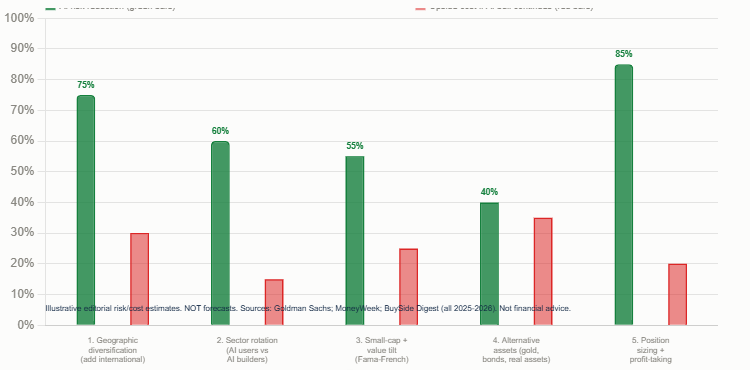
The five strategies above are designed to protect against both scenarios — correction and bubble burst — without betting on either. Geographic diversification, sector rotation, small-cap tilt, alternative assets, and position sizing discipline all reduce exposure to the specific AI valuation risk while preserving participation in market growth if the bull case proves correct. They are not calls to exit equities or time the market. They are calls to not hold more AI concentration than was deliberately chosen. Not financial advice.
Rob Morgan (chief investment analyst, Charles Stanley, as cited in MoneyWeek): ‘diversification is the key to protecting your portfolio against market volatility.’ Goldman’s Oppenheimer: ‘diversification has paid off this year and will likely continue to do so if hype outpaces reality.’ Standard Chartered CIO: ‘elevated valuations reinforce the importance of diversification.’ BuySide Digest: ‘build portfolios around long-term goals that can withstand various market environments rather than attempting to time AI bubble concerns or predict market movements.’
The most practically useful framing comes from the BuySide Digest: ‘market leadership can change abruptly and diversification works in real time.’ The protection is not preparation for a specific event; it is the structural condition of a portfolio that can withstand unpredictable events. Not financial advice. Consult a qualified financial adviser for personalised guidance.
Rob Morgan (Chief Investment Analyst, Charles Stanley, MoneyWeek): 'Diversification is the key to protecting your portfolio against market volatility.' Goldman Sachs Peter Oppenheimer: 'Diversification has paid off this year and will likely continue to do so if hype outpaces reality... maintain balance across sectors and regions.' BuySide Digest (Q4 2025): 'Market leadership can change abruptly and diversification works in real time. Long-term investors should focus on building diversified portfolios that can withstand various market environments rather than attempting to time AI bubble concerns.' Sources: MoneyWeek; Wealth Professional Canada (Goldman Sachs); BuySide Digest December 2025. Not financial advice.
What the data does tell you is that the US stock market is more concentrated than at any point in modern history, that the AI companies driving that concentration are carrying valuations that depend on future earnings growth materialising at unprecedented scale, and that the companies spending $725 billion per year on AI infrastructure have not yet demonstrated the returns on that capital that would justify the spending. That is a risk. It may not materialise. But it is visible, it is specific, and it is measurable.
The five strategies in this article — geographic diversification, sector rotation to AI customers rather than suppliers, small-cap and value tilt, alternative assets, and systematic position-sizing discipline — address that specific, visible, measurable risk without requiring you to predict the future. They allow continued equity market participation while reducing concentration in the specific segment most exposed to an AI sentiment shift. Protect first. Participate second. Not financial, investment, or tax advice. Consult a qualified financial adviser.
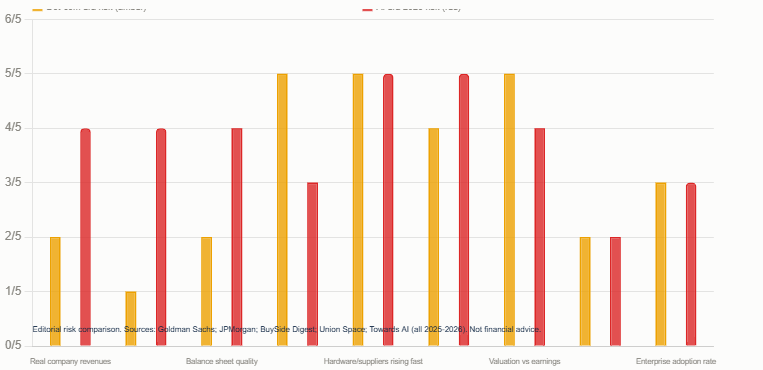
Serious experts disagree, and the disagreement is substantive. The bull case (Goldman Sachs, Citi): AI leaders are genuinely profitable, balance sheets are strong, the Magnificent Seven P/E is approximately half the dot-com peak, and the economic potential of AI is real -- Goldman estimates $20 trillion in global economic value from generative AI. The bear case (Bridgewater's Ray Dalio, JPMorgan warning note July 2026): Shiller CAPE ratio exceeded 40 for the first time since the dot-com crash; market concentration (top 10 stocks = 35% of S&P 500) exceeds dot-com peak; AI contribution to GDP was 'basically zero' as of March 2026 (Goldman Sachs 'Will AI Eat Software?' March 9, 2026). The most balanced view from multiple sources: 2026 shows bubble-like conditions in specific segments (AI infrastructure stocks, certain Nvidia-adjacent valuations) rather than a market-wide speculative frenzy comparable to 1999-2000. Not a prediction. Not financial advice.
How exposed am I to the AI bubble if I hold an index fund?
More exposed than most passive investors realise. The top ten stocks represent approximately 35% of the S&P 500 (Union Space, June 2026), and the Magnificent Seven alone represent approximately 35% of the S&P 500 (BuySide Digest, December 2025). A standard market-cap-weighted S&P 500 index fund means approximately a third of every dollar is concentrated in AI-exposed megacaps. AI-linked companies accounted for approximately 80% of US stock market gains over the past year. If AI sentiment shifts, a standard S&P 500 index fund will not be insulated. This is the MoneyWeek point: 'you are likely more exposed to any potential bursting of the AI megacap bubble than you think.' Not financial advice.
What is the dot-com parallel that JPMorgan identified in 2026?
In a July 2, 2026 client note, JPMorgan strategists identified a growing split between AI hardware stocks (Philadelphia Semiconductor Index up 87% in 2026) and the companies spending most heavily on AI capex (Microsoft, Meta, Alphabet, Amazon -- which have underperformed). JPMorgan compared this to 1999, when communications equipment makers (Cisco, Lucent) surged while the heavy internet infrastructure spenders fell -- the divergence that preceded the dot-com crash in early 2000. The parallel is NOT a prediction that 2026 equals 2000. JPMorgan did not call a bubble. It identified a specific historical risk pattern without an explicit 'crash is coming' conclusion. The note adds a historical risk marker to the debate. Source: InvestingLive, July 2, 2026. Not financial advice.
What is the single most important thing I can do to protect my portfolio?
The expert consensus across every institution cited in this article is: diversification. Rob Morgan (Charles Stanley/MoneyWeek): 'diversification is the key to protecting your portfolio against market volatility.' Goldman Sachs's Oppenheimer: 'diversification has paid off this year.' BuySide Digest: 'build portfolios around long-term goals that can withstand various market environments rather than attempting to time AI bubble concerns.' Practically: check your portfolio's geographic concentration (how much is US vs international); check sector concentration (how much is tech vs healthcare, financials, industrials, energy, utilities); check size concentration (how much is large-cap vs small-cap); and check asset class concentration (how much is equities vs bonds vs alternatives). Reduce any concentration that you would not have deliberately chosen. Not financial advice. Consult a qualified financial adviser.
Should I sell AI stocks now?
This article does not make recommendations to buy or sell any security. Selling AI stocks now would be a form of market timing -- a strategy with a poor long-run track record for most investors. Goldman Sachs's Oppenheimer notes that 'tech remains attractive' and recommends balance rather than exit. The five strategies in this article are specifically NOT about timing the market; they are about structural portfolio positioning that reduces concentration risk regardless of when or whether a correction occurs. The BuySide Digest makes this explicit: 'long-term investors should focus on building diversified portfolios that can withstand various market environments rather than attempting to time AI bubble concerns or predict market movements.' If you have an AI position that has grown to a concentration you would not deliberately choose today: rebalancing to a target allocation is different from market timing, and is generally considered sound portfolio management. Not financial, investment, or tax advice. Consult a qualified financial adviser.
Table of Contents
- The Uncomfortable Numbers: Why This Is Not Routine Volatility
- The Bull Case vs The Bear Case: What the Smartest Investors Say
- The Dot-Com Parallel: What JPMorgan’s Warning Actually Means
- Why You Are More Exposed Than You Think
- Way #1 — Geographic Diversification: Reduce US Tech Concentration
- Way #2 — Sector Rotation: Invest in AI’s Customers, Not Its Suppliers
- Way #3 — Small-Cap and Value Tilt: The Dot-Com Lesson
- Way #4 — Alternative Assets: Gold, Bonds and Real Assets
- Way #5 — Position Sizing and Profit-Taking: The Discipline Strategy
- The Bubble vs Correction Distinction: Why It Matters for Your Strategy
- What the Experts Actually Recommend Right Now
- Conclusion: Protect First, Participate Second
- Frequently Asked Questions
AI capex and valuation warnings — what the data shows
Dot-com vs AI comparison — bull case vs bear case
5 protection strategies — expected risk reduction
The Uncomfortable Numbers: Why This Is Not Routine Volatility
In June 2026, the Shiller cyclically-adjusted price-to-earnings ratio for the US stock market exceeded 40 for the first time since the dot-com crash. The last time this level was reached, the subsequent decade produced negative real returns for investors in the S&P 500. Market concentration has reached a level unprecedented even compared to the dot-com peak: the top ten stocks now account for approximately 35% of the S&P 500, compared to 25% at the height of the dot-com bubble. AI-linked companies accounted for roughly 80% of all US stock market gains over the past year.The AI capital expenditure numbers are staggering in their own right. Combined AI capex from Meta, Microsoft, Amazon and Alphabet is on track to reach approximately $725 billion in 2026 (JPMorgan client note, July 2, 2026). Citi’s most optimistic projections put total AI capex through 2030 at $8.9 trillion. Microsoft alone earmarked $80 billion for AI data centres in 2025. Meta’s 2026 AI spending is projected to potentially exceed $103 billion. Amazon expects capital spending to jump more than 50% in 2026. These are not marginal investments; they are transformative bets on a single technology at levels that have historically preceded significant market dislocations.
The specific stock damage has already begun. Microsoft fell approximately 17% year-to-date in 2026, erasing roughly $613 billion in market value. Nvidia, Apple, and Alphabet collectively shed more than $434 billion in market cap since the start of 2026 (Reuters/Colorado Biz). Oracle closed its worst week since the dot-com bubble with a 19% drop in the June 2026 sell-off. These are not peripheral companies; they are the core holdings of almost every index fund and most actively managed funds. Not financial advice.
Shiller CAPE ratio: exceeded 40 in June 2026 (first time since dot-com crash). Top 10 stocks: ~35% of S&P 500 (vs 25% at dot-com peak). AI companies: ~80% of US stock market gains past year. Combined AI capex (Meta/Microsoft/Amazon/Alphabet): on track for ~$725bn in 2026 (JPMorgan July 2026). Microsoft: -17% YTD 2026, -$613bn market cap. Oracle: -19% in one week (June 2026). Bridgewater (Ray Dalio): 'bubble indicators' at 2000 and 1929 levels. Sources: Union Space June 2026; JPMorgan client note (InvestingLive July 2026); Reuters/Colorado Biz 2026. Not financial advice.
The Bull Case vs The Bear Case: What the Smartest Investors Say
The AI bubble debate in 2026 is unusual for its genuine intellectual substance on both sides. This is not a case where one camp has the facts and the other has the sentiment. Both the bull case and the bear case rest on specific data and specific historical reasoning, and both are held by serious institutions with serious track records.The bull case, led most visibly by Goldman Sachs, rests on two core arguments. First, unlike the dot-com era, the leading AI companies are genuinely profitable. The Magnificent Seven generate billions in real earnings, fund their AI investments from ongoing cash flows rather than speculative capital raises, and have balance sheets that would have been unimaginable for 1999’s Pets.com equivalents. Goldman Sachs’s chief global equity strategist Peter Oppenheimer stated in the bank’s ‘AI: In a Bubble?’ report: ‘Even as those stocks have rallied substantially, they don’t appear to be in a bubble.’ Second, the economic potential is real: Goldman’s economist Joseph Briggs estimates generative AI could generate $20 trillion in global economic value. The current capex would need to reach approximately $700 billion to match the telecom investment peak as a share of GDP in the late 1990s.
The bear case is led by Bridgewater’s Ray Dalio (bubble indicators at 2000 and 1929 levels), JPMorgan’s Jamie Dimon (voiced concern), and JPMorgan’s July 2026 client note explicitly comparing the current hardware-versus-spender divergence to 1999. The most pointed observation: Goldman Sachs itself acknowledged in its March 2026 ‘Will AI Eat Software?’ report that AI’s contribution to GDP was ‘basically zero’ at that point. There is also the SoftBank signal: in October 2025, SoftBank sold all of its Nvidia stock for $5.83 billion — right at Nvidia’s peak value, just weeks before AI stocks started sliding. Not financial advice.
The Dot-Com Parallel: What JPMorgan’s Warning Actually Means
JPMorgan’s July 2, 2026 client note identified a specific and historically significant pattern in the AI market: chip and memory stocks have risen sharply (Philadelphia Semiconductor Index up 87% in 2026), while the companies spending the most on AI infrastructure have underperformed. JPMorgan compared this explicitly to 1999, when communications equipment makers surged — just as hardware sells GPUs today — while the companies spending heavily on Internet infrastructure (telecom providers, cable companies) began to fall. Within roughly a year of the split first becoming visible in 1999, the dot-com bubble burst in early 2000.The parallel is not a prediction that 2026’s AI market will replicate 2000’s dot-com crash. JPMorgan did not call a bubble. What it identified was a historical risk marker: the specific divergence between infrastructure suppliers (benefiting from current AI spend) and heavy AI capex spenders (whose returns on that spend have not yet materialised) is the same divergence that preceded the dot-com bust. The question the market is beginning to price is not whether AI is real, but whether the companies spending $725 billion in 2026 will generate sufficient return on that capital to justify the spending.
Goldman Sachs’ own March 2026 report contributed to this concern from an unexpected direction. ‘Will AI Eat Software?’ described what Goldman called ‘Seat Compression’: agentic AI systems that can execute tasks autonomously are threatening to replace, rather than augment, traditional software subscriptions. If AI agents replace the software that enterprise companies pay per-seat licensing for, the software sector — one of the primary claimed beneficiaries of AI — faces structural revenue decline. The AI revolution might simultaneously enable and disrupt technology investment theses. Not financial advice.
The dot-com template (1999-2000): Phase 1: hardware/infrastructure outperforms (Cisco, Lucent -- now Nvidia, Broadcom). Phase 2: internet companies/heavy spenders begin to underperform. Phase 3: hardware peaked; then crashed with everything else (-80% from peak). The JPMorgan signal (July 2026): PhilSox Index +87% in 2026; AI capex spenders (Microsoft, Alphabet, Meta) underperforming. This divergence first became visible in late 1999 -- roughly 12 months before the crash. Source: JPMorgan client note (InvestingLive, July 2, 2026). Historical context only; not a prediction. Not financial advice.
Why You Are More Exposed Than You Think
The MoneyWeek article on the AI bubble makes a point that is uncomfortable for passive index investors: ‘You are likely more exposed to any potential bursting of the AI megacap bubble than you think.’ This is quantifiably correct. If you hold a standard US equity index fund — S&P 500, Nasdaq, or any market-cap-weighted total market fund — you are heavily concentrated in the handful of companies driving the AI premium. The top ten stocks represent approximately 35% of the S&P 500, and a significant portion of that concentration is in AI-exposed megacaps.This is not the diversification that the phrase ‘I hold an index fund’ intuitively implies to most investors. Holding the S&P 500 in October 2026 means approximately 35% of every dollar is in ten companies, and a substantial proportion of that 35% is in companies whose valuations are partly driven by AI expectations. If AI sentiment shifts sharply — as it did in June 2026’s 5% Nasdaq sell-off, and as it did for Microsoft (-17% YTD 2026) — the index fund is not insulated. It moves with the concentrated positions.
The BuySide Digest quarterly letter (December 2025) is direct: ‘The Magnificent Seven tech companies represent 35% of the S&P 500 and 30% of all capex.’ Passive investing has produced outstanding long-run returns; but it currently means accepting the specific concentration risk of the AI megacap trade, regardless of the investor’s individual view on whether AI valuations are sustainable. This is the context in which the five protection strategies below should be understood. Not financial advice.
Way #1: Geographic Diversification: Reduce US Tech Concentration
The most straightforward form of protection against a US AI megacap correction is geographic diversification: increasing allocation to non-US markets. Goldman Sachs’s Peter Oppenheimer explicitly recommended maintaining balance ‘across sectors and regions,’ noting that diversification ‘has paid off this year and will likely continue to do so if hype outpaces reality.’ Standard Chartered’s CIO Global Market Outlook for 2026 projected strong earnings growth for Asia ex-Japan and described emerging market bonds as offering ‘attractive credit quality, higher yields and diversification from a Fed-centric outlook alone.’The historical evidence from the dot-com bust is instructive. The BuySide Digest quarterly letter (December 2025) is explicit: ‘Historical evidence from the dot-com bust shows how small-cap and international allocations helped when large growth stocks declined.’ During the 2000–2002 dot-com crash, international developed market equities and emerging markets significantly outperformed US large-cap growth stocks. US investors heavily concentrated in the S&P 500 lost more than 40%; investors with significant international allocations lost far less.
In practical terms for October 2026: increasing allocation to MSCI World ex-US index funds, European equities, UK mid-cap, or Asia ex-Japan reduces the percentage of the portfolio exposed to the specific AI megacap premium. It does not eliminate equity risk — a severe global recession would affect all markets — but it reduces concentration in the specific segment that JPMorgan, Dalio, and others have flagged as carrying bubble-like characteristics. Not financial advice.
Geographic diversification action: review the geographic exposure of your equity portfolio. If more than 50% is in US large-cap equities: consider whether the allocation to international stocks (MSCI World ex-US, MSCI Emerging Markets, MSCI Europe, or single-country funds) reflects deliberate diversification or simply index-tracking default. Goldman Sachs Oppenheimer recommendation: maintain balance across regions. Sources: Goldman Sachs Oppenheimer (Wealth Professional Canada); Standard Chartered CIO 2026; BuySide Digest December 2025. Not financial advice.
Way #2: Sector Rotation: Invest in AI’s Customers, Not Its Suppliers
Goldman Sachs’ Peter Oppenheimer offered one of the most actionable portfolio responses to AI bubble risk: ‘If you believe there’s a data center bubble and there’s going to be an overbuild of capacity, then you want to invest in consumers of compute — software firms that use AI rather than build it.’ This is the sector rotation thesis: if AI infrastructure is overbuilt (as happened with fibre-optic capacity in the 1990s), the companies that suffer are the builders; the companies that benefit from overcapacity are the consumers of cheap AI computing.The logic: in the late 1990s, massive overbuilding of fibre-optic networks caused Lucent, Cisco, and Nortel to collapse when demand did not materialise at the pace assumed. But the companies that used cheap internet capacity — Google, Amazon, eBay — thrived on the overbuilt infrastructure. If AI data centres are similarly overbuilt, the companies that access cheap AI computing services benefit from the excess capacity at lower prices. These are: enterprise software companies adopting AI capabilities; healthcare companies using AI diagnostics; financial services companies using AI underwriting; manufacturing companies using AI process optimisation.
This thesis has a complication that Goldman Sachs itself identified in March 2026: agentic AI may cause ‘Seat Compression’ — AI agents replacing traditional software subscriptions. Investors rotating from AI infrastructure builders to AI software adopters need to verify that the specific software companies in question are adapting to the agentic AI disruption rather than being threatened by it. Not financial advice.
Sector rotation action: review exposure to AI infrastructure (data centres, GPU manufacturers, semiconductor fabs) vs AI adopters (companies applying AI to improve products and services in non-tech sectors: healthcare, financials, industrials, energy, utilities). The Goldman Oppenheimer framework (cited in Decrypt): Pioneers, Enablers, Adapters, Reformers, Laggards. If overexposed to Enablers (hardware/infrastructure): consider reducing in favour of Adapters (companies changing their business models to implement AI solutions). Not financial advice. Individual securities involve individual risks.
Way #3: Small-Cap and Value Tilt: The Dot-Com Lesson
The dot-com crash of 2000–2002 devastated large-cap US growth stocks. The S&P 500 lost approximately 49% from peak to trough. But the Russell 2000 (small-cap index) fell significantly less and recovered faster. International value stocks — companies in traditional industries with low P/E ratios — actually delivered positive returns during the 2000–2002 period in some cases, as investors rotated from speculative growth into companies with demonstrated earnings.The BuySide Digest’s December 2025 quarterly letter specifically identifies this as the relevant historical lesson: ‘small-cap and international allocations helped when large growth stocks declined’ during the dot-com bust. The current AI bubble risk is concentrated in large-cap growth. The antidote — historically — was small-cap and value. This is the academic ‘Fama-French factor’ argument: small-cap and value premia tend to be rewarded over time, and they are structurally less correlated with the specific valuation excess in large-cap AI names.
In practical terms: increasing allocation to a US small-cap value fund (Russell 2000 Value, for example), or to international value funds, reduces the weight of the portfolio in the specific segment that carries the AI premium. These positions underperform in a continued AI bull market; that is the trade-off. The protection is that they do not carry the same AI valuation risk. Not financial advice.
Concentration risk: approximately 35% of the S&P 500 is in 10 stocks (Union Space June 2026). Approximately 35% of the S&P 500 weight is in the Magnificent Seven alone (BuySide Digest December 2025). AI-linked companies accounted for approximately 80% of US stock market gains over the past year. Holding a standard US index fund means approximately a third of every invested dollar is in the AI megacap premium, regardless of the investor's individual view on AI valuation. Source: Union Space June 2026; BuySide Digest December 2025. Not financial advice.
Way #4: Alternative Assets: Gold, Bonds and Real Assets
Standard Chartered’s CIO explicitly recommended alternative assets as a portfolio buffer in its 2026 Global Market Outlook: ‘the case for including alternative assets in a portfolio is twofold.’ The two arguments: first, as inflation protection and store of value if AI-driven economic disruption creates monetary uncertainty; second, as diversification from equity market concentration risk. Gold was specifically cited in multiple AI bubble analysis pieces as a smart wealth preservation tool during periods of AI bubble concern — and gold did rally to record highs during the April 2025 ‘Sell America’ episode when both stocks and bonds fell simultaneously.For bonds specifically: JPMorgan American Investment Trust’s Felise Agranoff noted in MoneyWeek that ‘corporate bond markets — often the first to spot trouble — remain calm, with credit spreads close to record lows.’ This is actually a cautiously reassuring signal: if corporate bonds were pricing in AI bubble risk, spreads would be widening. They are not (as of available data). US Treasury bonds and investment-grade corporate bonds remain a traditional safe-haven from equity market corrections, though in the current rate environment (Fed at 3.75–4.00%) they carry their own duration risk. Not financial advice.
Real assets — real estate investment trusts (REITs), infrastructure funds, commodities — provide returns that are driven by fundamentally different economic variables than the AI earnings expectations embedded in megacap tech valuations. The addition of real assets to a portfolio dominated by US large-cap equity reduces correlation with the specific AI trade. Not financial advice. Individual assets within each of these categories carry their own specific risks.
Alternative assets action: review the non-equity portion of your portfolio. If more than 80% is in equities (particularly US large-cap equities): consider whether an allocation to gold (via ETF), Treasury bonds or TIPS, investment-grade corporate bonds, or real assets (REITs, infrastructure) provides meaningful diversification vs the AI concentration risk. Standard Chartered CIO: EM bonds offer 'attractive credit quality, higher yields and diversification.' Gold as wealth preservation during market stress: cited in multiple AI bubble analyses. Not financial advice.
Way #5: Position Sizing and Profit-Taking: The Discipline Strategy
The final protection strategy is the most personal and the most frequently overlooked: active management of position sizes in AI-exposed stocks that have produced large gains. Many investors who bought Nvidia, Microsoft, or the broader Nasdaq two or three years ago hold positions that have grown to constitute a disproportionate percentage of their total portfolio — not through deliberate decision-making but through market appreciation. A stock that was 5% of a portfolio when bought at 3× earnings is 15% when it trades at 9× earnings. The investor did not make a decision to have a 15% single-stock position; the market made it for them.The discipline strategy: periodically rebalance back to a target allocation. If you had a target of 5% Nvidia and it is now 15%, sell the excess and redistribute to the diversification strategies above. This is not a prediction that Nvidia will fall; it is a systematic method of preventing any single position or sector from becoming so large that a correction causes disproportionate portfolio damage. The mechanism is identical to the rebalancing embedded in target-date funds, which automatically sell what has risen and buy what has fallen to maintain the target allocation.
SoftBank’s October 2025 decision to sell its entire Nvidia position for $5.83 billion was explicitly noted in multiple analyses as ‘smart money exiting early’ — right at Nvidia’s peak, weeks before AI stocks began declining. Individual investors rarely have SoftBank’s information advantage; but the discipline of systematic profit-taking — selling when a position exceeds its target allocation rather than when sentiment changes — is the closest equivalent available. Not financial advice.
Position sizing action: calculate the current weight of AI-exposed positions in your total portfolio (include Nvidia, Microsoft, Alphabet, Meta, Amazon, Apple, and any AI-specific ETFs or funds). If the combined AI-exposed equity concentration exceeds a percentage you would have deliberately chosen if starting fresh today: rebalance toward the target. The mechanism: sell the excess on a set schedule (quarterly, semi-annually) and reinvest in diversifying assets (international equities, small-cap, bonds, alternatives). This is systematic discipline, not timing. Not financial advice. Consult a qualified financial adviser.
The Bubble vs Correction Distinction: Why It Matters for Your Strategy
The protection strategies above are not all equivalent in their necessity depending on whether the AI market experiences a correction (a 20–30% decline followed by recovery) or a bubble burst (a 50–80% decline with a decade-long recovery period, as in 2000–2002). The distinction matters enormously for what protection is appropriate.Most serious market commentators in 2026 fall into the ‘correction risk’ rather than ‘bubble burst’ camp. Goldman Sachs’ Oppenheimer is explicit: the current situation shows ‘similarities but key differences’ from past bubbles. Key differences: strong balance sheets, genuine profit generation, real revenue. MoneyWeek’s Henry Wu (Alpine Macro) frames it well: ‘The AI capex boom will likely create excesses, but neither its size nor its leverage is extreme.’ The standard bullish case is not that AI is cheap but that AI companies can grow into their valuations.
The five strategies above are designed to protect against both scenarios — correction and bubble burst — without betting on either. Geographic diversification, sector rotation, small-cap tilt, alternative assets, and position sizing discipline all reduce exposure to the specific AI valuation risk while preserving participation in market growth if the bull case proves correct. They are not calls to exit equities or time the market. They are calls to not hold more AI concentration than was deliberately chosen. Not financial advice.
What the Experts Actually Recommend Right Now
Cutting through the debate to the actionable consensus: every major institution cited in this article — Goldman Sachs, JPMorgan, Standard Chartered, Bridgewater, and MoneyWeek’s assembled expert commentary — recommends some form of diversification as the primary response to AI concentration risk in 2026. Not one recommends exiting equities entirely. Not one recommends buying inverse ETFs or making directional bets on a crash.Rob Morgan (chief investment analyst, Charles Stanley, as cited in MoneyWeek): ‘diversification is the key to protecting your portfolio against market volatility.’ Goldman’s Oppenheimer: ‘diversification has paid off this year and will likely continue to do so if hype outpaces reality.’ Standard Chartered CIO: ‘elevated valuations reinforce the importance of diversification.’ BuySide Digest: ‘build portfolios around long-term goals that can withstand various market environments rather than attempting to time AI bubble concerns or predict market movements.’
The most practically useful framing comes from the BuySide Digest: ‘market leadership can change abruptly and diversification works in real time.’ The protection is not preparation for a specific event; it is the structural condition of a portfolio that can withstand unpredictable events. Not financial advice. Consult a qualified financial adviser for personalised guidance.
Rob Morgan (Chief Investment Analyst, Charles Stanley, MoneyWeek): 'Diversification is the key to protecting your portfolio against market volatility.' Goldman Sachs Peter Oppenheimer: 'Diversification has paid off this year and will likely continue to do so if hype outpaces reality... maintain balance across sectors and regions.' BuySide Digest (Q4 2025): 'Market leadership can change abruptly and diversification works in real time. Long-term investors should focus on building diversified portfolios that can withstand various market environments rather than attempting to time AI bubble concerns.' Sources: MoneyWeek; Wealth Professional Canada (Goldman Sachs); BuySide Digest December 2025. Not financial advice.
Conclusion
Nobody knows if the AI bubble will burst. Goldman Sachs says not yet. Ray Dalio’s bubble indicators say close to historical peak levels. JPMorgan has found a 1999 pattern in the hardware-vs-spenders divergence. The honest answer is that nobody with a credible track record can tell you with certainty whether the AI market in 2026 is the equivalent of Amazon in 1998 (about to grow into its valuation and become one of the most valuable companies in history) or Pets.com in 1999 (about to collapse spectacularly).What the data does tell you is that the US stock market is more concentrated than at any point in modern history, that the AI companies driving that concentration are carrying valuations that depend on future earnings growth materialising at unprecedented scale, and that the companies spending $725 billion per year on AI infrastructure have not yet demonstrated the returns on that capital that would justify the spending. That is a risk. It may not materialise. But it is visible, it is specific, and it is measurable.
The five strategies in this article — geographic diversification, sector rotation to AI customers rather than suppliers, small-cap and value tilt, alternative assets, and systematic position-sizing discipline — address that specific, visible, measurable risk without requiring you to predict the future. They allow continued equity market participation while reducing concentration in the specific segment most exposed to an AI sentiment shift. Protect first. Participate second. Not financial, investment, or tax advice. Consult a qualified financial adviser.
Frequently Asked Questions
Is the AI market actually a bubble in 2026?Serious experts disagree, and the disagreement is substantive. The bull case (Goldman Sachs, Citi): AI leaders are genuinely profitable, balance sheets are strong, the Magnificent Seven P/E is approximately half the dot-com peak, and the economic potential of AI is real -- Goldman estimates $20 trillion in global economic value from generative AI. The bear case (Bridgewater's Ray Dalio, JPMorgan warning note July 2026): Shiller CAPE ratio exceeded 40 for the first time since the dot-com crash; market concentration (top 10 stocks = 35% of S&P 500) exceeds dot-com peak; AI contribution to GDP was 'basically zero' as of March 2026 (Goldman Sachs 'Will AI Eat Software?' March 9, 2026). The most balanced view from multiple sources: 2026 shows bubble-like conditions in specific segments (AI infrastructure stocks, certain Nvidia-adjacent valuations) rather than a market-wide speculative frenzy comparable to 1999-2000. Not a prediction. Not financial advice.
How exposed am I to the AI bubble if I hold an index fund?
More exposed than most passive investors realise. The top ten stocks represent approximately 35% of the S&P 500 (Union Space, June 2026), and the Magnificent Seven alone represent approximately 35% of the S&P 500 (BuySide Digest, December 2025). A standard market-cap-weighted S&P 500 index fund means approximately a third of every dollar is concentrated in AI-exposed megacaps. AI-linked companies accounted for approximately 80% of US stock market gains over the past year. If AI sentiment shifts, a standard S&P 500 index fund will not be insulated. This is the MoneyWeek point: 'you are likely more exposed to any potential bursting of the AI megacap bubble than you think.' Not financial advice.
What is the dot-com parallel that JPMorgan identified in 2026?
In a July 2, 2026 client note, JPMorgan strategists identified a growing split between AI hardware stocks (Philadelphia Semiconductor Index up 87% in 2026) and the companies spending most heavily on AI capex (Microsoft, Meta, Alphabet, Amazon -- which have underperformed). JPMorgan compared this to 1999, when communications equipment makers (Cisco, Lucent) surged while the heavy internet infrastructure spenders fell -- the divergence that preceded the dot-com crash in early 2000. The parallel is NOT a prediction that 2026 equals 2000. JPMorgan did not call a bubble. It identified a specific historical risk pattern without an explicit 'crash is coming' conclusion. The note adds a historical risk marker to the debate. Source: InvestingLive, July 2, 2026. Not financial advice.
What is the single most important thing I can do to protect my portfolio?
The expert consensus across every institution cited in this article is: diversification. Rob Morgan (Charles Stanley/MoneyWeek): 'diversification is the key to protecting your portfolio against market volatility.' Goldman Sachs's Oppenheimer: 'diversification has paid off this year.' BuySide Digest: 'build portfolios around long-term goals that can withstand various market environments rather than attempting to time AI bubble concerns.' Practically: check your portfolio's geographic concentration (how much is US vs international); check sector concentration (how much is tech vs healthcare, financials, industrials, energy, utilities); check size concentration (how much is large-cap vs small-cap); and check asset class concentration (how much is equities vs bonds vs alternatives). Reduce any concentration that you would not have deliberately chosen. Not financial advice. Consult a qualified financial adviser.
Should I sell AI stocks now?
This article does not make recommendations to buy or sell any security. Selling AI stocks now would be a form of market timing -- a strategy with a poor long-run track record for most investors. Goldman Sachs's Oppenheimer notes that 'tech remains attractive' and recommends balance rather than exit. The five strategies in this article are specifically NOT about timing the market; they are about structural portfolio positioning that reduces concentration risk regardless of when or whether a correction occurs. The BuySide Digest makes this explicit: 'long-term investors should focus on building diversified portfolios that can withstand various market environments rather than attempting to time AI bubble concerns or predict market movements.' If you have an AI position that has grown to a concentration you would not deliberately choose today: rebalancing to a target allocation is different from market timing, and is generally considered sound portfolio management. Not financial, investment, or tax advice. Consult a qualified financial adviser.
0 Comments
Be the first to share your thoughts on this article.