

Investing
Are You Rebalancing Your Portfolio for the Right Reason?

The research says more frequent rebalancing tends to underperform. Vanguard says it’s a risk tool, not a return strategy. And Value Research says nothing the market does is a reason to rebalance. So what is?
Most investors who rebalance their portfolio believe they are being disciplined. They are acting on a principle they have read about, maintaining their allocation, keeping their investment strategy on track. Some of them are right. Some of them are rebalancing in response to a market move they found unsettling, or because they feel they should be doing something, or because they have read a headline that made them anxious about their current position. These are different activities with the same name. The difference between rebalancing for the right reason and rebalancing for the wrong one is not cosmetic. One aligns your portfolio with your goals and risk tolerance. The other generates transaction costs, potential tax events, and a portfolio decision disguised as discipline. This article draws on the latest research from Vanguard, YCharts, Ritholtz Wealth Management, Passiv, and Value Research Online to answer the question directly: what are the good reasons to rebalance, what are the wrong ones, and how do you tell them apart?
Significant allocation drift (5-10%+ from target) → rebalance to restore intended risk profile. Major life event changing goals or risk tolerance → update allocation accordingly. Accumulation rebalancing (directing new contributions to underweighted assets) → maintains allocation without selling. Scheduled annual review showing meaningful drift → rebalance then. Sources: Vanguard; Advisor Perspectives April 2025; Value Research Online September 2026.
Rebalance in tax-advantaged accounts (ISA, 401k, SIPP) first — no immediate tax event. Use new contributions to buy underweighted assets before selling anything. If selling in a taxable account is unavoidable, consider tax-loss harvesting opportunities at the same time. Passiv September 2026: 'which account you rebalance in matters more than which month you pick.
Vanguard: 'Rebalancing once or twice a year — and only when a portfolio has wandered from its target by at least 5% — produces results close to more frequent rebalancing.' YCharts/Advisor Perspectives April 2025: '29 years of data show marginal effect on portfolio risk from different rebalancing frequencies.' Value Research September 2026: 'Once a year is usually enough.' UNBC 20-year study: threshold 25-30% performs well.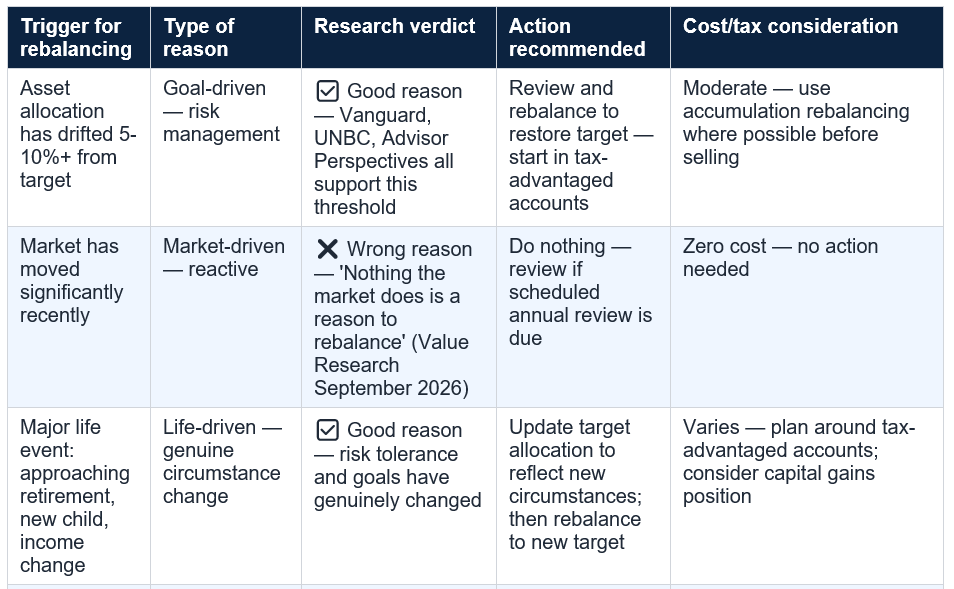
What the research converges on is this: rebalancing is worth doing, but primarily for one reason — to keep your portfolio at the risk level you deliberately chose, rather than the risk level it has drifted to through market movements. The best time to rebalance is at a scheduled annual review, when actual drift has moved an asset class more than 5-10% from its target, when your circumstances have genuinely changed, or when new contributions allow you to rebalance without selling. The worst time to rebalance is right after a market move made you anxious, when a news headline made you feel you should act, or when the calendar says ‘quarterly.’ The distinction, to borrow from Passiv’s framing, is the difference between a drop you were prepared for and a drop that blindsides you. Good rebalancing is what keeps you in the prepared category. Not financial or investment advice. Consult a qualified, regulated financial adviser for guidance specific to your circumstances.
The research consensus points to annual or semi-annual review as the right frequency for most investors. Vanguard's research finds that rebalancing once or twice a year, triggered by meaningful drift from target allocation (at least 5%) rather than by the calendar, produces outcomes close to those from more frequent rebalancing — at significantly lower transaction cost and tax burden. The YCharts/Advisor Perspectives study (April 2025) of 29 years of data found marginal differences in portfolio risk between quarterly, annual, and never-rebalancing strategies. Value Research Online's September 2026 guidance says once a year is usually enough, with fresh contribution money directed to underweighted assets before selling anything. The practical framework: set a calendar reminder once a year, check each asset class against its target, and rebalance only if any class has drifted more than 5-10% from target. If no meaningful drift has occurred, take no action. Sources: Vanguard; Advisor Perspectives April 2025; Value Research Online September 2026.
Is rebalancing actually worth it for returns?
The honest answer from the research: probably not as a return strategy, but yes as a risk management strategy. Passiv's September 2026 analysis reviewed market data from the AAII Journal (1926-2009) and found that rebalancing's effect on returns depends heavily on which stretch of market history you live through, making it unreliable as a return tool. The YCharts/Advisor Perspectives study found that never rebalancing actually edged out other strategies in pure total return performance over 29 years, though this ignores risk tolerance. Vanguard is explicit: the primary function is keeping aligned with risk tolerance, not maximising returns. The case for rebalancing is not 'it makes your portfolio grow faster.' The case is 'it prevents your risk profile from drifting materially beyond what you planned for, so you don't get blindsided by a drawdown larger than you expected.' Sources: Passiv September 2026; Advisor Perspectives April 2025; Vanguard.
Is a market downturn a reason to rebalance?
Not by itself, according to the research. Value Research Online's Fund Advisor piece (September 28, 2026) is direct: 'Nothing the market does is a reason to rebalance.' The reasoning is structural: the market is always moving, and every significant move feels like information about what you should do with your allocation. If the market decline has caused your equity allocation to fall below its target weight, a threshold-based rebalancing framework would eventually trigger a rebalance (buy more equities to restore the target). This is not 'timing the market' — it is a mechanical response to drift. The key is whether the action is driven by the drift metric (the allocation has moved meaningfully from target) or by the market move itself (recent news or performance). These look similar but have different triggers, different conditions, and different tax implications. A market decline that produces meaningful drift below an equity target is a legitimate mechanical trigger. Acting on the same decline out of anxiety or the feeling that you should respond to it is not. Sources: Value Research Online September 2026; Vanguard; Passiv.
What is the most tax-efficient way to rebalance?
Passiv's September 2026 analysis identifies the key principle: 'which account you rebalance in matters more than which month you pick.' The most tax-efficient rebalancing approaches, in rough order: (1) Accumulation rebalancing — directing new contributions to underweighted asset classes, which restores allocation without any selling and therefore without any capital gains event. Advisor Perspectives (April 2025) describes this as a 'great way to keep risk tolerances in check without triggering the tax consequences often associated with typical rebalancing strategies.' (2) Rebalancing within tax-advantaged accounts (ISA in the UK, 401k/IRA in the US, SIPP/pension) — selling within these accounts produces no immediate tax event. (3) Using withdrawals strategically — Vanguard recommends that cash outflows start with overweighted asset classes, so that required withdrawals serve a double purpose. (4) If selling in taxable accounts is unavoidable, consider whether tax-loss harvesting opportunities exist that can offset the capital gains. Sources: Passiv September 2026; Advisor Perspectives April 2025; Vanguard. Not tax advice. Consult a tax-qualified adviser.
Should I rebalance if I hold all-in-one ETFs or target-date funds?
Almost certainly not — these funds rebalance internally. Passiv's September 2026 analysis makes this explicit: 'If you hold a single all-in-one ETF, there's nothing for you to rebalance.' Target-date funds, balanced funds, and all-in-one ETFs (such as Vanguard LifeStrategy funds in the UK, or equivalent products elsewhere) maintain their internal allocation through continuous or periodic internal rebalancing by the fund manager. The investor buying and holding one of these does not need to rebalance. The rebalancing decision applies specifically to investors who hold several individual ETFs or funds representing different asset classes and manage their allocation themselves — where the investor has retained control of the allocation and therefore also the rebalancing responsibility. If you have shifted from individually-held ETFs to an all-in-one ETF, you have effectively outsourced the rebalancing to the fund. The only decision remaining is whether your all-in-one ETF's allocation still matches your risk tolerance and time horizon. Sources: Passiv September 2026; Vanguard. Not investment advice.
Most investors who rebalance their portfolio believe they are being disciplined. They are acting on a principle they have read about, maintaining their allocation, keeping their investment strategy on track. Some of them are right. Some of them are rebalancing in response to a market move they found unsettling, or because they feel they should be doing something, or because they have read a headline that made them anxious about their current position. These are different activities with the same name. The difference between rebalancing for the right reason and rebalancing for the wrong one is not cosmetic. One aligns your portfolio with your goals and risk tolerance. The other generates transaction costs, potential tax events, and a portfolio decision disguised as discipline. This article draws on the latest research from Vanguard, YCharts, Ritholtz Wealth Management, Passiv, and Value Research Online to answer the question directly: what are the good reasons to rebalance, what are the wrong ones, and how do you tell them apart?
Table of Contents
- Rebalancing as Discipline vs Rebalancing as Reaction
- What Rebalancing Actually Is — And What It Isn’t
- What the Latest Research Actually Says
- The Good Reasons to Rebalance
- The Wrong Reasons — And Why They’re So Tempting
- The Tax Dimension: Why Where You Rebalance Matters
- The Frequency Question: How Often Is Often Enough?
- The One Question That Decides Everything
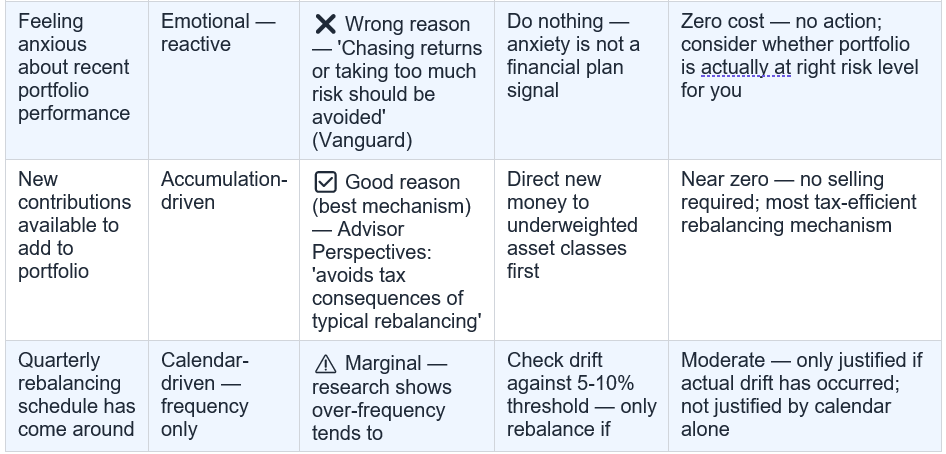
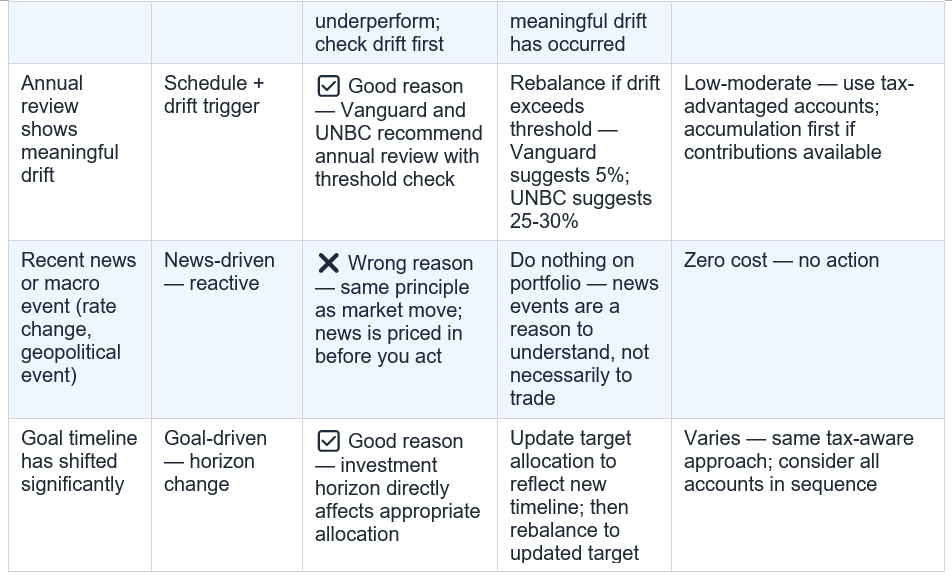
- The Rebalancing Decision Framework
- Conclusion: The Best Rebalancing Decision Is the One You Made Calmly
- Frequently Asked Questions
Rebalancing as Discipline vs Rebalancing as Reaction
There are two very different activities that both go by the name of rebalancing. The first is strategic: a pre-planned review of your portfolio’s allocation, conducted at intervals you chose in advance, with a clear threshold for action, driven by the gap between where your portfolio is and where your investment plan says it should be. The second is reactive: a response to recent market moves, a spike of anxiety about current holdings, or the vague feeling that you should be doing something because the market has been volatile. Both feel, from the inside, like responsible portfolio management. One of them is. The difficulty is that the reactive version is almost always triggered during the market environments when rebalancing decisions are least likely to produce good outcomes — when prices are moving sharply in one direction, when headlines are alarming, and when the temptation to ‘do something’ is highest. This article uses the research evidence to build a clear framework for distinguishing between the two.What Rebalancing Actually Is — And What It Isn’t
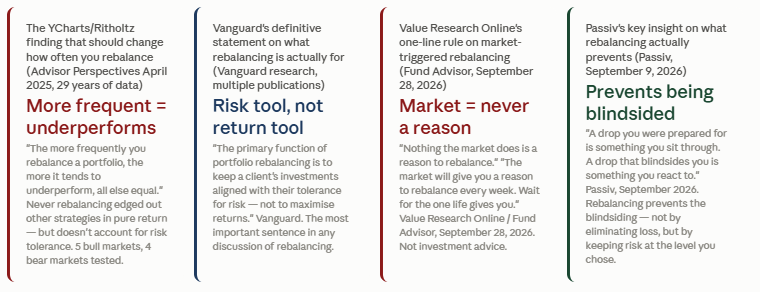
Rebalancing is often described as something every investor should do regularly, which creates the impression that the more frequently you do it, the better. This impression is wrong. Vanguard’s research is explicit on the fundamental purpose: ‘The primary function of portfolio rebalancing is to keep a client’s investments aligned with their tolerance for risk — not to maximise returns.’ This single sentence dissolves the most common misconception about rebalancing. It is not a performance strategy. It is a risk management strategy. What happens without any rebalancing is predictable: an equity-heavy portfolio in a prolonged bull market drifts from its starting allocation as equities outperform. A 60/40 portfolio built in 2020 that was never rebalanced likely became an 80/20 or 85/15 portfolio by 2025, after five years of equity outperformance. The investor who built a 60/40 because they understood they could tolerate a 20-25% drawdown on that mix is now effectively holding a portfolio with a significantly higher drawdown potential — without ever deciding to take on more risk. Passiv.com’s September 2026 analysis captures the practical risk: ‘A drop you were prepared for is something you sit through. A drop that blindsides you is something you react to.’ The blindsiding happens when drift has taken the portfolio well past the risk level the investor chose. Rebalancing exists to prevent that surprise.What the Latest Research Actually Says
YCharts and Nick Maggiulli (COO of Ritholtz Wealth Management) published research in April 2025 that examined rebalancing strategies over 29 years of data, including five bull markets and four bear markets. The headline finding has a counterintuitive quality: ‘The more frequently you rebalance a portfolio, the more it tends to underperform, all else equal.’ Never rebalancing actually edged out other strategies in terms of pure total return performance, though the researchers were careful to note that this strategy ignores risk tolerance. Vanguard’s own research aligns with the ‘less is more’ conclusion: ‘Rebalancing once or twice a year — and only when a portfolio has wandered from its target by at least 5% — produces absolute return/risk results close to those resulting from more frequent, complicated and time-consuming rebalancing.’ The comparison is striking. Monthly monitoring with a 1% threshold produced an average of 389 rebalancing events over the study period, with 2.3% annual portfolio turnover. Annual monitoring with a 10% threshold produced an average of just 15 rebalancing events and 1.4% annual portfolio turnover. Both approaches produced similar risk/return profiles — but the frequent rebalancer paid significantly more in transaction costs and potentially tax events. Passiv.com’s September 2026 assessment is perhaps the most useful framing: ‘Rebalancing’s effect on returns depends on which stretch of history you happen to live through, which makes it something you can’t plan around.’ The conclusion: rebalance for risk management, not return optimisation.The Good Reasons to Rebalance
Understanding that rebalancing is a risk management tool rather than a return optimiser clarifies what the good reasons to rebalance actually are. They are not market-driven. They are goal-driven and circumstance-driven. The first and most fundamental good reason is significant drift from your target allocation. Most research, including Vanguard’s, points to a threshold of around 5-10% as the trigger point — when any asset class has moved more than 5-10 percentage points from its target weight, the portfolio’s risk profile has changed materially from the one you chose. The second is a genuine life event that changes your financial circumstances. A major change in income, an approaching retirement, a new family member, a significant planned expenditure: any of these legitimately changes the right allocation for your situation. This is what Value Research Online means when it says: ‘The market will give you a reason to rebalance every week. Wait for the one life gives you.’ The third good reason is the accumulation approach — using new contributions rather than selling. Advisor Perspectives’ April 2025 study identifies this as ‘a great way to keep risk tolerances in check without triggering the tax consequences often associated with typical rebalancing strategies.’ When you regularly add to a portfolio, directing new money to underweighted assets gradually restores the target allocation without selling, without tax events, and without transaction costs. This is the most tax-efficient rebalancing mechanism available to regular investors.Significant allocation drift (5-10%+ from target) → rebalance to restore intended risk profile. Major life event changing goals or risk tolerance → update allocation accordingly. Accumulation rebalancing (directing new contributions to underweighted assets) → maintains allocation without selling. Scheduled annual review showing meaningful drift → rebalance then. Sources: Vanguard; Advisor Perspectives April 2025; Value Research Online September 2026.
The Wrong Reasons — And Why They’re So Tempting
The wrong reasons to rebalance are the ones that feel the most urgent, which is what makes them dangerous. The most common wrong reason is also the most seductive: the market moved. The market is always moving, and every significant move feels like information. A sharp equity decline feels like a signal to reduce equity exposure. A sharp equity rally feels like a reason to lock in gains. Both responses are reactive rather than strategic, and both generate the costs and tax consequences of rebalancing without producing a better risk-adjusted outcome. Value Research Online’s September 2026 Fund Advisor piece addressed this directly and memorably: ‘Nothing the market does is a reason to rebalance.’ The subscriber who asked the question had ‘a market view hiding inside it’ — they wanted to know whether the market’s current level was a reason to trim equity. The answer was: it is not. A closely related wrong reason is rebalancing in response to anxiety about current holdings. Vanguard’s research specifically identifies ‘chasing returns or taking too much risk’ as common pitfalls to avoid when rebalancing. The investor who rebalances because they feel anxious about their equity allocation after a bad week is almost certainly making a fear-driven decision, not a goal-driven one. The third wrong reason is over-frequency. The YCharts/Advisor Perspectives research found that more frequent rebalancing tends to underperform less frequent rebalancing, all else equal, while also generating more transaction costs and tax events. There is no research evidence that quarterly rebalancing outperforms annual rebalancing on a risk-adjusted, after-cost basis.The Tax Dimension: Why Where You Rebalance Matters
One of the most overlooked dimensions of the rebalancing decision is not whether to rebalance but where to rebalance. Selling appreciated assets in a taxable account to restore target allocation generates a realised capital gain and a tax liability. In a tax-advantaged account — an ISA in the UK, a 401(k) or IRA in the US — the same rebalancing transaction generates no immediate tax event. Passiv.com’s September 2026 analysis makes this point directly: ‘So which account you rebalance in matters more than which month you pick.’ This is not a minor consideration. For an investor who holds both taxable accounts and tax-advantaged accounts, the sequence of rebalancing decisions should always start with the tax-advantaged accounts. Selling a well-appreciated equity position in a taxable account to buy bonds may restore the target allocation but costs a significant percentage of the transaction value in capital gains tax. The same rebalancing within an ISA or 401(k) costs nothing in tax. The Vanguard research on cash-flow rebalancing addresses the related point: ‘Cash outflows, such as withdrawals from the portfolio, should start with overweighted asset classes.’ Even withdrawals can be used strategically to rebalance without generating additional transactions. The accumulation approach, directing new money to underweighted assets, achieves the same goal in the opposite direction. Both approaches reduce the cost of rebalancing dramatically relative to sell-to-rebalance in a taxable account.Rebalance in tax-advantaged accounts (ISA, 401k, SIPP) first — no immediate tax event. Use new contributions to buy underweighted assets before selling anything. If selling in a taxable account is unavoidable, consider tax-loss harvesting opportunities at the same time. Passiv September 2026: 'which account you rebalance in matters more than which month you pick.
The Frequency Question: How Often Is Often Enough?
The research consensus on rebalancing frequency is surprisingly comfortable for those who prefer not to manage their portfolios constantly. Vanguard’s research found that rebalancing once or twice a year, triggered by a meaningful drift from target rather than the calendar, produces outcomes similar to far more frequent monitoring. The YCharts/Advisor Perspectives study found that 29 years of data across multiple market cycles showed only a marginal difference in portfolio risk between different rebalancing frequencies. Value Research Online’s September 2026 guidance is similarly direct: ‘Rebalancing your portfolio once a year is usually enough.’ The academic UNBC study analysing 20 years of US portfolio data across 60/40, 50/50, and 40/60 allocations found that the optimal rebalancing strategy in their research was threshold-based at 25-30% — meaning very significant drift is tolerated before any action is taken. Importantly, they concluded that ‘the difference in portfolio performance of various rebalancing strategies vis-à-vis buy-and-hold strategy is not substantial to warrant a definitive recommendation of a particular rebalancing strategy.’ The practical framework this research supports: review the portfolio once or twice a year (not quarterly, not monthly), check whether any asset class has drifted more than 5-10% from its target, and rebalance only if it has. If it has not, take no action. Most years, for a broad, passive portfolio, it has not.Vanguard: 'Rebalancing once or twice a year — and only when a portfolio has wandered from its target by at least 5% — produces results close to more frequent rebalancing.' YCharts/Advisor Perspectives April 2025: '29 years of data show marginal effect on portfolio risk from different rebalancing frequencies.' Value Research September 2026: 'Once a year is usually enough.' UNBC 20-year study: threshold 25-30% performs well.
The One Question That Decides Everything
Before acting on any rebalancing impulse, there is one question that cuts through every rationalisation, every market commentary, and every emotional trigger: what has changed in my life, or in my target allocation, since the last time I reviewed this portfolio? If the answer is ‘nothing significant,’ the probability is high that the rebalancing impulse is being driven by market moves, recent news, or anxiety — all of which Value Research Online, Vanguard, and Advisor Perspectives identify as wrong reasons. If the answer is ‘my allocation has drifted materially,’ ‘I am five years closer to retirement,’ or ‘my income situation has changed,’ the rebalancing is driven by the right reasons. The distinction is not trivial. A rebalance triggered by a goal-driven reason aligns the portfolio with your actual financial situation. A rebalance triggered by a market-driven reason is effectively market timing in disguise — making an allocation decision based on what has just happened in markets rather than what you need your portfolio to do for you. Passiv.com’s framing is worth returning to: ‘A drop you were prepared for is something you sit through. A drop that blindsides you is something you react to.’ Good rebalancing eliminates the blindsiding by keeping the portfolio at the risk level you chose when you were thinking clearly, not the risk level you drifted to through inaction or overaction.The Rebalancing Decision Framework
Conclusion
The research on portfolio rebalancing is unusually consistent across sources and time periods. Vanguard finds it is a risk management tool, not a return strategy. YCharts and Ritholtz Wealth Management find that more frequent rebalancing tends to underperform less frequent rebalancing, all else equal. Value Research Online finds that nothing the market does is a reason to rebalance. Passiv finds that where you rebalance matters more than when, and that the easiest rebalance is the one where you sell nothing. The UNBC study finds that the differences between rebalancing strategies are not substantial enough to justify a specific single recommendation.What the research converges on is this: rebalancing is worth doing, but primarily for one reason — to keep your portfolio at the risk level you deliberately chose, rather than the risk level it has drifted to through market movements. The best time to rebalance is at a scheduled annual review, when actual drift has moved an asset class more than 5-10% from its target, when your circumstances have genuinely changed, or when new contributions allow you to rebalance without selling. The worst time to rebalance is right after a market move made you anxious, when a news headline made you feel you should act, or when the calendar says ‘quarterly.’ The distinction, to borrow from Passiv’s framing, is the difference between a drop you were prepared for and a drop that blindsides you. Good rebalancing is what keeps you in the prepared category. Not financial or investment advice. Consult a qualified, regulated financial adviser for guidance specific to your circumstances.
Frequently Asked Questions
How often should I rebalance my portfolio?The research consensus points to annual or semi-annual review as the right frequency for most investors. Vanguard's research finds that rebalancing once or twice a year, triggered by meaningful drift from target allocation (at least 5%) rather than by the calendar, produces outcomes close to those from more frequent rebalancing — at significantly lower transaction cost and tax burden. The YCharts/Advisor Perspectives study (April 2025) of 29 years of data found marginal differences in portfolio risk between quarterly, annual, and never-rebalancing strategies. Value Research Online's September 2026 guidance says once a year is usually enough, with fresh contribution money directed to underweighted assets before selling anything. The practical framework: set a calendar reminder once a year, check each asset class against its target, and rebalance only if any class has drifted more than 5-10% from target. If no meaningful drift has occurred, take no action. Sources: Vanguard; Advisor Perspectives April 2025; Value Research Online September 2026.
Is rebalancing actually worth it for returns?
The honest answer from the research: probably not as a return strategy, but yes as a risk management strategy. Passiv's September 2026 analysis reviewed market data from the AAII Journal (1926-2009) and found that rebalancing's effect on returns depends heavily on which stretch of market history you live through, making it unreliable as a return tool. The YCharts/Advisor Perspectives study found that never rebalancing actually edged out other strategies in pure total return performance over 29 years, though this ignores risk tolerance. Vanguard is explicit: the primary function is keeping aligned with risk tolerance, not maximising returns. The case for rebalancing is not 'it makes your portfolio grow faster.' The case is 'it prevents your risk profile from drifting materially beyond what you planned for, so you don't get blindsided by a drawdown larger than you expected.' Sources: Passiv September 2026; Advisor Perspectives April 2025; Vanguard.
Is a market downturn a reason to rebalance?
Not by itself, according to the research. Value Research Online's Fund Advisor piece (September 28, 2026) is direct: 'Nothing the market does is a reason to rebalance.' The reasoning is structural: the market is always moving, and every significant move feels like information about what you should do with your allocation. If the market decline has caused your equity allocation to fall below its target weight, a threshold-based rebalancing framework would eventually trigger a rebalance (buy more equities to restore the target). This is not 'timing the market' — it is a mechanical response to drift. The key is whether the action is driven by the drift metric (the allocation has moved meaningfully from target) or by the market move itself (recent news or performance). These look similar but have different triggers, different conditions, and different tax implications. A market decline that produces meaningful drift below an equity target is a legitimate mechanical trigger. Acting on the same decline out of anxiety or the feeling that you should respond to it is not. Sources: Value Research Online September 2026; Vanguard; Passiv.
What is the most tax-efficient way to rebalance?
Passiv's September 2026 analysis identifies the key principle: 'which account you rebalance in matters more than which month you pick.' The most tax-efficient rebalancing approaches, in rough order: (1) Accumulation rebalancing — directing new contributions to underweighted asset classes, which restores allocation without any selling and therefore without any capital gains event. Advisor Perspectives (April 2025) describes this as a 'great way to keep risk tolerances in check without triggering the tax consequences often associated with typical rebalancing strategies.' (2) Rebalancing within tax-advantaged accounts (ISA in the UK, 401k/IRA in the US, SIPP/pension) — selling within these accounts produces no immediate tax event. (3) Using withdrawals strategically — Vanguard recommends that cash outflows start with overweighted asset classes, so that required withdrawals serve a double purpose. (4) If selling in taxable accounts is unavoidable, consider whether tax-loss harvesting opportunities exist that can offset the capital gains. Sources: Passiv September 2026; Advisor Perspectives April 2025; Vanguard. Not tax advice. Consult a tax-qualified adviser.
Should I rebalance if I hold all-in-one ETFs or target-date funds?
Almost certainly not — these funds rebalance internally. Passiv's September 2026 analysis makes this explicit: 'If you hold a single all-in-one ETF, there's nothing for you to rebalance.' Target-date funds, balanced funds, and all-in-one ETFs (such as Vanguard LifeStrategy funds in the UK, or equivalent products elsewhere) maintain their internal allocation through continuous or periodic internal rebalancing by the fund manager. The investor buying and holding one of these does not need to rebalance. The rebalancing decision applies specifically to investors who hold several individual ETFs or funds representing different asset classes and manage their allocation themselves — where the investor has retained control of the allocation and therefore also the rebalancing responsibility. If you have shifted from individually-held ETFs to an all-in-one ETF, you have effectively outsourced the rebalancing to the fund. The only decision remaining is whether your all-in-one ETF's allocation still matches your risk tolerance and time horizon. Sources: Passiv September 2026; Vanguard. Not investment advice.
0 Comments
Be the first to share your thoughts on this article.