

Investing
Money Market vs High-Yield Savings: Which Is Better?

Both offer 4-5% APY and FDIC insurance. The national average is just 0.44-0.62%. The real question isn’t which pays more — it’s which fits how you actually use your money.
If you have money sitting in a traditional savings account earning 0.62% APY while the best high-yield savings accounts and money market accounts are offering 4-5%, you are leaving hundreds of dollars per year on the table. That much is clear. The more interesting question is which of the two competitive alternatives — money market account or high-yield savings account — is better for your specific situation. CBS News ran the numbers in early February 2026: on a $10,000 deposit, the top HYSA at 4.20% earns $103.39 after three months. A comparable money market account earns approximately $100.96 — a difference of $2.43. The headline rates are nearly identical at the top of the market. What differs is the structure: how you access the money, what minimum balances apply, who gets tiered rate advantages, and whether you ever need to write a check from your savings. This article works through every meaningful difference, tells you exactly when each account type wins, and gives you a decision framework that should settle the question for most households.
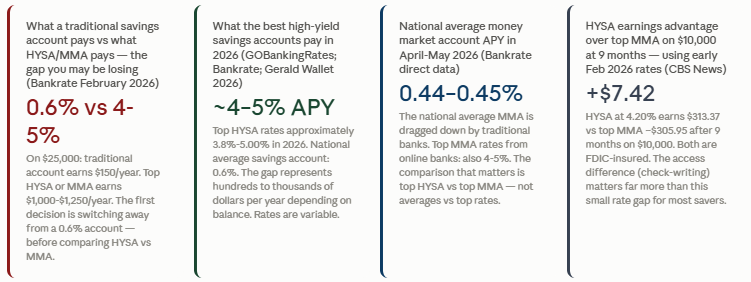
That establishes why you should switch from a traditional savings account. The more nuanced question — and the one this article answers in full — is whether to switch to a high-yield savings account or a money market account. Both are FDIC-insured, both are offered by reputable online banks, and both pay rates in the same 4-5% range at the top of the market. The difference is in the structure, the access, the minimums, and the specific use cases where one wins.
National average savings account APY (2026): 0.6% (Bankrate February 2026). National average MMA APY (2026): 0.44-0.45% (Bankrate April/May 2026). Top HYSA APY (2026): approximately 4-5%. Top MMA APY (2026): approximately 4-5%. On $10,000 at top rates: HYSA earns $103.39 after 3 months vs MMA at ~$100.96 (CBS News February 2026). Both FDIC-insured. Sources cited. Not financial advice.
HYSAs typically do not come with check-writing privileges or debit cards attached to the savings account itself. To spend money from a HYSA, you generally need to transfer it to a linked checking account first. Most transfers complete within one business day, and many online banks now offer instant transfers between their own accounts. This one-step separation between saving and spending is a feature for some people — it creates a small friction that prevents impulsive spending from savings — and a limitation for others who want more flexible direct access.
The national average money market account APY in April 2026 was 0.44% (Bankrate directly), but this average is dragged down substantially by traditional bank MMAs that pay near-nothing. The best money market accounts at competitive online banks pay rates in the same 4-5% range as the best HYSAs. Gerald Wallet’s 2026 savings market guide describes the distinction clearly: ‘Money market accounts give you check-writing and debit access; high-yield savings accounts are better for pure interest growth on untouched funds.
The practical implication: whether you open a HYSA or an MMA at a top-rated online bank, you are likely to land in a similar interest rate neighbourhood. The small differences at the margin — which product’s top rate leads on any given month — matter less than the decision to switch from a traditional savings account at all. The key differentiator in 2026 is not the rate at the top of the market. It is the access structure, the minimums, and the account fit.
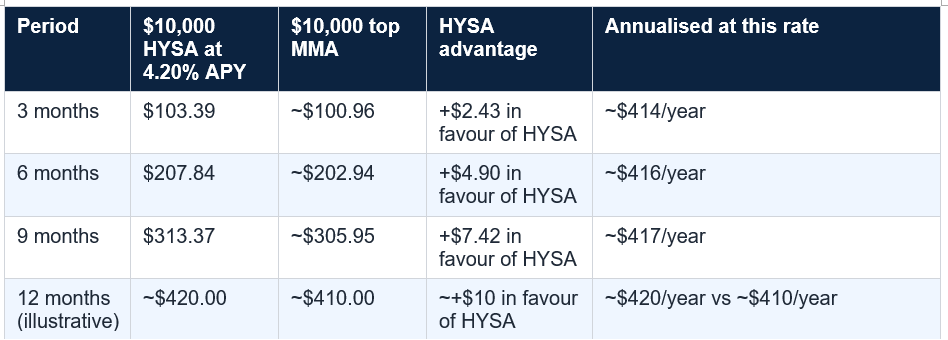
CBS News, early February 2026. Note: these figures use point-in-time rates; both HYSA and MMA rates are variable and will have changed. The CBS News conclusion: ‘Using today’s top rates, technically a $10,000 high-yield savings account will earn a bit more than a $10,000 money market account will this year — but this will evolve.’ The difference on $10,000 is approximately $10 per year in the HYSA’s favour. On $50,000, that difference scales to approximately $50 per year. Meaningful, but not the primary basis for the decision. Not financial advice. Rates change frequently.
The real rate gap is with traditional accounts: National average HYSA earns ~$400/year on $10,000 (at 4% APY). Traditional savings account earns ~$60/year on $10,000 (at 0.6% APY). The gap between HYSA and MMA at top rates: ~$10/year on $10,000. The decision that matters most is moving from traditional savings to either HYSA or MMA. Sources: CBS News Feb 2026; Bankrate; GOBankingRates.
High-yield savings accounts typically do not have this direct-spend access. To use money in a HYSA for a payment, you need to transfer it to a checking account first. Most online banks process these transfers within one business day, and many offer instant transfers between accounts at the same institution. For most savers, the one-step additional process is immaterial. For others — those who want easy direct access to savings for irregular bills, emergency withdrawals, or flexible fund management — the MMA’s check-writing and debit access is a genuine advantage. Bankrate’s April 2026 analysis puts the structural point plainly: ‘Except for the potential for check writing, a money market account and a high-yield savings account are nearly identical.
MMA: check-writing + debit card access. Direct spend without a transfer. HYSA: requires transfer to checking account first (typically 1 business day; instant between accounts at same bank). Source: Bankrate April 2026; PNC Insights; GOBankingRates 2026.
High-yield savings accounts at online banks typically have lower or no minimum balance requirements. GOBankingRates’ 2026 comparison notes that HYSAs often offer higher top-tier rates ‘with fewer requirements.’ For savers just starting to build a savings buffer, or for those with smaller balances, the HYSA’s lower-barrier structure tends to be more advantageous. Bankrate’s MMA guidance similarly notes: ‘Some FDIC-insured online banks have money market accounts that either don’t require a minimum opening deposit or require a small amount.
HYSAs more commonly offer a flat rate across all balances — simple and transparent, but without the upside for large deposits that tiered MMAs can provide. For a saver with $100,000 in a savings account, a tiered MMA specifically calibrated for large balances may produce a higher effective APY than a flat-rate HYSA. For a saver with $5,000, the tiered structure is irrelevant and the HYSA’s flat rate often leads. Not financial advice. Always compare actual rates for your specific balance tier.
The important note here is the distinction between a money market account and a money market fund. A money market account is a bank deposit account, FDIC-insured as described above. A money market fund is an investment product held in a brokerage account, insured by the Securities Investor Protection Corporation (SIPC) rather than the FDIC. SIPC protection covers brokerage account fraud and failure but is not the same as FDIC deposit insurance. Bankrate’s HYSA vs money market fund comparison is explicit: ‘High-yield savings accounts are FDIC-insured, while money market funds are insured by SIPC, which covers brokerage accounts.’ If you open a money market account at a bank, you have FDIC protection. If you open a money market fund at a brokerage, you do not.
This rate variability is a genuine risk for savers who are planning around a specific income stream from their savings account. The rates that made HYSAs and MMAs so attractive in 2022-2026 could fall if the Federal Reserve cuts rates substantially. Both account types carry identical rate-change risk. The solution for savers who want to lock in current rates is to consider CDs, which offer fixed rates for a defined term.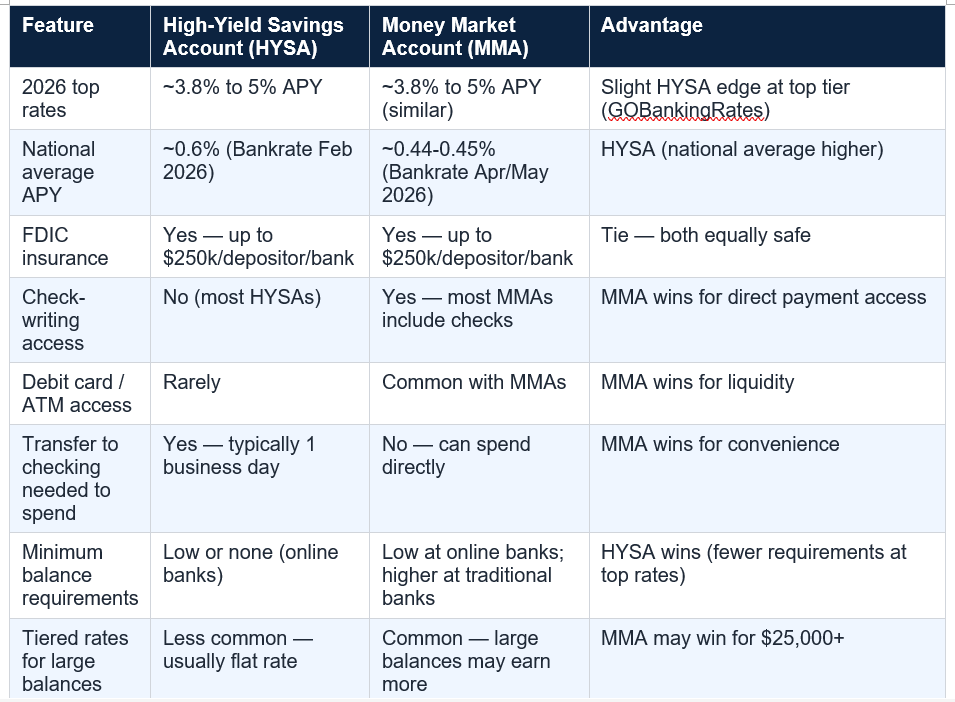
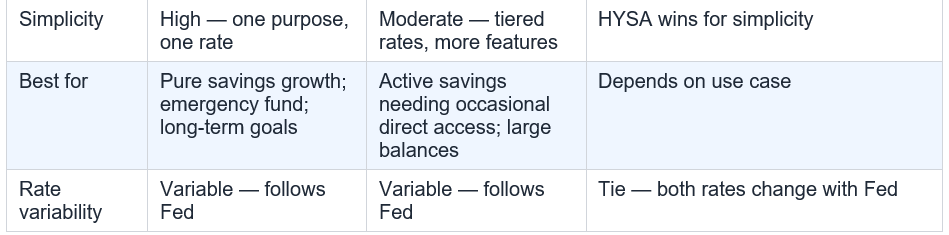
The HYSA is particularly well-suited to the emergency fund use case: three to six months of essential expenses held in a safe, interest-bearing account that is not too easy to dip into for non-emergencies. The transfer-required structure of most HYSAs adds a small friction that can actually prevent impulsive access to emergency savings.
HYSA wins when: you want the highest top-tier rate; your savings are genuinely untouched between emergencies or goal milestones; you have a smaller balance (flat rate = simpler); you value simplicity over access features. Sources: GOBankingRates 2026; Gerald Wallet 2026.
The MMA also becomes more competitive for larger balances. PNC Insights’ comparison and Yahoo Finance’s HYSA vs MMA analysis both note that tiered rate structures in money market accounts can favour larger depositors — if your balance exceeds $25,000-$50,000 and a specific MMA has a significantly higher rate tier at that level compared to a flat HYSA rate, the arithmetic may favour the MMA. Not financial advice. Always compare specific rates for your balance level at the time of decision.
MMA wins when: you need check-writing or debit access from your savings; you have a large balance where tiered rates produce a better APY; you want a savings account that can also occasionally function as a limited payment account. Sources: PNC Insights; Gerald Wallet 2026; Yahoo Finance. Not financial advice.
Bankrate’s comprehensive comparison notes that money market funds can sometimes offer higher rates than both HYSAs and MMAs: ‘Money market funds are considered very low-risk investments and may even have higher interest rates than high-yield savings accounts.’ However, they are not deposit accounts, and the SIPC insurance is different in nature from FDIC deposit insurance. For savers who want the simplest, most protected, most straightforward place for cash savings, the FDIC-insured bank accounts (HYSA or MMA) are the appropriate products. For those comfortable with a brokerage account and seeking potentially higher yields on their cash, money market funds are worth exploring.
The one product that is clearly inferior to both HYSAs and MMAs for any meaningful savings balance is the traditional savings account at a large traditional bank. The national average of 0.6% APY means most standard savings accounts at major banks are paying a fraction of what is available elsewhere. The decision between HYSA and MMA is genuinely nuanced. The decision to leave money in a traditional savings account when better alternatives are available is not.
The decision hierarchy: (1) Is the money in a traditional savings account at 0.6% APY? Switch to HYSA or MMA immediately. (2) Between HYSA and MMA: need check-writing or ATM access from savings? Choose MMA. Large balance ($25k+) with tiered MMA rates? Compare. Pure savings growth, no access needed? Choose HYSA. (3) Want to lock in today's rates? Consider a CD ladder. Not financial advice.
Once you are comparing HYSA against MMA, the decision simplifies to one question: do you need direct access to your savings via check-writing or debit card, or does money sitting untouched until you need it work for you? If you want direct access: money market account. If you want simplicity and slightly better top-tier rates: high-yield savings account. Bankrate’s April 2026 summary captures the practical reality most accurately: ‘Except for the potential for check writing, a money market account and a high-yield savings account are nearly identical.’ Not financial, banking, or investment advice. Always verify current rates and terms directly with institutions.
Neither is universally better — it depends on how you use your savings. GOBankingRates' 2026 comparison concludes: 'Money market accounts offer more access to funds, while savings accounts often provide higher top interest rates and simpler structures.' For the highest available rates on untouched savings: HYSAs typically lead or tie at the top of the market. For direct check-writing and debit card access: MMAs win. For large balances where tiered rates apply: MMAs may produce a higher effective APY. For simplicity and low minimum requirements: HYSAs tend to win. In practice, Bankrate's April 2026 analysis puts the two products near-identical in most respects: 'Except for the potential for check writing, a money market account and a high-yield savings account are nearly identical.' Sources: GOBankingRates 2026; Bankrate April 2026.
What interest rates are HYSA and MMA accounts paying in 2026?
As of early to mid-2026, the best high-yield savings accounts are paying approximately 3.8% to 5% APY, with top rates reaching 4.20%-5.00% at competitive online banks (GOBankingRates 2026; Gerald Wallet 2026; Bankrate). The best money market accounts are paying similar rates. The national average savings account APY is approximately 0.6% (Bankrate February 2026); the national average money market account APY is approximately 0.44-0.45% (Bankrate April/May 2026). The national averages are significantly dragged down by large traditional banks paying near-nothing. The top rates from online banks make both products genuinely competitive. CBS News ran a comparison in early February 2026: a $10,000 HYSA at 4.20% earned $103.39 after three months vs $100.96 in a comparable top MMA — a difference of $2.43. Sources: CBS News Feb 2026; Bankrate; GOBankingRates 2026. Rates change frequently; verify with institutions.
Are money market accounts and HYSAs FDIC-insured?
Yes. Both high-yield savings accounts and money market accounts held at FDIC-member banks are insured by the Federal Deposit Insurance Corporation up to $250,000 per depositor, per insured institution. At credit unions, both are insured by the National Credit Union Administration (NCUA) up to $250,000. The safety of both products is equivalent and extremely high. Important distinction: money market FUNDS (held in brokerage accounts) are NOT FDIC-insured — they are covered by SIPC, which is different in nature. Bankrate is explicit on this: 'High-yield savings accounts are FDIC-insured, while money market funds are insured by SIPC, which covers brokerage accounts.' If you are opening an account at a bank (not a brokerage), your money market account and HYSA both carry FDIC protection. Sources: Bankrate 2026; Gerald Wallet 2026.
What is the difference between a money market account and a money market fund?
These are two completely different products despite the similar names. A money market account is a bank deposit account — FDIC-insured, earning interest as an APY, directly comparable to a high-yield savings account. A money market fund is an investment product held in a brokerage account — investing in short-term, high-quality securities, insured by SIPC (not FDIC), with returns expressed as a 7-day yield rather than an APY. Bankrate's comparison notes that money market funds 'are considered very low-risk investments and may even have higher interest rates than high-yield savings accounts.' However, they are not deposit accounts, and SIPC protection is structurally different from FDIC deposit insurance. For straightforward cash savings: stick with FDIC-insured bank accounts (HYSA or MMA). For those comfortable with brokerage accounts: money market funds are worth exploring. Sources: Bankrate 2026.
What happens to HYSA and MMA rates if the Federal Reserve cuts rates?
Both high-yield savings accounts and money market accounts have variable rates that follow the Federal Reserve's rate decisions indirectly. When the Fed raises its benchmark rate, competitive banks tend to raise HYSA and MMA APYs; when the Fed cuts rates, APYs on both products typically fall. Bankrate's 2026 analysis notes this directly: 'Money market funds and high-yield savings accounts often respond quickly to Federal Reserve rate changes, which means the yield you earn can change over time.' Neither product locks in a rate — that is the function of a Certificate of Deposit (CD). If you want to protect the current rate environment's yields from Fed cuts, consider adding some CD positions alongside your HYSA or MMA. Both account types carry equal rate-change risk. Sources: Bankrate 2026; GOBankingRates 2026.
If you have money sitting in a traditional savings account earning 0.62% APY while the best high-yield savings accounts and money market accounts are offering 4-5%, you are leaving hundreds of dollars per year on the table. That much is clear. The more interesting question is which of the two competitive alternatives — money market account or high-yield savings account — is better for your specific situation. CBS News ran the numbers in early February 2026: on a $10,000 deposit, the top HYSA at 4.20% earns $103.39 after three months. A comparable money market account earns approximately $100.96 — a difference of $2.43. The headline rates are nearly identical at the top of the market. What differs is the structure: how you access the money, what minimum balances apply, who gets tiered rate advantages, and whether you ever need to write a check from your savings. This article works through every meaningful difference, tells you exactly when each account type wins, and gives you a decision framework that should settle the question for most households.
Table of Contents
- Why This Comparison Matters Now
- What Is a High-Yield Savings Account (HYSA)?
- What Is a Money Market Account (MMA)?
- The Rate Reality: What 2026 Numbers Actually Show
- The $10,000 Test: Which Account Earns More?
- Key Difference 1: Access to Your Money
- Key Difference 2: Minimum Balance Requirements
- Key Difference 3: Rate Structures and Tiers
- Key Difference 4: Safety and Insurance
- Key Difference 5: Rate Variability
- The Complete Feature Comparison Table
- When a HYSA Is the Better Choice
- When an MMA Is the Better Choice
- What About Money Market Funds? (Not the Same Thing)
- Alternatives: CDs and Traditional Savings
- Conclusion: The Decision Framework
- Frequently Asked Questions
Why This Comparison Matters Now
The gap between what a traditional savings account pays and what the top alternatives offer has never been more stark. The national average savings account APY in early 2026 is approximately 0.6% (Bankrate, cited by Gerald Wallet 2026). The best high-yield savings accounts and money market accounts are offering 4-5% APY. On a $10,000 balance, that is the difference between earning $60 per year and earning $400-$500 per year. On $50,000, the difference is $300 versus $2,000-$2,500. If you are in a traditional savings account and have not switched, you are losing roughly $1,700-$2,200 per year on a $50,000 balance relative to the best available alternative.That establishes why you should switch from a traditional savings account. The more nuanced question — and the one this article answers in full — is whether to switch to a high-yield savings account or a money market account. Both are FDIC-insured, both are offered by reputable online banks, and both pay rates in the same 4-5% range at the top of the market. The difference is in the structure, the access, the minimums, and the specific use cases where one wins.
National average savings account APY (2026): 0.6% (Bankrate February 2026). National average MMA APY (2026): 0.44-0.45% (Bankrate April/May 2026). Top HYSA APY (2026): approximately 4-5%. Top MMA APY (2026): approximately 4-5%. On $10,000 at top rates: HYSA earns $103.39 after 3 months vs MMA at ~$100.96 (CBS News February 2026). Both FDIC-insured. Sources cited. Not financial advice.
What Is a High-Yield Savings Account (HYSA)?
A high-yield savings account is a savings account that pays significantly more interest than a traditional bank savings account. It is otherwise structurally the same: it is a deposit account, FDIC-insured up to $250,000 per depositor per institution, held at a bank or credit union. The primary reason HYSAs pay more than traditional savings accounts is that they are predominantly offered by online-only banks, which have lower overhead costs than branch-based banks and can pass those savings to customers through higher rates. Bankrate’s 2026 data shows the national average savings account pays 0.6% APY, while the best high-yield savings accounts pay approximately 4%.HYSAs typically do not come with check-writing privileges or debit cards attached to the savings account itself. To spend money from a HYSA, you generally need to transfer it to a linked checking account first. Most transfers complete within one business day, and many online banks now offer instant transfers between their own accounts. This one-step separation between saving and spending is a feature for some people — it creates a small friction that prevents impulsive spending from savings — and a limitation for others who want more flexible direct access.
What Is a Money Market Account (MMA)?
A money market account is a type of savings deposit account that combines the interest-earning characteristics of a high-yield savings account with more direct access features. Bankrate’s April 2026 data on money market accounts describes them directly: MMAs tend to offer check-writing privileges and a debit card for ATM access to your savings. This makes money market accounts meaningfully more accessible than HYSAs for day-to-day or emergency spending, because you can write a check directly from the account or withdraw cash from an ATM without first transferring to a checking account.The national average money market account APY in April 2026 was 0.44% (Bankrate directly), but this average is dragged down substantially by traditional bank MMAs that pay near-nothing. The best money market accounts at competitive online banks pay rates in the same 4-5% range as the best HYSAs. Gerald Wallet’s 2026 savings market guide describes the distinction clearly: ‘Money market accounts give you check-writing and debit access; high-yield savings accounts are better for pure interest growth on untouched funds.
The Rate Reality: What 2026 Numbers Actually Show
The headline rate comparison in 2026 is closer than it was two or three years ago. When high-yield savings accounts first began attracting mass attention during the 2022-2023 rate environment, HYSAs often led money market accounts by a wider margin. In 2026, both product categories offer top rates of approximately 4-5% APY at competitive online banks. GOBankingRates’ 2026 comparison notes that HYSA rates run approximately 3.8% to 5%, with the top rates typically coming from HYSAs rather than MMAs. The caveat from Bankrate: the national average MMA rate (0.44-0.45%) is actually lower than the national average savings rate (0.6%) — this is because large traditional banks drag down the MMA average, and the best MMA rates come from online banks competing in the same space as HYSA providers.The practical implication: whether you open a HYSA or an MMA at a top-rated online bank, you are likely to land in a similar interest rate neighbourhood. The small differences at the margin — which product’s top rate leads on any given month — matter less than the decision to switch from a traditional savings account at all. The key differentiator in 2026 is not the rate at the top of the market. It is the access structure, the minimums, and the account fit.
The $10,000 Test: Which Account Earns More?
CBS News ran a direct comparison in early February 2026 using the top rates available at that time: a HYSA at 4.20% APY versus a comparable top money market account. On a $10,000 deposit:CBS News, early February 2026. Note: these figures use point-in-time rates; both HYSA and MMA rates are variable and will have changed. The CBS News conclusion: ‘Using today’s top rates, technically a $10,000 high-yield savings account will earn a bit more than a $10,000 money market account will this year — but this will evolve.’ The difference on $10,000 is approximately $10 per year in the HYSA’s favour. On $50,000, that difference scales to approximately $50 per year. Meaningful, but not the primary basis for the decision. Not financial advice. Rates change frequently.
The real rate gap is with traditional accounts: National average HYSA earns ~$400/year on $10,000 (at 4% APY). Traditional savings account earns ~$60/year on $10,000 (at 0.6% APY). The gap between HYSA and MMA at top rates: ~$10/year on $10,000. The decision that matters most is moving from traditional savings to either HYSA or MMA. Sources: CBS News Feb 2026; Bankrate; GOBankingRates.
Key Difference 1: Access to Your Money
This is the most practically significant difference between HYSAs and MMAs, and it is the one most likely to actually affect your daily financial life. Money market accounts come with check-writing privileges and, typically, a debit card attached to the account. You can write a check directly from your savings, pay a bill, or withdraw cash from an ATM without first transferring money to a separate checking account. PNC Insights’ comparison notes: ‘With a money market account, you can withdraw money by writing a check or use a debit card to withdraw money at an ATM.’High-yield savings accounts typically do not have this direct-spend access. To use money in a HYSA for a payment, you need to transfer it to a checking account first. Most online banks process these transfers within one business day, and many offer instant transfers between accounts at the same institution. For most savers, the one-step additional process is immaterial. For others — those who want easy direct access to savings for irregular bills, emergency withdrawals, or flexible fund management — the MMA’s check-writing and debit access is a genuine advantage. Bankrate’s April 2026 analysis puts the structural point plainly: ‘Except for the potential for check writing, a money market account and a high-yield savings account are nearly identical.
MMA: check-writing + debit card access. Direct spend without a transfer. HYSA: requires transfer to checking account first (typically 1 business day; instant between accounts at same bank). Source: Bankrate April 2026; PNC Insights; GOBankingRates 2026.
Key Difference 2: Minimum Balance Requirements
Money market accounts at traditional banks typically come with minimum balance requirements that can be meaningful: $1,000 to $10,000 or more to avoid monthly fees or to qualify for the best rates. This has been less true at competitive online banks, where both MMAs and HYSAs often have low or no minimum balance requirements. However, the tiered rate structure common in MMAs means that higher balances unlock higher APYs — which can be advantageous for those with larger deposits.High-yield savings accounts at online banks typically have lower or no minimum balance requirements. GOBankingRates’ 2026 comparison notes that HYSAs often offer higher top-tier rates ‘with fewer requirements.’ For savers just starting to build a savings buffer, or for those with smaller balances, the HYSA’s lower-barrier structure tends to be more advantageous. Bankrate’s MMA guidance similarly notes: ‘Some FDIC-insured online banks have money market accounts that either don’t require a minimum opening deposit or require a small amount.
Key Difference 3: Rate Structures and Tiers
One area where money market accounts can outperform HYSAs for specific savers is in tiered rate structures. Many MMAs offer progressively higher APYs as your balance grows: a balance of $0-$9,999 might earn 3.5%, while $10,000-$24,999 earns 4.0%, and $25,000+ earns 4.5% or higher. Yahoo Finance’s comparison of HYSA vs MMA noted: ‘If you have a larger amount of money to deposit, you may end up earning more interest with a money market account than with a high-yield savings account.’HYSAs more commonly offer a flat rate across all balances — simple and transparent, but without the upside for large deposits that tiered MMAs can provide. For a saver with $100,000 in a savings account, a tiered MMA specifically calibrated for large balances may produce a higher effective APY than a flat-rate HYSA. For a saver with $5,000, the tiered structure is irrelevant and the HYSA’s flat rate often leads. Not financial advice. Always compare actual rates for your specific balance tier.
Key Difference 4: Safety and Insurance
Both HYSAs and MMAs held at FDIC-member banks are insured by the Federal Deposit Insurance Corporation up to $250,000 per depositor, per insured bank. At credit unions, both account types are equivalently insured by the National Credit Union Administration (NCUA) up to $250,000. The safety of both products is therefore equivalent, and both are among the safest places to hold cash savings.The important note here is the distinction between a money market account and a money market fund. A money market account is a bank deposit account, FDIC-insured as described above. A money market fund is an investment product held in a brokerage account, insured by the Securities Investor Protection Corporation (SIPC) rather than the FDIC. SIPC protection covers brokerage account fraud and failure but is not the same as FDIC deposit insurance. Bankrate’s HYSA vs money market fund comparison is explicit: ‘High-yield savings accounts are FDIC-insured, while money market funds are insured by SIPC, which covers brokerage accounts.’ If you open a money market account at a bank, you have FDIC protection. If you open a money market fund at a brokerage, you do not.
Key Difference 5: Rate Variability
Both HYSAs and money market accounts carry variable interest rates. Neither product locks in a rate — that is the function of a Certificate of Deposit (CD). The Federal Reserve’s rate decisions indirectly influence both HYSA and MMA rates: when the Fed raises its benchmark rate, competitive banks tend to raise HYSA and MMA APYs; when the Fed cuts, rates often follow. Bankrate’s HYSA vs money market fund analysis notes this directly: ‘Money market funds and high-yield savings accounts often respond quickly to Federal Reserve rate changes, which means the yield you earn can change over time.’This rate variability is a genuine risk for savers who are planning around a specific income stream from their savings account. The rates that made HYSAs and MMAs so attractive in 2022-2026 could fall if the Federal Reserve cuts rates substantially. Both account types carry identical rate-change risk. The solution for savers who want to lock in current rates is to consider CDs, which offer fixed rates for a defined term.
The Complete Feature Comparison Table
When a HYSA Is the Better Choice
Choose a high-yield savings account in the following situations. First, when you want the absolute highest available rate on your savings and are willing to compare across providers to find the best current APY. GOBankingRates’ 2026 comparison shows that HYSAs tend to lead at the very top of the rate range. Second, when you do not need to write checks from your savings or access the money directly via debit card. If your emergency fund or goal-based savings sits untouched for months at a time, you never need the MMA’s access features. Third, when you have a small or medium balance and the flat-rate structure of a HYSA is more straightforward than a tiered MMA. Fourth, when you want simplicity — one account, one rate, one purpose.The HYSA is particularly well-suited to the emergency fund use case: three to six months of essential expenses held in a safe, interest-bearing account that is not too easy to dip into for non-emergencies. The transfer-required structure of most HYSAs adds a small friction that can actually prevent impulsive access to emergency savings.
HYSA wins when: you want the highest top-tier rate; your savings are genuinely untouched between emergencies or goal milestones; you have a smaller balance (flat rate = simpler); you value simplicity over access features. Sources: GOBankingRates 2026; Gerald Wallet 2026.
When an MMA Is the Better Choice
Choose a money market account when you want the flexibility to write checks or use a debit card directly from your savings. This is the primary MMA advantage, and it matters in specific real-world situations: paying a contractor who will not accept electronic transfer; making a large down payment or initial payment with a personal check; managing a small business account that handles irregular large payments; or simply preferring to have a single consolidated savings account that can act as both a savings vehicle and a limited-access spending account.The MMA also becomes more competitive for larger balances. PNC Insights’ comparison and Yahoo Finance’s HYSA vs MMA analysis both note that tiered rate structures in money market accounts can favour larger depositors — if your balance exceeds $25,000-$50,000 and a specific MMA has a significantly higher rate tier at that level compared to a flat HYSA rate, the arithmetic may favour the MMA. Not financial advice. Always compare specific rates for your balance level at the time of decision.
MMA wins when: you need check-writing or debit access from your savings; you have a large balance where tiered rates produce a better APY; you want a savings account that can also occasionally function as a limited payment account. Sources: PNC Insights; Gerald Wallet 2026; Yahoo Finance. Not financial advice.
What About Money Market Funds? (Not the Same Thing)
A money market fund is a completely different product from a money market account. This distinction confuses many savers who encounter both terms. A money market account is a bank deposit account: FDIC-insured, held at a bank, producing interest as an APY. A money market fund is an investment product: held at a brokerage, investing in short-term, high-quality securities (government bonds, commercial paper, and similar), with returns expressed as a 7-day yield, and insured by SIPC (not FDIC).Bankrate’s comprehensive comparison notes that money market funds can sometimes offer higher rates than both HYSAs and MMAs: ‘Money market funds are considered very low-risk investments and may even have higher interest rates than high-yield savings accounts.’ However, they are not deposit accounts, and the SIPC insurance is different in nature from FDIC deposit insurance. For savers who want the simplest, most protected, most straightforward place for cash savings, the FDIC-insured bank accounts (HYSA or MMA) are the appropriate products. For those comfortable with a brokerage account and seeking potentially higher yields on their cash, money market funds are worth exploring.
Alternatives: CDs and Traditional Savings
Both HYSAs and MMAs are variable-rate products. Their rates move with the Federal Reserve’s decisions. If you believe rates may fall substantially in the coming years and want to lock in current rates, Certificates of Deposit (CDs) offer a fixed APY for a defined term. Raisin’s savings comparison notes that ‘many certificates of deposit earn interest rates on par with or even greater than what you’d find with a high-yield savings account or money market account.’ The trade-off: CDs sacrifice liquidity, imposing an early withdrawal penalty if you need the money before the term expires. A laddering strategy — opening CDs at multiple term lengths so a portion matures regularly — can address this.The one product that is clearly inferior to both HYSAs and MMAs for any meaningful savings balance is the traditional savings account at a large traditional bank. The national average of 0.6% APY means most standard savings accounts at major banks are paying a fraction of what is available elsewhere. The decision between HYSA and MMA is genuinely nuanced. The decision to leave money in a traditional savings account when better alternatives are available is not.
The decision hierarchy: (1) Is the money in a traditional savings account at 0.6% APY? Switch to HYSA or MMA immediately. (2) Between HYSA and MMA: need check-writing or ATM access from savings? Choose MMA. Large balance ($25k+) with tiered MMA rates? Compare. Pure savings growth, no access needed? Choose HYSA. (3) Want to lock in today's rates? Consider a CD ladder. Not financial advice.
Conclusion
The rate gap between a traditional savings account and the best HYSAs and MMAs in 2026 is the story worth telling loudly. The national average savings account pays 0.6% APY. The best HYSAs and MMAs pay 4-5%. On a $25,000 emergency fund, that is the difference between earning $150 per year and earning $1,000-$1,250 per year. The first and most important decision is to make the move from the traditional account.Once you are comparing HYSA against MMA, the decision simplifies to one question: do you need direct access to your savings via check-writing or debit card, or does money sitting untouched until you need it work for you? If you want direct access: money market account. If you want simplicity and slightly better top-tier rates: high-yield savings account. Bankrate’s April 2026 summary captures the practical reality most accurately: ‘Except for the potential for check writing, a money market account and a high-yield savings account are nearly identical.’ Not financial, banking, or investment advice. Always verify current rates and terms directly with institutions.
Frequently Asked Questions
Is a money market account better than a high-yield savings account?Neither is universally better — it depends on how you use your savings. GOBankingRates' 2026 comparison concludes: 'Money market accounts offer more access to funds, while savings accounts often provide higher top interest rates and simpler structures.' For the highest available rates on untouched savings: HYSAs typically lead or tie at the top of the market. For direct check-writing and debit card access: MMAs win. For large balances where tiered rates apply: MMAs may produce a higher effective APY. For simplicity and low minimum requirements: HYSAs tend to win. In practice, Bankrate's April 2026 analysis puts the two products near-identical in most respects: 'Except for the potential for check writing, a money market account and a high-yield savings account are nearly identical.' Sources: GOBankingRates 2026; Bankrate April 2026.
What interest rates are HYSA and MMA accounts paying in 2026?
As of early to mid-2026, the best high-yield savings accounts are paying approximately 3.8% to 5% APY, with top rates reaching 4.20%-5.00% at competitive online banks (GOBankingRates 2026; Gerald Wallet 2026; Bankrate). The best money market accounts are paying similar rates. The national average savings account APY is approximately 0.6% (Bankrate February 2026); the national average money market account APY is approximately 0.44-0.45% (Bankrate April/May 2026). The national averages are significantly dragged down by large traditional banks paying near-nothing. The top rates from online banks make both products genuinely competitive. CBS News ran a comparison in early February 2026: a $10,000 HYSA at 4.20% earned $103.39 after three months vs $100.96 in a comparable top MMA — a difference of $2.43. Sources: CBS News Feb 2026; Bankrate; GOBankingRates 2026. Rates change frequently; verify with institutions.
Are money market accounts and HYSAs FDIC-insured?
Yes. Both high-yield savings accounts and money market accounts held at FDIC-member banks are insured by the Federal Deposit Insurance Corporation up to $250,000 per depositor, per insured institution. At credit unions, both are insured by the National Credit Union Administration (NCUA) up to $250,000. The safety of both products is equivalent and extremely high. Important distinction: money market FUNDS (held in brokerage accounts) are NOT FDIC-insured — they are covered by SIPC, which is different in nature. Bankrate is explicit on this: 'High-yield savings accounts are FDIC-insured, while money market funds are insured by SIPC, which covers brokerage accounts.' If you are opening an account at a bank (not a brokerage), your money market account and HYSA both carry FDIC protection. Sources: Bankrate 2026; Gerald Wallet 2026.
What is the difference between a money market account and a money market fund?
These are two completely different products despite the similar names. A money market account is a bank deposit account — FDIC-insured, earning interest as an APY, directly comparable to a high-yield savings account. A money market fund is an investment product held in a brokerage account — investing in short-term, high-quality securities, insured by SIPC (not FDIC), with returns expressed as a 7-day yield rather than an APY. Bankrate's comparison notes that money market funds 'are considered very low-risk investments and may even have higher interest rates than high-yield savings accounts.' However, they are not deposit accounts, and SIPC protection is structurally different from FDIC deposit insurance. For straightforward cash savings: stick with FDIC-insured bank accounts (HYSA or MMA). For those comfortable with brokerage accounts: money market funds are worth exploring. Sources: Bankrate 2026.
What happens to HYSA and MMA rates if the Federal Reserve cuts rates?
Both high-yield savings accounts and money market accounts have variable rates that follow the Federal Reserve's rate decisions indirectly. When the Fed raises its benchmark rate, competitive banks tend to raise HYSA and MMA APYs; when the Fed cuts rates, APYs on both products typically fall. Bankrate's 2026 analysis notes this directly: 'Money market funds and high-yield savings accounts often respond quickly to Federal Reserve rate changes, which means the yield you earn can change over time.' Neither product locks in a rate — that is the function of a Certificate of Deposit (CD). If you want to protect the current rate environment's yields from Fed cuts, consider adding some CD positions alongside your HYSA or MMA. Both account types carry equal rate-change risk. Sources: Bankrate 2026; GOBankingRates 2026.
0 Comments
Be the first to share your thoughts on this article.