

Investing
What Does $100K in a Jumbo CD Actually Earn?

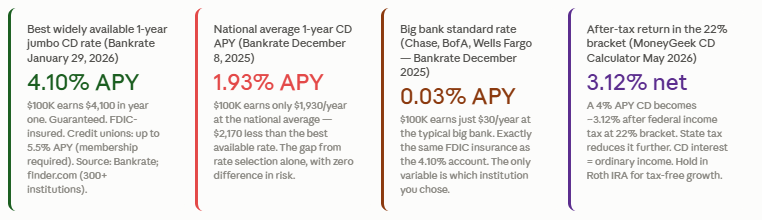
You have $100,000 sitting somewhere. Maybe it’s an inheritance. Maybe it’s a savings account that finally reached six figures after years of discipline. Maybe it’s the proceeds from a home sale waiting for its next job. The question is what to do with it, and one option that keeps coming up — especially when interest rates are historically decent — is a jumbo CD. The name sounds impressive: jumbo, certificate of deposit, institutional, serious. But what does it actually earn? And is the premium over a regular CD real, or mostly marketing? In 2026, the top widely available one-year jumbo CD pays 4.10% APY (Bankrate, January 2026). On $100,000, that’s $4,100 in twelve months — guaranteed, FDIC-insured, risk-free. At the national average rate of 1.93% APY (Bankrate December 2025), that same $100,000 earns $1,930. At a big bank’s standard rate of 0.03%, it earns $30. The gap between the best and worst options is not a rounding error. This article does the maths, explains what matters, and gives you everything you need to decide whether a jumbo CD is right for your $100,000.
The theory behind the jumbo designation is that a larger deposit is worth more to the institution — it is a more substantial, more stable pool of funding — and therefore deserves a higher interest rate in return. In practice, as we will see, the rate premium for the jumbo designation is often smaller than people expect in 2026. What the jumbo label does guarantee is access to the specific products marketed to large depositors, which sometimes — but not always — carry meaningfully higher rates, particularly at credit unions.
The safety features of a regular CD apply to jumbo CDs as well. Jumbo CDs at FDIC-insured banks are federally insured up to $250,000 per depositor per institution per ownership category. Jumbo CDs at NCUA-insured credit unions have equivalent protection. The interest rate is locked in for the term — it will not change if rates fall. And unlike stocks or bonds, the principal is not at risk from market movements. The practical risk of a jumbo CD is not loss of principal. It is the opportunity cost of locking money in at a fixed rate in a changing rate environment, and the inflation risk if the rate you locked in proves lower than inflation. Not financial advice.
At the top end of the market, the best widely available one-year jumbo CD rate as of January 29, 2026 was 4.10% APY (Bankrate). Yahoo Finance’s coverage through May 2026 consistently cited the best available CD rate at 4.00-4.05% APY. These rates are found primarily at online banks and credit unions, which have lower overhead costs than traditional branch banks and can pass more of that saving to depositors in the form of higher rates.
At credit unions specifically, finder.com’s review of over 300 institutions found jumbo CD rates ranging from 0.3% to 5.5% APY — with the highest rates at credit unions with membership requirements. The catch: you need to qualify for membership, which typically requires living in a specific area, working in a specific industry, or having a qualifying family connection. The national average one-year CD rate as of December 2025 was 1.93% APY (Bankrate), meaning the average bank is paying less than half what the best institutions pay. And at the major branch banks — Chase, Bank of America, Wells Fargo — the rate on a standard 1-year CD was as low as 0.03% APY (Bankrate December 2025). Not financial advice.
2026 jumbo CD rate landscape: Best widely available 1-year jumbo CD: 4.10% APY (Bankrate January 2026). Best available CD rate May 2026: 4.00% APY (Yahoo Finance). Credit union jumbo CDs (membership required): up to 5.5% APY (finder.com, 300+ institutions reviewed). National average 1-year CD: 1.93% APY (Bankrate December 2025). Big bank 1-year CD: as low as 0.03% APY (Bankrate December 2025). 5-year national average: 1.35-1.46% APY; competitive online: 3.5-4.5% APY (Gerald Wallet 2026). Federal Reserve: held rates steady in 2026 after three cuts in 2025 (Yahoo Finance May 2026). Sources cited. Rates change daily — verify before opening. Not financial advice.
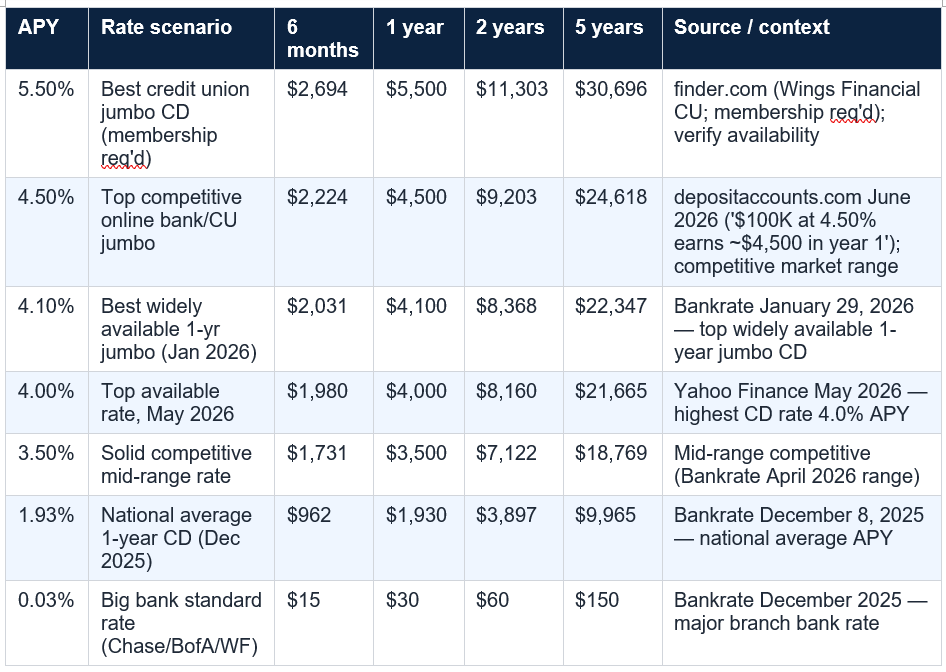
The gap between the best credit union rate (5.50%, $5,500/year) and the big bank rate (0.03%, $30/year) on the same $100,000 deposit is $5,470 per year — not a rounding error. Even the gap between the national average (1.93%, $1,930/year) and the best widely available rate (4.10%, $4,100/year) is $2,170 per year. Over five years, that rate-selection gap compounds to over $12,000 of additional interest from the same $100,000, with no additional risk. This is why shopping for rates is more important than the jumbo label itself. Not financial advice.
The national average exists because most people do not shop. They have a relationship with a bank, they ask that bank about CDs, and they open the CD that bank offers. The bank’s marketing calls it a jumbo rate because the deposit is large. The rate might be 1.5% or 2%. Meanwhile, an online bank or credit union is offering 4.0% or 4.1% for the same product, the same FDIC insurance, the same risk profile. The only difference is that you had to find it.
Bankrate April 2026 makes the competitive shopping point directly: ‘Savvy shoppers should search for the best rate, whether it’s on a jumbo CD or on a regular CD.’ The implication is that the jumbo label is less important than the specific rate. A $100,000 deposit at 4.10% — whether the bank calls it jumbo or not — earns $4,100. The same deposit at 1.93% earns $1,930. The label is marketing. The APY is the number that matters. Not financial advice.
Where to find competitive jumbo CD rates: Online banks (Ally, Marcus, Discover, CIT Bank) consistently offer rates above the national average. Credit unions (if you qualify for membership) often offer the highest rates of all. Comparison sites like Bankrate, NerdWallet, depositaccounts.com, and finder.com publish updated rate tables. Check these every time you have $100,000+ to deploy — never accept your bank’s first offer. Sources: Bankrate April 2026; Yahoo Finance May 2026; finder.com; depositaccounts.com June 2026. Not financial advice.
This matters. If the top jumbo rate is 4.10% and the top regular CD rate with a $1,000 minimum is also 4.10%, then opening a $100,000 CD as a ‘jumbo’ product gets you nothing extra over a regular CD at the same institution with the same rate. You are simply making a large deposit. The jumbo premium — the extra rate for the larger deposit — is essentially zero at many institutions.
Where the jumbo premium is real is at credit unions. Finder.com’s review of 300+ institutions found credit union jumbo CDs offering up to 5.5% APY, which is meaningfully above the 4.0-4.1% available from top online banks on standard CDs. If you qualify for membership at a credit union with a strong jumbo rate, the $100,000 threshold does earn you access to a genuinely higher rate. But this requires membership eligibility and active research — not simply walking into your nearest bank with a large deposit. Not financial advice.
MoneyGeek’s CD Calculator (May 2026) quantifies the tax impact directly: if you are in the 22% federal tax bracket, a 4% CD return becomes approximately 3.12% after federal taxes. In the 32% bracket, it becomes approximately 2.72% after-tax. These are the numbers that matter for comparison against alternatives — not the headline APY. State income tax adds further drag, since CD interest — unlike US Treasury interest — is fully subject to state income tax.
The mitigation strategies: holding CDs inside a traditional IRA defers the tax until withdrawal. Holding them inside a Roth IRA means the interest grows completely tax-free and qualified withdrawals are tax-free. For retirees in lower tax brackets, the IRA argument is less compelling than for high-income earners. For high earners, the Roth IRA CD is one of the most tax-efficient uses of the fixed-income portion of a portfolio. Not tax advice. Consult a CPA.
Tax impact by bracket (4% APY jumbo CD, $100K): 12% bracket: after-tax rate ~3.52% = $3,520/year after tax. 22% bracket: after-tax rate ~3.12% = $3,120/year after tax. 32% bracket: after-tax rate ~2.72% = $2,720/year after tax. Also: state income tax (except in no-income-tax states) on CD interest. Multi-year CDs: taxable annually even before maturity. Solution: hold CDs in a traditional IRA (deferred) or Roth IRA (tax-free). Source: MoneyGeek CD Calculator May 2026; Corporate Finance Institute; depositaccounts.com June 2026. Not tax advice. Consult a CPA.
The FDIC limit becomes relevant when deposits exceed $250,000. A couple with $500,000 to deposit can use the joint account provision: a joint account at a single FDIC-insured bank provides $500,000 in coverage ($250,000 per co-owner). Individual deposits across two FDIC-insured institutions provide $500,000 in coverage. Deposits over $250,000 at a single institution in a single ownership category are not insured on the excess.
For very large deposits, the IntraFi network (formerly known as CDARS) allows deposits to be distributed across multiple FDIC-insured institutions while maintaining a single relationship with one bank — effectively extending FDIC coverage to millions of dollars through network distribution. For a $100,000 jumbo CD, none of this is relevant — a single FDIC-insured institution fully covers the deposit. But it is worth knowing as the account grows. Not financial advice.
The FDIC limit trap: if your total deposits at one FDIC-insured bank exceed $250,000 (including the CD plus checking and savings balances), the excess above $250,000 is not insured. A $200,000 jumbo CD plus $80,000 in checking at the same bank = $280,000 total deposits = $30,000 uninsured. Solution: spread deposits across institutions or use IntraFi/CDARS for large amounts. Source: Bankrate; depositaccounts.com June 2026; FDIC.gov. Not financial advice.
On a $100,000 jumbo CD at 4.10% APY, three months of interest is approximately $1,025. Six months of interest is approximately $2,050. This means if you open a 1-year CD and withdraw after just a month, the penalty ($1,025) may exceed the interest earned in that month ($341) — you’d actually receive less than your original deposit back in the first few months. Longer terms have larger penalties that take proportionally longer to recoup.
The practical lesson: only commit money to a CD that you are genuinely certain you will not need for the full term. Keep your emergency fund — three to six months of living expenses — in a high-yield savings account or money market account with full liquidity. Deploy only discretionary savings that you know you will not need in the CD term. Not financial advice.
The advantages of laddering are significant: you capture the higher rates available on longer terms while maintaining periodic access to portions of the money (every 6-12 months, a rung matures). You also reduce the rate-lock risk — if rates rise, you reinvest the maturing CD at the new, higher rate rather than being locked in for five years at the old rate. If rates fall, only a portion of the money renews at the lower rate while the rest continues earning the higher locked-in rates.
MoneyGeek’s CD Calculator and several personal finance sources describe laddering as the standard strategy for savers who want both competitive rates and some degree of liquidity management. The CD ladder is particularly well-suited to the $100,000 amount because it maintains full FDIC coverage (the total across multiple CDs is still below $250,000 at a single institution) while spreading the maturity risk intelligently. Not financial advice.
A simple $100K CD ladder (illustrative at 2026 rates): $25,000 in a 3-month CD at ~3.8% APY = ~$237 interest. $25,000 in a 6-month CD at ~4.0% APY = ~$494 interest. $25,000 in a 1-year CD at ~4.10% APY = ~$1,025 interest. $25,000 in a 2-year CD at ~3.9% APY = ~$1,982 interest (2 years). Total first-year interest: ~$2,494 (some matures; rest still earning). At each maturity: deploy into new long-term CD or redeploy as needed. Source: Bankrate April 2026; Yahoo Finance May 2026; MoneyGeek May 2026. Illustrative only. Not financial advice.
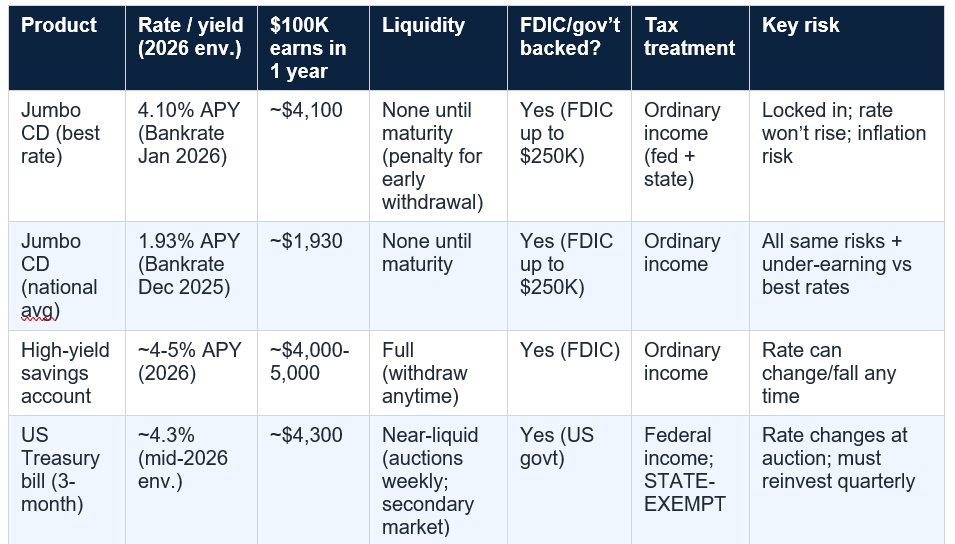
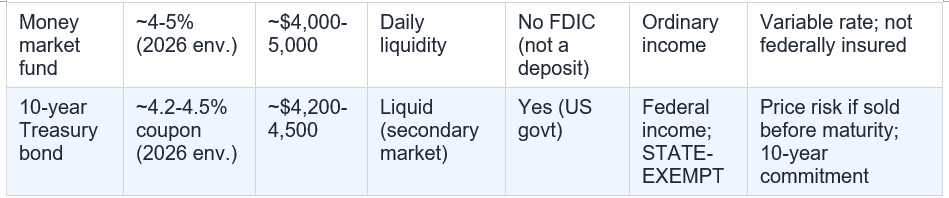
The jumbo CD’s competitive advantage is the combination of a guaranteed, fixed rate and federal deposit insurance. The HYSA and money market fund match the yield in 2026 but offer variable rates that will fall if the Fed cuts again. The Treasury products match or exceed the yield and offer state tax exemption — which can be meaningful for savers in high-state-income-tax states like California, New York, or New Jersey. For pure certainty and simplicity, the jumbo CD at the best available rate is hard to beat. For a saver in a high-tax state who expects rates to stay elevated, a short-term Treasury ladder may produce a better after-tax return. Not financial advice.
It is particularly well-suited to: retirees or near-retirees parking a portion of their fixed-income allocation in a guaranteed instrument; savers who have received a lump sum (inheritance, home sale, bonus) and are deciding what to do with it while they consider longer-term options; and conservative investors who have already maxed out their emergency fund and tax-advantaged accounts and are looking for a risk-free home for discretionary savings.
It is less suitable for: savers who might need the money before the term ends; high-income earners who would be better served by municipal bonds or a Roth IRA strategy that reduces the ordinary income tax drag; and savers who would benefit more from the flexibility of a high-yield savings account while rates remain competitive. Not financial advice. Consult a fee-only CFP for guidance specific to your situation.
The jumbo designation matters less in 2026 than the specific rate, institution, and term. Credit unions offer the highest rates but require membership. Online banks offer competitive rates without membership requirements. The national average and big bank rates are both substantially below what is available with 30 minutes of research on a comparison site. The tax treatment (ordinary income, taxable annually on multi-year CDs) is a real cost that reduces the after-tax yield by 0.5-1.0+ percentage points depending on your bracket. And the FDIC limit is not a concern for a $100,000 deposit at a single institution but is worth knowing as savings grow.
The bottom line: if you have $100,000 looking for a safe, fixed return in 2026, a jumbo CD at a competitive rate is one of the most reliable ways to earn meaningful interest with zero risk to principal. The key is shopping: $4,100 versus $30 for the same deposit, same federal insurance, same one-year term. Not financial, investment, or tax advice. Consult a qualified fee-only CFP and CPA for guidance specific to your situation.
It depends entirely on the APY (annual percentage yield) of the specific CD you open. Here are the key benchmarks for 2026: At 4.10% APY (the top widely available 1-year jumbo CD rate as of January 29, 2026, per Bankrate): ~$4,100 in interest after 12 months, total balance ~$104,100. At 4.50% APY (top competitive online bank/credit union jumbo rate per depositaccounts.com June 2026): ~$4,500 in interest, total balance ~$104,500. At 1.93% APY (national average 1-year CD, Bankrate December 2025): ~$1,930 in interest, total balance ~$101,930. At 0.03% APY (big bank standard rate, Bankrate December 2025): ~$30 in interest, total balance ~$100,030. The difference between a competitive rate and a big bank rate is over $4,070 per year on the same $100,000 deposit — for the same product with the same federal insurance. Always compare rates before opening. Sources: Bankrate January 2026; depositaccounts.com June 2026; Bankrate December 2025. Not financial advice.
What is the difference between a jumbo CD and a regular CD?
A jumbo CD is a certificate of deposit that requires a minimum deposit of $100,000 (the threshold varies by institution; Bankrate April 2026 defines it as a CD offering a different APY for deposits over $100,000). A regular CD typically has a minimum deposit of $500-$1,000. The theory is that a larger deposit earns a higher rate. In practice, Bankrate's April 2026 guidance notes: 'In today's CD rate environment, the difference between traditional and jumbo CD rates may not be much.' As of January 2026, the top widely available 1-year jumbo CD paid 4.10% APY — the same as the top standard 1-year CD at comparable institutions. Both offer the same FDIC insurance, the same fixed rate, and the same mechanics. Where the jumbo premium is real: at certain credit unions that specifically reward large deposits with meaningfully higher rates (finder.com found rates up to 5.5% APY at some credit unions for jumbo minimums). The label matters less than the specific APY. Sources: Bankrate April 2026; Yahoo Finance May 2026; finder.com. Not financial advice.
Is CD interest taxed? When do I owe tax?
Yes. CD interest is taxed as ordinary income at your marginal federal income tax rate — not as capital gains (which are taxed at a lower rate). This tax treatment applies regardless of whether you withdraw the interest or let it compound inside the CD. For multi-year CDs, you owe taxes on the interest earned in each calendar year, even if the CD has not matured and you cannot access the money without a penalty. Your bank will send you a Form 1099-INT at the end of each tax year showing the interest earned. At the 22% federal bracket, a 4% CD earns approximately 3.12% after federal taxes (MoneyGeek CD Calculator, May 2026). State income tax applies on top of federal tax (unlike US Treasury interest, which is state-tax-exempt). Strategies to reduce CD tax drag: hold CDs inside a traditional IRA (tax-deferred until withdrawal) or a Roth IRA (interest grows and withdraws completely tax-free on qualified distributions). Sources: MoneyGeek May 2026; depositaccounts.com June 2026; Corporate Finance Institute. Not tax advice. Consult a CPA.
Is my $100,000 in a jumbo CD fully FDIC insured?
Yes — at an FDIC-insured bank, a $100,000 jumbo CD is fully within the $250,000 per depositor per institution per ownership category insurance limit. The FDIC has never failed to pay a depositor within the insurance limit in its history. If your total deposits at the same bank (checking + savings + CDs) exceed $250,000, the excess above $250,000 in a single ownership category is not insured. A $100,000 CD alone is nowhere near this threshold. At credit unions, equivalent protection is provided by NCUA insurance, also at $250,000. For deposits larger than $250,000: spread across multiple FDIC-insured institutions, or use joint account rules ($500,000 coverage for a joint account between two owners at one bank), or use IntraFi/CDARS for distribution across multiple institutions. Sources: Bankrate; depositaccounts.com June 2026; FDIC.gov. Not financial advice.
What happens if I need my money before the CD matures?
You will pay an early withdrawal penalty. Bankrate's April 2026 guidance on jumbo CD penalties: CDs with terms of one year or less typically carry a penalty of three months' simple interest. CDs with terms of more than one year up to three years carry six months' simple interest. On a $100,000 jumbo CD at 4.10% APY: three months' interest penalty = approximately $1,025; six months' interest penalty = approximately $2,050. If you withdraw very early — before earning enough interest to cover the penalty — you may receive less than your original deposit back. This is why CDs should only be opened with money you are genuinely certain you will not need for the full term. Keep your emergency fund in a liquid account (HYSA, money market). A CD ladder (splitting $100,000 across multiple shorter terms) partially mitigates this risk by having portions mature at regular intervals. Source: Bankrate April 2026. Not financial advice.
Table of Contents
- What Is a Jumbo CD? The Plain-English Definition
- The 2026 Rate Environment: Where Jumbo CD Rates Sit Right Now
- The Core Earnings Table: What $100K Actually Makes at Every Rate
- The Real Numbers: 1 Year, 2 Years, 5 Years
- The National Average Trap: Why Rate Selection Is Everything
- Does Jumbo Status Actually Get You a Better Rate?
- The Tax Catch Most People Miss
- The FDIC Insurance Question
- Early Withdrawal Penalties: The Cost of Changing Your Mind
- The CD Ladder Strategy: How to Use $100K Across Multiple Terms
- Jumbo CD vs The Alternatives: How the Numbers Stack Up
- Who a Jumbo CD Is Actually Right For
- Conclusion: The Maths Are Simple. The Rate Selection Is Not.
- Frequently Asked Questions
What Is a Jumbo CD? The Plain-English Definition
A certificate of deposit is a savings product in which you agree to leave a fixed amount of money with a bank or credit union for a fixed period of time (the term) in exchange for a fixed interest rate. The bank pays you for the certainty of your deposit. A jumbo CD is the same product with one difference: the minimum deposit is larger. Most institutions define ‘jumbo’ as requiring $100,000 or more, though the exact threshold varies (Bankrate April 2026; finder.com).The theory behind the jumbo designation is that a larger deposit is worth more to the institution — it is a more substantial, more stable pool of funding — and therefore deserves a higher interest rate in return. In practice, as we will see, the rate premium for the jumbo designation is often smaller than people expect in 2026. What the jumbo label does guarantee is access to the specific products marketed to large depositors, which sometimes — but not always — carry meaningfully higher rates, particularly at credit unions.
The safety features of a regular CD apply to jumbo CDs as well. Jumbo CDs at FDIC-insured banks are federally insured up to $250,000 per depositor per institution per ownership category. Jumbo CDs at NCUA-insured credit unions have equivalent protection. The interest rate is locked in for the term — it will not change if rates fall. And unlike stocks or bonds, the principal is not at risk from market movements. The practical risk of a jumbo CD is not loss of principal. It is the opportunity cost of locking money in at a fixed rate in a changing rate environment, and the inflation risk if the rate you locked in proves lower than inflation. Not financial advice.
The 2026 Rate Environment: Where Jumbo CD Rates Sit Right Now
Understanding where rates sit in 2026 requires a little context. The Federal Reserve raised interest rates aggressively from 2022 through 2023 to combat inflation, pushing CD rates to their highest levels in over a decade. It then cut rates three times in 2025. As of 2026, the Fed has held rates steady, which Yahoo Finance’s May 2026 daily CD rate coverage describes as potentially ‘your last chance to lock in a competitive CD rate before rates move further.’At the top end of the market, the best widely available one-year jumbo CD rate as of January 29, 2026 was 4.10% APY (Bankrate). Yahoo Finance’s coverage through May 2026 consistently cited the best available CD rate at 4.00-4.05% APY. These rates are found primarily at online banks and credit unions, which have lower overhead costs than traditional branch banks and can pass more of that saving to depositors in the form of higher rates.
At credit unions specifically, finder.com’s review of over 300 institutions found jumbo CD rates ranging from 0.3% to 5.5% APY — with the highest rates at credit unions with membership requirements. The catch: you need to qualify for membership, which typically requires living in a specific area, working in a specific industry, or having a qualifying family connection. The national average one-year CD rate as of December 2025 was 1.93% APY (Bankrate), meaning the average bank is paying less than half what the best institutions pay. And at the major branch banks — Chase, Bank of America, Wells Fargo — the rate on a standard 1-year CD was as low as 0.03% APY (Bankrate December 2025). Not financial advice.
2026 jumbo CD rate landscape: Best widely available 1-year jumbo CD: 4.10% APY (Bankrate January 2026). Best available CD rate May 2026: 4.00% APY (Yahoo Finance). Credit union jumbo CDs (membership required): up to 5.5% APY (finder.com, 300+ institutions reviewed). National average 1-year CD: 1.93% APY (Bankrate December 2025). Big bank 1-year CD: as low as 0.03% APY (Bankrate December 2025). 5-year national average: 1.35-1.46% APY; competitive online: 3.5-4.5% APY (Gerald Wallet 2026). Federal Reserve: held rates steady in 2026 after three cuts in 2025 (Yahoo Finance May 2026). Sources cited. Rates change daily — verify before opening. Not financial advice.
The Core Earnings Table: What $100K Actually Makes at Every Rate
Before getting into strategy, here are the numbers. All figures below are calculated using standard compound interest (annually compounded). Actual earnings depend on compounding frequency (daily, monthly, or annually — most CDs compound monthly or daily, which slightly increases the effective yield above the stated APY). Not financial advice.The gap between the best credit union rate (5.50%, $5,500/year) and the big bank rate (0.03%, $30/year) on the same $100,000 deposit is $5,470 per year — not a rounding error. Even the gap between the national average (1.93%, $1,930/year) and the best widely available rate (4.10%, $4,100/year) is $2,170 per year. Over five years, that rate-selection gap compounds to over $12,000 of additional interest from the same $100,000, with no additional risk. This is why shopping for rates is more important than the jumbo label itself. Not financial advice.
The Real Numbers: 1 Year, 2 Years, 5 Years
Let’s be specific about what $100,000 in a jumbo CD does at the best widely available rate — 4.10% APY (Bankrate, January 2026) — across different time horizons. These are the numbers you would see on your statement at maturity. Not financial advice. Verify current rates; these calculations use the January 2026 best-available rate for illustration.- At 6 months: $2,031 in interest. Total account value: $102,031. Half a year, guaranteed, FDIC-insured. The rate is slightly lower on a 6-month calculation because you are only receiving half a year’s interest.
- At 1 year: $4,100 in interest. Total account value: $104,100. This is roughly what a 4.10% APY translates to in dollar terms: $4,100 per $100,000 per year. Simple, direct, guaranteed.
- At 2 years (assuming reinvestment at the same rate): $8,368 in interest. Total account value: $108,368. The second year earns slightly more than the first because you are earning interest on $104,100, not the original $100,000. This is compounding working in your favour across renewal cycles.
- At 5 years (assuming reinvestment at the same rate each year): $22,347 in interest. Total account value: $122,347. The same $100,000 has grown by 22.3% over five years through interest alone, with zero risk to principal. No stock, no bond, no real estate required.
The National Average Trap: Why Rate Selection Is Everything
The most important personal finance lesson in this article is not about jumbo CDs specifically — it is about the extraordinary difference between accepting the rate your bank offers and actively shopping for the best rate available. Bankrate’s December 2025 analysis of $100,000 in a one-year CD makes the point precisely: competitive rate (4%) earns approximately $4,000; national average (1.93%) earns approximately $1,930; big bank rate (0.03%) earns approximately $30.The national average exists because most people do not shop. They have a relationship with a bank, they ask that bank about CDs, and they open the CD that bank offers. The bank’s marketing calls it a jumbo rate because the deposit is large. The rate might be 1.5% or 2%. Meanwhile, an online bank or credit union is offering 4.0% or 4.1% for the same product, the same FDIC insurance, the same risk profile. The only difference is that you had to find it.
Bankrate April 2026 makes the competitive shopping point directly: ‘Savvy shoppers should search for the best rate, whether it’s on a jumbo CD or on a regular CD.’ The implication is that the jumbo label is less important than the specific rate. A $100,000 deposit at 4.10% — whether the bank calls it jumbo or not — earns $4,100. The same deposit at 1.93% earns $1,930. The label is marketing. The APY is the number that matters. Not financial advice.
Where to find competitive jumbo CD rates: Online banks (Ally, Marcus, Discover, CIT Bank) consistently offer rates above the national average. Credit unions (if you qualify for membership) often offer the highest rates of all. Comparison sites like Bankrate, NerdWallet, depositaccounts.com, and finder.com publish updated rate tables. Check these every time you have $100,000+ to deploy — never accept your bank’s first offer. Sources: Bankrate April 2026; Yahoo Finance May 2026; finder.com; depositaccounts.com June 2026. Not financial advice.
Does Jumbo Status Actually Get You a Better Rate?
The honest answer in 2026 is: sometimes, but often not much. Yahoo Finance’s CD rate coverage throughout 2026 consistently noted that ‘in today’s CD rate environment, however, the difference between traditional and jumbo CD rates may not be much.’ Bankrate’s January 2026 data showed the top widely available 1-year jumbo CD at 4.10% APY, which was ‘on par with what the best standard one-year CDs are paying with a $1,000 minimum deposit requirement.’This matters. If the top jumbo rate is 4.10% and the top regular CD rate with a $1,000 minimum is also 4.10%, then opening a $100,000 CD as a ‘jumbo’ product gets you nothing extra over a regular CD at the same institution with the same rate. You are simply making a large deposit. The jumbo premium — the extra rate for the larger deposit — is essentially zero at many institutions.
Where the jumbo premium is real is at credit unions. Finder.com’s review of 300+ institutions found credit union jumbo CDs offering up to 5.5% APY, which is meaningfully above the 4.0-4.1% available from top online banks on standard CDs. If you qualify for membership at a credit union with a strong jumbo rate, the $100,000 threshold does earn you access to a genuinely higher rate. But this requires membership eligibility and active research — not simply walking into your nearest bank with a large deposit. Not financial advice.
The Tax Catch Most People Miss
CD interest is taxed as ordinary income. Not as capital gains. Not at a lower rate. As ordinary income, in the year it is earned — and on multi-year CDs, this means you owe taxes on interest you cannot yet access. If you open a 3-year jumbo CD, you will receive a Form 1099-INT at the end of year one for the interest accrued in that year, even though the CD has not matured and you cannot withdraw the money without a penalty. The same happens in year two. By the time the CD matures in year three, you have paid taxes on all the interest that accrued during the term. This is not a trap that voids the CD’s value — it is simply an important feature to plan for.MoneyGeek’s CD Calculator (May 2026) quantifies the tax impact directly: if you are in the 22% federal tax bracket, a 4% CD return becomes approximately 3.12% after federal taxes. In the 32% bracket, it becomes approximately 2.72% after-tax. These are the numbers that matter for comparison against alternatives — not the headline APY. State income tax adds further drag, since CD interest — unlike US Treasury interest — is fully subject to state income tax.
The mitigation strategies: holding CDs inside a traditional IRA defers the tax until withdrawal. Holding them inside a Roth IRA means the interest grows completely tax-free and qualified withdrawals are tax-free. For retirees in lower tax brackets, the IRA argument is less compelling than for high-income earners. For high earners, the Roth IRA CD is one of the most tax-efficient uses of the fixed-income portion of a portfolio. Not tax advice. Consult a CPA.
Tax impact by bracket (4% APY jumbo CD, $100K): 12% bracket: after-tax rate ~3.52% = $3,520/year after tax. 22% bracket: after-tax rate ~3.12% = $3,120/year after tax. 32% bracket: after-tax rate ~2.72% = $2,720/year after tax. Also: state income tax (except in no-income-tax states) on CD interest. Multi-year CDs: taxable annually even before maturity. Solution: hold CDs in a traditional IRA (deferred) or Roth IRA (tax-free). Source: MoneyGeek CD Calculator May 2026; Corporate Finance Institute; depositaccounts.com June 2026. Not tax advice. Consult a CPA.
The FDIC Insurance Question
The FDIC insures deposits up to $250,000 per depositor, per FDIC-insured institution, per ownership category. Your $100,000 jumbo CD at an FDIC-insured bank sits well within this limit and is fully protected against bank failure. This is one of the genuine advantages of a CD over almost every other higher-yielding investment: the principal is not at market risk, and the government backs it.The FDIC limit becomes relevant when deposits exceed $250,000. A couple with $500,000 to deposit can use the joint account provision: a joint account at a single FDIC-insured bank provides $500,000 in coverage ($250,000 per co-owner). Individual deposits across two FDIC-insured institutions provide $500,000 in coverage. Deposits over $250,000 at a single institution in a single ownership category are not insured on the excess.
For very large deposits, the IntraFi network (formerly known as CDARS) allows deposits to be distributed across multiple FDIC-insured institutions while maintaining a single relationship with one bank — effectively extending FDIC coverage to millions of dollars through network distribution. For a $100,000 jumbo CD, none of this is relevant — a single FDIC-insured institution fully covers the deposit. But it is worth knowing as the account grows. Not financial advice.
The FDIC limit trap: if your total deposits at one FDIC-insured bank exceed $250,000 (including the CD plus checking and savings balances), the excess above $250,000 is not insured. A $200,000 jumbo CD plus $80,000 in checking at the same bank = $280,000 total deposits = $30,000 uninsured. Solution: spread deposits across institutions or use IntraFi/CDARS for large amounts. Source: Bankrate; depositaccounts.com June 2026; FDIC.gov. Not financial advice.
Early Withdrawal Penalties: The Cost of Changing Your Mind
CDs are not liquid. That is fundamental to their structure: you commit to a term, you receive a fixed rate, and the bank can count on having your money for that period. If you need the money before maturity, you pay an early withdrawal penalty. Bankrate’s April 2026 guidance on jumbo CD early withdrawal penalties: CDs with a term of one year or less typically carry a penalty of three months’ simple interest. CDs with terms of more than one year up to three years typically carry six months’ simple interest.On a $100,000 jumbo CD at 4.10% APY, three months of interest is approximately $1,025. Six months of interest is approximately $2,050. This means if you open a 1-year CD and withdraw after just a month, the penalty ($1,025) may exceed the interest earned in that month ($341) — you’d actually receive less than your original deposit back in the first few months. Longer terms have larger penalties that take proportionally longer to recoup.
The practical lesson: only commit money to a CD that you are genuinely certain you will not need for the full term. Keep your emergency fund — three to six months of living expenses — in a high-yield savings account or money market account with full liquidity. Deploy only discretionary savings that you know you will not need in the CD term. Not financial advice.
The CD Ladder Strategy: How to Use $100K Across Multiple Terms
Rather than deploying all $100,000 in a single CD, a CD ladder splits the deposit across multiple maturities simultaneously. A simple ladder with $100,000 might look like: $25,000 in a 6-month CD, $25,000 in a 1-year CD, $25,000 in a 2-year CD, and $25,000 in a 3-year CD. As each CD matures, you reinvest in a new long-term CD or use the cash if needed.The advantages of laddering are significant: you capture the higher rates available on longer terms while maintaining periodic access to portions of the money (every 6-12 months, a rung matures). You also reduce the rate-lock risk — if rates rise, you reinvest the maturing CD at the new, higher rate rather than being locked in for five years at the old rate. If rates fall, only a portion of the money renews at the lower rate while the rest continues earning the higher locked-in rates.
MoneyGeek’s CD Calculator and several personal finance sources describe laddering as the standard strategy for savers who want both competitive rates and some degree of liquidity management. The CD ladder is particularly well-suited to the $100,000 amount because it maintains full FDIC coverage (the total across multiple CDs is still below $250,000 at a single institution) while spreading the maturity risk intelligently. Not financial advice.
A simple $100K CD ladder (illustrative at 2026 rates): $25,000 in a 3-month CD at ~3.8% APY = ~$237 interest. $25,000 in a 6-month CD at ~4.0% APY = ~$494 interest. $25,000 in a 1-year CD at ~4.10% APY = ~$1,025 interest. $25,000 in a 2-year CD at ~3.9% APY = ~$1,982 interest (2 years). Total first-year interest: ~$2,494 (some matures; rest still earning). At each maturity: deploy into new long-term CD or redeploy as needed. Source: Bankrate April 2026; Yahoo Finance May 2026; MoneyGeek May 2026. Illustrative only. Not financial advice.
Jumbo CD vs The Alternatives: How the Numbers Stack Up
A $100,000 jumbo CD at 4.10% APY earns $4,100 in year one. How does that compare to the alternatives a saver with $100,000 might consider? The comparison depends on what you value: liquidity, certainty, tax treatment, or risk of loss.The jumbo CD’s competitive advantage is the combination of a guaranteed, fixed rate and federal deposit insurance. The HYSA and money market fund match the yield in 2026 but offer variable rates that will fall if the Fed cuts again. The Treasury products match or exceed the yield and offer state tax exemption — which can be meaningful for savers in high-state-income-tax states like California, New York, or New Jersey. For pure certainty and simplicity, the jumbo CD at the best available rate is hard to beat. For a saver in a high-tax state who expects rates to stay elevated, a short-term Treasury ladder may produce a better after-tax return. Not financial advice.
Who a Jumbo CD Is Actually Right For
A jumbo CD is the right product for a specific type of saver. It is ideal for someone who has $100,000 or more that they know they will not need for the full term of the CD, wants a guaranteed, risk-free return with zero principal loss risk, is comfortable with the illiquidity of the commitment, and prefers simplicity over optimisation.It is particularly well-suited to: retirees or near-retirees parking a portion of their fixed-income allocation in a guaranteed instrument; savers who have received a lump sum (inheritance, home sale, bonus) and are deciding what to do with it while they consider longer-term options; and conservative investors who have already maxed out their emergency fund and tax-advantaged accounts and are looking for a risk-free home for discretionary savings.
It is less suitable for: savers who might need the money before the term ends; high-income earners who would be better served by municipal bonds or a Roth IRA strategy that reduces the ordinary income tax drag; and savers who would benefit more from the flexibility of a high-yield savings account while rates remain competitive. Not financial advice. Consult a fee-only CFP for guidance specific to your situation.
Conclusion
A $100,000 jumbo CD in 2026 earns between $30 and $5,500 in its first year — depending entirely on where you open it. At 4.10% APY (best widely available, Bankrate January 2026), you earn $4,100 in twelve months, guaranteed, FDIC-insured, zero risk to principal. At 0.03% APY at a major branch bank, you earn $30. The maths are brutally simple. The rate selection is where almost everyone leaves money on the table.The jumbo designation matters less in 2026 than the specific rate, institution, and term. Credit unions offer the highest rates but require membership. Online banks offer competitive rates without membership requirements. The national average and big bank rates are both substantially below what is available with 30 minutes of research on a comparison site. The tax treatment (ordinary income, taxable annually on multi-year CDs) is a real cost that reduces the after-tax yield by 0.5-1.0+ percentage points depending on your bracket. And the FDIC limit is not a concern for a $100,000 deposit at a single institution but is worth knowing as savings grow.
The bottom line: if you have $100,000 looking for a safe, fixed return in 2026, a jumbo CD at a competitive rate is one of the most reliable ways to earn meaningful interest with zero risk to principal. The key is shopping: $4,100 versus $30 for the same deposit, same federal insurance, same one-year term. Not financial, investment, or tax advice. Consult a qualified fee-only CFP and CPA for guidance specific to your situation.
Frequently Asked Questions
How much does $100,000 in a jumbo CD earn in one year in 2026?It depends entirely on the APY (annual percentage yield) of the specific CD you open. Here are the key benchmarks for 2026: At 4.10% APY (the top widely available 1-year jumbo CD rate as of January 29, 2026, per Bankrate): ~$4,100 in interest after 12 months, total balance ~$104,100. At 4.50% APY (top competitive online bank/credit union jumbo rate per depositaccounts.com June 2026): ~$4,500 in interest, total balance ~$104,500. At 1.93% APY (national average 1-year CD, Bankrate December 2025): ~$1,930 in interest, total balance ~$101,930. At 0.03% APY (big bank standard rate, Bankrate December 2025): ~$30 in interest, total balance ~$100,030. The difference between a competitive rate and a big bank rate is over $4,070 per year on the same $100,000 deposit — for the same product with the same federal insurance. Always compare rates before opening. Sources: Bankrate January 2026; depositaccounts.com June 2026; Bankrate December 2025. Not financial advice.
What is the difference between a jumbo CD and a regular CD?
A jumbo CD is a certificate of deposit that requires a minimum deposit of $100,000 (the threshold varies by institution; Bankrate April 2026 defines it as a CD offering a different APY for deposits over $100,000). A regular CD typically has a minimum deposit of $500-$1,000. The theory is that a larger deposit earns a higher rate. In practice, Bankrate's April 2026 guidance notes: 'In today's CD rate environment, the difference between traditional and jumbo CD rates may not be much.' As of January 2026, the top widely available 1-year jumbo CD paid 4.10% APY — the same as the top standard 1-year CD at comparable institutions. Both offer the same FDIC insurance, the same fixed rate, and the same mechanics. Where the jumbo premium is real: at certain credit unions that specifically reward large deposits with meaningfully higher rates (finder.com found rates up to 5.5% APY at some credit unions for jumbo minimums). The label matters less than the specific APY. Sources: Bankrate April 2026; Yahoo Finance May 2026; finder.com. Not financial advice.
Is CD interest taxed? When do I owe tax?
Yes. CD interest is taxed as ordinary income at your marginal federal income tax rate — not as capital gains (which are taxed at a lower rate). This tax treatment applies regardless of whether you withdraw the interest or let it compound inside the CD. For multi-year CDs, you owe taxes on the interest earned in each calendar year, even if the CD has not matured and you cannot access the money without a penalty. Your bank will send you a Form 1099-INT at the end of each tax year showing the interest earned. At the 22% federal bracket, a 4% CD earns approximately 3.12% after federal taxes (MoneyGeek CD Calculator, May 2026). State income tax applies on top of federal tax (unlike US Treasury interest, which is state-tax-exempt). Strategies to reduce CD tax drag: hold CDs inside a traditional IRA (tax-deferred until withdrawal) or a Roth IRA (interest grows and withdraws completely tax-free on qualified distributions). Sources: MoneyGeek May 2026; depositaccounts.com June 2026; Corporate Finance Institute. Not tax advice. Consult a CPA.
Is my $100,000 in a jumbo CD fully FDIC insured?
Yes — at an FDIC-insured bank, a $100,000 jumbo CD is fully within the $250,000 per depositor per institution per ownership category insurance limit. The FDIC has never failed to pay a depositor within the insurance limit in its history. If your total deposits at the same bank (checking + savings + CDs) exceed $250,000, the excess above $250,000 in a single ownership category is not insured. A $100,000 CD alone is nowhere near this threshold. At credit unions, equivalent protection is provided by NCUA insurance, also at $250,000. For deposits larger than $250,000: spread across multiple FDIC-insured institutions, or use joint account rules ($500,000 coverage for a joint account between two owners at one bank), or use IntraFi/CDARS for distribution across multiple institutions. Sources: Bankrate; depositaccounts.com June 2026; FDIC.gov. Not financial advice.
What happens if I need my money before the CD matures?
You will pay an early withdrawal penalty. Bankrate's April 2026 guidance on jumbo CD penalties: CDs with terms of one year or less typically carry a penalty of three months' simple interest. CDs with terms of more than one year up to three years carry six months' simple interest. On a $100,000 jumbo CD at 4.10% APY: three months' interest penalty = approximately $1,025; six months' interest penalty = approximately $2,050. If you withdraw very early — before earning enough interest to cover the penalty — you may receive less than your original deposit back. This is why CDs should only be opened with money you are genuinely certain you will not need for the full term. Keep your emergency fund in a liquid account (HYSA, money market). A CD ladder (splitting $100,000 across multiple shorter terms) partially mitigates this risk by having portions mature at regular intervals. Source: Bankrate April 2026. Not financial advice.
0 Comments
Be the first to share your thoughts on this article.