

Investing
What's Your Investing Style? A Guide to Finding Yours

Passive funds now hold 55% of US long-term fund assets. Vanguard’s VOO became the first ETF ever to cross $1 trillion in June 2026. 79% of actively managed large-cap US funds underperformed the S&P 500 in 2025. And yet the most important question in personal investing is not whether passive beats active on a spreadsheet. It is: what kind of investor are you? The data on who actually succeeds at investing consistently points to the same answer: not the most sophisticated strategy, but the one that is most likely to be followed through — through market crashes, economic uncertainty, and the relentless noise of financial news. Knowing your investing style is the foundation of every good financial decision that follows. This article will help you find yours. Not financial advice.
Charles Stanley, in its 2026 investor guide, makes this explicit: ‘The important thing is not to allow dramatic events in 2025 sway the type of investor you are.’ Investment style consistency — staying the course through volatility rather than reacting to it — is what separates the investors with good long-term outcomes from those who buy high and sell low. Every style described in this article can produce good outcomes when consistently applied. Every style can produce poor outcomes when abandoned midway through a market cycle.
Academic research (Cronqvist, Siegel, and Yu) adds a deeper dimension: your investing style has roots you may not have consciously chosen. The research found that investors who grew up during the Great Depression or entered the labour market during a recession tend to have stronger value orientation decades later. Biological factors and early life experiences partially determine which style will feel natural to you — and which will feel like swimming against the current. Understanding your natural inclinations is the starting point for building a strategy that you will actually sustain. Not financial advice.
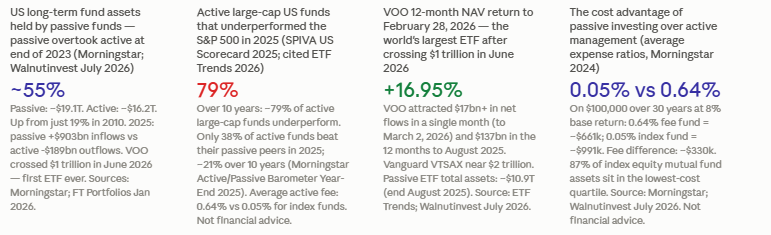
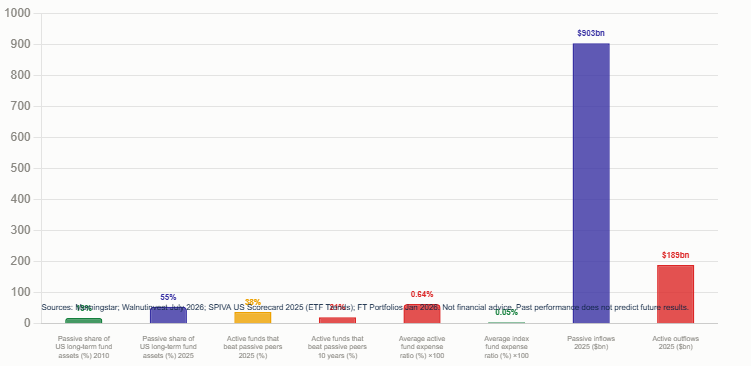
Passive overtook active: passive funds now hold ~55% of US long-term fund assets ($19.1T vs $16.2T active, October 2025; Morningstar). Passive ETFs had ~$10.9T in assets at end of August 2025. In 2025: passive funds attracted $903 billion inflows vs $189 billion outflows for active funds. VOO crossed $1 trillion in June 2026 (first ETF ever). 79% of active large-cap US funds underperformed the S&P 500 in 2025 (SPIVA US Scorecard 2025). Only 38% of active funds beat their passive peers in 2025; ~21% over 10 years (Morningstar Active/Passive Barometer Year-End 2025). Average expense ratio: index 0.05% vs active 0.64% (Morningstar). Sources: Walnutinvest July 2026; ETF Trends September 2025; FT Portfolios January 2026.
The active-passive divide is the most consequential choice most investors make. Active investing means making specific investment decisions — selecting individual securities, timing market entries and exits, or using managed funds where a portfolio manager makes those decisions. Passive investing means owning the market as a whole through index funds or ETFs, without attempting to select winners or time markets. The data on this choice is more one-sided than most investors realise: only 38% of active funds beat their passive peers in 2025, and approximately 21% (one in five) did so over ten years (Morningstar Active/Passive Barometer, Year-End 2025). The average active equity fund charges 0.64% annually versus 0.05% for an index fund — a 0.59% annual headwind that compounds powerfully over decades.
Within these two broad categories, Charles Stanley’s 2026 framework identifies four practical approaches that capture how real investors operate: value and growth (the two main active styles) and accumulation and income (the two main passive goals). This article extends that to six styles: passive index, value, growth, income, momentum, and ESG. Not all investors need to choose just one. But everyone should know which styles they are naturally aligned with — and which require a level of discipline, time, or knowledge they may not currently have. Not financial advice.
The numbers since the 2025 SPIVA report are decisive: 79% of actively managed large-cap US funds underperformed the S&P 500. Over 10 years, 79% of active funds failed to beat a simple index equivalent (Morningstar). The market has responded: passive funds now hold 55% of US long-term fund assets, Vanguard’s VOO crossed $1 trillion in June 2026, and passive ETFs alone hold approximately $10.9 trillion in assets. The Vanguard 500 Index Fund (VOO) attracted $137 billion in inflows over the 12 months to August 2025 alone — more than any other fund on Earth.
The passive style suits investors who want market returns without the time, expertise, or inclination to select individual securities. It is also the empirically supported default for those who are new to investing, those with long time horizons, and those who recognise that their biggest risk is their own behaviour (panic-selling during downturns) rather than the portfolio composition. Not financial advice.
Passive / index investing self-assessment questions: (1) Do I want to capture market returns without spending significant time on investment research? (2) Am I comfortable with the idea that my portfolio will fall when the market falls -- and can I resist selling during a downturn? (3) Is my primary goal wealth accumulation over 10+ years rather than generating regular income from investments? (4) Do the statistics on active fund underperformance (79% underperform in 2025) make me think a simple index fund is the smarter choice? If you answered yes to 3 or more: passive investing may be your natural home. Not financial advice.
Passive investing strengths: (1) Lowest cost: 0.05% average expense ratio vs 0.64% for active funds (Morningstar 2024). (2) Consistent market returns without selection risk. (3) No manager risk (no individual fund manager to underperform or leave). (4) Tax efficient (low turnover = fewer capital gains events). (5) Diversified by construction. (6) Minimal time commitment: set up and review annually. (7) VOO: +16.95% NAV return in the 12 months to February 28, 2026.
Passive investing weaknesses: (1) Will never outperform the market (by design). (2) 100% exposure to market downturns -- no defensive positioning. (3) Index concentration risk: in 2026, S&P 500 top 10 stocks = ~35% of index (AI megacap concentration). (4) Passive investors accept the market's weights, including overvalued sectors. (5) No income optimisation beyond the index dividend yield (~1.3-1.5% for S&P 500).
Best Fit For: Best fit: long-term wealth accumulation investors; beginners; those with limited time for research; those who recognise behavioural risk (tendency to panic-sell) as their biggest threat; those in workplace pension default funds. Works for both the accumulation phase (growing the pot) and can be adapted for the income phase (systematic withdrawal from a total-return index fund). Not financial advice.
Value investing is often considered the more patient discipline (Charles Stanley, 2026). It requires holding assets that are out of favour — often because the business faces genuine headwinds, or because sentiment about an industry is negative, or simply because the stock has fallen and the broader market is ignoring it. This requires emotional resilience: the value investor’s favourite holding may underperform growth stocks for extended periods, as it did consistently from approximately 2012 to 2021 before value dramatically rebounded in 2022–2023 when rising interest rates compressed growth stock valuations.
Academic evidence (the Fama-French three-factor model) supports value as a long-run factor premium: cheap stocks have historically outperformed expensive stocks over long periods. However, this premium is not guaranteed, is volatile, and can disappear for a decade at a time. Investors who grew up during the Great Depression or entered the labour market during recessions tend to have a stronger value orientation decades later (Cronqvist, Siegel, Yu) — the lived experience of economic hardship creates a preference for buying cheap. Not financial advice.
Value investing self-assessment: (1) Do I enjoy analysing financial statements to find stocks trading below what they're worth? (2) Am I comfortable holding unfashionable, overlooked, or declining businesses if I believe they are undervalued? (3) Can I hold a position that underperforms for 3-5 years without abandoning it, trusting the valuation thesis? (4) Do falling prices excite rather than frighten me (because a cheaper price means better value)? If yes to 3 or more: value investing aligns with your temperament. Not financial advice.
Value investing strengths: long-run academic evidence of a value premium (Fama-French); lower starting valuations provide downside protection; dividend income common in value stocks; strong performance in rising-interest-rate environments (2022-2023); psychological resilience against overpaying for fashionable assets.
Value investing weaknesses: value traps (stocks that are cheap because they are genuinely declining); underperformance vs growth in low-rate bull markets (2012-2021 decade); requires significant research and financial analysis skill; psychologically difficult to hold underperformers; extended periods of style disadvantage.
Growth investing thrives in low-interest-rate environments. When interest rates are near zero (as they were from 2012 to 2022), the present value of a company’s future earnings is much higher, because those future earnings are not discounted by a meaningful rate. This is why technology growth stocks dominated portfolio returns in the 2010s. When interest rates rose from 2022 to 2023, growth stocks fell sharply: the discount rate increased, compressing the present value of those future earnings. In 2025–2026, AI enthusiasm reignited growth stock momentum: the Philadelphia Semiconductor Index rose 87% in 2026, and the Nasdaq 100 delivered strong returns in 2023 and 2024.
WallStreetMojo (November 2025) notes: ‘growth-style investing will involve holding on to the stock for a couple of years in the hope that the stock’s intrinsic value will rise.’ The downside is volatility: growth stocks can fall 50–80% in market corrections, and many high-growth companies never deliver the earnings their valuations imply. Not financial advice.
Growth investing self-assessment: (1) Am I primarily interested in capital appreciation rather than income from dividends? (2) Can I handle significant volatility -- including 40-50% portfolio drawdowns -- without selling? (3) Do I enjoy researching technology, healthcare, or consumer companies that could become market leaders? (4) Is my investment horizon 5-15 years or longer (needed to recover from growth stock corrections)? (5) Do I find myself naturally excited by innovation, disruption, and new business models? Not financial advice.
Growth investing strengths: potential for market-beating capital appreciation; participation in disruptive technology trends; no requirement for immediate income; well-suited to long time horizons and high risk tolerance.
Growth investing weaknesses: extreme valuation sensitivity to interest rates; high volatility (50-80% drawdowns possible); no dividend income; many growth companies fail to meet expectations; requires monitoring; AI bubble risk (2026): Shiller CAPE >40, concentration risk.
The current interest rate environment (Fed funds rate 3.75–4.00%; ECB rate approximately 2.5% as of October 2026) has revived the case for income investing. After a decade in which bond yields were so low that income investing was barely viable, bonds and high-dividend stocks now offer competitive yields relative to the risk taken. The FTSE 100 yields approximately 3.5–4% in 2025–2026. High-dividend ETFs such as SCHD (Schwab US Dividend Equity ETF) and VYM (Vanguard High Dividend Yield ETF) have attracted significant investor flows.
Charles Stanley (2026) identifies income as one of the two primary passive approaches: ‘Passive investors usually make a simpler choice: to reinvest the income generated from their investments or draw it as an income — this being an accumulation strategy or an income strategy.’ The accumulation investor reinvests dividends to compound their returns; the income investor takes the dividends as cash. Not financial advice.
Income investing self-assessment: (1) Do I need (or want) regular cash payments from my portfolio, rather than waiting for capital growth? (2) Am I closer to or already in retirement, where converting portfolio value to income is the primary goal? (3) Does seeing regular dividend payments reassure me that my investments are working, even when market prices fall? (4) Am I comfortable with the trade-off that income-focused portfolios often grow more slowly in capital value than growth-oriented ones? Not financial advice.
Income investing strengths: predictable cash flow from dividends/interest; psychological reassurance of regular payments; natural protection against forced selling during market downturns (dividends pay you while you wait); tax-efficient structures available (ISA in UK, IRA in US); reinvested dividends compound powerfully over time.
Income investing weaknesses: income stocks can cut dividends in recessions; generally lower capital appreciation than growth stocks; inflation risk (fixed income erodes in purchasing power over time); high-yield stocks may carry more business risk than yield implies (yield traps).
In 2025–2026, the momentum style has produced striking examples. AI-related stocks (Nvidia, Broadcom, ASML) delivered extraordinary returns on the back of rapidly accelerating earnings. The Philadelphia Semiconductor Index rose 87% in 2026. Investors who applied a momentum lens — allocating to the strongest-performing sectors and cutting the weakest — captured significant returns. However, JPMorgan’s July 2026 analysis identified a parallel momentum risk: when the momentum trade reverses (as it did dramatically in the dot-com crash), the losses can be severe and sudden.
Momentum investing requires more active management than any other style in this article. It is not a buy-and-hold approach. It requires regular rebalancing to maintain exposure to the current momentum leaders and exit the momentum laggards. The transaction costs and tax events generated by this activity must be explicitly modelled. Not financial advice.
Momentum investing self-assessment: (1) Am I prepared to actively manage my portfolio -- reviewing and adjusting positions at least quarterly? (2) Can I execute decisions quickly and unemotionally (buying strength, selling weakness) without being swayed by attachment to a holding? (3) Do I understand that momentum strategies can reverse suddenly and catastrophically? (4) Have I modelled the impact of transaction costs and capital gains tax on my returns? If yes to all four: momentum may be appropriate as part of a diversified strategy. Not financial advice.
Momentum investing strengths: strong academic evidence for the momentum factor; captures trends in rapidly growing sectors; can be implemented via momentum factor ETFs (e.g. iShares MSCI World Momentum Factor ETF); outperforms in trending markets.
Momentum investing weaknesses: high transaction costs; significant tax events; sudden reversals ('momentum crashes') can be catastrophic; requires time and discipline; psychologically difficult (must sell losers without attachment); unsuitable as a standalone strategy for most retail investors.
The performance debate around ESG investing is genuinely unresolved. Long-running academic analysis has not found consistent evidence that ESG funds either outperform or underperform non-ESG equivalents after controlling for sector tilts and market conditions. During 2020–2021, ESG-heavy technology tilts boosted ESG fund returns. During 2022, the same technology tilt hurt ESG funds while energy stocks (which ESG funds typically underweight) surged. The performance of ESG portfolios depends largely on which exclusions or inclusions the specific fund applies and how those sectors perform in any given period.
ESG investing suits investors for whom the purpose of their capital is as important as its return. WallStreetMojo (November 2025) notes: ‘Some prefer fast returns, some income, and still others emphasize investing ethically.’ The choice of ESG is ultimately a values question as much as a financial one. Not financial advice.
ESG investing self-assessment: (1) Do I feel uncomfortable knowing my capital might be invested in industries or companies that conflict with my values (weapons, fossil fuels, tobacco, human rights violations)? (2) Am I willing to accept that value-aligned investing may involve performance trade-offs in certain market conditions? (3) Do I have a specific set of ethical or sustainability criteria that I want my portfolio to reflect? If yes to these: ESG deserves a place in your portfolio construction process. Not financial advice.
The most common and well-supported portfolio construction for an individual investor is a core-satellite structure. The ‘core’ is a low-cost passive index fund (capturing market returns at minimal cost), representing the majority of the portfolio. The ‘satellite’ is a smaller allocation to a specific style — value, growth, income, ESG, or a combination — that reflects the investor’s specific views or objectives. This structure has two advantages: it prevents the investor from completely abandoning passive efficiency, and it provides the engagement and specificity that purely passive investing may lack.
A practical example: a 40-year-old investor accumulating for retirement might hold 60% in a global passive index ETF (core), 20% in a dividend income ETF for reinvesting distributions (income satellite), and 20% in a ESG fund that aligns with their values (ESG satellite). As they approach retirement at 65, the portfolio shifts: the passive core reduces, the income allocation increases, and growth exposure is trimmed. Not financial advice.
The second most common mistake is misidentifying risk tolerance. Most investors discover their true risk tolerance during a market crash rather than when completing a questionnaire. Believing yourself to be a growth investor until your portfolio falls 40% — and then panic-selling at the bottom — is worse than choosing a lower-volatility style from the start. The self-assessment questions in this article are designed to surface this discrepancy before it becomes expensive. Not financial advice.
The third mistake is strategy proliferation: holding too many funds across too many styles, so the portfolio ends up mirroring the market anyway while paying higher fees than a simple index fund. If your 12-fund active portfolio essentially tracks the S&P 500 after combining its positions (which is empirically common), you have paid active management fees for an approximate passive result. Not financial advice.
And yet: a growth investor who genuinely understands the businesses they own, holds through 40% drawdowns, and rebalances through market cycles will outperform the passive investor who panic-sells at the first correction. A value investor who has the patience and knowledge to hold undervalued assets for five years will outperform the passive investor who drifts into momentum following during a bull market. An income investor who structures their portfolio for predictable dividends will sleep better at retirement than the growth investor who discovers their risk tolerance was lower than they thought.
The best investing style is not the one with the best recent performance. It is the one aligned with your time horizon, risk tolerance, income needs, and temperament — because that is the one you will follow consistently through market cycles, without abandoning it when it gets uncomfortable. Know yourself first. Build your portfolio second. Not financial advice. Consult a qualified financial adviser for guidance specific to your circumstances.
Active investing involves making specific investment selections -- choosing individual stocks, sectors, or managed funds where a portfolio manager makes investment decisions. The goal is to outperform the market. Passive investing (also called index investing) means buying a fund that owns every stock in a market index (such as the S&P 500 or FTSE All-World) in proportion to each company's size. The goal is to capture the market's return at the lowest possible cost, without attempting to beat it. The data in 2025-2026 shows: passive funds now hold ~55% of US long-term fund assets; 79% of active large-cap US funds underperformed the S&P 500 in 2025 (SPIVA); only 38% of active funds beat their passive peers in 2025 (Morningstar). Average cost: 0.05% for index equity funds vs 0.64% for active (Morningstar). Not financial advice.
Is value investing or growth investing better?
Neither is definitively better -- they perform differently in different economic conditions. Value investing tends to outperform when interest rates rise and in the aftermath of market crashes (the compressed valuations of cheap stocks provide downside protection, and a rate rise makes growth stock future earnings worth less in present value terms). Growth investing tends to outperform in low-interest-rate environments when the present value of future earnings is highest -- as it did from approximately 2012-2021. Academic evidence (Fama-French) supports a long-run value premium over very long periods. But investors also must be able to hold value stocks through extended underperformance (2012-2021 was a difficult decade for value investors). For most investors without the research skills and emotional resilience required for either active style: a passive index fund captures both value and growth companies in proportion to their market weight. Not financial advice.
What investing style is best for beginners?
The evidence most strongly supports passive index investing as the starting point for most beginners. The reasons: lowest cost (0.05% vs 0.64% for active); no requirement to select individual stocks or time markets; tax efficient; consistently outperforms most actively managed funds over 10 years; minimal time commitment (review annually); eliminates the manager selection problem. Vanguard's VOO (S&P 500 ETF) or VWRL/FTSE All-World ETF are widely used examples (not recommendations). As financial knowledge, experience, and wealth grow, a beginner can evolve their approach to include satellite allocations to specific styles (value, income, ESG) that reflect their evolving preferences. Starting with a simple, low-cost index fund and building from there is the approach supported by the data. Not financial advice. Consult a qualified financial adviser.
Can I use more than one investing style?
Yes -- blending styles is how most experienced investors actually operate, and it is often the most appropriate approach. The core-satellite portfolio construction is widely recommended: a passive index fund 'core' (capturing market returns at minimal cost) combined with 'satellite' allocations to specific styles -- such as a value ETF, a dividend income fund, or an ESG fund. Charles Stanley (2026): 'Someone might begin their investing life as a growth-focused, DIY investor... Eventually, they might blend growth and value active strategies to manage risk.' The core-satellite approach prevents over-dependence on any single style's performance cycle while allowing the investor to express specific preferences in the satellites. The key is that the core remains large enough to anchor the portfolio's risk/return characteristics. Not financial advice.
What is ESG investing and does it perform as well as conventional investing?
ESG (Environmental, Social, and Governance) investing applies ethical or sustainability criteria to portfolio construction. The ESG investor excludes companies in industries that conflict with their values (weapons, fossil fuels, tobacco) or positively selects companies with strong sustainability practices. ESG AUM globally is approximately $30 trillion -- the fastest-growing investment category in Europe. Performance: long-running academic analysis has not found consistent evidence that ESG funds either outperform or underperform non-ESG equivalents after controlling for sector tilts and market conditions. In 2020-2021, technology-heavy ESG funds outperformed; in 2022, the same technology tilt hurt ESG funds while energy stocks surged. The performance of ESG portfolios depends largely on the specific criteria applied and how those sectors perform. For investors for whom the purpose of their capital is as important as its return: ESG investing offers a values-aligned approach without a consistent performance penalty. Not financial advice.
Table of Contents
- Why Your Investing Style Matters More Than Your Stock Picks
- The Two Great Divides: Active vs Passive, and the Sub-Styles Within
- Style 1 — Passive / Index Investing: Buy the Haystack
- Style 2 — Value Investing: The Patient Treasure Hunter
- Style 3 — Growth Investing: Backing Tomorrow’s Winners
- Style 4 — Income Investing: Building a Dividend Income Stream
- Style 5 — Momentum Investing: Riding the Market’s Strongest Trends
- Style 6 — ESG / Socially Responsible Investing: Values-Led Portfolios
- The Full Style Comparison: All Six Investing Styles Side by Side
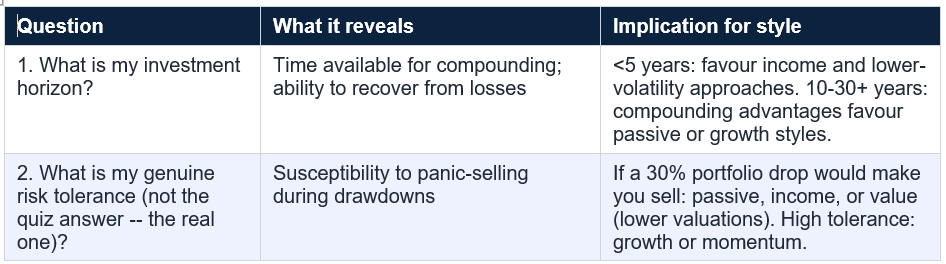
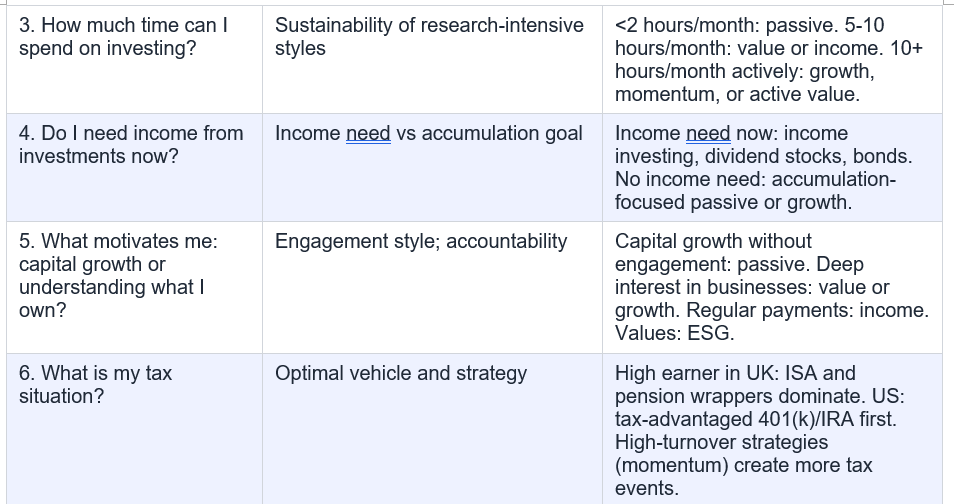
- Finding Your Style: The Six Questions That Matter Most
- Blending Styles: Why Most Real Investors Use More Than One
- Common Style Mistakes and How to Avoid Them
- Conclusion: The Best Investing Style Is the One You’ll Stick To
- Frequently Asked Questions
Passive vs active — assets, flows, and performance 2025-2026
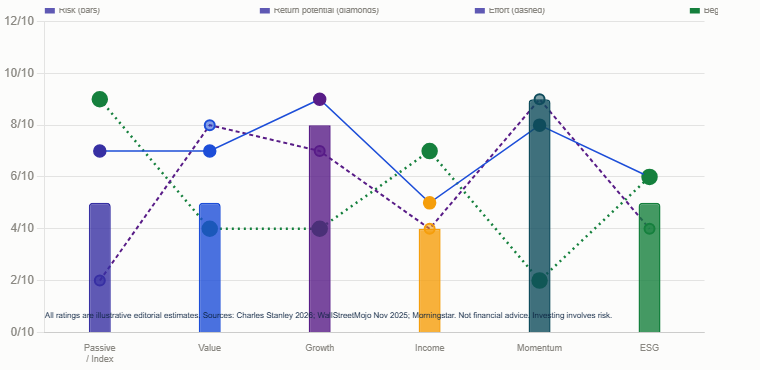
6 investing styles — risk, return, effort, and suitability
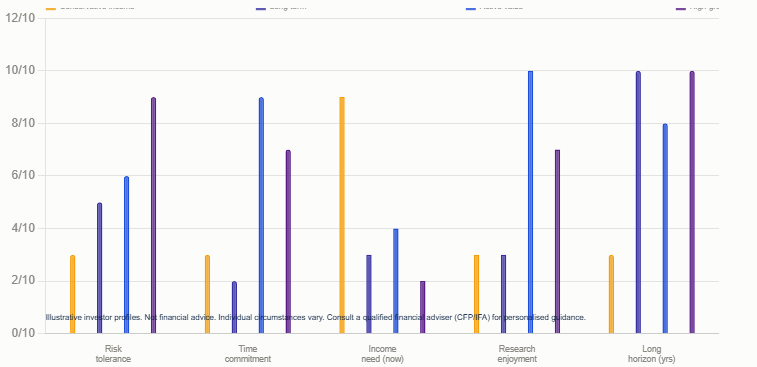
Which style are you? — the investor personality radar
Why Your Investing Style Matters More Than Your Stock Picks
Most conversations about investing focus on the what: which stocks to buy, which funds to hold, which sector is about to outperform. The more important conversation is the who: what kind of investor are you, and which approach is most likely to produce good outcomes for that specific person? The data is unambiguous on one point: an investor who follows a simple, consistent strategy for decades will almost always outperform one who chases performance, switches strategies with market conditions, and abandons their approach at the first sign of a drawdown.Charles Stanley, in its 2026 investor guide, makes this explicit: ‘The important thing is not to allow dramatic events in 2025 sway the type of investor you are.’ Investment style consistency — staying the course through volatility rather than reacting to it — is what separates the investors with good long-term outcomes from those who buy high and sell low. Every style described in this article can produce good outcomes when consistently applied. Every style can produce poor outcomes when abandoned midway through a market cycle.
Academic research (Cronqvist, Siegel, and Yu) adds a deeper dimension: your investing style has roots you may not have consciously chosen. The research found that investors who grew up during the Great Depression or entered the labour market during a recession tend to have stronger value orientation decades later. Biological factors and early life experiences partially determine which style will feel natural to you — and which will feel like swimming against the current. Understanding your natural inclinations is the starting point for building a strategy that you will actually sustain. Not financial advice.
Passive overtook active: passive funds now hold ~55% of US long-term fund assets ($19.1T vs $16.2T active, October 2025; Morningstar). Passive ETFs had ~$10.9T in assets at end of August 2025. In 2025: passive funds attracted $903 billion inflows vs $189 billion outflows for active funds. VOO crossed $1 trillion in June 2026 (first ETF ever). 79% of active large-cap US funds underperformed the S&P 500 in 2025 (SPIVA US Scorecard 2025). Only 38% of active funds beat their passive peers in 2025; ~21% over 10 years (Morningstar Active/Passive Barometer Year-End 2025). Average expense ratio: index 0.05% vs active 0.64% (Morningstar). Sources: Walnutinvest July 2026; ETF Trends September 2025; FT Portfolios January 2026.
The Two Great Divides: Active vs Passive, and the Sub-Styles Within
Every investing style sits somewhere on two intersecting axes: the active-passive axis and the strategy axis. Understanding these two dimensions clarifies the full landscape before we explore each individual style.The active-passive divide is the most consequential choice most investors make. Active investing means making specific investment decisions — selecting individual securities, timing market entries and exits, or using managed funds where a portfolio manager makes those decisions. Passive investing means owning the market as a whole through index funds or ETFs, without attempting to select winners or time markets. The data on this choice is more one-sided than most investors realise: only 38% of active funds beat their passive peers in 2025, and approximately 21% (one in five) did so over ten years (Morningstar Active/Passive Barometer, Year-End 2025). The average active equity fund charges 0.64% annually versus 0.05% for an index fund — a 0.59% annual headwind that compounds powerfully over decades.
Within these two broad categories, Charles Stanley’s 2026 framework identifies four practical approaches that capture how real investors operate: value and growth (the two main active styles) and accumulation and income (the two main passive goals). This article extends that to six styles: passive index, value, growth, income, momentum, and ESG. Not all investors need to choose just one. But everyone should know which styles they are naturally aligned with — and which require a level of discipline, time, or knowledge they may not currently have. Not financial advice.
Style 1 — Passive / Index Investing: Buy the Haystack
Passive index investing is the investing style that the data most consistently validates for the widest range of individual investors. John Bogle, who launched the first retail index fund in 1976, described it simply: ‘Don’t look for the needle in the haystack. Just buy the haystack.’ An index fund buys every stock in a market index (the S&P 500, the FTSE All-World, the MSCI World) in proportion to each company’s market capitalisation. When the market rises, the fund rises. When it falls, the fund falls. There is no attempt to outperform; the goal is to capture the market’s return at the lowest possible cost.The numbers since the 2025 SPIVA report are decisive: 79% of actively managed large-cap US funds underperformed the S&P 500. Over 10 years, 79% of active funds failed to beat a simple index equivalent (Morningstar). The market has responded: passive funds now hold 55% of US long-term fund assets, Vanguard’s VOO crossed $1 trillion in June 2026, and passive ETFs alone hold approximately $10.9 trillion in assets. The Vanguard 500 Index Fund (VOO) attracted $137 billion in inflows over the 12 months to August 2025 alone — more than any other fund on Earth.
The passive style suits investors who want market returns without the time, expertise, or inclination to select individual securities. It is also the empirically supported default for those who are new to investing, those with long time horizons, and those who recognise that their biggest risk is their own behaviour (panic-selling during downturns) rather than the portfolio composition. Not financial advice.
Passive / index investing self-assessment questions: (1) Do I want to capture market returns without spending significant time on investment research? (2) Am I comfortable with the idea that my portfolio will fall when the market falls -- and can I resist selling during a downturn? (3) Is my primary goal wealth accumulation over 10+ years rather than generating regular income from investments? (4) Do the statistics on active fund underperformance (79% underperform in 2025) make me think a simple index fund is the smarter choice? If you answered yes to 3 or more: passive investing may be your natural home. Not financial advice.
Passive investing strengths: (1) Lowest cost: 0.05% average expense ratio vs 0.64% for active funds (Morningstar 2024). (2) Consistent market returns without selection risk. (3) No manager risk (no individual fund manager to underperform or leave). (4) Tax efficient (low turnover = fewer capital gains events). (5) Diversified by construction. (6) Minimal time commitment: set up and review annually. (7) VOO: +16.95% NAV return in the 12 months to February 28, 2026.
Passive investing weaknesses: (1) Will never outperform the market (by design). (2) 100% exposure to market downturns -- no defensive positioning. (3) Index concentration risk: in 2026, S&P 500 top 10 stocks = ~35% of index (AI megacap concentration). (4) Passive investors accept the market's weights, including overvalued sectors. (5) No income optimisation beyond the index dividend yield (~1.3-1.5% for S&P 500).
Best Fit For: Best fit: long-term wealth accumulation investors; beginners; those with limited time for research; those who recognise behavioural risk (tendency to panic-sell) as their biggest threat; those in workplace pension default funds. Works for both the accumulation phase (growing the pot) and can be adapted for the income phase (systematic withdrawal from a total-return index fund). Not financial advice.
Style 2 — Value Investing: The Patient Treasure Hunter
Value investing is the approach of buying assets that appear to be trading below their intrinsic value — cheap on earnings, assets, or cash flows relative to their price. The philosophical foundation was laid by Benjamin Graham in his 1949 book The Intelligent Investor and refined by Warren Buffett into one of the most documented investment careers in history. The value investor is looking for what Graham called ‘Mr Market’s mistakes’: moments when the collective emotion of the market prices a business at less than it is worth.Value investing is often considered the more patient discipline (Charles Stanley, 2026). It requires holding assets that are out of favour — often because the business faces genuine headwinds, or because sentiment about an industry is negative, or simply because the stock has fallen and the broader market is ignoring it. This requires emotional resilience: the value investor’s favourite holding may underperform growth stocks for extended periods, as it did consistently from approximately 2012 to 2021 before value dramatically rebounded in 2022–2023 when rising interest rates compressed growth stock valuations.
Academic evidence (the Fama-French three-factor model) supports value as a long-run factor premium: cheap stocks have historically outperformed expensive stocks over long periods. However, this premium is not guaranteed, is volatile, and can disappear for a decade at a time. Investors who grew up during the Great Depression or entered the labour market during recessions tend to have a stronger value orientation decades later (Cronqvist, Siegel, Yu) — the lived experience of economic hardship creates a preference for buying cheap. Not financial advice.
Value investing self-assessment: (1) Do I enjoy analysing financial statements to find stocks trading below what they're worth? (2) Am I comfortable holding unfashionable, overlooked, or declining businesses if I believe they are undervalued? (3) Can I hold a position that underperforms for 3-5 years without abandoning it, trusting the valuation thesis? (4) Do falling prices excite rather than frighten me (because a cheaper price means better value)? If yes to 3 or more: value investing aligns with your temperament. Not financial advice.
Value investing strengths: long-run academic evidence of a value premium (Fama-French); lower starting valuations provide downside protection; dividend income common in value stocks; strong performance in rising-interest-rate environments (2022-2023); psychological resilience against overpaying for fashionable assets.
Value investing weaknesses: value traps (stocks that are cheap because they are genuinely declining); underperformance vs growth in low-rate bull markets (2012-2021 decade); requires significant research and financial analysis skill; psychologically difficult to hold underperformers; extended periods of style disadvantage.
Style 3 — Growth Investing: Backing Tomorrow’s Winners
Growth investors seek companies expected to grow revenues, earnings, or market share at significantly above-average rates. The price-to-earnings ratio matters less than the trajectory of the business: a growth investor will pay a premium price for a company they believe will be far larger in five or ten years than it is today. The canonical growth stocks of recent history — Amazon, Apple, Nvidia, Alphabet — would have appeared expensive on traditional valuation metrics at almost every point in their histories, yet delivered extraordinary returns to investors who held through multiple valuation-driven sell-offs.Growth investing thrives in low-interest-rate environments. When interest rates are near zero (as they were from 2012 to 2022), the present value of a company’s future earnings is much higher, because those future earnings are not discounted by a meaningful rate. This is why technology growth stocks dominated portfolio returns in the 2010s. When interest rates rose from 2022 to 2023, growth stocks fell sharply: the discount rate increased, compressing the present value of those future earnings. In 2025–2026, AI enthusiasm reignited growth stock momentum: the Philadelphia Semiconductor Index rose 87% in 2026, and the Nasdaq 100 delivered strong returns in 2023 and 2024.
WallStreetMojo (November 2025) notes: ‘growth-style investing will involve holding on to the stock for a couple of years in the hope that the stock’s intrinsic value will rise.’ The downside is volatility: growth stocks can fall 50–80% in market corrections, and many high-growth companies never deliver the earnings their valuations imply. Not financial advice.
Growth investing self-assessment: (1) Am I primarily interested in capital appreciation rather than income from dividends? (2) Can I handle significant volatility -- including 40-50% portfolio drawdowns -- without selling? (3) Do I enjoy researching technology, healthcare, or consumer companies that could become market leaders? (4) Is my investment horizon 5-15 years or longer (needed to recover from growth stock corrections)? (5) Do I find myself naturally excited by innovation, disruption, and new business models? Not financial advice.
Growth investing strengths: potential for market-beating capital appreciation; participation in disruptive technology trends; no requirement for immediate income; well-suited to long time horizons and high risk tolerance.
Growth investing weaknesses: extreme valuation sensitivity to interest rates; high volatility (50-80% drawdowns possible); no dividend income; many growth companies fail to meet expectations; requires monitoring; AI bubble risk (2026): Shiller CAPE >40, concentration risk.
Style 4 — Income Investing: Building a Dividend Income Stream
Income investing prioritises regular cash distributions from a portfolio over capital appreciation. The income investor builds a portfolio of dividend-paying stocks, bonds, REITs (Real Estate Investment Trusts), or other income-generating assets that produce a predictable cash flow stream. This stream can supplement or replace employment income — making income investing particularly popular among retirees, those in the transition to retirement, and investors who specifically want to see tangible returns without selling portfolio assets.The current interest rate environment (Fed funds rate 3.75–4.00%; ECB rate approximately 2.5% as of October 2026) has revived the case for income investing. After a decade in which bond yields were so low that income investing was barely viable, bonds and high-dividend stocks now offer competitive yields relative to the risk taken. The FTSE 100 yields approximately 3.5–4% in 2025–2026. High-dividend ETFs such as SCHD (Schwab US Dividend Equity ETF) and VYM (Vanguard High Dividend Yield ETF) have attracted significant investor flows.
Charles Stanley (2026) identifies income as one of the two primary passive approaches: ‘Passive investors usually make a simpler choice: to reinvest the income generated from their investments or draw it as an income — this being an accumulation strategy or an income strategy.’ The accumulation investor reinvests dividends to compound their returns; the income investor takes the dividends as cash. Not financial advice.
Income investing self-assessment: (1) Do I need (or want) regular cash payments from my portfolio, rather than waiting for capital growth? (2) Am I closer to or already in retirement, where converting portfolio value to income is the primary goal? (3) Does seeing regular dividend payments reassure me that my investments are working, even when market prices fall? (4) Am I comfortable with the trade-off that income-focused portfolios often grow more slowly in capital value than growth-oriented ones? Not financial advice.
Income investing strengths: predictable cash flow from dividends/interest; psychological reassurance of regular payments; natural protection against forced selling during market downturns (dividends pay you while you wait); tax-efficient structures available (ISA in UK, IRA in US); reinvested dividends compound powerfully over time.
Income investing weaknesses: income stocks can cut dividends in recessions; generally lower capital appreciation than growth stocks; inflation risk (fixed income erodes in purchasing power over time); high-yield stocks may carry more business risk than yield implies (yield traps).
Style 5 — Momentum Investing: Riding the Market’s Strongest Trends
Momentum investing is based on one of the most consistently documented anomalies in financial markets: stocks that have performed well over the past 3–12 months tend to continue performing well over the next 3–12 months. This ‘momentum factor’ was formally documented by academics Jegadeesh and Titman in 1993 and has been replicated across markets, time periods, and asset classes. The intuition is partly behavioural: investors underreact to new information initially, causing trends to persist; and partly structural: rising stocks attract more capital as they enter indices and attract attention.In 2025–2026, the momentum style has produced striking examples. AI-related stocks (Nvidia, Broadcom, ASML) delivered extraordinary returns on the back of rapidly accelerating earnings. The Philadelphia Semiconductor Index rose 87% in 2026. Investors who applied a momentum lens — allocating to the strongest-performing sectors and cutting the weakest — captured significant returns. However, JPMorgan’s July 2026 analysis identified a parallel momentum risk: when the momentum trade reverses (as it did dramatically in the dot-com crash), the losses can be severe and sudden.
Momentum investing requires more active management than any other style in this article. It is not a buy-and-hold approach. It requires regular rebalancing to maintain exposure to the current momentum leaders and exit the momentum laggards. The transaction costs and tax events generated by this activity must be explicitly modelled. Not financial advice.
Momentum investing self-assessment: (1) Am I prepared to actively manage my portfolio -- reviewing and adjusting positions at least quarterly? (2) Can I execute decisions quickly and unemotionally (buying strength, selling weakness) without being swayed by attachment to a holding? (3) Do I understand that momentum strategies can reverse suddenly and catastrophically? (4) Have I modelled the impact of transaction costs and capital gains tax on my returns? If yes to all four: momentum may be appropriate as part of a diversified strategy. Not financial advice.
Momentum investing strengths: strong academic evidence for the momentum factor; captures trends in rapidly growing sectors; can be implemented via momentum factor ETFs (e.g. iShares MSCI World Momentum Factor ETF); outperforms in trending markets.
Momentum investing weaknesses: high transaction costs; significant tax events; sudden reversals ('momentum crashes') can be catastrophic; requires time and discipline; psychologically difficult (must sell losers without attachment); unsuitable as a standalone strategy for most retail investors.
Style 6 — ESG / Socially Responsible Investing: Values-Led Portfolios
ESG (Environmental, Social, and Governance) investing applies ethical or sustainability criteria alongside financial metrics to portfolio construction. The ESG investor wants their capital to align with their values — excluding companies involved in weapons, fossil fuels, tobacco, or poor labour practices; or positively selecting companies with strong environmental records, diverse leadership, or robust governance structures. ESG assets under management globally are approximately $30 trillion, making it the fastest-growing investment category by assets, particularly in Europe.The performance debate around ESG investing is genuinely unresolved. Long-running academic analysis has not found consistent evidence that ESG funds either outperform or underperform non-ESG equivalents after controlling for sector tilts and market conditions. During 2020–2021, ESG-heavy technology tilts boosted ESG fund returns. During 2022, the same technology tilt hurt ESG funds while energy stocks (which ESG funds typically underweight) surged. The performance of ESG portfolios depends largely on which exclusions or inclusions the specific fund applies and how those sectors perform in any given period.
ESG investing suits investors for whom the purpose of their capital is as important as its return. WallStreetMojo (November 2025) notes: ‘Some prefer fast returns, some income, and still others emphasize investing ethically.’ The choice of ESG is ultimately a values question as much as a financial one. Not financial advice.
ESG investing self-assessment: (1) Do I feel uncomfortable knowing my capital might be invested in industries or companies that conflict with my values (weapons, fossil fuels, tobacco, human rights violations)? (2) Am I willing to accept that value-aligned investing may involve performance trade-offs in certain market conditions? (3) Do I have a specific set of ethical or sustainability criteria that I want my portfolio to reflect? If yes to these: ESG deserves a place in your portfolio construction process. Not financial advice.
The Full Style Comparison: All Six Investing Styles Side by Side
| Style | Core philosophy | Time commitment | Risk level | Income? | Best market conditions | Typical vehicles | Not suited for |
| Passive / Index | Buy the whole market at lowest cost | Very low (set & review annually) | Market-correlated | Accumulation or income (reinvest/distribute) | Any long-term period; works through cycles | Index funds, ETFs (VOO, VWRL, FTSE All-World) | Anyone wanting to beat the market; very short-term investors |
| Value | Buy undervalued assets below intrinsic value | High (research-intensive) | Moderate (lower starting valuations) | Often yes (dividend payers) | Rising interest rates; post-crash recoveries; bear markets | Individual stocks, value ETFs (VLUE, VTV, FCIT) | Impatient investors; those who can't hold 3-5yrs underperformance |
| Growth | Buy high-growth companies for capital appreciation | High (ongoing monitoring) | High (volatility + valuation sensitivity) | Low (few dividends) | Low interest rate environments; tech/AI booms | Individual stocks, Nasdaq 100 ETF, sector tech ETFs | Income-seekers; risk-averse investors; those near retirement |
| Income | Build cash flow from dividends/interest | Low-moderate (portfolio review) | Low-moderate | Yes (primary goal) | High/rising interest rates; inflation environments | Dividend ETFs (SCHD, VYM, HDIV), bond funds, REITs | Those needing capital appreciation; long time horizons (early 20s/30s) |
| Momentum | Own the market's current strongest performers | High (regular rebalancing) | High (reversal risk) | Low | Trending bull markets; strong sector rotations | Momentum ETFs (IWMO, MTUM), factor funds | Long-term buy-and-hold investors; those averse to high turnover/tax |
| ESG / SRI | Value-aligned investing with sustainability criteria | Low-moderate (fund selection) | Similar to market / sector-dependent | Depends on fund | Any; depends on sector tilts | ESG ETFs (ESGV, SUWS, iShares ESG), sustainable funds | Those for whom maximum financial return is the sole objective |
Finding Your Style: The Six Questions That Matter Most
Knowing which style fits you is not about picking the highest-performing one in the latest data. It is about identifying the style that aligns with your personal financial situation, your temperament, and your life stage. Charles Stanley (2026) puts it well: the style should be driven by ‘personality and early influences,’ not by last year’s performance table.
Blending Styles: Why Most Real Investors Use More Than One
Charles Stanley’s 2026 investor type guide describes how real investors evolve: ‘Someone might begin their investing life as a growth-focused, DIY investor, comfortable with risk. Eventually, they might partner with an investment manager who helps them blend growth and value active strategies to help manage risk.’ The blending of styles is not inconsistency — it is sophistication.The most common and well-supported portfolio construction for an individual investor is a core-satellite structure. The ‘core’ is a low-cost passive index fund (capturing market returns at minimal cost), representing the majority of the portfolio. The ‘satellite’ is a smaller allocation to a specific style — value, growth, income, ESG, or a combination — that reflects the investor’s specific views or objectives. This structure has two advantages: it prevents the investor from completely abandoning passive efficiency, and it provides the engagement and specificity that purely passive investing may lack.
A practical example: a 40-year-old investor accumulating for retirement might hold 60% in a global passive index ETF (core), 20% in a dividend income ETF for reinvesting distributions (income satellite), and 20% in a ESG fund that aligns with their values (ESG satellite). As they approach retirement at 65, the portfolio shifts: the passive core reduces, the income allocation increases, and growth exposure is trimmed. Not financial advice.
Common Style Mistakes and How to Avoid Them
The most common investing style mistake is style drift: abandoning your chosen approach when it underperforms. Value investors in 2017–2020 who switched to growth ‘because growth has won’ missed the 2022–2023 value comeback. Passive investors in 2022 who switched to active management ‘because the market is volatile’ paid higher fees during the period of active underperformance. The psychological tendency to chase recent performance is one of the most documented and destructive investor behaviours.The second most common mistake is misidentifying risk tolerance. Most investors discover their true risk tolerance during a market crash rather than when completing a questionnaire. Believing yourself to be a growth investor until your portfolio falls 40% — and then panic-selling at the bottom — is worse than choosing a lower-volatility style from the start. The self-assessment questions in this article are designed to surface this discrepancy before it becomes expensive. Not financial advice.
The third mistake is strategy proliferation: holding too many funds across too many styles, so the portfolio ends up mirroring the market anyway while paying higher fees than a simple index fund. If your 12-fund active portfolio essentially tracks the S&P 500 after combining its positions (which is empirically common), you have paid active management fees for an approximate passive result. Not financial advice.
Conclusion
The data could not be more emphatic: passive index investing is the most consistently supported style by performance evidence in 2025–2026. 79% of active large-cap US funds underperformed the S&P 500 (SPIVA 2025). Only 38% of active funds beat their passive peers (Morningstar). Passive funds collected $903 billion in inflows vs $189 billion outflows for active in 2025. Vanguard’s VOO crossed $1 trillion in June 2026.And yet: a growth investor who genuinely understands the businesses they own, holds through 40% drawdowns, and rebalances through market cycles will outperform the passive investor who panic-sells at the first correction. A value investor who has the patience and knowledge to hold undervalued assets for five years will outperform the passive investor who drifts into momentum following during a bull market. An income investor who structures their portfolio for predictable dividends will sleep better at retirement than the growth investor who discovers their risk tolerance was lower than they thought.
The best investing style is not the one with the best recent performance. It is the one aligned with your time horizon, risk tolerance, income needs, and temperament — because that is the one you will follow consistently through market cycles, without abandoning it when it gets uncomfortable. Know yourself first. Build your portfolio second. Not financial advice. Consult a qualified financial adviser for guidance specific to your circumstances.
Frequently Asked Questions
What is the difference between active and passive investing?Active investing involves making specific investment selections -- choosing individual stocks, sectors, or managed funds where a portfolio manager makes investment decisions. The goal is to outperform the market. Passive investing (also called index investing) means buying a fund that owns every stock in a market index (such as the S&P 500 or FTSE All-World) in proportion to each company's size. The goal is to capture the market's return at the lowest possible cost, without attempting to beat it. The data in 2025-2026 shows: passive funds now hold ~55% of US long-term fund assets; 79% of active large-cap US funds underperformed the S&P 500 in 2025 (SPIVA); only 38% of active funds beat their passive peers in 2025 (Morningstar). Average cost: 0.05% for index equity funds vs 0.64% for active (Morningstar). Not financial advice.
Is value investing or growth investing better?
Neither is definitively better -- they perform differently in different economic conditions. Value investing tends to outperform when interest rates rise and in the aftermath of market crashes (the compressed valuations of cheap stocks provide downside protection, and a rate rise makes growth stock future earnings worth less in present value terms). Growth investing tends to outperform in low-interest-rate environments when the present value of future earnings is highest -- as it did from approximately 2012-2021. Academic evidence (Fama-French) supports a long-run value premium over very long periods. But investors also must be able to hold value stocks through extended underperformance (2012-2021 was a difficult decade for value investors). For most investors without the research skills and emotional resilience required for either active style: a passive index fund captures both value and growth companies in proportion to their market weight. Not financial advice.
What investing style is best for beginners?
The evidence most strongly supports passive index investing as the starting point for most beginners. The reasons: lowest cost (0.05% vs 0.64% for active); no requirement to select individual stocks or time markets; tax efficient; consistently outperforms most actively managed funds over 10 years; minimal time commitment (review annually); eliminates the manager selection problem. Vanguard's VOO (S&P 500 ETF) or VWRL/FTSE All-World ETF are widely used examples (not recommendations). As financial knowledge, experience, and wealth grow, a beginner can evolve their approach to include satellite allocations to specific styles (value, income, ESG) that reflect their evolving preferences. Starting with a simple, low-cost index fund and building from there is the approach supported by the data. Not financial advice. Consult a qualified financial adviser.
Can I use more than one investing style?
Yes -- blending styles is how most experienced investors actually operate, and it is often the most appropriate approach. The core-satellite portfolio construction is widely recommended: a passive index fund 'core' (capturing market returns at minimal cost) combined with 'satellite' allocations to specific styles -- such as a value ETF, a dividend income fund, or an ESG fund. Charles Stanley (2026): 'Someone might begin their investing life as a growth-focused, DIY investor... Eventually, they might blend growth and value active strategies to manage risk.' The core-satellite approach prevents over-dependence on any single style's performance cycle while allowing the investor to express specific preferences in the satellites. The key is that the core remains large enough to anchor the portfolio's risk/return characteristics. Not financial advice.
What is ESG investing and does it perform as well as conventional investing?
ESG (Environmental, Social, and Governance) investing applies ethical or sustainability criteria to portfolio construction. The ESG investor excludes companies in industries that conflict with their values (weapons, fossil fuels, tobacco) or positively selects companies with strong sustainability practices. ESG AUM globally is approximately $30 trillion -- the fastest-growing investment category in Europe. Performance: long-running academic analysis has not found consistent evidence that ESG funds either outperform or underperform non-ESG equivalents after controlling for sector tilts and market conditions. In 2020-2021, technology-heavy ESG funds outperformed; in 2022, the same technology tilt hurt ESG funds while energy stocks surged. The performance of ESG portfolios depends largely on the specific criteria applied and how those sectors perform. For investors for whom the purpose of their capital is as important as its return: ESG investing offers a values-aligned approach without a consistent performance penalty. Not financial advice.
0 Comments
Be the first to share your thoughts on this article.