

Investing
A to Z Investing Jargon Buster: Every Term Explained Simply
48% of people are put off investing by complex financial jargon. A further 54% say they would consider investing if it were easier to understand. The language of investing was not designed to be accessible — but the concepts underneath the terminology are not complicated. This A-to-Z guide cuts through the jargon and explains every key investing term in plain English, from Alpha to Zero-coupon bond.
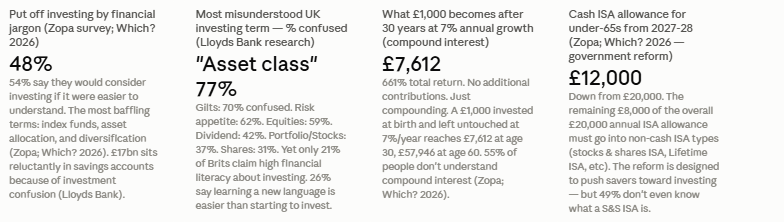
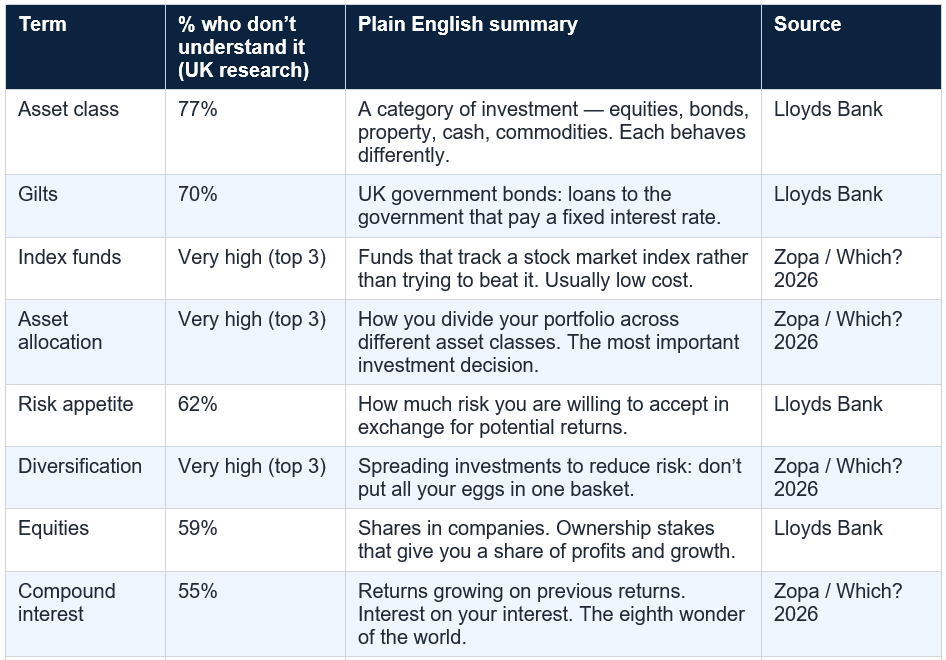
Lloyds Bank’s research found that 50% of Brits — rising to 58% of women — are intimidated by investing. The UK’s single most misunderstood investing term is ‘asset class,’ with 77% confused about its meaning. Other terms that a majority of Brits cannot define include gilts (70%), risk appetite (62%), and equities (59%). Only one in five (21%) claim to have high financial literacy about investing.
The cost of this barrier is real. Lloyds estimates that up to £17 billion sits reluctantly in savings accounts because investors are confused by investment terminology. WeCovr’s August 2026 financial jargon buster notes that financial language ‘often feels like it was designed to be exclusive,’ leading to inaction, poor decisions, and a lack of confidence in managing money.
This guide addresses all of that. It covers the terms you are most likely to encounter when reading the financial news, evaluating an investment product, or opening an investment account — in alphabetical order, in plain language, with examples. None of the concepts here are genuinely complicated once the terminology is removed.
48% of people are put off investing by complex financial jargon (Zopa; Which? 2026). 54% would consider investing if easier to understand. 'Index funds', 'asset allocation', and 'diversification' baffle people most (Zopa; Which? 2026). UK's most misunderstood term: 'asset class' (77% confused -- Lloyds Bank). 50% of Brits intimidated by investing; 58% of women (Lloyds Bank). Only 21% claim high financial literacy regarding investing (Lloyds Bank). Up to £17 billion sits reluctantly in savings accounts due to confusion (Lloyds Bank). From 2027-28: cash ISA allowance reduced to £12,000 for under-65s; rest of £20k must go into other ISA types (Zopa; Which? 2026). Not investment advice.
A note on usage: some terms have slightly different definitions in different contexts. The definitions here reflect UK usage and the way terms are most commonly encountered by private investors. Where a term has a specific US meaning that differs from its UK usage, that is noted. Not investment advice — always consult a qualified independent financial adviser before making investment decisions.
13. L — Liquidity, Long position
25. X–Z — Yield, Zero-coupon bond

The research is consistent in one direction: the people who understand these terms are far more likely to invest, and those who invest are far more likely to build long-term wealth than those who leave money in cash. Lloyds estimates that £17 billion sits reluctantly in savings accounts due to investment confusion. The cash ISA change from 2027-28 (which limits cash ISA contributions to £12,000 for under-65s and redirects the remaining £8,000 to other ISA types) will force many savers to make decisions they have been avoiding.
This glossary covers the terms you will encounter most often. It is a starting point. The best way to deepen this knowledge is to invest: open a stocks and shares ISA with a small amount you can afford to lose, choose a low-cost global index tracker, and watch what happens to the concepts described here in a real market context. The vocabulary becomes intuitive remarkably quickly once you have skin in the game. Not financial advice — always consult a qualified independent financial adviser.
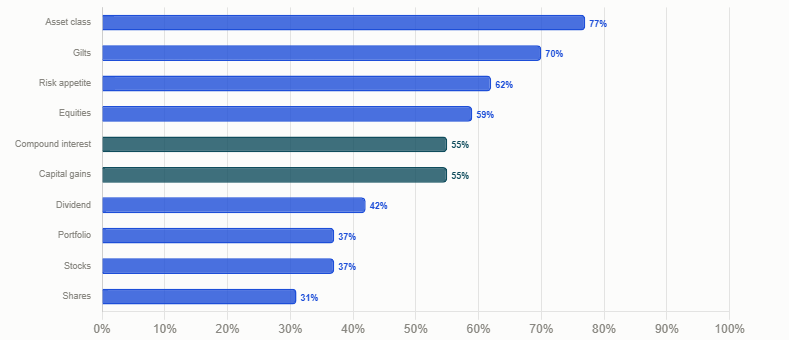
According to research in the UK, the most commonly misunderstood investing terms are: asset class (77% of Brits confused, Lloyds Bank), gilts (70%), risk appetite (62%), equities (59%), dividend (42%), portfolio and stocks (37% each), and shares (31%). Research by Zopa, reported by Which? in 2026, found that index funds, asset allocation, and diversification are the terms that most often baffle would-be investors. Compound interest and capital gains each confused 55% of respondents. All of these terms are defined in this guide in plain English
What is the difference between a stock, a share, and equity?
In everyday usage, stocks, shares, and equities all mean essentially the same thing: ownership in a company. When you buy shares (or stock) in a company, you are buying equity — a stake in the business. The terms are used interchangeably by most investors and journalists. Technically, ‘stock’ can also refer to a company’s inventory of goods, or broadly to a whole category of investments (‘stock market,’ for instance); and ‘equity’ in accounting refers to the net assets of a company (assets minus liabilities). But for practical investment purposes, buying a stock, buying a share, and gaining equity exposure all describe the same act.
What is the difference between a fund, an ETF, and a tracker?
A fund pools investors’ money to invest in a diversified range of assets according to a stated investment objective. An ETF (Exchange-Traded Fund) is a type of fund that trades on a stock exchange throughout the day like a share, rather than being priced once a day like a traditional unit trust or OEIC. A tracker (or index fund) is a fund that tracks a market index — it may be structured either as a traditional fund or as an ETF. Most ETFs are trackers, but not all trackers are ETFs (some are traditional open-ended funds). The key distinguishing feature of a tracker is its passive investment approach (replicating an index) and its low cost.
What does diversification actually mean in practice?
Diversification means not putting all your money into one investment, one company, one sector, or one country. In practice, it means holding a range of different assets whose prices don’t all move together. A UK investor whose entire portfolio is in UK equities is not diversified: if the UK market falls, everything falls. A diversified investor might hold UK equities, global equities, bonds, and property, spread across many individual companies and sectors. A simple global index tracker fund (such as one tracking the MSCI World index) provides instant diversification across thousands of companies in dozens of countries. Diversification was among the three terms that most baffled survey respondents in Zopa’s 2026 research (Which? 2026), despite being one of the most practically important concepts in investing.
What is compound interest and why does it matter?
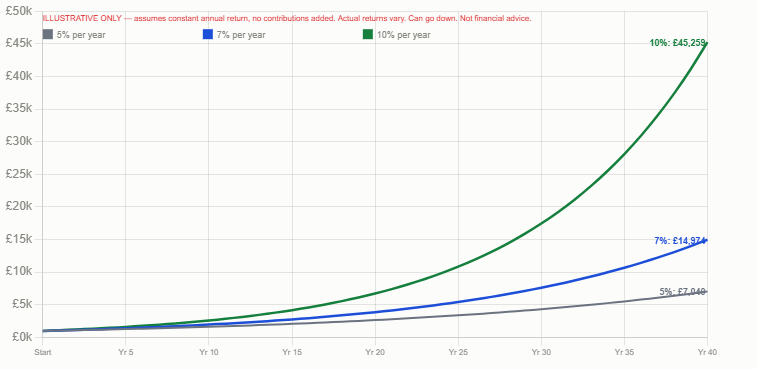
Compound interest (or compounding) is the process by which investment returns generate further returns over time. When you earn interest or investment growth on money that previously included interest or growth, the total grows exponentially rather than linearly. A £1,000 investment growing at 7% annually: after 10 years = £1,967; after 20 years = £3,870; after 30 years = £7,612. That is a 661% total return on the original £1,000, without contributing a single additional pound. The longer money is invested, the more powerful compounding becomes. This is why starting to invest early is one of the most significant financial decisions available to younger people. Albert Einstein is attributed with calling compounding ‘the eighth wonder of the world.’ 55% of people in Zopa’s 2026 survey said they did not understand this concept (Which? 2026). Not financial advice.
Table of Contents
- Why Jargon Is Stopping You From Investing
- How to Use This Glossary
- A — Asset class, Alpha, AER, Annual allowance
- B — Bear market, Bond, Bull market, Bid-offer spread
- C — Capital gains, Compound interest, Correlation, CAGR
- D — Diversification, Dividend, Drawdown, Duration
- E — Equity, ETF, Ex-dividend date, Expense ratio
- F — FTSE, Fund manager, Fundamental analysis
- G — Gilts, Growth investing, Gross vs net return
- H — Hedge, High-yield bond, Holdings
- I — Index, Index fund, Inflation, ISA
- J–K — Junk bond, KPI
- L — Liquidity, Long position
- M — Market capitalisation, Market timing
- N — Net asset value (NAV)
- O — OEIC, Open-ended fund
- P — P/E ratio, Passive investing, Portfolio, Premium vs discount
- Q — Quantitative easing (QE)
- R — Rebalancing, Risk appetite, Return
- S — Shares, SIPP, Stocks, Stock market
- T — Total return, Tracker fund
- U — Unit trust, Unrealised gain
- V — Valuation, Volatility
- W — Weighting
- X–Z — Yield, Zero-coupon bond
- The 10 Most Misunderstood Terms: Quick Reference
- Conclusion: The Language Was Never the Barrier
- Frequently Asked Questions
Which terms baffle UK investors most?
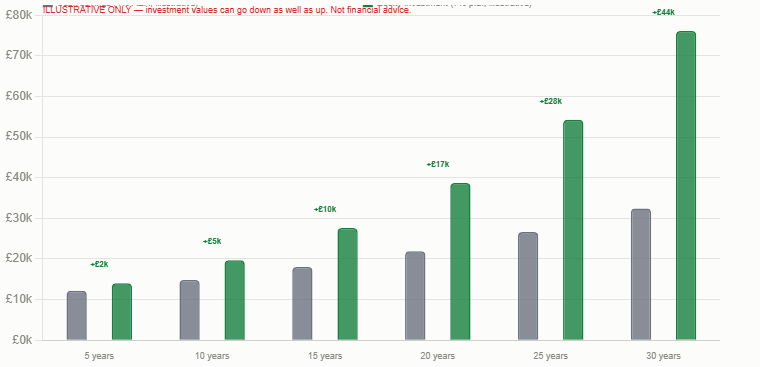
The cost of jargon fear — cash vs invested
Compound interest — the eighth wonder visualised
Why Jargon Is Stopping You From Investing
The language of investing is one of the most significant practical barriers to participation in financial markets, and the evidence for this is consistent across surveys. Research by Zopa, reported by Which? in 2026, found that 48% of people are put off investing by complex financial jargon, while 54% say they would consider investing if it were easier to understand. The same research found that £12 billion flowed into cash ISA accounts in April 2026 alone — money that earns taxable interest at lower expected long-term returns than equities, partly because the investors who deposited it did not understand what a stocks and shares ISA is.Lloyds Bank’s research found that 50% of Brits — rising to 58% of women — are intimidated by investing. The UK’s single most misunderstood investing term is ‘asset class,’ with 77% confused about its meaning. Other terms that a majority of Brits cannot define include gilts (70%), risk appetite (62%), and equities (59%). Only one in five (21%) claim to have high financial literacy about investing.
The cost of this barrier is real. Lloyds estimates that up to £17 billion sits reluctantly in savings accounts because investors are confused by investment terminology. WeCovr’s August 2026 financial jargon buster notes that financial language ‘often feels like it was designed to be exclusive,’ leading to inaction, poor decisions, and a lack of confidence in managing money.
This guide addresses all of that. It covers the terms you are most likely to encounter when reading the financial news, evaluating an investment product, or opening an investment account — in alphabetical order, in plain language, with examples. None of the concepts here are genuinely complicated once the terminology is removed.
48% of people are put off investing by complex financial jargon (Zopa; Which? 2026). 54% would consider investing if easier to understand. 'Index funds', 'asset allocation', and 'diversification' baffle people most (Zopa; Which? 2026). UK's most misunderstood term: 'asset class' (77% confused -- Lloyds Bank). 50% of Brits intimidated by investing; 58% of women (Lloyds Bank). Only 21% claim high financial literacy regarding investing (Lloyds Bank). Up to £17 billion sits reluctantly in savings accounts due to confusion (Lloyds Bank). From 2027-28: cash ISA allowance reduced to £12,000 for under-65s; rest of £20k must go into other ISA types (Zopa; Which? 2026). Not investment advice.
How to Use This Glossary
This glossary covers the investing terms you are most likely to encounter in financial news, investment platforms, fund factsheets, and conversations with advisers. It is organised alphabetically, with each letter covering the most important terms starting with that letter. For quick lookup, use the Table of Contents. For the ten most commonly misunderstood terms (based on Lloyds Bank and Zopa research), go to Section 26 for a quick-reference table.A note on usage: some terms have slightly different definitions in different contexts. The definitions here reflect UK usage and the way terms are most commonly encountered by private investors. Where a term has a specific US meaning that differs from its UK usage, that is noted. Not investment advice — always consult a qualified independent financial adviser before making investment decisions.
A — Asset class, Alpha, AER, Annual allowance
Alpha
A measure of an investment’s performance relative to its benchmark index. A positive alpha means the investment has outperformed its benchmark; a negative alpha means it has underperformed. A fund manager who ‘generates alpha’ has delivered returns above what the market alone would have produced. Alpha is the reason active fund management is sold — and its consistent delivery is what makes active management controversial. In practice: if the FTSE All Share index returned 8% and your fund returned 10%, your fund generated 2% of alpha.AER (Annual Equivalent Rate)
The interest rate on a savings account expressed as if interest is compounded once a year. AER is used to allow fair comparison between savings accounts that pay interest at different frequencies (monthly, quarterly, annually). A monthly interest account and an annual interest account with the same AER will produce the same total return over a year.Annual Allowance
The maximum amount you can save into pensions each year and still receive tax relief. In 2026/27 the annual allowance is £60,000 (or 100% of your UK earnings, whichever is lower). Exceeding it creates a tax charge. A reduced ‘Money Purchase Annual Allowance’ (MPAA) of £10,000 applies once you start drawing taxable income from a defined contribution pension.Asset allocation
The process of deciding how to divide an investment portfolio across different asset classes — such as equities, bonds, property, and cash. This is the most important decision in investing because asset allocation drives the majority of long-term portfolio returns and determines the risk profile of the portfolio. ‘Asset allocation’ was the most baffling term in Zopa’s 2026 jargon survey, despite being one of the most important concepts in personal finance.Asset class
A category of investment with similar characteristics, behaviour, and regulatory treatment. The main asset classes are: equities (shares in companies), bonds (loans to companies or governments), property (real estate), commodities (raw materials like gold and oil), and cash. Each asset class tends to respond differently to economic conditions, which is why mixing them reduces overall portfolio risk.B — Bear market, Bond, Bull market, Bid-offer spread
Bear market
A sustained period during which investment prices fall, typically defined as a decline of 20% or more from recent highs. Bear markets are associated with economic pessimism, rising unemployment, or recession. The opposite of a bull market. A ‘bear’ is an investor who expects prices to fall.Bid-offer spread
The difference between the buying price (offer) and selling price (bid) of an investment. You always buy at the higher offer price and sell at the lower bid price. The spread is a cost of investing — it means you start with a small loss the moment you buy, because selling immediately would only generate the lower bid price. Narrower spreads (common in liquid markets) are cheaper for investors than wider spreads.Bond
A loan made by an investor to a borrower — typically a company or government — in exchange for regular interest payments (called coupon payments) and the return of the original loan amount at a specified future date (the ‘maturity date’). Bonds are generally considered lower risk than equities but also offer lower long-term returns. UK government bonds are called gilts. Corporate bonds are issued by companies. High-yield (or junk) bonds are issued by companies with lower credit ratings and pay higher interest to compensate for higher default risk.Bull market
A sustained period during which investment prices rise, typically defined as a gain of 20% or more from recent lows. Bull markets are associated with economic optimism, low unemployment, or corporate earnings growth. The opposite of a bear market. A ‘bull’ is an investor who expects prices to rise.C — Capital gains, Compound interest, Correlation, CAGR
CAGR (Compound Annual Growth Rate)
The rate at which an investment grows each year if the growth were steady throughout the period. Used to compare investment returns over different time periods on a like-for-like basis. A £1,000 investment that becomes £1,610 after 5 years has a CAGR of approximately 10%. The formula: (End value / Start value) ÷ (1 / Number of years) − 1.Capital gains
The profit made when you sell an investment for more than you paid for it. Capital Gains Tax (CGT) may be payable on the gain above the annual exempt amount. In the UK, different CGT rates apply depending on whether the gain is from residential property or other assets, and on the investor’s income tax band. Investments held in ISAs or SIPPs are sheltered from CGT. 55% of respondents in Zopa’s 2026 survey did not understand the term (Which? 2026).Compound interest (or compounding)
The process by which investment returns generate further returns over time. When you earn interest on your interest (or returns on your returns), the investment grows exponentially rather than linearly. Albert Einstein is said to have called it the eighth wonder of the world. A £1,000 investment growing at 7% per year becomes £1,967 after 10 years, £3,870 after 20 years, and £7,612 after 30 years — without adding a single pound. The earlier you start, the more powerful compounding becomes. 55% of respondents in Zopa’s 2026 survey did not understand this term (Which? 2026).Correlation
A statistical measure of how closely two investments move in relation to each other. A correlation of +1 means they move in perfect lockstep; a correlation of −1 means they always move in opposite directions; 0 means no relationship. Low or negative correlation between assets in a portfolio is what makes diversification effective: when one asset falls, the other may rise or stay flat, reducing the overall portfolio impact.D — Diversification, Dividend, Drawdown, Duration
Diversification
Spreading investments across different asset classes, sectors, geographies, and individual securities to reduce the risk that any single investment failure destroys the portfolio. The principle: ‘don’t put all your eggs in one basket.’ Diversification is one of the few genuine ‘free lunches’ in investing — it reduces risk without necessarily reducing expected return. ‘Diversification’ was one of the three terms that baffled people most in Zopa’s 2026 survey (Which? 2026).Dividend
A payment made by a company to its shareholders, typically from its profits. Dividends are usually paid quarterly or twice a year and represent a share of the company’s earnings returned to investors. A company’s ‘dividend yield’ is the annual dividend per share divided by the current share price, expressed as a percentage. 42% of Brits do not understand the term ‘dividend’ according to Lloyds Bank research.Drawdown
In retirement planning: taking income from an invested pension pot rather than buying an annuity. In investment analysis: the decline from a peak value to a trough before a recovery, expressed as a percentage. A ‘maximum drawdown’ of 30% means the portfolio fell 30% from its highest point to its lowest point during a given period.Duration
A measure of how sensitive a bond’s price is to changes in interest rates. A bond with a duration of 5 years will fall approximately 5% in value if interest rates rise by 1%. Longer-duration bonds are more sensitive to rate changes and therefore carry higher interest rate risk. This matters particularly in a rising-rate environment.E — Equity, ETF, Ex-dividend date, Expense ratio
Equity
Ownership in a company. When you buy shares in a company, you are buying equity — a stake in the business and a claim on its future profits. Equity investors are last in line to be paid if a company goes bust (after debt holders), but they benefit fully from the company’s growth. Over long periods, equities have historically delivered higher returns than bonds or cash. 59% of Brits do not understand the term ‘equities’ according to Lloyds Bank research.ETF (Exchange-Traded Fund)
A fund that tracks an index (such as the FTSE 100 or S&P 500), a sector, or a commodity, and trades on a stock exchange throughout the day like an individual share. ETFs typically have very low fees (expense ratios of 0.05%–0.20%) and offer instant diversification. They are one of the most efficient ways for retail investors to access broad market exposure. ‘Index funds’ (of which ETFs are a type) were the most baffling term in Zopa’s 2026 survey.Ex-dividend date
The date on or after which a buyer of shares is NOT entitled to the next dividend payment. If you buy shares before the ex-dividend date, you will receive the upcoming dividend; if you buy on or after it, the dividend goes to the previous owner. Share prices typically fall by approximately the dividend amount on the ex-dividend date.Expense ratio (or OCF — Ongoing Charges Figure)
The annual cost of owning a fund, expressed as a percentage of the amount invested. A fund with a 0.10% expense ratio charges £10 per year on a £10,000 investment. An actively managed fund might charge 0.75%–1.50%; a passive index fund or ETF might charge 0.05%–0.20%. Over decades, the compounding difference between a 0.10% and a 1.50% annual charge is enormous.F — FTSE, Fund manager, Fundamental analysis
FTSE 100
The Financial Times Stock Exchange 100 Index: an index of the 100 largest UK-listed companies by market capitalisation. It is the primary benchmark for UK equity market performance. The FTSE All Share index covers a broader range of UK-listed companies. The FTSE 100 does NOT reflect the performance of the UK economy directly — many of its constituents earn the majority of their revenues overseas.Fund manager
A professional responsible for making investment decisions for a fund on behalf of investors. Active fund managers select individual investments and attempt to outperform their benchmark index. Passive fund managers simply replicate the index (a mechanical process). Research consistently shows that the majority of active fund managers do not outperform their benchmark index over long periods after costs.Fundamental analysis
An approach to investment analysis that examines a company’s financial statements, earnings, competitive position, and management quality to assess its intrinsic value. Investors using fundamental analysis aim to buy companies whose shares trade below their true value and sell those that trade above it. The opposite approach is technical analysis, which uses historical price charts rather than financial fundamentals.G — Gilts, Growth investing, Gross vs net return
Gilts
UK government bonds. When the government needs to borrow money, it issues gilts — essentially IOUs that pay a fixed rate of interest (the ‘coupon’) and return the face value at maturity. Gilts are considered among the safest investments in the UK market because the government can always print money to repay them. ‘Gilts’ is one of the most widely misunderstood UK investing terms: 70% of Brits cannot define it (Lloyds Bank research).Gross vs net return
Gross return is the investment return before fees, taxes, and other charges are deducted. Net return is what you actually receive after all deductions. The difference between gross and net return grows significantly over time due to compounding: on a 30-year investment, a 1.5% annual fee can consume 30–40% of the final portfolio value relative to a 0.1% fee, even though the annual difference seems small.Growth investing
An investment strategy that focuses on companies expected to grow faster than the broader market, even if their current share price appears expensive relative to current earnings. Growth investors are willing to pay a high price-to-earnings (P/E) ratio today in exchange for expected future earnings growth. The opposite of value investing.H — Hedge, High-yield bond, Holdings
Hedge
A position taken to reduce the risk of an existing investment. For example, an investor holding UK equities might buy a currency hedge to protect against sterling depreciation if their portfolio contains overseas assets. Hedging typically costs money (via options premiums or other instruments) and reduces potential gains as well as losses. The word comes from the idea of ‘hedging your bets.’High-yield bond (Junk bond)
A bond issued by a company with a below-investment-grade credit rating (rated BB or lower by Standard & Poor’s, or equivalent). Because these companies carry higher default risk, they pay higher interest rates to attract investors. High-yield bonds sit between investment-grade bonds and equities in terms of risk and return. Also called ‘junk bonds’ — a term that became common after the 1980s corporate leveraged buyout wave.Holdings
The individual investments within a fund or portfolio. A fund factsheet will list its ‘top ten holdings’ — the ten largest investments it currently owns, by weight. Looking at a fund’s holdings tells you what you actually own through the fund.I — Index, Index fund, Inflation, ISA
Index
A statistical measure of the change in value of a group of securities. Market indices (such as the FTSE 100, S&P 500, or MSCI World) track the performance of a specific group of stocks, weighted by market capitalisation or another method. They are used as benchmarks against which fund performance is measured.Index fund
A fund designed to replicate the performance of a market index, such as the FTSE All Share or the S&P 500, rather than trying to beat it. Index funds hold all (or a representative sample) of the securities in the index, in the same proportions. Because no active stock selection is required, they have very low costs. ‘Index funds’ was identified as the most confusing term by Zopa’s 2026 survey (Which? 2026).Inflation
The rate at which the general price level of goods and services rises over time, reducing the purchasing power of money. UK CPI (Consumer Prices Index) inflation hit 9.1% in June 2022 and has since fallen; as of June 2026, UK CPI stands at 2.9%. For investors, the ‘real return’ is the investment return minus inflation: a 5% return during 3% inflation provides a 2% real return. 29% of Brits don’t understand the term ‘inflation,’ including 6% who have never heard of it (Lloyds Bank).ISA (Individual Savings Account)
A UK wrapper for investments or savings that shelters returns from income tax and capital gains tax. The overall ISA allowance is £20,000 per person per tax year. Types include: Cash ISA (savings), Stocks and Shares ISA (investments), Lifetime ISA (for first home or retirement), and Innovative Finance ISA. From 2027-28, the cash ISA allowance will be limited to £12,000 for savers under 65, with the remaining £8,000 of the overall £20,000 needing to go into non-cash ISA types.J–K — Junk bond, KPI
Junk bond
See High-yield bond. The informal term for a bond with a below-investment-grade credit rating (BB or lower). Despite the name, junk bonds are widely used by professional investors as part of a diversified fixed income portfolio. The higher yield compensates for higher default risk.KPI (Key Performance Indicator)
A measurable value that demonstrates how effectively a company is achieving its objectives. In investing, KPIs vary by industry: for a retailer, KPIs might include like-for-like sales growth and profit margins; for a bank, return on equity and net interest margin. Investors analyse KPIs to assess a company’s operational health beyond the headline profit figures.13. L — Liquidity, Long position
Liquidity
How quickly and easily an investment can be converted to cash without significantly affecting its price. Cash is perfectly liquid. Shares in large-cap companies (such as FTSE 100 members) are highly liquid because they can be sold on the exchange within seconds. Property is illiquid because selling takes weeks or months. Open-ended property funds can face liquidity crises when many investors try to withdraw at the same time.Long position
Owning an investment outright in the expectation that its price will rise. ‘Going long’ on a stock means buying it and holding it. The opposite of a ‘short’ position (borrowing and selling shares you don’t own, expecting to buy them back more cheaply later). Most private investors are always long.M — Market capitalisation, Market timing
Market capitalisation (market cap)
The total market value of a company’s outstanding shares. Calculated as: share price × number of shares in issue. A company with 100 million shares trading at £10 each has a market cap of £1 billion. Market cap determines a company’s size classification: large-cap (FTSE 100), mid-cap (FTSE 250), and small-cap (smaller companies). Index weightings are usually based on market cap.Market timing
Attempting to predict the future direction of markets and buy or sell investments accordingly. Decades of research show that consistent market timing is extremely difficult, even for professional investors. The market’s best days and worst days often cluster together: missing the 10 best days in the stock market over a 20-year period dramatically reduces long-term returns. Most investment experts advocate ‘time in the market’ over ‘timing the market.’N — Net Asset Value (NAV)
NAV (Net Asset Value)
The total value of a fund’s assets minus its liabilities, divided by the number of units in issue. NAV is the price at which you buy and sell units in an open-ended fund. It is calculated once a day, after market close. For closed-ended investment trusts (also called investment companies), the share price can trade at a premium or discount to the NAV — an important consideration when buying investment trusts.O — OEIC, Open-ended fund
OEIC (Open-Ended Investment Company)
A type of investment fund that issues and redeems shares directly with investors at the NAV. Like unit trusts, OEICs allow an unlimited number of investors and the fund size expands or contracts based on investor demand. OEICs are the most common vehicle for UK retail investment funds. They cannot trade at a premium or discount to NAV, unlike investment trusts.Open-ended fund
A fund that can issue or redeem units (or shares) continuously as investors buy in or sell out. The size of the fund ‘opens’ and ‘closes’ with investor money. OEICs and unit trusts are open-ended. Investment trusts are closed-ended (they have a fixed number of shares that trade on a stock exchange).P — P/E ratio, Passive investing, Portfolio, Premium vs discount
Passive investing
An investment strategy that aims to replicate the returns of a market index rather than trying to outperform it through active stock selection. Passive funds (index funds and most ETFs) have lower costs, lower portfolio turnover, and tend to outperform a majority of active funds over longer periods after costs. The opposite of active management.P/E ratio (Price-to-Earnings ratio)
The most commonly used valuation metric for equities. Calculated as: share price ÷ earnings per share. A P/E of 15 means investors are paying £15 for every £1 of annual earnings. A high P/E suggests either high expected growth or expensive valuation; a low P/E suggests either low expected growth or a potential bargain. P/E ratios vary significantly by sector and market cycle.Portfolio
A collection of investments held by an individual or institution. A well-constructed portfolio typically includes multiple asset classes (equities, bonds, cash, property) and multiple individual securities within each class, to achieve diversification. 37% of Brits do not understand the term ‘portfolio’ according to Lloyds Bank research.Premium vs discount (investment trusts)
An investment trust’s shares can trade at a price above or below its NAV. If the share price is above the NAV, the trust trades at a ‘premium’. If below, it trades at a ‘discount.’ Buying a trust at a wide discount can be attractive if the discount narrows; buying at a premium means you are paying more than the underlying assets are worth.Q — Quantitative Easing (QE)
Quantitative easing (QE)
A monetary policy tool used by central banks (such as the Bank of England) in which they create new money to buy financial assets (usually government bonds) from banks. This injects money into the financial system, lowers interest rates, reduces borrowing costs, and stimulates economic activity. QE was used extensively from 2008 onwards and again during COVID-19. The reversal of QE is called quantitative tightening (QT). WeCovr (August 2026) identifies QE as one of the most commonly misunderstood UK financial terms.R — Rebalancing, Risk appetite, Return
Rebalancing
The process of restoring a portfolio back to its target asset allocation when market movements have caused the proportions to drift. For example: a 60/40 (equities/bonds) portfolio in which equities have risen strongly might become 70/30. Rebalancing involves selling some equities and buying bonds to restore the 60/40 target. It enforces a buy-low, sell-high discipline and maintains the portfolio’s intended risk level.Return
The gain or loss on an investment over a specified period, expressed as a percentage of the original investment. Total return includes both price changes (capital gains or losses) and income (dividends or interest). Real return is the return after adjusting for inflation. Risk-adjusted return accounts for the level of risk taken to achieve the return.Risk appetite
The degree of risk an investor is willing to accept in pursuit of potential returns. A high risk appetite means willingness to accept large price fluctuations in exchange for higher potential gains; a low risk appetite means preferring more stable, lower-returning investments. Understanding your risk appetite is the foundation of appropriate investment selection. 62% of Brits do not understand the term ‘risk appetite’ according to Lloyds Bank research.S — Shares, SIPP, Stocks, Stock market
Shares
Units of ownership in a company. When you buy shares, you become a part-owner (shareholder) of that company, entitled to a portion of its profits (via dividends) and its assets if it is wound up (after all debts are paid). The terms ‘shares’ and ‘stocks’ are largely interchangeable in everyday usage, though technically ‘stock’ can also refer to inventory or a broad index. 31% of Brits do not understand ‘shares’; 37% do not understand ‘stocks’ (Lloyds Bank).SIPP (Self-Invested Personal Pension)
A type of UK pension that gives the holder greater control over the investments held within it, compared to most workplace pensions. A SIPP can hold individual shares, funds, ETFs, bonds, and other assets. Contributions receive tax relief at the marginal rate and investments grow free of income and capital gains tax within the wrapper.Stock market
A marketplace where buyers and sellers trade shares (equities) in publicly listed companies. In the UK, the main stock market is the London Stock Exchange. In the US, the main markets are the New York Stock Exchange (NYSE) and NASDAQ. Stock markets also trade bonds, ETFs, and other instruments. The ‘stock market’ is often used interchangeably with equity indices such as the FTSE 100 or S&P 500.T — Total return, Tracker fund
Total return
The complete return on an investment, including both capital appreciation (the increase in the price of the investment) and income (dividends or interest payments). A share that rises 5% in price and pays a 3% dividend yield has delivered a 8% total return. Total return is the correct way to compare investment performance; looking at price return alone ignores a significant component of returns.Tracker fund
A fund that tracks (replicates) the performance of a specific market index. Used interchangeably with ‘index fund.’ A FTSE 100 tracker holds all 100 companies in the FTSE 100 in the same proportions as the index, and delivers the same return as the index minus the fund’s ongoing charges. Tracker funds are the simplest and most cost-effective way for most private investors to access equity market returns.U — Unit trust, Unrealised gain
Unit trust
A type of open-ended fund where investors’ money is pooled and divided into equal units. The fund manager invests the pooled money according to the fund’s stated objectives. As more investors buy in, more units are created; as investors sell, units are redeemed. Unit trusts and OEICs are the two most common structures for UK retail investment funds. They are priced once a day after market close.Unrealised gain (or paper gain)
A gain on an investment that exists on paper but has not yet been ‘crystallised’ by selling the investment. An investment worth £1,500 that was purchased for £1,000 shows an unrealised gain of £500. Once you sell, the gain becomes ‘realised’ and may be subject to Capital Gains Tax.V — Valuation, Volatility
Valuation
An assessment of what an investment is worth, relative to its current price. Common valuation metrics include the P/E ratio, price-to-book ratio, price-to-sales ratio, and dividend yield. ‘Valuation’ can also refer to the current level of the stock market relative to historical norms. A market trading at ‘high valuations’ is one where prices are elevated relative to current or expected earnings, implying lower expected future returns.Volatility
The degree of variation in an investment’s price over time. High volatility means large price swings (up and down); low volatility means steadier, more predictable price movement. Volatility is often used as a proxy for risk, though they are not the same thing: a highly volatile investment in a company with strong long-term fundamentals may be less ‘risky’ in a long-term sense than a low-volatility but declining asset.W — Weighting
Weighting
The proportion of a portfolio or index allocated to a particular asset, sector, geography, or individual security. In a market-cap weighted index (like the FTSE 100), larger companies receive a larger weighting. If you are ‘overweight’ a sector relative to your benchmark, you hold more of it than the benchmark does; ‘underweight’ means you hold less.25. X–Z — Yield, Zero-coupon bond
Yield
The income generated by an investment, expressed as a percentage of its current price. For shares: dividend yield = annual dividend per share ÷ share price. For bonds: yield = annual coupon payment ÷ bond price (though there are more complex measures such as yield to maturity). A rising yield on a bond means its price has fallen (yield and price move inversely). A falling yield means price has risen.Zero-coupon bond
A bond that pays no regular interest (coupon). Instead, it is issued at a discount to its face value and matures at full face value, with the difference representing the investor’s return. For example, a zero-coupon bond with a face value of £1,000 might be purchased for £750 and redeemed for £1,000 at maturity. Zero-coupon bonds are particularly sensitive to interest rate changes because all the return comes at maturity.The 10 Most Misunderstood Terms: Quick Reference
The Research: From Lloyds Bank research (2023): asset class (77% confused), gilts (70%), risk appetite (62%), equities (59%), dividend (42%), portfolio (37%), stocks (37%), shares (31%). From Zopa/Which? (2026): index funds, asset allocation, and diversification are the terms that baffle people most; 55% don't understand compound interest or capital gains. WeCovr (August 2026): QE, ETFs among most misunderstood UK financial terms.
Conclusion
The investing jargon that puts 48% of people off financial markets is not a reflection of the complexity of the underlying concepts. Alpha, beta, and yield are no more intellectually demanding than the concepts described by the everyday words they replace. They are simply unfamiliar. Familiarity changes everything: the investor who knows what a tracker fund is, understands what compounding does to returns over 30 years, and can read a fund factsheet without confusion is no more intelligent than one who does not — they are simply more informed.The research is consistent in one direction: the people who understand these terms are far more likely to invest, and those who invest are far more likely to build long-term wealth than those who leave money in cash. Lloyds estimates that £17 billion sits reluctantly in savings accounts due to investment confusion. The cash ISA change from 2027-28 (which limits cash ISA contributions to £12,000 for under-65s and redirects the remaining £8,000 to other ISA types) will force many savers to make decisions they have been avoiding.
This glossary covers the terms you will encounter most often. It is a starting point. The best way to deepen this knowledge is to invest: open a stocks and shares ISA with a small amount you can afford to lose, choose a low-cost global index tracker, and watch what happens to the concepts described here in a real market context. The vocabulary becomes intuitive remarkably quickly once you have skin in the game. Not financial advice — always consult a qualified independent financial adviser.
Frequently Asked Questions
What are the most confusing investing terms?According to research in the UK, the most commonly misunderstood investing terms are: asset class (77% of Brits confused, Lloyds Bank), gilts (70%), risk appetite (62%), equities (59%), dividend (42%), portfolio and stocks (37% each), and shares (31%). Research by Zopa, reported by Which? in 2026, found that index funds, asset allocation, and diversification are the terms that most often baffle would-be investors. Compound interest and capital gains each confused 55% of respondents. All of these terms are defined in this guide in plain English
What is the difference between a stock, a share, and equity?
In everyday usage, stocks, shares, and equities all mean essentially the same thing: ownership in a company. When you buy shares (or stock) in a company, you are buying equity — a stake in the business. The terms are used interchangeably by most investors and journalists. Technically, ‘stock’ can also refer to a company’s inventory of goods, or broadly to a whole category of investments (‘stock market,’ for instance); and ‘equity’ in accounting refers to the net assets of a company (assets minus liabilities). But for practical investment purposes, buying a stock, buying a share, and gaining equity exposure all describe the same act.
What is the difference between a fund, an ETF, and a tracker?
A fund pools investors’ money to invest in a diversified range of assets according to a stated investment objective. An ETF (Exchange-Traded Fund) is a type of fund that trades on a stock exchange throughout the day like a share, rather than being priced once a day like a traditional unit trust or OEIC. A tracker (or index fund) is a fund that tracks a market index — it may be structured either as a traditional fund or as an ETF. Most ETFs are trackers, but not all trackers are ETFs (some are traditional open-ended funds). The key distinguishing feature of a tracker is its passive investment approach (replicating an index) and its low cost.
What does diversification actually mean in practice?
Diversification means not putting all your money into one investment, one company, one sector, or one country. In practice, it means holding a range of different assets whose prices don’t all move together. A UK investor whose entire portfolio is in UK equities is not diversified: if the UK market falls, everything falls. A diversified investor might hold UK equities, global equities, bonds, and property, spread across many individual companies and sectors. A simple global index tracker fund (such as one tracking the MSCI World index) provides instant diversification across thousands of companies in dozens of countries. Diversification was among the three terms that most baffled survey respondents in Zopa’s 2026 research (Which? 2026), despite being one of the most practically important concepts in investing.
What is compound interest and why does it matter?
Compound interest (or compounding) is the process by which investment returns generate further returns over time. When you earn interest or investment growth on money that previously included interest or growth, the total grows exponentially rather than linearly. A £1,000 investment growing at 7% annually: after 10 years = £1,967; after 20 years = £3,870; after 30 years = £7,612. That is a 661% total return on the original £1,000, without contributing a single additional pound. The longer money is invested, the more powerful compounding becomes. This is why starting to invest early is one of the most significant financial decisions available to younger people. Albert Einstein is attributed with calling compounding ‘the eighth wonder of the world.’ 55% of people in Zopa’s 2026 survey said they did not understand this concept (Which? 2026). Not financial advice.

0 Comments Comments