
Investing
Diversification Rules Every Investor Should Follow

In 2025, a broadly diversified portfolio beat the classic 60/40 by 5 percentage points — the biggest gap since 2009. Here are the 10 rules Morningstar, SoFi, and the research agree on.
Everyone who has ever been given advice about investing has been told to diversify. It is the closest thing the investment world has to a universal principle. But knowing you should diversify and actually diversifying in a way that meaningfully reduces risk while preserving return potential are two different things. Morningstar’s 2026 Diversification Landscape report produced one of the most striking data points in recent investment research: a broadly diversified 11-asset portfolio returned 18.3% in 2025, compared with 13.3% for the standard 60/40 mix of US stocks and US investment-grade bonds. That is a 5-percentage-point advantage — the biggest margin favouring diversification over the basic allocation since 2009. SoFi’s 2026 investment survey found that 49% of investors are planning a balanced investment strategy this year, and that the classic 60/40 guideline is being rethought and applied with more flexibility. The research is aligning around a more nuanced, multi-layered approach to diversification than the simple version most people were taught. This article sets out the ten rules that the 2025-2026 research and expert consensus agree matter most.
Three specific forces drove the 2025 result: a weakening US dollar, more attractive valuations in international equity markets, and a significant surge in gold prices. All three are factors that a US-only or equity-only portfolio would have missed or been hurt by. A diversified portfolio that included international stocks, real assets, and commodities captured them. The SoFi 2026 investment survey found that 49% of investors are planning a balanced investment strategy for 2026, and that the classic 60/40 guideline is being rethought — applied with more flexibility rather than abandoned. The data suggests the direction of that flexibility: more geographic breadth, more real assets, and more attention to correlation.
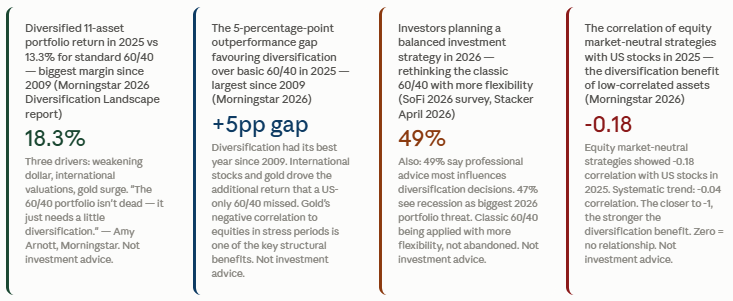
Morningstar 2026 Diversification Landscape report key finding: diversified 11-asset portfolio returned 18.3% in 2025 vs 13.3% for standard 60/40. Margin: 5 percentage points — biggest gap since 2009. Three drivers: weakening dollar, international valuations, gold surge. SoFi 2026: 49% of investors planning balanced strategy; 47% see recession as biggest portfolio threat. Sources cited.
Concreit’s 2025 guide to portfolio diversification makes the practical framing clear: ‘Successful portfolio diversification means balancing risk, not avoiding it entirely.’ The investor who puts everything in a single stock, a single sector, or a single country has taken on risk that is not compensated by additional expected return — because that same expected return could be achieved with less concentration risk through a diversified portfolio. The ten rules in this article address ten distinct dimensions of diversification, from asset class selection to the practical maintenance of a diversified portfolio over time.
Amy Arnott, Morningstar Portfolio Strategist (Yahoo Finance / Morningstar 2026): 'Just adding US stocks, international stocks and investment-grade bonds can take you pretty far from a diversification standpoint. The 60/40 portfolio isn't dead — it just needs a little diversification.' Source: Morningstar 2026 Diversification Landscape report. Not investment advice.
Own a deliberate mix of asset classes: equities, bonds, real assets (REITs, commodities), and cash or equivalents. Asset class diversification is the first level of protection against single-asset-class risk. Source: Financial Modeling Prep March 2026; Morningstar 2026.
Include international equity and bond exposure alongside domestic holdings. A portfolio invested entirely in one country's market carries home-country concentration risk. The 2025 data shows non-US assets outperformed US-only allocations in a diversified comparison (Morningstar 2026).
Diversification works through correlation — holding assets that don't move in lockstep. The most powerful portfolio additions are those with low or negative correlation to your existing holdings. Source: Morningstar 2026; Amy Arnott quote.
Rebalance at least annually, or whenever any asset class drifts more than 5 percentage points from its target allocation. Diversification drifts over time as different assets grow at different rates. Source: Concreit 2025; Financial Modeling Prep March 2026.
Effective diversification comes from covering different asset classes, geographies, and sectors — not from owning hundreds of individual stocks. A low-cost global equity index ETF provides more meaningful diversification than 50 individual stocks. Source: Mezzi 2026; Financial Modeling Prep 2026. advice.
Diversification strategy must align with your specific financial goals, time horizon, and risk capacity. A 30-year time horizon supports a more equity-heavy allocation; a 5-year horizon requires more conservative positioning. Source: SoFi 2026; Concreit 2025; Deliberate Directions 2026.
Cap any individual stock position at approximately 5-10% of total portfolio value. When a single holding grows beyond this through market appreciation, trim and redeploy. Concentration in one stock, sector, or theme creates recoverable volatility if diversified, but catastrophic risk if concentrated. Source: Morningstar 2026; SoFi 2026.
The 60/40 is a solid foundation, not a complete diversification strategy. Add international equities, real assets (REITs, commodities, gold), and potentially low-correlation alternatives. The 2025 Morningstar data shows the enhanced version outperformed the basic 60/40 by 5 percentage points. Source: Morningstar 2026; SoFi 2026.
Use low-cost index funds and ETFs as the foundation of a diversified portfolio. A global equity ETF (0.05-0.25% annual fee) provides more meaningful diversification than most actively constructed individual stock portfolios. Core-satellite: diversified core + targeted satellites. Source: Mezzi 2026; Financial Modeling Prep March 2026.
Review your diversification strategy at every significant life event and at least annually. A portfolio's ideal diversification shifts as goals, time horizons, and circumstances change. 'A set-and-forget approach can stall your growth' (Concreit 2025). Source: SoFi 2026; Deliberate Directions 2026; Concreit 2025.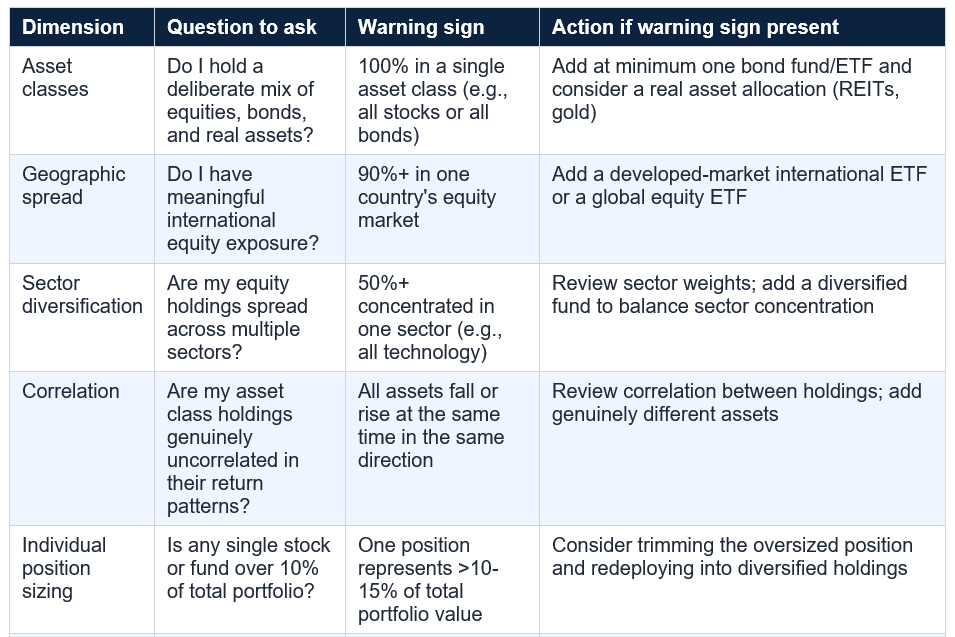

The ten rules in this article translate the research consensus into actionable principles. Start with asset class diversification. Add geographic breadth. Understand that diversification is about correlation, not just variety. Rebalance regularly. Don’t over-diversify within an asset class. Align the strategy with your specific goals and time horizon. Watch concentration in individual positions. Use the 60/40 as a starting framework, not a final answer. Build on low-cost index funds as the foundation. And review the portfolio as life evolves. Amy Arnott of Morningstar summarised it with appropriate directness: ‘The 60/40 portfolio isn’t dead — it just needs a little diversification.’ The same is true of almost every investor’s current portfolio. Not financial or investment advice. Consult a qualified financial adviser for guidance specific to your circumstances.
Portfolio diversification is the practice of spreading investments across multiple assets, asset classes, sectors, and geographies so that the underperformance of any single investment has a limited impact on the total portfolio. The core mechanism is correlation: when assets do not move in the same direction at the same time, the portfolio's volatility is reduced relative to any single holding. Concreit's 2025 guide describes it simply: 'Rather than relying on a single investment, diversification ensures that your portfolio can withstand market fluctuations, as losses in one area may be balanced out by gains in another.' The practical importance was demonstrated in 2025: Morningstar's 2026 Diversification Landscape report found that a broadly diversified 11-asset portfolio returned 18.3% compared to 13.3% for the basic 60/40 US stock and bond portfolio — a 5-percentage-point advantage, the biggest margin favouring diversification since 2009. Sources: Morningstar 2026; Concreit 2025.
How many assets do I need for a properly diversified portfolio?
For most individual investors, effective diversification is better achieved through a small number of diversified funds or ETFs than through a large number of individual holdings. A single global equity ETF can hold 1,500-3,000 individual stocks across dozens of countries and sectors, providing thorough within-asset-class diversification through one vehicle. Financial Modeling Prep's March 2026 guide and the Mezzi 2026 core-satellite framework both point to the practical answer: a core of broadly diversified, low-cost index funds (global equity, global bonds, and perhaps a real assets allocation) provides the foundational diversification that most individual investors need. Adding satellite positions for specific exposures is optional and additive. The critical insight is that the number of holdings matters less than the diversity of asset classes, geographies, and sectors covered. Sources: Financial Modeling Prep March 2026; Mezzi 2026; Morningstar 2026.
Did diversification actually work in 2025?
Yes — decisively. Morningstar's 2026 Diversification Landscape report found that a broadly diversified 11-asset portfolio returned 18.3% in 2025, compared with 13.3% for a standard 60/40 portfolio of US stocks and US investment-grade bonds. The 5-percentage-point margin was the biggest in favour of diversification since 2009. Three factors drove the outperformance: a weakening US dollar (which boosted returns from international assets when translated back to USD), more attractive valuations in international equity markets, and a significant surge in gold prices. Small-cap value and international value stocks also provided meaningful diversification away from US large-cap growth concentrations. The report concluded that diversification 'had its best year since 2009' — a clear empirical validation of the principle in the 2025 market environment specifically. Sources: Morningstar 2026 Diversification Landscape report; Yahoo Finance citing Morningstar. Not investment advice. Past performance does not guarantee future results.
Is the 60/40 portfolio still relevant in 2026?
Yes, as a starting point — but the research suggests it benefits from additional diversification layers. Morningstar's Amy Arnott was clear in the 2026 report: 'The 60/40 portfolio isn't dead — it just needs a little diversification.' The 2025 data makes the case: the broadly diversified 11-asset portfolio returned 5 percentage points more than the basic 60/40. The key additions that drove the outperformance were international equities and gold — both outside the standard US-stock-and-bond 60/40 framework. The SoFi 2026 investment survey found that the classic 60/40 guideline is being rethought and applied with more flexibility. The practical guidance from the 2026 research consensus: keep the 60/40 as a foundation but augment it with international equity exposure, real assets (gold, commodities, REITs), and potentially low-correlation alternative strategies. Sources: Morningstar 2026; SoFi/Stacker April 2026. Not investment advice.
How often should I rebalance a diversified portfolio?
The two main approaches are time-based rebalancing (annually or semi-annually) and threshold-based rebalancing (when any asset class drifts more than 5 percentage points from its target). Concreit's 2025 diversification guide recommends regular rebalancing to 'maintain the level of diversification you originally planned, keeping your investment strategy aligned with your goals.' Financial Modeling Prep's March 2026 guide identifies rebalancing as a practical maintenance step. The case for at least annual rebalancing is particularly strong when one asset class has significantly outperformed: a 60/40 portfolio that experienced strong equity growth and never rebalanced likely has an 80/20 or 85/15 allocation by now, meaning the investor is carrying significantly more equity risk than their original plan reflected. The SoFi 2026 survey's finding that 49% of respondents say professional advice most influences their diversification decisions suggests that regular engagement with a financial adviser is the mechanism through which most investors implement disciplined rebalancing. Sources: Concreit 2025; Financial Modeling Prep March 2026; SoFi 2026.
Everyone who has ever been given advice about investing has been told to diversify. It is the closest thing the investment world has to a universal principle. But knowing you should diversify and actually diversifying in a way that meaningfully reduces risk while preserving return potential are two different things. Morningstar’s 2026 Diversification Landscape report produced one of the most striking data points in recent investment research: a broadly diversified 11-asset portfolio returned 18.3% in 2025, compared with 13.3% for the standard 60/40 mix of US stocks and US investment-grade bonds. That is a 5-percentage-point advantage — the biggest margin favouring diversification over the basic allocation since 2009. SoFi’s 2026 investment survey found that 49% of investors are planning a balanced investment strategy this year, and that the classic 60/40 guideline is being rethought and applied with more flexibility. The research is aligning around a more nuanced, multi-layered approach to diversification than the simple version most people were taught. This article sets out the ten rules that the 2025-2026 research and expert consensus agree matter most.
Table of Contents
- Why Diversification Mattered More Than Ever in 2025
- What Diversification Actually Means
- Rule 1: Diversify Across Asset Classes First — Before Anything Else
- Rule 2: Spread Across Geographies — Your Home Country Is a Concentration Risk
- Rule 3: Understand Correlation — True Diversification Is About How Assets Move Together
- Rule 4: Rebalance Regularly — Diversification Drifts Without Maintenance
- Rule 5: Don’t Over-Diversify — More Holdings Is Not Always Better
- Rule 6: Align Diversification With Your Goals and Time Horizon
- Rule 7: Watch Concentration Risk in Individual Positions
- Rule 8: Consider the 60/40 a Starting Point, Not a Final Destination
- Rule 9: Use Low-Cost Index Funds and ETFs as the Foundation
- Rule 10: Diversification Is Dynamic — Review It as Life Evolves
- The Diversification Audit Checklist
- Conclusion: Diversification Is the Only Free Lunch — but Only if You Use It Properly
- Frequently Asked Questions
Why Diversification Mattered More Than Ever in 2025
The investing maxim that diversification is the only free lunch in finance is credited to the Nobel Prize-winning economist Harry Markowitz, and it is based on a mathematical observation: combining assets that do not move in perfect lockstep reduces the overall volatility of a portfolio without proportionally reducing its expected return. This is the theoretical case for diversification. The empirical case was made compellingly in 2025. Morningstar’s 2026 Diversification Landscape report found that a broadly diversified 11-asset portfolio returned 18.3% in 2025, compared with 13.3% for a standard 60/40 portfolio of US stocks and US investment-grade bonds. The 5-percentage-point gap was the largest in favour of diversification since 2009.Three specific forces drove the 2025 result: a weakening US dollar, more attractive valuations in international equity markets, and a significant surge in gold prices. All three are factors that a US-only or equity-only portfolio would have missed or been hurt by. A diversified portfolio that included international stocks, real assets, and commodities captured them. The SoFi 2026 investment survey found that 49% of investors are planning a balanced investment strategy for 2026, and that the classic 60/40 guideline is being rethought — applied with more flexibility rather than abandoned. The data suggests the direction of that flexibility: more geographic breadth, more real assets, and more attention to correlation.
Morningstar 2026 Diversification Landscape report key finding: diversified 11-asset portfolio returned 18.3% in 2025 vs 13.3% for standard 60/40. Margin: 5 percentage points — biggest gap since 2009. Three drivers: weakening dollar, international valuations, gold surge. SoFi 2026: 49% of investors planning balanced strategy; 47% see recession as biggest portfolio threat. Sources cited.
What Diversification Actually Means
Diversification is the practice of spreading investments across multiple assets, asset classes, sectors, and geographies in a way that reduces the impact of any single investment’s underperformance on the total portfolio. The core mechanism is correlation: when assets in a portfolio do not move in the same direction at the same time, the performance of the portfolio as a whole is smoothed relative to any single holding. Diversification does not eliminate risk — it cannot protect against broad market downturns that affect all asset classes simultaneously. What it does is reduce idiosyncratic risk: the risk specific to one company, one sector, one country, or one asset class, which can often be diversified away without sacrificing expected return.Concreit’s 2025 guide to portfolio diversification makes the practical framing clear: ‘Successful portfolio diversification means balancing risk, not avoiding it entirely.’ The investor who puts everything in a single stock, a single sector, or a single country has taken on risk that is not compensated by additional expected return — because that same expected return could be achieved with less concentration risk through a diversified portfolio. The ten rules in this article address ten distinct dimensions of diversification, from asset class selection to the practical maintenance of a diversified portfolio over time.
Amy Arnott, Morningstar Portfolio Strategist (Yahoo Finance / Morningstar 2026): 'Just adding US stocks, international stocks and investment-grade bonds can take you pretty far from a diversification standpoint. The 60/40 portfolio isn't dead — it just needs a little diversification.' Source: Morningstar 2026 Diversification Landscape report. Not investment advice.
Rule 1: Diversify Across Asset Classes First — Before Anything Else
The first and most foundational rule of portfolio diversification is the simplest to state and the hardest to consistently execute: hold more than one type of asset. A portfolio of twenty carefully selected stocks is not diversified. It is concentrated in a single asset class — equities — with the illusion of diversification created by the number of holdings. True first-level diversification means owning a deliberate mix of asset classes that behave differently from each other in different market environments. Financial Modeling Prep’s March 2026 guide to building a diversified investment portfolio describes the foundation clearly: ‘A diversified investment portfolio is a well-balanced mix of various asset classes such as stocks, bonds, real estate, and commodities. Rather than relying on a single investment, diversification ensures that if one asset underperforms, other investments can help stabilize your overall returns.’ The core logic is correlation: the most powerful diversification happens when the assets you hold do not move in the same direction at the same time. Bonds tend to perform differently from stocks; real estate responds to different economic signals than equities; commodities (particularly gold) have historically provided return during equity market stress. In 2025, this played out exactly as theory predicts: Morningstar’s 2026 Diversification Landscape report showed that gold’s surge was one of the three key drivers of diversified portfolio outperformance, alongside a weakening dollar and international valuations.Own a deliberate mix of asset classes: equities, bonds, real assets (REITs, commodities), and cash or equivalents. Asset class diversification is the first level of protection against single-asset-class risk. Source: Financial Modeling Prep March 2026; Morningstar 2026.
Rule 2: Spread Across Geographies — Your Home Country Is a Concentration Risk
Home-country bias is one of the most pervasive and under-recognised concentration risks in individual investor portfolios. Most investors significantly overweight the stock market of their own country — partly for psychological comfort and familiarity, partly because domestic markets are most accessible. The problem is that a single country’s stock market, however large, represents a concentrated bet on that country’s economic cycle, currency, regulatory regime, and sector composition. Morningstar’s 2026 Diversification Landscape report specifically identified international exposure as one of the three drivers of 2025’s diversified portfolio outperformance: more attractive international valuations and a weakening US dollar drove returns from non-US assets that a purely domestic portfolio would have missed entirely. The diversified 11-asset portfolio that returned 18.3% in 2025 included international equities; the basic 60/40 US-only portfolio returned only 13.3%, a 5-percentage-point gap. Concreit’s 2025 guide to portfolio diversification makes the global point directly: ‘Your portfolio may include stocks, bonds, real estate investment trusts (REITs), rental properties, commodities, or even alternative assets like cryptocurrency. Since every investor has unique goals and risk tolerance, no two portfolios look exactly alike.’ The Mezzi 2026 diversification guide explicitly calls out geographic diversification as one of the top strategies shaping modern portfolio construction.Include international equity and bond exposure alongside domestic holdings. A portfolio invested entirely in one country's market carries home-country concentration risk. The 2025 data shows non-US assets outperformed US-only allocations in a diversified comparison (Morningstar 2026).
Rule 3: Understand Correlation — True Diversification Is About How Assets Move Together
The technical definition of diversification is about correlation, not just variety. Two assets can both be in your portfolio while actually being very similar in how they behave — two large-cap US technology stocks held alongside each other provide almost no diversification benefit because their prices tend to move in the same direction for the same reasons. Genuine diversification comes from holding assets whose return patterns diverge under different conditions: rising rates, falling rates, inflation, recession, dollar weakness, geopolitical tension. Morningstar’s 2026 report quantified this directly for 2025: equity market-neutral strategies showed a negative correlation of -0.18 with US stocks, and systematic trend strategies posted a -0.04 correlation. The point is not that these correlations are large (they are small) but that in a year when US stocks faced specific pressures, these strategies provided genuine return diversification. Amy Arnott, cited in Yahoo Finance’s Morningstar summary, captured the practical advice: just adding US stocks, international stocks, and investment-grade bonds ‘can take you pretty far from a diversification standpoint.’ The three-asset foundation addresses the correlation problem at a practical level: US equities, international equities, and investment-grade bonds have historically had imperfect correlations that provide genuine risk reduction.Diversification works through correlation — holding assets that don't move in lockstep. The most powerful portfolio additions are those with low or negative correlation to your existing holdings. Source: Morningstar 2026; Amy Arnott quote.
Rule 4: Rebalance Regularly — Diversification Drifts Without Maintenance
A portfolio that is well-diversified at inception will naturally become less diversified over time without deliberate rebalancing. When equity markets outperform bonds over several years — as they did through much of the 2020s — the equity share of a mixed portfolio grows larger than intended, increasing risk concentration beyond what was originally planned. The investor who began with a 60/40 allocation in 2020 and never rebalanced likely had a 75/25 or even 80/20 allocation by 2025, having taken on substantially more equity risk than their original plan reflected. Concreit’s 2025 diversification guide addresses this directly: ‘Regular rebalancing helps maintain the level of diversification you originally planned, keeping your investment strategy aligned with your goals.’ Financial Modeling Prep’s March 2026 guide to building a diversified portfolio similarly identifies rebalancing as a practical step in maintaining portfolio construction. The two main rebalancing approaches are time-based (annually, semi-annually) and threshold-based (rebalance when any asset class drifts more than 5 percentage points from its target). The Deliberate Directions 2026 guide adds a nuanced point: ‘Your investment diversification plan should align with the changes as they happen.’ A set-and-forget approach to a diversified portfolio is not sufficient — the portfolio needs periodic maintenance to stay aligned with its original intent.Rebalance at least annually, or whenever any asset class drifts more than 5 percentage points from its target allocation. Diversification drifts over time as different assets grow at different rates. Source: Concreit 2025; Financial Modeling Prep March 2026.
Rule 5: Don’t Over-Diversify — More Holdings Is Not Always Better
Diversification has a law of diminishing returns that many investors ignore in the direction of excess. Research consistently shows that the marginal risk reduction from adding an additional stock to a portfolio falls sharply beyond 20-30 holdings in a single asset class. Beyond that point, adding more stocks in the same market adds administrative complexity and can actually dilute the portfolio’s return potential if it includes lower-conviction positions simply for the sake of adding positions. Financial Modeling Prep’s March 2026 diversification guide acknowledges the nuance: ‘Building a diversified portfolio may be nerve-racking, even for a seasoned investor.’ The Mezzi 2026 guide makes the practical recommendation of the core-satellite approach: a core of broadly diversified, low-cost index funds or ETFs — which provides instant diversification across hundreds or thousands of holdings — supplemented by satellite positions for targeted exposure. A single global equity index ETF can hold 1,500-3,000 stocks, providing thorough within-asset-class diversification through a single vehicle. The practical implication: for most individual investors, over-diversification within asset classes is less likely when using index funds, but over-diversification in the number of separate ETFs, funds, or individual holdings can create a portfolio that is difficult to monitor, expensive to rebalance, and essentially replicates the index anyway at higher cost. The goal of diversification is risk-adjusted return, not the maximum number of holdings.Effective diversification comes from covering different asset classes, geographies, and sectors — not from owning hundreds of individual stocks. A low-cost global equity index ETF provides more meaningful diversification than 50 individual stocks. Source: Mezzi 2026; Financial Modeling Prep 2026. advice.
Rule 6: Align Diversification With Your Goals and Time Horizon
The right diversification strategy is not universal — it is personal. The optimal allocation for a 28-year-old investing for retirement in 35 years is profoundly different from the right allocation for a 62-year-old planning to retire in three years. The SoFi 2026 investment survey, cited by Stacker in April 2026, found that 49% of investors are planning a balanced investment strategy in 2026 — but the right balance is different for every investor based on their goals, timeline, and risk capacity. Deliberate Directions’ 2026 diversification guide is direct: ‘Your investment diversification strategy should be in tandem with your financial goals.’ Concreit’s 2025 guide reinforces this: ‘Since every investor has unique goals and risk tolerance, no two portfolios look exactly alike. However, what makes a portfolio effective is how well it is structured through portfolio diversification.’ The practical implication: a longer time horizon can typically tolerate a higher equity allocation (and the volatility that comes with it) because there is more time to recover from short-term market downturns. A shorter time horizon requires a more conservative allocation because the investor cannot afford to wait for recovery. The classic 60/40 split is a reasonable starting framework for a medium-term investor — but as the SoFi survey notes, it is being applied with more flexibility, not as a rigid rule.Diversification strategy must align with your specific financial goals, time horizon, and risk capacity. A 30-year time horizon supports a more equity-heavy allocation; a 5-year horizon requires more conservative positioning. Source: SoFi 2026; Concreit 2025; Deliberate Directions 2026.
Rule 7: Watch Concentration Risk in Individual Positions
Concentration risk — the exposure created by any single investment becoming an oversized portion of the total portfolio — is one of the most common and most financially damaging diversification failures. It typically arises not from deliberate strategy but from the compounding success of a good initial investment: a stock purchased at 5% of the portfolio that grows to 30% through strong performance has quietly transformed a diversified portfolio into a concentrated one. The SoFi 2026 survey found that 47% of investors see a recession as the biggest threat to their portfolio in 2026. Concentration risk is the mechanism that converts a market event — recession, regulatory change, sector disruption — into a catastrophic personal financial outcome. A well-diversified portfolio exposed to the same market event typically sees a partial, recoverable drawdown. A concentrated position can produce a permanent loss. The general guidance in professional portfolio management is to cap any single stock position at 5-10% of total portfolio value. When a single holding grows beyond this through market appreciation, the disciplined response is to trim the position and redeploy into the diversified portfolio — even when the concentrated position has been performing well. Morningstar’s 2026 diversification report identified that small-cap value and international value stocks provided meaningful diversification away from US large-cap growth concentrations, noting that concentration in large-cap US growth had become a structural risk in many portfolios.Cap any individual stock position at approximately 5-10% of total portfolio value. When a single holding grows beyond this through market appreciation, trim and redeploy. Concentration in one stock, sector, or theme creates recoverable volatility if diversified, but catastrophic risk if concentrated. Source: Morningstar 2026; SoFi 2026.
Rule 8: Consider the 60/40 a Starting Point, Not a Final Destination
The 60/40 portfolio — 60% in equities and 40% in bonds — is one of the most widely referenced allocation frameworks in investing. For decades it delivered consistent risk-adjusted returns, with bonds acting as a counterweight to equity volatility. The SoFi 2026 survey found that as investors rethink their strategies, it is natural to rethink traditional rules such as the classic 60/40 allocation guideline — and that the rules of investing still matter, but they are being applied with more flexibility. Morningstar’s 2026 diversification data is instructive: the diversified 11-asset portfolio returned 18.3% vs 13.3% for the 60/40, a 5-point gap — the biggest since 2009. Amy Arnott of Morningstar articulated the nuance in Yahoo Finance’s summary: ‘The 60/40 portfolio isn’t dead — it just needs a little diversification.’ What the 2025 data suggests is that the 60/40 remains a solid foundation but benefits significantly from adding additional diversification layers: international stocks, real assets (REITs, commodities), and potentially alternatives with low equity correlation. The three-layer enhancement of the classic 60/40 — adding international equity, real assets, and some alternatives — is the consensus direction from the 2026 research.The 60/40 is a solid foundation, not a complete diversification strategy. Add international equities, real assets (REITs, commodities, gold), and potentially low-correlation alternatives. The 2025 Morningstar data shows the enhanced version outperformed the basic 60/40 by 5 percentage points. Source: Morningstar 2026; SoFi 2026.
Rule 9: Use Low-Cost Index Funds and ETFs as the Foundation
The most practical implementation of the diversification rules in this article, for most individual investors, is through low-cost index funds and exchange-traded funds (ETFs). A single global equity ETF provides exposure to thousands of stocks across dozens of countries and dozens of sectors through a single transaction, at an annual cost typically between 0.05% and 0.25%. This single holding addresses Rules 1 (asset class), 2 (geographic), and 3 (correlation within equity) simultaneously. The core-satellite approach recommended by Mezzi’s 2026 complete guide to portfolio diversification — a core of broadly diversified index funds supplemented by satellite positions — is the most widely endorsed practical framework for self-directed investors. Financial Modeling Prep’s March 2026 guide makes the connection to active versus passive management: step 5 in their diversification guide is ‘educate yourself and leverage expert insights,’ with Investopedia’s comprehensive guide referenced as an external resource. The Mezzi 2026 guide adds context: ‘In 2026, portfolio management is becoming increasingly high-tech,’ with AI-powered tools emerging for portfolio monitoring and rebalancing — but noting that ‘the principles of diversification remain constant.’ The technology changes; the fundamentals do not. Not investment advice.Use low-cost index funds and ETFs as the foundation of a diversified portfolio. A global equity ETF (0.05-0.25% annual fee) provides more meaningful diversification than most actively constructed individual stock portfolios. Core-satellite: diversified core + targeted satellites. Source: Mezzi 2026; Financial Modeling Prep March 2026.
Rule 10: Diversification Is Dynamic — Review It as Life Evolves
The final rule of diversification is one that requires no technical knowledge but a great deal of personal discipline: your portfolio’s diversification strategy should not be static. Life events change the right allocation. A new child, an approaching retirement, a career change, an inheritance, a significant purchase — each of these alters the financial goal, time horizon, or risk capacity that should be informing the portfolio’s construction. The SoFi 2026 survey found that 49% of respondents say professional advice is what influences them most when deciding how to diversify. Deliberate Directions’ 2026 guide states: ‘Your investment diversification plan should align with the changes as they happen.’ Concreit’s 2025 guide adds: ‘A set-and-forget approach can stall your growth.’ The most common practical failure mode is not the initial portfolio construction — it is the failure to update that construction as years pass and circumstances change. A 35-year-old’s optimal portfolio looks very different from the same investor’s optimal portfolio at 55. The transition from growth-oriented diversification to preservation-oriented diversification is one of the most important and most commonly delayed financial adjustments. The SoFi 2026 data on professional advice usage is instructive: 49% of investors say advice is what most influences diversification decisions — suggesting that regular engagement with a qualified adviser, aligned with life events, is the mechanism through which most investors actually update their portfolios. Not financial or investment advice.Review your diversification strategy at every significant life event and at least annually. A portfolio's ideal diversification shifts as goals, time horizons, and circumstances change. 'A set-and-forget approach can stall your growth' (Concreit 2025). Source: SoFi 2026; Deliberate Directions 2026; Concreit 2025.
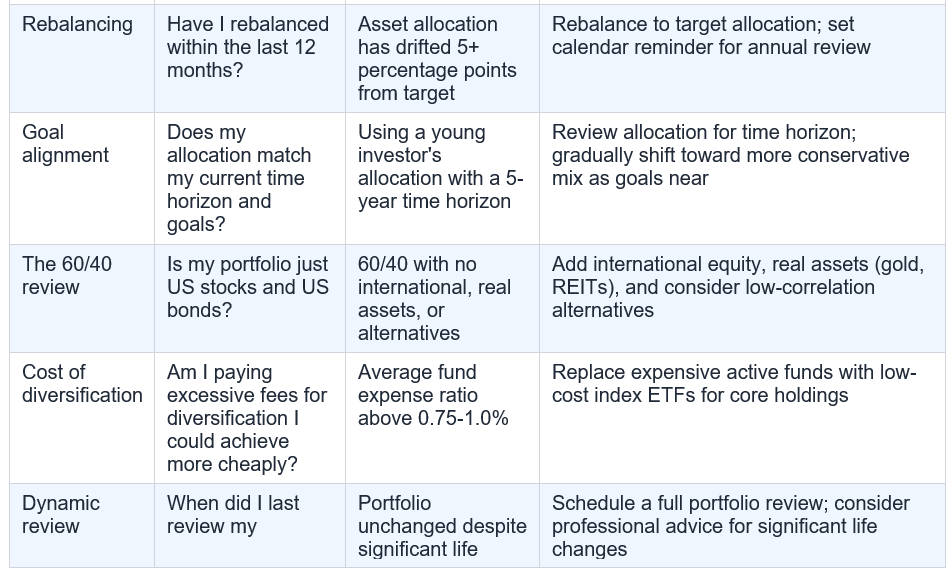
The Diversification Audit Checklist
Conclusion
The Morningstar 2026 Diversification Landscape report is a useful reminder that diversification’s benefits are not constant or automatic. In 2025, broad diversification produced a 5-percentage-point return advantage over the basic 60/40 approach — the biggest gap in favour of diversification since 2009. The mechanism was not complex: international stocks outperformed during a period of dollar weakness; gold surged; assets that had been undervalued relative to US large-cap growth delivered returns that a narrowly constructed portfolio missed entirely.The ten rules in this article translate the research consensus into actionable principles. Start with asset class diversification. Add geographic breadth. Understand that diversification is about correlation, not just variety. Rebalance regularly. Don’t over-diversify within an asset class. Align the strategy with your specific goals and time horizon. Watch concentration in individual positions. Use the 60/40 as a starting framework, not a final answer. Build on low-cost index funds as the foundation. And review the portfolio as life evolves. Amy Arnott of Morningstar summarised it with appropriate directness: ‘The 60/40 portfolio isn’t dead — it just needs a little diversification.’ The same is true of almost every investor’s current portfolio. Not financial or investment advice. Consult a qualified financial adviser for guidance specific to your circumstances.
Frequently Asked Questions
What is portfolio diversification and why does it matter?Portfolio diversification is the practice of spreading investments across multiple assets, asset classes, sectors, and geographies so that the underperformance of any single investment has a limited impact on the total portfolio. The core mechanism is correlation: when assets do not move in the same direction at the same time, the portfolio's volatility is reduced relative to any single holding. Concreit's 2025 guide describes it simply: 'Rather than relying on a single investment, diversification ensures that your portfolio can withstand market fluctuations, as losses in one area may be balanced out by gains in another.' The practical importance was demonstrated in 2025: Morningstar's 2026 Diversification Landscape report found that a broadly diversified 11-asset portfolio returned 18.3% compared to 13.3% for the basic 60/40 US stock and bond portfolio — a 5-percentage-point advantage, the biggest margin favouring diversification since 2009. Sources: Morningstar 2026; Concreit 2025.
How many assets do I need for a properly diversified portfolio?
For most individual investors, effective diversification is better achieved through a small number of diversified funds or ETFs than through a large number of individual holdings. A single global equity ETF can hold 1,500-3,000 individual stocks across dozens of countries and sectors, providing thorough within-asset-class diversification through one vehicle. Financial Modeling Prep's March 2026 guide and the Mezzi 2026 core-satellite framework both point to the practical answer: a core of broadly diversified, low-cost index funds (global equity, global bonds, and perhaps a real assets allocation) provides the foundational diversification that most individual investors need. Adding satellite positions for specific exposures is optional and additive. The critical insight is that the number of holdings matters less than the diversity of asset classes, geographies, and sectors covered. Sources: Financial Modeling Prep March 2026; Mezzi 2026; Morningstar 2026.
Did diversification actually work in 2025?
Yes — decisively. Morningstar's 2026 Diversification Landscape report found that a broadly diversified 11-asset portfolio returned 18.3% in 2025, compared with 13.3% for a standard 60/40 portfolio of US stocks and US investment-grade bonds. The 5-percentage-point margin was the biggest in favour of diversification since 2009. Three factors drove the outperformance: a weakening US dollar (which boosted returns from international assets when translated back to USD), more attractive valuations in international equity markets, and a significant surge in gold prices. Small-cap value and international value stocks also provided meaningful diversification away from US large-cap growth concentrations. The report concluded that diversification 'had its best year since 2009' — a clear empirical validation of the principle in the 2025 market environment specifically. Sources: Morningstar 2026 Diversification Landscape report; Yahoo Finance citing Morningstar. Not investment advice. Past performance does not guarantee future results.
Is the 60/40 portfolio still relevant in 2026?
Yes, as a starting point — but the research suggests it benefits from additional diversification layers. Morningstar's Amy Arnott was clear in the 2026 report: 'The 60/40 portfolio isn't dead — it just needs a little diversification.' The 2025 data makes the case: the broadly diversified 11-asset portfolio returned 5 percentage points more than the basic 60/40. The key additions that drove the outperformance were international equities and gold — both outside the standard US-stock-and-bond 60/40 framework. The SoFi 2026 investment survey found that the classic 60/40 guideline is being rethought and applied with more flexibility. The practical guidance from the 2026 research consensus: keep the 60/40 as a foundation but augment it with international equity exposure, real assets (gold, commodities, REITs), and potentially low-correlation alternative strategies. Sources: Morningstar 2026; SoFi/Stacker April 2026. Not investment advice.
How often should I rebalance a diversified portfolio?
The two main approaches are time-based rebalancing (annually or semi-annually) and threshold-based rebalancing (when any asset class drifts more than 5 percentage points from its target). Concreit's 2025 diversification guide recommends regular rebalancing to 'maintain the level of diversification you originally planned, keeping your investment strategy aligned with your goals.' Financial Modeling Prep's March 2026 guide identifies rebalancing as a practical maintenance step. The case for at least annual rebalancing is particularly strong when one asset class has significantly outperformed: a 60/40 portfolio that experienced strong equity growth and never rebalanced likely has an 80/20 or 85/15 allocation by now, meaning the investor is carrying significantly more equity risk than their original plan reflected. The SoFi 2026 survey's finding that 49% of respondents say professional advice most influences their diversification decisions suggests that regular engagement with a financial adviser is the mechanism through which most investors implement disciplined rebalancing. Sources: Concreit 2025; Financial Modeling Prep March 2026; SoFi 2026.
0 Comments
Be the first to share your thoughts on this article.