

Investing
Best Brokerages for Beginners Fees, Features, Picks: Explained

Fidelity won Best Broker for Beginners and Best Investing App; Robinhood best for basic trading; E*TRADE best for educational content; Schwab best for customer service and IRA investors. A separate investor survey ranked Fidelity best overall and Schwab second. Fees: $0 commissions and $0 minimums at the major brokers. Options contracts: $0.65 (Fidelity, Schwab), $1 (Vanguard), $0 (Robinhood). Outgoing transfer: $0 (Fidelity), $50 full (Schwab), $100 (Robinhood). Robinhood IRA match: 1% free, 3% with Gold ($5 a month or $50 a year); up to $225 a year at the 2026 IRA limit; match can be clawed back within five years. Idle cash (2026): Fidelity SPAXX about 3.3%; Robinhood Gold about 3.6% (0% without Gold); Vanguard money market 3.81%; top savings 4.34%–4.50%; 52-week T-bill 4.46%; inflation 3.7%. Fund fees matter more than commissions: on $500 a month for 30 years at 7% before fees, a 0.64% fund ends about $71,700 behind a zero-fee fund.
The answer is the stuff beneath the headline. How helpful is the support when you panic at 9 p.m.? What happens to the cash you have not invested yet? Can you buy a $50 slice of a stock? Is there a fee to leave? Does the broker offer funds that cost nothing, or ones that quietly cost a lot? This guide walks through those questions with 2026 data, compares the most popular options and ends with a simple way to choose.
But the best broker is the one that matches what you need. If you want top-tier customer service and an IRA home, Schwab is a strong choice. If you want the simplest app and a retirement match, Robinhood has appeal, with caveats. If you are a long-term index investor, Vanguard is a classic. Below I explain each, with the fine print.
Notice what is not on the list: the number of exotic features. NerdWallet’s review of Robinhood says it is the best for basic stock trading, but adds that its team does not love the gambling-style features. A beginner is usually better served by a broker that nudges them toward diversified, low-cost investing than one that makes speculation feel like a game.
The trade-offs are modest. Options trades carry a $0.65 contract fee, which will not matter to a beginner buying funds. Its default cash sweep, SPAXX, paid about 3.34% in September, which is decent but below the best savings accounts. Fidelity also offers a robo-advisor, Fidelity Go, with no management fee on balances up to $10,000, according to Finder. For a beginner who wants a single place to grow into, Fidelity is hard to beat.
The limits are worth knowing. Schwab does not offer an IRA match, and its interest on uninvested cash is not impressive, according to NerdWallet’s comparison. A full transfer out costs $50 ($25 for a partial transfer), and you cannot trade cryptocurrency there, per Finder. For a beginner who values human help and plans to invest mainly in retirement accounts, Schwab deserves a serious look.
The strings are real. Financer notes that the match can be clawed back if you withdraw or transfer your IRA before five years, and there is a $100 outgoing transfer fee, higher than most competitors. Without Gold, uninvested cash earns nothing, and even with Gold the IRA cash earns no interest. Instant withdrawals cost 1.75% of the amount, with a $1 minimum and $150 maximum. And NerdWallet’s caution about gambling features applies. It can be a good tool for a disciplined beginner. It is a risky one for an impulsive one. Do the math on the match. At $7,500 a year, the 3% Gold match is $225 minus the $50 Gold fee, or $175. Over five years that is $875, but leaving early could cost you the match and a $100 transfer fee.
The downsides for a beginner are mostly about convenience. Vanguard offers fractional shares only for its own ETFs, not individual stocks, charges $1 per options contract and, unlike Fidelity, has no nationwide branch offices. Some of its mutual funds have minimums, for instance $3,000 for one share class of its S&P 500 fund, so check before you buy. It is excellent for the simplest strategy, and a little less friendly if you want to explore.
If you prefer not to choose investments at all, a robo-advisor builds and rebalances a diversified portfolio for you for a small fee. Fidelity Go is free on balances up to $10,000, as noted. The trade-off is less control, but for someone paralyzed by choice, that can be a feature.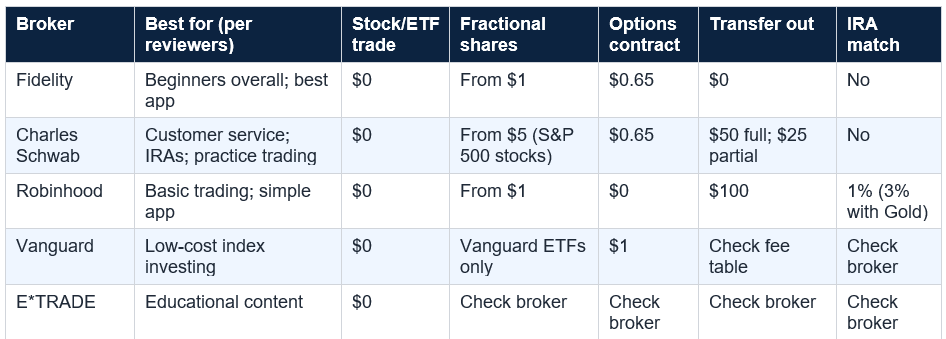
Two things stand out. The first is how similar the headline numbers are: $0 trades everywhere. The second is how different the fine print is, from transfer fees to IRA matches. That is where beginners should spend their attention. Terms change, so verify them before you open an account.
Other costs are smaller but real: options contract fees ($0.65 at Fidelity and Schwab, $1 at Vanguard, $0 at Robinhood), outgoing transfer fees, Gold subscriptions and instant-withdrawal fees. Beginners buying funds will rarely pay most of these. But they are worth knowing before you commit to a broker you might later leave.
The numbers: On $500 a month for 30 years at 7% before fees: zero-fee fund about $609,985; 0.04% fund about $605,193; 0.64% fund about $538,276. Illustrative constant-rate arithmetic, not a forecast.
The lesson is simple. Do not let cash sit in a default sweep or at 0% for long. On $10,000, the difference between 0% and a 4.46% Treasury bill is $446 a year. Either invest the cash promptly, move it to a money market fund or keep your emergency savings in a high-yield savings account outside your brokerage.
Then do the hard part, which is nothing. DALBAR research, cited by MyETFJourney, found that over 30 years the average investor earned about 6.8% a year while the S&P 500 returned about 10.2%, largely because of poorly timed trading. The broker you choose matters less than the habits you build in it. Common beginner mistakes include chasing a hot stock because an app made it easy, choosing a broker for a sign-up bonus rather than its fees, trading too often, leaving cash in a default sweep and buying individual stocks before building a diversified core. A quick test before any trade: could I explain why I am buying this, and would I still hold it if it fell 30%? If not, wait. Starting with a broad index fund and adding to it automatically avoids most of these traps.
Whichever you choose, the fundamentals matter more than the logo. Buy broad, low-cost funds. Do not leave idle cash earning nothing. Automate your contributions and resist trading on headlines. And remember that you can switch later if your needs change, though it may cost something. Start small, start now and let time do the work. This is general education, not personalized advice, and the terms in this article may have changed by the time you read it.
For most beginners, Fidelity is the most widely recommended choice. NerdWallet named it both its Best Broker for Beginners and Best Investing App in 2026, and a separate 2026 investor survey ranked it best overall. Schwab, Robinhood, Vanguard and E*TRADE each suit particular needs, so the best choice depends on whether you want customer service, a simple app, an IRA match or low-cost index funds.
How much money do I need to open a brokerage account?
Often nothing. Fidelity, Schwab and Robinhood all have $0 account minimums for standard brokerage accounts, and fractional shares let you start with as little as $1 at Fidelity and Robinhood or $5 at Schwab. Some mutual funds have their own minimums, such as $3,000 for one Vanguard share class, so check the fund before you buy.
Are $0 commissions really free?
Trading is free, but brokers still earn money elsewhere, and some costs remain: options contract fees ($0.65 at Fidelity and Schwab, $1 at Vanguard), outgoing transfer fees ($100 at Robinhood), fund expense ratios and low interest on idle cash. The real cost to beginners is usually fund fees and cash left earning little.
What is SIPC protection?
SIPC, the Securities Investor Protection Corporation, protects customers of member brokerages if the firm fails, up to $500,000 per customer, including $250,000 for cash. It does not protect against market losses. Check that your broker is a SIPC member and review its record on FINRA BrokerCheck.
Can I switch brokers later?
Yes. The transfer process, called ACATS, moves your holdings between brokers without selling. But some fees apply, such as $100 at Robinhood and $50 for a full transfer at Schwab, and fractional shares may not transfer and could be sold. Robinhood can also claw back an IRA match if you leave within five years.
Table of Contents
- Free Trades Are the Baseline Now
- The Short Answer
- What Beginners Should Look For
- Fidelity: The Best All-Around Pick
- Charles Schwab: Service, IRAs and Practice Trading
- Robinhood: Simplicity With Strings Attached
- Vanguard: The Index Investor’s Home
- E*TRADE, SoFi, Interactive Brokers and Robo-Advisors
- Head to Head: The Brokers Side by Side
- The Costs That Still Exist
- The Idle Cash Trap
- Safety: SIPC, FINRA and Bank Sweeps
- How to Open Your First Account
- Which Broker Fits You?
- Conclusion
- Frequently Asked Questions
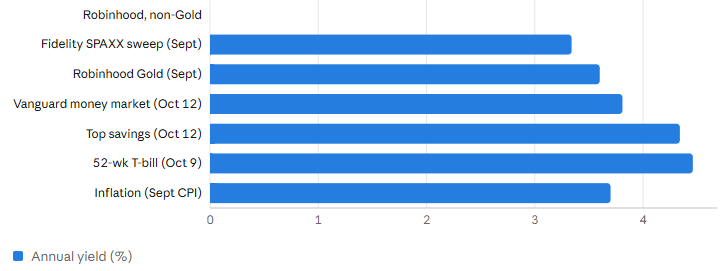
The idle-cash trap: what uninvested cash earns, 2026 (%)
% per year by Different dates and sources; inflation shown for comparison
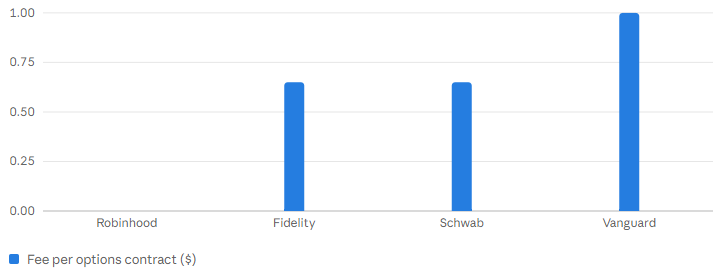
Options contract fees by broker, 2026 ($ per contract)
$ per contract by Sources: NerdWallet, Finder, ShopBack (Vanguard, secondary)
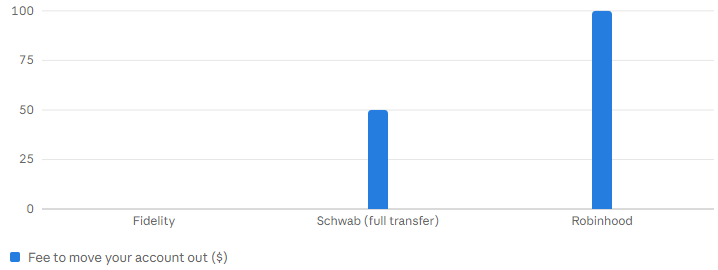
Exit costs: outgoing full-account transfer fee ($)
$ per transfer by Sources: Financer, Finder, NerdWallet (Vanguard and E*TRADE not confirmed)
Free Trades Are the Baseline Now
There was a time when choosing a broker meant comparing commissions. Not anymore. Fidelity, Schwab, Vanguard, E*TRADE and Robinhood all charge $0 to trade stocks and ETFs online, and several have no account minimums. That sounds like good news, and it is, but it creates a new problem for beginners: if the price of a trade no longer separates the brokers, what does?The answer is the stuff beneath the headline. How helpful is the support when you panic at 9 p.m.? What happens to the cash you have not invested yet? Can you buy a $50 slice of a stock? Is there a fee to leave? Does the broker offer funds that cost nothing, or ones that quietly cost a lot? This guide walks through those questions with 2026 data, compares the most popular options and ends with a simple way to choose.
The Short Answer
For most beginners, Fidelity is the safest starting point. NerdWallet named it both its Best Broker for Beginners and its Best Investing App in 2026, and The College Investor’s 2026 investor survey also ranked it best overall, with Schwab second. It combines $0 trades and minimums, fractional shares, round-the-clock phone support and index funds with a 0.00% expense ratio.But the best broker is the one that matches what you need. If you want top-tier customer service and an IRA home, Schwab is a strong choice. If you want the simplest app and a retirement match, Robinhood has appeal, with caveats. If you are a long-term index investor, Vanguard is a classic. Below I explain each, with the fine print.
What Beginners Should Look For
Seven criteria matter most. First, costs: not just commissions but fund expense ratios, transfer fees and options fees. Second, account types: you will probably want both a taxable brokerage account and an IRA. Third, investment choices: a good beginner broker offers low-cost index funds and ETFs. Fourth, fractional shares, which let you invest small amounts. Fifth, education and support, because beginners need answers. Sixth, the app and tools, since you will use them regularly. Seventh, safety, meaning SIPC membership and FINRA registration.Notice what is not on the list: the number of exotic features. NerdWallet’s review of Robinhood says it is the best for basic stock trading, but adds that its team does not love the gambling-style features. A beginner is usually better served by a broker that nudges them toward diversified, low-cost investing than one that makes speculation feel like a game.
Fidelity: The Best All-Around Pick
Fidelity earned NerdWallet’s two 2026 awards for Best Broker for Beginners and Best Investing App. It charges $0 for online US stock and ETF trades, has no account minimum and offers fractional shares from $1. NerdWallet notes it is one of only two brokers offering free index funds, and Finder points to Fidelity’s four ZERO funds, with a 0.00% expense ratio, available only at Fidelity. It offers 24/7 phone support, plus chat and a virtual assistant, and, unlike Vanguard, has branch offices nationwide, according to The College Investor.The trade-offs are modest. Options trades carry a $0.65 contract fee, which will not matter to a beginner buying funds. Its default cash sweep, SPAXX, paid about 3.34% in September, which is decent but below the best savings accounts. Fidelity also offers a robo-advisor, Fidelity Go, with no management fee on balances up to $10,000, according to Finder. For a beginner who wants a single place to grow into, Fidelity is hard to beat.
Charles Schwab: Service, IRAs and Practice Trading
Schwab is a different kind of strong. NerdWallet named it best for customer service and best online broker for IRA investors in 2026, and The College Investor’s survey ranked it second overall. It also offers practice trading through its thinkorswim platform, which lets you test the waters with virtual money. Fractional shares come through Schwab Stock Slices, available for S&P 500 stocks with a $5 minimum.The limits are worth knowing. Schwab does not offer an IRA match, and its interest on uninvested cash is not impressive, according to NerdWallet’s comparison. A full transfer out costs $50 ($25 for a partial transfer), and you cannot trade cryptocurrency there, per Finder. For a beginner who values human help and plans to invest mainly in retirement accounts, Schwab deserves a serious look.
Robinhood: Simplicity With Strings Attached
Robinhood is the app that made investing feel easy. It has $0 minimums, fractional shares from $1 and no per-contract options fee, which is rare. NerdWallet calls it the best for basic stock trading. Its biggest hook for 2026 is its IRA match: 1% on contributions for free accounts and 3% with Robinhood Gold, which costs $5 a month or $50 a year. At the 2026 IRA limit of $7,500, that is up to $225 a year, according to Finder.The strings are real. Financer notes that the match can be clawed back if you withdraw or transfer your IRA before five years, and there is a $100 outgoing transfer fee, higher than most competitors. Without Gold, uninvested cash earns nothing, and even with Gold the IRA cash earns no interest. Instant withdrawals cost 1.75% of the amount, with a $1 minimum and $150 maximum. And NerdWallet’s caution about gambling features applies. It can be a good tool for a disciplined beginner. It is a risky one for an impulsive one. Do the math on the match. At $7,500 a year, the 3% Gold match is $225 minus the $50 Gold fee, or $175. Over five years that is $875, but leaving early could cost you the match and a $100 transfer fee.
Vanguard: The Index Investor’s Home
Vanguard built its reputation on low-cost index funds, and the College Investor survey ranked it best for low-cost index investors. It charges $0 for online stocks, ETFs and Vanguard funds. Its money market fund, VMFXX, yielded about 3.81% in mid-October, according to MyMoneyBlog. If you plan to buy a few broad funds and hold them for decades, it is a natural home.The downsides for a beginner are mostly about convenience. Vanguard offers fractional shares only for its own ETFs, not individual stocks, charges $1 per options contract and, unlike Fidelity, has no nationwide branch offices. Some of its mutual funds have minimums, for instance $3,000 for one share class of its S&P 500 fund, so check before you buy. It is excellent for the simplest strategy, and a little less friendly if you want to explore.
E*TRADE, SoFi, Interactive Brokers and Robo-Advisors
A few others deserve a mention. NerdWallet names E*TRADE best for educational content and notes it is the only broker outside Fidelity offering free index funds. It sits between beginner-friendly and feature-rich. The College Investor survey named SoFi Invest best for beginners who want an all-in-one finance app. And Interactive Brokers is the pick for advanced traders, which most beginners do not need.If you prefer not to choose investments at all, a robo-advisor builds and rebalances a diversified portfolio for you for a small fee. Fidelity Go is free on balances up to $10,000, as noted. The trade-off is less control, but for someone paralyzed by choice, that can be a feature.
Head to Head: The Brokers Side by Side
Two things stand out. The first is how similar the headline numbers are: $0 trades everywhere. The second is how different the fine print is, from transfer fees to IRA matches. That is where beginners should spend their attention. Terms change, so verify them before you open an account.
The Costs That Still Exist
A free trade is not a free investment. The biggest cost for most beginners is the expense ratio on the funds they buy. Top S&P 500 index funds charge 0.015% to 0.04% a year, according to Bankrate, and Fidelity’s ZERO funds charge 0.00%. By contrast, the average actively managed fund charges far more. As my own illustration, $500 a month invested for 30 years at a 7% return before fees ends at about $609,985 in a zero-fee fund, about $605,193 at 0.04% and about $538,276 at 0.64%. The gap between the zero-fee and the 0.64% fund is roughly $71,700.Other costs are smaller but real: options contract fees ($0.65 at Fidelity and Schwab, $1 at Vanguard, $0 at Robinhood), outgoing transfer fees, Gold subscriptions and instant-withdrawal fees. Beginners buying funds will rarely pay most of these. But they are worth knowing before you commit to a broker you might later leave.
The numbers: On $500 a month for 30 years at 7% before fees: zero-fee fund about $609,985; 0.04% fund about $605,193; 0.64% fund about $538,276. Illustrative constant-rate arithmetic, not a forecast.
The Idle Cash Trap
In 2026, with rates around 4%, what your broker pays on uninvested cash matters more than it did when rates were near zero. Fidelity’s SPAXX sweep paid about 3.34% in September. Robinhood Gold members earned about 3.6%, but non-Gold accounts earned 0%, and IRA cash earns no interest. Meanwhile, MyMoneyBlog’s October 12 survey found top savings accounts at 4.34% to 4.50%, a 52-week Treasury bill at 4.46% and Vanguard’s money market fund at 3.81%. Inflation was 3.7%.The lesson is simple. Do not let cash sit in a default sweep or at 0% for long. On $10,000, the difference between 0% and a 4.46% Treasury bill is $446 a year. Either invest the cash promptly, move it to a money market fund or keep your emergency savings in a high-yield savings account outside your brokerage.
Safety: SIPC, FINRA and Bank Sweeps
Safety deserves a minute. SIPC protects customers of member brokerages if the firm fails, up to $500,000 including $250,000 in cash. It does not protect against market losses. You can verify a broker’s registration and disciplinary history on FINRA’s BrokerCheck. Many brokers also sweep uninvested cash into partner banks, which can provide FDIC coverage, according to Finder. All the big names above are established firms, but check the details yourself before depositing.How to Open Your First Account
The process is more straightforward than it sounds. First, decide on the account: an IRA for retirement, a taxable account for flexibility, or both. Second, choose a broker using the criteria above. Third, open the account online, which takes about ten to fifteen minutes and requires your Social Security number, ID and bank details. Fourth, link your bank and fund the account. Fifth, buy a broad, low-cost index fund or ETF, or a target-date fund. Sixth, set up automatic monthly investments.Then do the hard part, which is nothing. DALBAR research, cited by MyETFJourney, found that over 30 years the average investor earned about 6.8% a year while the S&P 500 returned about 10.2%, largely because of poorly timed trading. The broker you choose matters less than the habits you build in it. Common beginner mistakes include chasing a hot stock because an app made it easy, choosing a broker for a sign-up bonus rather than its fees, trading too often, leaving cash in a default sweep and buying individual stocks before building a diversified core. A quick test before any trade: could I explain why I am buying this, and would I still hold it if it fell 30%? If not, wait. Starting with a broad index fund and adding to it automatically avoids most of these traps.
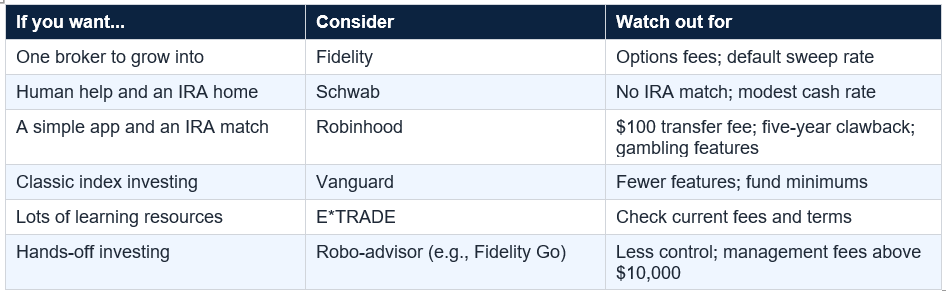
Which Broker Fits You?
Match the broker to your situation. If you want one well-rounded home and room to grow, choose Fidelity. If you value help from real people and plan to invest mostly through IRAs, consider Schwab. If you are drawn to a minimalist app and the IRA match, and you are confident you will stay put for five years, Robinhood can work. If you want a classic low-cost index investing setup, Vanguard fits. If education is your priority, look at E*TRADE. And if you do not want to choose investments, consider a robo-advisor.
Conclusion
With $0 commissions everywhere, the best brokerage for a beginner comes down to the details: support, funds, cash handling and exit costs. Fidelity is the strongest all-around choice, according to NerdWallet and The College Investor’s survey, thanks to its beginner-friendly app, zero-fee funds and 24/7 support. Schwab is excellent for service and IRAs, Robinhood offers a unique IRA match with real strings attached and Vanguard remains a favorite for low-cost index investors.Whichever you choose, the fundamentals matter more than the logo. Buy broad, low-cost funds. Do not leave idle cash earning nothing. Automate your contributions and resist trading on headlines. And remember that you can switch later if your needs change, though it may cost something. Start small, start now and let time do the work. This is general education, not personalized advice, and the terms in this article may have changed by the time you read it.
Frequently Asked Questions
What is the best brokerage for a complete beginner?For most beginners, Fidelity is the most widely recommended choice. NerdWallet named it both its Best Broker for Beginners and Best Investing App in 2026, and a separate 2026 investor survey ranked it best overall. Schwab, Robinhood, Vanguard and E*TRADE each suit particular needs, so the best choice depends on whether you want customer service, a simple app, an IRA match or low-cost index funds.
How much money do I need to open a brokerage account?
Often nothing. Fidelity, Schwab and Robinhood all have $0 account minimums for standard brokerage accounts, and fractional shares let you start with as little as $1 at Fidelity and Robinhood or $5 at Schwab. Some mutual funds have their own minimums, such as $3,000 for one Vanguard share class, so check the fund before you buy.
Are $0 commissions really free?
Trading is free, but brokers still earn money elsewhere, and some costs remain: options contract fees ($0.65 at Fidelity and Schwab, $1 at Vanguard), outgoing transfer fees ($100 at Robinhood), fund expense ratios and low interest on idle cash. The real cost to beginners is usually fund fees and cash left earning little.
What is SIPC protection?
SIPC, the Securities Investor Protection Corporation, protects customers of member brokerages if the firm fails, up to $500,000 per customer, including $250,000 for cash. It does not protect against market losses. Check that your broker is a SIPC member and review its record on FINRA BrokerCheck.
Can I switch brokers later?
Yes. The transfer process, called ACATS, moves your holdings between brokers without selling. But some fees apply, such as $100 at Robinhood and $50 for a full transfer at Schwab, and fractional shares may not transfer and could be sold. Robinhood can also claw back an IRA match if you leave within five years.
0 Comments
Be the first to share your thoughts on this article.