
Investing
Rocket Lab Crashed: Intuitive Machines Is My One Space Stock

Rocket Lab: fell 25.5% in the week to October 16, 2026 (S&P 500 −1.9%) after Neutron’s first launch slipped to 2027; Q2 revenue $234 million (+62%); backlog $2.36 billion (+137%); free cash flow −$110.1 million in Q2; Q3 gross margin guidance 29%–31%; about 51 times trailing sales (early September). Intuitive Machines: Q2 revenue $206.2 million vs $50.3 million (+309.8%, including the Lanteris acquisition); backlog $1.8 billion; $920 million of Q2 bookings plus $300 million in Q3 to date; net loss $62.8 million; cash $367 million; 2026 revenue guidance $900 million to $1 billion. Valuation (Zacks): forward price-to-sales about 36.55 for Rocket Lab vs about 3.07 for Intuitive Machines. Past month: Rocket Lab −18.3%, Intuitive Machines −26.3%. LUNR monthly closes: $43.83 (May) to $10.68 (October): about −76%. Illustrative scenarios on a roughly $2.4 billion market cap: −50% (bear), +19% (base), +108% (bull).
A crash like that tends to produce two reactions. Some investors see a bargain in a company that just posted record revenue. Others see a warning that the story is stretched. Meanwhile, a quieter question starts to circulate among people who like the space theme but not the price tag: if you could only own one space stock after this, which would it be?
My answer is Intuitive Machines. It is growing faster, it trades at a far lower valuation and it has a backlog that gives it a clearer path to revenue than most small space companies. But I want to be honest from the first paragraph: it is also a much riskier and more volatile business than that sentence makes it sound, and the reasons are as important as the case for it.
The counterweights are real. LUNR’s growth was boosted by an acquisition, it is losing money, it missed Wall Street’s estimates last quarter and its shares have already fallen about 76% from their May month-end price. Rocket Lab is the better-proven operator. The honest framing is that Intuitive Machines offers more upside per dollar if it executes and more ways to fail if it does not. Neither is a safe holding.
The problem is what the market was paying for them. Trefis noted in early September that the stock traded at roughly 51 times trailing sales. At that multiple, investors are pricing in a successful Neutron, and Neutron slipped. There was more. Management guided third-quarter GAAP gross margin to 29% to 31%, below the roughly 36% Wall Street expected and below the 36.1% reported in the second quarter. Non-GAAP free cash flow was a use of $110.1 million in the quarter. About $1.08 billion of Rocket Lab’s roughly $2.4 billion of cash and securities is earmarked for the pending Iridium acquisition, which has an enterprise value of nearly $8 billion, and other deals, leaving a thinner buffer for burn.
StockStory also reported that investor anxiety over Iridium-related dilution, $3.6 billion of bridge financing and a wave of insider sales, including by CEO Peter Beck, helped push shares to a three-month low at one point. And Rocket Lab has a history of overreacting to market stress: Trefis found that across five market shocks since 2022, it fell an average of 37.2% versus 13.4% for the index, roughly 2.8 times as hard. The stock sat 57% below its $151 high in early September, before this week’s slide.
Rocket Lab: −25.5% in the week to Oct 16 (S&P 500 −1.9%); Neutron slipped to 2027; Q2 revenue $234M (+62%); backlog $2.36B (+137%); Q2 free cash flow −$110.1M; Q3 gross margin guided to 29%–31%; about 51x trailing sales in early September.
What I like most is the mix. Intuitive Machines used to be a one-trick lunar-lander story. Today it is more of a space infrastructure company. National security revenue rose from 3% to 30% of the total in a year, helped by a July award for 18 spacecraft for the Golden Dome missile-defense constellation. It signed a $600 million-plus contract for three commercial geostationary satellites, won a sixth NASA lunar delivery contract and closed the Goonhilly Earth Station and COMSAT acquisition in August to build out its space-to-ground network. Revenue that comes from several customers and programs is less likely to vanish with one delayed launch.
Management affirmed 2026 revenue guidance of $900 million to $1 billion and continues to expect positive adjusted EBITDA for the year. It ended the quarter with $367 million in cash. And on valuation, the difference with Rocket Lab is stark. At roughly $2.4 billion of market value, on a rough $950 million of expected 2026 revenue, LUNR trades around 2.5 times sales on my math, consistent with Zacks’ forward multiple near 3.
The numbers: Intuitive Machines: Q2 revenue $206.2M vs $50.3M (+309.8%); backlog $1.8B; Q2 bookings $920M plus $300M in Q3 to date; national security share of revenue 3% to 30%; cash $367M; 2026 guidance $900M–$1B; forward price-to-sales about 3.07 (Zacks).
Second, profitability. Revenue missed Wall Street’s estimate and so did earnings. The company lost $62.8 million for the quarter, versus a $38.2 million loss a year earlier. Operating loss was $47.1 million and adjusted EBITDA was a $13.8 million loss, including a $14.7 million charge on the IM-4 lunar mission after customer payload changes. Cash use included about $34 million tied to inventory and a launch milestone. Hitting positive full-year adjusted EBITDA means the second half has to be much better.
Third, the track record. In late May, NASA’s lunar rover awards went to Astrolab and Lunar Outpost, and LUNR closed that day at $34.86, down 17.43%. Earlier lunar landings by the company ended with the spacecraft tipped on its side. Execution on IM-3, which targets a January to March 2027 window and includes the first lunar communications relay satellite, matters enormously.
Fourth, the stock itself. LUNR’s monthly closes ran from $43.83 in May to $10.68 in October, a fall of about 76%. It fell 26.3% in the month before Zacks’ comparison, more than Rocket Lab’s 18.3%. Even Zacks’ separate review of LUNR’s quarter concluded that valuation, margin variability and cash use argue for patience. So when I say it is my one pick, I mean relative to Rocket Lab, not relative to safety. A low price-to-sales multiple is not a guarantee of value. It can mean the market doubts the revenue will convert into profit. Always read the loss lines as carefully as the growth lines.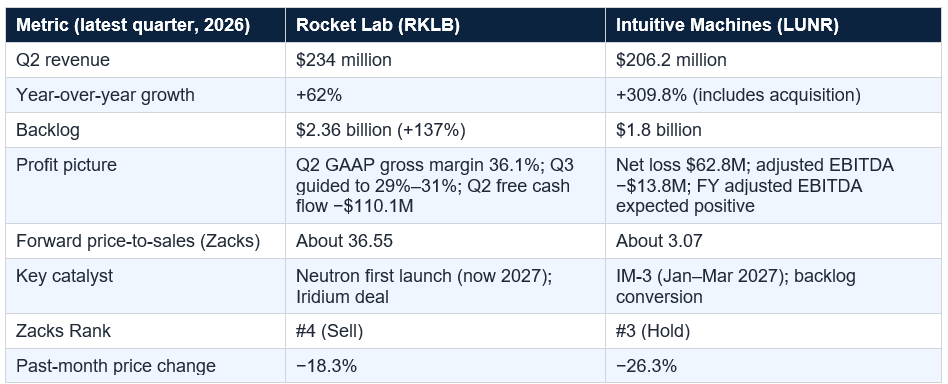
Look at the revenue line first. The two companies are now about the same size by quarterly revenue, $234 million versus $206 million. But one is valued at roughly twelve times the other on forward sales. That gap is the heart of the argument. Rocket Lab’s premium rests on Neutron succeeding and margins expanding. LUNR’s discount rests on skepticism about its profitability and execution.
In a bull case, it hits $1 billion, margins improve and the market pays 5 times sales, a still-modest multiple. That implies $5 billion, roughly 108% higher. In a bear case, contract delays leave revenue near $800 million and the market pays only 1.5 times sales, implying $1.2 billion, about 50% lower. Notice the shape. The downside is real and the upside is larger, but the outcomes are wide. That is what a volatile small-cap looks like.

Now consider Rocket Lab. At about 36.55 times forward sales, even a good outcome requires revenue to grow dramatically or the multiple to hold. A stock priced for near-perfection can fall hard on small disappointments, which is precisely what happened this month. I am not saying Rocket Lab cannot recover; Trefis found that it has regained its prior peak after each past fall, with a median wait of about two months, though after 2022 the wait stretched to roughly 28 months. I am saying the margin for error is thinner.
On the first, LUNR leads on growth rate while Rocket Lab leads on a proven track record and a bigger backlog. On the second, LUNR wins clearly. On the third, LUNR’s broadening mix is a point in its favor, although Rocket Lab is also diversifying with acquisitions. On the fourth, both have catalysts, and both could disappoint. The scorecard favors LUNR on price and diversification, and Rocket Lab on execution history and balance sheet scale. Weighing them, valuation tips my choice. If you weigh execution history more heavily, you could reasonably choose the other.
But “faster and cheaper” comes with asterisks: acquisition-boosted growth, a $62.8 million quarterly loss, a miss against estimates, a 76% drop from its May price and execution risk in every lunar mission. The wise response is not to bet the portfolio on either. It is to understand the trade-offs, size any position small and let the evidence update you. This is general education and opinion, not personalized advice, and a qualified adviser can help you decide what fits your situation.
Rocket Lab fell 25.5% in the week to October 16, against a 1.9% dip for the S&P 500. On October 14 the company pushed the first launch of its Neutron rocket to 2027. That came on top of third-quarter margin guidance below Wall Street expectations, heavy cash burn, dilution concerns tied to the pending Iridium acquisition and a broad rotation out of richly valued growth and space stocks.
Is Intuitive Machines really growing faster than Rocket Lab?
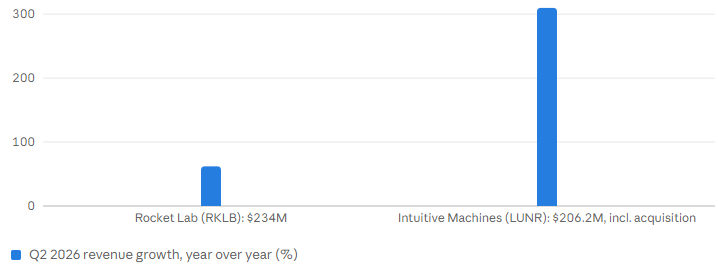
On headline numbers, yes. Second-quarter revenue rose 309.8% to $206.2 million, versus 62% growth to $234 million for Rocket Lab. But Intuitive Machines’ figure includes the Lanteris acquisition, which closed in January 2026, so much of the jump is acquired rather than organic. Rocket Lab also made acquisitions, though its growth rate is far lower.
Is Intuitive Machines stock cheap?
It is cheaper on sales. Zacks put its forward price-to-sales multiple at about 3.07 versus 36.55 for Rocket Lab. But cheap on sales is not cheap on profits: Intuitive Machines posted a $62.8 million net loss in the second quarter and its shares are down roughly 76% from their May month-end price. Low multiples often reflect higher perceived risk.
For most investors, a diversified fund is a better choice than any single space stock. Both companies are volatile, loss-making and dependent on contracts and launches. If you buy a space stock, size it as a small, speculative position that you could lose without harming your goals. This article is general education, not personal advice.
What are the next catalysts for each stock?
For Intuitive Machines: the IM-3 flight-readiness review in October, the IM-3 launch window of January to March 2027, third-quarter results and conversion of its $1.8 billion backlog. For Rocket Lab: Neutron’s first launch, now pushed to 2027, third-quarter margins, cash burn and the closing of the Iridium deal.
Table of Contents
- The Week Rocket Lab Fell 25%
- The Short Answer
- What Actually Happened to Rocket Lab
- Why Intuitive Machines Wins on Growth and Price
- The Uncomfortable Footnotes
- Head to Head: The Numbers Side by Side
- What 3x vs 37x Really Means: Three Scenarios
- Why “Only One”? My Criteria
- Catalysts and Dates to Watch
- Sizing the Bet
- What Would Change My Mind
- Conclusion
- Frequently Asked Questions
Q2 2026 revenue growth: Rocket Lab vs. Intuitive Machines (% year over year)
Growth (%) by Company SEC filings (August 2026)
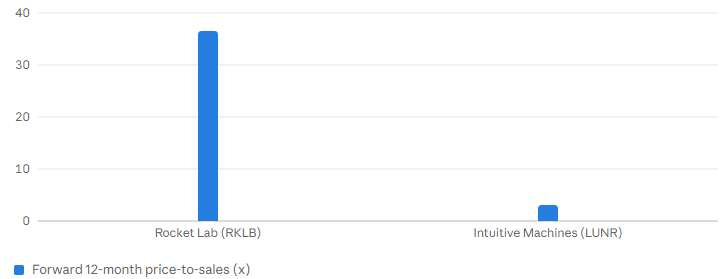
Valuation: forward price-to-sales (Zacks snapshot, x)
Forward P/S multiple (x) by About a 12x gap; multiples change daily, and both shares fell afterward
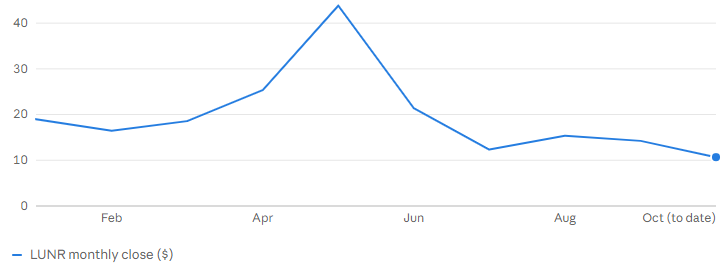
The risk side: Intuitive Machines (LUNR) monthly closing price, 2026 ($)
Share price ($) by Source: Digrin monthly price history; May to October: about -76%
The Week Rocket Lab Fell 25%
Some weeks, a stock does not so much fall as drop through a trapdoor. Rocket Lab lost 25.5% in the week to October 16, 2026, while the S&P 500 slipped just 1.9%. The trigger was a delay: on October 14 the company moved the first launch of Neutron, its big new reusable rocket, into 2027. Reuters reported that the shares fell about 6% in extended trading on the news, and by that Friday the stock was down roughly 27% for the year.A crash like that tends to produce two reactions. Some investors see a bargain in a company that just posted record revenue. Others see a warning that the story is stretched. Meanwhile, a quieter question starts to circulate among people who like the space theme but not the price tag: if you could only own one space stock after this, which would it be?
My answer is Intuitive Machines. It is growing faster, it trades at a far lower valuation and it has a backlog that gives it a clearer path to revenue than most small space companies. But I want to be honest from the first paragraph: it is also a much riskier and more volatile business than that sentence makes it sound, and the reasons are as important as the case for it.
The Short Answer
If I could buy only one, I would pick Intuitive Machines (LUNR) over Rocket Lab (RKLB), mainly on valuation and growth. Zacks puts LUNR’s forward price-to-sales at about 3.07 against about 36.55 for Rocket Lab, a gap of roughly twelve times. LUNR’s second-quarter revenue grew 309.8%, versus 62% for Rocket Lab. That is the case in two numbers.The counterweights are real. LUNR’s growth was boosted by an acquisition, it is losing money, it missed Wall Street’s estimates last quarter and its shares have already fallen about 76% from their May month-end price. Rocket Lab is the better-proven operator. The honest framing is that Intuitive Machines offers more upside per dollar if it executes and more ways to fail if it does not. Neither is a safe holding.
What Actually Happened to Rocket Lab
It is worth separating the headline from the substance. Rocket Lab’s business is, by most measures, healthy. Second-quarter revenue hit a record $234 million, up 62% from a year earlier, and backlog reached $2.36 billion, up 137%, with more than 90 launches in the manifest. Those are the numbers of a company executing.The problem is what the market was paying for them. Trefis noted in early September that the stock traded at roughly 51 times trailing sales. At that multiple, investors are pricing in a successful Neutron, and Neutron slipped. There was more. Management guided third-quarter GAAP gross margin to 29% to 31%, below the roughly 36% Wall Street expected and below the 36.1% reported in the second quarter. Non-GAAP free cash flow was a use of $110.1 million in the quarter. About $1.08 billion of Rocket Lab’s roughly $2.4 billion of cash and securities is earmarked for the pending Iridium acquisition, which has an enterprise value of nearly $8 billion, and other deals, leaving a thinner buffer for burn.
StockStory also reported that investor anxiety over Iridium-related dilution, $3.6 billion of bridge financing and a wave of insider sales, including by CEO Peter Beck, helped push shares to a three-month low at one point. And Rocket Lab has a history of overreacting to market stress: Trefis found that across five market shocks since 2022, it fell an average of 37.2% versus 13.4% for the index, roughly 2.8 times as hard. The stock sat 57% below its $151 high in early September, before this week’s slide.
Rocket Lab: −25.5% in the week to Oct 16 (S&P 500 −1.9%); Neutron slipped to 2027; Q2 revenue $234M (+62%); backlog $2.36B (+137%); Q2 free cash flow −$110.1M; Q3 gross margin guided to 29%–31%; about 51x trailing sales in early September.
Why Intuitive Machines Wins on Growth and Price
Now the other side. Intuitive Machines reported second-quarter revenue of $206.2 million on August 13, against $50.3 million a year earlier. CEO Steve Altemus called it revenue “over four times” the prior year. Backlog finished the quarter at a record $1.8 billion after $920 million of new awards in the quarter, with another $300 million of awards in the third quarter to date. Management expects 25% to 30% of that backlog to convert to revenue in 2026 and 35% to 40% in 2027, which on my arithmetic is roughly $450 million to $540 million this year and $630 million to $720 million next.What I like most is the mix. Intuitive Machines used to be a one-trick lunar-lander story. Today it is more of a space infrastructure company. National security revenue rose from 3% to 30% of the total in a year, helped by a July award for 18 spacecraft for the Golden Dome missile-defense constellation. It signed a $600 million-plus contract for three commercial geostationary satellites, won a sixth NASA lunar delivery contract and closed the Goonhilly Earth Station and COMSAT acquisition in August to build out its space-to-ground network. Revenue that comes from several customers and programs is less likely to vanish with one delayed launch.
Management affirmed 2026 revenue guidance of $900 million to $1 billion and continues to expect positive adjusted EBITDA for the year. It ended the quarter with $367 million in cash. And on valuation, the difference with Rocket Lab is stark. At roughly $2.4 billion of market value, on a rough $950 million of expected 2026 revenue, LUNR trades around 2.5 times sales on my math, consistent with Zacks’ forward multiple near 3.
The numbers: Intuitive Machines: Q2 revenue $206.2M vs $50.3M (+309.8%); backlog $1.8B; Q2 bookings $920M plus $300M in Q3 to date; national security share of revenue 3% to 30%; cash $367M; 2026 guidance $900M–$1B; forward price-to-sales about 3.07 (Zacks).
The Uncomfortable Footnotes
Here is where a responsible case has to slow down. First, the growth. The 309.8% jump includes the Lanteris acquisition, which closed in January 2026 and contributed $612.8 million of backlog. So part of the growth is purchased, not organic, and acquisitions bring integration risk. Intuitive Machines also closed the KinetX, Goonhilly and COMSAT deals this year.Second, profitability. Revenue missed Wall Street’s estimate and so did earnings. The company lost $62.8 million for the quarter, versus a $38.2 million loss a year earlier. Operating loss was $47.1 million and adjusted EBITDA was a $13.8 million loss, including a $14.7 million charge on the IM-4 lunar mission after customer payload changes. Cash use included about $34 million tied to inventory and a launch milestone. Hitting positive full-year adjusted EBITDA means the second half has to be much better.
Third, the track record. In late May, NASA’s lunar rover awards went to Astrolab and Lunar Outpost, and LUNR closed that day at $34.86, down 17.43%. Earlier lunar landings by the company ended with the spacecraft tipped on its side. Execution on IM-3, which targets a January to March 2027 window and includes the first lunar communications relay satellite, matters enormously.
Fourth, the stock itself. LUNR’s monthly closes ran from $43.83 in May to $10.68 in October, a fall of about 76%. It fell 26.3% in the month before Zacks’ comparison, more than Rocket Lab’s 18.3%. Even Zacks’ separate review of LUNR’s quarter concluded that valuation, margin variability and cash use argue for patience. So when I say it is my one pick, I mean relative to Rocket Lab, not relative to safety. A low price-to-sales multiple is not a guarantee of value. It can mean the market doubts the revenue will convert into profit. Always read the loss lines as carefully as the growth lines.
Head to Head: The Numbers Side by Side
Look at the revenue line first. The two companies are now about the same size by quarterly revenue, $234 million versus $206 million. But one is valued at roughly twelve times the other on forward sales. That gap is the heart of the argument. Rocket Lab’s premium rests on Neutron succeeding and margins expanding. LUNR’s discount rests on skepticism about its profitability and execution.
What 3x vs 37x Really Means: Three Scenarios
It helps to translate multiples into outcomes. Here is a deliberately simple illustration of my own, not a forecast. Start with LUNR’s market value of roughly $2.4 billion. In a base case, it delivers about $950 million of 2026 revenue, the middle of guidance, and the market keeps valuing it at about 3 times sales. That implies a market value near $2.85 billion, about 19% above today.In a bull case, it hits $1 billion, margins improve and the market pays 5 times sales, a still-modest multiple. That implies $5 billion, roughly 108% higher. In a bear case, contract delays leave revenue near $800 million and the market pays only 1.5 times sales, implying $1.2 billion, about 50% lower. Notice the shape. The downside is real and the upside is larger, but the outcomes are wide. That is what a volatile small-cap looks like.
Now consider Rocket Lab. At about 36.55 times forward sales, even a good outcome requires revenue to grow dramatically or the multiple to hold. A stock priced for near-perfection can fall hard on small disappointments, which is precisely what happened this month. I am not saying Rocket Lab cannot recover; Trefis found that it has regained its prior peak after each past fall, with a median wait of about two months, though after 2022 the wait stretched to roughly 28 months. I am saying the margin for error is thinner.
Why “Only One”? My Criteria
The “only one” framing forces discipline. If I could hold a single space stock, I would want four things. First, growth I can see in the numbers, backed by a backlog. Second, a valuation that does not require perfection. Third, several revenue streams so that no single launch decides the outcome. Fourth, catalysts within a reasonable time frame that can validate or break the thesis.On the first, LUNR leads on growth rate while Rocket Lab leads on a proven track record and a bigger backlog. On the second, LUNR wins clearly. On the third, LUNR’s broadening mix is a point in its favor, although Rocket Lab is also diversifying with acquisitions. On the fourth, both have catalysts, and both could disappoint. The scorecard favors LUNR on price and diversification, and Rocket Lab on execution history and balance sheet scale. Weighing them, valuation tips my choice. If you weigh execution history more heavily, you could reasonably choose the other.
Catalysts and Dates to Watch
For Intuitive Machines, the near-term markers are the IM-3 flight-readiness review in October, the mission’s launch window of January to March 2027 and third-quarter results, where investors will look for backlog conversion, margins and cash use. For Rocket Lab, the markers are Neutron’s new schedule, third-quarter margins against that 29% to 31% guide, free cash flow and the closing of Iridium. Outside the companies, interest rates matter: with the 10-year Treasury yield near 5.2% and the Fed raising rates, long-duration growth stocks are under pressure, and space names have been among the hardest hit.Sizing the Bet
This is the part that matters more than the choice. Both stocks can lose half their value in months, as both just showed. If you buy either, treat it as a speculative position, small enough that a total loss would not change your plans. Many investors cap speculative positions at a low single-digit percentage of their portfolio. Avoid borrowing to buy, avoid putting emergency savings or near-term goals at risk and consider building a position gradually rather than all at once. For most people, the core of a portfolio should be diversified index funds, with any single space stock a small side bet.What Would Change My Mind
A good thesis has an exit. I would reconsider LUNR if second-half revenue fell well short of its $900 million to $1 billion guidance, if adjusted EBITDA stayed negative for the year, if cash fell quickly without matching bookings or if IM-3 slipped materially or failed. I would grow more positive on Rocket Lab if Neutron reached orbit, gross margins recovered above 35% and cash burn fell. Facts, not stories, should move the decision.Conclusion
Rocket Lab’s 25.5% weekly crash did not change its business overnight. It changed how much investors were willing to pay for a business that still has to prove Neutron. That reset makes the comparison with Intuitive Machines more interesting. LUNR offers faster reported growth, a $1.8 billion backlog, a broadening revenue base and a forward price-to-sales of about 3 against about 37, which is why it is my one space stock if forced to choose.But “faster and cheaper” comes with asterisks: acquisition-boosted growth, a $62.8 million quarterly loss, a miss against estimates, a 76% drop from its May price and execution risk in every lunar mission. The wise response is not to bet the portfolio on either. It is to understand the trade-offs, size any position small and let the evidence update you. This is general education and opinion, not personalized advice, and a qualified adviser can help you decide what fits your situation.
Frequently Asked Questions
Why did Rocket Lab stock crash in October 2026?Rocket Lab fell 25.5% in the week to October 16, against a 1.9% dip for the S&P 500. On October 14 the company pushed the first launch of its Neutron rocket to 2027. That came on top of third-quarter margin guidance below Wall Street expectations, heavy cash burn, dilution concerns tied to the pending Iridium acquisition and a broad rotation out of richly valued growth and space stocks.
Is Intuitive Machines really growing faster than Rocket Lab?
On headline numbers, yes. Second-quarter revenue rose 309.8% to $206.2 million, versus 62% growth to $234 million for Rocket Lab. But Intuitive Machines’ figure includes the Lanteris acquisition, which closed in January 2026, so much of the jump is acquired rather than organic. Rocket Lab also made acquisitions, though its growth rate is far lower.
Is Intuitive Machines stock cheap?
It is cheaper on sales. Zacks put its forward price-to-sales multiple at about 3.07 versus 36.55 for Rocket Lab. But cheap on sales is not cheap on profits: Intuitive Machines posted a $62.8 million net loss in the second quarter and its shares are down roughly 76% from their May month-end price. Low multiples often reflect higher perceived risk.
For most investors, a diversified fund is a better choice than any single space stock. Both companies are volatile, loss-making and dependent on contracts and launches. If you buy a space stock, size it as a small, speculative position that you could lose without harming your goals. This article is general education, not personal advice.
What are the next catalysts for each stock?
For Intuitive Machines: the IM-3 flight-readiness review in October, the IM-3 launch window of January to March 2027, third-quarter results and conversion of its $1.8 billion backlog. For Rocket Lab: Neutron’s first launch, now pushed to 2027, third-quarter margins, cash burn and the closing of the Iridium deal.
0 Comments
Be the first to share your thoughts on this article.