

Investing
How to Invest in Stocks: A Step-by-Step Guide to Get Started

The best-performing 4.3% of US stocks (1,092 of about 26,000) explain all net wealth creation since 1926 (about $35 trillion above Treasury bills); 58% of stocks failed to beat Treasury bills over their lives. S&P 500 (October 2026): record 7,816.70 on August 13; forward P/E about 20.0 (five-year average 19.9); CAPE about 41.6; top 10 stocks about 39.1% of the index; top three 21.59%. Top 10 stocks: about 40% of index weight but about 32% of earnings (end of 2025). 2026 long-term capital gains: 0% up to $49,450 (single) or $98,900 (joint); 15% up to $545,500 or $613,700; 20% above; 3.8% extra above $200,000 or $250,000. Short-term gains taxed as ordinary income up to 37%. DALBAR: average equity investor earned about 6.8% a year vs 10.2% for the S&P 500 over 30 years ending 2023.
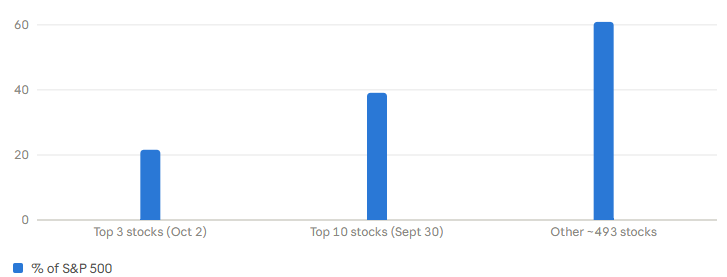
There is another feature worth knowing. The S&P 500 holds roughly 500 companies, but its top 10 account for about 39.1% of the index as of September 30, according to S&P Dow Jones Indices data cited by KuCoin, and the top three alone were 21.59% on October 2. None of this tells you to buy or to wait. It tells you the market is richly valued and concentrated, which is exactly why a disciplined approach matters more than a clever one.
The takeaway is not that stocks are bad. The market as a whole has rewarded investors handsomely. It is that the rewards come from a few giant winners, and finding them in advance is hard. Own only a few stocks and you may miss the winners entirely. One analysis of Bessembinder’s work, citing Jason Zweig, said a 25-stock portfolio still has a 64% chance of underperforming the total market. An index fund owns the needles by owning the haystack.
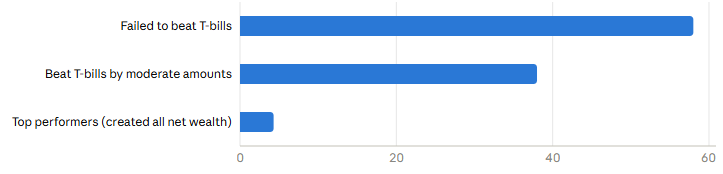
The numbers: Bessembinder (2018): 4.3% of stocks created all net wealth since 1926; 58% of stocks failed to beat Treasury bills; 86 stocks made up half the total. Source: ASU W. P. Carey; Journal of Financial Economics.
This leads to a practical approach many investors use: a core of broad index funds, plus, if you want, a small "satellite" of individual stocks you chose on purpose. If you do pick stocks, the steps below show how to do it with your eyes open.
Fractional shares matter for beginners. If one share costs $400 and you have $50 to invest, a broker offering fractions lets you buy an eighth of a share. It makes diversification possible with a small starting amount.
The S&P 500’s concentration deserves a thought. A fund that tracks it puts roughly 39% of your money in ten companies, though those companies produce only about 32% of the index’s earnings, according to Firstrade. If that bothers you, you can add a fund that covers other parts of the market, such as smaller companies or international stocks. No fund removes risk. You are choosing the kind of risk.
Top 10 stocks: about 40% of S&P 500 weight but about 32% of earnings (end of 2025). The top 20 had a median forward P/E of 36.6 in October 2025, well above the historical median of 25.4 (SIFMA).
That last question is where valuation comes in. The price-to-earnings ratio divides a stock’s price by its earnings per share. A forward P/E of 20 means you pay $20 for each dollar of expected annual profit, and the S&P 500 is near 20 now. Fast-growing companies can deserve higher numbers, but very high multiples leave little room for error. The point is not to find a magic P/E. It is to know what has to go right for your price to make sense. Some professionals see opportunity: Goldman Sachs noted that low expected correlation among stocks could favor stock pickers. That is an opinion, not a guarantee.
Avoid two traps at the start. Do not borrow money to invest, known as margin, which can magnify losses beyond what you put in. And do not buy based only on a tip or a viral post. If you cannot explain why you are buying, wait.
Two practical points. Selling a loser can offset gains, a tactic called tax-loss harvesting, but buying the same stock again within 30 days can trigger the wash-sale rule, which disallows the loss. And tax-advantaged accounts shelter trades from these rules, which is one more reason to use them first. State taxes vary. Confirm details with a tax professional.

Set rules in advance. Invest on a schedule, reinvest dividends if you do not need the income, and review holdings a couple of times a year, not every day. For each stock, write down why you bought it, and sell only if that reason is no longer true, not because the price moved. A written reason is a surprisingly effective antidote to panic.
Keep in mind: Past market averages are not promises. Stocks can fall sharply and stay down for years. Only invest money you will not need for at least several years.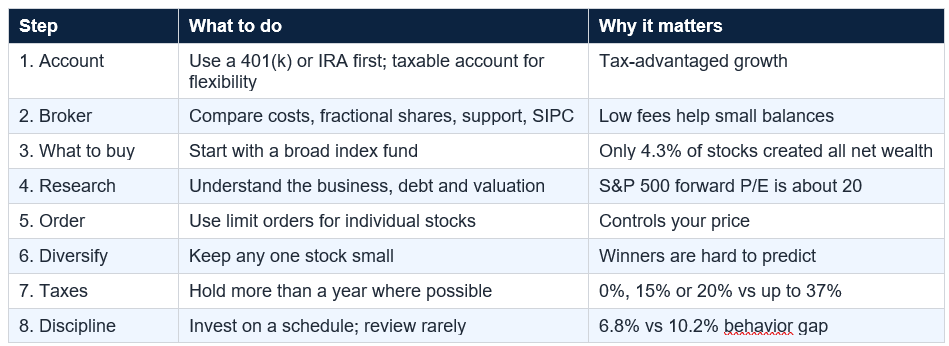
If you do choose individual stocks, do it with a small slice of your money, a written reason and patience. Start with whatever amount you can, build the habit and let time do the work. A qualified professional can help you apply this to your situation.
Much less than most people assume. Many brokerages offer fractional shares, so you can buy a slice of a stock for a small amount rather than a whole share. What matters more than the starting amount is that you start, keep contributing and avoid costs that eat into small balances.
Should I buy individual stocks or an index fund?
For most people, a broad index fund is the simpler core. Research by Hendrik Bessembinder found that the best 4% of US stocks explain all of the market’s net gains since 1926, while most individual stocks failed to beat Treasury bills. Some investors add a few individual stocks as a small side portion, understanding the odds.
What is a good price-to-earnings ratio?
There is no single good number. The forward P/E of the S&P 500 was about 20 in October 2026, close to its five-year average of 19.9, while a longer-run measure known as CAPE was near 41.6, close to an all-time high. Compare a stock with its industry, its growth and its own history, not just the market.
How are stock profits taxed in 2026?
Gains on stocks held one year or less are taxed as ordinary income, up to 37%. Gains on stocks held longer than a year are taxed at 0%, 15% or 20%, depending on income. In 2026 the 0% rate applies up to $49,450 of taxable income for single filers and $98,900 for married couples filing jointly. High earners may owe an extra 3.8%.
Is it a bad time to buy stocks after record highs?
Nobody can reliably time the market. The S&P 500 set a record in August 2026 and has been volatile since, with Treasury yields near multi-decade highs. Investing a fixed amount on a regular schedule spreads your entry points and removes the pressure to pick the perfect day. This is general information, not advice.
Bessembinder: how US stocks did vs. Treasury bills over their lifetimes (%)
% of stocks by Outcome (share of about 26,000 stocks)
S&P 500 concentration: share of the index by group (%)
% of index weight by Group
Table of Contents
- The Market You Are Walking Into
- What You Actually Own When You Buy a Stock
- The Honest Odds: Index Funds vs Picking Stocks
- Step 1: Choose the Right Account
- Step 2: Pick a Broker
- Step 3: Decide What to Buy
- Step 4: If You Pick Stocks, Do Basic Research
- Step 5: Place Your Order
- Step 6: Diversify and Size Your Positions
- Step 7: Understand the Taxes
- Step 8: Hold, Review and Stay Disciplined
- The Eight Steps at a Glance
- Conclusion
- Frequently Asked Questions
The Market You Are Walking Into
It helps to know the terrain before you start. The S&P 500 set a record of 7,816.70 on August 13, 2026, then pulled back about 2% as the 30-year Treasury yield touched 5.337%, its highest in nearly two decades, according to MercoPress. By early October it had hit fresh records, then retreated again as oil prices and rate-hike worries returned. The index trades at a forward price-to-earnings ratio of about 20, near its five-year average of 19.9. A longer-run measure, CAPE, sits near 41.6, close to an all-time high.There is another feature worth knowing. The S&P 500 holds roughly 500 companies, but its top 10 account for about 39.1% of the index as of September 30, according to S&P Dow Jones Indices data cited by KuCoin, and the top three alone were 21.59% on October 2. None of this tells you to buy or to wait. It tells you the market is richly valued and concentrated, which is exactly why a disciplined approach matters more than a clever one.
What You Actually Own When You Buy a Stock
A share of stock is a slice of ownership in a company. If the business earns more over time, the value of your slice tends to rise. Some companies also pay dividends, a share of profits paid in cash. You can lose money two ways: the company does poorly, or the market decides to pay less for the same earnings. Neither is predictable in the short run, which is why time horizon is half the strategy.The Honest Odds: Index Funds vs Picking Stocks
Before choosing stocks, look at the evidence on picking them. Finance professor Hendrik Bessembinder studied every US common stock since 1926, and the results, published in the Journal of Financial Economics in 2018, are sobering. The best-performing 4.3% of stocks, about 1,092 of nearly 26,000, explain all of the net wealth created above Treasury bills, roughly $35 trillion. The remaining 96% collectively matched Treasury bills, and 58% failed to beat them over their lifetimes. Just 86 stocks accounted for half of all the wealth created.The takeaway is not that stocks are bad. The market as a whole has rewarded investors handsomely. It is that the rewards come from a few giant winners, and finding them in advance is hard. Own only a few stocks and you may miss the winners entirely. One analysis of Bessembinder’s work, citing Jason Zweig, said a 25-stock portfolio still has a 64% chance of underperforming the total market. An index fund owns the needles by owning the haystack.
The numbers: Bessembinder (2018): 4.3% of stocks created all net wealth since 1926; 58% of stocks failed to beat Treasury bills; 86 stocks made up half the total. Source: ASU W. P. Carey; Journal of Financial Economics.
This leads to a practical approach many investors use: a core of broad index funds, plus, if you want, a small "satellite" of individual stocks you chose on purpose. If you do pick stocks, the steps below show how to do it with your eyes open.
Step 1: Choose the Right Account
Decide where the investments will live. Tax-advantaged accounts come first for long-term money: a 401(k), especially up to any employer match, then an IRA. The 2026 limits are $24,500 for a 401(k) and $7,500 for an IRA. A regular taxable brokerage account has no contribution limit and no restrictions on withdrawals, but you pay tax on dividends and on gains when you sell. Many people use both: retirement accounts for long-term goals and a taxable account for flexibility.Step 2: Pick a Broker
A broker is the company that lets you buy and sell. When comparing, look at costs (commissions on stock trades have largely disappeared at major brokers, but check for account and fund fees), whether it offers fractional shares, the quality of its tools and research, customer support and whether it is a member of SIPC, which protects customers’ securities if the firm fails. That protection does not cover losses from market declines. Open the account online, which usually takes minutes, and link a bank account to fund it.Fractional shares matter for beginners. If one share costs $400 and you have $50 to invest, a broker offering fractions lets you buy an eighth of a share. It makes diversification possible with a small starting amount.
Step 3: Decide What to Buy
Your main options are index funds or ETFs, which hold hundreds or thousands of stocks in one purchase, and individual stocks. Top S&P 500 index funds charge 0.015% to 0.04% a year, according to Bankrate, which is very cheap. For most beginners, starting with a broad fund is the sensible default because it solves the diversification problem from day one.The S&P 500’s concentration deserves a thought. A fund that tracks it puts roughly 39% of your money in ten companies, though those companies produce only about 32% of the index’s earnings, according to Firstrade. If that bothers you, you can add a fund that covers other parts of the market, such as smaller companies or international stocks. No fund removes risk. You are choosing the kind of risk.
Top 10 stocks: about 40% of S&P 500 weight but about 32% of earnings (end of 2025). The top 20 had a median forward P/E of 36.6 in October 2025, well above the historical median of 25.4 (SIFMA).
Step 4: If You Pick Stocks, Do Basic Research
If you want to choose individual companies, a few questions go a long way. Can you explain how the company makes money, in a sentence? Are its sales and profits growing, and is it profitable at all? How much debt does it carry? Does it have an advantage that competitors cannot easily copy? And what are you paying for it?That last question is where valuation comes in. The price-to-earnings ratio divides a stock’s price by its earnings per share. A forward P/E of 20 means you pay $20 for each dollar of expected annual profit, and the S&P 500 is near 20 now. Fast-growing companies can deserve higher numbers, but very high multiples leave little room for error. The point is not to find a magic P/E. It is to know what has to go right for your price to make sense. Some professionals see opportunity: Goldman Sachs noted that low expected correlation among stocks could favor stock pickers. That is an opinion, not a guarantee.
Step 5: Place Your Order
When you buy, you choose an order type. A market order buys immediately at the best available price, which is fast but can differ slightly from the price you saw, especially in a fast-moving or thinly traded stock. A limit order sets the maximum price you will pay, so it will not fill above that, but it may not fill at all if the stock stays higher. Beginners often prefer limit orders for individual stocks, while market orders are generally fine for large, heavily traded funds.Avoid two traps at the start. Do not borrow money to invest, known as margin, which can magnify losses beyond what you put in. And do not buy based only on a tip or a viral post. If you cannot explain why you are buying, wait.
Step 6: Diversify and Size Your Positions
Diversification means not letting any one outcome sink your plan. Spread money across many companies and industries, and keep any single stock to a small slice of your total, so that if it falls 50% the damage is survivable. The Bessembinder numbers are the argument: you cannot know which stocks will be the winners, so owning many improves your odds of owning some. Build gradually rather than all at once.Step 7: Understand the Taxes
In a taxable account, how long you hold a stock changes your tax bill. Gains on stocks held one year or less are taxed as ordinary income, at rates up to 37%. Gains on stocks held longer than a year qualify for lower rates. For 2026, according to the sources cited, the 0% rate applies to taxable income up to $49,450 for single filers and $98,900 for married couples filing jointly. The 15% rate runs up to $545,500 and $613,700, and 20% applies above. Higher earners may also owe a 3.8% net investment income tax over $200,000 (single) or $250,000 (joint).Two practical points. Selling a loser can offset gains, a tactic called tax-loss harvesting, but buying the same stock again within 30 days can trigger the wash-sale rule, which disallows the loss. And tax-advantaged accounts shelter trades from these rules, which is one more reason to use them first. State taxes vary. Confirm details with a tax professional.
Step 8: Hold, Review and Stay Disciplined
This is where most of the money is made or lost. DALBAR research, cited by MyETFJourney, found that over the 30 years ending in 2023 the average equity investor earned about 6.8% a year while the S&P 500 returned about 10.2%. The gap came from behavior: buying near highs and selling near lows. In a year with records, rate scares and a 5% Treasury yield, the temptation to react is real.Set rules in advance. Invest on a schedule, reinvest dividends if you do not need the income, and review holdings a couple of times a year, not every day. For each stock, write down why you bought it, and sell only if that reason is no longer true, not because the price moved. A written reason is a surprisingly effective antidote to panic.
Keep in mind: Past market averages are not promises. Stocks can fall sharply and stay down for years. Only invest money you will not need for at least several years.
The Eight Steps at a Glance
Conclusion
Investing in stocks is easier to start than most people think and harder to do well than it looks. The mechanics are simple: open an account, choose a broker, buy something and place an order. The difficulty is behavioral, and it is made worse by a market that is richly valued, concentrated in a few giant companies and swinging with every inflation report. The evidence says a broad, low-cost fund is a strong foundation, because the market’s gains have come from a small group of winners that are hard to pick in advance.If you do choose individual stocks, do it with a small slice of your money, a written reason and patience. Start with whatever amount you can, build the habit and let time do the work. A qualified professional can help you apply this to your situation.
Frequently Asked Questions
How much money do I need to start investing in stocks?Much less than most people assume. Many brokerages offer fractional shares, so you can buy a slice of a stock for a small amount rather than a whole share. What matters more than the starting amount is that you start, keep contributing and avoid costs that eat into small balances.
Should I buy individual stocks or an index fund?
For most people, a broad index fund is the simpler core. Research by Hendrik Bessembinder found that the best 4% of US stocks explain all of the market’s net gains since 1926, while most individual stocks failed to beat Treasury bills. Some investors add a few individual stocks as a small side portion, understanding the odds.
What is a good price-to-earnings ratio?
There is no single good number. The forward P/E of the S&P 500 was about 20 in October 2026, close to its five-year average of 19.9, while a longer-run measure known as CAPE was near 41.6, close to an all-time high. Compare a stock with its industry, its growth and its own history, not just the market.
How are stock profits taxed in 2026?
Gains on stocks held one year or less are taxed as ordinary income, up to 37%. Gains on stocks held longer than a year are taxed at 0%, 15% or 20%, depending on income. In 2026 the 0% rate applies up to $49,450 of taxable income for single filers and $98,900 for married couples filing jointly. High earners may owe an extra 3.8%.
Is it a bad time to buy stocks after record highs?
Nobody can reliably time the market. The S&P 500 set a record in August 2026 and has been volatile since, with Treasury yields near multi-decade highs. Investing a fixed amount on a regular schedule spreads your entry points and removes the pressure to pick the perfect day. This is general information, not advice.
0 Comments
Be the first to share your thoughts on this article.